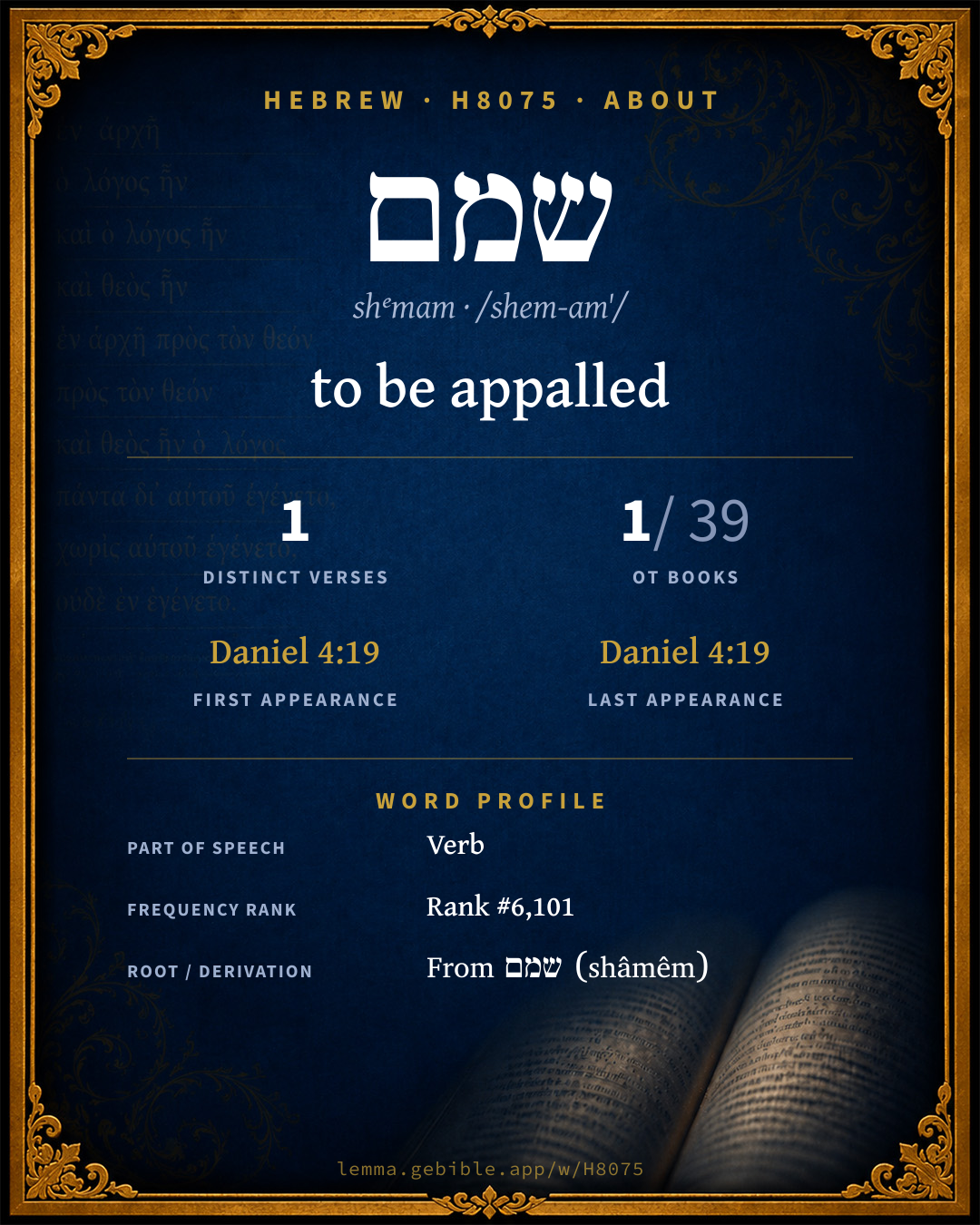
שְׁמַם
to be appalled
Full lexicon entry — Brown-Driver-Briggs (BDB)
From Brown-Driver-Briggs (BDB)
Where this word appears
Grammar key — what these labels mean
Part of speech
- Verb
- An action or state-of-being word.
Form
- Perfect
- A completed action or state — Hebrew marks aspect (completeness) more than strict tense (“he wrote”).
Person
- 3rd Person
- The one spoken about (“he / she / it / they”).
Gender
- Masculine
- Grammatically masculine.
Number
- Singular
- One.
Every verse where H8075 appears — 1 distinct verse across 1 book. Click any verse to open its interlinear word-by-word view. Verse text shown in the World English Bible for context — . Each verse’s Hebrew form is shown with its reference; the English is not keyword-highlighted, since the data carries no word-level English alignment. Use “Compare translations” on any verse to read it across multiple English versions. This concordance covers the Hebrew Bible; Septuagint (Greek Old Testament) occurrences are not indexed here.
Daniel 1 verse
About this entry
At a glance — auto-summarized from this page’s data, not written by a person. Every figure links to its source below. This summary describes the numbers; it doesn’t interpret them.
At its core, שמם (shᵉmam) means “to be appalled.” The Hebrew Bible uses it only 1 verse. The word gravitates to Daniel (100%). Scripture uses it exactly once, at Daniel 4:19. It clusters with שמם, משמה and שמה under a shared root. Each statement above links to its evidence; the full detail follows below.
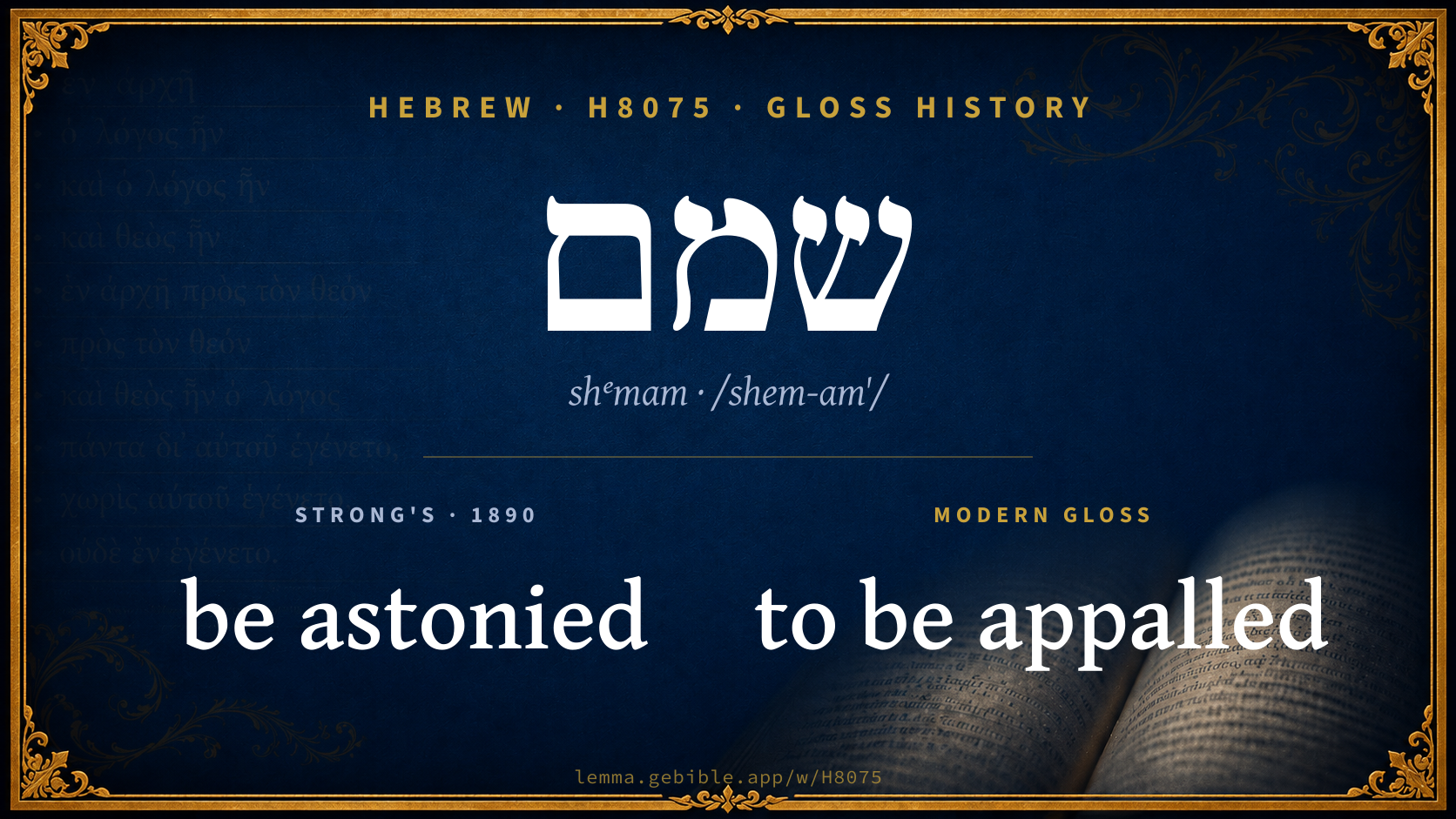
Gloss history
Strong's 1890 vs modern scholarship
About this word
Strong's H8075 catalogs a Hebrew word from the Hebrew Old Testament.
These counts are not copied from any lexicon or concordance. They are computed here, from the morphology-tagged Hebrew Old Testament. What Lemma adds →
- 1
- distinct verses
- The word appears in 1 distinct verse.
- 1 / 39
- OT books
- The word appears in 1 of 39 Old Testament books.
- #6,101
- by frequency
- Rank #6,101 (rank 6,101 of 8,640 Hebrew words by occurrence).
View all 1 occurrence in the concordance →
Most concentrated in
- Daniel 1 verse 100%
By section of the Old Testament
By traditional corpus
Conventional, traditional groupings — biblical authorship is debated, so this is a traditional corpus grouping, not an authorship claim. Each share is this word’s portion of its verses in that division of the Hebrew canon. Each figure is a share of the word’s 1 distinct verse.
- Writings (Ketuvim) 1 verse · 100%
How translations render this word
Counts come from each version’s own published word-to-Strong’s tagging or interlinear alignment — an approximate guide to how each version renders this word, not a word-level alignment the data otherwise carries. Because each total is that version’s own tagged count, the per-version totals vary from one another and need not match the appearance or distinct-verse counts above. These counts may also differ from a printed concordance because Lemma counts each distinctly tagged rendering and does not collapse phrase taggings into a single head-word total. This is a fixed set of word-tagged versions (KJV, ASV, BSB, ULT) and does not change with the reading translation you choose elsewhere. Each version’s license is shown beside its name below (and on Sources).
- King James Version: Was astonied 1×
- American Standard Version: Was stricken dumb 1×
- Berean Standard Bible: Was perplexed 1×
- unfoldingWord Literal Text: Was appalled 1×
King James Version Public Domain
Renders H8075 across 1 tagged occurrence — most commonly:
American Standard Version Public Domain
Renders H8075 across 1 tagged occurrence — most commonly:
Berean Standard Bible Public Domain
Renders H8075 across 1 tagged occurrence — most commonly:
unfoldingWord Literal Text CC BY-SA 4.0
Renders H8075 across 1 tagged occurrence — most commonly:
Senses in BDB
The 1 sense BDB distinguishes for this word, in lexicon order (not ranked by frequency or importance). The full entry — with sub-senses — is in the Lexicon Entry tab.
- (Ithpolel) [CLBL] to be appalled, be stunned
Word origin
[ שְׁמַם ] vb. Ethpō‛l. be appalled;— Dn 4:16.
— Brown-Driver-Briggs (Oxford 1906, public domain), digitized via Sefaria, supplemented by the OpenScriptures HebrewLexicon (CC BY 4.0). See Sources.
Derived from שמם (shâmêm) (H8074) — to be desolate.
Jastrow Dictionary
A second Hebrew/Aramaic lexicon for comparison, covering Aramaic and post-biblical (Talmudic, Targumic, Midrashic) usage that the biblical-Hebrew BDB does not. Matched by lemma rather than by Strong’s number, so a lemma may carry more than one Jastrow headword (shown separately below), and the entries cover usage well beyond the Bible.
שָׁמֵם
- (b. h.) [to stand still,] to be astonished; to be waste. Tosef. Sot. XV, 10 ונמצא ישראל ש׳ וזרע וכ׳ and as a consequence Israel will be laid waste, and the seed of Abraham cease. Y. Bets. II, 61ᶜ top פעם … ומצא אותה שׁוֹמֶמֶת once he entered the Temple court and found it deserted; יָשֹׁמּוּ בתיהם … שׁהֵשֵׁימּוּ וכ׳ (or יִשַּׁמּוּ) deserted be the homes of those who caused the house of our God to be laid waste; Y. Ḥag. II, 78ᵃ bot. שׁהֵישַׁמּוּ. Cant. R. to V, 5 ראה המדינה שוממת he (Cyrus) saw that the country was ruined. Y. Ber. IV, 8ᵃ ההרוסה והשׁוֹמֵמָה destroyed and deserted. Meg. III, 3 (ref. to Lev. XXVI, 31) קדושתן … שׁוֹמֵמִין (Y. ed. שׁוֹמֵימִין) they remain holy, even when they lie in ruins. Lam. R. introd. (R. Joḥ. 1) שָׁמְמָה עלי נפשי my soul within me is waste (mourns); a. fr. e.g. Leviticus 26:31
- to lay waste, ruin; to confound. Yalk. Prov. 959 אם זכה משמחו ואם לאו מְשַׁמְּמוֹ if a man is good, it (dreaming of wine) means joy to him, if not, it means confounding.—Part. pass. מְשׁוּמָּם; f. מְשׁוּמֶּמֶת. Tosef. Keth. VII, 10 מש׳ היא (ed. Zuck. שעמומית) she (my daughter) is confused in her mind; v. שִׁעֲמֵם, שַׁעֲמוּמִית.
- same. Gen. R. s. 26 (play on אנשי השם, Gen. IV, 4) שׁהֵשִׁימּוּ את העולם ושהוּשַׁמּוּ … שׁיִשּׁוֹם they confounded the world, and they were ruined (driven) out of the world, and caused the world to be laid waste. Y. Bets. l. c.; Y. Ḥag. l. c., v. supra. e.g. Genesis 4:4
- , Hof. הוּשַׁם to be laid waste, ruined. Gen. R. l. c., v. supra. Sot. IX, 15; Cant. R. to II, 13 והגבלן יִשּׁוֹם, v. גַּבְלָן. Y. Bets. l. c.; Y. Ḥag. l. c., v. supra.
- 1. to be astounded. Gen. R. s. 4, end (expl. ש̇מ̇י̇ם̇) שהבריות מִשְׁתּוֹמְמִים … של אש̇ הן של מ̇י̇ם̇ הן men wonder at them, (asking) are they of fire? are they of water?
- 2. to be waste, ruined. Kidd. 66ᵃ והיה העולם מִשְׁתּוֹמֵם וכ׳ and the (Jewish) world was ruined (demoralized), until Simon b. Sh. came and restored the Law &c. Sabb. 33ᵃ והדרכים מִשְׁתּוֹמְמִין and the roads are desolate; a. e.
שַׁמָּם
- (preced.) confounded, demented.—Pl. שַׁמָּמִין. Cant. R. to IV, 7.
A Dictionary of the Targumim, the Talmud Babli and Yerushalmi, and the Midrashic Literature (Marcus Jastrow; London, Luzac, 1903) — Public Domain. Digitized via Sefaria. Digitized via Sefaria. Full attribution on Sources.
Same root — word family
Other BDB entries built from the same root as H8075, grouped by Strong’s listed origin. These share a root / origin per the lexicon — not necessarily a shared meaning. Each links to that word’s own entry.
Derives from
Shares the same root
- משמה mᵉshammâh H4923 devastation
- שמה shammâh H8047 desolation
- שמועה shᵉmûwʻâh H8052 report
- שמם shâmêm H8076 desolate
- שממון shimmâmôwn H8078 horror
- שממית sᵉmâmîyth H8079 lizard
Proper names from this root
People and places named from this root — a name, not an additional meaning of the word.
Compare all same-root words → Showing 4 of 10 — not the complete family. 2 of the same-root words are proper names (people or places). They share a root, not necessarily a meaning.
Septuagint verse parallels
This word appears in 1 verse that also exists in the Greek Old Testament (Septuagint), out of the 1 Hebrew verse it occurs in. You can read those verses in Greek by switching the Old Testament edition to the Septuagint.
Read these verses in the Septuagint
This is a verse-level parallel only — the same verses exist in both the Hebrew and Greek Old Testaments. No word-level Hebrew↔Greek correspondence is claimed: the data carries no such alignment, so no Greek word is shown as this Hebrew word’s translation. Coverage is not total — the Septuagint omits the deuterocanon and renumbers the Psalms, so some Hebrew verses have no direct Greek parallel.