
Job 16:7

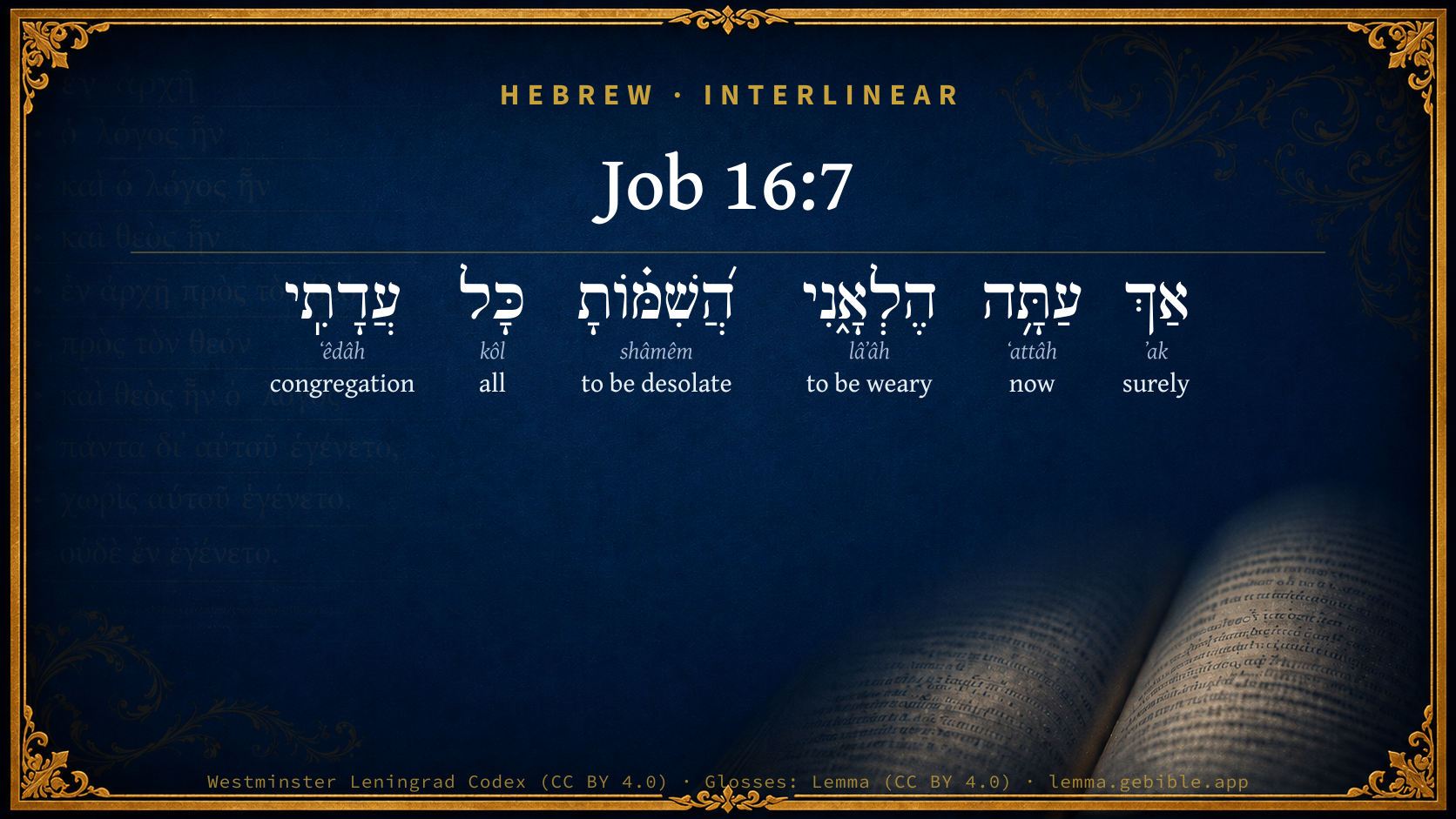
Hebrew (Westminster Leningrad Codex) Job 16:7 appears in the Hebrew Old Testament. The text above is from the Westminster Leningrad Codex. Each word links to its Strong’s number, a concise gloss, and parsing drawn from the Open Scriptures Hebrew Bible morphology. Click any word for its full Brown-Driver-Briggs (BDB) entry.
Download image
Cite this verse

Job 16:7 (World English Bible). Public Domain. Lemma interlinear Bible study tool, https://lemma.gebible.app/v/job/16/7.

Show BibTeX & RIS
BibTeX
RIS
English Translation
But now, God, you have surely worn me out. You have made desolate all my company.
World English Bible · Public Domain
Download a study sheet

One document with this verse’s original text, its word-by-word gloss line, the meaning frame, cross-references with their text, attributed commentary, and full source and license credits — printable, and it pastes into notes with its structure intact.

This verse Autodidact and up

Study sheet (.html) Plain text (.txt)

A passage Seminary Student

Up to 50 verses in one chapter. A passage sheet keeps up to 6 commentary sources and 12 cross-references per verse, in the order this page ranks them, and says so on the sheet whenever that leaves anything out. Ask for a single verse and you get the Autodidact verse sheet above.

Everything on this page stays free to read, with no account — the sheet is a download of what is already on screen, not access to it.

Want to remove ads? Support Godless Engineer
Compare translations 3

The same verse in 3 English versions, stacked beneath the original-language interlinear above. Click any original word for its lexicon entry.

Each is an independent rendering of the whole verse — the interlinear is not word-aligned to these translations.

Highlighted words mark where these versions differ — a whole-verse word diff, not a word-by-word alignment.

  • World English Bible Public Domain
    But now, God, you have surely worn me out. You have made desolate all my company.
  • King James Version Public Domain
    But now he hath made me weary: thou hast made desolate all my company.
  • unfoldingWord Literal Text CC BY-SA 4.0
    But now he has exhausted me; you have devastated my whole family,

unfoldingWord Literal Text — © unfoldingWord, licensed CC BY-SA 4.0. Word-aligned USFM3 via Door43 (git.door43.org/unfoldingWord/en_ult).

Versions to compare (up to 4)

3 of 4 selected

Show all 18 translations

Every available English version of this verse, each an independent rendering of the whole verse.

  • World English Bible Public Domain
    But now, God, you have surely worn me out. You have made desolate all my company.
  • Berean Standard Bible Public Domain
    Surely He has now exhausted me; You have devastated all my family.
  • Majority Standard Bible Public Domain
    Surely He has now exhausted me; You have devastated all my family.
  • King James Version Public Domain
    But now he hath made me weary: thou hast made desolate all my company.
  • American Standard Version (1901) Public Domain
    But now he hath made me weary: Thou hast made desolate all my company.
  • Revised Version (1885) Public Domain
    But now he hath made me weary: thou hast made desolate all my company.
  • Geneva Bible (1599) Public Domain
    But now hee maketh mee wearie: O God, thou hast made all my congregation desolate,
  • Douay-Rheims (1899) Public Domain
    But what shall I do? If I speak, my pain will not rest: and if I hold my peace, it will not depart from me.
  • Young's Literal Translation Public Domain
    Only, now, it hath wearied me; Thou hast desolated all my company,
  • Literal Standard Version CC BY-SA 4.0
    Only, now, it has wearied me; You have desolated all my company,
  • Unlocked Literal Bible CC BY-SA 4.0
    But now, God, you have made me weary; you have made all my family desolate.
  • unfoldingWord Literal Text CC BY-SA 4.0
    But now he has exhausted me; you have devastated my whole family,
  • Darby Bible Public Domain
    But now he hath made me weary;... thou hast made desolate all my family;
  • World Messianic Bible Public Domain
    But now, God, you have surely worn me out. You have made all my company desolate.
  • Webster's Bible Public Domain
    But now he hath made me weary: thou hast made desolate all my company.
  • Free Bible Version CC BY-SA 4.0
    God, you have worn me out. You have destroyed my whole family.
  • Bible in Basic English Public Domain
    But now he has overcome me with weariness and fear, and I am in the grip of all my trouble.
  • JPS Tanakh (1917) Public Domain
    But now He hath made me weary; Thou hast made desolate all my company.

Literal Standard Version (2020), Covenant Press — licensed CC BY-SA 4.0. Text via the HelloAO Bible API (eBible.org). Unlocked Literal Bible (unfoldingWord) — licensed CC BY-SA 4.0. Text via the HelloAO Bible API (eBible.org). unfoldingWord Literal Text — © unfoldingWord, licensed CC BY-SA 4.0. Word-aligned USFM3 via Door43 (git.door43.org/unfoldingWord/en_ult). Free Bible Version, Dr. Jonathan Gallagher — licensed CC BY-SA 4.0. Text via the HelloAO Bible API (eBible.org).

Word by word

More ways to search: Search by grammar → Find every occurrence → Compare this word →

Practice this passage: Drill this verse → Learn its vocabulary →

About this verse

These counts appear in no published source. They are computed here, from the morphology-tagged text and Lemma’s own curated glosses. What Lemma adds →

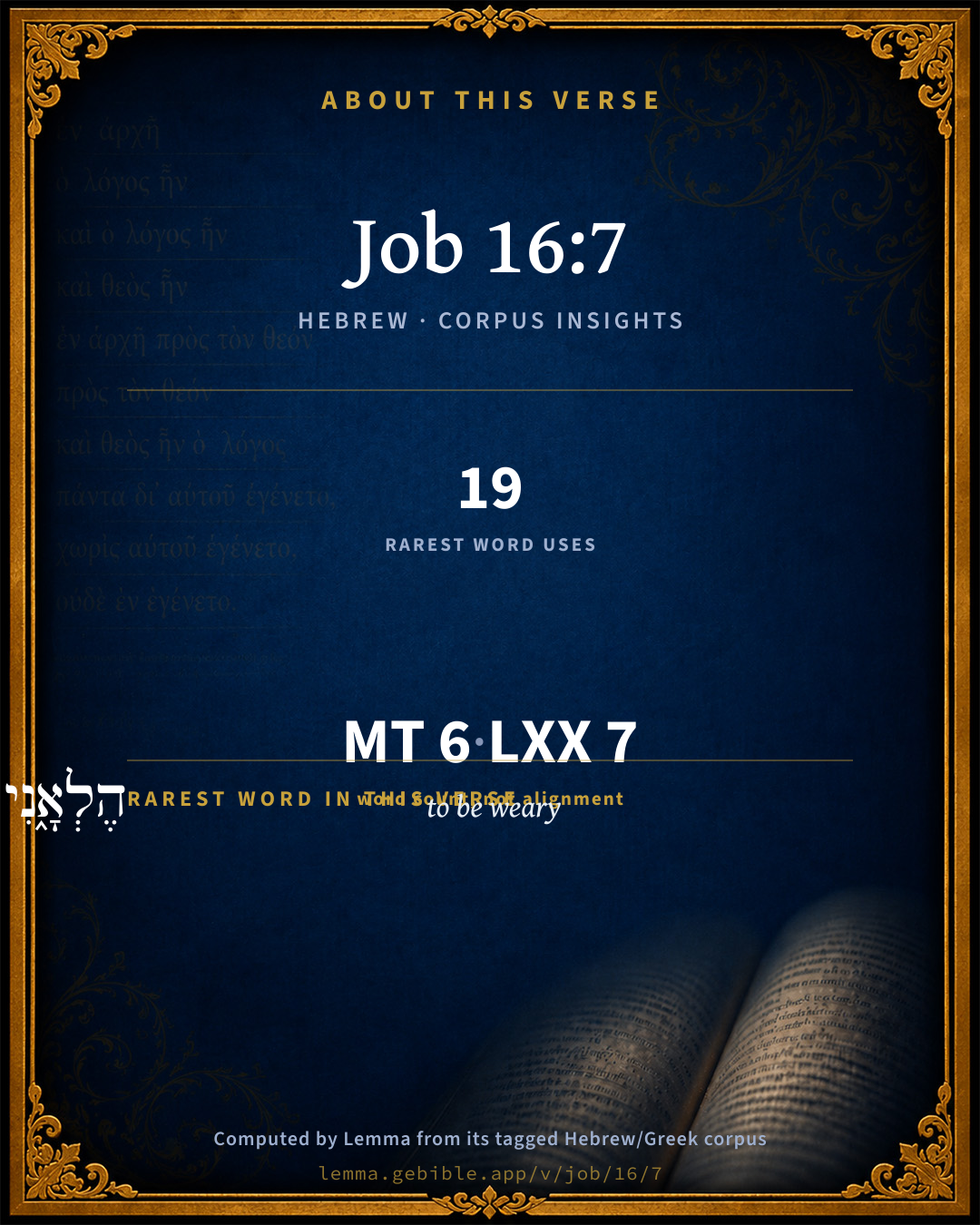
6
words
6
distinct lemmas
Wisdom
section

Notable vocabulary

The rarest word here is הֶלְאָ֑נִי to be weary H3811 — appearing just 19 times in the whole Hebrew Bible.

Shared distinctive vocabulary

הֶלְאָ֑נִי to be weary H3811 occurs in 18 verses of the Hebrew Bible. Also found in:

Grammatical profile

  • 2 verbs
  • 2 nouns
  • 1 adverb
  • 1 particle

Verb forms

  • הֶלְאָ֑נִי Hiphil · Perfect
  • הֲ֝שִׁמּ֗וֹתָ Hiphil · Perfect

Hebrew & Septuagint length

In English translation the verse runs 16 words from the Hebrew and 27 from the Septuagint (LXX English) — the Septuagint runs noticeably longer here. See the side-by-side →

A rough comparison of the two English renderings, which tokenize alike — not a word-level alignment.

Word counts can differ between the Hebrew and the Greek without any difference in meaning — e.g. the Hebrew direct-object marker אֵת has no separate Greek word, and Greek often adds the article ὁ.

In the original languages it is 6 Hebrew tokens and 7 Greek tokens — but the two are counted differently (Hebrew bundles its prefixes and suffixes into one token; the Greek is in lemma form), so that isn’t a like-for-like length.

Cross-references

10

Topical passages linked to Job 16:7 in the Treasury of Scripture Knowledge — connected by theme and wording, ordered by reader-vote popularity; previews shown in the World English Bible.

  • Job 7:3 So am I made to possess months of misery, Wearisome nights are appointed to me.
  • Job 1:15–19 and the Sabeans attacked, and took them away. Yes, they have killed the servants with the edge of the sword, and I alone have escaped to tell you."
  • Job 3:17 There the wicked cease from troubling; There the weary are at rest.
  • Job 7:16 I loathe my life. I don't want to live forever. Leave me alone; for my days are but a breath.
  • Job 10:1 "My soul is weary of my life; I will give free course to my complaint. I will speak in the bitterness of my soul.
  • Job 29:5–25 When the Almighty was yet with me, And my children were around me;
  • Psalms 6:6–7 I am weary with my groaning; Every night I flood my bed; I drench my couch with my tears.
  • Proverbs 3:11–12 My son, don't despise Yahweh's discipline, Neither be weary of his reproof:
  • Isaiah 50:4 The Lord Yahweh has given me the tongue of those who are taught, that I may know how to sustain with words him who is weary: he wakens morning by morning, he wakens my ear to hear as those who are taught.
  • Micah 6:13 Therefore I also have struck you with a grievous wound. I have made you desolate because of your sins.

Cross-references courtesy of OpenBible.info (CC BY 4.0).

Hebrew and Greek witnesses Masoretic Hebrew ↔ Greek Septuagint

The same verse in the two great witnesses to the Old Testament, shown verse-for-verse.

Here the Septuagint runs noticeably longer than the Hebrew — LXX2012 (modern English Septuagint) 27 words vs World English Bible 16. A rough length comparison of the two English translations, not a word-level alignment — read both below.

These are two independent witnesses, not word-aligned to each other, and the Septuagint is shown in lemma (dictionary) form.

Hebrew Job 16:7 Masoretic · Westminster Leningrad Codex

אַךְ עַתָּ֥ה הֶלְאָ֑נִי הֲ֝שִׁמּ֗וֹתָ כָּל עֲדָתִֽי

But now, God, you have surely worn me out. You have made desolate all my company.

World English Bible · Public Domain

Greek LXX Job 16:7 Septuagint · lemma form

νῦν δέ κατάκοπος ἐγώ ποιέω μωρός σήπω

For if I should speak, I shall not feel the pain of my wound: and if I should be silent, how shall I be wounded the less?

LXX2012 (modern English Septuagint) · Public Domain

On this verse, Trapp's Complete Commentary discusses the Septuagint’s reading. Read the note in Commentary ↓

Hebrew: Westminster Leningrad Codex (CC BY 4.0). Greek: Septuagint (public domain); English from LXX2012 (modern English Septuagint) (Public Domain). How the Septuagint differs from the Hebrew →

Commentary

Notes on Job 16:7 from classic Christian and Jewish commentators (each source and its license shown beneath its notes). The classic Christian expositions comment on the surrounding passage and are grouped to its opening verse, so a note may address several verses; the Jewish commentaries on the Tanakh (Rashi and others) are per-verse, so they appear only where the commentator wrote on this verse.

Lemma curates 59 commentaries, every one of them public domain or Creative Commons licensed, each selected and text-cleaned for this edition rather than reprinted as found. About our sources →

Trapp's Complete Commentary

John Trapp

Job 16:7 But now he hath made me weary: thou hast made desolate all my company.

Ver. 7. But now he hath made me weary] i.e. God, whom he acknowledgeth the author of his afflictions; but he should better have borne up under them than to faint and fret even unto madness, as the Septuagint here translates, Quis eum fatigavit? Dolor, vel Deus ipse? (Lavat.). Job was now not only wet to the skin, but his soul came into iron, as Joseph’s once, Psa 105:18. Like Ezekiel’s book, Eze 2:10, he was written quite through with woes and lamentations. And he might say, with Heman, Psa 88:15, "While I suffer thy terrors I am distracted." The grief which he here describeth, Maior erat quam ut verbis comprehendi, gravior quam ut ferri, molestior quam ut credi possit, saith Brentius; i.e. was greater than could be uttered, heavier than could be borne, more troublesome than can be believed. He, therefore, sets it out as well as he can, and amplifies it by figures and hyperbole, to move God and his friends to pity him, and to show that he complained not without cause.

Thou hast made desolate all my company] Heb. Thou hast wonderfully desolated, or wasted, all my company; that is, all my joints and members (so. the Vulgate translateth it, In nihilum redact; sunt omnes artus mei); but they do better that understand it of Job’s family and familiar friends, who were either destroyed, or stood amazed at his so great affliction, and yielded him little comfort. Ne te autem turbet enallage personae, saith Mercer here; the change of person need not trouble us; only the troubled and uneven speech of Job showeth that his spirit was troubled and unsettled. We meet with the like oft in the Psalms.

John Trapp, A Commentary or Exposition upon All the Books of the Old and New Testament (1647–1656) — public domain. Text from a community e-Sword module.

The Biblical Illustrator

Joseph S. Exell

Job_16:7

But now He hath made me weary.

Weariness under affliction

The word he is not in the original. Some understand it of his grief and sorrow, and read thus, And now it hath made me weary, or, my pain hath tired me. Others understand it of what had been spoken by his friends; your tedious discourses, and severer censures, have quite spent my spirits, and made me weary. Our translation leads us to a person, and our interpretation leads us to God. Job everywhere acknowledges that God was the author and orderer of all his sorrows. Weariness of mind is referred to, and it is the most painful weariness.

1. A state of affliction is a wearisome estate. Suffering wearies more than doing; and none are so weary as those who are wearied with doing nothing.

2. Some afflictions are a weariness both to soul and body. There are afflictions which strike right through, and there are afflictions which are only skin deep.

3. Some afflictions do not only afflict, they unsettle the mind. They unsettle not only the comforts, but the powers and faculties of it. A man under some afflictions can scarce speak sense while he acts faith, or do rationally while he lives graciously.

4. A godly man may grow extremely weary of his afflictions. The best cannot always rejoice in temptations, nor triumph under a cross. True believers, as they have more patience in doing, so in suffering; yet even their patience doth not always hold out; they, as Job, speak sometimes mournfully and complainingly. (Joseph Caryl.)

The Biblical Illustrator, edited by Joseph S. Exell (c. 1880s–1900s) — public domain. Text from a community e-Sword module.

Joseph Benson's Commentary

Job 16:7. But now he — Namely, God; hath made me weary — Either of complaining, or of my life. “He hath long since quite tired me with one trouble upon another.” — Bishop Patrick. Thou hast made desolate all my company — “Thou hast not ceased, O God, till thou hast left me neither goods nor children, no, nor a friend to comfort me.” He speaks in the second person, to God, as in the former clause in the third person, of God: such a change of persons is very usual in Scripture, and “is esteemed,” says Chappelow, “a singular ornament in poetry.”

Joseph Benson's Commentary on the Old and New Testaments (1811–1818) — public domain. Text from a community e-Sword module.

Tyndale Open Study Notes

Tyndale Open Resources

16:7 Job’s family here means his extended household, including his servants (1:15-19).

Tyndale Open Study Notes — © Tyndale Open Resources, licensed CC BY-SA 4.0. Text via the HelloAO Bible API.

Geneva Bible (1599)

Geneva Bible translators

That is, destroyed most of my family.

Meaning, God.

Geneva Bible (1599) marginal notes — public domain. Text via Bolls.life.

Jamieson, Fausset & Brown

Robert Jamieson, A. R. Fausset & David Brown

But now--rather, "ah!"

he--God.

company--rather, "band of witnesses," namely, those who could attest his innocence (his children, servants, &c.). So the same Hebrew is translated in Job 16:8. UMBREIT makes his "band of witnesses," himself, for, alas! he had no other witness for him. But this is too recondite.

Jamieson, Fausset & Brown — Commentary Critical and Explanatory on the Whole Bible (1871) — public domain (CC PDM 1.0). Text via the HelloAO Bible API.

Adam Clarke's Commentary

Verse 7. But now he hath made me weary] The Vulgate translates thus: - Nunc autem oppressit me dolor meus; et in nihilum redacti sunt omnes artus mei; "But now my grief oppresses me, and all my joints are reduced to nothing." Perhaps Job alluded here to his own afflictions, and the desolation of his family. Thou hast made me weary with continual affliction; my strength is quite exhausted; and thou hast made desolate all my company, not leaving me a single child to continue my name, or to comfort me in sickness or old age. Mr. Good translates: -

"Here, indeed, hath he distracted me;

Thou hast struck apart all my witnesses."

Adam Clarke's Commentary on the Bible (1810–1826) — public domain. Text from a community e-Sword/MySword module.

Ellicott's Commentary for English Readers

(7) But now he hath made me weary.—He turns again, in his passionate plaint, to God, whom he alternately speaks of in the third person and addresses in the second. “Thou hast made desolate all my company,” by destroying all his children and alienating the hearts or his friends.

A Bible Commentary for English Readers, edited by Charles John Ellicott (1878–1897) — public domain. Text from a community e-Sword module.

The Cambridge Bible for Schools and Colleges

gen. ed. J. J. S. Perowne

7. made me weary] i. e. exhausted me; and now describes the new situation which he realizes. The second clause indicates in what way he had been wearied or exhausted, all his “company,” his familiar friends, all on whom he could rely, or hope in, had been removed from him, and turned into his enemies and haters, cf. ch. Job_19:13-19; every resource was taken from him, cf. ch. Job_15:34. In the first clause he is God, to whom as his emotion rises the speaker turns directly in the second clause—thou hast made desolate.

The Cambridge Bible for Schools and Colleges (gen. ed. J. J. S. Perowne; Cambridge University Press, 1878–1918) — public domain. Text from a community e-Sword module.

John Gill's Exposition

And thou hast filled me with wrinkles,.... Not through old age, but through affliction, which had sunk his flesh, and made furrows in him, so that he looked older than he was, and was made old thereby before his time; see Lam 3:4; for this is to be understood of his body, for as for his soul, that through the grace of God, and righteousness of Christ, was without spot or wrinkle, or any such thing:

which is a witness against me; as it was improved by his friends, who represented his afflictions as proofs and testimonies of his being a bad man; though these wrinkles were witnesses for him, as it may be as well supplied, that he really was an afflicted man:

and my leanness rising up in me; his bones standing up, and standing out, and having scarce anything on them but skin, the flesh being gone:

beareth witness to my face; openly, manifestly, to full conviction; not that he was a sinful man, but an afflicted man; Eliphaz had no reason to talk to Job of a wicked man's being covered with fatness, and of collops of fat on his flanks, Job 15:27;

John Gill's Exposition of the Whole Bible (1746–1763) — public domain (CC PDM 1.0). Text via the HelloAO Bible API.

Albert Barnes' Notes on the Bible

But now he hath made me weary - That is, God has exhausted my strength. This verse introduces a new description of his sufferings; and he begins with a statement of the woes that God had brought on him. The first was, that he had taken away all his strength.

All my company - The word rendered “company” (עדה ‛êdâh) means properly an assembly that comes together by appointment, or at stated times; but here it is evidently used in the sense of the little community of which Job was the head and father. The sense is, that all his family had been destroyed.

Albert Barnes' Notes on the Bible (1834–1885) — public domain. Text from a community e-Sword/MySword module.

Haydock's Catholic Bible Commentary

But. Hebrew, "If I speak," &c.

George Leo Haydock (1774–1849), Haydock's Catholic Family Bible and Commentary, 1859 edition — public domain. Excludes Psalms (Douay-Rheims chapter numbering differs from Protestant) and Deuterocanonical books (Catholic canon only).

Matthew Poole's English Annotations

But; or, surely, as this Hebrew particle most commonly signifies. He, i.e. God, as appears by the following words and verses.

Hath made me weary; either of complaining, or of my life.

Thou; he speaks in the second person to God, as in the former clause in the third person of God. Such change of persons are very usual in Scripture, and elsewhere.

Hast made desolate all my company; hast turned my society into desolation, by destroying my children and servants.

Matthew Poole's English Annotations on the Holy Bible (1683–1685) — public domain. Text from a community e-Sword/MySword module.

Whedon's Commentary on the Bible

Daniel D. Whedon

7. Made me weary — Wearied me out.

Company — Household. Same word as Eliphaz uses, Job_15:34.

Daniel D. Whedon (gen. ed.), Commentary on the Old and New Testaments (1874–1909) — public domain. Text from a community e-Sword module.

The Pulpit Commentary

But now. These words mark a transition. Job turns from complaints against his "comforters" to an enumeration of his own sufferings. He hath made me weary. God has afflicted him with an intolerable sense of weariness. He is tired of life; tired of disputing with his friends; tired even of pouring out his lamentations and complaints and expostulations to God. His one desire is rest. So I have seen in the piombi of Venice, where political prisoners were tortured by cold and heat, and hunger and thirst, for long weeks or months, and brought to despair, such scratchlags as the following: "Luigi A. implora pace, Giuseppe B. implore eterna quiete." Job has entreated for this boon of rest repeatedly. (Job_3:13 Job_6:9 Job_7:15 Job_10:18, etc.) Thou hast made desolate all my company. The loss of his children has desolated his household; his other afflictions have alienated his friends.

HOMILIES BY R. GREEN Ver. 6. Sorrow without hope.

Unalleviated by the words of his friends, Job turns round upon them, and in painful, half-passionate words retorts upon them their incompotency to give him consolation. "Miserable comforters are ye all." He is driven almost to despair. The painful alternative of speech or silence is before him; but neither offers him any hope, and he is compelled to reflect upon his helpless condition. He is exhausted. The future presents no prospect of alleviation. He has sorrow without hope. Such sorrow distinguished

I BY ITS EXTREME PAINFULNESS. To endure pain of body or mind is hard enough, and many succumb to it. But if there be a gleam of hope the aching spirit clings to it and is upborne. When, however, no ray of brightness is apparent, when only the darkness of an undiminished sorrow is present, then is the painfulness of the circumstances in which the sufferer is placed heightened in a great degree. To suffer without hope of a termination is the very perfection of suffering. The poor heart searches for some avenue of escape, but none is present. It is thrown back again and again upon itself. This is extremest sorrow. To see only the long, unvaried line of suffering drawn out to the utmost future, and no break appearing, robs the soul of its one consolation in extreme trial the hope of release. If a bound be put to sorrow it may be endured; but if no limit can be traced, and all probability of limitation be cut off, the case is desperate. The worst that can be said of any evil is It is hopeless.

II Sorrow without hope is AN EXCESSIVE STRAIN UPON THE ENDURANCE OF THE SUFFERER. To lose hope is to lose heart. The strong can bear up under the heavy burden, but the weak must yield. It is to add to the weight of the burden by every hour that elapses. Time, which so often comes to relieve the sorrowful, but brings a heavier load. The exhausted spirit bravely fighting against its oppressive surroundings is more and more driven to the conclusion that all effort is unavailing, and the added experience of every hour but confirms the assurance that there is no hope left. It is the severest of all strains that the spirit can be subjected to. It is the inevitable precursor of despair.

III Such sorrow reaches a climax of severity when, as in this case, THE APPEAL TO GOD, THE GREAT HELPER, IS UNAVAILING. "He hath made me weary." He hath exhausted me. It is true a real help is in reserve for Job, but he does not know it. He suffers without hope. He has turned to man and found no relief. His cry to God is unavailing. If he "speak," his "grief is not assuaged." His cry returns upon him. If he "forbear," still he is not "eased." The world is indebted to this sufferer for the painful experiment of which he is the subject. Now the world knows that in patient endurance and unswerving fidelity there is assured hope. The hand of help may be hidden, but it is there. God may seem to be inattentive to the sorrowful cry, but he is only testing and proving his faithful servant, and the severity of the test marks the measure of the final award. Hence may we learn

(1) that the apparent hopelessness of human sorrow is not a perfect representation;

(2) the wisdom of maintaining the spirit of hope, even when we seem to have no encouragement to do so;

(3) the certainty of a final relief and reward to the faithful. R.G.

Incurable grief.

Job does not know what to do; neither speech nor silence will assuage his grief. It appears to be incurable.

I GREAT GRIEF SEEMS INCURABLE TO THE SUFFERER.

1. It cannot be measured. Feeling destroys the sense of proportion. Every one who suffers much is tempted to think himself the greatest of sufferers. A passion of emotion sweeps away all standards of comparison. The stormy sea appears to be unfathomable.

2. It excludes the thought of anything but itself. The black cloud shuts out the heavens and narrows the horizon. The world of sorrow is shrunken to the range of present, personal experience, Thus in overwhelming grief there is no room or power in the soul to conceive of a means of escape. The absorbing interest of pain will not allow a rival consciousness.

3. It is found to be irresistible. If a man thought he could conquer his grief or escape from it, surely he would not tamely submit to his torments unless he were a fanatic of asceticism. But if the pain cannot be set aside at once, it is difficult to believe that it will not endure for ever, for agony destroys the sense of time.

II GREAT GRIEF MAY NOT BE CURABLE BY MAN. There are diseases that no medicine can heal, and sorrows that no human aid can touch. Grief naturally tends to endure by its own creation of a habit of grieving. "Sorrow, like a heavy-hanging bell, Once set on ringing, with his own weight goes: Then little strength rings out the doleful knell. (Shakespeare)

Some sorrows are evidently incurable by man.

1. The loss of those greatly beloved. No human comforter could bring back Job"s seven sons and three daughters from the dead. What word or work of man could touch his sorrow of utter bereavement? We know only too well that nothing on earth can make up for our greatest losses by death.

2. The discovery of a wasted life. When the old man comes to himself and finds that he has been living in a delusion, when he sees with bitter remorse that he has been squandering his years in folly and sin, what can man do to comfort him? The past can never be recovered.

3. The despair of guilt. If this is soothed by flattery and falsehood, a fatal mischief is done. But if the conscience is fairly roused, it cannot be thus soothed. To man sin is incurable.

III GRIEF THAT APPEARS TO BE INCURABLE MAY YET BE ALL CURED BY GOD. No child of God should despair, for infinite love and almighty energy can know of no impossibility. The gospel of Christ offers complete cure.

1. Present peace.

(1) If the trouble is from sin, the peace is in pardon. All sin is curable by Christ, for "he is able also to save them to the uttermost that come unto God by him". (Heb_7:25)

(2) If the trouble is from any other cause, the peace is in the love of God. This love, which also brings the peace of forgiveness, is itself an infinite consolation. It is better to be Lazarus with God than Dives with purple and fine linen.

2. Future blessedness. The dead will not return to us. But we shall go to them. Christ promises to his people a home in the great house of God. There "God shall wipe away all tears from their eyes". (Rev_7:17) The old wasted life cannot be given back in its pristine innocence. But the renewed soul may live a new life in God"s eternity. W.F.A.

Vers. 7-17. Job to God: resumption of the third controversy:

1. The sorrows of a weary man.

I DIVINELY SENT. Whether directly addressed in the second person (vers. 7, 8), or indirectly alluded to in the third (vers. 7, 9, 12, 14), it is ever God to whom Job traces back his sufferings. It is faith"s function, as well as faith"s delight, to recognize God"s hand in affliction as in felicity; but not seldom sense intervenes to misconstrue the end and motive of God"s dealings with the saint, and to regard as indicative of anger and enmity what, rightly viewed, is rather symptomatic of affection and care (ver. 17; Psa_94:12; Pro_3:12; Heb_12:6; Rev_3:19). From the first Job had connected his adversity with God"s appointment. (Job_1:21 Job_2:10) For a long time he had struggled bravely, against the eloquent representations of his friends, to maintain his confidence in God"s affection, notwithstanding all untoward appearances. But now, under extreme pressure of misery, he is on the eve of giving way talking quite openly of God as his enemy, whose wrath tears him and makes war upon him, and whose teeth sharpen themselves against him (ver. 9). The stern facts which appear to shut him up to so reluctant an inference are three.

1. The inward testimony of his own consciousness. Though it would be wrong to say that this witness of an anguish-laden spirit expressed the maturely formed and definitely fixed judgment of the patriarch, it would yet be equally erroneous not to recognize that, for the moment, Job did believe that God had turned against him. Such a complete reversal of a good man"s consciousness was exceptional; the result, not of affliction alone, however severe and protracted, but of Satanic influence and temptation. It discloses the extraordinary power the devil has to work upon the human spirit. If he can so handle "a perfect man and an upright," it is not at all surprising he should be able to lead captive at his will "silly women, laden with sins, led away with divers lusts", (2Ti_3:6) and even proud and imperious men who oppose themselves to the truth. (2Ti_2:26) It reveals also how far a saint may go in a course of unbelief and backsliding without renouncing his integrity; and is fitted to suggest hope concerning many who are supposed to have lapsed entirely from the truth. It sheds a light upon the Divine Father"s forbearance and mercy, that he can see a saint misconstrue his providences, and calumniate his character, and yet lay not his sin to his charge. (Job_42:7)

2. The expressed judgment of his fellow-men. Eliphaz had cited, as one of the items in the sinner"s doom, the desolation of his family, (Job_15:34) and the obvious allusion to this remark in Job"s language, "Thou hast made desolate all my household" (ver. 7), seems to intimate that Job regarded the cruel verdict of his friends upon his case as substantially correct. He could see, from a comparison of his sad condition with the sentiments they had uttered, that they, as well as he, had arrived at the inference that God was against him.

3. The palpable witness of his misery. His emaciated body, his weary and pinched face, his feeble and wasting frame, all covered over with ulcers, seemed to rise up and tell him to his face that God was dealing with him as with a convicted criminal. According to the theology of the period, this was strong circumstantial evidence against the patriarch; but circumstantial evidence often lies. Here it notoriously did, as afterwards it did in the case of Christ, whose marred face was no proof that he was "stricken, smitten of God, and afflicted". (Isa_53:4) "A marred and meagre visage may testify to our grief, but not to our guilt" (Robinson).

II EXTREMELY SEVERE.

1. Their variety. Almost every form of calamity was heaped upon the patriarch.

(1) Bodily distress; consisting of complete exhaustion of physical vigour (ver. 7), unsightly enunciation of the countenance (ver. 8), lamentable wasting of the once strong and goodly frame (ver. 8).

(2) Mental anguish; occasioned by the overthrow of his family (ver. 7), the alienation of his friends, who beheld in his miseries a witness to his condemnation (ver. 8); the opposition and insolence of wicked men, to whose mercy God had apparently abandoned him, who gaped upon him with their mouths, rejoicing in his misfortune, smote him upon the cheek reproachfully, adding insult to enmity, and conspired against him, in order to complete his destruction (ver. 10) an experience which in all its parts was predicted of Messiah and fulfilled in Christ. (cf. Psa_22:12-21 Mat_26:59, Mat_26:67; and Psa_2:1 with Act_4:25-27)

(3) Spiritual sorrow; arising, as above explained, from a sense of abandonment by God.

2. Their unexpectedness. Job had been at ease, prosperous and contented, fearing God and eschewing evil, when all at once misfortune leaped upon him, and God. seizing him, broke him in pieces. And this was an aggravation of the sufferers distress, that without apparent cause, and certainly without warning, he was hurled from the pinnacle of prosperity to the lowest depths of adversity; as the wicked will eventually be, (Psa_73:19) and as at any moment, though not for the same reason, the godly may be. Therefore let no one indulge in a vain confidence like David, that his mountain shall stand strong for ever; (Psa_30:6, Psa_30:7) or like Job, that he shall die in his nest; (Job_29:18) or like the daughter of the Chaldeans, that she shall be a lady for ever; (Isa_47:7) but being forewarned, as the patriarch of Uz was not, let him also be forearmed.

3. Their violence. Job pictures the dreadful hostility of God against himself by means of three striking figures, in which he represents God as

(1) a mighty Hunter, with wrathful soul and gnashing teeth and flaming eyes (ver. 9) pursuing a poor frail, timid creature with a pack of fierce and yelping curs (ver. 10), to which the prey when caught is mercilessly thrown (ver. 11);

(2) a gigantic Wrestler, strong in thew and sinew, seizing his antagonist by the neck, triumphantly holding him aloft in his clenched fist, and then furiously.dashing him to the ground (ver. 12); and

(3) a skillful Archer, who, tying up his helpless enemy to a post, makes his arrows whistle for a time round the wretch"s head, so as to fill him with consternation without inflicting mortal injury, and then, having sported with him for a while, as a tiger might do with its prey, sends a shaft into a vital part (on the emptying of the gall-bladder, consult the Exposition), so that the miserable victim writhes in mortal agony.

4. Their degradation. The abject humiliation to which Job had been reduced by his sufferings is set forth in four particulars.

(1) The sewing of sackcloth upon his loins. Sackcloth, the symbol of mourning, (Gen_37:34 1Ch_21:16 Psa_35:13Jo Psa_3:5, Psa_3:6) is here represented as not only put upon the patriarch"s person, but sewed upon his skin; partly, perhaps, because of the ulcerous condition of his body, but partly also, it is probable, to indicate the depth of Job"s abasement.

(2) The defiling of his horn with dust; the horn being the emblem of personal dignity and social honour, (Psa_132:17) and the meaning being that all Job"s glory was completely tarnished and laid low. This is one of the expressly designed results of affliction; and they who defile their horns in the dust before God when overtaken by his chastisements have taken the first step towards the final exaltation of their horns. (Psa_89:17)

(3) The reddening of the eyes with weeping. Great grief makes strong men weep. Yet weeping for a sufficient cause is not unmanly. Examples: Abraham, (Gen_32:2) Joseph, (Gen_43:30) David, (2Sa_18:33) Hezekiah, (2Ki_20:3) St. Paul, (Php_3:13) Jesus. (Luk_19:41Jo Luk_11:35)

(4) The shading of the eyelids with gloom; an indication of approaching death. Death makes the eyelid droop, and wraps the eye itself in darkness. It was an aggravation of Job"s misery that it had brought him to the confines of the grave.

III WHOLLY UNDESERVED.

1. His life had not been wicked. There had been no injustice, wrong, or evil deed of any kind in his hand, as his friends asserted. The hand being the instrument of action, clean hands are the symbol of an upright life. (Psa_24:4) Where the hands are not clean the heart cannot be pure.

2. His devotions had not been insincere. Notwithstanding the imputations of his friends to the contrary, (Job_15:4) his conscience told him that his prayer was pure. Genuine sincerity is one of the first requisites of devotion. "When thou prayest, thou shalt not be as the hypocrites are". (Mat_6:5)

Learn:

1. That the same God who makes a saint weak and weary beneath life"s burdens can also impart strength and cheerfulness to bear them.

2. That one of the hardest works faith has to do is to oppose those representations of the Divine character and providence that are g yen by sense.

3. That, while the saint"s calamities are not always sent in punishment of sin, they are mostly designed to produce within the saint a spirit of self-humiliation.

4. That God never abandons a saint to the ungodly, though he will yet deliver over the ungodly to perdition.

5. That, next to the comfortable shining of God"s face upon a human soul, which Job at this time wanted, the best lodestar, while struggling over and through a sea of trouble, is the ineradicable conviction of one"s own sincerity, the testimony of a good conscience before God.

The Pulpit Commentary (1880–1919), ed. H.D.M. Spence-Jones & Joseph S. Exell — public domain. Text from a community e-Sword module.

John Wesley's Explanatory Notes

He - God, as appears by the following words. Weary - Either of complaining, or, of my life. Desolate - Hast turned my society into desolation, by destroying my children and servants.

John Wesley, Explanatory Notes Upon the Whole Bible (1754–1765) — public domain. Text via the GEBible commentary corpus.

Kretzmann's Popular Commentary

Paul E. Kretzmann

Job Shows The Pitifulness of his Case and Maintains his Innocence

v. 7. But now He hath made me weary, God had brought him to the point of utter exhaustion; Thou hast made desolate all my company, his whole family, the loss of which, together with the estrangement of his wife, was doubly hard to bear, now that his friends had become hostile to him.

v. 8. And Thou hast filled me with wrinkles, which is a witness against me, the fact that God had seized him and placed him in a shriveled and wrinkled condition seemed a witness of his guilt; and my leanness rising up in me beareth witness to my face, his wasted condition appeared against him, accusing him to his face, this also being construed as a proof of his guilt.

v. 9. He teareth me in His wrath, who hateth me, God’s anger had apparently made war upon him, torn him, was pursuing him hard; He gnasheth upon me with His teeth, as though He were truly enraged against Job; mine Enemy, which God now seemed to have become, sharpeneth His eyes upon me, whetting them as though He intended to use them for piercing Job through as with swords.

v. 10. They, the enemies of Job among men, have gaped upon me with their mouth, in a gesture of insolent mockery; they have smitten me upon the cheek reproachfully, to show their contempt of him; they have gathered themselves together against me, coming in ranks and heaps and strengthening one another for the attack.

v. 11. God hath delivered me to the ungodly, exposing him to the attacks of the unrighteous, and turned me over into the hands of the wicked, casting him headlong into the power of knaves and rascals, these harsh expressions being directed also against his professed friends.

v. 12. I was at ease, but He hath broken me asunder, shattering him, dashing him to pieces; He hath also taken me by my neck and shaken me to pieces, like a man who is seized by his head and thrown down over a precipice, where all his limbs are broken, and set me up for His mark, the target at which He directed His shafts.

v. 13. His archers compass me round about, rather, whirred about me His arrows or darts; He cleaveth my reins asunder and doth not spare, cutting open vital organs of his body; He poureth out my gall upon the ground, spoken figuratively of the violent pain which affected his entire being. The picture is now changed to that of a besieged city or fortress.

v. 14. He breaketh me with breach upon breach, like a wall which is being battered down by heavy projectiles; He runneth upon me like a giant, like a mighty warrior striking down everything in his path.

v. 15. I have sewed sackcloth upon my skin, stitching it about his loins as a garment of mourning,and defiled my horn in the dust, all his power and dignity had been covered with the deepest humiliation.

v. 16. My face is foul with weeping, burning, glowing red, almost inflamed with the sharp pain caused by the tears, and on my eyelids is the shadow of death, he had wept himself almost to blindness or out of life.

v. 17. Not for any injustice in mine hands, all this had come upon him although no violence clung to his hands, he was not guilty of gross wickedness; also my prayer is pure, it was made without hypocrisy, in all sincerity of his heart.

v. 18. O earth, cover not thou my blood, so that it might cry to heaven in witness of his innocence, and let my cry have no place, his call for vengeance should not be quieted until an avenger had arisen for his blood; for Job still believed that God would finally avenge the blood which His wrath had shed, as blood which had been innocently poured out.

v. 19. Also now, behold, my Witness is in heaven, and my Record, He who attested to his innocence, is on high, even though all appearances are now against him.

v. 20. My friends scorn me, literally, "although mockers of me my friends"; but mine eye poureth out tears unto God, directing his tearful entreaty to the Lord for justice and help.

v. 21. Oh, that one might plead for a man with God, that God would decide before His own tribunal in favor of Job, that He would pronounce him not guilty, as a man pleadeth for his neighbor, that God would also decide in favor of Job over against his friends, setting him forth as innocent.

v. 22. When a few years are come, the years which are numbered very carefully, the last ones which remain before death, then I shall go the way whence I shall not return, for Job knew that the course of the illness with which he was suffering was rapid and invariably fatal. Some commentators find a reference to the intercessory work of Christ in the words: The Son of Man for His neighbor. The words may surely be taken as typical of the work of the Savior as our Advocate with the Father.

Paul E. Kretzmann, Popular Commentary of the Bible (1921–1924) — public domain. Text from a community e-Sword module.

Rashi

Rabbi Shlomo Yitzchaki (Rashi)

you have silenced Heb. השמות, you have silenced, like (Dan. 4:16), “was appalled (אשתומם),” and like (Jer. 2:12), “O heavens, be astonished (שמו).” Be silent and wonder.

Rashi on the Tanakh — English translations: “The Judaica Press complete Tanach with Rashi, translated by A. J. Rosenberg” (CC BY 4.0); “Pentateuch with Rashi's commentary by M. Rosenbaum and A.M. Silbermann, 1929-1934” (public domain); “The Metsudah Tanach series, Lakewood, N.J” (CC BY 4.0); and “The Book of Joshua, Metsudah Publications, 1997” (CC BY 4.0). Text via Sefaria.

Lesson kit

Teaching starters — assembled from the data on this page, not authored interpretation. Every prompt links to the verse data it draws on. Edit before teaching.

Job, in the Wisdom, opens this verse with 6 words (6 distinct Hebrew lemmas). Its most distinctive word is lâʼâh (“to be weary”). The Greek Septuagint runs longer here. A historical commentator’s framing appears above. Read the whole chapter for the surrounding context.

Discussion questions

  1. The word lâʼâh carries the sense “to be weary.” How does it shape the verse?
  2. How does Genesis 19:11, which shares the word «to be weary», read alongside this verse?
  3. The Septuagint runs longer here than the Hebrew. What might account for the difference?
  4. These translations render this verse differently. What is at stake in choosing one wording over another?
  5. «הֶלְאָ֑נִי» is a Hiphil Perfect verb. How does that grammatical form shape the action described?
  6. Compare how Trapp's Complete Commentary and The Biblical Illustrator read this verse. Where do they agree or differ?

Things to notice

Reading settings

Reading text

Shown beneath each verse's original-language words.

Old Testament
Old Testament edition

Read the OT as the Masoretic Hebrew (MT) or the Greek Septuagint (LXX).

English shown for the Greek Septuagint (in the Hebrew ↔ Greek comparison).

Comparing translations? Open the Compare panel on any verse page to stack up to four side by side.