Joel 1:17

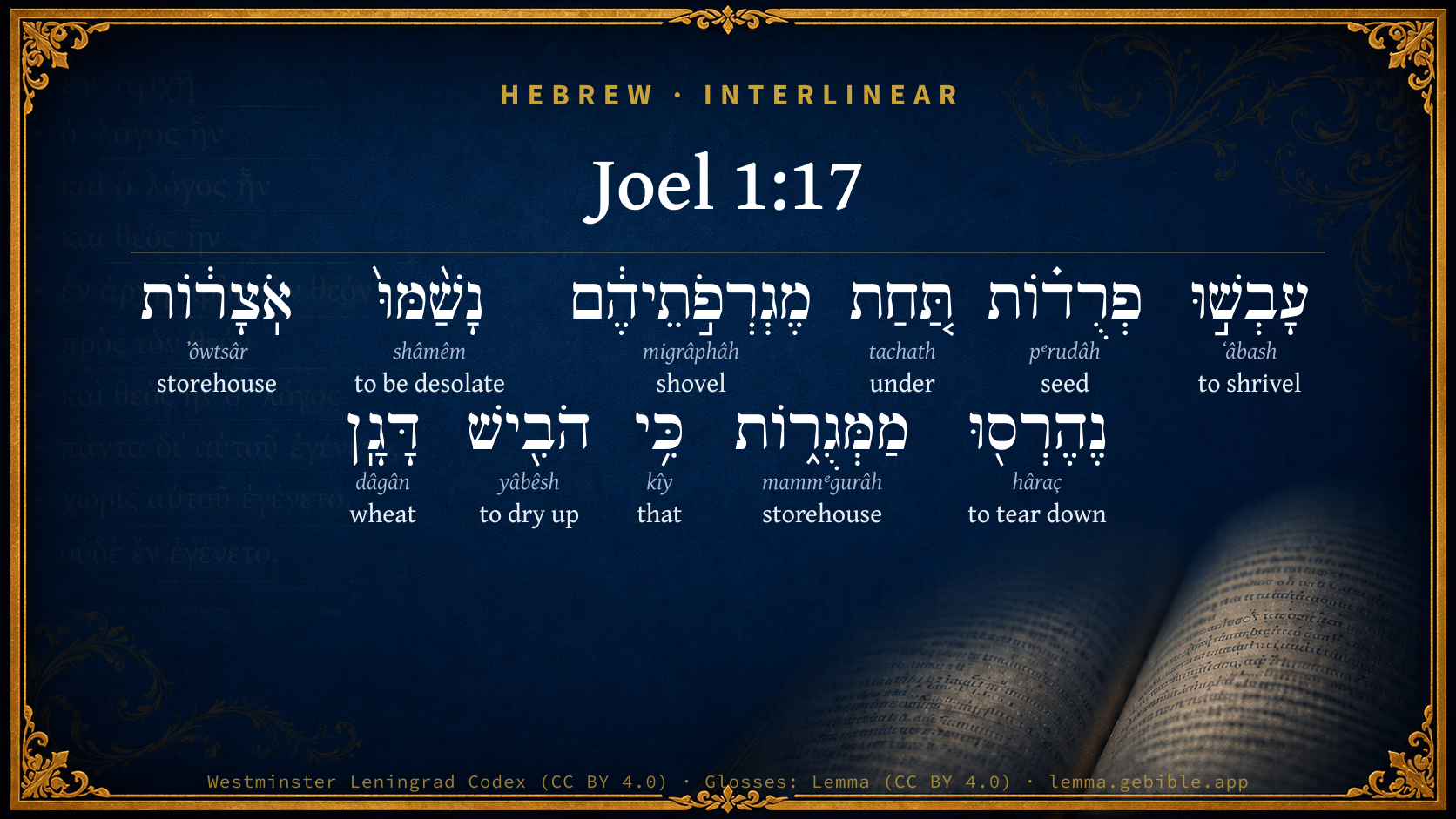
Hebrew (Westminster Leningrad Codex) Joel 1:17 appears in the Hebrew Old Testament. The text above is from the Westminster Leningrad Codex. Each word links to its Strong’s number, a concise gloss, and parsing drawn from the Open Scriptures Hebrew Bible morphology. Click any word for its full Brown-Driver-Briggs (BDB) entry.
Download image
Cite this verse

Joel 1:17 (World English Bible). Public Domain. Lemma interlinear Bible study tool, https://lemma.gebible.app/v/joel/1/17.

Show BibTeX & RIS
BibTeX
RIS
English Translation
The seeds rot under their clods. The granaries are laid desolate. The barns are broken down, for the grain has withered.
World English Bible · Public Domain
Highlights
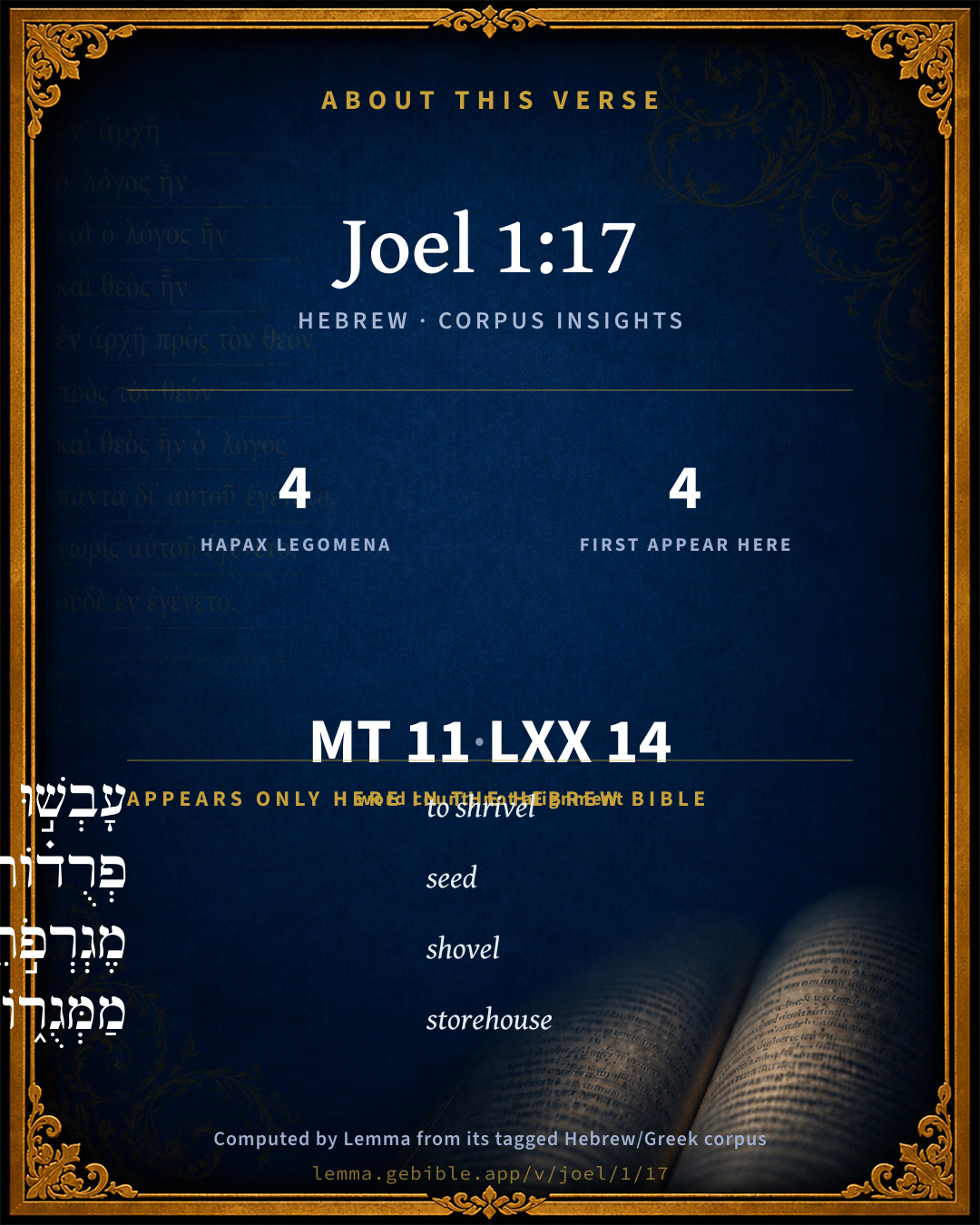
  • 4 hapax legomena — only here in the Hebrew Bible
  • 4 first appearances in the Hebrew Bible
Full analysis ↓
Download a study sheet

One document with this verse’s original text, its word-by-word gloss line, the meaning frame, cross-references with their text, attributed commentary, and full source and license credits — printable, and it pastes into notes with its structure intact.

This verse Autodidact and up

Study sheet (.html) Plain text (.txt)

A passage Seminary Student

Up to 50 verses in one chapter. A passage sheet keeps up to 6 commentary sources and 12 cross-references per verse, in the order this page ranks them, and says so on the sheet whenever that leaves anything out. Ask for a single verse and you get the Autodidact verse sheet above.

Everything on this page stays free to read, with no account — the sheet is a download of what is already on screen, not access to it.

Want to remove ads? Support Godless Engineer
Compare translations 3

The same verse in 3 English versions, stacked beneath the original-language interlinear above. Click any original word for its lexicon entry.

Each is an independent rendering of the whole verse — the interlinear is not word-aligned to these translations.

Highlighted words mark where these versions differ — a whole-verse word diff, not a word-by-word alignment.

  • World English Bible Public Domain
    The seeds rot under their clods. The granaries are laid desolate. The barns are broken down, for the grain has withered.
  • King James Version Public Domain
    The seed is rotten under their clods, the garners are laid desolate, the barns are broken down; for the corn is withered.
  • unfoldingWord Literal Text CC BY-SA 4.0
    The seeds shrivel under their clods. The storehouses are desolate, the granaries have been broken down, for the grain has dried up.

unfoldingWord Literal Text — © unfoldingWord, licensed CC BY-SA 4.0. Word-aligned USFM3 via Door43 (git.door43.org/unfoldingWord/en_ult).

Versions to compare (up to 4)

3 of 4 selected

Show all 18 translations

Every available English version of this verse, each an independent rendering of the whole verse.

  • World English Bible Public Domain
    The seeds rot under their clods. The granaries are laid desolate. The barns are broken down, for the grain has withered.
  • Berean Standard Bible Public Domain
    The seeds lie shriveled beneath the clods; the storehouses are in ruins; the granaries are broken down, for the grain has withered away.
  • Majority Standard Bible Public Domain
    The seeds lie shriveled beneath the clods; the storehouses are in ruins; the granaries are broken down, for the grain has withered away.
  • King James Version Public Domain
    The seed is rotten under their clods, the garners are laid desolate, the barns are broken down; for the corn is withered.
  • American Standard Version (1901) Public Domain
    The seeds rot under their clods; the garners are laid desolate, the barns are broken down; for the grain is withered.
  • Revised Version (1885) Public Domain
    The seeds rot under their clods; the garners are laid desolate, the barns are broken down; for the corn is withered.
  • Geneva Bible (1599) Public Domain
    The seede is rotten vnder their cloddes: the garners are destroyed: the barnes are broken downe, for the corne is withered.
  • Douay-Rheims (1899) Public Domain
    The beasts have rotted in their dung, the barns are destroyed, the storehouses are broken down: because the corn is confounded.
  • Young's Literal Translation Public Domain
    Rotted have scattered things under their clods, Desolated have been storehouses, Broken down have been granaries, For withered hath the corn.
  • Literal Standard Version CC BY-SA 4.0
    Scattered things have rotted under their clods, || Storehouses have been desolated, || Granaries have been broken down, || For the grain has withered.
  • Unlocked Literal Bible CC BY-SA 4.0
    The seeds rot under their clods, the granaries are desolate, and the barns have been broken down, for the grain has withered.
  • unfoldingWord Literal Text CC BY-SA 4.0
    The seeds shrivel under their clods. The storehouses are desolate, the granaries have been broken down, for the grain has dried up.
  • Darby Bible Public Domain
    The seeds are rotten under their clods, the granaries are laid desolate, the barns are broken down; for the corn is withered.
  • World Messianic Bible Public Domain
    The seeds rot under their clods. The granaries are laid desolate. The barns are broken down, for the grain has withered.
  • Webster's Bible Public Domain
    The seed hath perished under their clods, the granaries are laid desolate, the barns are broken down; for the corn is withered.
  • Free Bible Version CC BY-SA 4.0
    Seeds planted in the ground shrivel up; the storehouses are empty, the barns are torn down because the grain has dried up.
  • Bible in Basic English Public Domain
    The grains have become small and dry under the spade; the store-houses are made waste, the grain-stores are broken down; for the grain is dry and dead.
  • JPS Tanakh (1917) Public Domain
    The grains shrivel under their hoes; the garners are laid desolate, the barns are broken down; for the corn is withered.

Literal Standard Version (2020), Covenant Press — licensed CC BY-SA 4.0. Text via the HelloAO Bible API (eBible.org). Unlocked Literal Bible (unfoldingWord) — licensed CC BY-SA 4.0. Text via the HelloAO Bible API (eBible.org). unfoldingWord Literal Text — © unfoldingWord, licensed CC BY-SA 4.0. Word-aligned USFM3 via Door43 (git.door43.org/unfoldingWord/en_ult). Free Bible Version, Dr. Jonathan Gallagher — licensed CC BY-SA 4.0. Text via the HelloAO Bible API (eBible.org).

Word by word

More ways to search: Search by grammar → Find every occurrence → Compare this word →

Practice this passage: Drill this verse → Learn its vocabulary →

עָבְשׁ֣וּ
ʻâbash
H5685
“to shrivel”
Verb, Qal, Perfect, 3rd Person, Common, Plural
Part of Speech
Verb
Stem
Qal
Form
Perfect
Person
3rd Person
Gender
Common
Number
Plural
Full BDB Definition

Origin: a primitive root

TWOT: 1557

(Qal) to shrivel, waste away
  1. פְרֻד֗וֹת pᵉrudâh H6507 “seeds” Noun, Common, Feminine, Plural, Absolute
  2. תַּ֚חַת tachath H8478 “under” Preposition
  3. מֶגְרְפֹ֣תֵיהֶ֔ם migrâphâh H4053 “shovels · their” Noun, Common, Feminine, Plural, Construct + Suffix, Personal, 3rd Person, Masculine, Plural
  4. נָשַׁ֨מּוּ֙ shâmêm H8074 “to be desolate” Verb, Niphal, Perfect, 3rd Person, Common, Plural
  5. אֹֽצָר֔וֹת ʼôwtsâr H214 “storehouses” Noun, Common, Masculine, Plural, Absolute
  6. נֶהֶרְס֖וּ hâraç H2040 “to tear down” Verb, Niphal, Perfect, 3rd Person, Common, Plural
  7. מַמְּגֻר֑וֹת mammᵉgurâh H4460 “storehouses” Noun, Common, Feminine, Plural, Absolute
  8. כִּ֥י kîy H3588 “that” Conjunction
  9. הֹבִ֖ישׁ yâbêsh H3001 “to dry up” Verb, Hiphil, Perfect, 3rd Person, Masculine, Singular
  10. דָּגָֽן dâgân H1715 “wheat” Noun, Common, Masculine, Singular, Absolute

About this verse

These counts appear in no published source. They are computed here, from the morphology-tagged text and Lemma’s own curated glosses. What Lemma adds →

11
words
11
distinct lemmas
Prophets
section

Notable vocabulary

4 hapax legomena — words that appear only here in the entire Hebrew Bible:

  • עָבְשׁ֣וּ to shrivel H5685
  • פְרֻד֗וֹת seed H6507
  • מֶגְרְפֹ֣תֵיהֶ֔ם shovel H4053
  • מַמְּגֻר֑וֹת storehouse H4460

First appearance in Scripture

These words make their first canonical appearance in the Hebrew Bible here:

  • עָבְשׁ֣וּ to shrivel H5685
  • פְרֻד֗וֹת seed H6507
  • מֶגְרְפֹ֣תֵיהֶ֔ם shovel H4053
  • מַמְּגֻר֑וֹת storehouse H4460

Shared distinctive vocabulary

דָּגָֽן wheat H1715 occurs in 40 verses of the Hebrew Bible. Also found in:

Grammatical profile

  • 4 verbs
  • 5 nouns
  • 1 preposition
  • 1 conjunction

Verb forms

  • עָבְשׁ֣וּ Qal · Perfect
  • נָשַׁ֨מּוּ֙ Niphal · Perfect
  • נֶהֶרְס֖וּ Niphal · Perfect
  • הֹבִ֖ישׁ Hiphil · Perfect

Hebrew & Septuagint length

In English translation the verse runs 21 words from the Hebrew and 22 from the Septuagint (LXX English) — closely comparable.

A rough comparison of the two English renderings, which tokenize alike — not a word-level alignment.

Word counts can differ between the Hebrew and the Greek without any difference in meaning — e.g. the Hebrew direct-object marker אֵת has no separate Greek word, and Greek often adds the article ὁ.

In the original languages it is 11 Hebrew tokens and 14 Greek tokens — but the two are counted differently (Hebrew bundles its prefixes and suffixes into one token; the Greek is in lemma form), so that isn’t a like-for-like length.

Cross-references

2

Topical passages linked to Joel 1:17 in the Treasury of Scripture Knowledge — connected by theme and wording, ordered by reader-vote popularity; previews shown in the World English Bible.

  • Genesis 23:16 Abraham listened to Ephron. Abraham weighed to Ephron the silver which he had named in the audience of the children of Heth, four hundred shekels of silver, according to the current merchants' standard.
  • Isaiah 17:10–11 For you have forgotten the God of your salvation, and have not been mindful of the rock of your strength; therefore you plant pleasant plants, and set it with strange slips.

Cross-references courtesy of OpenBible.info (CC BY 4.0).

Hebrew and Greek witnesses Masoretic Hebrew ↔ Greek Septuagint

The same verse in the two great witnesses to the Old Testament, shown verse-for-verse.

These are two independent witnesses, not word-aligned to each other, and the Septuagint is shown in lemma (dictionary) form.

Hebrew Joel 1:17 Masoretic · Westminster Leningrad Codex

עָבְשׁ֣וּ פְרֻד֗וֹת תַּ֚חַת מֶגְרְפֹ֣תֵיהֶ֔ם נָשַׁ֨מּוּ֙ אֹֽצָר֔וֹת נֶהֶרְס֖וּ מַמְּגֻר֑וֹת כִּ֥י הֹבִ֖ישׁ דָּגָֽן

The seeds rot under their clods. The granaries are laid desolate. The barns are broken down, for the grain has withered.

World English Bible · Public Domain

Greek LXX Joel 1:17 Septuagint · lemma form

σκιρτέω δάμαλις ἐπί ὁ φάτνη αὐτός ἀπο ἀναἵζω θησαυρός κατασκάπτω ληνός ὅτι ξηραίνω σῖτος

The heifers have started at their mangers, the treasures are abolished, the wine presses are broken down; for the corn is withered.

LXX2012 (modern English Septuagint) · Public Domain

On this verse, Haydock's Catholic Bible Commentary discusses the Septuagint’s reading. Read the note in Commentary ↓

Hebrew: Westminster Leningrad Codex (CC BY 4.0). Greek: Septuagint (public domain); English from LXX2012 (modern English Septuagint) (Public Domain). How the Septuagint differs from the Hebrew →

Targum (Aramaic paraphrase)

1

The Targum is the ancient Jewish Aramaic paraphrase of the Hebrew Scriptures — an interpretive translation, not the Hebrew text itself. Onkelos (literal) and Pseudo-Jonathan (expansive) render the Torah, and Jonathan the Prophets. Coverage is partial: where no permissively-licensed English translation exists for a verse, only the Aramaic is shown. This is verse-level text, not a word-by-word alignment to the Hebrew.

  1. Targum Jonathan Prophets (Joshua–Malachi)
    אִתְמְסִיאוּ גַרְבֵי חֲמַר תְּחוֹת מִגוּפָתְהוֹן צְדִיאוּ אוֹצְרַיָא אִתְפַּגָרוּ חִסָנַיָא אֲרֵי סַף עִבּוּרָא:

    (no public-domain English translation for this verse)

    Targum Jonathan — Aramaic: “Mikraot Gedolot” (public domain). English: “Sefaria Community Translation” (CC0 1.0 (public-domain dedication)); “London "Chaldee Paraphrase," 1871” (public domain). Text via Sefaria.

Commentary

Notes on Joel 1:17 from classic Christian and Jewish commentators (each source and its license shown beneath its notes). The classic Christian expositions comment on the surrounding passage and are grouped to its opening verse, so a note may address several verses; the Jewish commentaries on the Tanakh (Rashi and others) are per-verse, so they appear only where the commentator wrote on this verse.

Lemma curates 59 commentaries, every one of them public domain or Creative Commons licensed, each selected and text-cleaned for this edition rather than reprinted as found. About our sources →

Trapp's Complete Commentary

John Trapp

Joe 1:17 The seed is rotten under their clods, the garners are laid desolate, the barns are broken down; for the corn is withered.

Ver. 17. The seed is rotten under their clods] It lieth buried or drowned with excessive rain and moisture, corrupting the seed soon after it was sown: and that which was not so marred was afterwards, when it came to be grain, dried up with excessive heat.

The corn is withered] So that the garners were desolated, the barns broken down for want of stuffing, and for that there was no use of them, since they sowed but reaped not, Mic 6:15. The husbandman was called to mourning, Amo 5:16, for a threefold calamity that lay upon his tillage. First, immoderate rain in or about seeding; secondly, locusts and other vermin at spring; thirdly, extreme drought after all, Joe 1:19-20. Thus God followeth sinners with one plague in the neck of another (as he did Pharaoh, that sturdy rebel), till he have made his foes his footstools. To multiply sin is to multiply sorrow, Psa 16:4; to heap up wickedness is to heap up wrath, Rom 2:5. "I will heap mischiefs upon them," saith God; "I will spend mine arrows upon them," Deu 32:23, which yet cannot be all spent up, as Ovid feared of his Jupiter, that if he should punish men for every offence his store of thunder bolts would be soon spent and exhausted.

“ Si queries peccent homines sua fulmina mittat

Iupiter, exiguo tempore inermis erit. ”

John Trapp, A Commentary or Exposition upon All the Books of the Old and New Testament (1647–1656) — public domain. Text from a community e-Sword module.

Tyndale Open Study Notes

Tyndale Open Resources

1:17 Plague and drought had so reduced the food supply that the barns stood empty.

Tyndale Open Study Notes — © Tyndale Open Resources, licensed CC BY-SA 4.0. Text via the HelloAO Bible API.

Jamieson, Fausset & Brown

Robert Jamieson, A. R. Fausset & David Brown

is rotten--"is dried up," "vanishes away," from an Arabic root [MAURER]. "Seed," literally, "grains." The drought causes the seeds to lose all their vitality and moisture.

garners--granaries; generally underground, and divided into separate receptacles for the different kinds of grain.

Jamieson, Fausset & Brown — Commentary Critical and Explanatory on the Whole Bible (1871) — public domain (CC PDM 1.0). Text via the HelloAO Bible API.

Adam Clarke's Commentary

Verse 17. The seed is rotten under their clods] When the sprout was cut off as low as possible by the locusts, there was no farther germination. The seed rotted away.

Adam Clarke's Commentary on the Bible (1810–1826) — public domain. Text from a community e-Sword/MySword module.

John Calvin's Commentaries

He shows the cause of the evil, Rotted have the grains in the very furrows. For they call seeds פרדות peredut from the act of scattering. He then calls grains by this name, because they are scattered; and he says that they rotted in the fields when they ought to have germinated. He then adds, The granaries halve become desolated and the barns have been pulled down; for there was no use for them. Hence we conclude, that sterility had become most grievousand perpetual; for if the people had been only afflicted by famine for a few harvests or for one year, the Prophet would not have spoken thus. The famine must then have been, as it has been already stated for a long time. Let us now proceed —

John Calvin's Commentaries (1540-1563) — public domain. Text from the Calvin Translation Society English edition (1840s-50s) via the Christian Classics Ethereal Library (ccel.org). Calvin's coverage is partial (roughly two-thirds of the Bible); uncommented books and verses are honest gaps, never fabricated. The 19th-century editor's footnotes and remarks are omitted so the notes are faithfully Calvin's own voice.

Ellicott's Commentary for English Readers

(17) The corn is withered.—The results of the terrible drought, coincident with the ravages of the locusts, are now described. The ancient versions present difficulty and variety in the exact rendering of this verse, owing to several words occurring in it being not found elsewhere in Holy Scripture. On the whole the English text seems correct and satisfactory.

A Bible Commentary for English Readers, edited by Charles John Ellicott (1878–1897) — public domain. Text from a community e-Sword module.

The Cambridge Bible for Schools and Colleges

gen. ed. J. J. S. Perowne

17. The grains shrivel (R.V. marg.) under their shovels (or hoes)] unable to withstand the scorching heat. This is the only rendering which the existing text will permit[32]; but the last word especially is not satisfactory. Merx (p. 100 f.) examines the passage at some length; but his restoration is not convincing.

[32] Grains, lit. things parted (cf. Syr. perdâ). A.V. is rotten follows Ibn Ezra and Kimchi in explaining the Heb. ‘âbhçsh from the Aram, ‘aphash, to rot; but the meaning is unsuitable (for rotting is not an effect of drought), and the Arab. ‘abisa, to be dried up (esp. of dirt) both agrees better phonetically and yields a preferable sense. מנרפות is derived obviously from נרף to sweep away (Jdg_5:21, of a torrent; so also in Arab. and Syr.): in Arab. the corresponding word means a broom for sweeping away mud &c., also (now) a shovel, and in Palestine (PEFQSt., 1891, p. III), a hoe, and in Aram. a shovel for removing ashes (Num_4:14, &c.). The Arab. gurf does not mean gleba terrae (Keil), but (Lane, Arab. Lex. p. 411) the water-worn bank of a stream. Clod (Heb. רִגד, Job_21:33; Job_38:38) would not be a probable generalization even of a word signifying properly masses of earth swept away by a stream.

garners] lit. treasuries, store-houses,—a word, in itself, of wider meaning than “garner”: cf. 1Ch_27:27-28 (for wine and oil); 2Ch_32:27 (for money and other valuables); Neh_13:12, &c.

are laid desolate … broken down] being empty, and falling into disrepair through disuse.

barns] not the usual word (Deu_28:8, &c.), but another, not found elsewhere, though nearly resembling the word found in Hag_2:19.

is withered] sheweth shame, fig. for fails, as Joe_1:10; Joe_1:12.

The Cambridge Bible for Schools and Colleges (gen. ed. J. J. S. Perowne; Cambridge University Press, 1878–1918) — public domain. Text from a community e-Sword module.

John Gill's Exposition

The seed is rotten under their clods,.... Or "grains" (z) of wheat or barley, which had been sown, and, for want of rain, putrefied and wasted away under the clods of earth, through the great drought; so that what with locusts, which cropped that that did bud forth, and with the drought, by reason of which much of the seed sown came to nothing, an extreme famine ensued: the Targum is,

"casks of wine rotted under their coverings:''

the garners are desolate; the "treasuries" (a), or storehouses, having nothing in them, and there being nothing to put into them; Jarchi makes these to be peculiar for wine and oil, both which failed, Joe 1:10;

the barns are broken down; in which the wheat and barley had used to be laid up; but this judgment of the locusts and drought continuing year after year, the walls fell down, and, no care was taken to repair them, there being no, use for them; these were the granaries, and, as Jarchi, for wheat particularly:

for the corn is withered; that which sprung up withered and dried away, through the heat and drought: or was "ashamed" (b); not answering the expectation of the sower.

(z) "grana", Pagninus, Montanus, Mercerus, Tarnovius, Cocceius, Bochartus. So Ben Melech, who observes they are so called, because they are separated and scattered under the earth. (a) "thesauri", Pagninus, Montanus, Mercerus, Vatablus, Piscator. (b) "confusum est", V. L. "puduit", Drusius; "pudore afficit", Cocceius.

John Gill's Exposition of the Whole Bible (1746–1763) — public domain (CC PDM 1.0). Text via the HelloAO Bible API.

Albert Barnes' Notes on the Bible

The seed is rotten under the clods - Not only was all to be cut off for the present, but, with it, all hope for the future. The scattered seed, as it lay, each under its clod known to God, was dried up, and so decayed. The garners lay desolate, nay, were allowed to go to ruin, in hopelessness of any future harvest.

Albert Barnes' Notes on the Bible (1834–1885) — public domain. Text from a community e-Sword/MySword module.

Haydock's Catholic Bible Commentary

Dung. Horse-dung dried for bedding, was used in the East instead of straw, (Busb. 3.) as it is still by the Arabs. (Darvieux 11.) --- Hebrew, "the seeds are rotten under their clods," (Haydock) finding no moisture. Septuagint, "the cows have stamped in their stalls;" or Syriac, "remain without food in their cribs." Chaldean, "the pitchers of wine have been corrupted under their covers," as there was no new wine. (Calmet) --- Houses. Hebrew mammeguroth. Protestants, "barns, (Haydock) or country houses;" which means cabins erected for the season, (Ruth ii. 7.) the Magaria (Calmet) or Mopalia of the Africans. (St. Jerome pref. Amos.) --- Septuagint, "the wine presses." Wine and corn were preserved in pits carefully covered over, Aggeus ii. 20. These fell to decay, as there was no use for them.

George Leo Haydock (1774–1849), Haydock's Catholic Family Bible and Commentary, 1859 edition — public domain. Excludes Psalms (Douay-Rheims chapter numbering differs from Protestant) and Deuterocanonical books (Catholic canon only).

Matthew Poole's English Annotations

The seed; called so from the seedsman’s scattering it abroad when he soweth it, and in this place only so used, for aught I can observe, and yet this use of it here is justified by all the following words; the grain which is sown for the seed against next spring.

Is rotten; is putrefied, grown musty and fruitless; nor is this word any where else used in Scripture. Under their clods, and earth, from under which the seed covered should spring up, but now, as unsound, rotten, and fruitless seed, is lost under it.

The garners, or storehouses, treasuries of corn, in which it was kept for future use,

are laid desolate; either run to ruin, because the owners, discouraged with the barrenness of the seasons, would not repair them; this will intimate that this judgment lasted some years, and is better ground for it than the four sorts of vermin repeated one after another, in Joe 1:4; or else desolate, being pulled down, and the materials employed for other uses, till they may have corn to keep in them.

The barns, in which they lodged their unthrashed corn,

are broken down; neglected, and without repair;

for the corn is withered; there was no use of them, no corn to be laid up, all withered, and therefore the barns were not regarded.

Matthew Poole's English Annotations on the Holy Bible (1683–1685) — public domain. Text from a community e-Sword/MySword module.

The Pulpit Commentary

Vers. 17, 18. The desolation of the land.

Whether actually and literally by a plague of locusts, or by a hostile incursion such as a plague of this kind might well typify, Judah was overrun, afflicted, and cursed. The picture is one of unrelieved gloom and misery.

I THE PUNITIVE JUDGMENTS OF GOD REACH MEN THROUGH THE CROPS OF THE FIELD, AND THE HERDS AND FLOCKS OF THE PASTURE. The necessaries of life, the constituents of wealth, are in the hand of God. He rules not only in heaven but upon earth. It may be doubted whether we are at liberty confidently to attribute to Divine displeasure the sufferings which befall nations in the way of disaster and famine; but in this passage this interpretation is given upon prophetic authority.

II SUCH JUDGMENTS ARE INTENDED TO SUMMON THOSE AFFLICTED WITH THEM TO CONTRITION AND REPENTANCE. It may be that only by some such means can the hard heart be broken, and brought to true humiliation and penitence.

III SUCH JUDGMENTS SHOULD LEAD MEN TO SEEK THEIR HIGHEST GOOD, NOT IN PERISHABLE POSSESSIONS, BUT IN SPIRITUAL ENRICHMENT. To many men poverty, losses, worldly ruin, have been the means of the highest happiness. Well is it if, losing the gifts, we find the Giver; losing the streams, we find the Fountain. The soul may learn to cry, "Thou art my Portion, O my God! T.

The Pulpit Commentary (1880–1919), ed. H.D.M. Spence-Jones & Joseph S. Exell — public domain. Text from a community e-Sword module.

John Wesley's Explanatory Notes

Laid desolate - Run to ruin because the owners discouraged with the barrenness of the seasons, would not repair them.

John Wesley, Explanatory Notes Upon the Whole Bible (1754–1765) — public domain. Text via the GEBible commentary corpus.

Rashi

Rabbi Shlomo Yitzchaki (Rashi)

have gathered mold Heb. עָבְשׁוּ, have gathered rust and mold. in French moisir, to become moldy.

casks of wine Heb. פְרֻדּדוֹת. Jonathan renders: casks of wine.

under their bungs Heb. מֶגְרְפֹתֵיהֶם. Jonathan renders: מְגוּפָתֵיהוֹן, the cover of the cask.

the storehouses are laid desolate—I.e. the storehouses of wine and oil.

garners are demolished—Granaries of wheat.

Rashi on the Tanakh — English translations: “The Judaica Press complete Tanach with Rashi, translated by A. J. Rosenberg” (CC BY 4.0); “Pentateuch with Rashi's commentary by M. Rosenbaum and A.M. Silbermann, 1929-1934” (public domain); “The Metsudah Tanach series, Lakewood, N.J” (CC BY 4.0); and “The Book of Joshua, Metsudah Publications, 1997” (CC BY 4.0). Text via Sefaria.

Lesson kit

Teaching starters — assembled from the data on this page, not authored interpretation. Every prompt links to the verse data it draws on. Edit before teaching.

Joel, in the Prophets, opens this verse with 11 words (11 distinct Hebrew lemmas). Its most distinctive word is ʻâbash (“to shrivel”). A historical commentator’s framing appears above. Read the whole chapter for the surrounding context.

Discussion questions

  1. What does “to shrivel” (ʻâbash) contribute to the verse as a whole?
  2. 4 words here appear nowhere else in the Hebrew Bible. Why might the author reach for such rare wording?
  3. 4 words make their first appearance in Scripture here. What does this debut establish?
  4. How does Genesis 27:28, which shares the word «wheat», read alongside this verse?
  5. The translations on this page render this verse differently — a whole-verse word diff, not a word-by-word alignment. What might account for the different wordings?
  6. «עָבְשׁ֣וּ» is a Qal Perfect verb. How does that grammatical form shape the action described?
  7. Compare how Trapp's Complete Commentary and Tyndale Open Study Notes read this verse. Where do they agree or differ?

Things to notice

Reading settings

Reading text

Shown beneath each verse's original-language words.

Old Testament
Old Testament edition

Read the OT as the Masoretic Hebrew (MT) or the Greek Septuagint (LXX).

English shown for the Greek Septuagint (in the Hebrew ↔ Greek comparison).

Comparing translations? Open the Compare panel on any verse page to stack up to four side by side.