
Ezekiel 3:15

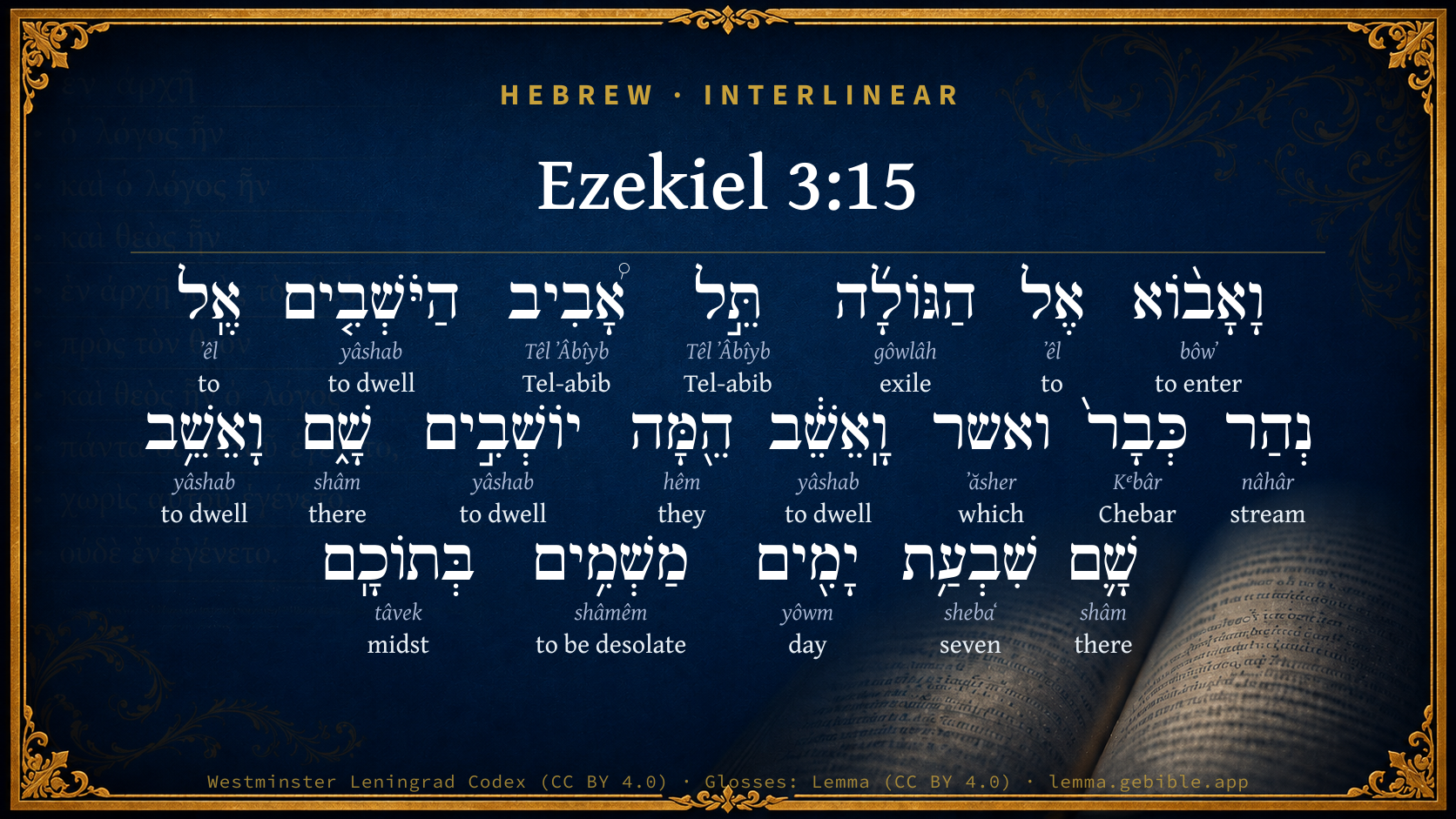
Hebrew (Westminster Leningrad Codex) Ezekiel 3:15 appears in the Hebrew Old Testament. The text above is from the Westminster Leningrad Codex. Each word links to its Strong’s number, a concise gloss, and parsing drawn from the Open Scriptures Hebrew Bible morphology. Click any word for its full Brown-Driver-Briggs (BDB) entry.
Download image
Cite this verse

Ezekiel 3:15 (World English Bible). Public Domain. Lemma interlinear Bible study tool, https://lemma.gebible.app/v/ezekiel/3/15.

Show BibTeX & RIS
BibTeX
RIS
English Translation
Then I came to them of the captivity at Tel Aviv, that lived by the river Chebar, and to where they lived; and I sat there overwhelmed among them seven days.
World English Bible · Public Domain
Highlights
  • 1 first appearance in the Hebrew Bible
Full analysis ↓
Download a study sheet

One document with this verse’s original text, its word-by-word gloss line, the meaning frame, cross-references with their text, attributed commentary, and full source and license credits — printable, and it pastes into notes with its structure intact.

This verse Autodidact and up

Study sheet (.html) Plain text (.txt)

A passage Seminary Student

Up to 50 verses in one chapter. A passage sheet keeps up to 6 commentary sources and 12 cross-references per verse, in the order this page ranks them, and says so on the sheet whenever that leaves anything out. Ask for a single verse and you get the Autodidact verse sheet above.

Everything on this page stays free to read, with no account — the sheet is a download of what is already on screen, not access to it.

Want to remove ads? Support Godless Engineer
Compare translations 3

The same verse in 3 English versions, stacked beneath the original-language interlinear above. Click any original word for its lexicon entry.

Each is an independent rendering of the whole verse — the interlinear is not word-aligned to these translations.

Highlighted words mark where these versions differ — a whole-verse word diff, not a word-by-word alignment.

  • World English Bible Public Domain
    Then I came to them of the captivity at Tel Aviv, that lived by the river Chebar, and to where they lived; and I sat there overwhelmed among them seven days.
  • King James Version Public Domain
    Then I came to them of the captivity at Telabib, that dwelt by the river of Chebar, and I sat where they sat, and remained there astonished among them seven days.
  • unfoldingWord Literal Text CC BY-SA 4.0
    So I went to the captives at Tel Aviv who lived along the Kebar Canal, and I stayed there among them for seven days, overwhelmed in amazement.

unfoldingWord Literal Text — © unfoldingWord, licensed CC BY-SA 4.0. Word-aligned USFM3 via Door43 (git.door43.org/unfoldingWord/en_ult).

Versions to compare (up to 4)

3 of 4 selected

Show all 18 translations

Every available English version of this verse, each an independent rendering of the whole verse.

  • World English Bible Public Domain
    Then I came to them of the captivity at Tel Aviv, that lived by the river Chebar, and to where they lived; and I sat there overwhelmed among them seven days.
  • Berean Standard Bible Public Domain
    I came to the exiles at Tel-abib who dwelt by the River Kebar. And for seven days I sat where they sat and remained there among them, overwhelmed.
  • Majority Standard Bible Public Domain
    I came to the exiles at Tel-abib who dwelt by the River Kebar. And for seven days I sat where they sat and remained there among them, overwhelmed.
  • King James Version Public Domain
    Then I came to them of the captivity at Telabib, that dwelt by the river of Chebar, and I sat where they sat, and remained there astonished among them seven days.
  • American Standard Version (1901) Public Domain
    Then I came to them of the captivity at Tel-abib, that dwelt by the river Chebar, and to where they dwelt; and I sat there overwhelmed among them seven days.
  • Revised Version (1885) Public Domain
    Then I came to them of the captivity at Tel-abib, that dwelt by the river Chebar, and to where they dwelt; and I sat there astonied among them seven days.
  • Geneva Bible (1599) Public Domain
    Then I came to them that were led away captiues to Tel-abib, that dwelt by the riuer Chebar, and I sate where they sate, and remained there astonished among them seuen dayes.
  • Douay-Rheims (1899) Public Domain
    And I came to them of the captivity, to the heap of new corn, to them that dwelt by the river Chobar, and I sat where they sat: and I remained there seven days mourning in the midst of them.
  • Young's Literal Translation Public Domain
    And I come in unto the Removed, at Tel-Ahib, who are dwelling at the river Chebar, and where they are dwelling I also dwell seven days, causing astonishment in their midst.
  • Literal Standard Version CC BY-SA 4.0
    And I come to the expulsion, at Tel-Ahib, who are dwelling at the river Chebar, and where they are dwelling I also dwell [for] seven days, causing astonishment in their midst.
  • Unlocked Literal Bible CC BY-SA 4.0
    So I went to the captives at Tel Aviv who lived along the Kebar Canal, and I stayed there among them for seven days, overwhelmed in amazement.
  • unfoldingWord Literal Text CC BY-SA 4.0
    So I went to the captives at Tel Aviv who lived along the Kebar Canal, and I stayed there among them for seven days, overwhelmed in amazement.
  • Darby Bible Public Domain
    And I came to them of the captivity at Tel-abib, that dwelt by the river Chebar, and I sat where they sat; and I sat there astonied among them seven days.
  • World Messianic Bible Public Domain
    Then I came to them of the captivity at Tel Aviv who lived by the river Chebar, and to where they lived; and I sat there overwhelmed among them seven days.
  • Webster's Bible Public Domain
    Then I came to them of the captivity at Tel-abib, that dwelt by the river of Kebar, and I sat where they sat, and remained there astonished among them seven days.
  • Free Bible Version CC BY-SA 4.0
    I arrived at the place where the exiles lived, Tel-abib by the River Kebar. I just sat with them, staying with them there for seven days. I was completely overcome with emotion.
  • Bible in Basic English Public Domain
    Then I came to those who had been taken away as prisoners, who were at Telabib by the river Chebar, and I was seated among them full of wonder for seven days.
  • JPS Tanakh (1917) Public Domain
    Then I came to them of the captivity at Tel-abib, that dwelt by the river Chebar, and I sat where they sat; and I remained there appalled among them seven days.

Literal Standard Version (2020), Covenant Press — licensed CC BY-SA 4.0. Text via the HelloAO Bible API (eBible.org). Unlocked Literal Bible (unfoldingWord) — licensed CC BY-SA 4.0. Text via the HelloAO Bible API (eBible.org). unfoldingWord Literal Text — © unfoldingWord, licensed CC BY-SA 4.0. Word-aligned USFM3 via Door43 (git.door43.org/unfoldingWord/en_ult). Free Bible Version, Dr. Jonathan Gallagher — licensed CC BY-SA 4.0. Text via the HelloAO Bible API (eBible.org).

Word by word

More ways to search: Search by grammar → Find every occurrence → Compare this word →

Practice this passage: Drill this verse → Learn its vocabulary →

תֵּ֣ל
Têl ʼÂbîyb
H8512
“Tel-abib”
Noun, Proper
Part of Speech
Noun
Type
Proper
Full BDB Definition

Origin: from H8510 and H24

TWOT: None

Tel-abib = "mound of the flood" - a city in Babylon, the home of the prophet Ezekiel, located on the river Chebar which was probably a branch of the Euphrates
  1. וָאָב֨וֹא bôwʼ H935 “and · to enter” Conjunction + Verb, Qal, Sequential Imperfect, 1st Person, Common, Singular
  2. אֶל ʼêl H413 “to” Preposition
  3. הַגּוֹלָ֜ה gôwlâh H1473 “the · exile” Particle, Definite Article + Noun, Common, Feminine, Singular, Absolute
  4. אָ֠בִיב Têl ʼÂbîyb H8512 “Tel-abib” Noun, Proper
  5. הַיֹּשְׁבִ֤ים yâshab H3427 “the · dwelling” Particle, Definite Article + Verb, Qal, Participle Active, Masculine, Plural, Absolute
  6. אֶֽל ʼêl H413 “to” Preposition
  7. נְהַר nâhâr H5104 “stream of” Noun, Common, Masculine, Singular, Construct
  8. כְּבָר֙ Kᵉbâr H3529 “Chebar” Noun, Proper
  9. ואשר ʼăsher H834 “and · which” Conjunction + Particle, Relative
  10. וָֽאֵשֵׁ֔ב yâshab H3427 “and · to dwell” Conjunction + Verb, Qal, Sequential Imperfect, 1st Person, Common, Singular
  11. הֵ֖מָּה hêm H1992 “they” Pronoun, Personal, 3rd Person, Masculine, Plural
  12. יוֹשְׁבִ֣ים yâshab H3427 “dwelling” Verb, Qal, Participle Active, Masculine, Plural, Absolute
  13. שָׁ֑ם shâm H8033 “there” Adverb
  14. וָאֵשֵׁ֥ב yâshab H3427 “and · to dwell” Conjunction + Verb, Qal, Sequential Imperfect, 1st Person, Common, Singular
  15. שָׁ֛ם shâm H8033 “there” Adverb
  16. שִׁבְעַ֥ת shebaʻ H7651 “seven” Adjective, Cardinal number, Masculine, Singular, Construct
  17. יָמִ֖ים yôwm H3117 “days” Noun, Common, Masculine, Plural, Absolute
  18. מַשְׁמִ֥ים shâmêm H8074 “being desolate” Verb, Hiphil, Participle Active, Masculine, Singular, Absolute
  19. בְּתוֹכָֽם tâvek H8432 “in/at · midst · their” Preposition + Noun, Common, Masculine, Singular, Construct + Suffix, Personal, 3rd Person, Masculine, Plural

About this verse

These counts appear in no published source. They are computed here, from the morphology-tagged text and Lemma’s own curated glosses. What Lemma adds →

20
words
14
distinct lemmas
Prophets
section

Notable vocabulary

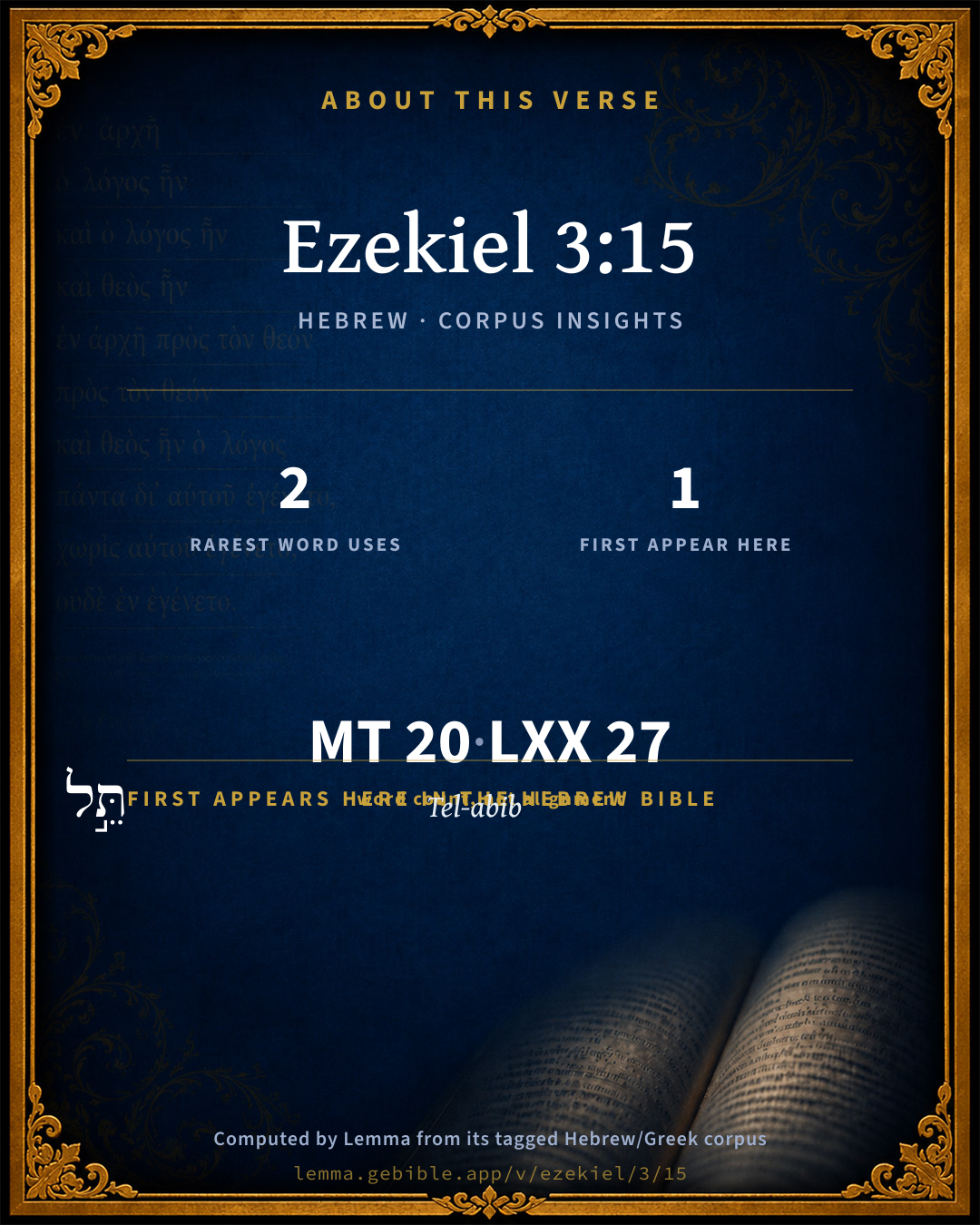
The rarest word here is תֵּ֣ל Tel-abib H8512 — appearing just 2 times in the whole Hebrew Bible.

First appearance in Scripture

This word makes its first canonical appearance in the Hebrew Bible here:

  • תֵּ֣ל Tel-abib H8512

Grammatical profile

  • 6 verbs
  • 7 nouns
  • 1 adjective
  • 1 pronoun
  • 2 prepositions
  • 2 adverbs
  • 1 particle

Verb forms

  • וָאָב֨וֹא Qal · Sequential Imperfect
  • הַיֹּשְׁבִ֤ים Qal · Participle Active
  • וָֽאֵשֵׁ֔ב Qal · Sequential Imperfect
  • יוֹשְׁבִ֣ים Qal · Participle Active
  • וָאֵשֵׁ֥ב Qal · Sequential Imperfect
  • מַשְׁמִ֥ים Hiphil · Participle Active

Repetition

Words recur within this verse — often emphatic in Hebrew:

  • הַיֹּשְׁבִ֤ים to dwell H3427 ×4
  • תֵּ֣ל Tel-abib H8512 ×2
  • שָׁ֑ם there H8033 ×2
  • אֶל to H413 ×2

Hebrew & Septuagint length

In English translation the verse runs 31 words from the Hebrew and 38 from the Septuagint (LXX English) — closely comparable.

A rough comparison of the two English renderings, which tokenize alike — not a word-level alignment.

Word counts can differ between the Hebrew and the Greek without any difference in meaning — e.g. the Hebrew direct-object marker אֵת has no separate Greek word, and Greek often adds the article ὁ.

In the original languages it is 20 Hebrew tokens and 27 Greek tokens — but the two are counted differently (Hebrew bundles its prefixes and suffixes into one token; the Greek is in lemma form), so that isn’t a like-for-like length.

Cross-references

9

Topical passages linked to Ezekiel 3:15 in the Treasury of Scripture Knowledge — connected by theme and wording, ordered by reader-vote popularity; previews shown in the World English Bible.

  • Job 2:13 So they sat down with him on the ground seven days and seven nights, and none spoke a word to him, for they saw that his grief was very great.
  • Psalms 137:1 By the rivers of Babylon, there we sat down. Yes, we wept, when we remembered Zion.
  • Genesis 50:10 They came to the threshing floor of Atad, which is beyond the Jordan, and there they lamented with a very great and sore lamentation. He mourned for his father seven days.
  • Ezekiel 1:1 Now it happened in the thirtieth year, in the fourth [month], in the fifth [day] of the month, as I was among the captives by the river Chebar, that the heavens were opened, and I saw visions of God.
  • Jeremiah 23:9 Concerning the prophets. My heart within me is broken, all my bones shake; I am like a drunken man, and like a man whom wine has overcome, because of Yahweh, and because of his holy words.
  • Ezekiel 10:15 The cherubim mounted up: this is the living creature that I saw by the river Chebar.
  • Habakkuk 3:16 I heard, and my body trembled. My lips quivered at the voice. Rottenness enters into my bones, and I tremble in my place, Because I must wait quietly for the day of trouble, For the coming up of the people who invade us.
  • Ezekiel 3:23 Then I arose, and went forth into the plain: and, behold, the glory of Yahweh stood there, as the glory which I saw by the river Chebar; and I fell on my face.
  • Ezekiel 43:3 It was according to the appearance of the vision which I saw, even according to the vision that I saw when I came to destroy the city; and the visions were like the vision that I saw by the river Chebar; and I fell on my face.

Cross-references courtesy of OpenBible.info (CC BY 4.0).

Hebrew and Greek witnesses Masoretic Hebrew ↔ Greek Septuagint

The same verse in the two great witnesses to the Old Testament, shown verse-for-verse.

These are two independent witnesses, not word-aligned to each other, and the Septuagint is shown in lemma (dictionary) form.

Hebrew Ezekiel 3:15 Masoretic · Westminster Leningrad Codex

וָאָב֨וֹא אֶל הַגּוֹלָ֜ה תֵּ֣ל אָ֠בִיב הַיֹּשְׁבִ֤ים אֶֽל נְהַר כְּבָר֙ ואשר וָֽאֵשֵׁ֔ב הֵ֖מָּה יוֹשְׁבִ֣ים שָׁ֑ם וָאֵשֵׁ֥ב שָׁ֛ם שִׁבְעַ֥ת יָמִ֖ים מַשְׁמִ֥ים בְּתוֹכָֽם

Then I came to them of the captivity at Tel Aviv, that lived by the river Chebar, and to where they lived; and I sat there overwhelmed among them seven days.

World English Bible · Public Domain

Greek LXX Ezekiel 3:15 Septuagint · lemma form

καί εἰςἔρχομαι εἰς ὁ αἰχμαλωσία μετέωρος καί περιἔρχομαι ὁ καταοἰκέω ἐπί ὁ ποταμός ὁ χοβαρ ὁ εἰμί ἐκεῖ καί καταἵζω ἐκεῖ ἑπτά ἡμέρα ἀναστρέφω ἐν μέσος αὐτός

Then I passed through the air and came into the captivity, and went round to them that lived by the river of Chobar who were there; and I sat there seven days, conversant in the midst of them.

LXX2012 (modern English Septuagint) · Public Domain

On this verse, John Calvin's Commentaries discusses the Septuagint’s reading. Read the note in Commentary ↓

Hebrew: Westminster Leningrad Codex (CC BY 4.0). Greek: Septuagint (public domain); English from LXX2012 (modern English Septuagint) (Public Domain). How the Septuagint differs from the Hebrew →

Targum (Aramaic paraphrase)

1

The Targum is the ancient Jewish Aramaic paraphrase of the Hebrew Scriptures — an interpretive translation, not the Hebrew text itself. Onkelos (literal) and Pseudo-Jonathan (expansive) render the Torah, and Jonathan the Prophets. Coverage is partial: where no permissively-licensed English translation exists for a verse, only the Aramaic is shown. This is verse-level text, not a word-by-word alignment to the Hebrew.

  1. Targum Jonathan Prophets (Joshua–Malachi)
    וְאָתֵית לְוַת בְּנֵי גָלוּתָא לְתֵל אָבִיב דְיָתְבִין עַל נְהַר כְּבָר וְנָחֵית בֵּינֵיהוֹן וְאִינוּן יַתְבִין תַּמָן וִיתִיבֵית תַּמָן שַׁבְעָא יוֹמִין שָׁתִיק בֵּינֵיהוֹן:

    (no public-domain English translation for this verse)

    Targum Jonathan — Aramaic: “Mikraot Gedolot” (public domain). English: “Sefaria Community Translation” (CC0 1.0 (public-domain dedication)); “London "Chaldee Paraphrase," 1871” (public domain). Text via Sefaria.

Commentary

Notes on Ezekiel 3:15 from classic Christian and Jewish commentators (each source and its license shown beneath its notes). The classic Christian expositions comment on the surrounding passage and are grouped to its opening verse, so a note may address several verses; the Jewish commentaries on the Tanakh (Rashi and others) are per-verse, so they appear only where the commentator wrote on this verse.

Lemma curates 59 commentaries, every one of them public domain or Creative Commons licensed, each selected and text-cleaned for this edition rather than reprinted as found. About our sources →

Trapp's Complete Commentary

John Trapp

Eze 3:15 Then I came to them of the captivity at Telabib, that dwelt by the river of Chebar, and I sat where they sat, and remained there astonished among them seven days.

Ver. 15. Then I came to them of the captivity of Telabib.] Which was the name of some chief place or plantation of the Jews in captivity, saith Diodat. It was in the middle part of Mesopotamia, saith Junius, between two rivers, Chebar and Saocorah.

I sat where they sat.] Skulking and lurking, or at least not acting according to my prophetic function, and the gift bestowed upon me, which I ought to have stirred up and exercised for the good of my fellow captives. This he freely confesseth, as giving glory to God, and taking shame to himself.

Seven days.] Which circumstance of time increased his sins, saith Polanus.

John Trapp, A Commentary or Exposition upon All the Books of the Old and New Testament (1647–1656) — public domain. Text from a community e-Sword module.

Joseph Benson's Commentary

Eze 3:15. Then I came to them of the captivity — To those of my countrymen who were captives, at Tel-abib. The prophet was before at some distance from this place, though on the same river, and these therefore must have been a distinct colony of captives from those mentioned Eze 1:1; Eze 1:3 : see Eze 3:23 of this chapter. And I sat where they sat — This translation is according to the Vulgate, sedi, ubi illi sedebant. But Bishop Newcome renders the Hebrew, I dwelt where they dwelt; that is, I took up my residence among them; and remained there astonished seven days — “Having my spirit wholly cast down and amazed, under the apprehension of these terrible judgments, which were to come upon my nation, and of which I was to be the messenger: see the margin. Seven days was the space of time appointed for mourning.” — Lowth. But the Vulgate, instead of astonished, reads mærens, mourning; and some render the clause, I remained there among them solitary seven days: supposing the meaning to be, that the prophet stayed that time among them, without saying any thing particular to them, or acquainting them that he was appointed to the prophetic office, in order that he might observe their actions and manner of life, and so might the better know how to address them in the discharge of his office, and what reproofs it would be most proper to give them.

Joseph Benson's Commentary on the Old and New Testaments (1811–1818) — public domain. Text from a community e-Sword module.

The Annotated Bible

Arno C. Gaebelein

CHAPTERS 3:15-7:27

The Judgment Announced, the Four Signs and Their Meaning, and the Two Messages

This section extends from chapter 3:15 to the close of the seventh chapter. The prophet is told of his great responsibility as watchman, and has to enact four signs. Two solemn messages close this section. The first message first predicts that the sword is to come upon the land and disperse them; the second message predicts the end.

1. The new charge and Ezekiel’s new experience (Eze 3:15-27)

2. The sign of the tile (Eze 4:1-3) on (Eze 4:4-8)

3. The sign of the prophet’s physical position (Eze 4:4-8)

4. The sign of the famine and the defiled bread (Eze 4:9-17)

5. The sign of the shaving of head and face (Eze 5:1-4)

6. The message of denunciation (Eze 5:5-17)

7. The first judgment message: I will bring a sword upon you (Eze 6:1-14)

8. The second judgment message: The end is at hand (Eze 7:1-27)

Eze 3:15-27. He had been transported by the power of God from the river Chebar to Tel-abib, where a number of captives dwelt. He sat for seven days in their presence without opening his lips. (See Job 2:13.) The silence of Ezekiel was broken by the Lord, who spoke to him and gave him a new charge, that of a watchman unto the house of Israel. His duty was to be twofold: First, to hear the word of the Lord from His own lips, and then to give the warning. It is a solemn message and charge, making known to the prophet his great responsibility.

The passage, as well as the corresponding one in Eze 33:1-20, has been often used in the defence of what is termed “falling from grace,”--that a true believer, who is saved by grace, may by sinning become unsaved again and then perish in his sins like the wicked. The words “fallen from grace” are found only once in the Bible, that is in Gal 5:4. The context shows what they mean. If a believer goes to the law to be justified before God, if he tries by his own works, and by ordinances, to be righteous before God, he abandons the ground of grace. The dispensation in which we live is the dispensation of grace; grace reigns through righteousness unto eternal life through Jesus Christ our Lord Rom 5:20.The message delivered by God to Ezekiel is in fullest keeping with the character of the law-covenant, though grace is also manifested in it. Righteousness has not the same meaning here as in the New Testament. We are constituted righteous by faith in Jesus Christ. It is now not the question of doing righteous deeds in order to be saved and live. We are saved by grace through faith. “Now to him that worketh is the reward not reckoned as of grace but as of debt. But to him that worketh not, but believeth on Him, who justifieth the ungodly, his faith is reckoned for righteousness” Rom 4:4. And he who is justified by faith has peace With God. The true believer may sin, but he does not deliberately practice and live in sin, for “he that is born of God doth not commit (practice) sin” 1Jn 3:9. If he falls in sin, a gracious provision is made. We have an Advocate with the Father, Jesus Christ the righteous, and therefore we can confess our sins; forgiveness and cleansing follow according to the divine promise 1Jn 1:9; 1Jn 2:1-22).

Then he was commanded to go into the plain, where he again beheld the glory of the Lord and fell on his face. After that, he was shut up in his house; they were to put bands upon him and bind him. He was not to go among the captives, and God made him dumb (verses 25-26). Yet this dumbness was not complete or constant. Finally it ceased altogether. That was after Jerusalem had fallen (Eze 33:21-22). The dumbness was a sign to the nation--the sign of God’s displeasure and the coming judgment upon Jerusalem (Eze 24:27).

Arno C. Gaebelein, The Annotated Bible (1913–1922) — public domain. Text from a community e-Sword module.

Tyndale Open Study Notes

Tyndale Open Resources

3:15 The exact location of Tel-abib in Babylonia has not been determined. • As one of the exiles, Ezekiel was overwhelmed by the prospect of this fearsome judgment. As with Job’s counselors, no words were possible at first, and he sat silently for seven days (see Job 2:13).

Tyndale Open Study Notes — © Tyndale Open Resources, licensed CC BY-SA 4.0. Text via the HelloAO Bible API.

Geneva Bible (1599)

Geneva Bible translators

Declaring hereby that God’s ministers must with advisement and deliberation utter his judgments.

Which was a place by Euphrates, where the Jews were prisoners.

Geneva Bible (1599) marginal notes — public domain. Text via Bolls.life.

Jamieson, Fausset & Brown

Robert Jamieson, A. R. Fausset & David Brown

Tel-Abib--Tel means an "elevation." It is identified by MICHAELIS with Thallaba on the Chabor. Perhaps the name expressed the Jew's hopes of restoration, or else the fertility of the region. Abib means the green ears of corn which appeared in the month Nisan, the pledge of the harvest.

I sat, &c.--This is the Hebrew Margin reading. The text is rather, "I beheld them sitting there" [GESENIUS]; or, "And those that were settled there," namely, the older settlers, as distinguished from the more recent ones alluded to in the previous clause. The ten tribes had been long since settled on the Chabor or Habor (Kg2 17:6) [HAVERNICK].

Jamieson, Fausset & Brown — Commentary Critical and Explanatory on the Whole Bible (1871) — public domain (CC PDM 1.0). Text via the HelloAO Bible API.

John Calvin's Commentaries

Now he says, that he had returned to his own people, not that he had ever removed from them, but had been drawn by the vision from the intercourse with men. For God revealed himself to him on the bank of the river Chebar, but he was solitary: and that this was done by vision, is by no means doubtful, since he was always among his own people. How then does he say, that he is now returned? Why, because the vision had vanished, and so he was entirely occupied with the other captives. What some affirm with subtlety, that he was like a monk, is frivolous: for they say, that he abhorred the wickedness of the people, and, that he might not contract any stain of impurity, had sought solitude: but this is not probable. Without doubt., the Prophet means that he returned to his former mode of life from the time when he heard God speaking and saw the vision. He then says — I sat seven days in some way absorbed in either admiration or sorrow, for שמם, shemew, signifies “to be desolate,” “to be astonished,” “to wonder.” But as to the Prophet sitting quiet and silent for seven days, there is little doubt but that in this way God prepared him for beginning to speak afterwards to the greater surprise of the whole people. Nor ought it to seem absurd that he was dumb although sent by God:: for this did not occur through any negligence or delay which can be accounted a fault, but the office of teaching had been so imposed that he was not yet instructed by any fixed commands; as if any one were chosen ambassador either by a king or a senate, and were afterwards furnished with his instructions, so the Prophet was called to the prophetic office., but knew not yet what he was to say. He had indeed eaten the roll, but God had not yet suggested whence he ought to begin, nor how he ought to temper his doctrine. Hence Ezekiel had not yet been drawn forth: therefore he says, that he sat with either great stupor or great desolation, as they say. For his very appearance would rouse the attention of men, that they should enquire the meaning of this unusual sorrow. Whatever it was, we see that this silence was a preparation for the discharge of his duty with greater fruit and efficacy, since his speech ought afterwards to be received with greater reverence when he had been silent for seven days

Then he says, I came to the exiles who sat in Thelabib I willingly accord with the opinion of those who take this for the name of a place, and ancient interpreters even have left these two words. Their Septuagint version has μετέωρον, as if it meant “lofty.” תלל, thelel, signifies to elevate, but it ought to be תלול, thelol, if the Prophet meant that he was exalted, but this is not suitable, since he rather asserts that he was like the rest of mankind after the vision was withdrawn. Some render it “skillful,” but I am not aware of their reason: but as I have already said, their opinion is probable, who suppose it the proper name of a place. Jerome translates, “a heap of fruit,” and not badly; for this was probably the origin of the place’s name, as cities and villages and mountains often receive their name from their situation and other circumstances; so also this place was called Thelabib. For תל, thel, signifies “a heap,” and אביב, abib, means a “stalk,” or “straw of corn,” and it may, therefore, be that the place was called Thelabib on account of its fertility, since the harvest there is very plentiful. But this is of no great moment. What we have mentioned must be especially remembered, that the Prophet was beheld in that sad and sorrowful countenance, and was silent for seven days

John Calvin's Commentaries (1540-1563) — public domain. Text from the Calvin Translation Society English edition (1840s-50s) via the Christian Classics Ethereal Library (ccel.org). Calvin's coverage is partial (roughly two-thirds of the Bible); uncommented books and verses are honest gaps, never fabricated. The 19th-century editor's footnotes and remarks are omitted so the notes are faithfully Calvin's own voice.

Ellicott's Commentary for English Readers

(15) I came to them of the captivity at Telabib.—Ezekiel now leaves the place where he had been, and comes to Tel-abib, which is described as still by the same “river of Chebar,” and which signifies the “mound of ears (of grain),” and was probably a place of especial fruitfulness, but which cannot be further identified. It appears to have been the central place of the captivity.

I sat where they sat is an expression of so much difficulty in the Hebrew, that it has given rise to various readings in the manuscripts, and to a marginal correction which has been followed by the English. Probably the vowel-pointing of the first word should be changed, and it will then read, “and I saw where they sat.”

Remained there astonished among them seven days.—Comp. Dan_4:19; Ezr_9:3-4. The word implies a fixed and determined silence. “To be silent was the characteristic of mourners (Lam_3:28); to sit, their proper attitude (Isa_3:26; Lam_1:1); seven days, the set time of mourning (Job_2:13).” By this act the prophet shows his deep sympathy with his people in their affliction. This week of silent meditation among those to whom he was commissioned to speak corresponds, as already said, to the week of the consecration of his fathers to their priestly office (Leviticus 8). Such a season of retirement and thought has been given to other great religious leaders—to Moses, in his forty years of exile; to Elijah, in his forty days in Mount Horeb (1Ki_19:4-8); to St. Paul, in his journey to Arabia (Gal_1:17); and to our Lord Himself, when He went into the wilderness after His baptism.

A Bible Commentary for English Readers, edited by Charles John Ellicott (1878–1897) — public domain. Text from a community e-Sword module.

The Cambridge Bible for Schools and Colleges

gen. ed. J. J. S. Perowne

15. The name Tel-abib means possibly, Hill of corn-ears, or shortly, Cornhill; but see against this Frd. Del. Heb. Lang. p. 16. Names compounded with the word Tel, hill, are very common. The place is not otherwise known.

and I sat where they sat] This is the Heb. marg. (Ḳri); the text is as R.V., “and to where they dwelt.” The passage is almost certainly corrupt. Most probably the words: “that dwelt by the river Chebar, and” should be omitted: then I came to them of the captivity to Tel-abib where they dwelt; and I sat there astonied among them seven days.

astonished among them] R. V. astonied, i.e. dumb and motionless. Ezr_9:3-4, “And when I heard this word I rent my garment and my mantle, and sat down astonied,” Dan_9:27; Dan_11:31. There was enough in the prophet’s circumstances to produce a conflict of feelings in his mind—the sin of Israel, who were yet his own people; the task before which he stood, and his close and awful communications with heaven. The simple feeling of bitterness and indignation which filled his mind when he newly left the presence of God became broken into a tumult of feelings when he saw the face of men. Zeal for God becomes tempered and humanized in actual service. Ezekiel felt himself a prophet a moment ago, now he feels himself a watchman (Eze_3:17 seq.). Comp. the pathetic story of Samuel and Saul, 1Sa_15:25-31.

seven days] Job’s friends “sat down with him upon the ground seven days and seven nights; and none spake a word unto him; for they saw that the affliction was very great.” The week was the first large division of time, and the long period of motionless silence expresses the strength of the prophet’s emotions. Ezra sat in stupor only until the evening.

The Cambridge Bible for Schools and Colleges (gen. ed. J. J. S. Perowne; Cambridge University Press, 1878–1918) — public domain. Text from a community e-Sword module.

John Gill's Exposition

Then I came to them of the captivity at Telabib,.... For it seems the captive Jews were disposed of at different places, and there were some at this place; for this was the name of a place, as Jarchi and Kimchi observe; as were Telmelah, and Telharsa, Ezr 2:59; it signifies "a heap of new fruit", and so the Vulgate Latin version renders it: not that there were such at this time here; and the captives were beating out the ripe ears of corn, as "abib" signifies; whence the month Abib has its name, and which was the first month with the Jews; whereas it was in the fourth month when Ezekiel was here, and there could no ears of new corn, Eze 1:1; according to Junius, this Telabib was a tract in Mesopotamia, reaching from Mount Masius to the river Euphrates, and lay between two rivers, Chebar and Saocoras; and he thinks the captive Jews were placed here, partly that they might be secured safe from getting away, or returning from their captivity; and partly that they might secure and defend the place from enemies, it being through inundations uninhabited, and so exposed unto them:

that dwelt by the river of Chebar; See Gill on Eze 1:1;

and I sat where they sat; there is a double reading here; the "Cetib" or writing is which Junius takes to be the name of a river the prophet calls Haesher, the same with Saocoras, connecting it with the preceding clause, "that dwelt by the river of Chebar and Haesher"; the "Keri" or marginal reading is "and I sat" or "dwelt"; but both signify the same thing, Since is from which in Chaldee signifies to dwell (s); and the "Keri" is confirmed by the Targum, which we follow. The sense is, that he placed himself among the captives,

and remained there astonished among them seven days: at the change of place and company; at the sad condition his people were in; and, above all, at the dreadful things he had to deliver to them. The Targum renders it, "silent"; through grief and trouble. So many days Job's friends kept silence, when they came to visit him, and saw his distress, Job 2:13. Or he might be waiting all this time for orders and instructions to prophesy; or to prepare the people to attend with more reverence and earnestness, to hear what he had to say when he should break silence. The Septuagint render it the reverse, "conversing in the midst of them".

(s) Vid. Hillerum de Arcano Kethib & Keri, l. 2. p. 329.

John Gill's Exposition of the Whole Bible (1746–1763) — public domain (CC PDM 1.0). Text via the HelloAO Bible API.

Albert Barnes' Notes on the Bible

Tel-abib - , on the river Chebar was the chief seat of the Jewish exiles in Babylonia. The name “Tel-abib” (“mount of ears of corn”) was probably given on account of its fertility.

I sat where they sat - Rather, “And I saw them sitting there and I sat there.”

Astonished - Rather, silent, with fixed and determined silence (compare Ezr 9:3-4). “To be silent” was characteristic of mourners Lam 3:28; “to sit” their proper attitude Isa 3:26; Lam 1:1; “seven days” the set time of mourning Job 2:13.

Albert Barnes' Notes on the Bible (1834–1885) — public domain. Text from a community e-Sword/MySword module.

Haydock's Catholic Bible Commentary

The heap of new corn. It was the name of a place; in Hebrew, Telabib, (Challoner) as the Chaldean leaves it (Menochius) with the three Greek interpreters. (Calmet) --- Tel means "a heap," and abib "new corn." (Haydock) --- There was no new wheat in the fourth month, but rather in May or June, chap. i. 1. Ptolemy places Thelda near the Chaboras. --- Mourning; or Protestants, "astonished," like Job’s friends, for people dead in sin. (Haydock) --- Many suppose that he never spoke. Yet this is not certain, (ver. 11.; Calmet) though probable from ver. 16. (Haydock)

George Leo Haydock (1774–1849), Haydock's Catholic Family Bible and Commentary, 1859 edition — public domain. Excludes Psalms (Douay-Rheims chapter numbering differs from Protestant) and Deuterocanonical books (Catholic canon only).

Matthew Poole's English Annotations

See Eze 3:11.

Tel-abib; the name of a place in that part of Mesopotamia, which was shut up within Chebar westward, and Saocora eastward. This was divided into superior, called Gozan, and inferior, called here Tel-abib, a low country, and unprofitable, because spoiled by waters, and secure to keep captives in, and so it afforded matter of labour and toil to the captive Jews, and was as a prison to them lest they should escape, and in both pleased the Babylonians.

By the river; on or near to that part of the river Chebar which runs westward of this Tel-abib. Here then is no more contradiction than is in this, if I should name a place between two rivers, and say the place is near one of those rivers.

I sat where they sat; sat sad and astonished, where I found and saw them sitting astonished; for sitting sometimes is a posture of mourning and sadness, as in Lam 1:1, and Job’s friends, and Psa 137:1.

Remained there astonished; either at the sight of that woeful change of the Jews from freedom and honour to servitude and shame; or astonished at foresight of that which the roll contained, or at the Jews’ impenitence and unreformed manner of living under all these afflictions.

Seven days; mourning no doubt all that while, and waiting till the Spirit of prophecy should open his mouth, and till he might know persons, their inclinations, vices, and temper in them, and till he might speak somewhat of personal knowledge against their wickednesses.

Matthew Poole's English Annotations on the Holy Bible (1683–1685) — public domain. Text from a community e-Sword/MySword module.

Whedon's Commentary on the Bible

Daniel D. Whedon

15. Tel-abib — This was the name of the village where most of the Hebrew community seems to have resided, on the river Chebar. (Compare Eze_1:3.) The meaning of the term is given differently by different scholars; for example, Kuenen, following the Vulgate, “Cornear Hill;” Fred. Delitzsch, “Forest Hill;” more recently, “Mound of the Storm” (Pinches), or, “Hill of the Deluge” (Haupt). All over Mesopotamia are ancient mounds, or “tells.” This word may indicate that the Israelites resided on or near the ruins of an ancient city (Abib).

I sat where they sat — Literally, to where they lived. Toy translates the latter half of the verse, “and sat there among them seven days dismayed.”

Astonished… seven days — Kautzsch, “staring;” that is, dumb and motionless. This does not seem to have been a silence commanded of God, such as occurred later (Eze_3:26). God had again and again commanded Ezekiel to “speak” (Eze_2:4; Eze_2:7; Eze_3:4; Eze_3:11); but through bitterness of spirit the prophet remained silent. The vision was over, and he found himself, as if carried by the wind, before the very people whom Jehovah had commanded him to rebuke. But they were his neighbors and countrymen, and companions in affliction, and for seven days the prophet remained silent. Perhaps he was physically overcome by the vision, perhaps humility and lack of self-confidence may partially explain this conduct, but more probably it was a deep repugnance to the task assigned him. He only remained on the spot because the hand of the Lord “was heavy upon him” (Eze_3:14). His body was controlled by that Hand as if he, too, were a “wheel” or a “living creature;” yet his tongue was free, and his rebellious spirit refused to utter the awful message which he had seen written in the roll (Eze_2:9; Job_2:13).

Daniel D. Whedon (gen. ed.), Commentary on the Old and New Testaments (1874–1909) — public domain. Text from a community e-Sword module.

The Pulpit Commentary

At Tel-Abib, etc., We now enter on the first scene of the prophet"s ministry. The LXX leaves the proper name. The Vulgate rightly translates it as acervus novarum frugum, the "mound of ears of corn" (the meaning appears in the name of the Passover month, Abib. Luther gives, strangely enough, "where the almond trees stood, in the mouth Abib"). Jerome"s suggestion, that here also there was a nomen et omen. and that those who shared Ezekiel"s exile were regarded as the "firstfruits" of the future, is at least ingenious, and finds some support in Psa_126:5, Psa_126:6. The place has not been identified, and its position depends on that of the river with which it is connected. (see note on Eze_1:1) The word "Tel" is commonly applied to the mounds formed out of masses of ruins, which are common all over the plains of Mesopotamia. The name in this case may suggest that the earth had gathered over it, and that it was cultivated. I sat where they sat, etc. The ministry begins not with speech, but silence. Our Western habits hardly enable us to enter into the impressiveness of such a procedure. The conduct of Job"s friends (Job_2:13) presents a parallel, and as Ezekiel seems to have known that book, (Eze_14:14, Eze_14:20) he may have been influenced by it. Like actions meet us in Ezr_9:3-5; Dan_4:19.

Silence.

When Ezekiel came upon a settlement of captives he sat down with them in silent amazement for seven days. At the end of that time a Divine message roused him, and sent him forth on his mission. We have now to consider the lessons of the week of silence. They may be the more valuable for us because we seem to have lost the faculty of keeping quiet. The rush and roar of modern life have killed that ancient power, and its depth and spiritual range are lost to us. No doubt much of the superficiality and unreality of modern life may be traced to the habit of ceaseless chatter: It would be well if we could rediscover silence. Silence has many shades according to the varying circumstances in which it arises and the diverse moods in which it is cherished. Some of the characteristics of silence are illustrated in the case of Ezekiel.

I THE SILENCE OF GRIEF. Ezekiel grieved to see the sorrowful state of his fellow captives, and to think that it was his mission at first even to add to their distress by words of rebuke and warning. Like a true patriot, he found the troubles of his countrymen occasions of personal mourning. As a tender-hearted man, he could not fail to be pained at their moral shame and peril. Their grief silenced his voice. The greatest sorrow lies too deep for words. The widow of Tennyson"s "warrior" was stricken into a fearful silence. Referring to a season of extreme trouble, David said, "I was dumb with silence, I held my peace". (Psa_39:2) Thus terrible blows stun the sufferer.

II THE SILENCE OF WONDER. The prophet was astonished, The fearful spectacle of his kindred in distress overwhelmed him with amazement. A great surprise produces a shock of silence, by throwing us off the familiar lines of thought, so that we know not what to think or say. It is fortunate for us that this is the case, or we might blunder into some very rash expressions. We may well be silent before "the burden and the mystery of all this unintelligible world.

III THE SILENCE OF SYMPATHY. Job"s three friends "sat down with him upon the ground seven days and seven nights, and none spake a word unto him: for they saw that his grief was very great". (Job_2:13) In the deepest trouble the kindest words sound harsh. You cannot handle an open wound in the most tender manner without giving pain. A look of sympathy is more helpful than a speech of most choice phrases. To weep with those who weep is better than to preach to them.

IV THE SILENCE OF ANTICIPATION. Ezekiel has not received the message which he is to give to the captives. So he waits for it in silence. Having as yet no utterance to give, he is wise in keeping his lips closed. It has been truly remarked that we should not attempt to speak because we have to say something, but only because we have something to say. Macaulay delighted his companions by "flashes of silence" in the torrent of his conversation. It would be well if some of us kept longer silence, that when we did open our mouths some words of weight might come forth. It is good to understand the libeling of "II Penseroso," and to be able to welcome the "spirit of contemplation

Come, pensive nun, devout and pure, Sober, steadfast, and demure.

Vers. 15-21. Responsibility.

It is a serious thing to be responsible for our own conduct; it is (if possible) yet more serious to have responsibility for others. The two things are inseparably intertwined.

I RESPONSIBILITY SPRINGS FROM NATURAL RELATIONSHIP. Relationships are of all kinds near and remote. No man is completely detached from others. His life penetrates other lives. A father is responsible for his children. Brothers are responsible for sisters, and vice versa, it was not until the demon of murderous hate had strangled the natural instinct of brotherhood, that the sullen miscreant asked, "Am I my brother"s keeper?

II RESPONSIBILITY SPRINGS FROM OFFICIAL POSITION. The eternal God had exalted Ezekiel to a position of honour in his kingdom; and high rank is another name for high responsibility. To make this clear to his servant, God employed comparison, analogy, forcible illustration. On the city watchman hung the fate of the city the lives of fellow citizens. He was exempted from other duties that he might the better discharge this. For many reasons, some manifest, some hidden, God appoints men, not angels, to be the exponents of his will to men. Faithful service will be richly rewarded; the loss of such rewards is a heavy penalty. But responsibility, if abused, bears a prolific harvest of disasters.

III RESPONSIBILITY SPRINGS FROM SUPERIOR KNOWLEDGE. If knowledge is power, knowledge is responsibility also. The light of wisdom or of science is entrusted to us that it may be diffused. In proportion to the practical value of the knowledge is the responsible duty to propagate it. Hence the special insight into man"s fallen state, the subtlety of temptation, and the overwhelming results of impenitence in brief, the special knowledge of God"s intention with respect to guilty men this entails on every prophet and preacher an imponderableresponsibility to be faithful. Men might have been saved had they known both the generous and the judicial purposes of God; we knew and might have instructed them.

IV RESPONSIBILITY SPRINGS FROM POSSIBLE INFLUENCE. To the utmost extent that we can touch the springs of motive and of action in our fellow men are we responsible for them. Our responsibility does not begin and end with the message we deliver. We are to warn men. This mystic influence we possess over others is reflected from every smile and tone and feature. Hence temper, motive, fervour, earnestness, are elements of our power. We warn others by our own abstinence from sin, by our self-denials, our heavenly-mindedness, our fruitful goodness, our pious walk and converse. Responsibility ends only when we have exhausted every method to draw men heavenward.

V RESPONSIBILITY SPRINGS FROM THE KNOWN RESULTS OF NEGLECTED TRUST. The God who has placed his servants in responsible positions has deigned to inform them what shall be the effects of neglect and cowardice. To the unwarned wicked the effect shall be destruction: "They shall surely die." To the unfaithful watchman the effect shall be dishonour and loss: "The blood of the unwarned shall be required at his hand." The wicked might have died, though warned; but he might have repented and lived. A diseased man may die, although the remedy be applied; but if the known remedy be withheld, the blame of that death will fall on the slothful attendant. God has not seen it to be wise or fitting to make provision against unfaithfulness in his prophets. If they fail in the discharge of their momentous functions, no other agency will supply the room. The impenitent (who have no claim on God for any remedial measures) will, in such a case, die in their iniquity. Forevery position of influence, or honour, or usefulness we hold, "we must give account of ourselves before God. D.

The Pulpit Commentary (1880–1919), ed. H.D.M. Spence-Jones & Joseph S. Exell — public domain. Text from a community e-Sword module.

John Wesley's Explanatory Notes

Tel-abib - A part of Mesopotamia, which was shut up within Chebar westward, and Saocora eastward. By - On that part of the river Chebar, which runs west-ward of Tel-abib. Where - Where I found them sitting astonished, at the sight of their change from freedom and honour to servitude and shame. Seven days - Mourning no doubt all that while, and waiting 'till the spirit of prophecy should open his mouth.

John Wesley, Explanatory Notes Upon the Whole Bible (1754–1765) — public domain. Text via the GEBible commentary corpus.

Rashi

Rabbi Shlomo Yitzchaki (Rashi)

Tel Aviv To Tel Aviv, a place name.

bewildered Heb. מַשְּׁמִים, bewildered, a man silenced and unable to speak.

Rashi on the Tanakh — English translations: “The Judaica Press complete Tanach with Rashi, translated by A. J. Rosenberg” (CC BY 4.0); “Pentateuch with Rashi's commentary by M. Rosenbaum and A.M. Silbermann, 1929-1934” (public domain); “The Metsudah Tanach series, Lakewood, N.J” (CC BY 4.0); and “The Book of Joshua, Metsudah Publications, 1997” (CC BY 4.0). Text via Sefaria.

Lesson kit

Teaching starters — assembled from the data on this page, not authored interpretation. Every prompt links to the verse data it draws on. Edit before teaching.

Ezekiel, in the Prophets, opens this verse with 20 words (14 distinct Hebrew lemmas). Its most distinctive word is Têl ʼÂbîyb (“Tel-abib”). A historical commentator’s framing appears above. Read the whole chapter for the surrounding context.

Discussion questions

  1. The word Têl ʼÂbîyb carries the sense “Tel-abib.” How does it shape the verse?
  2. The word “Tel-abib” first appears here in Scripture. What is being introduced at this debut?
  3. Job 2:13 shares this passage’s theme. How do the two illuminate each other?
  4. “to dwell” occurs 4× in this one verse. What is the effect of the repetition?
  5. The translations on this page render this verse differently — a whole-verse word diff, not a word-by-word alignment. What might account for the different wordings?
  6. The verb «וָאָב֨וֹא» is Qal Sequential Imperfect. How does its form color the action?
  7. Reading how Trapp's Complete Commentary and Joseph Benson's Commentary read this verse, where do the two commentators agree and where do they part?

Things to notice

Reading settings

Reading text

Shown beneath each verse's original-language words.

Old Testament
Old Testament edition

Read the OT as the Masoretic Hebrew (MT) or the Greek Septuagint (LXX).

English shown for the Greek Septuagint (in the Hebrew ↔ Greek comparison).

Comparing translations? Open the Compare panel on any verse page to stack up to four side by side.