Jeremiah 12:11

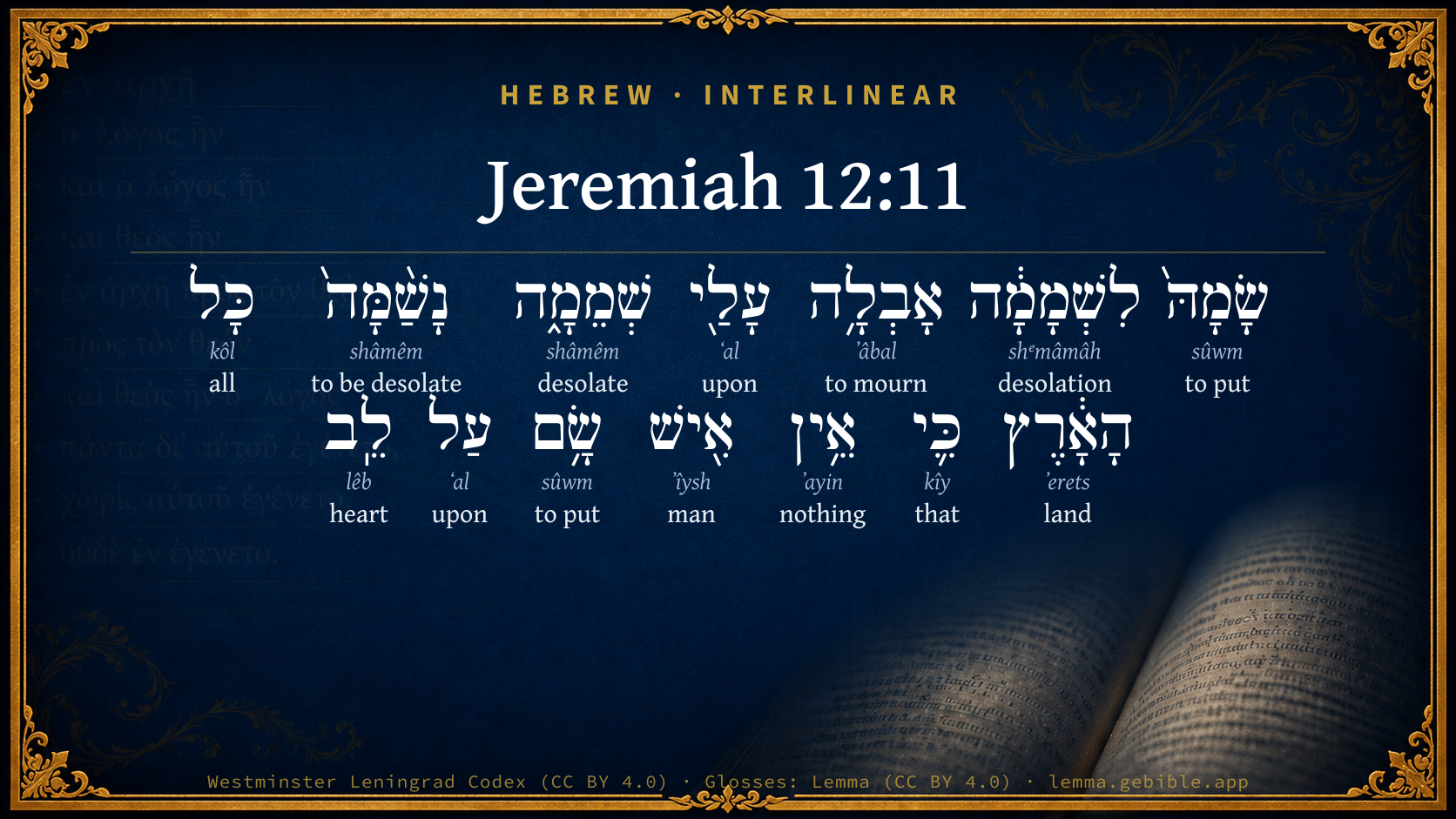
Hebrew (Westminster Leningrad Codex) Jeremiah 12:11 appears in the Hebrew Old Testament. The text above is from the Westminster Leningrad Codex. Each word links to its Strong’s number, a concise gloss, and parsing drawn from the Open Scriptures Hebrew Bible morphology. Click any word for its full Brown-Driver-Briggs (BDB) entry.
Download image
Cite this verse

Jeremiah 12:11 (World English Bible). Public Domain. Lemma interlinear Bible study tool, https://lemma.gebible.app/v/jeremiah/12/11.

Show BibTeX & RIS
BibTeX
RIS
English Translation
They have made it a desolation; it mourns to me, being desolate; the whole land is made desolate, because no man lays it to heart.
World English Bible · Public Domain
Download a study sheet

One document with this verse’s original text, its word-by-word gloss line, the meaning frame, cross-references with their text, attributed commentary, and full source and license credits — printable, and it pastes into notes with its structure intact.

This verse Autodidact and up

Study sheet (.html) Plain text (.txt)

A passage Seminary Student

Up to 50 verses in one chapter. A passage sheet keeps up to 6 commentary sources and 12 cross-references per verse, in the order this page ranks them, and says so on the sheet whenever that leaves anything out. Ask for a single verse and you get the Autodidact verse sheet above.

Everything on this page stays free to read, with no account — the sheet is a download of what is already on screen, not access to it.

Want to remove ads? Support Godless Engineer
Compare translations 3

The same verse in 3 English versions, stacked beneath the original-language interlinear above. Click any original word for its lexicon entry.

Each is an independent rendering of the whole verse — the interlinear is not word-aligned to these translations.

Highlighted words mark where these versions differ — a whole-verse word diff, not a word-by-word alignment.

  • World English Bible Public Domain
    They have made it a desolation; it mourns to me, being desolate; the whole land is made desolate, because no man lays it to heart.
  • King James Version Public Domain
    They have made it desolate, and being desolate it mourneth unto me; the whole land is made desolate, because no man layeth it to heart.
  • unfoldingWord Literal Text CC BY-SA 4.0
    He has made it a desolation, she mourns to me; desolate she is made desolate, all the land, because no man lays to heart.

unfoldingWord Literal Text — © unfoldingWord, licensed CC BY-SA 4.0. Word-aligned USFM3 via Door43 (git.door43.org/unfoldingWord/en_ult).

Versions to compare (up to 4)

3 of 4 selected

Show all 18 translations

Every available English version of this verse, each an independent rendering of the whole verse.

  • World English Bible Public Domain
    They have made it a desolation; it mourns to me, being desolate; the whole land is made desolate, because no man lays it to heart.
  • Berean Standard Bible Public Domain
    They have made it a desolation; desolate before Me, it mourns. All the land is laid waste, but no man takes it to heart.
  • Majority Standard Bible Public Domain
    They have made it a desolation; desolate before Me, it mourns. All the land is laid waste, but no man takes it to heart.
  • King James Version Public Domain
    They have made it desolate, and being desolate it mourneth unto me; the whole land is made desolate, because no man layeth it to heart.
  • American Standard Version (1901) Public Domain
    They have made it a desolation; it mourneth unto me, being desolate; the whole land is made desolate, because no man layeth it to heart.
  • Revised Version (1885) Public Domain
    They have made it a desolation; it mourneth unto me, being desolate; the whole land is made desolate, because no man layeth it to heart.
  • Geneva Bible (1599) Public Domain
    They haue layde it waste, and it, being waste, mourneth vnto me: and the whole lande lyeth waste, because no man setteth his minde on it.
  • Douay-Rheims (1899) Public Domain
    They have laid it waste, and it hath mourned for me. With desolation is all the land made desolate; because there is none that considereth in the heart.
  • Young's Literal Translation Public Domain
    He hath made it become a desolation, The desolation hath mourned unto Me, Desolated hath been all the land, But there is no one laying it to heart.
  • Literal Standard Version CC BY-SA 4.0
    He has made it become a desolation, || The desolation has mourned to Me, || All the land has been desolated, || But there is no one laying it to heart.
  • Unlocked Literal Bible CC BY-SA 4.0
    They have made her a desolation. I mourn for her; she is desolate. All the land has been made desolate, for there is no one who takes it to heart.
  • unfoldingWord Literal Text CC BY-SA 4.0
    He has made it a desolation, she mourns to me; desolate she is made desolate, all the land, because no man lays to heart.
  • Darby Bible Public Domain
    they have made it a desolation; desolate, it mourneth unto me: the whole land is made desolate, for no man layeth it to heart.
  • World Messianic Bible Public Domain
    They have made it a desolation. It mourns to me, being desolate. The whole land is made desolate, because no one cares.
  • Webster's Bible Public Domain
    They have made it desolate, and being desolate it mourneth to me; the whole land is made desolate, because no man layeth it to heart.
  • Free Bible Version CC BY-SA 4.0
    They have made it into a desert; it mourns before me, lying desolate. The whole country is a wasteland, but no one cares.
  • Bible in Basic English Public Domain
    They have made it waste; it is weeping to me, being wasted; all the land is made waste, because no man takes it to heart.
  • JPS Tanakh (1917) Public Domain
    They have made it a desolation, it mourneth unto Me, being desolate; the whole land is made desolate, because no man layeth it to heart.

Literal Standard Version (2020), Covenant Press — licensed CC BY-SA 4.0. Text via the HelloAO Bible API (eBible.org). Unlocked Literal Bible (unfoldingWord) — licensed CC BY-SA 4.0. Text via the HelloAO Bible API (eBible.org). unfoldingWord Literal Text — © unfoldingWord, licensed CC BY-SA 4.0. Word-aligned USFM3 via Door43 (git.door43.org/unfoldingWord/en_ult). Free Bible Version, Dr. Jonathan Gallagher — licensed CC BY-SA 4.0. Text via the HelloAO Bible API (eBible.org).

Word by word

More ways to search: Search by grammar → Find every occurrence → Compare this word →

Practice this passage: Drill this verse → Learn its vocabulary →

שְׁמֵמָ֑ה
shâmêm
H8076
“desolate”
Adjective, Adjective, Feminine, Singular, Absolute
Part of Speech
Adjective
Type
Adjective
Gender
Feminine
Number
Singular
State
Absolute
Full BDB Definition

Origin: from H8074

TWOT: 2409a

devastated, deserted, desolate
  1. שָׂמָהּ֙ sûwm H7760 “to put · her” Verb, Qal, Perfect, 3rd Person, Masculine, Singular + Suffix, Personal, 3rd Person, Feminine, Singular
  2. לִשְׁמָמָ֔ה shᵉmâmâh H8077 “to/for · desolation” Preposition + Noun, Common, Feminine, Singular, Absolute
  3. אָבְלָ֥ה ʼâbal H56 “to mourn” Verb, Qal, Perfect, 3rd Person, Feminine, Singular
  4. עָלַ֖י ʻal H5921 “upon · me” Preposition + Suffix, Personal, 1st Person, Common, Singular
  5. נָשַׁ֨מָּה֙ shâmêm H8074 “to be desolate” Verb, Niphal, Perfect, 3rd Person, Feminine, Singular
  6. כָּל kôl H3605 “all of” Noun, Common, Masculine, Singular, Construct
  7. הָאָ֔רֶץ ʼerets H776 “the · land” Particle, Definite Article + Noun, Common, Both, Singular, Absolute
  8. כִּ֛י kîy H3588 “that” Conjunction
  9. אֵ֥ין ʼayin H369 “nothing” Particle, Negative
  10. אִ֖ישׁ ʼîysh H376 “man” Noun, Common, Masculine, Singular, Absolute
  11. שָׂ֥ם sûwm H7760 “putting” Verb, Qal, Participle Active, Masculine, Singular, Absolute
  12. עַל ʻal H5921 “upon” Preposition
  13. לֵֽב lêb H3820 “heart” Noun, Common, Masculine, Singular, Absolute

About this verse

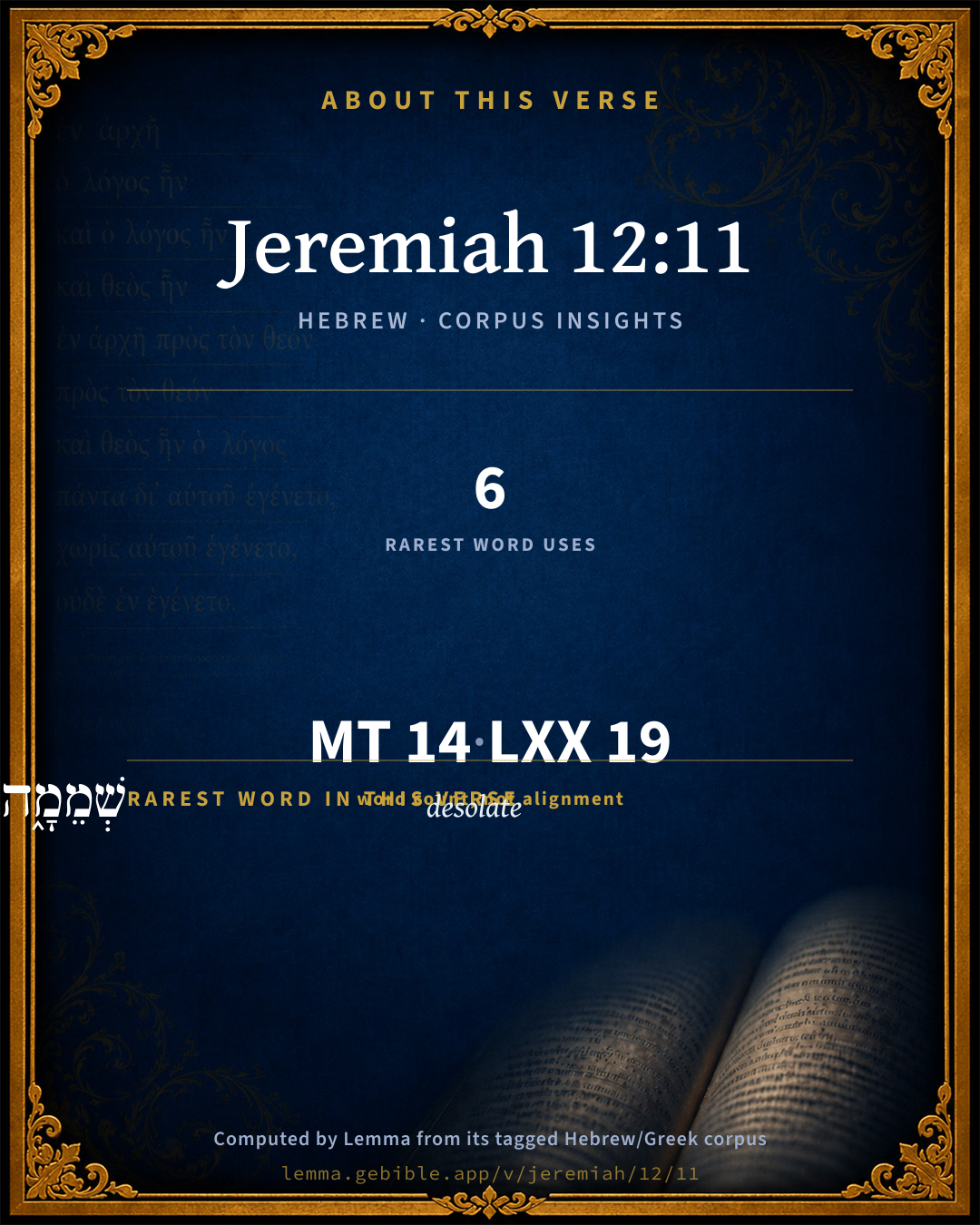
These counts appear in no published source. They are computed here, from the morphology-tagged text and Lemma’s own curated glosses. What Lemma adds →

14
words
12
distinct lemmas
Prophets
section

Notable vocabulary

The rarest word here is שְׁמֵמָ֑ה desolate H8076 — appearing just 6 times in the whole Hebrew Bible.

Shared distinctive vocabulary

שְׁמֵמָ֑ה desolate H8076 occurs in 6 verses of the Hebrew Bible. Also found in:

Grammatical profile

  • 4 verbs
  • 5 nouns
  • 1 adjective
  • 2 prepositions
  • 1 conjunction
  • 1 particle

Verb forms

  • שָׂמָהּ֙ Qal · Perfect
  • אָבְלָ֥ה Qal · Perfect
  • נָשַׁ֨מָּה֙ Niphal · Perfect
  • שָׂ֥ם Qal · Participle Active

Repetition

Words recur within this verse — often emphatic in Hebrew:

  • שָׂמָהּ֙ to put H7760 ×2
  • עָלַ֖י upon H5921 ×2

Hebrew & Septuagint length

In the original languages it is 14 Hebrew tokens and 19 Greek tokens — but the two are counted differently (Hebrew bundles its prefixes and suffixes into one token; the Greek is in lemma form), so that isn’t a like-for-like length.

Cross-references

14

Topical passages linked to Jeremiah 12:11 in the Treasury of Scripture Knowledge — connected by theme and wording, ordered by reader-vote popularity; previews shown in the World English Bible.

  • Isaiah 42:25 Therefore he poured on him the fierceness of his anger, and the strength of battle; and it set him on fire round about, yet he didn't know; and it burned him, yet he didn't lay it to heart.
  • Jeremiah 23:10 For the land is full of adulterers; for because of swearing the land mourns; the pastures of the wilderness are dried up. Their course is evil, and their might is not right;
  • Jeremiah 14:2 Judah mourns, and the gates of it languish, they sit in black on the ground; and the cry of Jerusalem is gone up.
  • Ecclesiastes 7:2 It is better to go to the house of mourning than to go to the house of feasting: for that is the end of all men, and the living should take this to heart.
  • Isaiah 57:1 The righteous perishes, and no man lays it to heart; and merciful men are taken away, none considering that the righteous is taken away from the evil [to come].
  • Jeremiah 6:8 Be instructed, Jerusalem, lest my soul be alienated from you; lest I make you a desolation, a land not inhabited.
  • Jeremiah 9:11 I will make Jerusalem heaps, a dwelling-place of jackals; and I will make the cities of Judah a desolation, without inhabitant.
  • Jeremiah 10:22 The voice of news, behold, it comes, and a great commotion out of the north country, to make the cities of Judah a desolation, a dwelling-place of jackals.
  • Jeremiah 10:25 Pour out your wrath on the nations that don't know you, and on the families that don't call on your name: for they have devoured Jacob, yes, they have devoured him and consumed him, and have laid waste his habitation.
  • Jeremiah 12:4–8 How long shall the land mourn, and the herbs of the whole country wither? for the wickedness of those who dwell therein, the animals are consumed, and the birds; because they said, He shall not see our latter end.
  • Jeremiah 19:8 I will make this city an astonishment, and a hissing; everyone who passes thereby shall be astonished and hiss because of all the plagues of it.
  • Lamentations 1:1–5 How does the city sit solitary, that was full of people! She has become as a widow, who was great among the nations! She who was a princess among the provinces is become tributary!
  • Zechariah 7:5 "Speak to all the people of the land, and to the priests, saying, 'When you fasted and mourned in the fifth and in the seventh month for these seventy years, did you at all fast to me, really to me?
  • Malachi 2:2 If you will not listen, and if you will not lay it to heart, to give glory to my name," says Yahweh of Hosts, "then will I send the curse on you, and I will curse your blessings. Indeed, I have cursed them already, because you do not lay it to heart.

Cross-references courtesy of OpenBible.info (CC BY 4.0).

Hebrew and Greek witnesses Masoretic Hebrew ↔ Greek Septuagint

The same verse in the two great witnesses to the Old Testament, shown verse-for-verse.

These are two independent witnesses, not word-aligned to each other, and the Septuagint is shown in lemma (dictionary) form.

Hebrew Jeremiah 12:11 Masoretic · Westminster Leningrad Codex

שָׂמָהּ֙ לִשְׁמָמָ֔ה אָבְלָ֥ה עָלַ֖י שְׁמֵמָ֑ה נָשַׁ֨מָּה֙ כָּל הָאָ֔רֶץ כִּ֛י אֵ֥ין אִ֖ישׁ שָׂ֥ם עַל לֵֽב

They have made it a desolation; it mourns to me, being desolate; the whole land is made desolate, because no man lays it to heart.

World English Bible · Public Domain

Greek LXX Structure differs

In the Septuagint, Jeremiah is about an eighth shorter than the Hebrew and arranges its material differently — the Oracles Against the Nations (Hebrew chapters 46–51) appear in the middle of the Greek book, after 25:13. Because the chapter and verse boundaries do not line up, a verse-for-verse comparison with the Hebrew is not shown.

A verse-for-verse comparison isn’t shown here because the chapters and verses don’t line up. Switch to the LXX edition with the MT / LXX toggle above to read the Greek directly.

Hebrew: Westminster Leningrad Codex (CC BY 4.0). Greek: Septuagint (public domain); English from a public-domain English Septuagint. How the Septuagint differs from the Hebrew →

Targum (Aramaic paraphrase)

1

The Targum is the ancient Jewish Aramaic paraphrase of the Hebrew Scriptures — an interpretive translation, not the Hebrew text itself. Onkelos (literal) and Pseudo-Jonathan (expansive) render the Torah, and Jonathan the Prophets. Coverage is partial: where no permissively-licensed English translation exists for a verse, only the Aramaic is shown. This is verse-level text, not a word-by-word alignment to the Hebrew.

  1. Targum Jonathan Prophets (Joshua–Malachi)
    שַׁוְיוּהָא לְצָדוּ אִתְאַבְּלַת קֳדָמַי חֲרוֹבַת צְדִיאַת כָּל אַרְעָא אֲרֵי לֵית אֱנַשׁ דִמְשַׁוֵי דְחַלְתִּי עַל לִבָּא:

    (no public-domain English translation for this verse)

    Targum Jonathan — Aramaic: “Mikraot Gedolot” (public domain). English: “Sefaria Community Translation” (CC0 1.0 (public-domain dedication)); “London "Chaldee Paraphrase," 1871” (public domain). Text via Sefaria.

Commentary

Notes on Jeremiah 12:11 from classic Christian and Jewish commentators (each source and its license shown beneath its notes). The classic Christian expositions comment on the surrounding passage and are grouped to its opening verse, so a note may address several verses; the Jewish commentaries on the Tanakh (Rashi and others) are per-verse, so they appear only where the commentator wrote on this verse.

Lemma curates 59 commentaries, every one of them public domain or Creative Commons licensed, each selected and text-cleaned for this edition rather than reprinted as found. About our sources →

Trapp's Complete Commentary

John Trapp

Jer 12:11 They have made it desolate, [and being] desolate it mourneth unto me; the whole land is made desolate, because no man layeth [it] to heart.

Ver. 11. Because no man layeth it to heart.] Heb., There is not a man putting it upon heart, that is, duly and deeply affected with my menaces, so as to take a timely course for prevention, and their own preservation.

John Trapp, A Commentary or Exposition upon All the Books of the Old and New Testament (1647–1656) — public domain. Text from a community e-Sword module.

Tyndale Open Study Notes

Tyndale Open Resources

12:11 Sorrow gripped the Lord as he saw the empty wasteland. He had ordered the invasion according to the terms of the Sinai covenant, but the act gave him no satisfaction. Sadly, no one other than God even cared.

Tyndale Open Study Notes — © Tyndale Open Resources, licensed CC BY-SA 4.0. Text via the HelloAO Bible API.

Geneva Bible (1599)

Geneva Bible translators

Because no man regardeth my word, or the plagues that I have sent upon the land.

Geneva Bible (1599) marginal notes — public domain. Text via Bolls.life.

Jamieson, Fausset & Brown

Robert Jamieson, A. R. Fausset & David Brown

mourneth unto me--that is, before Me. EICHORN translates, "by reason of Me," because I have given it to desolation (Jer 12:7).

because no man layeth it to heart--because none by repentance and prayer seek to deprecate God's wrath. Or, "yet none lays it to heart"; as in Jer 5:3 [CALVIN].

Jamieson, Fausset & Brown — Commentary Critical and Explanatory on the Whole Bible (1871) — public domain (CC PDM 1.0). Text via the HelloAO Bible API.

Adam Clarke's Commentary

Verse 11. No man layeth it to heart.] Notwithstanding all these desolations, from which the land every where mourns, and which are so plainly the consequences of the people's crimes, no man layeth it to heart, or considereth that these are God's judgments; and that the only way to have them removed is to repent of their sins, and turn to God with all their hearts.

Adam Clarke's Commentary on the Bible (1810–1826) — public domain. Text from a community e-Sword/MySword module.

John Calvin's Commentaries

There is a change of number in the verb שם shem; but there is no obscurity: for the Prophet means, that the Jews would be exposed to the outrage of all, so that every one would plunder and lay waste the land. He does not then speak only of all their enemies or of the whole army; but he also declares that every one would be their master, so as to vex, scatter, devour, and wholly to destroy them at his pleasure: in short, he sets forth the atrocity of their punishment, — that the whole land would not only be spoiled by the united army, but also by every individual in it.

He then adds that the land was in mourning before him. The Prophet seems to me to touch here the torpor of his own nation, because there was no one who had any regard for God; nay, they laughed at the judgments which were nigh at hand, and of which he had often spoken. Hence God says, that they would at length come to him when calamities oppressed them and caused them to mourn. “As then in peaceable times,” he says, “they are unwining to come to me, but are so refractory and untameable, that I can effect nothing by so many warnings, they shall come,” he says, “but in another state of mind, even in extreme mourning.”

He afterwards adds, No one lays on the heart What this means we have elsewhere explained. But the particle כי, ki, which is properly a causative, may be here rendered as an adversative. If we take it in its first and most proper sense, then a reason is here given why the Jews would be brought to a most grievous mourning, even because they had despised all the prophets, and wholly disregarded as a fable what they had so often heard from God’s mouth: and this is the view taken by most interpreters. But it may be also taken as an adversative, as in many other places, — “Though no one lays on the heart;” and thus it will be a complaint as to their perverse stupor, inasmuch as, when smitten by God’s hand, they did not perceive that they were punished for their sins, not that they were wholly insensible as to their evils. But what avails it to cry and to howl, as God’s Spirit speaks elsewhere, except, the hand of the smiter be perceived? The Jews then ought, had a spark of wisdom been in them, to have considered their sins, to have prayed for forgiveness, and to have repented, and also to have embraced the favor promised to them. But when they perversely added sins to sins, God justly expostulated with them, because they did not attend to the signs of his wrath, by which they ought not only to have been taught, but also subdued. It follows —

John Calvin's Commentaries (1540-1563) — public domain. Text from the Calvin Translation Society English edition (1840s-50s) via the Christian Classics Ethereal Library (ccel.org). Calvin's coverage is partial (roughly two-thirds of the Bible); uncommented books and verses are honest gaps, never fabricated. The 19th-century editor's footnotes and remarks are omitted so the notes are faithfully Calvin's own voice.

Ellicott's Commentary for English Readers

(11) They have made it desolate.—The Hebrew is impersonal. “One has made it . . . ,” i.e., it is made desolate. As in other poetry of strong emotion, the prophet dwells with a strange solemn iteration on the same sound—“desolate,” “desolate,” “desolate”—thrice in the same breath. The Hebrew word shemâma, so uttered, must have sounded like a wail of lamentation.

Because no man layeth it to heart.—Better, no man laid it . . . The neglect of the past was bearing fruit in the misery of the present.

A Bible Commentary for English Readers, edited by Charles John Ellicott (1878–1897) — public domain. Text from a community e-Sword module.

The Cambridge Bible for Schools and Colleges

gen. ed. J. J. S. Perowne

11. unto me] lit. upon me, i.e. to my sorrow. Dr. quotes the parallel in Gen_48:7.

layeth it to heart] i.e. has taken warning in time.

The Cambridge Bible for Schools and Colleges (gen. ed. J. J. S. Perowne; Cambridge University Press, 1878–1918) — public domain. Text from a community e-Sword module.

John Gill's Exposition

They have made it desolate,.... Which is repeated to denote the certainty of it; astonishment at it, and that it might be observed:

and being desolate it mourneth unto me; not the inhabitants of it for their sins, the cause of this desolation; but the land itself, because of the calamities upon it; it crying to God, in its way, for a restoration to its former beauty and glory.

The whole land is made desolate; it was not only the case of Jerusalem, and the parts adjacent, but even of the whole land of Judea:

because no man layeth it to heart, took any notice of the judgment threatened, foretold by the prophets; nor repented of their sins, for which they were threatened with such a desolation; nor even were properly affected with the destruction itself; the earth seemed more sensible of it than they were; this expresses the great stupidity of this people.

John Gill's Exposition of the Whole Bible (1746–1763) — public domain (CC PDM 1.0). Text via the HelloAO Bible API.

Albert Barnes' Notes on the Bible

Desolate - The force of the protest lies in this word. Thrice the prophet uses it.

Layeth it to heart - Rather, laid it “to heart.” The desolate land must put up its silent cry to God, because the people had refused to see the signs of the coming retribution.

Albert Barnes' Notes on the Bible (1834–1885) — public domain. Text from a community e-Sword/MySword module.

Haydock's Catholic Bible Commentary

Heart, to seek God and the cause of their misfortunes.

George Leo Haydock (1774–1849), Haydock's Catholic Family Bible and Commentary, 1859 edition — public domain. Excludes Psalms (Douay-Rheims chapter numbering differs from Protestant) and Deuterocanonical books (Catholic canon only).

Matthew Poole's English Annotations

They have made it desolate, Heb. He hath made it desolate; but it cannot be meant of God, for it is God that speaketh, and God is he mentioned in the next words: it must therefore either be understood of Nebuchadnezzar, the instrumental cause; or (one number being put for another) of the people or the rulers as the meritorious cause; and in that rueful state into which their sins had brought it it cried unto God. And one great cause of this sore judgment upon the land; as the people’s not laying to heart, not seriously considering, what God had done or was doing against it.

Matthew Poole's English Annotations on the Holy Bible (1683–1685) — public domain. Text from a community e-Sword/MySword module.

Whedon's Commentary on the Bible

Daniel D. Whedon

11. The rhetorical effect of the previous verse is heightened and intensified in this. They have made it desolate… desolate it mourneth unto me… desolate is the whole land, for no one layeth it to heart.

Daniel D. Whedon (gen. ed.), Commentary on the Old and New Testaments (1874–1909) — public domain. Text from a community e-Sword module.

The Pulpit Commentary

Layeth it to heart; rather, laid it to heart. Inconsiderateness is repeatedly spoken of as an aggravation of the moral sickness of Israel. (Isa_42:25 Isa_57:1, Isa_57:11)

The Pulpit Commentary (1880–1919), ed. H.D.M. Spence-Jones & Joseph S. Exell — public domain. Text from a community e-Sword module.

John Wesley's Explanatory Notes

They - Hebrew. He hath made it desolate: but it cannot be meant of God, for it is God that speaketh, and God is he mentioned in the next words; it must therefore either be understood of Nebuchadnezzar, the instrumental cause; or (one number being put for another) of the people or the rulers as the meritorious cause, and in that rueful state into which their sins had brought it, it cried onto God. Because - And one great cause of this sore judgment was, the peoples not seriously considering what God had done or was doing against it.

John Wesley, Explanatory Notes Upon the Whole Bible (1754–1765) — public domain. Text via the GEBible commentary corpus.

Rashi

Rabbi Shlomo Yitzchaki (Rashi)

the wasted one mourns before Me Heb. עלי, lit. on Me.

Rashi on the Tanakh — English translations: “The Judaica Press complete Tanach with Rashi, translated by A. J. Rosenberg” (CC BY 4.0); “Pentateuch with Rashi's commentary by M. Rosenbaum and A.M. Silbermann, 1929-1934” (public domain); “The Metsudah Tanach series, Lakewood, N.J” (CC BY 4.0); and “The Book of Joshua, Metsudah Publications, 1997” (CC BY 4.0). Text via Sefaria.

Lesson kit

Teaching starters — assembled from the data on this page, not authored interpretation. Every prompt links to the verse data it draws on. Edit before teaching.

Jeremiah, in the Prophets, opens this verse with 14 words (12 distinct Hebrew lemmas). Its most distinctive word is shâmêm (“desolate”). A historical commentator’s framing appears above. Read the whole chapter for the surrounding context.

Discussion questions

  1. The word shâmêm carries the sense “desolate.” How does it shape the verse?
  2. 2 Samuel 13:20 shares the word «desolate» with this verse. How do the two illuminate each other?
  3. “to put” occurs 2× in this one verse. What is the effect of the repetition?
  4. These translations render this verse differently. What is at stake in choosing one wording over another?
  5. The verb «שָׂמָהּ֙» is Qal Perfect. How does its form color the action?
  6. Reading how Trapp's Complete Commentary and Tyndale Open Study Notes read this verse, where do the two commentators agree and where do they part?

Things to notice

Reading settings

Reading text

Shown beneath each verse's original-language words.

Old Testament
Old Testament edition

Read the OT as the Masoretic Hebrew (MT) or the Greek Septuagint (LXX).

English shown for the Greek Septuagint (in the Hebrew ↔ Greek comparison).

Comparing translations? Open the Compare panel on any verse page to stack up to four side by side.