Ezekiel 27:35

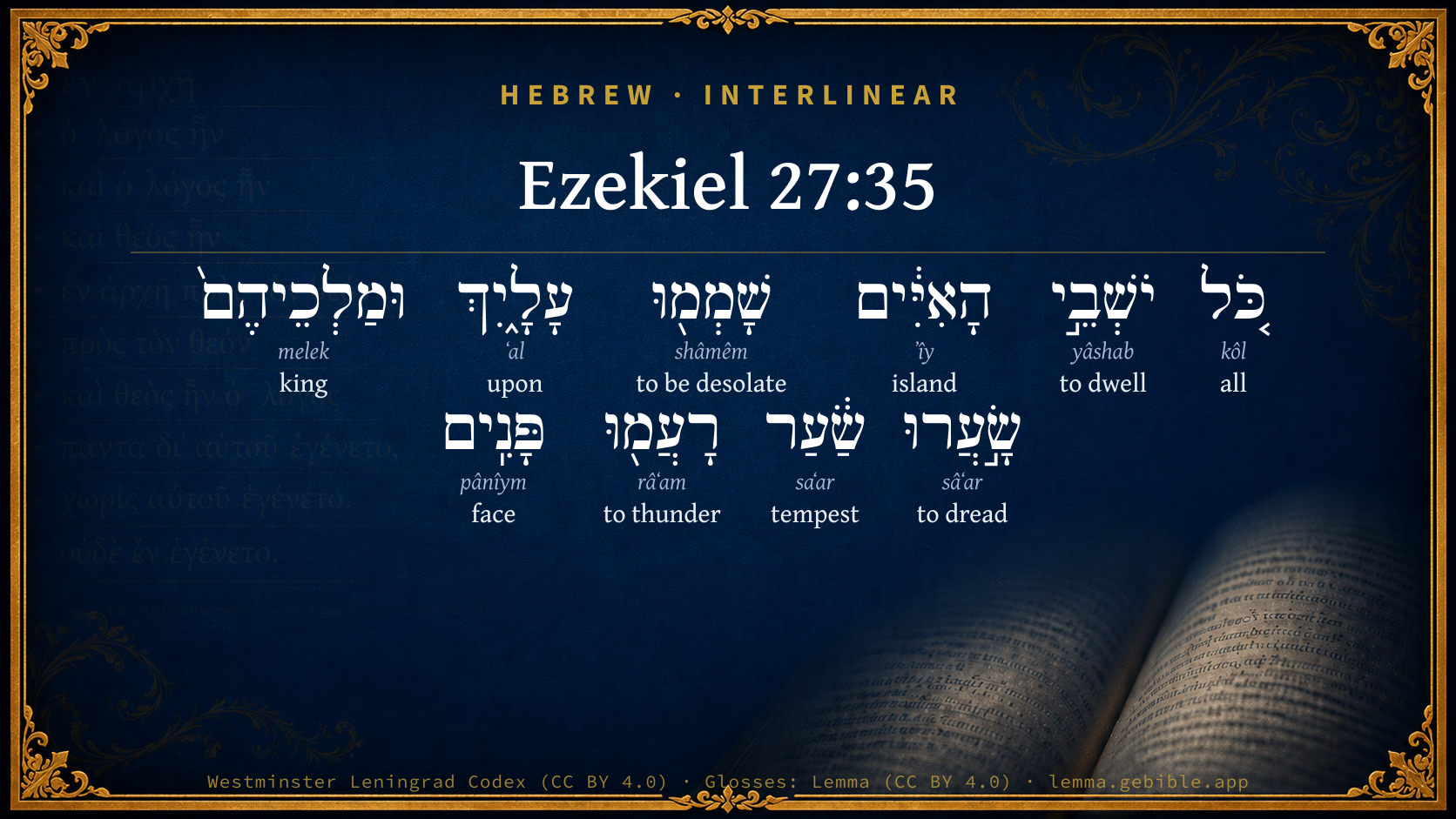
Hebrew (Westminster Leningrad Codex) Ezekiel 27:35 appears in the Hebrew Old Testament. The text above is from the Westminster Leningrad Codex. Each word links to its Strong’s number, a concise gloss, and parsing drawn from the Open Scriptures Hebrew Bible morphology. Click any word for its full Brown-Driver-Briggs (BDB) entry.
Download image
Cite this verse

Ezekiel 27:35 (World English Bible). Public Domain. Lemma interlinear Bible study tool, https://lemma.gebible.app/v/ezekiel/27/35.

Show BibTeX & RIS
BibTeX
RIS
English Translation
All the inhabitants of the isles are astonished at you, and their kings are horribly afraid; they are troubled in their face.
World English Bible · Public Domain
Download a study sheet

One document with this verse’s original text, its word-by-word gloss line, the meaning frame, cross-references with their text, attributed commentary, and full source and license credits — printable, and it pastes into notes with its structure intact.

This verse Autodidact and up

Study sheet (.html) Plain text (.txt)

A passage Seminary Student

Up to 50 verses in one chapter. A passage sheet keeps up to 6 commentary sources and 12 cross-references per verse, in the order this page ranks them, and says so on the sheet whenever that leaves anything out. Ask for a single verse and you get the Autodidact verse sheet above.

Everything on this page stays free to read, with no account — the sheet is a download of what is already on screen, not access to it.

Want to remove ads? Support Godless Engineer
Compare translations 3

The same verse in 3 English versions, stacked beneath the original-language interlinear above. Click any original word for its lexicon entry.

Each is an independent rendering of the whole verse — the interlinear is not word-aligned to these translations.

Highlighted words mark where these versions differ — a whole-verse word diff, not a word-by-word alignment.

  • World English Bible Public Domain
    All the inhabitants of the isles are astonished at you, and their kings are horribly afraid; they are troubled in their face.
  • King James Version Public Domain
    All the inhabitants of the isles shall be astonished at thee, and their kings shall be sore afraid, they shall be troubled in their countenance.
  • unfoldingWord Literal Text CC BY-SA 4.0
    All the inhabitants of the coasts were appalled at you, and their kings shuddered in horror! Their faces trembled!

unfoldingWord Literal Text — © unfoldingWord, licensed CC BY-SA 4.0. Word-aligned USFM3 via Door43 (git.door43.org/unfoldingWord/en_ult).

Versions to compare (up to 4)

3 of 4 selected

Show all 18 translations

Every available English version of this verse, each an independent rendering of the whole verse.

  • World English Bible Public Domain
    All the inhabitants of the isles are astonished at you, and their kings are horribly afraid; they are troubled in their face.
  • Berean Standard Bible Public Domain
    All the people of the coastlands are appalled over you. Their kings shudder with fear; their faces are contorted.
  • Majority Standard Bible Public Domain
    All the people of the coastlands are appalled over you. Their kings shudder with fear; their faces are contorted.
  • King James Version Public Domain
    All the inhabitants of the isles shall be astonished at thee, and their kings shall be sore afraid, they shall be troubled in their countenance.
  • American Standard Version (1901) Public Domain
    All the inhabitants of the isles are astonished at thee, and their kings are horribly afraid; they are troubled in their countenance.
  • Revised Version (1885) Public Domain
    All the inhabitants of the isles are astonished at thee, and their kings are horribly afraid, they are troubled in their countenance.
  • Geneva Bible (1599) Public Domain
    All the inhabitantes of the yles shall be astonished at thee, and all their Kings shall be sore afraide and troubled in their countenance.
  • Douay-Rheims (1899) Public Domain
    All the inhabitants of the islands are astonished at thee: and all their kings being struck with the storm have changed their countenance.
  • Young's Literal Translation Public Domain
    All inhabitants of the isles have been astonished at thee, And their kings have been sore afraid, They have been troubled in countenance.
  • Literal Standard Version CC BY-SA 4.0
    All inhabitants of the islands have been astonished at you, || And their kings have been severely afraid, || They have been troubled in countenance.
  • Unlocked Literal Bible CC BY-SA 4.0
    All the inhabitants of the coasts were appalled at you, and their kings shuddered in horror! Their faces trembled!
  • unfoldingWord Literal Text CC BY-SA 4.0
    All the inhabitants of the coasts were appalled at you, and their kings shuddered in horror! Their faces trembled!
  • Darby Bible Public Domain
    All the inhabitants of the isles are amazed at thee, and their kings are horribly afraid, [their] countenance is troubled.
  • World Messianic Bible Public Domain
    All the inhabitants of the islands are astonished at you, and their kings are horribly afraid. They are troubled in their face.
  • Webster's Bible Public Domain
    All the inhabitants of the isles shall be astonished at thee, and their kings shall be terribly afraid, they shall be troubled in their countenance.
  • Free Bible Version CC BY-SA 4.0
    Everyone living on the coastlands is shocked at what happened to you. Their kings are horrified; their faces twisted with fear.
  • Bible in Basic English Public Domain
    All the people of the sea-lands are overcome with wonder at you, and their kings are full of fear, their faces are troubled.
  • JPS Tanakh (1917) Public Domain
    All the inhabitants of the isles are appalled at thee, and their kings are horribly afraid, they are troubled in their countenance;

Literal Standard Version (2020), Covenant Press — licensed CC BY-SA 4.0. Text via the HelloAO Bible API (eBible.org). Unlocked Literal Bible (unfoldingWord) — licensed CC BY-SA 4.0. Text via the HelloAO Bible API (eBible.org). unfoldingWord Literal Text — © unfoldingWord, licensed CC BY-SA 4.0. Word-aligned USFM3 via Door43 (git.door43.org/unfoldingWord/en_ult). Free Bible Version, Dr. Jonathan Gallagher — licensed CC BY-SA 4.0. Text via the HelloAO Bible API (eBible.org).

Word by word

More ways to search: Search by grammar → Find every occurrence → Compare this word →

Practice this passage: Drill this verse → Learn its vocabulary →

שַׂ֔עַר
saʻar
H8178
“tempest”
Noun, Common, Masculine, Singular, Absolute
Part of Speech
Noun
Type
Common
Gender
Masculine
Number
Singular
State
Absolute
Full BDB Definition

Origin: from H8175

TWOT: 2275a

storm, tempest, terror, horror
  1. כֹּ֚ל kôl H3605 “all of” Noun, Common, Masculine, Singular, Construct
  2. יֹשְׁבֵ֣י yâshab H3427 “dwelling” Verb, Qal, Participle Active, Masculine, Plural, Construct
  3. הָאִיִּ֔ים ʼîy H339 “the · islands” Particle, Definite Article + Noun, Common, Masculine, Plural, Absolute
  4. שָׁמְמ֖וּ shâmêm H8074 “to be desolate” Verb, Qal, Perfect, 3rd Person, Common, Plural
  5. עָלָ֑יִךְ ʻal H5921 “upon · you” Preposition + Suffix, Personal, 2nd Person, Feminine, Singular
  6. וּמַלְכֵיהֶם֙ melek H4428 “and · kings · their” Conjunction + Noun, Common, Masculine, Plural, Construct + Suffix, Personal, 3rd Person, Masculine, Plural
  7. שָׂ֣עֲרוּ sâʻar H8175 “to dread” Verb, Qal, Perfect, 3rd Person, Common, Plural
  8. רָעֲמ֖וּ râʻam H7481 “to thunder” Verb, Qal, Perfect, 3rd Person, Common, Plural
  9. פָּנִֽים pânîym H6440 “face(s)” Noun, Common, Both, Plural, Absolute

About this verse

These counts appear in no published source. They are computed here, from the morphology-tagged text and Lemma’s own curated glosses. What Lemma adds →

10
words
10
distinct lemmas
Prophets
section

Notable vocabulary

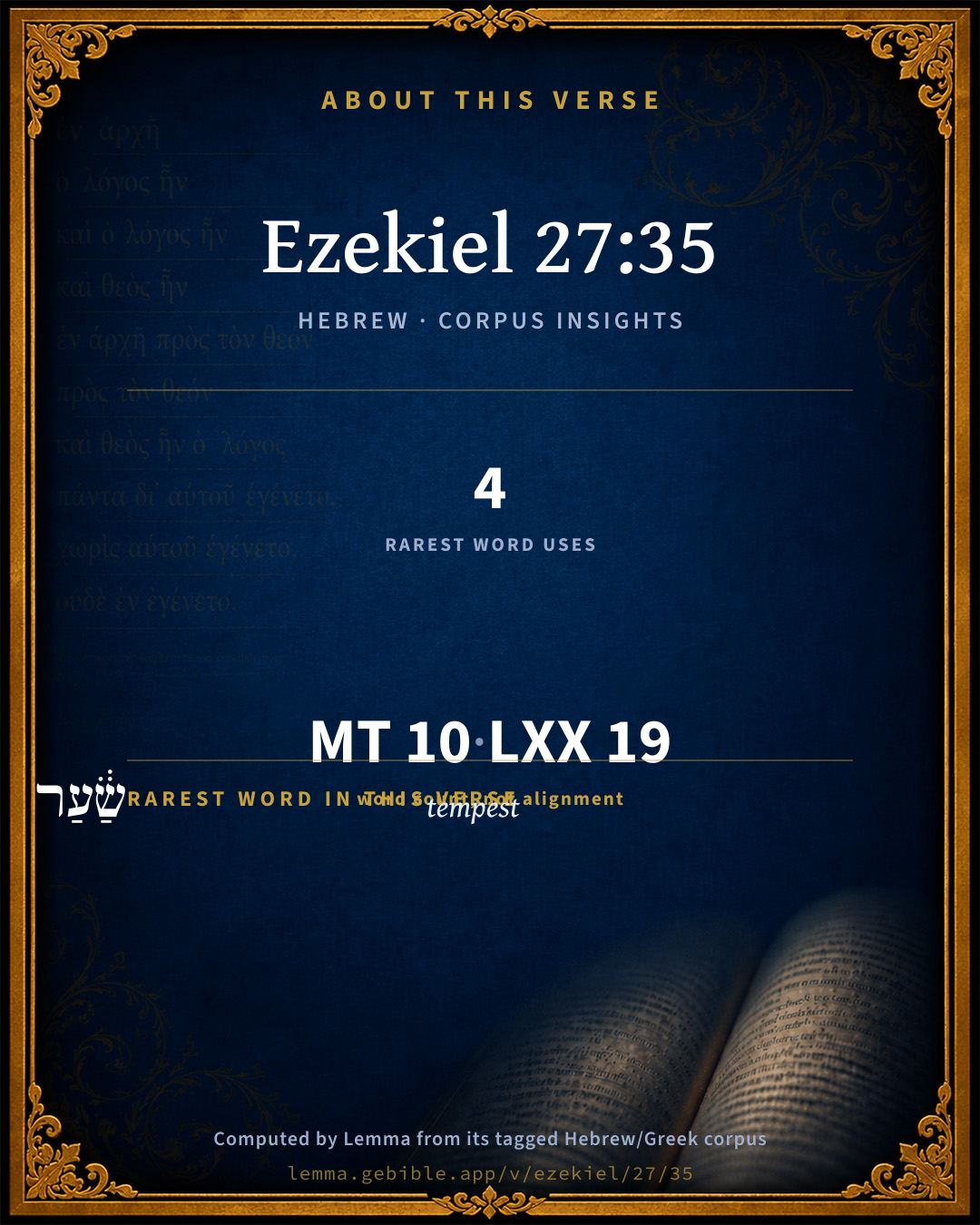
The rarest word here is שַׂ֔עַר tempest H8178 — appearing just 4 times in the whole Hebrew Bible.

Shared distinctive vocabulary

שַׂ֔עַר tempest H8178 occurs in 4 verses of the Hebrew Bible. Also found in:

Grammatical profile

  • 4 verbs
  • 5 nouns
  • 1 preposition

Verb forms

  • יֹשְׁבֵ֣י Qal · Participle Active
  • שָׁמְמ֖וּ Qal · Perfect
  • שָׂ֣עֲרוּ Qal · Perfect
  • רָעֲמ֖וּ Qal · Perfect

Hebrew & Septuagint length

In English translation the verse runs 22 words from the Hebrew and 22 from the Septuagint (LXX English) — the same length.

A rough comparison of the two English renderings, which tokenize alike — not a word-level alignment.

Word counts can differ between the Hebrew and the Greek without any difference in meaning — e.g. the Hebrew direct-object marker אֵת has no separate Greek word, and Greek often adds the article ὁ.

In the original languages it is 10 Hebrew tokens and 19 Greek tokens — but the two are counted differently (Hebrew bundles its prefixes and suffixes into one token; the Greek is in lemma form), so that isn’t a like-for-like length.

Cross-references

5

Topical passages linked to Ezekiel 27:35 in the Treasury of Scripture Knowledge — connected by theme and wording, ordered by reader-vote popularity; previews shown in the World English Bible.

  • Isaiah 23:6 Pass over to Tarshish; wail, you inhabitants of the coast.
  • Ezekiel 32:10 Yes, I will make many peoples amazed at you, and their kings shall be horribly afraid for you, when I shall brandish my sword before them; and they shall tremble at every moment, every man for his own life, in the day of your fall.
  • Ezekiel 26:15–18 Thus says the Lord Yahweh to Tyre: shall not the isles shake at the sound of your fall, when the wounded groan, when the slaughter is made in the midst of you?
  • Ezekiel 28:17–19 Your heart was lifted up because of your beauty; you have corrupted your wisdom by reason of your brightness: I have cast you to the ground; I have laid you before kings, that they may see you.
  • Revelation 18:9–10 The kings of the earth, who committed sexual immorality and lived wantonly with her, will weep and wail over her, when they look at the smoke of her burning,

Cross-references courtesy of OpenBible.info (CC BY 4.0).

Hebrew and Greek witnesses Masoretic Hebrew ↔ Greek Septuagint

The same verse in the two great witnesses to the Old Testament, shown verse-for-verse.

These are two independent witnesses, not word-aligned to each other, and the Septuagint is shown in lemma (dictionary) form.

Hebrew Ezekiel 27:35 Masoretic · Westminster Leningrad Codex

כֹּ֚ל יֹשְׁבֵ֣י הָאִיִּ֔ים שָׁמְמ֖וּ עָלָ֑יִךְ וּמַלְכֵיהֶם֙ שָׂ֣עֲרוּ שַׂ֔עַר רָעֲמ֖וּ פָּנִֽים

All the inhabitants of the isles are astonished at you, and their kings are horribly afraid; they are troubled in their face.

World English Bible · Public Domain

Greek LXX Ezekiel 27:35 Septuagint · lemma form

πᾶς ὁ καταοἰκέω ὁ νήσος στυγνάζω ἐπί σύ καί ὁ βασιλεύς αὐτός ἔκστασις ἐκἵστημι καί δακρύω ὁ πρόσωπον αὐτός

All the dwellers in the islands have mourned over you, and their kings have been utterly amazed, and their countenance has wept.

LXX2012 (modern English Septuagint) · Public Domain

Hebrew: Westminster Leningrad Codex (CC BY 4.0). Greek: Septuagint (public domain); English from LXX2012 (modern English Septuagint) (Public Domain). How the Septuagint differs from the Hebrew →

Targum (Aramaic paraphrase)

1

The Targum is the ancient Jewish Aramaic paraphrase of the Hebrew Scriptures — an interpretive translation, not the Hebrew text itself. Onkelos (literal) and Pseudo-Jonathan (expansive) render the Torah, and Jonathan the Prophets. Coverage is partial: where no permissively-licensed English translation exists for a verse, only the Aramaic is shown. This is verse-level text, not a word-by-word alignment to the Hebrew.

  1. Targum Jonathan Prophets (Joshua–Malachi)
    כָּל יַתְבֵי נַגְוָתָא צְדִיאוּ עֲלָךְ וּמַלְכֵיהוֹן זָעוּ זִיעַ אִתְרְשִׁימוּ אַפֵּיהוֹן:

    (no public-domain English translation for this verse)

    Targum Jonathan — Aramaic: “Mikraot Gedolot” (public domain). English: “Sefaria Community Translation” (CC0 1.0 (public-domain dedication)); “London "Chaldee Paraphrase," 1871” (public domain). Text via Sefaria.

Commentary

Notes on Ezekiel 27:35 from classic Christian and Jewish commentators (each source and its license shown beneath its notes). The classic Christian expositions comment on the surrounding passage and are grouped to its opening verse, so a note may address several verses; the Jewish commentaries on the Tanakh (Rashi and others) are per-verse, so they appear only where the commentator wrote on this verse.

Lemma curates 59 commentaries, every one of them public domain or Creative Commons licensed, each selected and text-cleaned for this edition rather than reprinted as found. About our sources →

Trapp's Complete Commentary

John Trapp

Eze 27:35 All the inhabitants of the isles shall be astonished at thee, and their kings shall be sore afraid, they shall be troubled in [their] countenance.

Ver. 35. They shall be troubled in their countenance,] i.e., Appalled and dispirited.

John Trapp, A Commentary or Exposition upon All the Books of the Old and New Testament (1647–1656) — public domain. Text from a community e-Sword module.

Jamieson, Fausset & Brown

Robert Jamieson, A. R. Fausset & David Brown

isles--seacoasts.

Jamieson, Fausset & Brown — Commentary Critical and Explanatory on the Whole Bible (1871) — public domain (CC PDM 1.0). Text via the HelloAO Bible API.

John Gill's Exposition

The merchants among the people shall hiss at thee,.... As Tyre had done at Jerusalem, Eze 26:2 as she hoped to make better markets upon the fall of Jerusalem, and therefore rejoiced at it; so these merchants upon her fall will hope that her trade will come into their hands, and therefore despise her, hiss, and laugh at her in her abject state. The Targum is,

"shall be astonished at thee;''

struck with wonder, and even with a stupor at her fall: "and thou shalt be a terror"; not only to thyself, but to kings and merchants, and to all the inhabitants of the isles, and to all that trade by sea; who will be struck with surprise and dread when they hear of thy destruction; see Rev 18:9,

and never shall be any more; upon the same spot, and in the same grandeur and glory: some understand this only of a long time, as seventy years, when it was rebuilt; see Isa 23:15, it may respect its last destruction, since which it has not been, nor now is, or ever will be: this will be true of mystical Babylon, the antitype of Tyre, Rev 18:21.

Next: Ezekiel Chapter 28

John Gill's Exposition of the Whole Bible (1746–1763) — public domain (CC PDM 1.0). Text via the HelloAO Bible API.

Albert Barnes' Notes on the Bible

The news of Tyre’s ruin shall reach to distant isles, to merchant cities who trade with her. These in their selfish love of gain shall rejoice over her who was once paramount over them, hissing out against her curses and scorn.

Albert Barnes' Notes on the Bible (1834–1885) — public domain. Text from a community e-Sword/MySword module.

Matthew Poole's English Annotations

The isles; strictly and in a larger sense the seacoasts.

Astonished; wondering it ever should be effected that Tyre should fall.

Sore afraid: knowing how they are much less able to resist and defend themselves, and not knowing where that mighty conqueror would next try his arms and fortune.

They shall be troubled; shall not be able to conceal the discomposure of their mind; but in their countenance a trouble made up of grief, fear, and indignation, grief for their friends, fear for themselves, against that cruelty and inhumanity which, without respect to any thing dear to mankind, ruined the glory of the world, destroyed what could not be repaired by all the riches, and wisdom, and bounty of the Babylonish kingdom.

Matthew Poole's English Annotations on the Holy Bible (1683–1685) — public domain. Text from a community e-Sword/MySword module.

Whedon's Commentary on the Bible

Daniel D. Whedon

35. Isles — Rather, as usual, coast.

Daniel D. Whedon (gen. ed.), Commentary on the Old and New Testaments (1874–1909) — public domain. Text from a community e-Sword module.

The Pulpit Commentary

A great surprise.

All the neighboring inhabitants are astonished at the terrible and unexpected fate of strong, proud Tyre. The dramatic event sends a shock of amazement through all the region round about. This great surprise is instructive.

I MEN EXPECT THE CUSTOMARY TO CONTINUE. The intellect is conservative. Novelty is unlocked for. We believe that the future will be like the past for no other reason than that, on the whole, things seem to be stable and the course of the world uniform. But every now and then the unexpected happens, as though to warn us that things may not continue forever in their present quiet state. The antediluvians were too much accustomed to the regular rotation of the seasons to believe Noah"s preaching. Vesuvius had slumbered for unknown years before the great eruption overthrew Herculaneum and Pompeii, and the consequence was that its foot was covered with buildings. People have but faint apprehensions of Divine judgment because life runs on at present in its old groove.

II SUPERFICIAL PROSPERITY IS OFTEN MISTAKEN FOE SOLID SECURITY. Tyre was so great and rich and beautiful that her neighbors had never anticipated her downfall. There is no surprise at the destruction of poor little pastoral kingdoms like Ammon and Moab. But when a nation that is in the foremost rank of the world"s progress is smitten down, men are simply confounded. Thus the destruction of Tyre surprised her neighbors, as the sack of Rome by the Goths astounded the contemporaries of St. Augustine and St. Jerome. Men have to learn that splendor is not strength, and that prosperity is not its own security.

III PEOPLE MAY BE TAKEN FOR A TIME AT THEIR OWN ESTIMATE. Tyre boasted of her magnificence. "Thou hast said, I am of perfect beauty" (Ver. 3). She prided herself in her strong sea-walls, and until they were tested in battle none knew that they were not strong enough to withstand the shock of the northern invader. The Church is proud of her orthodoxy, her splendor, her strength, and thus she may lead simple minds to trust in her certain safety. But all such boasting brings no real strength. It goes down at a touch from hard realities. Then the deceived are dismayed. In the end the discovery brings shame on the head of the boasters.

IV A FEARFUL CALAMITY IS ASTOUNDING. We use big words, but we fail to comprehend their meaning; and even when our own language is translated into fact we are surprised at seeing what it really meant. There is a tendency to water down the strong language of Scripture. No doubt this is largely due to a reaction against the coarse literalism of earlier ages. A revolt from descriptions of future punishment which quiet, thinking people could not believe to be true of their own familiar acquaintances, has landed us in a region of mild theology. But there are stern and terrible realities in God"s judgments on that horrible thing sin. When these are witnessed assuredly they will give a great surprise to complacent people who are now content to imbibe the thinnest dilutions of Scripture doctrines of coming judgment.

The Pulpit Commentary (1880–1919), ed. H.D.M. Spence-Jones & Joseph S. Exell — public domain. Text from a community e-Sword module.

John Wesley's Explanatory Notes

Troubled - They shall not be able to conceal the discomposure of their mind, but will shew it in their countenance.

John Wesley, Explanatory Notes Upon the Whole Bible (1754–1765) — public domain. Text via the GEBible commentary corpus.

Rashi

Rabbi Shlomo Yitzchaki (Rashi)

their faces were angry [Heb. רָעֲמוּ פָּנִים,] angry faces, and so (I Sam. 1:6): “in order to make her complain (הַרְעִימָהּ),” and so every expression of complaint is called תּוּרְעֲמָתָא.

Rashi on the Tanakh — English translations: “The Judaica Press complete Tanach with Rashi, translated by A. J. Rosenberg” (CC BY 4.0); “Pentateuch with Rashi's commentary by M. Rosenbaum and A.M. Silbermann, 1929-1934” (public domain); “The Metsudah Tanach series, Lakewood, N.J” (CC BY 4.0); and “The Book of Joshua, Metsudah Publications, 1997” (CC BY 4.0). Text via Sefaria.

Lesson kit

Teaching starters — assembled from the data on this page, not authored interpretation. Every prompt links to the verse data it draws on. Edit before teaching.

Ezekiel, in the Prophets, opens this verse with 10 words (10 distinct Hebrew lemmas). Its most distinctive word is saʻar (“tempest”). A historical commentator’s framing appears above. Read the whole chapter for the surrounding context.

Discussion questions

  1. How does “tempest” (saʻar) shape what this verse is saying?
  2. Job 18:20 shares the word «tempest» with this verse. How do the two illuminate each other?
  3. These translations render this verse differently; the difference is in the English rendering, not the original. What questions does that raise?
  4. The verb «יֹשְׁבֵ֣י» is Qal Participle Active. How does its form color the action?
  5. Reading how Trapp's Complete Commentary and Jamieson, Fausset & Brown read this verse, where do the two commentators agree and where do they part?

Things to notice

Reading settings

Reading text

Shown beneath each verse's original-language words.

Old Testament
Old Testament edition

Read the OT as the Masoretic Hebrew (MT) or the Greek Septuagint (LXX).

English shown for the Greek Septuagint (in the Hebrew ↔ Greek comparison).

Comparing translations? Open the Compare panel on any verse page to stack up to four side by side.