
Ezekiel 36:35

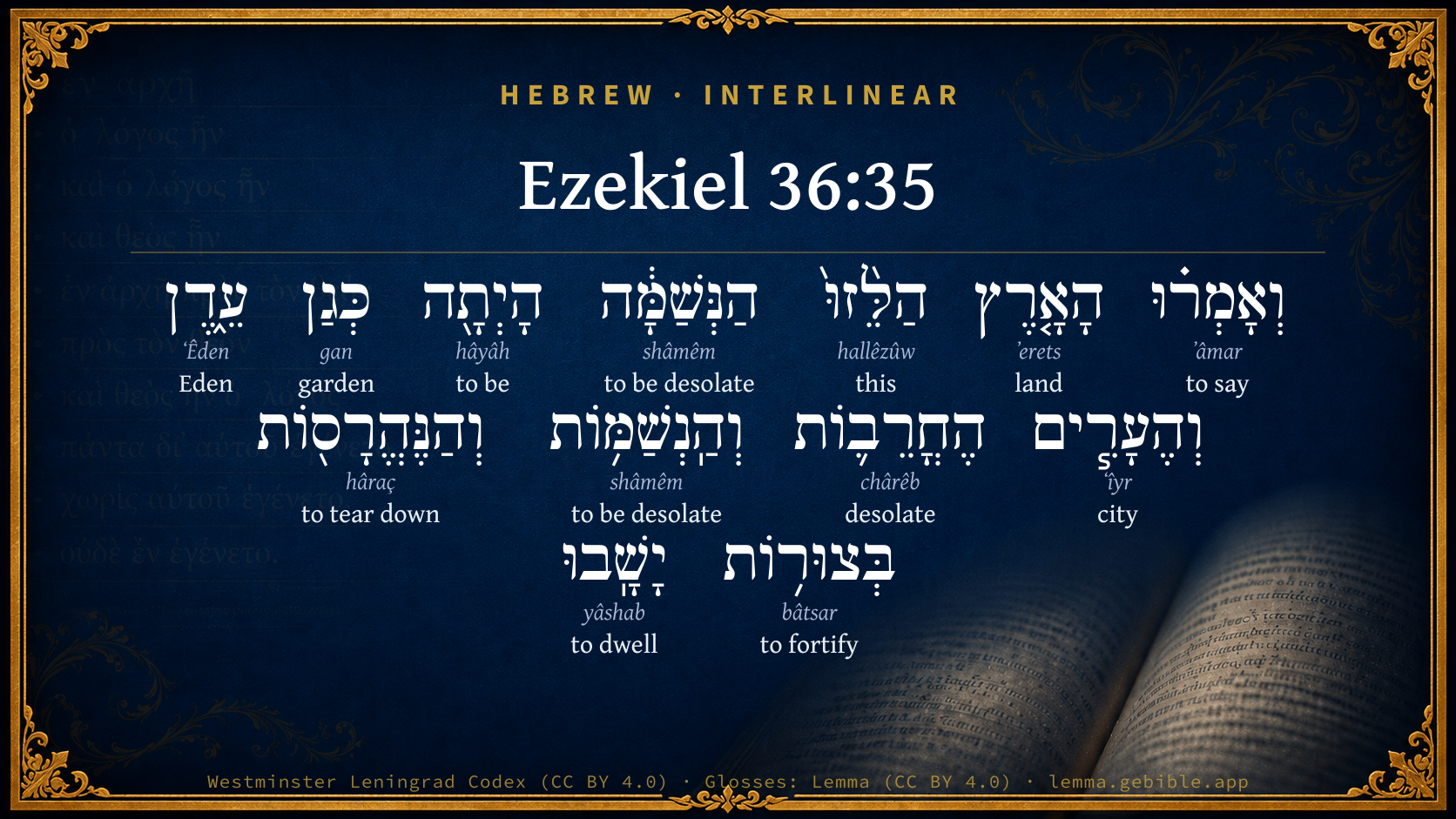
Hebrew (Westminster Leningrad Codex) Ezekiel 36:35 appears in the Hebrew Old Testament. The text above is from the Westminster Leningrad Codex. Each word links to its Strong’s number, a concise gloss, and parsing drawn from the Open Scriptures Hebrew Bible morphology. Click any word for its full Brown-Driver-Briggs (BDB) entry.
Download image
Cite this verse

Ezekiel 36:35 (World English Bible). Public Domain. Lemma interlinear Bible study tool, https://lemma.gebible.app/v/ezekiel/36/35.

Show BibTeX & RIS
BibTeX
RIS
English Translation
They shall say, This land that was desolate is become like the garden of Eden; and the waste and desolate and ruined cities are fortified and inhabited.
World English Bible · Public Domain
Highlights
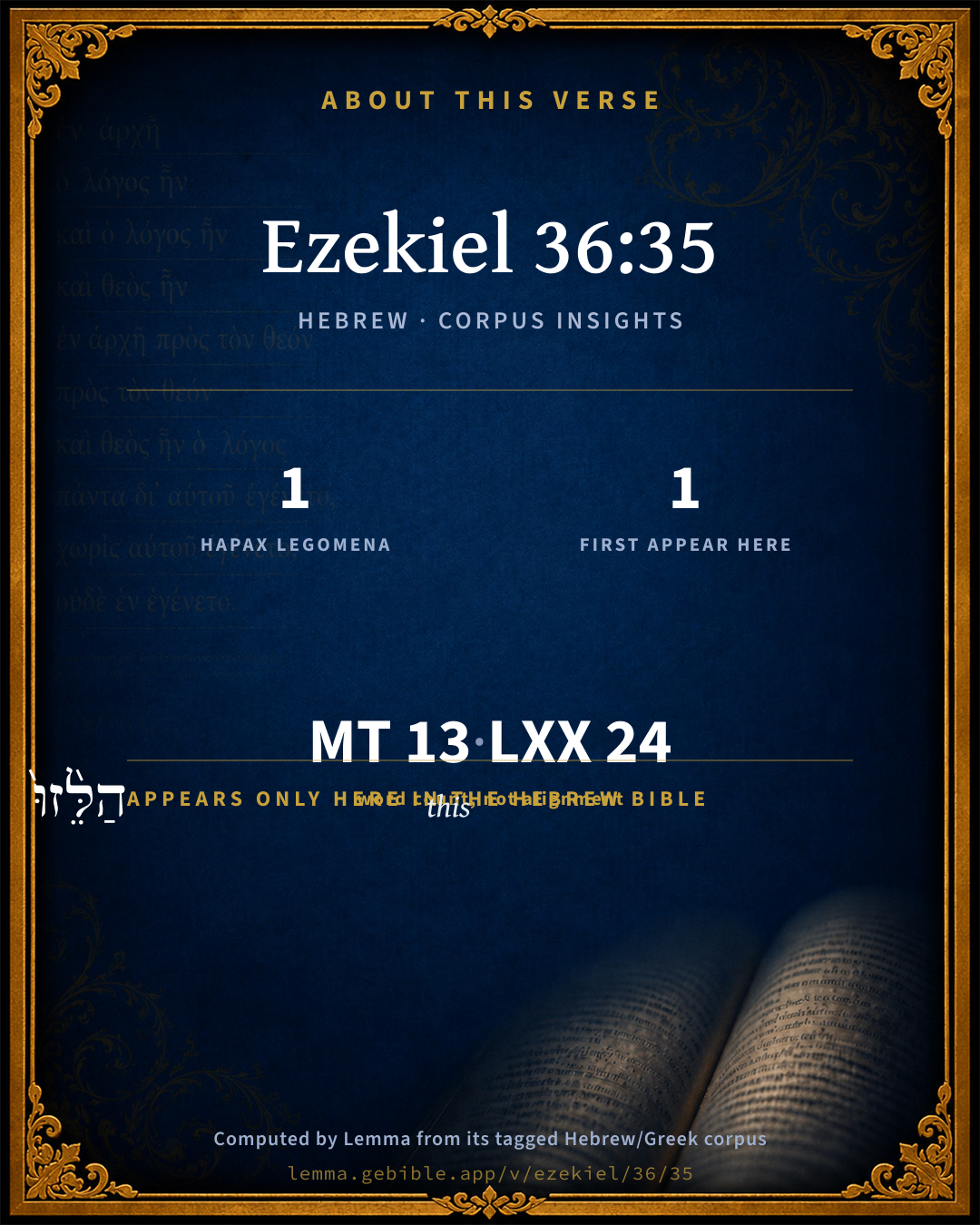
  • 1 hapax legomenon — only here in the Hebrew Bible
  • 1 first appearance in the Hebrew Bible
Full analysis ↓
Download a study sheet

One document with this verse’s original text, its word-by-word gloss line, the meaning frame, cross-references with their text, attributed commentary, and full source and license credits — printable, and it pastes into notes with its structure intact.

This verse Autodidact and up

Study sheet (.html) Plain text (.txt)

A passage Seminary Student

Up to 50 verses in one chapter. A passage sheet keeps up to 6 commentary sources and 12 cross-references per verse, in the order this page ranks them, and says so on the sheet whenever that leaves anything out. Ask for a single verse and you get the Autodidact verse sheet above.

Everything on this page stays free to read, with no account — the sheet is a download of what is already on screen, not access to it.

Want to remove ads? Support Godless Engineer
Compare translations 3

The same verse in 3 English versions, stacked beneath the original-language interlinear above. Click any original word for its lexicon entry.

Each is an independent rendering of the whole verse — the interlinear is not word-aligned to these translations.

Highlighted words mark where these versions differ — a whole-verse word diff, not a word-by-word alignment.

  • World English Bible Public Domain
    They shall say, This land that was desolate is become like the garden of Eden; and the waste and desolate and ruined cities are fortified and inhabited.
  • King James Version Public Domain
    And they shall say, This land that was desolate is become like the garden of Eden; and the waste and desolate and ruined cities are become fenced, and are inhabited.
  • unfoldingWord Literal Text CC BY-SA 4.0
    Then they will say, “This land was desolate, but it has become like the garden of Eden; the desolate cities and the uninhabited ruins that were torn down are now fortified and inhabited.”

unfoldingWord Literal Text — © unfoldingWord, licensed CC BY-SA 4.0. Word-aligned USFM3 via Door43 (git.door43.org/unfoldingWord/en_ult).

Versions to compare (up to 4)

3 of 4 selected

Show all 18 translations

Every available English version of this verse, each an independent rendering of the whole verse.

  • World English Bible Public Domain
    They shall say, This land that was desolate is become like the garden of Eden; and the waste and desolate and ruined cities are fortified and inhabited.
  • Berean Standard Bible Public Domain
    Then they will say, ‘This land that was desolate has become like the garden of Eden. The cities that were once ruined, desolate, and destroyed are now fortified and inhabited.’
  • Majority Standard Bible Public Domain
    Then they will say, ‘This land that was desolate has become like the garden of Eden. The cities that were once ruined, desolate, and destroyed are now fortified and inhabited.’
  • King James Version Public Domain
    And they shall say, This land that was desolate is become like the garden of Eden; and the waste and desolate and ruined cities are become fenced, and are inhabited.
  • American Standard Version (1901) Public Domain
    And they shall say, This land that was desolate is become like the garden of Eden; and the waste and desolate and ruined cities are fortified and inhabited.
  • Revised Version (1885) Public Domain
    And they shall say, This land that was desolate is become like the garden of Eden; and the waste and desolate and ruined cities are fenced and inhabited.
  • Geneva Bible (1599) Public Domain
    For they sayd, This waste land was like the garden of Eden, and these waste and desolate and ruinous cities were strong, and were inhabited.
  • Douay-Rheims (1899) Public Domain
    They shall say: This land that was untilled is become as a garden of pleasure: and the cities that were abandoned, and desolate, and destroyed, are peopled and fenced.
  • Young's Literal Translation Public Domain
    And they have said: This land, that was desolated, Hath been as the garden of Eden, And the cities -- the wasted, And the desolated, and the broken down, Fenced places have remained.
  • Literal Standard Version CC BY-SA 4.0
    And they have said: This land, that was desolated, || Has been as the Garden of Eden, || And the cities—the dried up, || And the desolated, and the broken down, || [And the] fortified have remained.
  • Unlocked Literal Bible CC BY-SA 4.0
    Then they will say, “This land was desolate, but it has become like the garden of Eden; the desolate cities and the uninhabited ruins that were torn down are now fortified and inhabited.”
  • unfoldingWord Literal Text CC BY-SA 4.0
    Then they will say, “This land was desolate, but it has become like the garden of Eden; the desolate cities and the uninhabited ruins that were torn down are now fortified and inhabited.”
  • Darby Bible Public Domain
    And they shall say, This land that was desolate is become like the garden of Eden; and the waste and desolate and ruined cities [are] fortified [and] inhabited.
  • World Messianic Bible Public Domain
    They will say, ‘This land that was desolate has become like the garden of Eden. The waste, desolate, and ruined cities are fortified and inhabited.’
  • Webster's Bible Public Domain
    And they shall say, This land that was desolate is become like the garden of Eden; and the waste and desolate and ruined cities are become fortified, and are inhabited.
  • Free Bible Version CC BY-SA 4.0
    Then they will say, ‘This deserted land is now like the garden of Eden. The towns that were demolished, abandoned, and destroyed have been restored and strengthened, and people are living in them.’
  • Bible in Basic English Public Domain
    And they will say, This land which was waste has become like the garden of Eden; and the towns which were unpeopled and wasted and pulled down are walled and peopled.
  • JPS Tanakh (1917) Public Domain
    And they shall say: This land that was desolate is become like the garden of Eden; and the waste and desolate and ruined cities are fortified and inhabited.

Literal Standard Version (2020), Covenant Press — licensed CC BY-SA 4.0. Text via the HelloAO Bible API (eBible.org). Unlocked Literal Bible (unfoldingWord) — licensed CC BY-SA 4.0. Text via the HelloAO Bible API (eBible.org). unfoldingWord Literal Text — © unfoldingWord, licensed CC BY-SA 4.0. Word-aligned USFM3 via Door43 (git.door43.org/unfoldingWord/en_ult). Free Bible Version, Dr. Jonathan Gallagher — licensed CC BY-SA 4.0. Text via the HelloAO Bible API (eBible.org).

Word by word

More ways to search: Search by grammar → Find every occurrence → Compare this word →

Practice this passage: Drill this verse → Learn its vocabulary →

הַלֵּ֨זוּ֙
hallêzûw
H1977
“this”
Pronoun, Demonstrative, Feminine, Singular
Part of Speech
Pronoun
Type
Demonstrative
Gender
Feminine
Number
Singular
Full BDB Definition

Origin: another form of H1976

TWOT: 497

this, this one (without subst), yonder
  1. וְאָמְר֗וּ ʼâmar H559 “and · to say” Conjunction + Verb, Qal, Sequential Perfect, 3rd Person, Common, Plural
  2. הָאָ֤רֶץ ʼerets H776 “the · land” Particle, Definite Article + Noun, Common, Both, Singular, Absolute
  3. הַנְּשַׁמָּ֔ה shâmêm H8074 “the · desolate” Particle, Definite Article + Verb, Niphal, Participle Passive, Feminine, Singular, Absolute
  4. הָיְתָ֖ה hâyâh H1961 “to be” Verb, Qal, Perfect, 3rd Person, Feminine, Singular
  5. כְּגַן gan H1588 “like/as · garden of” Preposition + Noun, Common, Both, Singular, Construct
  6. עֵ֑דֶן ʻÊden H5731 “Eden” Noun, Proper
  7. וְהֶעָרִ֧ים ʻîyr H5892 “and · the · cities” Conjunction + Particle, Definite Article + Noun, Common, Feminine, Plural, Absolute
  8. הֶחֳרֵב֛וֹת chârêb H2720 “the · desolate” Particle, Definite Article + Adjective, Adjective, Feminine, Plural, Absolute
  9. וְהַֽנְשַׁמּ֥וֹת shâmêm H8074 “and · the · desolate” Conjunction + Particle, Definite Article + Verb, Niphal, Participle Passive, Feminine, Plural, Absolute
  10. וְהַנֶּהֱרָס֖וֹת hâraç H2040 “and · the · torn down” Conjunction + Particle, Definite Article + Verb, Niphal, Participle Passive, Feminine, Plural, Absolute
  11. בְּצוּר֥וֹת bâtsar H1219 “fortified” Adjective, Adjective, Feminine, Plural, Absolute
  12. יָשָֽׁבוּ yâshab H3427 “to dwell” Verb, Qal, Perfect, 3rd Person, Common, Plural

About this verse

These counts appear in no published source. They are computed here, from the morphology-tagged text and Lemma’s own curated glosses. What Lemma adds →

13
words
12
distinct lemmas
Prophets
section

Notable vocabulary

1 hapax legomenon — a word that appears only here in the entire Hebrew Bible:

  • הַלֵּ֨זוּ֙ this H1977

First appearance in Scripture

This word makes its first canonical appearance in the Hebrew Bible here:

  • הַלֵּ֨זוּ֙ this H1977

Shared distinctive vocabulary

הֶחֳרֵב֛וֹת desolate H2720 occurs in 8 verses of the Hebrew Bible. Also found in:

Grammatical profile

  • 6 verbs
  • 4 nouns
  • 2 adjectives
  • 1 pronoun

Verb forms

  • וְאָמְר֗וּ Qal · Sequential Perfect
  • הַנְּשַׁמָּ֔ה Niphal · Participle Passive
  • הָיְתָ֖ה Qal · Perfect
  • וְהַֽנְשַׁמּ֥וֹת Niphal · Participle Passive
  • וְהַנֶּהֱרָס֖וֹת Niphal · Participle Passive
  • יָשָֽׁבוּ Qal · Perfect

Repetition

A word recurs within this verse — often emphatic in Hebrew:

  • הַנְּשַׁמָּ֔ה to be desolate H8074 ×2

Hebrew & Septuagint length

In English translation the verse runs 27 words from the Hebrew and 24 from the Septuagint (LXX English) — closely comparable.

A rough comparison of the two English renderings, which tokenize alike — not a word-level alignment.

Word counts can differ between the Hebrew and the Greek without any difference in meaning — e.g. the Hebrew direct-object marker אֵת has no separate Greek word, and Greek often adds the article ὁ.

In the original languages it is 13 Hebrew tokens and 24 Greek tokens — but the two are counted differently (Hebrew bundles its prefixes and suffixes into one token; the Greek is in lemma form), so that isn’t a like-for-like length.

Cross-references

9

Topical passages linked to Ezekiel 36:35 in the Treasury of Scripture Knowledge — connected by theme and wording, ordered by reader-vote popularity; previews shown in the World English Bible.

  • Isaiah 51:3 For Yahweh has comforted Zion; he has comforted all her waste places, and has made her wilderness like Eden, and her desert like the garden of Yahweh; joy and gladness shall be found therein, thanksgiving, and the voice of melody.
  • Jeremiah 33:9 [This city] shall be to me for a name of joy, for a praise and for a glory, before all the nations of the earth, which shall hear all the good that I do to them, and shall fear and tremble for all the good and for all the peace that I procure to it.
  • Joel 2:3 A fire devours before them, And behind them, a flame burns. The land is as the garden of Eden before them, And behind them, a desolate wilderness. Yes, and no one has escaped them.
  • Psalms 58:11 So that men shall say, "Most assuredly there is a reward for the righteous. Most assuredly there is a God who judges the earth."
  • Genesis 13:10 Lot lifted up his eyes, and saw all the plain of the Jordan, that it was well watered every where, before Yahweh destroyed Sodom and Gomorrah, like the garden of Yahweh, like the land of Egypt, as you go to Zoar.
  • Psalms 64:9 All mankind shall be afraid. They shall declare the work of God, And shall wisely ponder what he has done.
  • Psalms 126:2 Then our mouth was filled with laughter, And our tongue with singing. Then they said among the nations, "Yahweh has done great things for them."
  • Ezekiel 37:13 You shall know that I am Yahweh, when I have opened your graves, and caused you to come up out of your graves, my people.
  • Genesis 2:8–9 Yahweh God planted a garden eastward, in Eden, and there he put the man whom he had formed.

Cross-references courtesy of OpenBible.info (CC BY 4.0).

Hebrew and Greek witnesses Masoretic Hebrew ↔ Greek Septuagint

The same verse in the two great witnesses to the Old Testament, shown verse-for-verse.

These are two independent witnesses, not word-aligned to each other, and the Septuagint is shown in lemma (dictionary) form.

Hebrew Ezekiel 36:35 Masoretic · Westminster Leningrad Codex

וְאָמְר֗וּ הָאָ֤רֶץ הַלֵּ֨זוּ֙ הַנְּשַׁמָּ֔ה הָיְתָ֖ה כְּגַן עֵ֑דֶן וְהֶעָרִ֧ים הֶחֳרֵב֛וֹת וְהַֽנְשַׁמּ֥וֹת וְהַנֶּהֱרָס֖וֹת בְּצוּר֥וֹת יָשָֽׁבוּ

They shall say, This land that was desolate is become like the garden of Eden; and the waste and desolate and ruined cities are fortified and inhabited.

World English Bible · Public Domain

Greek LXX Ezekiel 36:35 Septuagint · lemma form

καί εἶπον ὁ γῆ ἐκεῖνος ὁ ἀπο ἀναἵζω γίγνομαι ὡς κῆπος τρυφή καί ὁ πόλις ὁ ἔρημος καί ἀπο ἀναἵζω καί κατασκάπτω ὀχυρός καταἵζω

And they shall say, That desolate land is become like a garden of delight; and the waste and desolate and ruined cities are inhabited.

LXX2012 (modern English Septuagint) · Public Domain

Hebrew: Westminster Leningrad Codex (CC BY 4.0). Greek: Septuagint (public domain); English from LXX2012 (modern English Septuagint) (Public Domain). How the Septuagint differs from the Hebrew →

Targum (Aramaic paraphrase)

1

The Targum is the ancient Jewish Aramaic paraphrase of the Hebrew Scriptures — an interpretive translation, not the Hebrew text itself. Onkelos (literal) and Pseudo-Jonathan (expansive) render the Torah, and Jonathan the Prophets. Coverage is partial: where no permissively-licensed English translation exists for a verse, only the Aramaic is shown. This is verse-level text, not a word-by-word alignment to the Hebrew.

  1. Targum Jonathan Prophets (Joshua–Malachi)
    וְיֵמְרוּן אַרְעָא דְנַן דְיִשְׂרָאֵל דַהֲוַת צַדְיָא תָּבַת לְמֶהֱוֵי כְּגִינְתָא דְעֵדֶן וְקִרְוַיָא חֶרְבָתָא וְצַדְיָתָא וּמְפַגְרָתָא כְּרִיכִין תַּקִיפִין יְתִיבוּ:

    (no public-domain English translation for this verse)

    Targum Jonathan — Aramaic: “Mikraot Gedolot” (public domain). English: “Sefaria Community Translation” (CC0 1.0 (public-domain dedication)); “London "Chaldee Paraphrase," 1871” (public domain). Text via Sefaria.

Commentary

Notes on Ezekiel 36:35 from classic Christian and Jewish commentators (each source and its license shown beneath its notes). The classic Christian expositions comment on the surrounding passage and are grouped to its opening verse, so a note may address several verses; the Jewish commentaries on the Tanakh (Rashi and others) are per-verse, so they appear only where the commentator wrote on this verse.

Lemma curates 59 commentaries, every one of them public domain or Creative Commons licensed, each selected and text-cleaned for this edition rather than reprinted as found. About our sources →

Trapp's Complete Commentary

John Trapp

Eze 36:35 And they shall say, This land that was desolate is become like the garden of Eden; and the waste and desolate and ruined cities [are become] fenced, [and] are inhabited.

Ver. 35. This land.] Such a change can God soon make for worse or better. Fear him therefore; fear the Lord and his goodness. {Hos 3:5}

John Trapp, A Commentary or Exposition upon All the Books of the Old and New Testament (1647–1656) — public domain. Text from a community e-Sword module.

Tyndale Open Study Notes

Tyndale Open Resources

36:35-38 The restored land would become like the Garden of Eden, the ultimate symbol of fertility and fruitfulness. The original garden would be enhanced by restored cities, overflowing with renewed humanity like Jerusalem’s streets at the time of her festivals. The greatest blessing, however, would be God’s willingness to hear Israel’s prayers once more. He had once refused to listen to his rebellious people (14:3; 20:3), but now the Lord would turn his face toward them and hear their cries. The proof of this would be the number of people in the rebuilt cities who would acknowledge that the Lord is God.

Tyndale Open Study Notes — © Tyndale Open Resources, licensed CC BY-SA 4.0. Text via the HelloAO Bible API.

Jamieson, Fausset & Brown

Robert Jamieson, A. R. Fausset & David Brown

they shall say--The heathen, who once made Israel's desolation a ground of reproach against the name of Jehovah Himself (Eze 36:20-21); but now He so vindicates its sanctity (Eze 36:22-23) that these same heathen are constrained to acknowledge Israel's more than renewed blessedness to be God's own work, and a ground for glorifying His name (Eze 36:36).

Eden--as Tyre (the type of the world powers in general: so Assyria, a cedar "in the garden of God, Eden," Eze 31:8-9), in original advantages, had been compared to "Eden, the garden of God" (Eze 28:13), from which she had fallen irrecoverably; so Israel, once desolate, is to be as "the garden of Eden" (Isa 51:3), and is to be so unchangeably.

Jamieson, Fausset & Brown — Commentary Critical and Explanatory on the Whole Bible (1871) — public domain (CC PDM 1.0). Text via the HelloAO Bible API.

Adam Clarke's Commentary

Verse 35. This land that was desolate by sin, is become like the garden of Eden by righteousness. - Satan's blast is removed; God's blessing has taken place.

Adam Clarke's Commentary on the Bible (1810–1826) — public domain. Text from a community e-Sword/MySword module.

Ellicott's Commentary for English Readers

(35) Like the garden of Eden.—This may be meant merely to describe the exceeding excellence and prosperity of the land; but, in connection with what has been previously said, it seems rather to point forward to that state in which man shall again be entirely freed from sin, which has been the state for which the Church in all ages has been preparing.

A Bible Commentary for English Readers, edited by Charles John Ellicott (1878–1897) — public domain. Text from a community e-Sword module.

John Gill's Exposition

And they shall say,.... Either the neighbouring nations that lived round about the land of Israel, Eze 36:36, or rather the travellers, as before, who having as they passed by observed what it had been, and now see what it is; these shall say to one another:

this land that was desolate is become like the garden of Eden; for delight and fruitfulness: this may well be applied to the flourishing and fruitful state of the church of God, consisting of converted Jews, in the latter day:

and the waste and desolate and ruined cities are become fenced, and are inhabited; which, as it will be true of cities in a literal sense, so of the churches of Christ in Judea in a spiritual sense; which will be rebuilt by the grace of God, fenced and fortified by his almighty power, and inhabited by true believers.

John Gill's Exposition of the Whole Bible (1746–1763) — public domain (CC PDM 1.0). Text via the HelloAO Bible API.

Matthew Poole's English Annotations

They shall say; strangers or foreigners, who had heard or seen the sad wastes, and now either hear or see the replanting of it, and how it succeedeth.

Like the garden of Eden; see the phrase Eze 28:13; most fruitful, pleasant, and desirable. This is true of the church of Christ without an hyperbole, but here it is to be accommodated by a comparative, thus; that good state the Jews are now in, compared with what they were in, is as an Eden to a wilderness. Fenced; not only built for habitation, but fortified for defence.

Matthew Poole's English Annotations on the Holy Bible (1683–1685) — public domain. Text from a community e-Sword/MySword module.

The Pulpit Commentary

This land that was desolate is become like the garden of Eden. (For the reverse picture, see Joe_2:3) The thought of the firstParadise, (Gen_2:8) in the historicity of which clearly Ezekiel believed, was one on which his mind often dwelt (Eze_28:13 Eze_31:9) as an ideal of earthly beauty and fertility which should recur in the closing age of the world a hope which appears to have been shared by Isaiah, (Isa_51:3) and taken up by John. (Rev_2:7 Rev_22:1-3) In the day when that hope should be realized for Israel, the waste, desolate, and ruined cities, on which the passers-by who visited Palestine gazed, should be fenced and inhabited; literally, inhabited as fortresses. The three predicates, "waste," "desolate," and" ruined," have been distinguished as signifying "stripped of its inhabitants," "untilled in its lands," and "broken down in its buildings;" in contrast with which, in the golden era of the future, the towns should be inhabited, the fields tilled, and the ruined fortresses built.

A new Eden.

The new heart (ver. 26) is to be followed by a new Eden. The outer world is to be changed when the inner world is renewed, and that sweet, fair Paradise, the dream of which hovers on the distant horizon of history, is to be once more seen on earth, when men are renewed in nature. The new Adam brings the new Eden. Consider some of its features.

I LIFE. The desolate land becomes like the garden of Eden. It was desolate in death. Parched up and neglected, unwatered and untilled, the ruined country resembles the wilderness. Sin reduces the world to a wilderness. But Isaiah had prophesied that the wilderness should blossom like the rose. (Isa_35:1) Heathenism is characterized by deadness of civilization. The vitality and energy of the world are found in Christendom. The life of the earthly paradise of culture, art, science, invention, manufacture, and commerce is concentrated in Christian lauds. It is by no means all in the lands of Christian men. But it flourishes in an atmosphere of Christianity some of the essential elements of which are

(1) justice,

(2) truth,

(3) liberty,

(4) human brotherhood, and

(5) hopefulness.

Without these five things progress languishes. They constitute the very air it breathes.

II ORDER. The desolate place is in confusion; the garden is a well-ordered scene of life and growth. Its perfection is largely dependent on its perfect culture well-kept paths, smooth lawns, flower-beds without weeds, trees pruned and trim. Christ brings order to a world of confusion. St. James wrote of the "perfect law of liberty for Christian freedom observes its own lofty law. The great secret of disorder is selfishness. Hence spring war and all strife and confusion. The great secret of order is love; for love involves sympathy, and sympathy inspires harmony, and harmony secures order. If human society is ever to become like an orderly garden, it will not be by means of the fierce contests of competition; nor owing to the rankling jealousy of class-differences between rich and poor, landlord and tenant, employer and workpeople; it will be through the spread of the spirit of Christian brotherhood. Thus Christ will bring "on earth peace.

III FRUITFULNESS. The fruit-trees covering the walls of a rich and fertile old English garden give to it great value. In the East a garden is often just an orchard. The garden of Eden is described as a fruit-growing place. The wilderness is barren; the garden is fruitful. Now, there are various fruits that grow out of the redeeming work of Christ. The best and choicest are spirituali.e. "the fruits of the Spirit." But society also reaps external good in the activities and charities of the Christian life. A living Church must be a boon to a neighborhood like a fruit-garden planted among weary men who sadly need its refreshing products.

IV BEAUTY. Whenever the name of Eden is mentioned, we think of a picture of exceeding beauty. There are few more lovely sights than a cottage garden, with its quaint old-fashioned flowers its airy columbines its still, tall, white lilies its sweet, rich roses.

How the rose of orient glow Mingles with the lily"s snow!

Alas! for the scenes of city life contrasted with this fresh vision of beauty! But Christ will plant a new Eden. He will bring beauty into faded lives, and joy to the old, weary earth. Christ does not only give grace; he adds glory. The beauty of the Lord is on his people. And this joy is not reserved for a future heaven of departed souls. The new Eden, like the old one, is to flourish on earth. Here Christ converts the wilderness into a garden.

The Pulpit Commentary (1880–1919), ed. H.D.M. Spence-Jones & Joseph S. Exell — public domain. Text from a community e-Sword module.

John Wesley's Explanatory Notes

And they - Strangers, or foreigners.

John Wesley, Explanatory Notes Upon the Whole Bible (1754–1765) — public domain. Text via the GEBible commentary corpus.

unfoldingWord translationNotes

Door43 World Missions Community

General Information:

Yahweh continues giving Ezekiel his message to Israel.

Then they

The word "they" refers to the people who walk through the land of Israel.

the uninhabited ruins

"the ruins that no one lived in"

that were torn down

This can be stated in active form. Possible meanings are 1) AT: "that enemies had torn down" or 2) AT: "that people could not get into" (See: Active or Passive)

are now fortified and inhabited

This can be stated in active form. AT: "the people have now rebuilt them and have started living there again" (See: Active or Passive)

that I built up the ruins

"and that I built up the cities that enemies had torn down"

replanted the abandoned places

"planted crops in the desolate land"

translationWords

desolate

Eden

ruin

nation

know

unfoldingWord translationNotes — © Distant Shores Media and the Door43 World Missions Community, licensed CC BY-SA 4.0. Source: git.door43.org/Door43/en_tn.

Rashi

Rabbi Shlomo Yitzchaki (Rashi)

has become like the Garden of Eden [Heb. הָיְתָה,] has now been transformed into being like the Garden of Eden.

and the cities that were destroyed these many days, have now become settled as fortified cities.

Rashi on the Tanakh — English translations: “The Judaica Press complete Tanach with Rashi, translated by A. J. Rosenberg” (CC BY 4.0); “Pentateuch with Rashi's commentary by M. Rosenbaum and A.M. Silbermann, 1929-1934” (public domain); “The Metsudah Tanach series, Lakewood, N.J” (CC BY 4.0); and “The Book of Joshua, Metsudah Publications, 1997” (CC BY 4.0). Text via Sefaria.

Lesson kit

Teaching starters — assembled from the data on this page, not authored interpretation. Every prompt links to the verse data it draws on. Edit before teaching.

Ezekiel, in the Prophets, opens this verse with 13 words (12 distinct Hebrew lemmas). Its most distinctive word is hallêzûw (“this”). A historical commentator’s framing appears above. Read the whole chapter for the surrounding context.

Discussion questions

  1. The word hallêzûw carries the sense “this.” How does it shape the verse?
  2. This verse holds 1 word here found nowhere else in the Hebrew Bible. What might the rare word draw attention to?
  3. The word “this” first appears here in Scripture. What is being introduced at this debut?
  4. Leviticus 7:10 shares the word «desolate» with this verse. How do the two illuminate each other?
  5. “to be desolate” occurs 2× in this one verse. What is the effect of the repetition?
  6. These translations render this verse differently; the difference is in the English rendering, not the original. What questions does that raise?
  7. The verb «וְאָמְר֗וּ» is Qal Sequential Perfect. How does its form color the action?
  8. Reading how Trapp's Complete Commentary and Tyndale Open Study Notes read this verse, where do the two commentators agree and where do they part?

Things to notice

  • 1 word in this verse appears nowhere else in the Hebrew Bible.
  • 1 word makes its first canonical appearance in Scripture here.
  • This verse counts 13 Hebrew ↔ 24 Greek words.
  • These translations choose different wording for 12 words in this verse.
  • “to be desolate” occurs 2× in this single verse.

Reading settings

Reading text

Shown beneath each verse's original-language words.

Old Testament
Old Testament edition

Read the OT as the Masoretic Hebrew (MT) or the Greek Septuagint (LXX).

English shown for the Greek Septuagint (in the Hebrew ↔ Greek comparison).

Comparing translations? Open the Compare panel on any verse page to stack up to four side by side.