Jeremiah 18:16

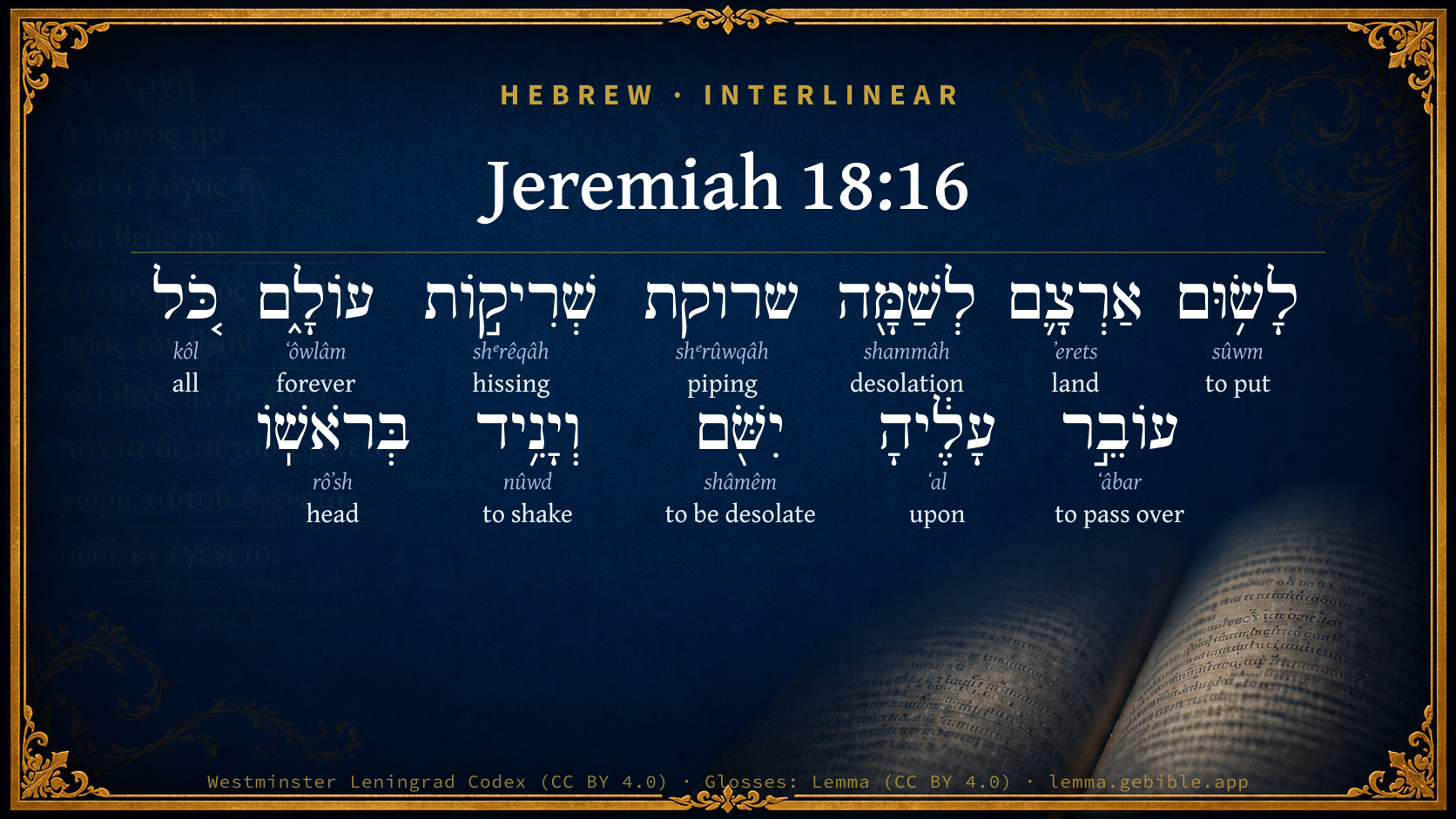
Hebrew (Westminster Leningrad Codex) Jeremiah 18:16 appears in the Hebrew Old Testament. The text above is from the Westminster Leningrad Codex. Each word links to its Strong’s number, a concise gloss, and parsing drawn from the Open Scriptures Hebrew Bible morphology. Click any word for its full Brown-Driver-Briggs (BDB) entry.
Download image
Cite this verse

Jeremiah 18:16 (World English Bible). Public Domain. Lemma interlinear Bible study tool, https://lemma.gebible.app/v/jeremiah/18/16.

Show BibTeX & RIS
BibTeX
RIS
English Translation
to make their land an astonishment, and a perpetual hissing; everyone who passes thereby shall be astonished, and shake his head.
World English Bible · Public Domain
Download a study sheet

One document with this verse’s original text, its word-by-word gloss line, the meaning frame, cross-references with their text, attributed commentary, and full source and license credits — printable, and it pastes into notes with its structure intact.

This verse Autodidact and up

Study sheet (.html) Plain text (.txt)

A passage Seminary Student

Up to 50 verses in one chapter. A passage sheet keeps up to 6 commentary sources and 12 cross-references per verse, in the order this page ranks them, and says so on the sheet whenever that leaves anything out. Ask for a single verse and you get the Autodidact verse sheet above.

Everything on this page stays free to read, with no account — the sheet is a download of what is already on screen, not access to it.

Want to remove ads? Support Godless Engineer
Compare translations 3

The same verse in 3 English versions, stacked beneath the original-language interlinear above. Click any original word for its lexicon entry.

Each is an independent rendering of the whole verse — the interlinear is not word-aligned to these translations.

Highlighted words mark where these versions differ — a whole-verse word diff, not a word-by-word alignment.

  • World English Bible Public Domain
    to make their land an astonishment, and a perpetual hissing; everyone who passes thereby shall be astonished, and shake his head.
  • King James Version Public Domain
    To make their land desolate, and a perpetual hissing; every one that passeth thereby shall be astonished, and wag his head.
  • unfoldingWord Literal Text CC BY-SA 4.0
    to make their land a desolation, a hissing of eternity. Everyone passing over it will be appalled and will shake his head.

unfoldingWord Literal Text — © unfoldingWord, licensed CC BY-SA 4.0. Word-aligned USFM3 via Door43 (git.door43.org/unfoldingWord/en_ult).

Versions to compare (up to 4)

3 of 4 selected

Show all 18 translations

Every available English version of this verse, each an independent rendering of the whole verse.

  • World English Bible Public Domain
    to make their land an astonishment, and a perpetual hissing; everyone who passes thereby shall be astonished, and shake his head.
  • Berean Standard Bible Public Domain
    They have made their land a desolation, a perpetual object of scorn; all who pass by will be appalled and shake their heads.
  • Majority Standard Bible Public Domain
    They have made their land a desolation, a perpetual object of scorn; all who pass by will be appalled and shake their heads.
  • King James Version Public Domain
    To make their land desolate, and a perpetual hissing; every one that passeth thereby shall be astonished, and wag his head.
  • American Standard Version (1901) Public Domain
    to make their land an astonishment, and a perpetual hissing; every one that passeth thereby shall be astonished, and shake his head.
  • Revised Version (1885) Public Domain
    to make their land an astonishment, and a perpetual hissing; every one that passeth thereby shall be astonished, and shake his head.
  • Geneva Bible (1599) Public Domain
    To make their land desolate and a perpetual derision, so that euery one that passeth thereby, shalbe astonished and wagge his head,
  • Douay-Rheims (1899) Public Domain
    That their land might be given up to desolation, and to a perpetual hissing: every one that shall pass by it, shall be astonished, and wag his head.
  • Young's Literal Translation Public Domain
    To make their land become a desolation, A hissing age-during, Every passer by it is astonished, And bemoaneth with his head.
  • Literal Standard Version CC BY-SA 4.0
    To make their land become a desolation, || A continuous hissing, || Everyone passing by it is astonished, || And bemoans with his head.
  • Unlocked Literal Bible CC BY-SA 4.0
    Their land will become a horror, an object of everlasting hissing. Everyone who passes by her will shudder and shake his head.
  • unfoldingWord Literal Text CC BY-SA 4.0
    to make their land a desolation, a hissing of eternity. Everyone passing over it will be appalled and will shake his head.
  • Darby Bible Public Domain
    to make their land an astonishment, a perpetual hissing: every one that passeth by shall be astonished, and shake his head.
  • World Messianic Bible Public Domain
    to make their land an astonishment, and a perpetual hissing. Everyone who passes by it will be astonished, and shake his head.
  • Webster's Bible Public Domain
    To make their land desolate, and a perpetual hissing; every one that passeth by it shall be astonished, and wag his head.
  • Free Bible Version CC BY-SA 4.0
    They have turned their country into a horrific wasteland, a place that will always be treated with contempt. People passing by will be shocked, shaking their heads in disbelief.
  • Bible in Basic English Public Domain
    Making their land a thing of wonder, causing sounds of surprise for ever; everyone who goes by will be overcome with wonder, shaking his head.
  • JPS Tanakh (1917) Public Domain
    To make their land an astonishment, and a perpetual hissing; every one that passeth thereby shall be astonished, and shake his head.

Literal Standard Version (2020), Covenant Press — licensed CC BY-SA 4.0. Text via the HelloAO Bible API (eBible.org). Unlocked Literal Bible (unfoldingWord) — licensed CC BY-SA 4.0. Text via the HelloAO Bible API (eBible.org). unfoldingWord Literal Text — © unfoldingWord, licensed CC BY-SA 4.0. Word-aligned USFM3 via Door43 (git.door43.org/unfoldingWord/en_ult). Free Bible Version, Dr. Jonathan Gallagher — licensed CC BY-SA 4.0. Text via the HelloAO Bible API (eBible.org).

Word by word

More ways to search: Search by grammar → Find every occurrence → Compare this word →

Practice this passage: Drill this verse → Learn its vocabulary →

שרוקת
shᵉrûwqâh
H8292
“piping of”
Noun, Common, Feminine, Singular, Construct
Part of Speech
Noun
Type
Common
Gender
Feminine
Number
Singular
State
Construct
Full BDB Definition

Origin: pass part of H8319

TWOT: 2468b

piping, whistling, hissing
  1. לָשׂ֥וּם sûwm H7760 “to put” Preposition + Verb, Qal, Infinitive Construct
  2. אַרְצָ֛ם ʼerets H776 “land · their” Noun, Common, Both, Singular, Construct + Suffix, Personal, 3rd Person, Masculine, Plural
  3. לְשַׁמָּ֖ה shammâh H8047 “to/for · desolation” Preposition + Noun, Common, Feminine, Singular, Absolute
  4. שְׁרִיק֣וֹת shᵉrêqâh H8322 “hissing of” Noun, Common, Feminine, Plural, Construct
  5. עוֹלָ֑ם ʻôwlâm H5769 “forever” Noun, Common, Masculine, Singular, Absolute
  6. כֹּ֚ל kôl H3605 “all of” Noun, Common, Masculine, Singular, Construct
  7. עוֹבֵ֣ר ʻâbar H5674 “passing over” Verb, Qal, Participle Active, Masculine, Singular, Absolute
  8. עָלֶ֔יהָ ʻal H5921 “upon · her” Preposition + Suffix, Personal, 3rd Person, Feminine, Singular
  9. יִשֹּׁ֖ם shâmêm H8074 “to be desolate” Verb, Qal, Imperfect, 3rd Person, Masculine, Singular
  10. וְיָנִ֥יד nûwd H5110 “and · to shake” Conjunction + Verb, Hiphil, Imperfect, 3rd Person, Masculine, Singular
  11. בְּרֹאשֽׁוֹ rôʼsh H7218 “in/at · head · his” Preposition + Noun, Common, Masculine, Singular, Construct + Suffix, Personal, 3rd Person, Masculine, Singular

About this verse

These counts appear in no published source. They are computed here, from the morphology-tagged text and Lemma’s own curated glosses. What Lemma adds →

12
words
12
distinct lemmas
Prophets
section

Notable vocabulary

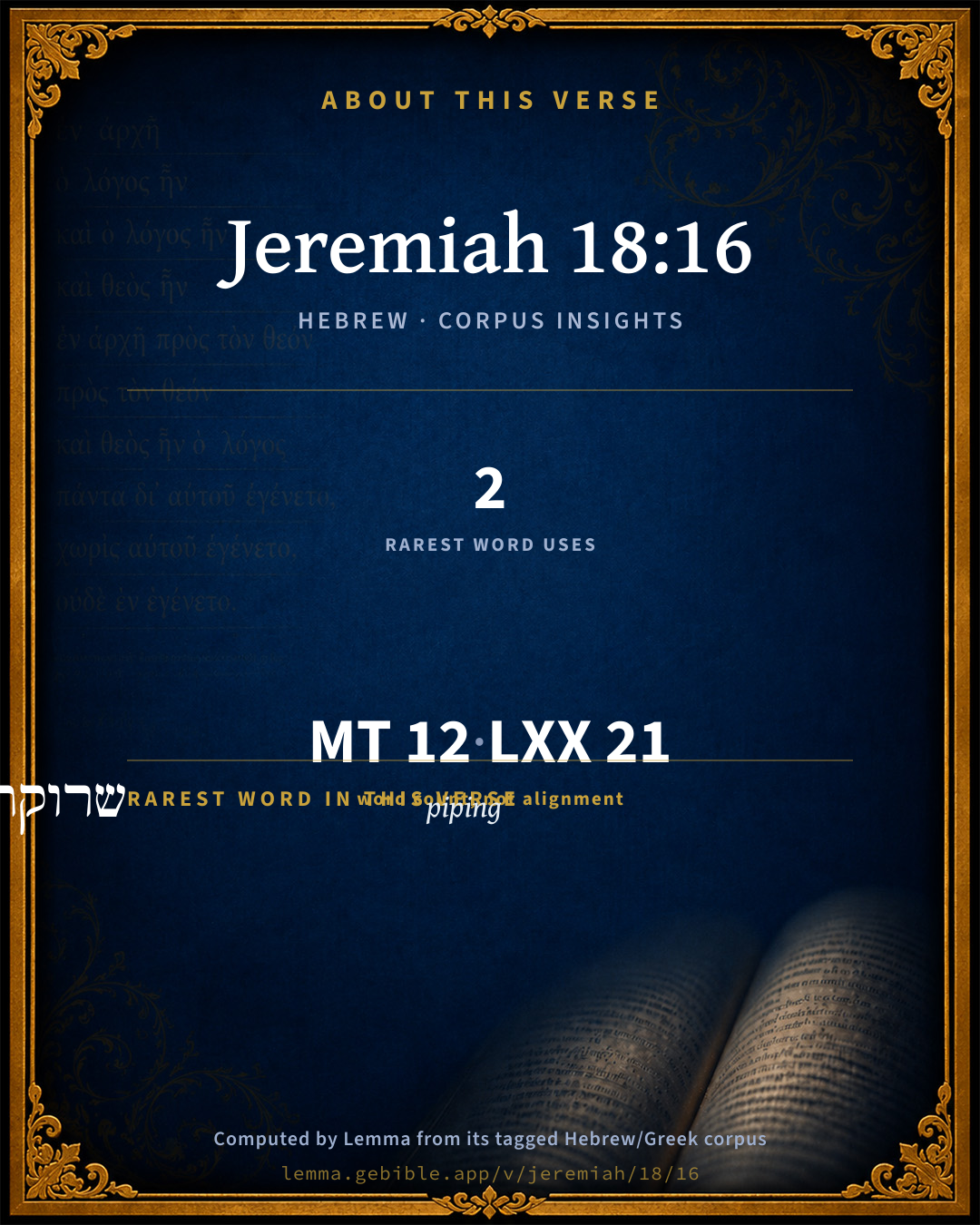
The rarest word here is שרוקת piping H8292 — appearing just 2 times in the whole Hebrew Bible.

Shared distinctive vocabulary

שרוקת piping H8292 occurs in 2 verses of the Hebrew Bible. Also found in:

Grammatical profile

  • 4 verbs
  • 7 nouns
  • 1 preposition

Verb forms

  • לָשׂ֥וּם Qal · Infinitive Construct
  • עוֹבֵ֣ר Qal · Participle Active
  • יִשֹּׁ֖ם Qal · Imperfect
  • וְיָנִ֥יד Hiphil · Imperfect

Hebrew & Septuagint length

In the original languages it is 12 Hebrew tokens and 21 Greek tokens — but the two are counted differently (Hebrew bundles its prefixes and suffixes into one token; the Greek is in lemma form), so that isn’t a like-for-like length.

Cross-references

22

Topical passages linked to Jeremiah 18:16 in the Treasury of Scripture Knowledge — connected by theme and wording, ordered by reader-vote popularity; previews shown in the World English Bible.

  • Psalms 22:7 All those who see me mock me. They insult me with their lips. They shake their heads, saying,
  • Jeremiah 25:9 behold, I will send and take all the families of the north, says Yahweh, and [I will send] to Nebuchadrezzar the king of Babylon, my servant, and will bring them against this land, and against the inhabitants of it, and against all these nations round about; and I will utterly destroy them, and make them an astonishment, and a hissing, and perpetual desolations.
  • Jeremiah 19:8 I will make this city an astonishment, and a hissing; everyone who passes thereby shall be astonished and hiss because of all the plagues of it.
  • 1 Kings 9:8 Though this house is so high, yet shall everyone who passes by it be astonished, and shall hiss; and they shall say, Why has Yahweh done thus to this land, and to this house?
  • Jeremiah 49:13 For I have sworn by myself, says Yahweh, that Bozrah shall become an astonishment, a reproach, a waste, and a curse; and all the cities of it shall be perpetual wastes.
  • Jeremiah 50:13 Because of the wrath of Yahweh she shall not be inhabited, but she shall be wholly desolate: everyone who goes by Babylon shall be astonished, and hiss at all her plagues.
  • Ezekiel 33:28–29 I will make the land a desolation and an astonishment; and the pride of her power shall cease; and the mountains of Israel shall be desolate, so that none shall pass through.
  • Micah 6:16 For the statutes of Omri are kept, And all the works of the house of Ahab. You walk in their counsels, That I may make you a ruin, And her inhabitants a hissing; And you will bear the reproach of my people."
  • Matthew 27:39 Those who passed by blasphemed him, wagging their heads,
  • 2 Chronicles 7:20–21 then will I pluck them up by the roots out of my land which I have given them; and this house, which I have made holy for my name, will I cast out of my sight, and I will make it a proverb and a byword among all peoples.
  • Isaiah 37:22 this is the word which Yahweh has spoken concerning him: The virgin daughter of Zion has despised you and ridiculed you; the daughter of Jerusalem has shaken her head at you.
  • Lamentations 2:15–16 All that pass by clap their hands at you; They hiss and wag their head at the daughter of Jerusalem, [saying], Is this the city that men called The perfection of beauty, The joy of the whole earth?
  • Mark 15:29 Those who passed by blasphemed him, wagging their heads, and saying, "Ha! You who destroy the temple, and build it in three days,
  • Leviticus 26:33–34 I will scatter you among the nations, and I will draw out the sword after you: and your land will be a desolation, and your cities shall be a waste.
  • Leviticus 26:43 The land also will be left by them, and will enjoy its sabbaths while it lies desolate without them: and they will accept the punishment of their iniquity; because, even because they rejected my ordinances, and their soul abhorred my statutes.
  • Deuteronomy 28:59 then Yahweh will make your plagues wonderful, and the plagues of your seed, even great plagues, and of long continuance, and sore sicknesses, and of long continuance.
  • Deuteronomy 29:23 [and that] the whole land of it is sulfur, and salt, [and] a burning, [that] it is not sown, nor bears, nor any grass grows therein, like the overthrow of Sodom and Gomorrah, Admah and Zeboiim, which Yahweh overthrew in his anger, and in his wrath:
  • Psalms 44:14 You make us a byword among the nations, A shaking of the head among the peoples.
  • Isaiah 6:11 Then I said, "Lord, how long?" He answered, "Until cities are waste without inhabitant, And houses without man, And the land becomes utterly waste,
  • Jeremiah 9:11 I will make Jerusalem heaps, a dwelling-place of jackals; and I will make the cities of Judah a desolation, without inhabitant.
  • Ezekiel 6:14 I will stretch out my hand on them, and make the land desolate and waste, from the wilderness toward Diblah, throughout all their habitations: and they shall know that I am Yahweh.
  • Ezekiel 12:19 and tell the people of the land, Thus says the Lord Yahweh concerning the inhabitants of Jerusalem, and the land of Israel: They shall eat their bread with fearfulness, and drink their water in dismay, that her land may be desolate, [and despoiled] of all that is therein, because of the violence of all those who dwell therein.

Cross-references courtesy of OpenBible.info (CC BY 4.0).

Hebrew and Greek witnesses Masoretic Hebrew ↔ Greek Septuagint

The same verse in the two great witnesses to the Old Testament, shown verse-for-verse.

These are two independent witnesses, not word-aligned to each other, and the Septuagint is shown in lemma (dictionary) form.

Hebrew Jeremiah 18:16 Masoretic · Westminster Leningrad Codex

לָשׂ֥וּם אַרְצָ֛ם לְשַׁמָּ֖ה שרוקת שְׁרִיק֣וֹת עוֹלָ֑ם כֹּ֚ל עוֹבֵ֣ר עָלֶ֔יהָ יִשֹּׁ֖ם וְיָנִ֥יד בְּרֹאשֽׁוֹ

to make their land an astonishment, and a perpetual hissing; everyone who passes thereby shall be astonished, and shake his head.

World English Bible · Public Domain

Greek LXX Structure differs

In the Septuagint, Jeremiah is about an eighth shorter than the Hebrew and arranges its material differently — the Oracles Against the Nations (Hebrew chapters 46–51) appear in the middle of the Greek book, after 25:13. Because the chapter and verse boundaries do not line up, a verse-for-verse comparison with the Hebrew is not shown.

A verse-for-verse comparison isn’t shown here because the chapters and verses don’t line up. Switch to the LXX edition with the MT / LXX toggle above to read the Greek directly.

On this verse, John Gill's Exposition discusses the Septuagint’s reading. Read the note in Commentary ↓

Hebrew: Westminster Leningrad Codex (CC BY 4.0). Greek: Septuagint (public domain); English from a public-domain English Septuagint. How the Septuagint differs from the Hebrew →

Targum (Aramaic paraphrase)

1

The Targum is the ancient Jewish Aramaic paraphrase of the Hebrew Scriptures — an interpretive translation, not the Hebrew text itself. Onkelos (literal) and Pseudo-Jonathan (expansive) render the Torah, and Jonathan the Prophets. Coverage is partial: where no permissively-licensed English translation exists for a verse, only the Aramaic is shown. This is verse-level text, not a word-by-word alignment to the Hebrew.

  1. Targum Jonathan Prophets (Joshua–Malachi)
    לְשַׁוְאָה אַרְעֲהוֹן לְצָדוּ אִשְׁתְּמָמוּת עֲלָם כָּל דְיֶעְבַּר עֲלָהּ יִכְלֵי וְיָגִיד בְּרֵישֵׁיהּ:

    (no public-domain English translation for this verse)

    Targum Jonathan — Aramaic: “Mikraot Gedolot” (public domain). English: “Sefaria Community Translation” (CC0 1.0 (public-domain dedication)); “London "Chaldee Paraphrase," 1871” (public domain). Text via Sefaria.

Commentary

Notes on Jeremiah 18:16 from classic Christian and Jewish commentators (each source and its license shown beneath its notes). The classic Christian expositions comment on the surrounding passage and are grouped to its opening verse, so a note may address several verses; the Jewish commentaries on the Tanakh (Rashi and others) are per-verse, so they appear only where the commentator wrote on this verse.

Lemma curates 59 commentaries, every one of them public domain or Creative Commons licensed, each selected and text-cleaned for this edition rather than reprinted as found. About our sources →

Trapp's Complete Commentary

John Trapp

Jer 18:16 To make their land desolate, [and] a perpetual hissing; every one that passeth thereby shall be astonished, and wag his head.

Ver. 16. To make their land desolate.] Not intentionally so; but yet eventually. Idolatry is a land desolating sin.

John Trapp, A Commentary or Exposition upon All the Books of the Old and New Testament (1647–1656) — public domain. Text from a community e-Sword module.

Tyndale Open Study Notes

Tyndale Open Resources

18:16-17 The Lord pronounced sentence on Judah and Jerusalem. • their land will become desolate . . . I will scatter my people: In 605–586 BC, Judah and Jerusalem were progressively emptied of residents. • as the east wind scatters dust: During the summer, a strong hot wind from the east can blow sand and dust from the desert into Judah. • I will turn my back on them: The people would no longer experience a covenant relationship with the Lord.

Tyndale Open Study Notes — © Tyndale Open Resources, licensed CC BY-SA 4.0. Text via the HelloAO Bible API.

Jamieson, Fausset & Brown

Robert Jamieson, A. R. Fausset & David Brown

hissing-- (Kg1 9:8). In sign of contempt. That which was to be only the event is ascribed to the purpose of the people, although altogether different from what they would have been likely to hope for. Their purpose is represented as being the destruction of their country, because it was the inevitable result of their course of acting.

wag . . . head--in mockery (Kg2 19:21; Mat 27:39). As "wag . . . head" answers to "hissing," so "astonished" answers to "desolate," for which, therefore, MUNSTER and others rather translate, "an object of wonder" (Jer 19:8).

Jamieson, Fausset & Brown — Commentary Critical and Explanatory on the Whole Bible (1871) — public domain (CC PDM 1.0). Text via the HelloAO Bible API.

Adam Clarke's Commentary

Verse 16. A perpetual hissing] שריקות sherikoth, a shrieking, hissing; an expression of contempt.

Adam Clarke's Commentary on the Bible (1810–1826) — public domain. Text from a community e-Sword/MySword module.

John Calvin's Commentaries

The Prophet again denounces the punishment which they deserved, that desolation awaited the land. It would be, he says, their reward to have the land reduced to a solitude, and also to perpetual hissings. The word עולם oulam, which the Prophet had just used, is here also used, but in a different sense, for when he said, the paths of ages, he referred to past time, but now to a future time. As then the Jews had alienated themselves from the ways of ages, that is, from the eternal verity of God, so now he says, that their land would be for the hissings of ages, for the dreadful calamity now at hand would not be for a few years but to the end of the world.

And in the second clause he expresses more clearly what he meant by eternal hissings, that every one passing through it would be astonished and move or shake his head, as one does either in amazement, or in contempt, or in abhorrence; this kind of speaking often occurs in the Prophets. The land of Canaan, after having been given to the Jews, became as it were an extraordinary country, in which all kinds of opulence appeared, for God poured upon it the invaluable treasures of his bounty, so that the very sight of it filled all with admiration; on the other hand, it became the scene of horror and an object of hissing when God cursed it. A confirmation then follows —

John Calvin's Commentaries (1540-1563) — public domain. Text from the Calvin Translation Society English edition (1840s-50s) via the Christian Classics Ethereal Library (ccel.org). Calvin's coverage is partial (roughly two-thirds of the Bible); uncommented books and verses are honest gaps, never fabricated. The 19th-century editor's footnotes and remarks are omitted so the notes are faithfully Calvin's own voice.

Ellicott's Commentary for English Readers

(16) Desolate . . . astonished.—Better, desolate in both clauses. The Hebrew verb is the same, and there is a manifest emphasis in the repetition which it is better to reproduce in English.

A perpetual hissing.—The Hebrew word is onomatopoetic, and expresses the inarticulate sounds which we utter on seeing anything that makes us shudder, rather than “hissing in its modern use as an expression of contempt or disapproval.

Wag his head.—Better, shake his head. The verb is not the same as that which describes the gesture of scorn in Psa_22:7; Psa_109:25; Lam_2:15; Zep_2:15, and describes pity or bemoaning rather than contempt. Men would not mock the desolation of Israel, but would gaze on it astounded and pitying, themselves also desolate.

A Bible Commentary for English Readers, edited by Charles John Ellicott (1878–1897) — public domain. Text from a community e-Sword module.

John Gill's Exposition

Then said they, come, and let us devise devices against Jeremiah,.... Being enraged at the judgments threatened them, they propose to enter into a confederacy and consultation together, to think of ways and means to stop the mouth of the prophet, and even to take away his life; since he had told them that God had devised a device against them, they were for devising devices against him; that so they might walk after their own devices, without being teased and tormented with this prophet:

for the law shall not perish from the priest; whose business it is to teach it; we have other priests besides Jeremiah, and we shall seek the law at their mouths, and not at his; and perhaps these are the words of the priests themselves, the men of Anathoth; so Jarchi thinks; pleasing themselves with their character and office, and the perpetuity of it; that, notwithstanding what Jeremiah had said, there would be a constant succession of this order of then; nor should the law ever cease from being aught by them, to whose instruction men ought to listen, and not to such a prophet:

nor counsel from the wise; we have wise rulers and governors, counsellors of state, and members of the sanhedrim, and judges of all controversies, and who are capable of giving advice upon any occasion; nor shall we ever want such, to whose prudent counsel we do well to attend, and not to what this babbling man says; does he think to know better than our statesmen and sages, our counsellors in church and state?

nor the word from the prophet; we have prophets among us, that prophesy as well as he, and better things; and whose words of prophecy shall be fulfilled, when his will not; who assure us that we shall have peace and prosperity; and therefore let us not regard what this man says, or be intimidated by his threatenings:

come, and let us smite him with the tongue; by saying all the evil we can of him: by threatening him with pains and penalties; by loading him with reproaches and calumnies; by taking away his good name, and lessening his character and reputation among the people; and so the Targum,

"let us bear false witness against him;''

or, "let us smite him in the tongue" (c); cut it out, as Abarbinel; or stop his mouth, and hinder him from speaking any more in this manner to the people; or, "let us smite him for the tongue" (d); because of the words he says, or the prophecies he delivers out:

and let us not give heed to any of his words; or, "to all his words" (e); all which they reckoned his own, and not the words of the Lord. The Septuagint version is, "and we shall hear all his words"; we shall provoke him to say all he has to say, and shall hear and have enough out of his mouth to condemn him; and in all this, and in many other things that follow, Jeremiah was a type of Christ, to whom Jerom applies the whole passage.

(c) "in lingua", Montanus, Castalio. (d) Propter "linguam istam", Junius & Tremellius. (e) "ad omnia verba ejus", Gataker; "ad universa verba ejus", Pagninus, Montanus.

John Gill's Exposition of the Whole Bible (1746–1763) — public domain (CC PDM 1.0). Text via the HelloAO Bible API.

Albert Barnes' Notes on the Bible

Hissing - Not derision, but the drawing in of the breath quickly as men do when they shudder.

Way his head - Or, “shake his head,” a sign among the Jews not of scorn but of pity. The desolation of the land of Israel is to fill people with dismay.

Albert Barnes' Notes on the Bible (1834–1885) — public domain. Text from a community e-Sword/MySword module.

Haydock's Catholic Bible Commentary

Head, through contempt (Calmet) and pity, Lamentations ii. 15.

George Leo Haydock (1774–1849), Haydock's Catholic Family Bible and Commentary, 1859 edition — public domain. Excludes Psalms (Douay-Rheims chapter numbering differs from Protestant) and Deuterocanonical books (Catholic canon only).

Matthew Poole's English Annotations

Not that this was finis operantis, their end which they aimed at, none wisheth ill or doth any thing designedly to bring evil upon himself; but it was finis operis the end these courses would certainly issue in, they would bring the land of Judah to desolations, and to be a reproach; so as strangers that were wont to admire at the prosperity of this people above any other people should stand astonished, and wag their heads at them in scorn and derision.

Matthew Poole's English Annotations on the Holy Bible (1683–1685) — public domain. Text from a community e-Sword/MySword module.

Whedon's Commentary on the Bible

Daniel D. Whedon

16. Wag his head — Rather, shake his head, a sign, not of contempt, but pity.

Daniel D. Whedon (gen. ed.), Commentary on the Old and New Testaments (1874–1909) — public domain. Text from a community e-Sword module.

The Pulpit Commentary

The effect of this is to make the land of the transgressors an object of horror and astonishment (so render rather than desolate).

The Pulpit Commentary (1880–1919), ed. H.D.M. Spence-Jones & Joseph S. Exell — public domain. Text from a community e-Sword module.

John Wesley's Explanatory Notes

Desolate - Not that this was the end they aimed at, but it was the end these courses would certainly issue in.

John Wesley, Explanatory Notes Upon the Whole Bible (1754–1765) — public domain. Text via the GEBible commentary corpus.

Rashi

Rabbi Shlomo Yitzchaki (Rashi)

hissing One who passes by ruins that he already saw with good buildings is accustomed to whistle.

will be astonished will wonder.

Rashi on the Tanakh — English translations: “The Judaica Press complete Tanach with Rashi, translated by A. J. Rosenberg” (CC BY 4.0); “Pentateuch with Rashi's commentary by M. Rosenbaum and A.M. Silbermann, 1929-1934” (public domain); “The Metsudah Tanach series, Lakewood, N.J” (CC BY 4.0); and “The Book of Joshua, Metsudah Publications, 1997” (CC BY 4.0). Text via Sefaria.

Lesson kit

Teaching starters — assembled from the data on this page, not authored interpretation. Every prompt links to the verse data it draws on. Edit before teaching.

Jeremiah, in the Prophets, opens this verse with 12 words (12 distinct Hebrew lemmas). Its most distinctive word is shᵉrûwqâh (“piping”). A historical commentator’s framing appears above. Read the whole chapter for the surrounding context.

Discussion questions

  1. How does “piping” (shᵉrûwqâh) shape what this verse is saying?
  2. How does Judges 5:16, which shares the word «piping», read alongside this verse?
  3. These translations render this verse differently. What is at stake in choosing one wording over another?
  4. «לָשׂ֥וּם» is a Qal Infinitive Construct verb. How does that grammatical form shape the action described?
  5. Compare how Trapp's Complete Commentary and Tyndale Open Study Notes read this verse. Where do they agree or differ?

Things to notice

Reading settings

Reading text

Shown beneath each verse's original-language words.

Old Testament
Old Testament edition

Read the OT as the Masoretic Hebrew (MT) or the Greek Septuagint (LXX).

English shown for the Greek Septuagint (in the Hebrew ↔ Greek comparison).

Comparing translations? Open the Compare panel on any verse page to stack up to four side by side.