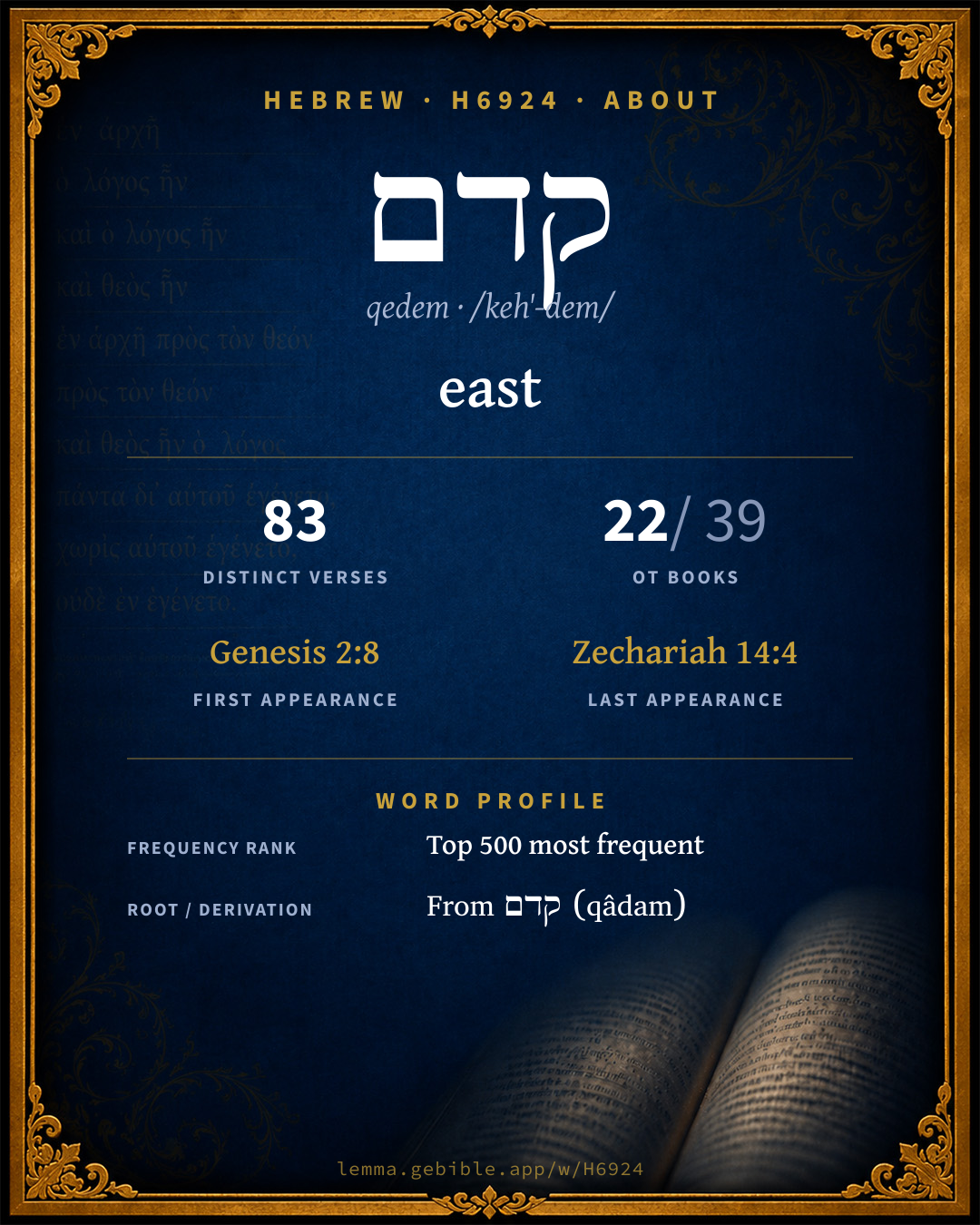
קדם
east
also: antiquity, front, aforetime fuller range ↓
Full lexicon entry — Brown-Driver-Briggs (BDB)
From Brown-Driver-Briggs (BDB)
Where this word appears
See every Absolute-state word in the Hebrew Bible →
Grammar key — what these labels mean
Part of speech
- Noun
- A naming word — a person, place, thing, or idea.
- Adverb
- A word that modifies a verb, adjective, or other adverb.
Noun type
- Common
- A common noun — a general class of person, place, or thing (“king,” “city,” “water”), not a specific name.
State
- Absolute
- The independent form of a noun, not bound to a following word.
- Construct
- A noun bound to a following noun in a possessive / “of” relationship (the construct chain).
Gender
- Masculine
- Grammatically masculine.
Number
- Singular
- One.
- Plural
- More than one (in Hebrew, generally three or more).
Grammatical forms
- Noun, Common, Masculine, Singular, Absolute 83 times (95%)
- Adverb 2 times (2%)
- Noun, Common, Masculine, Singular, Construct 1 time (1%)
- Noun, Common, Masculine, Plural, Construct 1 time (1%)
Parsed forms decoded from the imported morphology (morphhb / Westminster Leningrad Codex — WLC text public domain, morphhb tagging CC BY 4.0), counted across 87 parsed occurrences — not distinct verses.
Every verse where H6924 appears — 83 distinct verses across 22 books. Click any verse to open its interlinear word-by-word view. Verse text shown in the World English Bible for context — . Each verse’s Hebrew form is shown with its reference; the English is not keyword-highlighted, since the data carries no word-level English alignment. Use “Compare translations” on any verse to read it across multiple English versions. This concordance covers the Hebrew Bible; Septuagint (Greek Old Testament) occurrences are not indexed here.
Genesis 10 verses
- Genesis 2:8 מִ/קֶּ֑דֶם prep + n c ms Yahweh God planted a garden eastward, in Eden, and there he put the man whom he had formed.
- Genesis 3:24 מִ/קֶּ֨דֶם prep + n c ms So he drove out the man; and he placed Cherubs at the east of the garden of Eden, and the flame of a sword which turned every way, to guard the way to the tree of life.
- Genesis 10:30 הַ/קֶּֽדֶם ptcl def.art + n c ms Their dwelling was from Mesha, as you go toward Sephar, the mountain of the east.
- Genesis 11:2 מִ/קֶּ֑דֶם prep + n c ms It happened, as they traveled east, that they found a plain in the land of Shinar; and they lived there.
- Genesis 12:8 מִ/קֶּ֛דֶם מִ/קֶּ֔דֶם prep + n c ms prep + n c ms He left from there to the mountain on the east of Bethel, and pitched his tent, having Bethel on the west, and Ai on the east. There he built an altar to Yahweh, and called on the name of Yahweh.
- Genesis 13:11 מִ/קֶּ֑דֶם prep + n c ms So Lot chose the Plain of the Jordan for himself. Lot traveled east, and they separated themselves the one from the other.
- Genesis 13:14 וָ/קֵ֥דְמָ/ה conj + n c ms + sfx dem Yahweh said to Abram, after Lot was separated from him, "Now, lift up your eyes, and look from the place where you are, northward and southward and eastward and westward,
- Genesis 25:6 קֵ֖דְמָ/ה קֶֽדֶם n c ms + sfx dem n c ms but to the sons of the concubines who Abraham had, Abraham gave gifts. He sent them away from Isaac his son, while he yet lived, eastward, to the east country.
- Genesis 28:14 וָ/קֵ֖דְמָ/ה conj + n c ms + sfx dem Your seed will be as the dust of the earth, and you will spread abroad to the west, and to the east, and to the north, and to the south. In you and in your seed will all the families of the earth be blessed.
- Genesis 29:1 קֶֽדֶם n c ms Then Jacob went on his journey, and came to the land of the children of the east.
Exodus 2 verses
Leviticus 2 verses
- Leviticus 1:16 קֵ֔דְמָ/ה adv + sfx dem and he shall take away its crop with its filth, and cast it beside the altar on the east part, in the place of the ashes.
- Leviticus 16:14 קֵ֑דְמָ/ה n c ms + sfx dem He shall take some of the blood of the bull, and sprinkle it with his finger on the mercy seat on the east; and before the mercy seat he shall sprinkle some of the blood with his finger seven times.
Numbers 9 verses
- Numbers 2:3 קֵ֣דְמָ/ה n c ms + sfx dem Those who encamp on the east side toward the sunrise shall be of the standard of the camp of Judah, according to their divisions: and the prince of the children of Judah shall be Nahshon the son of Amminadab.
- Numbers 3:38 קֵ֣דְמָ/ה n c ms + sfx dem Those who encamp before the tabernacle eastward, in front of the Tent of Meeting toward the sunrise, shall be Moses, and Aaron and his sons, keeping the charge of the sanctuary for the charge of the children of Israel. The stranger who comes near shall be put to death.
- Numbers 10:5 קֵֽדְמָ/ה n c ms + sfx dem When you blow an alarm, the camps that lie on the east side shall take their journey.
- Numbers 23:7 קֶ֔דֶם n c ms He took up his parable, and said, From Aram has Balak brought me, The king of Moab from the mountains of the East: Come, curse me Jacob, Come, defy Israel.
- Numbers 34:3 קֵֽדְמָ/ה n c ms + sfx dem then your south quarter shall be from the wilderness of Zin along by the side of Edom, and your south border shall be from the end of the Salt Sea eastward;
- Numbers 34:10 קֵ֑דְמָ/ה n c ms + sfx dem You shall mark out your east border from Hazar Enan to Shepham;
- Numbers 34:11 מִ/קֶּ֣דֶם קֵֽדְמָ/ה prep + n c ms n c ms + sfx dem and the border shall go down from Shepham to Riblah, on the east side of Ain; and the border shall go down, and shall reach to the side of the sea of Chinnereth eastward;
- Numbers 34:15 קֵ֥דְמָ/ה n c ms + sfx dem the two tribes and the half-tribe have received their inheritance beyond the Jordan at Jericho eastward, toward the sunrise.
- Numbers 35:5 קֵ֣דְמָ/ה n c ms + sfx dem You shall measure outside of the city for the east side two thousand cubits, and for the south side two thousand cubits, and for the west side two thousand cubits, and for the north side two thousand cubits, the city being in the midst. This shall be to them the suburbs of the cities.
Deuteronomy 2 verses
Joshua 5 verses
- Joshua 7:2 מִ/קֶּ֣דֶם prep + n c ms Joshua sent men from Jericho to Ai, which is beside Beth Aven, on the east side of Bethel, and spoke to them, saying, Go up and spy out the land. The men went up and spied out Ai.
- Joshua 15:5 קֵ֨דְמָ/ה֙ n c ms + sfx dem The east border was the Salt Sea, even to the end of the Jordan. The border of the north quarter was from the bay of the sea at the end of the Jordan;
- Joshua 18:20 קֵ֑דְמָ/ה n c ms + sfx dem The Jordan was the border of it on the east quarter. This was the inheritance of the children of Benjamin, by the borders of it round about, according to their families.
- Joshua 19:12 קֵ֚דְמָ/ה n c ms + sfx dem and it turned from Sarid eastward toward the sunrise to the border of Chisloth Tabor; and it went out to Daberath, and went up to Japhia;
- Joshua 19:13 קֵ֣דְמָ/ה n c ms + sfx dem and from there it passed along eastward to Gath Hepher, to Eth-kazin; and it went out at Rimmon which stretches to Neah;
Judges 5 verses
- Judges 6:3 קֶ֖דֶם n c ms So it was, when Israel had sown, that the Midianites came up, and the Amalekites, and the children of the east; they came up against them;
- Judges 6:33 קֶ֖דֶם n c ms Then all the Midianites and the Amalekites and the children of the east assembled themselves together; and they passed over, and encamped in the valley of Jezreel.
- Judges 7:12 קֶ֨דֶם֙ n c ms The Midianites and the Amalekites and all the children of the east lay along in the valley like locusts for multitude; and their camels were without number, as the sand which is on the sea-shore for multitude.
- Judges 8:10 קֶ֑דֶם n c ms Now Zebah and Zalmunna were in Karkor, and their hosts with them, about fifteen thousand men, all who were left of all the host of the children of the east; for there fell one hundred twenty thousand men who drew sword.
- Judges 8:11 מִ/קֶּ֥דֶם prep + n c ms Gideon went up by the way of those who lived in tents on the east of Nobah and Jogbehah, and struck the host; for the host was secure.
1 Kings 3 verses
- 1 Kings 4:30 קֶ֑דֶם n c ms Solomon's wisdom excelled the wisdom of all the children of the east, and all the wisdom of Egypt.
- 1 Kings 7:39 קֵ֖דְמָ/ה n c ms + sfx dem He set the bases, five on the right side of the house, and five on the left side of the house: and he set the sea on the right side of the house eastward, toward the south.
- 1 Kings 17:3 קֵ֑דְמָ/ה n c ms + sfx dem Get you hence, and turn you eastward, and hide yourself by the brook Cherith, that is before the Jordan.
2 Kings 2 verses
- 2 Kings 13:17 קֵ֖דְמָ/ה n c ms + sfx dem He said, Open the window eastward; and he opened it. Then Elisha said, Shoot; and he shot. He said, Yahweh's arrow of victory, even the arrow of victory over Syria; for you shall strike the Syrians in Aphek, until you have consumed them.
- 2 Kings 19:25 קֶ֖דֶם n c ms Haven't you heard how I have done it long ago, and formed it of ancient times? now have I brought it to pass, that it should be yours to lay waste fortified cities into ruinous heaps.
2 Chronicles 1 verse
Nehemiah 1 verse
Job 3 verses
- Job 1:3 קֶֽדֶם n c ms His possessions also were seven thousand sheep, three thousand camels, five hundred yoke of oxen, five hundred she-donkeys, and a very great household; so that this man was the greatest of all the children of the east.
- Job 23:8 קֶ֣דֶם n c ms "If I go east, he is not there; If west, I can't find him;
- Job 29:2 קֶ֑דֶם n c ms "Oh that I were as in the months of old, As in the days when God watched over me;
Psalms 11 verses
- Psalms 44:1 קֶֽדֶם n c ms We have heard with our ears, God; Our fathers have told us, What work you did in their days, In the days of old.
- Psalms 55:19 קֶ֗דֶם n c ms God, who is enthroned forever, Will hear, and answer them. Selah. They never change, Who don't fear God.
- Psalms 68:33 קֶ֑דֶם n c ms To him who rides on the heaven of heavens, which are of old; Behold, he utters his voice, a mighty voice.
- Psalms 74:2 קֶּ֗דֶם n c ms Remember your congregation, which you purchased of old, Which you have redeemed to be the tribe of your inheritance; Mount Zion, in which you have lived.
- Psalms 74:12 מִ/קֶּ֑דֶם prep + n c ms Yet God is my King of old, Working salvation in the midst of the earth.
- Psalms 77:5 מִ/קֶּ֑דֶם prep + n c ms I have considered the days of old, The years of ancient times.
- Psalms 77:11 מִ/קֶּ֣דֶם prep + n c ms I will remember Yah's deeds; For I will remember your wonders of old.
- Psalms 78:2 קֶֽדֶם n c ms I will open my mouth in a parable. I will utter dark sayings of old,
- Psalms 119:152 קֶ֣דֶם n c ms Of old I have known from your testimonies, That you have founded them forever.
- Psalms 139:5 וָ/קֶ֣דֶם conj + n c ms You hem me in behind and before. You laid your hand on me.
- Psalms 143:5 מִ/קֶּ֗דֶם prep + n c ms I remember the days of old. I meditate on all your doings. I contemplate the work of your hands.
Proverbs 2 verses
Isaiah 9 verses
- Isaiah 2:6 מִ/קֶּ֔דֶם prep + n c ms For you have forsaken your people, the house of Jacob, Because they are filled from the east, With those who practice divination like the Philistines, And they clasp hands with the children of foreigners.
- Isaiah 9:12 מִ/קֶּ֗דֶם prep + n c ms the Syrians before, and the Philistines behind; and they shall devour Israel with open mouth. For all this his anger is not turned away, but his hand is stretched out still.
- Isaiah 11:14 קֶ֑דֶם n c ms They shall fly down on the shoulder of the Philistines on the west; together shall they despoil the children of the east: they shall put forth their hand on Edom and Moab; and the children of Ammon shall obey them.
- Isaiah 19:11 קֶֽדֶם n c ms The princes of Zoan are utterly foolish; the counsel of the wisest counselors of Pharaoh is become brutish: how do you say to Pharaoh, I am the son of the wise, the son of ancient kings?
- Isaiah 23:7 קֶ֤דֶם n c ms Is this your joyous [city], whose antiquity is of ancient days, whose feet carried her afar off to sojourn?
- Isaiah 37:26 קֶ֖דֶם n c ms Have you not heard how I have done it long ago, and formed it of ancient times? now have I brought it to pass, that it should be your to lay waste fortified cities into ruinous heaps.
- Isaiah 45:21 מִ/קֶּ֜דֶם prep + n c ms Declare you, and bring [it] forth; yes, let them take counsel together: who has shown this from ancient time? who has declared it of old? Haven't I, Yahweh? and there is no God else besides me, a just God and a Savior; there is no one besides me.
- Isaiah 46:10 וּ/מִ/קֶּ֖דֶם conj + prep + n c ms declaring the end from the beginning, and from ancient times things that are not [yet] done; saying, My counsel shall stand, and I will do all my pleasure;
- Isaiah 51:9 קֶ֔דֶם n c ms Awake, awake, put on strength, arm of Yahweh; awake, as in the days of old, the generations of ancient times. Isn't it you who did cut Rahab in pieces, who pierced the monster?
Jeremiah 3 verses
- Jeremiah 30:20 כְּ/קֶ֔דֶם prep + n c ms Their children also shall be as before, and their congregation shall be established before me; and I will punish all who oppress them.
- Jeremiah 46:26 קֶ֖דֶם n c ms and I will deliver them into the hand of those who seek their lives, and into the hand of Nebuchadrezzar king of Babylon, and into the hand of his servants; and afterwards it shall be inhabited, as in the days of old, says Yahweh.
- Jeremiah 49:28 קֶֽדֶם n c ms Of Kedar, and of the kingdoms of Hazor, which Nebuchadrezzar king of Babylon struck. Thus says Yahweh: Arise you, go up to Kedar, and destroy the children of the east.
Lamentations 3 verses
- Lamentations 1:7 קֶ֑דֶם n c ms Jerusalem remembers in the days of her affliction and of her miseries all her pleasant things that were from the days of old: When her people fell into the hand of the adversary, and none did help her, The adversaries saw her, they did mock at her desolations.
- Lamentations 2:17 קֶ֔דֶם n c ms Yahweh has done that which he purposed; he has fulfilled his word that he commanded in the days of old; He has thrown down, and has not pitied: He has caused the enemy to rejoice over you; he has exalted the horn of your adversaries.
- Lamentations 5:21 כְּ/קֶֽדֶם prep + n c ms Turn you us to you, Yahweh, and we shall be turned; Renew our days as of old.
Ezekiel 5 verses
- Ezekiel 8:16 קֵ֔דְמָ/ה קֵ֖דְמָ/ה n c ms + sfx dem n c ms + sfx dem He brought me into the inner court of Yahweh's house; and see, at the door of the temple of Yahweh, between the porch and the altar, were about twenty-five men, with their backs toward the temple of Yahweh, and their faces toward the east; and they were worshipping the sun toward the east.
- Ezekiel 11:23 מִ/קֶּ֥דֶם prep + n c ms The glory of Yahweh went up from the midst of the city, and stood on the mountain which is on the east side of the city.
- Ezekiel 25:4 קֶ֜דֶם n c ms therefore, behold, I will deliver you to the children of the east for a possession, and they shall set their encampments in you, and make their dwellings in you; they shall eat your fruit, and they shall drink your milk.
- Ezekiel 25:10 קֶ֨דֶם֙ n c ms to the children of the east, [to go] against the children of Ammon; and I will give them for a possession, that the children of Ammon may not be remembered among the nations.
- Ezekiel 45:7 קֵ֖דְמָ/ה n c ms + sfx dem [Whatever is] for the prince [shall be] on the one side and on the other side of the holy offering and of the possession of the city, in front of the holy offering and in front of the possession of the city, on the west side westward, and on the east side eastward; and in length answerable to one of the portions, from the west border to the east border.
Jonah 1 verse
Micah 2 verses
- Micah 5:2 מִ/קֶּ֖דֶם prep + n c ms But you, Bethlehem Ephrathah, Being small among the clans of Judah, Out of you one will come forth to me that is to be ruler in Israel; Whose goings forth are from of old, from everlasting.
- Micah 7:20 קֶֽדֶם n c ms You will give truth to Jacob, and mercy to Abraham, As you have sworn to our fathers from the days of old.
Habakkuk 1 verse
Zechariah 1 verse
About this entry
At a glance — auto-summarized from this page’s data, not written by a person. Every figure links to its source below. This summary describes the numbers; it doesn’t interpret them.
קדם — transliterated qedem — is a Hebrew word carrying the sense “east.” Debuting at Genesis 2:8, it then recurs through the corpus. With 83 verses in 22 books, it is a moderately common word in the Hebrew Bible. Alongside “east” the lexicon also lists “antiquity”, “front”, and “aforetime” — part of its full sense range. Sharing its root, it stands alongside קדם, קדום and קדים. See the sense tree, 83-verse concordance, and the renderings breakdown below.
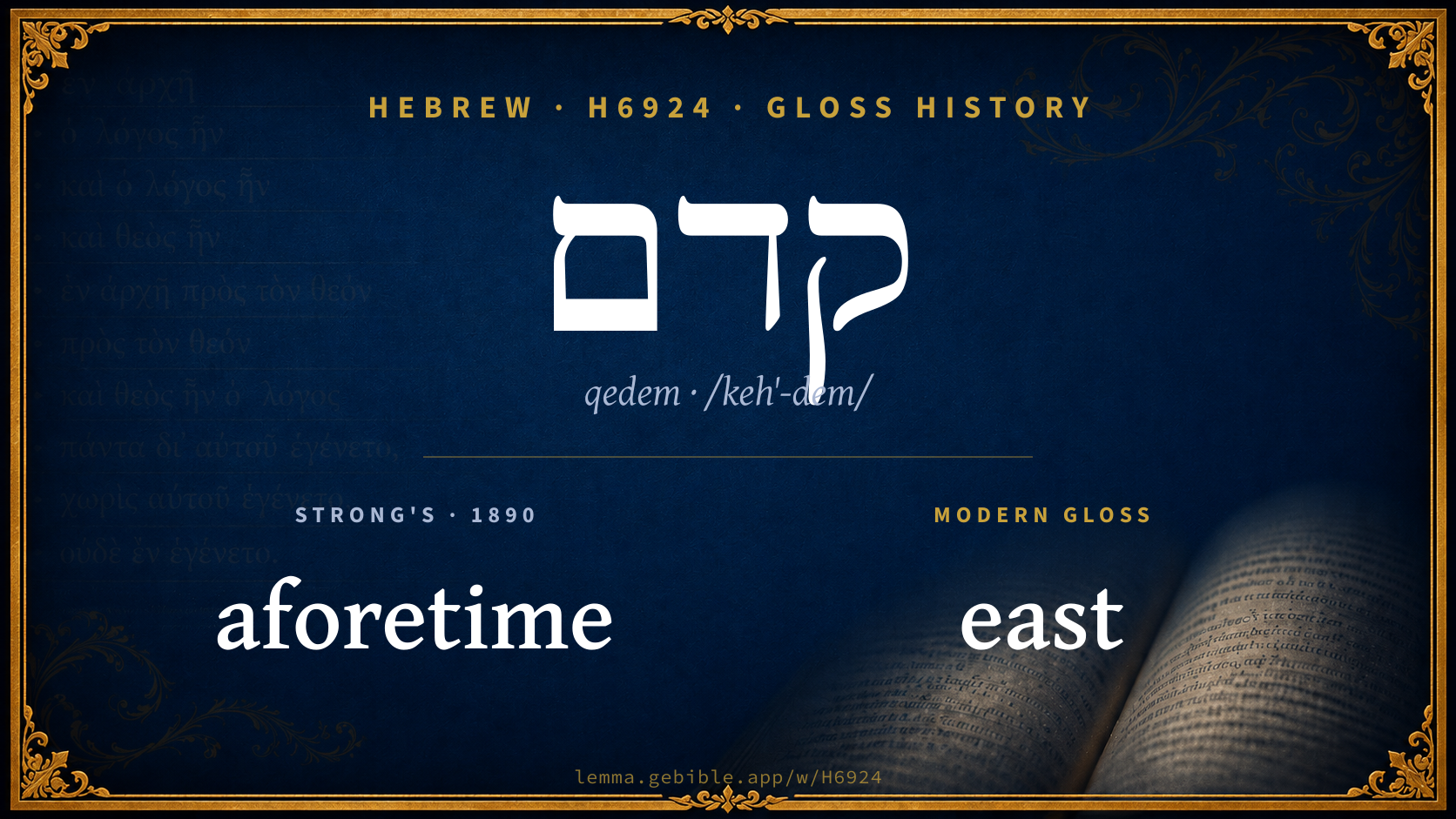
Gloss history
Strong's 1890 vs modern scholarship
About this word
Strong's H6924 catalogs a Hebrew word from the Hebrew Old Testament.
These counts are not copied from any lexicon or concordance. They are computed here, from the morphology-tagged Hebrew Old Testament. What Lemma adds →
- 83
- distinct verses
- The word appears in 83 distinct verses.
- 22 / 39
- OT books
- The word appears in 22 of 39 Old Testament books.
- #470
- by frequency
- Top 500 most frequent Hebrew words (rank 470 of 8,640 Hebrew words by occurrence).
View all 83 occurrences in the concordance →
By section of the Old Testament
By traditional corpus
Conventional, traditional groupings — biblical authorship is debated, so this is a traditional corpus grouping, not an authorship claim. Each share is this word’s portion of its verses in that division of the Hebrew canon. Each figure is a share of the word’s 83 distinct verses.
- Prophets (Nevi'im) 37 verses · 45%
- Torah (Pentateuch) 25 verses · 30%
- Writings (Ketuvim) 21 verses · 25%
How translations render this word
Counts come from each version’s own published word-to-Strong’s tagging or interlinear alignment — an approximate guide to how each version renders this word, not a word-level alignment the data otherwise carries. Because each total is that version’s own tagged count, the per-version totals vary from one another and need not match the appearance or distinct-verse counts above. These counts may also differ from a printed concordance because Lemma counts each distinctly tagged rendering and does not collapse phrase taggings into a single head-word total. This is a fixed set of word-tagged versions (KJV, ASV, BSB, ULT) and does not change with the reading translation you choose elsewhere. Each version’s license is shown beside its name below (and on Sources).
BDB lists this Strong’s number as 2 distinct words (homographs). Each count above pools all of them and is not split by sense — see the Senses section below. A low-frequency rendering may belong to a different one of those words, not the primary meaning.
- King James Version†: East 29×, Old 15×, Eastward 10×
- American Standard Version†: East 29×, Old 15×, Eastward 10×
- Berean Standard Bible†: East 35×, Old 12×, Eastern 5×
- unfoldingWord Literal Text†: East 38×, Antiquity 14×, Eastward 12×
King James Version Public Domain
Renders H6924 across 86† tagged occurrences — most commonly:
Plus 17 renderings that appear only once — usually multi-word phrases or single function words the recovered tagging swept in, not distinct renderings. Not rendered by a distinct English word in 1 further occurrence.
American Standard Version Public Domain
Renders H6924 across 86† tagged occurrences — most commonly:
Plus 16 renderings that appear only once — usually multi-word phrases or single function words the recovered tagging swept in, not distinct renderings.
Berean Standard Bible Public Domain
Renders H6924 across 85† tagged occurrences — most commonly:
Plus 13 renderings that appear only once — usually multi-word phrases or single function words the recovered tagging swept in, not distinct renderings. Not rendered by a distinct English word in 1 further occurrence.
unfoldingWord Literal Text CC BY-SA 4.0
Renders H6924 across 85† tagged occurrences — most commonly:
Plus 14 renderings that appear only once — usually multi-word phrases or single function words the recovered tagging swept in, not distinct renderings.
9 senses and sub-senses in the full BDB
What do BDB’s symbols mean?
BDB uses these scholarly abbreviations:
| Symbol | Meaning |
|---|---|
| 𝔊 | the Septuagint (the ancient Greek translation, LXX) |
| 𝔙 | the Vulgate (the Latin translation) |
| 𝔖 | the Syriac version (the Peshitta) |
| 𝔗 | the Targum (the Aramaic translation) |
| ψ | the Psalms |
| √ | root (the underlying root or stem) |
| ‖ | parallel passage (a synonymous or contrasted parallel) |
| † | the dagger: every passage where the word occurs is cited |
The 9 senses and sub-senses the full Brown-Driver-Briggs lexicon distinguishes for this word, in lexicon order (not ranked by frequency), with BDB’s own verbatim wording and sub-sense lettering. Shown in Hebrew script with BDB’s own scholarly abbreviations. The condensed entry is in the Lexicon Entry tab. See also the Forms in the corpus table below.
קדם I [m.] front, east, aforetime
- 1. loc.
- a. front, מִקּ׳ Is 9:11 from the front (i.e. East), in front (opp. מֵאָחוֹר), אָחוֹר וָק׳ ψ 139:5 behind and before; ק׳ אֶהֱלֹךְ Jb 23:8 I go forward (opp. אָחוֹר). e.g. Isaiah 9:11
- b. East: הַר־הַקּ׳ Gn 10:30 (J) mount of the East; בְּנֵי־ק׳ = dwellers in the E., tribes E. or NE. of Canaan Gn 29:1 (E), Ju 6:3, 33; 7:12; 8:10; 1 K 5:10; Is 11:14; Je 49:28; Ez 25:4, 10; Jb 1:3; הַרְרֵי ק׳ Nu 23:7, v. Di SachauReise (1883), 159 ff. 165 ff. Dr in Hastpethor; אֶרֶץ ק׳ Gn 25:6 (J); מָֽלְאוּ מִקֶּדֶם Is 2:6 they are full from the E. (ins. prob. קֶסֶם, מִקְסָם, or קֹסְמִים before מִקּ׳, cf. Lo De Du CheHpt. Di-Kit); elsewhere מִקּ׳ = eastward: (1) in the E. Gn 2:8; (2) on the E. (side) 12:8 (J) Zc 14:4; מִקּ׳ לְ on the E. of Gn 3:24 (J), 12:8 (J), Nu 34:11 (P), Jos 7:2 (JE), Ju 8:11; Ez 11:23; Jon 4:5; (3) eastward, c. vb. of motion Gn 11:2; 13:11 (both J). e.g. Genesis 10:30
- 2. temp., ancient time, aforetime:
- a. הַרְרֵי ק׳ Dt 33:15 ancient mts., cf. אֱלֹהֵי ק׳ v 27, מַלְכֵי־ק׳ Is 19:11, בִּשְׁמֵי שְׁמֵי־ק׳ ψ 68:34. e.g. Deuteronomy 33:15
- b. בִּימֵי ק׳ ψ 44:2 in ancient days; cf. מִימֵי ק׳ from of old Is 23:7; Mi 7:20; La 1:7; 2:17, Is 37:26 = לְמִימֵי ק׳ 2 K 19:25 (v. מִן 9 b (2)); כִּימֵי ק׳ Is 51:9; Je 46:26; יַרְחֵי קֹ Jb 29:2 months of old. e.g. Psalms 44:2
- c. מִקּ׳ from of old Mi 5:1; Is 45:21; 46:10; Hb 1:12; Ne 12:46 ψ 74:12; 77:12; מִנִּי־ק׳ 78:2 springing out of, derived from, ancient times (cf. Dr); יָמִים מִקּ׳ 77:6; 143:5 days from of old. e.g. Micah 5:1
- d. ק׳ alone, as adv. anciently, of old ψ 74:2; 119:152; כְּק׳ Je 30:20; La 5:21; ישֵׁב ק׳ ψ 55:20 he that sitteth (enthroned from) of old. e.g. Psalms 74:2
- e. beginning, מִקַּדְמֵי־אָ֑רֶץ Pr 8:23 from the beginnings of the earth; ק׳ מִפְעָלָיו Pr 8:22 the beginning of his works (‖ רֵאשִׁית). e.g. Proverbs 8:23
קדם II c. ה loc. i. קִ֫דְמָה adv. eastward to, toward the East
Senses from the full Brown-Driver-Briggs lexicon (Brown, Driver, Briggs; Oxford 1906 — public domain), digitized via Sefaria, supplemented by the OpenScriptures HebrewLexicon (CC BY 4.0). Full attribution on Sources.
Word origin
I. n.[m.] front, east, aforetime;—abs. ק׳ Dt 33:27 +, קֶ֑דֶם Ju 8:10 +, cstr. קֶדֶם Pr 8:22; once pl. cstr. קַדְמֵי v 23;—
I. c. ה loc. i. קִ֫דְמָה adv. eastward to, toward the East;—Gn 25:6 (J), Lv 1:16; 16:14; Nu 34:3, 11, 15; Jos 19:12, 13 (all P), 1 K 7:39 = 2 Ch 4:10; 1 K 17:3; 2 K 13:17; Ez 8:16(×2); + N, S, W, Gn 13:14; 28:14 (both J), Nu 2:3; 3:28; 10:5 (N, W, in 𝔊), 34:10 (all P); also as n. after פְּאַח = E. side, Ex 27:13; 38:13 (both P), + W Ez 45:7 (del. Co; read קֶדֶם Berthol Toy Krae), + N, S, W, Nu 35:5 Jos 18:20 so גְּבוּל ק׳ 15:5 (all P).
— Brown-Driver-Briggs (Oxford 1906, public domain), digitized via Sefaria, supplemented by the OpenScriptures HebrewLexicon (CC BY 4.0). See Sources.
Derived from קדם (qâdam) (H6923) — to meet.
Jastrow Dictionary
A second Hebrew/Aramaic lexicon for comparison, covering Aramaic and post-biblical (Talmudic, Targumic, Midrashic) usage that the biblical-Hebrew BDB does not. Matched by lemma rather than by Strong’s number, so a lemma may carry more than one Jastrow headword (shown separately below), and the entries cover usage well beyond the Bible.
קָדַם
- (b. h.) [to bend, go forward,] to advance, precede; to anticipate. Y. Meg. III, 74ᵃ bot. צפה … מוטב שיִקְדּוֹם … לכספו וכ׳ the Lord foresaw that Haman the wicked would weigh his silver for Israel’s destruction (Esth. III, 9), and he said, it is better that my children’s silver (the half-Shekel, Ex. XXX, 11 sq.) anticipate Haman’s silver (to act as a protection from evil designs); ib. I, 70ᵈ bot. שיַּקְדִּים (Hif.). Sifra Vayiḳra, Ḥob., Par. 3, ch. V, v. infra. Gen. R. s. 1 ששה דברים קָדְמוּ וכ׳ six things preceded the creation of the world. Ib. איני יודע איזה מהן קוֹדֵם אם התורה קָדְמָה וכ׳ I know not yet, which of them was first, whether the Torah was created before the throne of glory &c. Ib. התורה קדמה וכ׳, v. קְרִימָה. Ḥull. 100ᵃ, sq. ק׳ וסלקו he removed it first (before putting in other pieces). Snh. 38ᵃ; Lev. R. s. 14, beg. יתוש קְדָמְךָ, v. יַתּוּשׁ. B. Mets. II, 11 אבדתו … אבדתו קוֹדֶמֶת if a man’s own loss and his father’s loss are to be attended to, his own has the precedence; ib. שלו קודמת (Bab. ed. 33ᵃ קודם). Ab. III, 9 כל … קודמת לחכמתו וכ׳ he to whom fear of sin comes before his learning, his learning will endure. Y. Ned. IX, 42ᶜ bot. חיי העיר הזאת קוֹדְמִין וכ׳ the supply of provisions for the people of one’s own town has the precedence over &c. Kel. XXV, 4, v. כַּתְּ; a. fr. e.g. Esther 3:9
- , Taan. 20ᵃ נקדמה, v. נָקַד I.]
- to get the start of. Y. Taan. I, end, 64ᵈ שלא יְקַדְּמֶנּוּ אחר lest another man get ahead of him (in proposing to a woman he desires to marry); Y. Bets. V, 63ᵃ bot. Sifré Deut. 34 לא קִידְּמוּם מצוות וכ׳ no other commands were promulgated before them; a. fr.
- 1. to advance; to do first; to anticipate, provide against. Y. Meg. l. c. לפיכך מַקְדִּימִין וקירין וכ׳ therefore we read the section of Sh’ḳalim first (before the first of Adar, and before the Sabbath Zakhor); Bab. ib. 13ᵇ לפיכך ה׳ שקליהן וכ׳ therefore the Lord ordered their Shekels in anticipation of his (Haman’s) Shekels, v. supra. Ib. 30ᵃ מקדימין לשבת שעברה we read it the Sabbath before, opp. מאחרין. Ib. when Purim falls on a Friday, מקדימין פרשת זכור we read the section Zakhor on the Sabbath previous. Y. Sot. VIII, 22ᵈ bot. ה׳ לו שכרי if he paid the builder in advance. Zeb. 106ᵃ (ref. to Lev. IV, 12) שיהא שם דשן שיַקְדִּים לשם דשן this means that ashes must be there, that he must first have put ashes there; Sifra Vayikra l. c. שׁיִקְדּו̇ם; a. fr.—ה׳ שלום to salute first. Ber. 6ᵇ כל שיודע … יקדים לו שלום he who knows his neighbor to be in the habit of greeting him, should salute him first. Ib. 17ᵃ לא הִקְדִּימוֹ אדם וכ׳ never was a man the first in saluting him, not even a stranger &c. Ex. R. s. 23 באו … להַקְדִּים שירה the angels came wanting to be the first to offer song; יַקְדִּימוּ בני תחלה let my children be the first; a. v. fr.—Part. pass. מוּקְדָּם; f. מוּקְדֶּמֶת; pl. מוּקְדָּמִים &c. Pes. 6ᵇ, a. fr. אין מ׳ ומאוחר וכ׳, v. אָחַר. Shebi. X, 5, v. פְּרוֹזְבּוּל. Ib. שטרי חוב המ׳ antedated notes of indebtedness. M. Mets. V, 10 נתן עיניו … זו היא רבית מ׳ if he intends to borrow money, and he sends his neighbor a gift and says, ‘in order to make thee inclined to lend me money’,—this is interest paid in advance; a. fr.—2) to be early, zealous. Naz. 23ᵇ, a. e. לעולם יקדים אדם לדבר וכ׳ man should always be anxious to do a good deed as early as possible. Pes. 4ᵃ, a. e. מקדימין וכ׳, v. זָרִיז; a. fr.—[Y. Erub. V, 22ᵈ top שמקדימין העליון, read: שמקדירין or שמקדרין, v. קָדַר I.] e.g. Leviticus 4:12
קְדַם
- ; Pa. קַדֵּם
- 1. to precede; to do early, be early, first. Targ. Ps. LXIX, 32 דקַדִּימוּ קרנוי וכ׳ (some ed. דקָדִ׳) whose horns grew prior to its hoofs. Targ. Gen. XIX, 2; a. fr.—Ber. 8ᵃ מְקַדְּמֵי וכ׳; קַדִּימוּ וחשיכו, v. חֲשַׁךְ I. Tam. 27ᵇ וקַדֵּים וכ׳, v. הֲשַׁךְ I; a. e.
- 2. to go before, come to meet. Targ. Ps. LXXXVIII, 14. Ib. LXXIX, 8 יקדמון לן Ms. (ed. לך, corr. acc.); a. fr.
- 1. to be early. Targ. Gen. XXVI, 31. Targ. I Sam. XVII, 16; a. fr.
- 2. to precede, anticipate. Targ. Job XLI, 3; a. e.
- 3. to get the start of; to prevent. Targ. Ps. XVII, 13; a. e.—3) to be earlier than, be quick in doing. Ib. CXIX, 147, sq.; a. fr.—Sabb. 119ᵃ אי רגיליתו לאַקְדּוּמֵי … אַקְדִּימוּ if you are accustomed to take an early meal, make it later (on the Sabbath), and if you are used to dine late, dine earlier. Ib. 151ᵇ when a poor man comes, אַקְדִּים … דליקַדְּמוּ וכ׳ be quick in giving him bread, in order that people may be ready to do so to thy children.
- 4. to give preference to. Y. Snh. I, 18ᶜ bot. אַקִדְּמוּן ליה … בעיבור they preferred a certain old man to him at the session for intercalation; Y. R. Hash. II, 58ᵇ top; a. e.
קֶדֶם
- (b. h.) olden time, (adv.) before, v. קוֹדֶם.
קֶדֶם ²
- Targ. Ez. XXXVIII, 17; a. e.
קָדָם
- (preced.) [precedence,]
- 1. (prepos. of time and place) before. Targ. Gen. XXIX, 26. Ib. XLIII, 29; a. fr.—With suffix of personal pronoun mostly in pl. Targ. Prov. XXIII, 1 קָדָמָךְ ed. Lag. (oth. ed. קָדָמָיִךְ). Targ. Ps. XCVI, 9 מן קֳדָמוֹי. Ib. 8 לִקְדָמוֹי; a. fr.—Lev. R. s. 37 נפק … קדמוי וכ׳ a proclamation went before him, and all the people came out to meet him. Lam. R. to III, 16; a. fr.
- 2. (conj.) a) ere, before; b) מן ק׳ since, because(h.. Targ. Y. Gen. XIII, 10 ק׳ עד לא. Targ. Prov. VIII, 23. Ib. 25 Ms. (ed. קְדִים); a. fr.—Targ. O. a. Y. II Ex. XIX, 18 מן ק׳ (Y. I מן בגלל).—Y. Yeb. XII, 13ᵃ top; Y. Snh. I, 19ᵃ bot. קרבת קַדְמָנָא she came before us; ורקת קדמנא and spat in our presence; Y. M. Kat. III, 82ᵃ bot. קוּדְמֵינָא; Yeb. 39ᵇ; a. e.—V. קַדְמִין. e.g. Exodus 19:18
A Dictionary of the Targumim, the Talmud Babli and Yerushalmi, and the Midrashic Literature (Marcus Jastrow; London, Luzac, 1903) — Public Domain. Digitized via Sefaria. Digitized via Sefaria. Full attribution on Sources.
Forms in the corpus
The 36 distinct written forms H6924 takes in the Hebrew Bible, most frequent first — each parse links to that state’s occurrences in the concordance. Hebrew forms include their vowel points and cantillation, so a single lemma takes many written forms.
Same root — word family
Other BDB entries built from the same root as H6924, grouped by Strong’s listed origin. These share a root / origin per the lexicon — not necessarily a shared meaning. Each links to that word’s own entry.
Derives from
Shares the same root
- קדום qâdûwm H6917 antiquity
- קדים qâdîym H6921 east
- קדמה qadmâh H6927 antiquity
- קדמון qadmôwn H6930 eastern
- קדמי qadmay H6933 former
- קרדם qardôm H7134 axe
Derived from this word
Proper names from this root
People and places named from this root — a name, not an additional meaning of the word.
Compare all same-root words → Showing 4 of 13 — not the complete family. 3 of the same-root words are proper names (people or places). They share a root, not necessarily a meaning.
Septuagint verse parallels
This word appears in 76 verses that also exist in the Greek Old Testament (Septuagint), out of the 83 Hebrew verses it occurs in. You can read those verses in Greek by switching the Old Testament edition to the Septuagint.
Read these verses in the Septuagint
- Genesis 2:8
- Exodus 27:13
- Leviticus 1:16
- Numbers 2:3
- Deuteronomy 33:15
- Joshua 7:2
- Judges 6:3
- 1 Kings 7:39
- 2 Kings 13:17
- 2 Chronicles 4:10
- Job 1:3
- Psalms 44:1
This is a verse-level parallel only — the same verses exist in both the Hebrew and Greek Old Testaments. No word-level Hebrew↔Greek correspondence is claimed: the data carries no such alignment, so no Greek word is shown as this Hebrew word’s translation. Coverage is not total — the Septuagint omits the deuterocanon and renumbers the Psalms, so some Hebrew verses have no direct Greek parallel.