
Proverbs 8:23

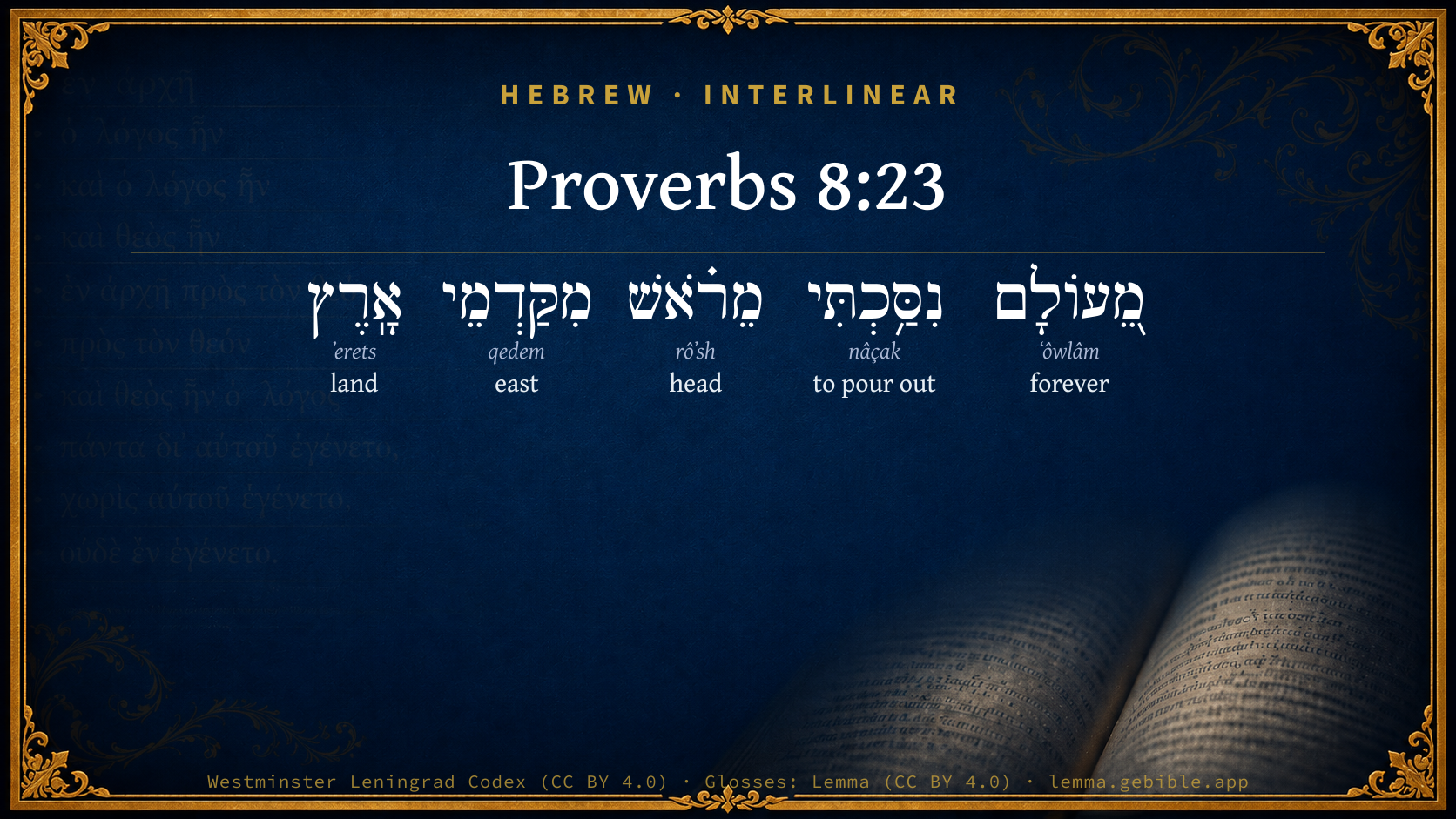
Hebrew (Westminster Leningrad Codex) Proverbs 8:23 appears in the Hebrew Old Testament. The text above is from the Westminster Leningrad Codex. Each word links to its Strong’s number, a concise gloss, and parsing drawn from the Open Scriptures Hebrew Bible morphology. Click any word for its full Brown-Driver-Briggs (BDB) entry.
Download image
Cite this verse

Proverbs 8:23 (World English Bible). Public Domain. Lemma interlinear Bible study tool, https://lemma.gebible.app/v/proverbs/8/23.

Show BibTeX & RIS
BibTeX
RIS
English Translation
I was set up from everlasting, from the beginning, Before the earth existed.
World English Bible · Public Domain
Download a study sheet

One document with this verse’s original text, its word-by-word gloss line, the meaning frame, cross-references with their text, attributed commentary, and full source and license credits — printable, and it pastes into notes with its structure intact.

This verse Autodidact and up

Study sheet (.html) Plain text (.txt)

A passage Seminary Student

Up to 50 verses in one chapter. A passage sheet keeps up to 6 commentary sources and 12 cross-references per verse, in the order this page ranks them, and says so on the sheet whenever that leaves anything out. Ask for a single verse and you get the Autodidact verse sheet above.

Everything on this page stays free to read, with no account — the sheet is a download of what is already on screen, not access to it.

Want to remove ads? Support Godless Engineer
Compare translations 3

The same verse in 3 English versions, stacked beneath the original-language interlinear above. Click any original word for its lexicon entry.

Each is an independent rendering of the whole verse — the interlinear is not word-aligned to these translations.

Highlighted words mark where these versions differ — a whole-verse word diff, not a word-by-word alignment.

  • World English Bible Public Domain
    I was set up from everlasting, from the beginning, Before the earth existed.
  • King James Version Public Domain
    I was set up from everlasting, from the beginning, or ever the earth was.
  • unfoldingWord Literal Text CC BY-SA 4.0
    From eternity I was poured out, from the head, from the ancient times of the earth.

unfoldingWord Literal Text — © unfoldingWord, licensed CC BY-SA 4.0. Word-aligned USFM3 via Door43 (git.door43.org/unfoldingWord/en_ult).

Versions to compare (up to 4)

3 of 4 selected

Show all 18 translations

Every available English version of this verse, each an independent rendering of the whole verse.

  • World English Bible Public Domain
    I was set up from everlasting, from the beginning, Before the earth existed.
  • Berean Standard Bible Public Domain
    From everlasting I was established, from the beginning, before the earth began.
  • Majority Standard Bible Public Domain
    From everlasting I was established, from the beginning, before the earth began.
  • King James Version Public Domain
    I was set up from everlasting, from the beginning, or ever the earth was.
  • American Standard Version (1901) Public Domain
    I was set up from everlasting, from the beginning, Before the earth was.
  • Revised Version (1885) Public Domain
    I was set up from everlasting, from the beginning, or ever the earth was.
  • Geneva Bible (1599) Public Domain
    I was set vp from euerlasting, from the beginning and before the earth.
  • Douay-Rheims (1899) Public Domain
    I was set up from eternity, and of old before the earth was made.
  • Young's Literal Translation Public Domain
    From the age I was anointed, from the first, From former states of the earth.
  • Literal Standard Version CC BY-SA 4.0
    I was anointed from the age, from the first, || From former states of the earth.
  • Unlocked Literal Bible CC BY-SA 4.0
    In ages long ago I was made—from the first, from the beginnings of the earth.
  • unfoldingWord Literal Text CC BY-SA 4.0
    From eternity I was poured out, from the head, from the ancient times of the earth.
  • Darby Bible Public Domain
    I was set up from eternity, from the beginning, before the earth was.
  • World Messianic Bible Public Domain
    I was set up from everlasting, from the beginning, before the earth existed.
  • Webster's Bible Public Domain
    I was set up from everlasting, from the beginning, or ever the earth was.
  • Free Bible Version CC BY-SA 4.0
    I was formed a long time ago, at the first, before the world began.
  • Bible in Basic English Public Domain
    From eternal days I was given my place, from the birth of time, before the earth was.
  • JPS Tanakh (1917) Public Domain
    I was set up from everlasting, from the beginning, or ever the earth was.

Literal Standard Version (2020), Covenant Press — licensed CC BY-SA 4.0. Text via the HelloAO Bible API (eBible.org). Unlocked Literal Bible (unfoldingWord) — licensed CC BY-SA 4.0. Text via the HelloAO Bible API (eBible.org). unfoldingWord Literal Text — © unfoldingWord, licensed CC BY-SA 4.0. Word-aligned USFM3 via Door43 (git.door43.org/unfoldingWord/en_ult). Free Bible Version, Dr. Jonathan Gallagher — licensed CC BY-SA 4.0. Text via the HelloAO Bible API (eBible.org).

Word by word

More ways to search: Search by grammar → Find every occurrence → Compare this word →

Practice this passage: Drill this verse → Learn its vocabulary →

נִסַּ֥כְתִּי
nâçak
H5258
“to pour out”
Verb, Niphal, Perfect, 1st Person, Common, Singular
Part of Speech
Verb
Stem
Niphal
Form
Perfect
Person
1st Person
Gender
Common
Number
Singular
Full BDB Definition

Origin: a primitive root

TWOT: 1375 , 1377

to pour out, pour, offer, cast - (Qal) - to pour out - to cast metal images - to anoint (a king) - (Niphal) to be anointed - (Piel) to pour out (as a libation) - (Hiphil) to pour out libations - (Hophal) to be poured out - to set, install - (Qal) to install - (Niphal) to be installed
  1. מֵ֭עוֹלָם ʻôwlâm H5769 “from · forever” Preposition + Noun, Common, Masculine, Singular, Absolute
  2. מֵרֹ֗אשׁ rôʼsh H7218 “from · head” Preposition + Noun, Common, Masculine, Singular, Absolute
  3. מִקַּדְמֵי qedem H6924 “from · ancient times of” Preposition + Noun, Common, Masculine, Plural, Construct
  4. אָֽרֶץ ʼerets H776 “land” Noun, Common, Both, Singular, Absolute

About this verse

These counts appear in no published source. They are computed here, from the morphology-tagged text and Lemma’s own curated glosses. What Lemma adds →

5
words
5
distinct lemmas
Wisdom
section

Notable vocabulary

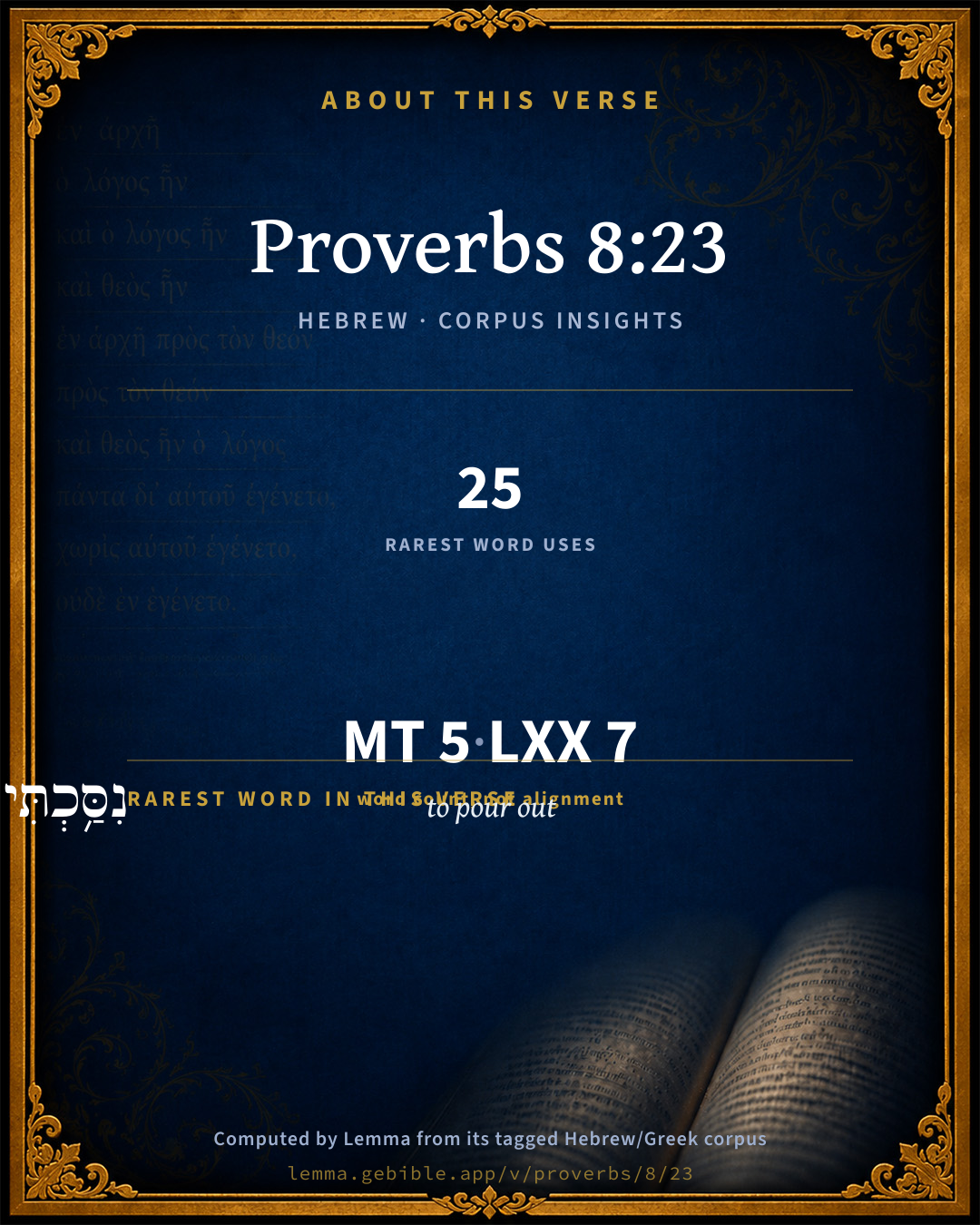
The rarest word here is נִסַּ֥כְתִּי to pour out H5258 — appearing just 25 times in the whole Hebrew Bible.

Shared distinctive vocabulary

נִסַּ֥כְתִּי to pour out H5258 occurs in 24 verses of the Hebrew Bible. Also found in:

Grammatical profile

  • 1 verb
  • 4 nouns

Verb forms

  • נִסַּ֥כְתִּי Niphal · Perfect

Hebrew & Septuagint length

In English translation the verse runs 13 words from the Hebrew and 14 from the Septuagint (LXX English) — closely comparable.

A rough comparison of the two English renderings, which tokenize alike — not a word-level alignment.

Word counts can differ between the Hebrew and the Greek without any difference in meaning — e.g. the Hebrew direct-object marker אֵת has no separate Greek word, and Greek often adds the article ὁ.

In the original languages it is 5 Hebrew tokens and 7 Greek tokens — but the two are counted differently (Hebrew bundles its prefixes and suffixes into one token; the Greek is in lemma form), so that isn’t a like-for-like length.

Cross-references

7

Topical passages linked to Proverbs 8:23 in the Treasury of Scripture Knowledge — connected by theme and wording, ordered by reader-vote popularity; previews shown in the World English Bible.

  • John 17:24 Father, I desire that they also whom you have given me be with me where I am, that they may see my glory, which you have given me, for you loved me before the foundation of the world.
  • Genesis 1:26 God said, "Let us make man in our image, after our likeness: and let them have dominion over the fish of the sea, and over the birds of the sky, and over the cattle, and over all the earth, and over every creeping thing that creeps on the earth."
  • Psalms 2:6 "Yet I have set my king on my holy hill of Zion."
  • Micah 5:2 But you, Bethlehem Ephrathah, Being small among the clans of Judah, Out of you one will come forth to me that is to be ruler in Israel; Whose goings forth are from of old, from everlasting.
  • John 17:5 Now, Father, glorify me with your own self with the glory which I had with you before the world existed.
  • 1 John 1:1–2 That which was from the beginning, that which we have heard, that which we have seen with our eyes, that which we saw, and our hands touched, concerning the Word of life
  • Ephesians 1:10–11 to an administration of the fullness of the times, to sum up all things in Christ, the things in the heavens, and the things on the earth, in him;

Cross-references courtesy of OpenBible.info (CC BY 4.0).

Hebrew and Greek witnesses Masoretic Hebrew ↔ Greek Septuagint

The same verse in the two great witnesses to the Old Testament, shown verse-for-verse.

These are two independent witnesses, not word-aligned to each other, and the Septuagint is shown in lemma (dictionary) form.

Hebrew Proverbs 8:23 Masoretic · Westminster Leningrad Codex

מֵ֭עוֹלָם נִסַּ֥כְתִּי מֵרֹ֗אשׁ מִקַּדְמֵי אָֽרֶץ

I was set up from everlasting, from the beginning, Before the earth existed.

World English Bible · Public Domain

Greek LXX Proverbs 8:23 Septuagint · lemma form

πρό ὁ αἰών θεμελιόω ἐγώ ἐν ἀρχή

He established me before time was in the beginning, before he made the earth:

LXX2012 (modern English Septuagint) · Public Domain

On this verse, The Cambridge Bible for Schools and Colleges discusses the Septuagint’s reading. Read the note in Commentary ↓

Hebrew: Westminster Leningrad Codex (CC BY 4.0). Greek: Septuagint (public domain); English from LXX2012 (modern English Septuagint) (Public Domain). How the Septuagint differs from the Hebrew →

Commentary

Notes on Proverbs 8:23 from classic Christian and Jewish commentators (each source and its license shown beneath its notes). The classic Christian expositions comment on the surrounding passage and are grouped to its opening verse, so a note may address several verses; the Jewish commentaries on the Tanakh (Rashi and others) are per-verse, so they appear only where the commentator wrote on this verse.

Lemma curates 59 commentaries, every one of them public domain or Creative Commons licensed, each selected and text-cleaned for this edition rather than reprinted as found. About our sources →

The Cambridge Bible for Schools and Colleges

gen. ed. J. J. S. Perowne

23. set up] Gesenius renders anointed here and in Psa_2:6, where the same word occurs. But “the verb means ‘to pour out,’ and then ‘to pour metals in a state of fusion into a mould’: hence it passes over into the meaning of setting fast, establishing, &c. So the Niph, Pro_8:23, and hence נָסִיךְ means, not ‘one anointed,’ but ‘one appointed’ to his office.” Bp. Perowne, Crit. Note on Psa_2:6. See also note there in this Series.

ἐθεμελίωσέ με, LXX., ordinata sum, Vulg.

The Cambridge Bible for Schools and Colleges (gen. ed. J. J. S. Perowne; Cambridge University Press, 1878–1918) — public domain. Text from a community e-Sword module.

Trapp's Complete Commentary

John Trapp

Pro 8:23 I was set up from everlasting, from the beginning, or ever the earth was.

Ver. 23. I was set up.] Coronata sum; I was crowned; so some render it. Inuncta fui, I was anointed - so others - for king, priest, and prophet of my Church. And to this high honour I grew not up by degrees, but had it presently from before all beginnings.

John Trapp, A Commentary or Exposition upon All the Books of the Old and New Testament (1647–1656) — public domain. Text from a community e-Sword module.

The Biblical Illustrator

Joseph S. Exell

Pro_8:23

I was set up from everlasting.

Christ set up from everlasting

Doctrine: That as Christ is the everlasting God, so, from all eternity, He was foreordained and set up for the great service of mans redemption.

I. To prove That Christ is the everlasting God.

1. That He existed before the incarnation is evident from the appearance He made to our first parents in paradise.

2. We find His existence and agency in the production of all created beings.

3. Run up to the endless ages before the creation of the world, and we find Him existing or ever the earth was.

II. What is imported in His being set up from everlasting.

1. It supposes the council of peace, or an eternal transaction between the Father and the Son concerning the redemption of lost sinners.

2. It implies the infinite complacency that the Father and Son had in each other from all eternity.

3. It implies a Divine ordination and decree, whereby He was from eternity elected into the great service of mans redemption.

4. It implies that, in consequence of the decree, He was called of God to undertake the work of redemption.

5. It implies His own voluntary consent to, and complacence with, His Fathers call. He was actually set up in time.

(1) His first appearance was in the promise made to our first parents.

(2) Set up typically under the Old Testament.

(3) Set up prophetically.

(4) Personally and actually, in His incarnation, obedience, and death.

(5) In His resurrection and ascension.

(6) Sacramentally, in baptism and the last supper.

(7) In conversion.

(8) Will be set up at His second coming.

III. For what ends and purposes Christ was thus set up.

1. As a sun, to give light to this lower world.

2. As a second Adam, the head of a new covenant of grace and promise.

3. As a repairer of breaches between God and man.

IV. The grounds and reasons way Christ was set up.

1. Because it was the Fathers will and pleasure.

2. Because of the good-will He did bear to man upon earth.

3. Because of His ability for the undertaking.

4. Because He voluntarily offered Himself for the work and service.

5. Because from everlasting God foresaw what a revenue of glory would accrue to the crown of heaven through His mediation.

V. Application of the doctrine. See the antiquity and activity of the love of God; the stability and perpetuity of the covenant of grace and of the Church; the reason why all hands should be at work to exalt Him. (E. Erskine.)

The Biblical Illustrator, edited by Joseph S. Exell (c. 1880s–1900s) — public domain. Text from a community e-Sword module.

Geneva Bible (1599)

Geneva Bible translators

He declareth the eternity of the Son of God, which is meant by this word, wisdom, who was before all time, and ever present with the father.

Geneva Bible (1599) marginal notes — public domain. Text via Bolls.life.

Jamieson, Fausset & Brown

Robert Jamieson, A. R. Fausset & David Brown

I was set up--ordained, or inaugurated (Psa 2:6). The other terms carry out the idea of the earliest antiquity, and illustrate it by the details of creation [Pro 8:24-29].

Jamieson, Fausset & Brown — Commentary Critical and Explanatory on the Whole Bible (1871) — public domain (CC PDM 1.0). Text via the HelloAO Bible API.

Adam Clarke's Commentary

Verse 23. I was set up from everlasting] נסכתי nissachti, "I was diffused or poured out," from נסך nasach, "to diffuse, pour abroad, as a spirit or disposition," Isa 29:10. See Parkhurst. Or from סך sach, "to cover, overspread, smear over, as with oil;" to be anointed king. Hence some have translated it, principatum habui, I had the principality, or was a ruler, governor, and director, from eternity. All the schemes, plans, and circumstances, relative to creation, government, providence, and to all being, material, animal, and intellectual, were conceived in the Divine mind, by the Divine wisdom, from eternity, or ever the earth was. There was no fortuitous creation, no jumbling concourse of original atoms, that entered into the composition of created beings; all was the effect of the plans before conceived, laid down, and at last acted upon by God's eternal wisdom.

Adam Clarke's Commentary on the Bible (1810–1826) — public domain. Text from a community e-Sword/MySword module.

Ellicott's Commentary for English Readers

(23) I was set up.—An unusual word; also applied to our Lord in Psa_2:6 when “set” as King on Zion.

A Bible Commentary for English Readers, edited by Charles John Ellicott (1878–1897) — public domain. Text from a community e-Sword module.

John Gill's Exposition

I was set up from everlasting,.... I, a person, and not a quality; a person, and not a nature; the person of Christ as the Son of God, and not the human nature of Christ, which then did not exist; this phrase designs the ordination and constitution of Christ in his office as Mediator. So the Vulgate Latin version renders it, "I was ordained"; Christ was foreordained to be the Redeemer and Saviour of men, to be the propitiation for their sins, to be the head of the church, and the Judge of the world. It intends likewise his inauguration into his office, and his investiture with it; and because anointing with oil was used in installing persons into the offices of prophet, priest, and king; hence Christ's instalment into his office as Mediator is here expressed by an anointing; for the words may be rendered, "I was anointed" (i); it takes in all that goes to his constitution as Mediator, his call, appointment, and investiture; and the whole of his office, every part and branch of it; and chiefly his kingly office, with reference to which the same word is used Psa 2:6; and so Gersom paraphrases it,

"and there were given to me power, dominion, and greatness;''

all which suppose the eternity of his person; for had he not existed from everlasting, he could not have been set up, and anointed as Mediator, or invested with his office as such;

from the beginning, or ever the earth was; or from the first of the earth, or the original of it; that is, before all time, before the earth or anything was created; this further confirms the eternal existence of Christ's person, the antiquity of his office, the early provision of grace in him as Mediator for his people, and may lead to entertain high and honourable thoughts of him.

(i) "uncta sum", Cocceius, Michaelis, Schultens; "inuncta fui", Gejerus.

John Gill's Exposition of the Whole Bible (1746–1763) — public domain (CC PDM 1.0). Text via the HelloAO Bible API.

Albert Barnes' Notes on the Bible

I was set up - Rather, “I was anointed” (compare Psa 2:6 margin: 2Ch 28:15). The image is that of Wisdom anointed, as at her birth, with “the oil of gladness.”

Or ever the earth was - literally, “from the times before the earth.”

Albert Barnes' Notes on the Bible (1834–1885) — public domain. Text from a community e-Sword/MySword module.

Haydock's Catholic Bible Commentary

Up. Hebrew, "anointed." Septuagint, "he founded." Christ was appointed to be the foundation, on which we must be built. (St. Athanasius iii. Orat.)

George Leo Haydock (1774–1849), Haydock's Catholic Family Bible and Commentary, 1859 edition — public domain. Excludes Psalms (Douay-Rheims chapter numbering differs from Protestant) and Deuterocanonical books (Catholic canon only).

Matthew Poole's English Annotations

Set up, Heb. anointed; ordained or constituted to be the person by whom the Father resolved to do all his works, first to create, and then to uphold, and govern, and judge, and afterwards to redeem and save the world; all which works are particularly ascribed to the Son of God, as is manifest from Joh 1:1, &c.; Col 1:16,17; Heb 1:3, and many other places, as we may see hereafter in their several places.

From the beginning; before which there was nothing but a vast eternity.

Or ever the earth was; which he mentions, because this, together with the heaven, was the first of God’s visible works.

Matthew Poole's English Annotations on the Holy Bible (1683–1685) — public domain. Text from a community e-Sword/MySword module.

Whedon's Commentary on the Bible

Daniel D. Whedon

23. I was set up from everlasting — Rather, from eternity, or from unknown ages, I was anointed.

From the beginning — Before the earth existed. Anointing was the initiating ceremony into high office among the Hebrews; hence the word is equivalent to appointing, constituting, inaugurating. Wisdom was installed in her high functions from eternity. The other expressions, “from the beginning,” “or ever the earth,” are paraphrastic, exegetical, or qualificative. עולם, (‘holam,) rendered everlasting, is not as definite in its signification as our word eternity. It means indefinite or unknown duration. The terms following it define its meaning here.

Daniel D. Whedon (gen. ed.), Commentary on the Old and New Testaments (1874–1909) — public domain. Text from a community e-Sword module.

The Pulpit Commentary

I was set up from everlasting. The verb used here is remarkable. It is (nasak), in niph.; and it is found in Psa_2:6, "I have set my King upon my holy hill." Both here and there it has been translated "anointed," which would make a noteworthy reference to Christ. But there seems no proof that the word has this meaning. It signifies properly "to pour forth" (as of molten metal), then "to put down," "to appoint or establish." The versions recognize this. Thus the Septuagint, "he established (eyemeliwse ) me;" Vulgate, ordinata sum; Aquila, katestayhn ; Symmachus, proeceirismai ; Venetian, kecumai (comp. Ecc_1:9). So what is here said is that Wisdom was from everlasting exalted as ruler and disposer of all things. To express eternal relation, three synonymous terms are used. From everlasting; pro tou aiwnov , Septuagint, as Delitzsch notes, points back to infinite distance. From the beginning; i.e. before the world was begun to be made; as St. John says, (Joh_1:1) "In the beginning was the Word;" and Christ prays, "Glorify thou me with thine own self, with the glory which I had with thee before the world was". (Joh_17:5) Or ever the earth was. This looks to the most remote time after the actual creation, while the earth was being formed and adapted.

The Pulpit Commentary (1880–1919), ed. H.D.M. Spence-Jones & Joseph S. Exell — public domain. Text from a community e-Sword module.

John Wesley's Explanatory Notes

Set up - Hebrew. anointed, constituted to be the person by whom the Father resolved to do all his works, to create, to uphold and govern and judge, to redeem and save the world. From the beginning - Before which, there was nothing but a vast eternity. The earth - Which together with the heaven, was the first of God's visible works.

John Wesley, Explanatory Notes Upon the Whole Bible (1754–1765) — public domain. Text via the GEBible commentary corpus.

Keil & Delitzsch

C. F. Keil & F. Delitzsch

A designation of the When? expressed first by מאז (Isa 48:8, cf. Isa 40:21), is further unfolded:

"From everlasting was I set up,

From the beginning, from the foundations of the earth."

That נסּכתּי cannot be translated: I was anointed = consecrated, vid., at Psa 2:6. But the translation also: I was woven = wrought (Hitzig, Ewald, and previously one of the Greeks, ἐδιάσθην), does not commend itself, for רקּם (Psa 139:15), used of the embryo, lies far from the metaphorical sense in which נסך = Arab. nasaj, texere, would here be translated of the origin of a person, and even of such a spiritual being as Wisdom; נסדתּי, as the lxx reads (ἐθεμελιωσέ με), is not once used of such. Rightly Aquila, κατεστάθην; Symmachus, προκεχείρισμαι; Jerome, ordinata sum. Literally, but unintelligibly, the Gr. Venet. κέχυμαι, according to which (cf. Sir. 1:10) Bttcher: I was poured forth = formed, but himself acknowledging that this figure is not suitable to personification; nor is it at all likely that the author applied the word, used in this sense of idols, to the origin of Wisdom. The fact is, that נסך, used as seldom of the anointing or consecration of kings, as סוּך, passes over, like יצק (הצּיק), צוּק (מצוּק, a pillar), and יצג (הצּיג), from the meaning of pouring out to that of placing and appointing; the mediating idea appears to be that of the pouring forth of the metal, since נסיך, Dan 11:8, like נסך, signifies a molten image. The Jewish interpreters quite correctly remark, in comparing it with the princely name נסיך [cf. Psa 83:12] (although without etymological insight), that a placing in princely dignity is meant. Of the three synonyms of aeternitas a parte ante, מעולם points backwards into the infinite distance, מראשׁ into the beginning of the world, מקּדמי־ארץ not into the times which precede the origin of the earth, but into the oldest times of its gradual arising; this קדמי it is impossible to render, in conformity with the Hebr. use of language: it is an extensive plur. of time, Bttcher, 697. The מן repeated does not mean that the origin and greatness of Wisdom are contemporaneous with the foundation of the world; but that when the world was founded, she was already an actual existence.

Keil & Delitzsch — Biblical Commentary on the Old Testament (1861–1891) — public domain (CC PDM 1.0). Text via the HelloAO Bible API. (Old Testament only.)

Rashi

Rabbi Shlomo Yitzchaki (Rashi)

I was enthroned, from the beginning Heb. נסכתי, an expression of (Ezek. 35): “Princes (נסיכי) of the sons of man.”

Rashi on the Tanakh — English translations: “The Judaica Press complete Tanach with Rashi, translated by A. J. Rosenberg” (CC BY 4.0); “Pentateuch with Rashi's commentary by M. Rosenbaum and A.M. Silbermann, 1929-1934” (public domain); “The Metsudah Tanach series, Lakewood, N.J” (CC BY 4.0); and “The Book of Joshua, Metsudah Publications, 1997” (CC BY 4.0). Text via Sefaria.

Lesson kit

Teaching starters — assembled from the data on this page, not authored interpretation. Every prompt links to the verse data it draws on. Edit before teaching.

Proverbs, in the Wisdom, opens this verse with 5 words (5 distinct Hebrew lemmas). Its most distinctive word is nâçak (“to pour out”). A historical commentator’s framing appears above. Read the whole chapter for the surrounding context.

Discussion questions

  1. What does “to pour out” (nâçak) contribute to the verse as a whole?
  2. Genesis 35:14 shares the word «to pour out» with this verse. How do the two illuminate each other?
  3. These translations render this verse differently; the difference is in the English rendering, not the original. What questions does that raise?
  4. The verb «נִסַּ֥כְתִּי» is Niphal Perfect. How does its form color the action?
  5. Reading how The Cambridge Bible for Schools and Colleges and Trapp's Complete Commentary read this verse, where do the two commentators agree and where do they part?

Things to notice

Reading settings

Reading text

Shown beneath each verse's original-language words.

Old Testament
Old Testament edition

Read the OT as the Masoretic Hebrew (MT) or the Greek Septuagint (LXX).

English shown for the Greek Septuagint (in the Hebrew ↔ Greek comparison).

Comparing translations? Open the Compare panel on any verse page to stack up to four side by side.