
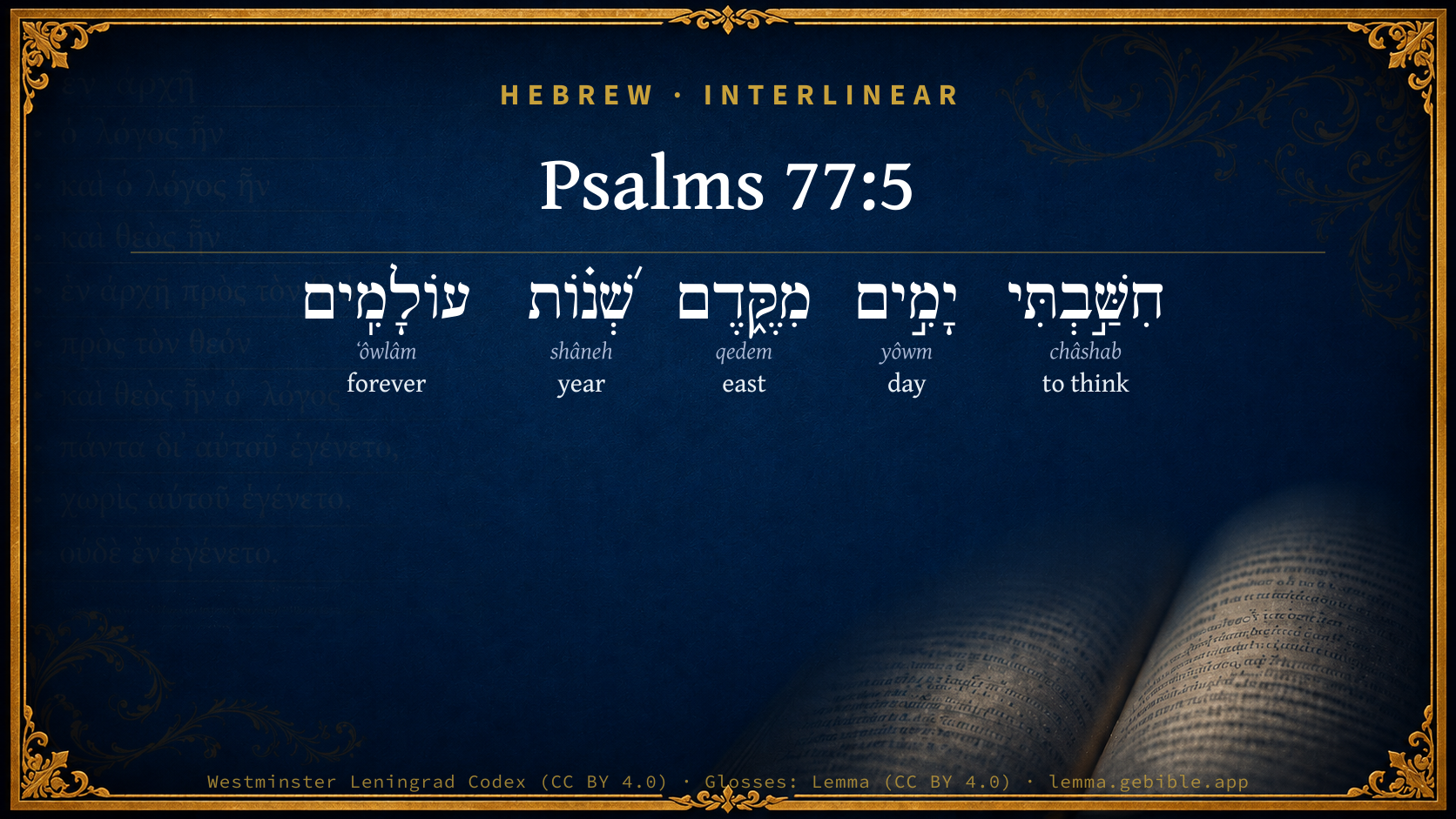
Psalms 77:5

Hebrew (Westminster Leningrad Codex) Psalms 77:5 appears in the Hebrew Old Testament. The text above is from the Westminster Leningrad Codex. Each word links to its Strong’s number, a concise gloss, and parsing drawn from the Open Scriptures Hebrew Bible morphology. Click any word for its full Brown-Driver-Briggs (BDB) entry.
Download image
Cite this verse

Psalms 77:5 (World English Bible). Public Domain. Lemma interlinear Bible study tool, https://lemma.gebible.app/v/psalms/77/5.

Show BibTeX & RIS
BibTeX
RIS
English Translation
I have considered the days of old, The years of ancient times.
World English Bible · Public Domain
Download a study sheet

One document with this verse’s original text, its word-by-word gloss line, the meaning frame, cross-references with their text, attributed commentary, and full source and license credits — printable, and it pastes into notes with its structure intact.

This verse Autodidact and up

Study sheet (.html) Plain text (.txt)

A passage Seminary Student

Up to 50 verses in one chapter. A passage sheet keeps up to 6 commentary sources and 12 cross-references per verse, in the order this page ranks them, and says so on the sheet whenever that leaves anything out. Ask for a single verse and you get the Autodidact verse sheet above.

Everything on this page stays free to read, with no account — the sheet is a download of what is already on screen, not access to it.

Want to remove ads? Support Godless Engineer
Compare translations 3

The same verse in 3 English versions, stacked beneath the original-language interlinear above. Click any original word for its lexicon entry.

Each is an independent rendering of the whole verse — the interlinear is not word-aligned to these translations.

Highlighted words mark where these versions differ — a whole-verse word diff, not a word-by-word alignment.

  • World English Bible Public Domain
    I have considered the days of old, The years of ancient times.
  • King James Version Public Domain
    I have considered the days of old, the years of ancient times.
  • unfoldingWord Literal Text CC BY-SA 4.0
    I thought about days from antiquity, years of long ago.

unfoldingWord Literal Text — © unfoldingWord, licensed CC BY-SA 4.0. Word-aligned USFM3 via Door43 (git.door43.org/unfoldingWord/en_ult).

Versions to compare (up to 4)

3 of 4 selected

Show all 18 translations

Every available English version of this verse, each an independent rendering of the whole verse.

  • World English Bible Public Domain
    I have considered the days of old, The years of ancient times.
  • Berean Standard Bible Public Domain
    I considered the days of old, the years long in the past.
  • Majority Standard Bible Public Domain
    I considered the days of old, the years long in the past.
  • King James Version Public Domain
    I have considered the days of old, the years of ancient times.
  • American Standard Version (1901) Public Domain
    I have considered the days of old, The years of ancient times.
  • Revised Version (1885) Public Domain
    I have considered the days of old, the years of ancient times.
  • Geneva Bible (1599) Public Domain
    Then I considered the daies of olde, and the yeeres of ancient time.
  • Douay-Rheims (1899) Public Domain
    My eyes prevented the watches: I was troubled, and I spoke not.
  • Young's Literal Translation Public Domain
    I have reckoned the days of old, The years of the ages.
  • Literal Standard Version CC BY-SA 4.0
    I have reckoned the days of old, || The years of the ages.
  • Unlocked Literal Bible CC BY-SA 4.0
    I thought about the days of old, about times long past.
  • unfoldingWord Literal Text CC BY-SA 4.0
    I thought about days from antiquity, years of long ago.
  • Darby Bible Public Domain
    I consider the days of old, the years of ancient times.
  • World Messianic Bible Public Domain
    I have considered the days of old, the years of ancient times.
  • Webster's Bible Public Domain
    \\77:4\\Thou holdest my eyes waking: I am so troubled that I cannot speak.
  • Free Bible Version CC BY-SA 4.0
    I think of the old days, years ago.
  • Bible in Basic English Public Domain
    My thoughts go back to the days of the past, to the years which are gone.
  • JPS Tanakh (1917) Public Domain
    (77-6) I have pondered the days of old, the years of ancient times.

Literal Standard Version (2020), Covenant Press — licensed CC BY-SA 4.0. Text via the HelloAO Bible API (eBible.org). Unlocked Literal Bible (unfoldingWord) — licensed CC BY-SA 4.0. Text via the HelloAO Bible API (eBible.org). unfoldingWord Literal Text — © unfoldingWord, licensed CC BY-SA 4.0. Word-aligned USFM3 via Door43 (git.door43.org/unfoldingWord/en_ult). Free Bible Version, Dr. Jonathan Gallagher — licensed CC BY-SA 4.0. Text via the HelloAO Bible API (eBible.org).

Word by word

More ways to search: Search by grammar → Find every occurrence → Compare this word →

Practice this passage: Drill this verse → Learn its vocabulary →

מִקֶּ֑דֶם
qedem
H6924
“from · east”
Preposition + Noun, Common, Masculine, Singular, Absolute
Part of Speech
Preposition + Noun
Type
Common
Gender
Masculine
Number
Singular
State
Absolute
Full BDB Definition

Origin: from H6923

TWOT: 1988a

east, antiquity, front, that which is before, aforetime (noun masculine) - front, from the front or east, in front, mount of the East - ancient time, aforetime, ancient, from of old, earliest time - anciently, of old (adverb) - beginning - east - eastward, to or toward the East (adverb)
  1. חִשַּׁ֣בְתִּי châshab H2803 “to think” Verb, Piel, Perfect, 1st Person, Common, Singular
  2. יָמִ֣ים yôwm H3117 “days” Noun, Common, Masculine, Plural, Absolute
  3. שְׁ֝נ֗וֹת shâneh H8141 “years of” Noun, Common, Feminine, Plural, Construct
  4. עוֹלָמִֽים ʻôwlâm H5769 “ages” Noun, Common, Masculine, Plural, Absolute

About this verse

These counts appear in no published source. They are computed here, from the morphology-tagged text and Lemma’s own curated glosses. What Lemma adds →

5
words
5
distinct lemmas
Wisdom
section

Grammatical profile

  • 1 verb
  • 4 nouns

Verb forms

  • חִשַּׁ֣בְתִּי Piel · Perfect

Hebrew & Septuagint length

In English translation the verse runs 12 words from the Hebrew and 10 from the Septuagint (LXX English) — closely comparable.

A rough comparison of the two English renderings, which tokenize alike — not a word-level alignment.

Word counts can differ between the Hebrew and the Greek without any difference in meaning — e.g. the Hebrew direct-object marker אֵת has no separate Greek word, and Greek often adds the article ὁ.

Cross-references

7

Topical passages linked to Psalms 77:5 in the Treasury of Scripture Knowledge — connected by theme and wording, ordered by reader-vote popularity; previews shown in the World English Bible.

  • Deuteronomy 32:7 Remember the days of old, Consider the years of many generations: Ask your father, and he will show you; Your elders, and they will tell you.
  • Isaiah 51:9 Awake, awake, put on strength, arm of Yahweh; awake, as in the days of old, the generations of ancient times. Isn't it you who did cut Rahab in pieces, who pierced the monster?
  • Psalms 143:5 I remember the days of old. I meditate on all your doings. I contemplate the work of your hands.
  • Psalms 44:1 We have heard with our ears, God; Our fathers have told us, What work you did in their days, In the days of old.
  • Psalms 74:12–18 Yet God is my King of old, Working salvation in the midst of the earth.
  • Isaiah 63:9–15 In all their affliction he was afflicted, and the angel of his presence saved them: in his love and in his pity he redeemed them; and he bore them, and carried them all the days of old.
  • Micah 7:14–15 Shepherd your people with your staff, The flock of your heritage, Who dwell by themselves in a forest, In the midst of fertile pasture land, let them feed; In Bashan and Gilead, as in the days of old.

Cross-references courtesy of OpenBible.info (CC BY 4.0).

Hebrew and Greek witnesses Masoretic Hebrew ↔ Greek Septuagint

The same verse in the two great witnesses to the Old Testament, shown verse-for-verse.

You’re reading Greek Psalm 76 (Hebrew Psalm 77). The Septuagint counts the superscription, so verse numbers can differ from the Hebrew — chapter-level alignment, not verse-by-verse. Numbering follows Rahlfs.

These are two independent witnesses, not word-aligned to each other, and the Septuagint is shown in lemma (dictionary) form.

Hebrew Psalms 77:5 Masoretic · Westminster Leningrad Codex

חִשַּׁ֣בְתִּי יָמִ֣ים מִקֶּ֑דֶם שְׁ֝נ֗וֹת עוֹלָמִֽים

I have considered the days of old, The years of ancient times.

World English Bible · Public Domain

Greek LXX Greek Psalm 76:5 Septuagint · lemma form

προ καταλαμβάνω φυλακή ὁ ὀφθαλμός ἐγώ ταράσσω καί οὐ λαλέω

I considered the days of old, and remembered ancient years.

LXX2012 (modern English Septuagint) · Public Domain

Hebrew: Westminster Leningrad Codex (CC BY 4.0). Greek: Septuagint (public domain); English from LXX2012 (modern English Septuagint) (Public Domain). How the Septuagint differs from the Hebrew →

Commentary

Notes on Psalms 77:5 from classic Christian and Jewish commentators (each source and its license shown beneath its notes). The classic Christian expositions comment on the surrounding passage and are grouped to its opening verse, so a note may address several verses; the Jewish commentaries on the Tanakh (Rashi and others) are per-verse, so they appear only where the commentator wrote on this verse.

Lemma curates 59 commentaries, every one of them public domain or Creative Commons licensed, each selected and text-cleaned for this edition rather than reprinted as found. About our sources →

Trapp's Complete Commentary

John Trapp

Psa 77:5 I have considered the days of old, the years of ancient times.

Ver. 5. I have considered the days of old] What thou didst for Adam, Abraham, Israel, in Egypt, &c., all which was written purposely, that we, through patience and comfort of the Scriptures, might have hope. See Deu 32:7.

John Trapp, A Commentary or Exposition upon All the Books of the Old and New Testament (1647–1656) — public domain. Text from a community e-Sword module.

The Biblical Illustrator

Joseph S. Exell

Psa_77:5

I have considered the days of old, the years of ancient times.

Lessons drawn from Scripture history

From the history of the Bible we may learn much concerning--

I. The character of God.

1. His wisdom.

2. His power.

3. His holiness and justice.

4. His goodness.

5. His faithfulness to His promises.

6. His unchangeableness.

II. The value of the blessings of redemption.

1. The greatness of the preparations made to obtain it.

2. The greatness of the sacrifice made to purchase it.

3. The greatness of the means used to proclaim it.

III. The condition, character, and fate of man.

1. In his natural state.

2. As redeemed.

(1) The way of salvation.

(2) The failings of the people of God.

(3) The sorrows and fears of the godly.

(4) The Christians reward. (W. Dickson.)

The Biblical Illustrator, edited by Joseph S. Exell (c. 1880s–1900s) — public domain. Text from a community e-Sword module.

Joseph Benson's Commentary

Psa 77:5-6. I have considered the days of old — The mighty works of God, wrought for his people in former times, if by that means I could get any comfort. I call to remembrance my song in the night — The many and great mercies and favours of God vouchsafed to me and his people, which have obliged me to adore him and sing his praise, not only in the day, the time appointed for that work, but also by night, as often as they came into my mind. My spirit made diligent search — What should be the reason of this strange and vast alteration, and how this sore trouble could come from the hand of so gracious and merciful a God as ours is, and what might be expected as to its continuance or removal. “A recollection of former mercies is the proper antidote against a temptation to despair in the day of calamity: and as in the divine dispensations, which are always uniform and like themselves, whatever has happened may, and probably will, happen again when the circumstances are similar; the experience of ancient times is to be called in to our aid, and duly consulted. Upon these topics we should, in the night of affliction, commune with our own hearts, and make diligent search, as Daniel did in Babylon, into the cause of our troubles, with the proper methods of shortening and bringing them to an end; by suffering them to have their intended and full effect in a sincere repentance, and thorough reformation.” — Horne.

Joseph Benson's Commentary on the Old and New Testaments (1811–1818) — public domain. Text from a community e-Sword module.

J. A. Alexander on Psalms

Joseph Addison Alexander

6. (Psa 77:5). I thought on days of old, years of antiquities (or perpetuities.) The contrast of the present with the past is again urged as an aggravating circumstance in his condition.

Joseph Addison Alexander, The Psalms Translated and Explained (1850) — public domain. Text from a community e-Sword module.

Adam Clarke's Commentary

Verse 5. I have considered the days of old] חשבתי chishshabti, I have counted up; I have reckoned up the various dispensations of thy mercy in behalf of the distressed, marked down in the history of our fathers.

Adam Clarke's Commentary on the Bible (1810–1826) — public domain. Text from a community e-Sword/MySword module.

John Calvin's Commentaries

5. I have recounted the days of old. There is no doubt that he endeavored to assuage his grief by the remembrance of his former joy; but he informs us that relief was not so easily nor so speedily obtained. By the days of old, and the years of ancient times, he seems not only to refer to the brief course of his own life, but to comprehend many ages. The people of God, in their afflictions, ought, undoubtedly, to set before their eyes, and to call to their remembrance, not only the Divine blessings which they have individually experienced, but also all the blessings which God in every age has bestowed upon his Church It may, however, be easily gathered from the text, that when the prophet reckoned up in his own mind the mercies which God had bestowed in time past, he began with his own experience.

John Calvin's Commentaries (1540-1563) — public domain. Text from the Calvin Translation Society English edition (1840s-50s) via the Christian Classics Ethereal Library (ccel.org). Calvin's coverage is partial (roughly two-thirds of the Bible); uncommented books and verses are honest gaps, never fabricated. The 19th-century editor's footnotes and remarks are omitted so the notes are faithfully Calvin's own voice.

The Cambridge Bible for Schools and Colleges

gen. ed. J. J. S. Perowne

5. I considered the days of old,

The years of ages past, (saying),

5. “Not pathetic only but profound also and of the most solid substance was that reply made by an old Carthusian monk to the trifler who asked him how he had managed to get through his life:—Cogitavi dies antiquos, et annos aeternos in mente habui.”

The Cambridge Bible for Schools and Colleges (gen. ed. J. J. S. Perowne; Cambridge University Press, 1878–1918) — public domain. Text from a community e-Sword module.

John Gill's Exposition

I have considered the days of old,.... Either the former part of his life, the various occurrences of it, how it had been with him in time past, what experience he had had of the divine goodness; so the Syriac version renders it, "I have considered my days of old"; or the preceding age, and what has happened in that, which his ancestors had acquainted him with; or rather many ages past, from the days of Adam to the then present time; at least it may include the Israelites coming out of Egypt, their passage through the Red sea and wilderness, the times of the judges, and what befell them in their days, and how they were delivered out of their troubles; as appears from the latter part of the psalm, and with which agrees the following clause:

the years of ancient times; or, "of ages" (n); of times long ago past; it is very useful to read the history of the Bible, with respect to ancient times, and so the ecclesiastical history of ages past, and observe the faith and dependence of the Lord's people upon him, and their deliverance out of trouble by him; which may be a means of strengthening faith in him, and of relief under present trials; but frequently the goodness of former times is only observed as an aggravation of the badness of the present ones, and of trouble in them; see Ecc 7:10, the Targum interprets the whole of happy days and times, paraphrasing it thus,

"I have mentioned the good days which were of old, the good years which were of ages past.''

(n) "annos seculorum", Pagninus, Montanus, Musculus, Piscator, Cocceius, Gejerus.

John Gill's Exposition of the Whole Bible (1746–1763) — public domain (CC PDM 1.0). Text via the HelloAO Bible API.

Albert Barnes' Notes on the Bible

I have considered the days of old - Rather, “I do consider;” that is, “I think upon.” This refers to his resolution in his perplexity and trouble; the method to which he resorted in examining the subject, and in endeavoring to allay his troubles. He resolved to look at the past. He asked what was the evidence which was furnished on the subject by the former dealings of God with himself and with mankind; what could be learned from those dealings in regard to the great and difficult questions which now so perplexed his mind.

The years of ancient times - The records and remembrances of past ages. What is the testimony which the history of the world bears on this subject? Does it prove that God is worthy of confidence or not? Does it or does it not authorize and justify these painful thoughts which pass through the mind?

Albert Barnes' Notes on the Bible (1834–1885) — public domain. Text from a community e-Sword/MySword module.

Matthew Poole's English Annotations

I have considered, if by that means I could get any comfort, the days of old, i.e. the mighty works of God done for his people in former times.

Days are put for events done in them, as Psa 37:13; 137:7; Oba 1:12; Mic 7:4.

Matthew Poole's English Annotations on the Holy Bible (1683–1685) — public domain. Text from a community e-Sword/MySword module.

The Treasury of David

Charles H. Spurgeon

Ver. 5. I have considered the days of old, the years of ancient times. If no good was in the present, memory ransacked the past to find consolation. She fain would borrow a light from the altars of yesterday to light the gloom of today. It is our duty to search for comfort, and not in sullen indolence yield to despair; in quiet contemplation topics may occur to us which will prove the means of raising our spirits, and there is scarcely any theme more likely to prove consolatory than that which deals with the days of yore, the years of the olden time, when the Lord's faithfulness was tried and proven by hosts of his people. Yet it seems that even this consideration created depression rather than delight in the good man's soul, for he contrasted his own mournful condition with all that was bright in the venerable experiences of ancient saints, and so complained the more. Ah, sad calamity of a jaundiced mind, to see nothing as it should be seen, but everything as through a veil of mist.

Whole Psalm. Whenever, and by whomsoever, the Psalm may have been written, it clearly is individual, not national. It utterly destroys all the beauty, all the tenderness and depth of feeling in the opening portion, if we suppose that the people are introduced speaking in the first person. The allusions to the national history may indeed show that the season was a season of national distress, and that the sweet singer was himself bowed down by the burden of the time, and oppressed by woes which he had no power to alleviate; but it is his own sorrow, not the sorrow of others under which he sighs, and of which he has left the pathetic record. J. J. Stewart Perowne.

Ver. 5. The days of old. Doubtless to our first parents the darkness of the first night was somewhat strange; persons who had never seen anything but the light of the day, when the shadows of the night first did encompass them, could not be without some apprehension: yet when at the back of a number of nights they had seen the day spring of the morning lights constantly to arise; the darkness of the blackest nights was passed over without fear, and in as great security, as the light of the fairest days. To men who have always lived upon land, when first they set to sea, the winds, waves, and storms are exceeding terrible; but when they are a little beaten with the experience of tempests, their fears do change into resolution and courage. It is of no small use to remember that those things which vex most our spirit, are not new, but have already been in times before our days. Robert Baylie's Sermon before the House of Commons. 1643.

Ver. 5-6. There are four rules for obtaining comfort in affliction.

I. The consideration of God's goodness to his people of

old.

II. Remembrance of our own past experience.

III. Self examination.

IV. The diligent study of the word. G. R.

Psalms 77:6*

Ver. 5-6. There are four rules for obtaining comfort in affliction.

I. The consideration of God's goodness to his people of

old.

II. Remembrance of our own past experience.

III. Self examination.

IV. The diligent study of the word. G. R.

Charles H. Spurgeon's The Treasury of David (1869–1885) — public domain. Psalms only. Text from a community e-Sword/MySword module.

Whedon's Commentary on the Bible

Daniel D. Whedon

5. I have considered the days of old—I recount the providence of God toward the nation in ancient times, and contrast with that its present forsaken condition.

Daniel D. Whedon (gen. ed.), Commentary on the Old and New Testaments (1874–1909) — public domain. Text from a community e-Sword module.

The Pulpit Commentary

I have considered; rather, I considered. In my perplexity, when I could no longer speak, I betook myself to meditation. I considered the days of old, the years of ancient times. He called to mind, i.e., God"s doings in the past (comp. vers. 14-19).

The Pulpit Commentary (1880–1919), ed. H.D.M. Spence-Jones & Joseph S. Exell — public domain. Text from a community e-Sword module.

John Wesley's Explanatory Notes

The days - The mighty works of God in former times.

John Wesley, Explanatory Notes Upon the Whole Bible (1754–1765) — public domain. Text via the GEBible commentary corpus.

Rashi

Rabbi Shlomo Yitzchaki (Rashi)

You held fast the awakenings of my eyes Heb. שמרות, an expression of the watch (אשמרת) of the night, for [when] a person awakens from his sleep his mind is settled and his heart returns to him, but I am not like that. In this night of exile, my eyes are always stuck together, like a man sleeping from a clogged heart, and in the troubles that I see, my spirit throbs and I have no speech within me.

Rashi on the Tanakh — English translations: “The Judaica Press complete Tanach with Rashi, translated by A. J. Rosenberg” (CC BY 4.0); “Pentateuch with Rashi's commentary by M. Rosenbaum and A.M. Silbermann, 1929-1934” (public domain); “The Metsudah Tanach series, Lakewood, N.J” (CC BY 4.0); and “The Book of Joshua, Metsudah Publications, 1997” (CC BY 4.0). Text via Sefaria.

Lesson kit

Teaching starters — assembled from the data on this page, not authored interpretation. Every prompt links to the verse data it draws on. Edit before teaching.

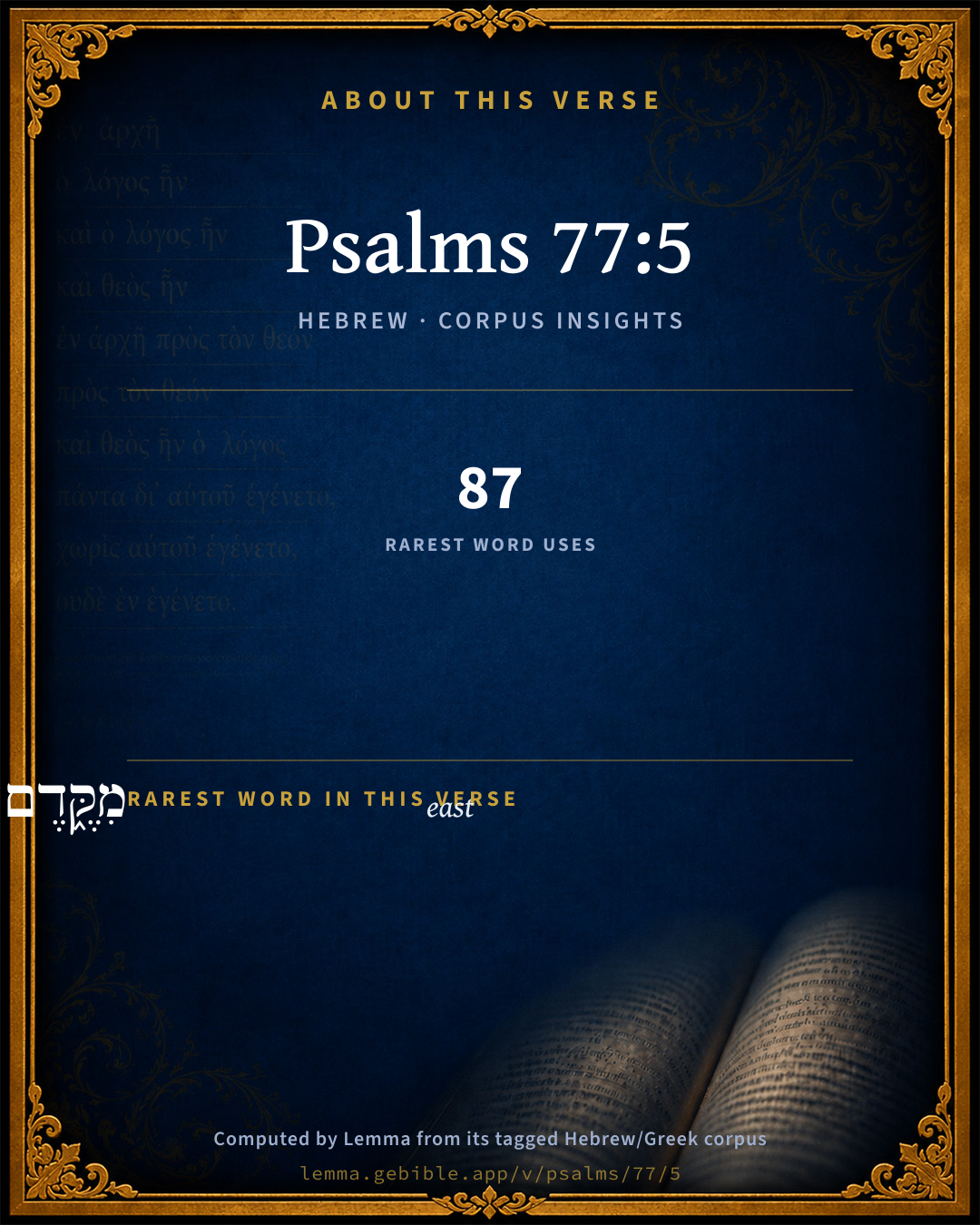
Psalms, in the Wisdom, opens this verse with 5 words (5 distinct Hebrew lemmas). Its most distinctive word is qedem (“east”). A historical commentator’s framing appears above. Read the whole chapter for the surrounding context.

Discussion questions

  1. What does “east” (qedem) contribute to the verse as a whole?
  2. How does Deuteronomy 32:7, which shares this passage’s theme, read alongside this verse?
  3. The translations on this page render this verse differently — a whole-verse word diff, not a word-by-word alignment. What might account for the different wordings?
  4. «חִשַּׁ֣בְתִּי» is a Piel Perfect verb. How does that grammatical form shape the action described?
  5. Compare how Trapp's Complete Commentary and The Biblical Illustrator read this verse. Where do they agree or differ?

Things to notice

Reading settings

Reading text

Shown beneath each verse's original-language words.

Old Testament
Old Testament edition

Read the OT as the Masoretic Hebrew (MT) or the Greek Septuagint (LXX).

English shown for the Greek Septuagint (in the Hebrew ↔ Greek comparison).

Comparing translations? Open the Compare panel on any verse page to stack up to four side by side.