Judges 6:3

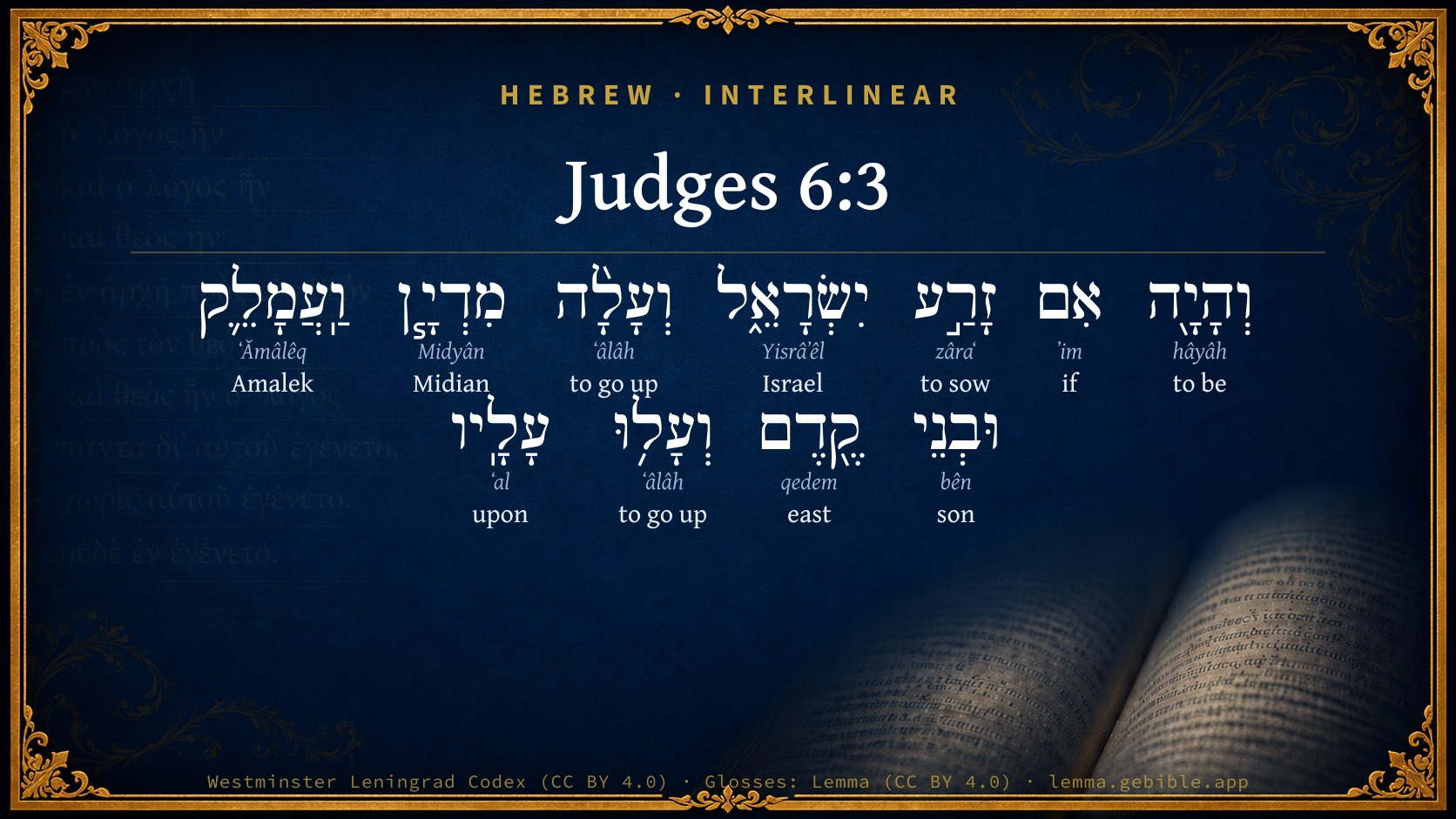
Hebrew (Westminster Leningrad Codex) Judges 6:3 appears in the Hebrew Old Testament. The text above is from the Westminster Leningrad Codex. Each word links to its Strong’s number, a concise gloss, and parsing drawn from the Open Scriptures Hebrew Bible morphology. Click any word for its full Brown-Driver-Briggs (BDB) entry.
Download image
Cite this verse

Judges 6:3 (World English Bible). Public Domain. Lemma interlinear Bible study tool, https://lemma.gebible.app/v/judges/6/3.

Show BibTeX & RIS
BibTeX
RIS
English Translation
So it was, when Israel had sown, that the Midianites came up, and the Amalekites, and the children of the east; they came up against them;
World English Bible · Public Domain
Download a study sheet

One document with this verse’s original text, its word-by-word gloss line, the meaning frame, cross-references with their text, attributed commentary, and full source and license credits — printable, and it pastes into notes with its structure intact.

This verse Autodidact and up

Study sheet (.html) Plain text (.txt)

A passage Seminary Student

Up to 50 verses in one chapter. A passage sheet keeps up to 6 commentary sources and 12 cross-references per verse, in the order this page ranks them, and says so on the sheet whenever that leaves anything out. Ask for a single verse and you get the Autodidact verse sheet above.

Everything on this page stays free to read, with no account — the sheet is a download of what is already on screen, not access to it.

Want to remove ads? Support Godless Engineer
Compare translations 3

The same verse in 3 English versions, stacked beneath the original-language interlinear above. Click any original word for its lexicon entry.

Each is an independent rendering of the whole verse — the interlinear is not word-aligned to these translations.

Highlighted words mark where these versions differ — a whole-verse word diff, not a word-by-word alignment.

  • World English Bible Public Domain
    So it was, when Israel had sown, that the Midianites came up, and the Amalekites, and the children of the east; they came up against them;
  • King James Version Public Domain
    And so it was, when Israel had sown, that the Midianites came up, and the Amalekites, and the children of the east, even they came up against them;
  • unfoldingWord Literal Text CC BY-SA 4.0
    Now it happened, when Israel sowed, that Midian came up and Amalek and the sons of the east, that they came up against him.

unfoldingWord Literal Text — © unfoldingWord, licensed CC BY-SA 4.0. Word-aligned USFM3 via Door43 (git.door43.org/unfoldingWord/en_ult).

Versions to compare (up to 4)

3 of 4 selected

Show all 17 translations

Every available English version of this verse, each an independent rendering of the whole verse.

  • World English Bible Public Domain
    So it was, when Israel had sown, that the Midianites came up, and the Amalekites, and the children of the east; they came up against them;
  • Berean Standard Bible Public Domain
    Whenever the Israelites would plant their crops, the Midianites, Amalekites, and other people of the east would come up and invade them,
  • Majority Standard Bible Public Domain
    Whenever the Israelites planted their crops, the Midianites, Amalekites, and other people of the east would come up and invade them,
  • King James Version Public Domain
    And so it was, when Israel had sown, that the Midianites came up, and the Amalekites, and the children of the east, even they came up against them;
  • American Standard Version (1901) Public Domain
    And so it was, when Israel had sown, that the Midianites came up, and the Amalekites, and the children of the east; they came up against them;
  • Revised Version (1885) Public Domain
    And so it was, when Israel had sown, that the Midianites came up, and the Amalekites, and the children of the east; they came up against them;
  • Geneva Bible (1599) Public Domain
    When Israel had sowen, then came vp the Midianites, the Amalekites, and they of the East, and came vpon them,
  • Young's Literal Translation Public Domain
    And it hath been, if Israel hath sowed, that Midian hath come up, and Amalek, and the sons of the east, yea, they have come up against him,
  • Literal Standard Version CC BY-SA 4.0
    And it has been, if Israel has sowed, that Midian has come up, and Amalek, and the sons of the east, indeed, they have come up against him,
  • Unlocked Literal Bible CC BY-SA 4.0
    It happened that any time the Israelites planted their crops, the Midianites and the Amalekites and the people from the east would attack the Israelites.
  • unfoldingWord Literal Text CC BY-SA 4.0
    Now it happened, when Israel sowed, that Midian came up and Amalek and the sons of the east, that they came up against him.
  • Darby Bible Public Domain
    For whenever the Israelites put in seed the Mid'ianites and the Amal'ekites and the people of the East would come up and attack them;
  • World Messianic Bible Public Domain
    So it was, when Israel had sown, that the Midianites, the Amalekites, and the children of the east came up against them.
  • Webster's Bible Public Domain
    And so it was, when Israel had sown, that the Midianites came up, and the Amalekites, and the children of the east, even they came up against them;
  • Free Bible Version CC BY-SA 4.0
    Whenever the Israelites planted their crops, the Midianites, Amalekites, and other peoples from the east would come and attack them.
  • Bible in Basic English Public Domain
    And whenever Israel's grain was planted, the Midianites and the Amalekites and the people of the east came up against them;
  • JPS Tanakh (1917) Public Domain
    And so it was, when Israel had sown, that the Midianites came up, and the Amalekites, and the children of the east; they came up against them;

Literal Standard Version (2020), Covenant Press — licensed CC BY-SA 4.0. Text via the HelloAO Bible API (eBible.org). Unlocked Literal Bible (unfoldingWord) — licensed CC BY-SA 4.0. Text via the HelloAO Bible API (eBible.org). unfoldingWord Literal Text — © unfoldingWord, licensed CC BY-SA 4.0. Word-aligned USFM3 via Door43 (git.door43.org/unfoldingWord/en_ult). Free Bible Version, Dr. Jonathan Gallagher — licensed CC BY-SA 4.0. Text via the HelloAO Bible API (eBible.org).

Word by word

More ways to search: Search by grammar → Find every occurrence → Compare this word →

Practice this passage: Drill this verse → Learn its vocabulary →

וַֽעֲמָלֵ֛ק
ʻĂmâlêq
H6002
“and · Amalek”
Conjunction + Noun, Proper
Part of Speech
Conjunction + Noun
Type
Proper
Full BDB Definition

Origin: probably of foreign origin

TWOT: None

Amalek = "dweller in a valley" - son of Eliphaz by his concubine Timnah, grandson of Esau, and progenitor of a tribe of people in southern Canaan - descendants of Amalek
  1. וְהָיָ֖ה hâyâh H1961 “and · to be” Conjunction + Verb, Qal, Sequential Perfect, 3rd Person, Masculine, Singular
  2. אִם ʼim H518 “if” Conjunction
  3. זָרַ֣ע zâraʻ H2232 “to sow” Verb, Qal, Perfect, 3rd Person, Masculine, Singular
  4. יִשְׂרָאֵ֑ל Yisrâʼêl H3478 “Israel” Noun, Proper
  5. וְעָלָ֨ה ʻâlâh H5927 “and · to go up” Conjunction + Verb, Qal, Sequential Perfect, 3rd Person, Masculine, Singular
  6. מִדְיָ֧ן Midyân H4080 “Midian” Noun, Proper
  7. וּבְנֵי bên H1121 “and · sons of” Conjunction + Noun, Common, Masculine, Plural, Construct
  8. קֶ֖דֶם qedem H6924 “east” Noun, Common, Masculine, Singular, Absolute
  9. וְעָל֥וּ ʻâlâh H5927 “and · to go up” Conjunction + Verb, Qal, Sequential Perfect, 3rd Person, Common, Plural
  10. עָלָֽיו ʻal H5921 “upon · him” Preposition + Suffix, Personal, 3rd Person, Masculine, Singular

About this verse

These counts appear in no published source. They are computed here, from the morphology-tagged text and Lemma’s own curated glosses. What Lemma adds →

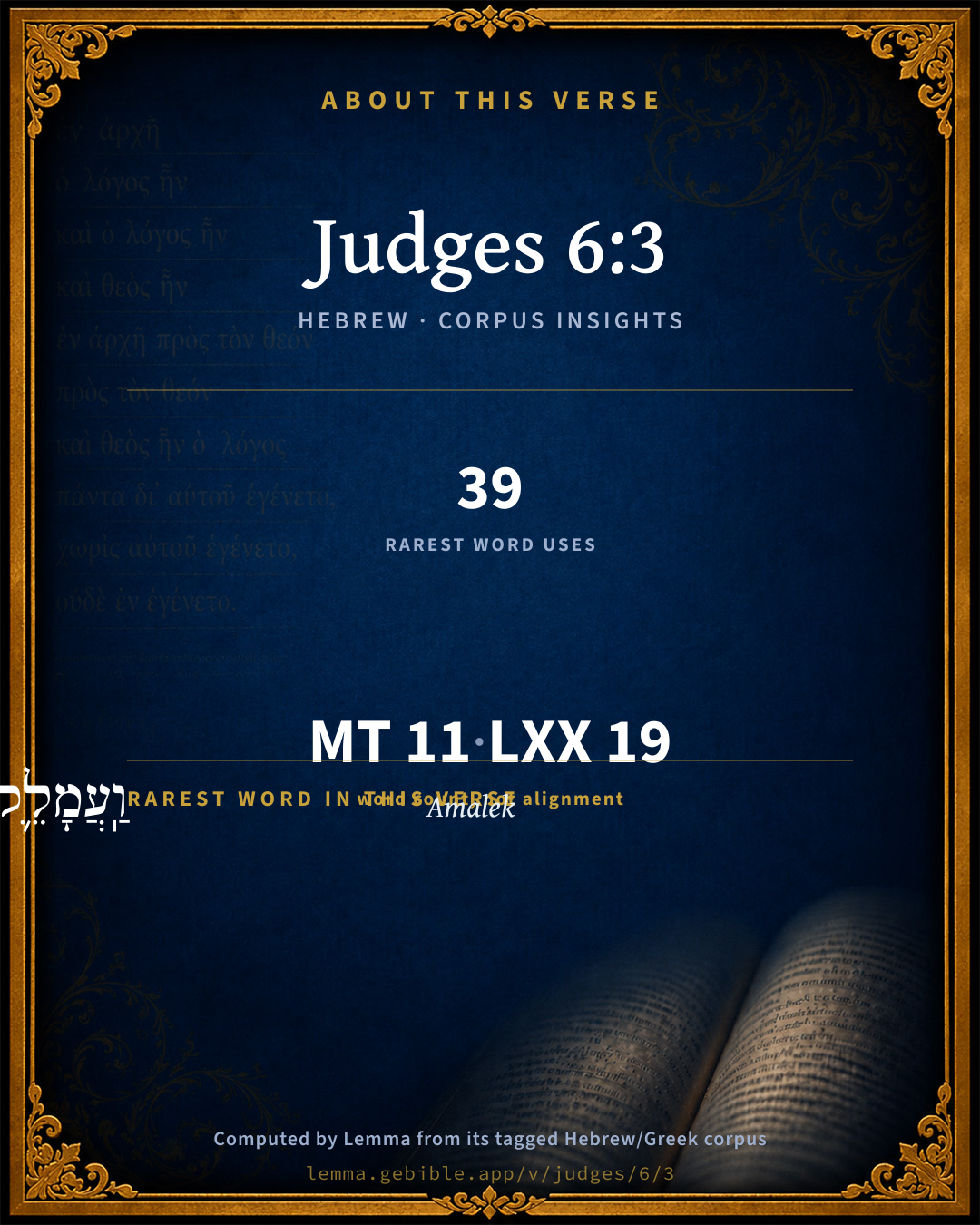
11
words
10
distinct lemmas
Historical
section

Shared distinctive vocabulary

וַֽעֲמָלֵ֛ק Amalek H6002 occurs in 37 verses of the Hebrew Bible. Also found in:

Grammatical profile

  • 4 verbs
  • 5 nouns
  • 1 preposition
  • 1 conjunction

Verb forms

  • וְהָיָ֖ה Qal · Sequential Perfect
  • זָרַ֣ע Qal · Perfect
  • וְעָלָ֨ה Qal · Sequential Perfect
  • וְעָל֥וּ Qal · Sequential Perfect

Repetition

A word recurs within this verse — often emphatic in Hebrew:

  • וְעָלָ֨ה to go up H5927 ×2

Hebrew & Septuagint length

In English translation the verse runs 26 words from the Hebrew and 28 from the Septuagint (LXX English) — closely comparable.

A rough comparison of the two English renderings, which tokenize alike — not a word-level alignment.

Word counts can differ between the Hebrew and the Greek without any difference in meaning — e.g. the Hebrew direct-object marker אֵת has no separate Greek word, and Greek often adds the article ὁ.

In the original languages it is 11 Hebrew tokens and 19 Greek tokens — but the two are counted differently (Hebrew bundles its prefixes and suffixes into one token; the Greek is in lemma form), so that isn’t a like-for-like length.

Cross-references

13

Topical passages linked to Judges 6:3 in the Treasury of Scripture Knowledge — connected by theme and wording, ordered by reader-vote popularity; previews shown in the World English Bible.

  • Judges 3:13 He gathered to him the children of Ammon and Amalek; and he went and struck Israel, and they possessed the city of palm trees.
  • Judges 6:33 Then all the Midianites and the Amalekites and the children of the east assembled themselves together; and they passed over, and encamped in the valley of Jezreel.
  • Judges 7:12 The Midianites and the Amalekites and all the children of the east lay along in the valley like locusts for multitude; and their camels were without number, as the sand which is on the sea-shore for multitude.
  • Genesis 29:1 Then Jacob went on his journey, and came to the land of the children of the east.
  • Judges 8:10 Now Zebah and Zalmunna were in Karkor, and their hosts with them, about fifteen thousand men, all who were left of all the host of the children of the east; for there fell one hundred twenty thousand men who drew sword.
  • 1 Kings 4:30 Solomon's wisdom excelled the wisdom of all the children of the east, and all the wisdom of Egypt.
  • Job 1:3 His possessions also were seven thousand sheep, three thousand camels, five hundred yoke of oxen, five hundred she-donkeys, and a very great household; so that this man was the greatest of all the children of the east.
  • Isaiah 65:21–22 They shall build houses, and inhabit them; and they shall plant vineyards, and eat the fruit of them.
  • Leviticus 26:16 I also will do this to you: I will appoint terror over you, even consumption and fever, that shall consume the eyes, and make the soul to pine away; and you will sow your seed in vain, for your enemies will eat it.
  • Deuteronomy 28:30–33 You shall betroth a wife, and another man shall lie with her: you shall build a house, and you shall not dwell therein: you shall plant a vineyard, and shall not use the fruit of it.
  • Deuteronomy 28:51 and shall eat the fruit of your cattle, and the fruit of your ground, until you are destroyed; that also shall not leave you grain, new wine, or oil, the increase of your cattle, or the young of your flock, until they have caused you to perish.
  • Job 31:8 Then let me sow, and let another eat; Yes, let the produce of my field be rooted out.
  • Micah 6:15 You will sow, but won't reap. You will tread the olives, but won't anoint yourself with oil; And crush grapes, but won't drink the wine.

Cross-references courtesy of OpenBible.info (CC BY 4.0).

Hebrew and Greek witnesses Masoretic Hebrew ↔ Greek Septuagint

The same verse in the two great witnesses to the Old Testament, shown verse-for-verse.

These are two independent witnesses, not word-aligned to each other, and the Septuagint is shown in lemma (dictionary) form.

Hebrew Judges 6:3 Masoretic · Westminster Leningrad Codex

וְהָיָ֖ה אִם זָרַ֣ע יִשְׂרָאֵ֑ל וְעָלָ֨ה מִדְיָ֧ן וַֽעֲמָלֵ֛ק וּבְנֵי קֶ֖דֶם וְעָל֥וּ עָלָֽיו

So it was, when Israel had sown, that the Midianites came up, and the Amalekites, and the children of the east; they came up against them;

World English Bible · Public Domain

Greek LXX Judges 6:3 Septuagint · lemma form

καί γίγνομαι ἐάν σπείρω ὁ υἱός ἰσραήλ καί ἀναβαίνω μαδιαμ καί αμαληκ καί ὁ υἱός ἀνατολή συν ἀναβαίνω αὐτός

And it came to pass when the children of Israel sowed, that Madiam and Amalec went up, and the children of the east went up together with them.

LXX2012 (modern English Septuagint) · Public Domain

Hebrew: Westminster Leningrad Codex (CC BY 4.0). Greek: Septuagint (public domain); English from LXX2012 (modern English Septuagint) (Public Domain). How the Septuagint differs from the Hebrew →

Targum (Aramaic paraphrase)

1

The Targum is the ancient Jewish Aramaic paraphrase of the Hebrew Scriptures — an interpretive translation, not the Hebrew text itself. Onkelos (literal) and Pseudo-Jonathan (expansive) render the Torah, and Jonathan the Prophets. Coverage is partial: where no permissively-licensed English translation exists for a verse, only the Aramaic is shown. This is verse-level text, not a word-by-word alignment to the Hebrew.

  1. Targum Jonathan Prophets (Joshua–Malachi)
    וַהֲוָה כַּד זְרַע יִשְׂרָאֵל וְסַלְקִין מִדְיָנָאֵי וַעֲמַלְקָאֵי וּבְנֵי מַדִינְחָא וְסַלְקִין עֲלוֹהִי:

    (no public-domain English translation for this verse)

    Targum Jonathan — Aramaic: “Mikraot Gedolot” (public domain). English: “Sefaria Community Translation” (CC0 1.0 (public-domain dedication)); “London "Chaldee Paraphrase," 1871” (public domain). Text via Sefaria.

Commentary

Notes on Judges 6:3 from classic Christian and Jewish commentators (each source and its license shown beneath its notes). The classic Christian expositions comment on the surrounding passage and are grouped to its opening verse, so a note may address several verses; the Jewish commentaries on the Tanakh (Rashi and others) are per-verse, so they appear only where the commentator wrote on this verse.

Lemma curates 59 commentaries, every one of them public domain or Creative Commons licensed, each selected and text-cleaned for this edition rather than reprinted as found. About our sources →

Trapp's Complete Commentary

John Trapp

Jdg 6:3 And [so] it was, when Israel had sown, that the Midianites came up, and the Amalekites, and the children of the east, even they came up against them;

Ver. 3. And so it was, when Israel had sown.] This was threatened, {Deu 28:14-68} but not believed till it befell them, and the proverb {Joh 4:37} verified, "One soweth, and another reapeth."

John Trapp, A Commentary or Exposition upon All the Books of the Old and New Testament (1647–1656) — public domain. Text from a community e-Sword module.

Joseph Benson's Commentary

Jdg 6:3-5. The children of the east — Probably the Ishmaelites, or Arabians, especially the eastern part of them. Unto Gaza — That is, from the east, on which side they entered, to the west, where Gaza was, near the Mediterranean sea. So that they destroyed the whole land. Without number — That is, so many that it was not easy to number them. And not in a regular army to engage, but in a confused swarm, to plunder the country. Yet Israel, being forsaken of God, had not spirit to make head against them; God fighting against them with those very terrors with which otherwise he would have fought for them.

Joseph Benson's Commentary on the Old and New Testaments (1811–1818) — public domain. Text from a community e-Sword module.

Whedon's Commentary on the Bible

Daniel D. Whedon

3. So it was — Constantly for the seven years. Jdg_6:3-6 picture the ordinary state of the land during all this Midianite oppression.

The Amalekites — Also a nomadic race, who had dwindled into a band of robbers, and were ready to join with any stronger tribe in a predatory adventure. See on Jdg_3:13, and compare Gen_14:7; Exo_17:8.

Children of the east — A general name applied indiscriminately to all the tribes that occupied the deserts east of Palestine. Compare Jdg_8:10.

The east — kedem — was a term naturally and appropriately given by the early Israelites to the vast range of desert country that lay before them toward the rising sun, as they gazed from the hills on the east of the Jordan.

Daniel D. Whedon (gen. ed.), Commentary on the Old and New Testaments (1874–1909) — public domain. Text from a community e-Sword module.

Geneva Bible (1599)

Geneva Bible translators

Or, of Kedem.

Geneva Bible (1599) marginal notes — public domain. Text via Bolls.life.

Adam Clarke's Commentary

Verse 3. Children of the East] Probably those who inhabited Arabia Deserta, Ishmaelites.

Adam Clarke's Commentary on the Bible (1810–1826) — public domain. Text from a community e-Sword/MySword module.

Ellicott's Commentary for English Readers

(3) When Israel had sown.—The invasions of these Arab tribes were of the most crushing and irritating kind. Living in idleness and marauding expeditions, they let the Israelites sow their corn, and came themselves to reap and carry it away. They said, “Let us take to ourselves the pastures of God”—i.e., the rich, blessed pastures—“in possession” (Psa_83:12). Alyattes, king of Lydia, treated the people of Miletus in exactly the same way, leaving their houses un-destroyed, solely that they might be tempted to return to them, and plough and sow once more (Herod. i. 17). The same thing goes on to this day. The wretched Fellahîn, neglected and oppressed by the effete and corrupt Turkish Government, sow their corn, with the constant dread that they are but sowing it for the Bedouin, who yearly plunder them, unrepressed and unpunished. Hence the squalid towns and villages of the Fellahîn abound in huge subterranean places of concealment, in which they stow away their corn, and everything else of value which they possess, to save them from these wild marauders.

The Amalekites.—See Jdg_3:13; Gen_36:12.

The children of the east.—Benî Kedem (Gen_25:6; Job_1:3) is a general name for Arabs, as Josephus rightly calls them. From Jdg_8:26 we can derive a picture of their chiefs in their gorgeous robes and golden ear-rings, mounted on dromedaries and camels, of which the necks were hung with moon-shaped ornaments of gold.

A Bible Commentary for English Readers, edited by Charles John Ellicott (1878–1897) — public domain. Text from a community e-Sword module.

The Cambridge Bible for Schools and Colleges

gen. ed. J. J. S. Perowne

3. the Amalekites] Hereditary foes of Israel, Exo_17:8 ff.; see on Jdg_3:13. The children of the East were Bedouin from the desert E. of Moab and Ammon; see Jer_49:28, Eze_25:4; Eze_25:10. These tribes appear again in Jdg_6:33 and Jdg_7:12. There is no reason why they should not have joined the Midianite raids, but they do not belong to the earlier form of the tradition which is concerned with the Midianites only.

The Cambridge Bible for Schools and Colleges (gen. ed. J. J. S. Perowne; Cambridge University Press, 1878–1918) — public domain. Text from a community e-Sword module.

John Gill's Exposition

And so it was, when Israel had sown,.... Their land, and it was grown up, and near being ripe, or quite; for the Midianites gave them no disturbance in the winter, and during seedtime, when they came out of their lurking holes, and manured their land, and sowed it:

that the Midianites came up; into the land of Canaan, from the other side Jordan, where their country lay, and which it seems lay lower than the land of Israel:

and the Amalekites, and the children of the east: the former were implacable enemies of Israel, and on every occasion would join other nations in oppressing them; and the children of the east were Arabians, as Josephus (b) expressly affirms:

even they came up against them; all these three sorts of people in a confederacy.

(b) Antiqu. l. 5. c. 6. sect. 1.

John Gill's Exposition of the Whole Bible (1746–1763) — public domain (CC PDM 1.0). Text via the HelloAO Bible API.

Haydock's Catholic Bible Commentary

Amalec was formerly widely dispersed through Arabia. Some dwelt to the south of the promised land, Exodus xvii., Numbers xiii. 3., 1 Kings xv. 6., and xxxi. 1. But these inhabited the eastern countries, concerning whom Balaam spoke, Numbers xxiv. 20. The Amalecites were scattered from Hevila upon the Euphrates, as far as the Red Sea and Sur, which is near Egypt, 1 Kings xv. 7., and xxvii. 8. The other eastern nations denote those who inhabited the desert Arabia, the Moabites, Ammonites, Idumeans, Cedarenians, &c., Isaias xi. 14., Jeremias xlix. 28., and Ezechiel viii. 7.

George Leo Haydock (1774–1849), Haydock's Catholic Family Bible and Commentary, 1859 edition — public domain. Excludes Psalms (Douay-Rheims chapter numbering differs from Protestant) and Deuterocanonical books (Catholic canon only).

Matthew Poole's English Annotations

The children of the east, i.e. the Arabians, who are commonly called the children of the east, as Gen 29:1; Jdg 8:10,11; Job 1:3; Eze 25:4. Not all the Arabians, for in that were many and divers people; but in the eastern part of Arabia.

Matthew Poole's English Annotations on the Holy Bible (1683–1685) — public domain. Text from a community e-Sword/MySword module.

The Pulpit Commentary

Children of the east. We first find this term in Gen_29:1, where it is applied to the people of Haran. Comparing the analogous phrases, "the east country", (Gen_25:6) the mountains of the east, (Num_23:7) "the men of the east", (Job_1:3) "the east", (Mat_2:1) we gather that the country lying to the east of Palestine as far as the river Euphrates was called the east country, and that the various tribes of Arabs and others who peopled that desert were called "the children of the cast". (see ver. 33 and Jud_1:7:12 8:10)

The Pulpit Commentary (1880–1919), ed. H.D.M. Spence-Jones & Joseph S. Exell — public domain. Text from a community e-Sword module.

John Wesley's Explanatory Notes

Children of the east - That is, the Arabians, who are commonly called the children of the east. Not all the Arabians; but the eastern part of them.

John Wesley, Explanatory Notes Upon the Whole Bible (1754–1765) — public domain. Text via the GEBible commentary corpus.

unfoldingWord translationNotes

Door43 World Missions Community

They would set up their army

"The army would encamp" or "The army would set up their tents"

translationWords

Israel

Midian

Amalek

Gaza

ewe

cow

donkey

unfoldingWord translationNotes — © Distant Shores Media and the Door43 World Missions Community, licensed CC BY-SA 4.0. Source: git.door43.org/Door43/en_tn.

Lesson kit

Teaching starters — assembled from the data on this page, not authored interpretation. Every prompt links to the verse data it draws on. Edit before teaching.

Judges, in the Historical, opens this verse with 11 words (10 distinct Hebrew lemmas). Its most distinctive word is ʻĂmâlêq (“Amalek”). A historical commentator’s framing appears above. Read the whole chapter for the surrounding context.

Discussion questions

  1. How does “Amalek” (ʻĂmâlêq) shape what this verse is saying?
  2. How does Genesis 36:12, which shares the word «Amalek», read alongside this verse?
  3. What does the repetition of “to go up” (2× in this one verse) do in this verse?
  4. These translations render this verse differently; the difference is in the English rendering, not the original. What questions does that raise?
  5. «וְהָיָ֖ה» is a Qal Sequential Perfect verb. How does that grammatical form shape the action described?
  6. Compare how Trapp's Complete Commentary and Joseph Benson's Commentary read this verse. Where do they agree or differ?

Things to notice

Reading settings

Reading text

Shown beneath each verse's original-language words.

Old Testament
Old Testament edition

Read the OT as the Masoretic Hebrew (MT) or the Greek Septuagint (LXX).

English shown for the Greek Septuagint (in the Hebrew ↔ Greek comparison).

Comparing translations? Open the Compare panel on any verse page to stack up to four side by side.