
Jeremiah 49:28

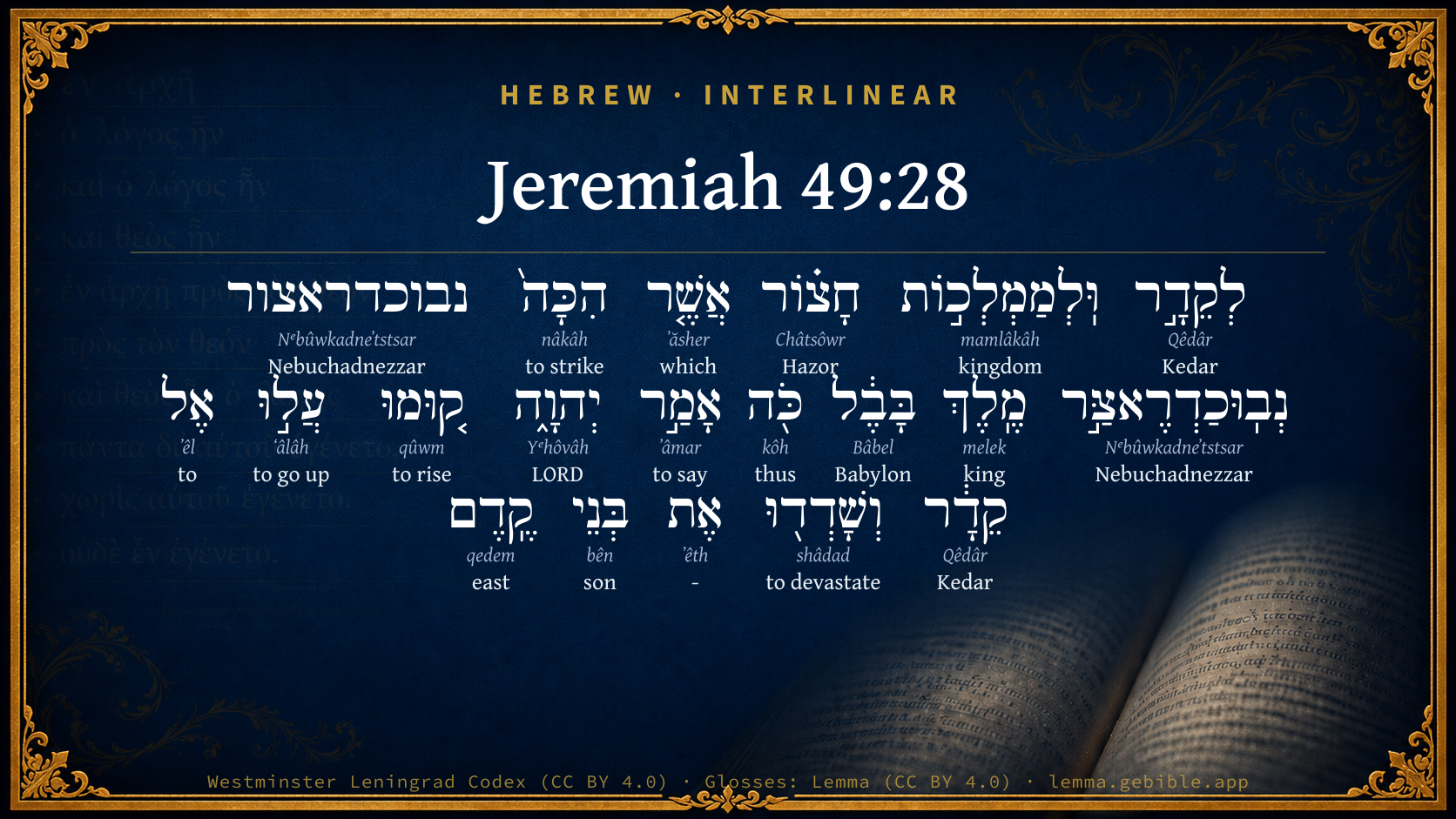
Hebrew (Westminster Leningrad Codex) Jeremiah 49:28 appears in the Hebrew Old Testament. The text above is from the Westminster Leningrad Codex. Each word links to its Strong’s number, a concise gloss, and parsing drawn from the Open Scriptures Hebrew Bible morphology. Click any word for its full Brown-Driver-Briggs (BDB) entry.
Download image
Cite this verse

Jeremiah 49:28 (World English Bible). Public Domain. Lemma interlinear Bible study tool, https://lemma.gebible.app/v/jeremiah/49/28.

Show BibTeX & RIS
BibTeX
RIS
English Translation
Of Kedar, and of the kingdoms of Hazor, which Nebuchadrezzar king of Babylon struck. Thus says Yahweh: Arise you, go up to Kedar, and destroy the children of the east.
World English Bible · Public Domain
Download a study sheet

One document with this verse’s original text, its word-by-word gloss line, the meaning frame, cross-references with their text, attributed commentary, and full source and license credits — printable, and it pastes into notes with its structure intact.

This verse Autodidact and up

Study sheet (.html) Plain text (.txt)

A passage Seminary Student

Up to 50 verses in one chapter. A passage sheet keeps up to 6 commentary sources and 12 cross-references per verse, in the order this page ranks them, and says so on the sheet whenever that leaves anything out. Ask for a single verse and you get the Autodidact verse sheet above.

Everything on this page stays free to read, with no account — the sheet is a download of what is already on screen, not access to it.

Want to remove ads? Support Godless Engineer
Compare translations 3

The same verse in 3 English versions, stacked beneath the original-language interlinear above. Click any original word for its lexicon entry.

Each is an independent rendering of the whole verse — the interlinear is not word-aligned to these translations.

Highlighted words mark where these versions differ — a whole-verse word diff, not a word-by-word alignment.

  • World English Bible Public Domain
    Of Kedar, and of the kingdoms of Hazor, which Nebuchadrezzar king of Babylon struck. Thus says Yahweh: Arise you, go up to Kedar, and destroy the children of the east.
  • King James Version Public Domain
    Concerning Kedar, and concerning the kingdoms of Hazor, which Nebuchadrezzar king of Babylon shall smite, thus saith the LORD; Arise ye, go up to Kedar, and spoil the men of the east.
  • unfoldingWord Literal Text CC BY-SA 4.0
    About Kedar and the kingdoms of Hazor, Yahweh says this to Nebuchadnezzar (now Nebuchadnezzar king of Babylon was going to attack these places): “Arise and attack Kedar and destroy those people of the east.

unfoldingWord Literal Text — © unfoldingWord, licensed CC BY-SA 4.0. Word-aligned USFM3 via Door43 (git.door43.org/unfoldingWord/en_ult).

Versions to compare (up to 4)

3 of 4 selected

Show all 18 translations

Every available English version of this verse, each an independent rendering of the whole verse.

  • World English Bible Public Domain
    Of Kedar, and of the kingdoms of Hazor, which Nebuchadrezzar king of Babylon struck. Thus says Yahweh: Arise you, go up to Kedar, and destroy the children of the east.
  • Berean Standard Bible Public Domain
    Concerning Kedar and the kingdoms of Hazor, which Nebuchadnezzar king of Babylon defeated, this is what the LORD says: “Rise up, advance against Kedar, and destroy the people of the east!
  • Majority Standard Bible Public Domain
    Concerning Kedar and the kingdoms of Hazor, which Nebuchadnezzar king of Babylon defeated, this is what the LORD says: “Rise up, advance against Kedar, and destroy the people of the east!
  • King James Version Public Domain
    Concerning Kedar, and concerning the kingdoms of Hazor, which Nebuchadrezzar king of Babylon shall smite, thus saith the LORD; Arise ye, go up to Kedar, and spoil the men of the east.
  • American Standard Version (1901) Public Domain
    Of Kedar, and of the kingdoms of Hazor, which Nebuchadrezzar king of Babylon smote. Thus saith Jehovah: Arise ye, go up to Kedar, and destroy the children of the east.
  • Revised Version (1885) Public Domain
    Of Kedar, and of the kingdoms of Hazor, which Nebuchadrezzar king of Babylon smote: Thus saith the LORD: Arise ye, go up to Kedar, and spoil the children of the east.
  • Geneva Bible (1599) Public Domain
    Vnto Kedar, and to the kingdomes of Hazor, which Nebuchad-nezzar, king of Babel shall smite, thus sayeth the Lord, Arise, and goe vp vnto Kedar, and destroy the men of the East.
  • Douay-Rheims (1899) Public Domain
    Against Cedar and against the kingdoms of Asor, which Nabuchodonouor king of Babylon destroyed. Thus saith the Lord: Arise, and go ye up to Cedar, and waste the children of the east.
  • Young's Literal Translation Public Domain
    Concerning Kedar, and concerning the kingdoms of Hazor, that Nebuchadrezzar king of Babylon hath smitten: `Thus said Jehovah: Arise ye, go ye up unto Kedar, And spoil the sons of the east.
  • Literal Standard Version CC BY-SA 4.0
    Concerning Kedar, and concerning the kingdoms of Hazor that Nebuchadnezzar king of Babylon has struck: “Thus said YHWH: Arise, go up to Kedar, || And spoil the sons of the east.
  • Unlocked Literal Bible CC BY-SA 4.0
    About Kedar and the kingdoms of Hazor, Yahweh says this to Nebuchadnezzar (now Nebuchadnezzar king of Babylon was going to attack these places): “Arise and attack Kedar and destroy those people of the east.
  • unfoldingWord Literal Text CC BY-SA 4.0
    About Kedar and the kingdoms of Hazor, Yahweh says this to Nebuchadnezzar (now Nebuchadnezzar king of Babylon was going to attack these places): “Arise and attack Kedar and destroy those people of the east.
  • Darby Bible Public Domain
    Concerning Kedar, and concerning the kingdoms of Hazor, which Nebuchadrezzar king of Babylon smote. Thus saith Jehovah: Arise, go up to Kedar, and spoil the men of the east.
  • World Messianic Bible Public Domain
    Of Kedar, and of the kingdoms of Hazor, which Nebuchadnezzar king of Babylon struck, The LORD says: “Arise, go up to Kedar, and destroy the children of the east.
  • Webster's Bible Public Domain
    Concerning Kedar, and concerning the kingdoms of Hazor, which Nebuchadrezzar king of Babylon shall smite, thus saith the LORD; Arise ye, go up to Kedar, and lay waste the men of the east.
  • Free Bible Version CC BY-SA 4.0
    A prophecy about the land of Kedar and the kingdoms of Hazor that were attacked by Nebuchadnezzar king of Babylon. This is what the Lord says: Go and attack Kedar; destroy the people of the east!
  • Bible in Basic English Public Domain
    About Kedar and the kingdoms of Hazor, which Nebuchadrezzar, king of Babylon, overcame. This is what the Lord has said: Up! go against Kedar, and make an attack on the children of the east.
  • JPS Tanakh (1917) Public Domain
    Of Kedar, and of the kingdoms of Hazor, which Nebuchadrezzar king of Babylon smote. Thus saith the LORD: Arise ye, go up against Kedar, and spoil the children of the east.

Literal Standard Version (2020), Covenant Press — licensed CC BY-SA 4.0. Text via the HelloAO Bible API (eBible.org). Unlocked Literal Bible (unfoldingWord) — licensed CC BY-SA 4.0. Text via the HelloAO Bible API (eBible.org). unfoldingWord Literal Text — © unfoldingWord, licensed CC BY-SA 4.0. Word-aligned USFM3 via Door43 (git.door43.org/unfoldingWord/en_ult). Free Bible Version, Dr. Jonathan Gallagher — licensed CC BY-SA 4.0. Text via the HelloAO Bible API (eBible.org).

Word by word

More ways to search: Search by grammar → Find every occurrence → Compare this word →

Practice this passage: Drill this verse → Learn its vocabulary →

לְקֵדָ֣ר
Qêdâr
H6938
“to/for · Kedar”
Preposition + Noun, Proper
Part of Speech
Preposition + Noun
Type
Proper
Full BDB Definition

Origin: from H6937

TWOT: None

Kedar = "dark" - a son of Ishmael (noun proper masculine) - the descendants of Kedar (noun proper people)
  1. וּֽלְמַמְלְכ֣וֹת mamlâkâh H4467 “and · to/for · kingdoms of” Conjunction + Preposition + Noun, Common, Feminine, Plural, Construct
  2. חָצ֗וֹר Châtsôwr H2674 “Hazor” Noun, Proper
  3. אֲשֶׁ֤ר ʼăsher H834 “which” Particle, Relative
  4. הִכָּה֙ nâkâh H5221 “to strike” Verb, Hiphil, Perfect, 3rd Person, Masculine, Singular
  5. נבוכדראצור Nᵉbûwkadneʼtstsar H5019 “Nebuchadnezzar” Noun, Proper
  6. נְבֽוּכַדְרֶאצַּ֣ר Nᵉbûwkadneʼtstsar H5019 “Nebuchadnezzar” Noun, Proper
  7. מֶֽלֶךְ melek H4428 “king of” Noun, Common, Masculine, Singular, Construct
  8. בָּבֶ֔ל Bâbel H894 “Babylon” Noun, Proper
  9. כֹּ֖ה kôh H3541 “thus” Adverb
  10. אָמַ֣ר ʼâmar H559 “to say” Verb, Qal, Perfect, 3rd Person, Masculine, Singular
  11. יְהוָ֑ה Yᵉhôvâh H3068 “LORD” Noun, Proper
  12. ק֚וּמוּ qûwm H6965 “rise” Verb, Qal, Imperative, 2nd Person, Masculine, Plural
  13. עֲל֣וּ ʻâlâh H5927 “go up” Verb, Qal, Imperative, 2nd Person, Masculine, Plural
  14. אֶל ʼêl H413 “to” Preposition
  15. קֵדָ֔ר Qêdâr H6938 “Kedar” Noun, Proper
  16. וְשָׁדְד֖וּ shâdad H7703 “and · devastate” Conjunction + Verb, Qal, Imperative, 2nd Person, Masculine, Plural
  17. אֶת ʼêth H853 “-” Particle, Direct Object
  18. בְּנֵי bên H1121 “sons of” Noun, Common, Masculine, Plural, Construct
  19. קֶֽדֶם qedem H6924 “east” Noun, Common, Masculine, Singular, Absolute

About this verse

These counts appear in no published source. They are computed here, from the morphology-tagged text and Lemma’s own curated glosses. What Lemma adds →

20
words
18
distinct lemmas
Prophets
section

Notable vocabulary

The rarest word here is לְקֵדָ֣ר Kedar H6938 — appearing just 12 times in the whole Hebrew Bible.

Shared distinctive vocabulary

לְקֵדָ֣ר Kedar H6938 occurs in 11 verses of the Hebrew Bible. Also found in:

Grammatical profile

  • 5 verbs
  • 11 nouns
  • 1 preposition
  • 1 adverb
  • 2 particles

Verb forms

  • הִכָּה֙ Hiphil · Perfect
  • אָמַ֣ר Qal · Perfect
  • ק֚וּמוּ Qal · Imperative
  • עֲל֣וּ Qal · Imperative
  • וְשָׁדְד֖וּ Qal · Imperative

Repetition

Words recur within this verse — often emphatic in Hebrew:

  • לְקֵדָ֣ר Kedar H6938 ×2
  • נבוכדראצור Nebuchadnezzar H5019 ×2

Cross-references

17

Topical passages linked to Jeremiah 49:28 in the Treasury of Scripture Knowledge — connected by theme and wording, ordered by reader-vote popularity; previews shown in the World English Bible.

  • Genesis 25:13 These are the names of the sons of Ishmael, by their names, according to the order of their birth: the firstborn of Ishmael, Nebaioth, then Kedar, Adbeel, Mibsam,
  • Judges 6:3 So it was, when Israel had sown, that the Midianites came up, and the Amalekites, and the children of the east; they came up against them;
  • Isaiah 11:14 They shall fly down on the shoulder of the Philistines on the west; together shall they despoil the children of the east: they shall put forth their hand on Edom and Moab; and the children of Ammon shall obey them.
  • Isaiah 21:16–17 For thus has the Lord said to me, Within a year, according to the years of a hireling, all the glory of Kedar shall fail;
  • Jeremiah 2:10 For pass over to the isles of Kittim, and see; and send to Kedar, and consider diligently; and see if there has been such a thing.
  • Jeremiah 49:14 I have heard news from Yahweh, and an ambassador is sent among the nations, [saying], Gather yourselves together, and come against her, and rise up to the battle.
  • Ezekiel 27:21 Arabia, and all the princes of Kedar, they were the merchants of your hand; in lambs, and rams, and goats, in these were they your merchants.
  • Genesis 25:6 but to the sons of the concubines who Abraham had, Abraham gave gifts. He sent them away from Isaac his son, while he yet lived, eastward, to the east country.
  • 1 Chronicles 1:29 These are their generations: the firstborn of Ishmael, Nebaioth; then Kedar, and Adbeel, and Mibsam,
  • Job 1:3 His possessions also were seven thousand sheep, three thousand camels, five hundred yoke of oxen, five hundred she-donkeys, and a very great household; so that this man was the greatest of all the children of the east.
  • Song of Solomon 1:5 I am dark, but lovely, You daughters of Jerusalem, Like Kedar's tents, Like Solomon's curtains.
  • Isaiah 13:2–5 Set up an ensign on the bare mountain, lift up the voice to them, wave the hand, that they may go into the gates of the nobles.
  • Isaiah 21:13 The burden on Arabia. In the forest in Arabia shall you lodge, you caravans of Dedanites.
  • Isaiah 42:11 Let the wilderness and the cities of it lift up [their voice], the villages that Kedar does inhabit; let the inhabitants of Sela sing, let them shout from the top of the mountains.
  • Jeremiah 49:30–31 Flee you, wander far off, dwell in the depths, you inhabitants of Hazor, says Yahweh; for Nebuchadrezzar king of Babylon has taken counsel against you, and has conceived a purpose against you.
  • Jeremiah 49:33 Hazor shall be a dwelling-place of jackals, a desolation forever: no man shall dwell there, neither shall any son of man sojourn therein.
  • Jeremiah 50:14–16 Set yourselves in array against Babylon round about, all you who bend the bow; shoot at her, spare no arrows: for she has sinned against Yahweh.

Cross-references courtesy of OpenBible.info (CC BY 4.0).

Hebrew and Greek witnesses Masoretic Hebrew ↔ Greek Septuagint

The same verse in the two great witnesses to the Old Testament, shown verse-for-verse.

These are two independent witnesses, not word-aligned to each other, and the Septuagint is shown in lemma (dictionary) form.

Hebrew Jeremiah 49:28 Masoretic · Westminster Leningrad Codex

לְקֵדָ֣ר וּֽלְמַמְלְכ֣וֹת חָצ֗וֹר אֲשֶׁ֤ר הִכָּה֙ נבוכדראצור נְבֽוּכַדְרֶאצַּ֣ר מֶֽלֶךְ בָּבֶ֔ל כֹּ֖ה אָמַ֣ר יְהוָ֑ה ק֚וּמוּ עֲל֣וּ אֶל קֵדָ֔ר וְשָׁדְד֖וּ אֶת בְּנֵי קֶֽדֶם

Of Kedar, and of the kingdoms of Hazor, which Nebuchadrezzar king of Babylon struck. Thus says Yahweh: Arise you, go up to Kedar, and destroy the children of the east.

World English Bible · Public Domain

Greek LXX Structure differs

In the Septuagint, Jeremiah is about an eighth shorter than the Hebrew and arranges its material differently — the Oracles Against the Nations (Hebrew chapters 46–51) appear in the middle of the Greek book, after 25:13. Because the chapter and verse boundaries do not line up, a verse-for-verse comparison with the Hebrew is not shown.

A verse-for-verse comparison isn’t shown here because the chapters and verses don’t line up. Switch to the LXX edition with the MT / LXX toggle above to read the Greek directly.

On this verse, The Cambridge Bible for Schools and Colleges discusses the Septuagint’s reading. Read the note in Commentary ↓

Hebrew: Westminster Leningrad Codex (CC BY 4.0). Greek: Septuagint (public domain); English from a public-domain English Septuagint. How the Septuagint differs from the Hebrew →

Targum (Aramaic paraphrase)

1

The Targum is the ancient Jewish Aramaic paraphrase of the Hebrew Scriptures — an interpretive translation, not the Hebrew text itself. Onkelos (literal) and Pseudo-Jonathan (expansive) render the Torah, and Jonathan the Prophets. Coverage is partial: where no permissively-licensed English translation exists for a verse, only the Aramaic is shown. This is verse-level text, not a word-by-word alignment to the Hebrew.

  1. Targum Jonathan Prophets (Joshua–Malachi)
    לְקֵדָר וּלְמַמְלָכוֹת חָצוֹר דִמְחָא נְבוּכַדְרֶאצַר מַלְכָּא דְבָבֶל כִּדְנַן אֲמַר יְיָ קוּמוּ סַקוּ עַל קַדָר וּבְזָז יַת בְּנֵי מַדִינְחָא:

    (no public-domain English translation for this verse)

    Targum Jonathan — Aramaic: “Mikraot Gedolot” (public domain). English: “Sefaria Community Translation” (CC0 1.0 (public-domain dedication)); “London "Chaldee Paraphrase," 1871” (public domain). Text via Sefaria.

Commentary

Notes on Jeremiah 49:28 from classic Christian and Jewish commentators (each source and its license shown beneath its notes). The classic Christian expositions comment on the surrounding passage and are grouped to its opening verse, so a note may address several verses; the Jewish commentaries on the Tanakh (Rashi and others) are per-verse, so they appear only where the commentator wrote on this verse.

Lemma curates 59 commentaries, every one of them public domain or Creative Commons licensed, each selected and text-cleaned for this edition rather than reprinted as found. About our sources →

Matthew Henry's Commentary

These verses foretell the desolation that Nebuchadnezzar and his forces should make among the people of Kedar (who descended from Kedar the son of Ishmael, and inhabited a part of Arabia the Stony), and of the kingdoms, the petty principalities, of Hazor, that joined to them, who perhaps were originally Canaanites, of the kingdom of Hazor, in the north of Canaan, which had Jabin for its king, but, being driven thence, settled in the deserts of Arabia and associated themselves with the Kedarenes. Concerning this people we may here observe,

I. What was their present state and posture? They dwelt in tents and had no walls, but curtains (Jer 49:20), no fortified cities; they had neither gates nor bars, Jer 49:31. They were shepherds, and had no treasures, but stock upon land, no money, but flocks and camels. They had no soldiers among them, for they were in no fear of invaders, no merchants, for they dwelt alone, Jer 49:31. Those of other nations neither came among them nor traded with them; but they lived within themselves, content with the products and pleasures of their own country. This was their manner of living, very different from that of the nations that were round about them. And, 1. They were very rich; though they had not trade, no treasures, yet they are here said to be a wealthy nation (Jer 49:31), because they had a sufficiency to answer all the occasions of human life and they were content with it. Note, Those are truly rich who have enough to supply their necessities, and know when they have enough. We need not go to the treasures of kings and provinces, or to the cash of merchants, to look for wealthy people; they may be found among shepherds that dwell in tents. 2. They were very easy: They dwelt without care. Their wealth was such as nobody envied them, or, if any did, they might come peaceably and enjoy the like; and therefore they feared nobody. Note, Those that live innocently and honestly may live very securely, though they have neither gates nor bars.

II. The design of the king of Babylon against them and the descent he make upon them: He has taken counsel against you and has conceived a purpose against you, Jer 49:30. That proud man resolves it shall never be said that he, who had conquered so many strong cities, will leave those unconquered that dwell in tents. It was strange that that eagle should stoop to catch these flies, that so great a prince should play at such small game; but all is fish that comes to the ambitious covetous man's net. Note, It will not always secure men from suffering wrong to be able to say that they have done no wrong; not to have given offence will not be a defence against such men as Nebuchadnezzar. Yet, how unrighteous soever he was in doing it, God was righteous in directing it. These people had lived inoffensively among their neighbours, as many do, who yet, like them, are guilty before God; and it was to punish them for their offences against him that God said (Jer 49:28): Arise, go up to Kedar, and spoil the men of the east. They will do it to gratify their own covetousness and ambition, but God orders it for the correcting of an unthankful people, and for warning to a careless world to expect trouble when they seem to be most safe. God says to the Chaldeans (Jer 49:31): "Arise, get up to the wealthy nation that dwells without care; go and give them an alarm, that none may imagine their mountain stands so strong that it cannot be moved."

III. The great amazement that this put them into, and the great desolation hereby made among them: They shall cry unto them; those on the borders shall send the alarm into all parts of the country, which shall be put into the utmost confusion by it; they shall cry, "Fear is on every side - We are surrounded by the enemy." the very terror of which shall drive them all to their feet and they shall none of them have any heart to make resistance. The enemy shall proclaim fear upon them, or against them, on every side. They need not strike a stroke; they shall shout them out of their tents, Jer 49:29. Upon the first alarm, they shall flee, get far off, and dwell deep (Jer 49:30), as the Edomites, Jer 49:8. And it will be found that this fear on every side is not groundless, for their calamity shall be brought from all sides thereof, Jer 49:32. No marvel there are fears on every side when there are foes on every side. The issue will be, 1. What they have will be a prey to the Chaldeans; they shall take to themselves their curtains and vessels; though they are but plain and coarse, and they have better of their own, yet they shall take them for spite, and spoil for spoiling sake. They shall carry away their tents and their flocks, Jer 49:29. Their camels shall be a booty to those that came for nothing else, Jer 49:32. 2. It is not said that any of them shall be slain, for they attempt not to make any resistance and their tents and flocks are accepted as a ransom for their lives; but they shall be dislodged and dispersed; though now they dwell in the utmost corners, out of the way, and therefore they think out of the reach, of danger (by this character those people were distinguished, Jer 9:26, Jer 9:25, Jer 9:23), yet they shall be scattered thence into all winds, into all parts of the world. Note, Privacy and obscurity are not always a protection and security. Many that affect to be strangers to the world may yet by unthought-of providences be forced into it; and those that live most retired may have the same lot with those that thrust themselves forth and lie most exposed. 3. Their country shall lie uninhabited; for, lying remote and out of all high roads, and having neither cities nor lands inviting to strangers, none shall care to succeed them, so that Hazor shall be a desolation for ever, Jer 49:33. If busy men be displaced, many strive to get into their placed, because they lived great; but here are easy quiet men displaced, and no man cared to abide where they did, because they lived meanly.

Matthew Henry's Commentary on the Whole Bible (1708–1710) — public domain (CC PDM 1.0). Text via the HelloAO Bible API.

The Cambridge Bible for Schools and Colleges

gen. ed. J. J. S. Perowne

28. Kedar] See on ch. Jer_2:10.

kingdoms of Hazor] Hazor elsewhere is the name of towns in Palestine, but here “is probably a collective term, derived from ḥâẓêr, a ‘village,’ denoting Arab tribes living in fixed settlements or ‘villages,’ ” Dr., as opposed to nomadic life alluded to in Jer_49:29 (“curtains”). Cp. Isa_42:11.

children of the east] Arabian tribes E. of Palestine.

28–33 (= LXX. Ch. Jer_30:6-11). Prophecy against Kedar and Hazor

28–33. This utterance, like the last, is rejected by Gi. and Co., though accepted, at any rate as containing a genuine element, by Kuenen, Erbt, and others. As elsewhere in these oracles, there have doubtless been later additions (see on 31 f.); but the reference to Dedan and Tema, tribes in the N. of Arabia, in Jer_25:23, would of itself lead us to expect a prophecy of this kind on Jeremiah’s part, a conclusion which receives support from the mention of Nebuchadrezzar in Jer_49:28; Jer_49:36, although this may be due to a writer’s intentional projection of himself into Jeremiah’s time.

This section may be divided into two subsections, which closely correspond in length, sense, and structure. Each consists of three verses, and the three consecutive thoughts in each are (i) a summons of the enemy to the attack, (ii) a promise of booty, (iii) an intimation that safety would be procured only by flight.

The Cambridge Bible for Schools and Colleges (gen. ed. J. J. S. Perowne; Cambridge University Press, 1878–1918) — public domain. Text from a community e-Sword module.

Trapp's Complete Commentary

John Trapp

Jer 49:28 Concerning Kedar, and concerning the kingdoms of Hazor, which Nebuchadrezzar king of Babylon shall smite, thus saith the LORD; Arise ye, go up to Kedar, and spoil the men of the east.

Ver. 28. Concerning Kedar.] These Kedarenes, the offspring of Kedar, Ishmael’s son, {Gen 25:13} dwelt, or rather abode for most part, in Arabia the stony, or desert. Hagarenes they were also called, and afterward Saracens, of Sarah, their chief city, saith Stephanus; {a} or of Sarach, for more credit sake, as others hold. Of this people came Mohammed, that grand impostor, and the Turks, who have now gotten into their hands so great a part of the habitable world. A rude people they were in Jeremiah’s days, and uncivilised; yet because wicked, they are here doomed.

And concerning the kingdoms of Hazor.] Their head city.

{a} Lib. de Urbib.

John Trapp, A Commentary or Exposition upon All the Books of the Old and New Testament (1647–1656) — public domain. Text from a community e-Sword module.

Joseph Benson's Commentary

Jer 49:28-29. Concerning Kedar and the kingdoms of Hazor — Kedar is well known to have been one of the sons of Ishmael, Gen 25:13, who settled in Arabia. But of Hazor we find no satisfactory account given by commentators. There is, indeed, a city called Hazor, mentioned Jos 11:10, and in other parts of Scripture: but this was in the land of Canaan; whereas the kingdoms of Hazor, here mentioned, were evidently in Arabia, in the neighbourhood, at least, of Kedar. Among the sons of Joktan, however, who were prior to the Ishmaelites in Arabia, and whose descendants are therefore looked on as the only genuine Arabs, we find one whose name was Hazar-maveth, Gen 10:26-30. And, as by Kedar all the descendants of Ishmael are probably here designed, so all the other branches of the family of Joktan may, in like manner, be included under the general name of Hazor. And perhaps the most probable reason why the Arabians are called a mingled people is, that they were thus made up of the people of different descents; some of them being sprung from Joktan, others from Ishmael, to whom must be added the sons of Abraham by Keturah, who are also said to have been settled in Kedem, or the east country, Gen 25:6, and perhaps other families besides. All these were divided into petty sovereign ties under certain chiefs or princes, which explains what is to be understood by the kingdoms of Hazor: see Blaney. Arise ye, go up to Kedar, &c. — Here the prophet foretels that Nebuchadnezzar should conquer these kingdoms, and spoil the men of the East, as the Arabians are called in the Scriptures. Their tents and their flock shall they — Namely, the Chaldeans; take away — Their substance consisted in their cattle and their tents, from whence the country itself is called the tents of Kedar, Psa 120:5 : with these they removed from place to place for the convenience of pasture. They shall take to themselves their curtains — Those elegant coverings of which their tents were made. and which were much superior to those of any other people. And they shall cry unto them — Hebrew, וקראו, Let them call for, or command, that is, as Blaney renders it, Let them bring, upon them terror from every side.

Joseph Benson's Commentary on the Old and New Testaments (1811–1818) — public domain. Text from a community e-Sword module.

Keil & Delitzsch

C. F. Keil & F. Delitzsch

"Concerning Kedar and the Kingdoms of Hazor, which Nebuchadrezzar the king of Babylon smote." (The Kethib נבוּכדראצּור is perhaps merely an error in transcription occasioned by the occurrence of the preceding חצור). Kedar, the Kedarenes, a Bedouin nation descended from Ishmael, dwelling in tents throughout the region between Arabia Petraea and Babylonia (see on Gen 25:13 and Eze 27:21), is here, no doubt, a general name for all the nomadic tribes and shepherd nations of Arabia. Hazor elsewhere occurs only as the name of various cities in Palestine (Jos 11:1; Jos 15:23, Jos 15:25; Jos 19:23; Nah. 11:33), of which we need not think here, since it is Arabians who are spoken of. No locality or region of this name in Arabia is known. Jeremiah appears to have formed the name for the purpose of designating those Arabians who dwelt in חצרים, "courts" or "villages," and who thus differed from the Bedouins proper, or nomads and dwellers in tents; cf. Isa 42:11 with Gen 25:16. The settled Arabians are to this day called Hadarijeh, in contrast with Wabarijeh, who dwell in tents. "Hadar, חצר, is the settled dwelling-place, in contrast with bedû, the steppe, where the tents are pitched, sometimes here, sometimes there, and only for a time" (Delitzsch on Isa 42:11). "The kingdoms of Hazor" are the regions of the settled tribes, ruled by their own princes or sheiks; cf. Jer 25:24.

(Note: According to Mrc. v. Niebuhr, Gesch. Ass. u. Bab. p. 210, "Hazor is the modern Hajar, a region which occupies the whole north-eastern corner of the Nejed, and to which, in the wider sense, Lascha, the region on the coast, also belongs" But חצור, from חצר, which corresponds to Arab. htsr or hdr, is fundamentally different from Arab. hjr or ḥjr.)

In the prophecy, the general designation, "children of the east," i.e., Orientals, alternates with Kedar: the former is the most common name given to the tribes living to the east of Palestine, in the wilderness: cf. Jdg 6:3; Job 1:3; Eze 25:4. Instead of this name, Josephus uses the designation "Arabians" (Ant. Eze 25:6. 1); later, "Nabateans" or "Kedarenes" became common. Here also (Jer 49:32) is used the special designation קצוּצי פאה cut (at) the corner (of the hair), which points to the custom, usual among several of these Bedouin tribes, of cropping the hair of the head and beard; see on Jer 9:25 and Jer 25:23.

Jer 49:28

"Thus saith Jahveh, Arise, go up to Kedar, and destroy the children of the east. Jer 49:29. Their tents and their flocks shall they take: their curtains, and all their vessels, and their camels shall they carry away for themselves; and they shall cry over them, Fear is on every side. Jer 49:30. Flee! wander far, dwell deep, ye inhabitants of Hazor, saith Jahveh; for Nebuchadrezzar king of Babylon hath taken counsel against you, and hath devised a plan against them. Jer 49:31. Arise! go up against a nation at ease, dwelling carelessly, saith Jahveh; it has no gates nor bars - they dwell alone. Jer 49:32. And their camels shall be a prey, and the multitude of their herds a spoil; and I will scatter them to every wind who have cut the corner [of their beards], and from all sides will I bring their destruction, saith Jahveh. Jer 49:33. And Hazor shall be an habitation of jackals, a desolation for ever. No man shall dwell there, nor shall a son of man sojourn in it."

This prophecy consists of two brief strophes, which begin with a summons to the army of the enemy to wage war on the Arabians (Jer 49:28 and Jer 49:31), and then announce the execution of this order; the arrangement, moreover, is such that there is attached to the first strophe a summons to the Arabians to save themselves by flight (Jer 49:30), while the other concludes with the threat that their territory shall be destroyed (Jer 49:33).

Jer 49:28-30

עלה is used with אל instead of על, to signify hostile advance against a nation or city. שׁדדוּ with Qametz-Hatuph (without Metheg) is imperative; cf. Ewald, 227, i, with 251, c. The verbs יקּחוּ and ישׂאוּ in Jer 49:29 are not jussives (Ewald, Umbreit, etc.), but imperfects, describing what takes place in consequence of the order given. Tents and flocks of sheep and goats, curtains and vessels, together with camels, form the property and wealth of the nomads. נשׂא, to take away, carry off; להם, sibi. They call out over them, as if it were a watch-cry, "Horror around:" on this expression, see Jer 6:25. This justifies the call addressed to them, "Flee," etc. To נסוּ is added נדוּ for the purpose of intensifying, and this again is further strengthened by appending מאד: "Use every effort to flee." העמיקוּ as in Jer 49:8. A reason is given for the summons, in the statement that Nebuchadnezzar, as the instrument of Jahveh, has formed a plan against them; cf. Jer 49:20 and Jer 18:11. Instead of עליהם, many MSS and the ancient versions have עליכם, in conformity with the first member. In all probability, the original reading is "against them," inasmuch as "the discourse, as in other instances, makes a transition, in the last portion, from direct address to a calmer style of speaking" (Ewald).

Jer 49:31-32

Jer 49:31 does not declare the plan of the king of Babylon; but the words, "Arise, go ye up," etc., are once more the summons of the Lord, as is shown by the expression "saith Jahveh." The enemy is to march against a peaceful nation, dwelling securely, that has neither doors nor bars, i.e., does not live in cities surrounded by walls with gates and bars (cf. Sa1 23:7; Deu 3:5), whose territory, therefore, is easily conquered. They dwell alone, apart from others, without connection and intercourse with other nations, from which they could obtain help and support. שׁליו, like זעיר, Job 36:2; Dan 7:8, is a Chaldaizing form; elsewhere it is written שׁליו, Job 21:23, or שׁלו, Job 16:12. As to living securely, cf. Jdg 18:7; Eze 38:11; on living alone, 15:17. This last is elsewhere said only of Israel, Num 23:9; Deu 33:28. Their possessions will become the spoil of the enemy; God will scatter them to every wind (cf. Eze 5:12; Eze 12:14), and bring destruction on them from every side (on עבריו, cf. Kg1 5:4).

Jer 49:33

The dwelling-places of the settled tribes (Hazor) shall become the habitation of jackals (cf. Jer 9:10), an uninhabited desolation for ever. Jer 49:33 is in part a repetition of Jer 49:18.

With regard to the fulfilment of this prophecy, it follows from the latter part of the title that Nebuchadnezzar had smitten the Arabian tribes, i.e., defeated them, and subjected them to his sway. But we have no historical information as to the time when this took place. M. von Niebuhr (Gesch. Assyr. u. Bab. S. 209) and Duncker (Gesch. d. Alterth. i. S. 427) suppose that Nebuchadnezzar, after he had returned home to Babylon from Hither Asia, having heard of the death of his father, after his victory at Carchemish, and after he had ascended the throne, "as it seems," first thought of extending his authority over the Arabians on the lower portion of the Euphrates, in North Arabia, and in the Syrian desert. This supposition may possibly be true, but cannot be raised to historic probability; moreover, it is connected, by the above-mentioned historians, with theories regarding the campaigns against Hither Asia which rest upon statements of Josephus that are very uncertain, and some of which can be proved to be incorrect. Such is the statement in Antt. x. 6. 1, that Nebuchadnezzar, after his victory at Carchemish, in pursuing the Egyptians to the borders of their country, did not touch Judea. The only notice we have, apart from Scripture, of the conquest of Arabia by Nebuchadnezzar, is that furnished by Josephus (contra Ap. i. 19) from Berosus: κρατῆσαι δέ φησί τὸν Βαβυλώνιον (i.e., Nebuchadnezzar) Αἰγύπτου Συρίας Φοινίκης ̓Αραβίας. But this notice is stated in such indefinite and general terms, that nothing more specific can be inferred from it regarding the time and circumstances of the conquest of Arabians.

Keil & Delitzsch — Biblical Commentary on the Old Testament (1861–1891) — public domain (CC PDM 1.0). Text via the HelloAO Bible API. (Old Testament only.)

The Expositor's Bible

CHAPTER XXIII

KEDAR AND HAZOR

Jer_49:28-33

"Concerning Kedar, and the kingdoms of Hazor which Nebuchadnezzar king of Babylon smote."- Jer_49:28

FROM an immemorial seat of human culture, an "eternal city" which antedates Rome by centuries, if not millenniums, we turn to those Arab tribes whose national life and habits were as ancient and have been as persistent as the streets of Damascus. While Damascus has almost always been in the forefront of history, the Arab tribes-except in the time of Mohammed and the early Caliphs-have seldom played a more important part than that of frontier marauders. Hence, apart from a few casual references, the only other passage in the Old Testament which deals, at any length, with Kedar is the parallel prophecy of Isaiah. And yet Kedar was the great northern tribe, which ranged the deserts between Palestine and the Euphrates, and which must have had closer relations with Judah than most Arab peoples.

"The kingdoms of Hazor" are still more unknown to history. There were several "Hazors" in Palestine, besides sundry towns whose names are also derived from Hacer, a village; and some of these are on or beyond the southern frontier of Judah, in the wilderness of the Exodus, where we might expect to find nomad Arabs. But even these latter cities can scarcely be the "Hazor" of Jeremiah, and the more northern are quite out of the question. It is generally supposed that Hazor here is either some Arabian town, or, more probably, a collective term used for the district inhabited by Arabs, who lived not in tents, but in Hacerim, or villages. This district would be in Arabia itself, and more distant from Palestine than the deserts over which Kedar roamed. Possibly Isaiahs "villages (Hacerim) that Kedar doth inhabit" were to be found in the Hazor of Jeremiah, and the same people were called Kedar and Hazor respectively according as they lived a nomad life or settled in more permanent dwellings.

The great warlike enterprises of Egypt, Assyria, and Chaldea during the last centuries of the Jewish monarchy would bring these desert horsemen into special prominence. They could either further or hinder the advance of armies marching westward from Mesopotamia, and could command their lines of communication. Kedar, and possibly Hazor too, would not be slack to use the opportunities of plunder presented by the calamities of the Palestinian states. Hence their conspicuous position in the pages of Isaiah and Jeremiah.

As the Assyrians, when their power was at its height, had chastised the aggressions of the Arabs, so now Nebuchadnezzar "smote Kedar and the kingdoms of Hazor." Even the wandering nomads and dwellers by distant oases in trackless deserts could not escape the sweeping activity of this scourge of God. Doubtless the ravages of Chaldean armies might serve to punish many sins besides the wrongs they were sent to revenge. The Bedouin always had their virtues, but the wild liberty of the desert easily degenerated into unbridled license. Judah and every state bordering on the wilderness knew by painful experience how large a measure of rapine and cruelty might coexist with primitive customs. and the Jewish prophet gives Nebuchadnezzar a Divine commission as for a holy war:-

"Arise, go up to Kedar;

Spoil the men of the east.

They (the Chaldeans) shall take away their tents and flocks;

They shall take for themselves their tent coverings,

And all their gear and their camels:

Men shall cry concerning them,

Terror on every side."

Then the prophet turns to the more distant Hazor with words of warning:-

"Flee, get you far off, dwell in hidden recesses of the land, O inhabitants of Hazor-It is the utterance of Jehovah-

For Nebuchadnezzar king of Babylon hath counseled a counsel and purposed a purpose against you."

But then, as if this warning were a mere taunt, he renews his address to the Chaldeans and directs their attack against Hazor:-

"Arise, go up against a nation that is at ease, that dwelleth without fear- it is the utterance of Jehovah-

Which abide alone, without gates or bars"- like the people of Laish before the Danites came, and like Sparta before the days of Epaminondas.

Possibly we are to combine these successive "utterances," and to understand that it was alike Jehovahs will that the Chaldeans should invade and lay waste Hazor, and that the unfortunate inhabitants should escape-but escape plundered and impoverished: for

"Their camels shall become a spoil,

The multitude of their cattle a prey:

I will scatter to every wind them that have the corners of their hair polled;

I will bring their calamity upon them from all sides.

Hazor shall be a haunt of jackals, a desolation forever:

No one shall dwell there,

No soul shall sojourn therein."

William Robertson Nicoll, ed., The Expositor's Bible (London: Hodder & Stoughton, 1887–1910) — public domain. 65 of 66 books (1 Corinthians is not separately keyed, as that volume carries no machine-parseable verse references); section-level commentary keyed to the opening verse. Introductory and overview sections not keyed to a specific passage are excluded.

Tyndale Open Study Notes

Tyndale Open Resources

49:28-33 The nomads of Kedar roamed freely in the upper Arabian Desert east of Palestine. They were a belligerent people (Ps 120:5-7; Isa 21:13-16) who raised flocks and herds for lucrative trade with Tyre (Ezek 27:21). • Hazor was a region east of Damascus inhabited by nomads. • The poem urges King Nebuchadnezzar to attack, and it describes the impact of the battles.

49:28-29 The Babylonians wanted to defeat the warriors of Kedar so they could capture their rich household goods and camels.

Tyndale Open Study Notes — © Tyndale Open Resources, licensed CC BY-SA 4.0. Text via the HelloAO Bible API.

Geneva Bible (1599)

Geneva Bible translators

Meaning, the Arabians, and their borderers.

Geneva Bible (1599) marginal notes — public domain. Text via Bolls.life.

Jamieson, Fausset & Brown

Robert Jamieson, A. R. Fausset & David Brown

Kedar--son of Ishmael (Gen 25:13). The Kedarenes led a wandering predatory life in Arabia-Petræa, as the Bedouin Arabs (Ch2 21:16-17; Psa 120:5). Kedar means "blackness" (Sol 1:5).

Hazor--not the city in Palestine, but a district in Arabia-Petræa. "Kingdoms" refer to the several combinations of clans, each under its own sheik.

men of the east--Kedar and Hazor were east of Judea (Jdg 6:3; Job 1:3).

Jamieson, Fausset & Brown — Commentary Critical and Explanatory on the Whole Bible (1871) — public domain (CC PDM 1.0). Text via the HelloAO Bible API.

Adam Clarke's Commentary

Verse 28. CONCERNING KEDAR, AND CONCERNING THE KINGDOMS OF HAZOR] This is the title of another new prophecy.

Kedar was the name of one of the sons of Ishmael (Ge 25:13) who settled in Arabia, and who gave name to a powerful tribe of Arabs who used to traffic with the Tyrians in cattle. It appears from this prophecy that Nebuchadnezzar got a commission to go against and reduce them to great misery.

Adam Clarke's Commentary on the Bible (1810–1826) — public domain. Text from a community e-Sword/MySword module.

John Calvin's Commentaries

There is here another prophecy added respecting the Kedareans, who inhabited a part of Arabia. There is elsewhere mention made of them, and it is probable that they were neighbors to the Syrians and not far from Judea; for David complained (if he was the author of that psalm) that he dwelt among the children of Kedar,

“Woe to me, because I am compelled to dwell in Mesech and with the children of Kedar,” (Psalm 120:5)

Whoever, then, composed that psalm, it is a probable conjecture that the Kedareans, though not contiguous to Judea, were not yet far distant; and we have said that they were the inhabitants of Arabia. And the Prophet adds, the children of Kedem; so some render the word, as though it were the name of a nation; and Moses tells us that Kedem was one of the sons of Ishmael. It may be that for this reason Jeremiah joined this people to the Kedareans, (Genesis 25:13-15.) But I am, however, inclined to the opinion, that he mentions here the children of the East, that is, with respect to Judea; not that they were nigh the Persians or other oriental nations, but he only points out a land to the east of Judea.

But why God took vengeance on that people, the cause is not expressed. It may yet have been that they formerly had much injured the Israelites; God therefore having long spared them at length appeared as their severe judge. And though the reason was unknown, yet it did good to the Jews to know, that God’s hand was extended to every part of the world to execute vengeance; for they might have hence concluded that they were justly punished, because they had rebelled against God; for we know that a servant who willfully and disdainfully disobeys his master, deserves double punishment. (Luke 12:47) When the Jews then saw that these barbarians, who were like wild beasts, could not escape God’s vengeance, they might have thought within themselves how just must have been God’s judgments executed on them, who had knowingly and willfully despised him. This then was one of the benefits to be derived from this prophecy.

And then, as we have elsewhere said, this general rule ought to be borne in mind, that when changes happen in the world, it is necessary, as men’s thoughts and feelings are evanescent, that this warning should be given, that God so rules in all these changes, that chance has no place in them. For when calamities, like a deluge, spread over the whole world, then we think, as it has been stated, that such a confusion happens by chance, and without any cause. For when God afflicts some portion, the difference may lead us to some reflection, — “One part is afflicted and another escapes;” but when evils overwhelm the whole world, then, there being no difference, we think that all things are in a state of confusion, nor can we collect our thoughts so as to know, that God so takes vengeance on all, that he yet regulates his judgments, as it is right, according to his infinite and incomprehensible wisdom and justice. As then this adjustment which God makes, as to his judgments, is not evident to the mind and perception of men, it was necessary, when God was at the same time fulminating through the whole world, that the Jews should be reminded to be ever attentive to the operations of his hand. They saw themselves ruined, they saw the same thing happening to the Egyptians and to all other contiguous nations; at length Assyria was to have its turn, then Chaldea, and afterwards the Medians and Persians. As then no part was to remain untouched, who would not have thought that all things revolved, as it were, through blind and uncertain fate? God, therefore, did not, without reason, forewarn the faithful, lest they should think, that in so great vicissitudes and violent changes, all things were indiscriminately mixed together, but that they might know that God, from heaven, regulated and overruled all these confusions. This is the reason why the Prophets so particularly spoke of the calamities of all nations.

Let us come now to the Kedareans: To Kedar, he says, and the kingdoms of Hazor These kingdoms, no doubt, included a large country, for it is hardly credible that Hazor was the name of a city; for who would have said, the kingdoms of Hazor, had it been only the name of a city? It is, indeed, certain, that there was a city of this name, as it is mentioned by Joshua. But here it means a large region, contiguous to the Kedareans. And he says that all these nations had been smitten by Nebuchadnezzar, because these barbarous men were probably but little known to the Jews. It must yet be observed, that they had not been as yet smitten by Nebuchadnezzar, that is, at the time the Prophet spoke of their destruction. But Jeremiah spoke thus, in order to confirm his prophecy, as though he had said, that what many disregarded, and even treated with disdain, was at length really fulfilled. For when he threatened ruin to these remote nations, it is probable that he was derided by his own people; and hence he says, that he had not spoken in vain, but that by the event itself his vocation was proved, because these were smitten as he had predicted.

And this is the prophecy, Arise ye, ascend against Kedar, and destroy the children of the East Here the Prophet speaks of the Babylonians, and in the person of God, as his herald. And we have said that God’s servants commanded and ordered what was future with supreme authority, in order to gain more reverence and honor to their words or doctrine. For prophecies were despised by ungodly men, and they insultingly said, that they were only words. Hence the servants of God, to show that their words had accomplishment connected with them, assumed the person of God. Thus they boldly commanded the greatest kings, as Jeremiah does here, Arise ye; for whom does he here address? the king of Babylon, that greatest of monarchs, and also the Assyrians as well as the Chaldeans: and he commanded them to arise and to ascend, as though he had them ready for his service, even because he did not speak except by God’s command.

And such mode of speaking ought to be especially observed, that we may learn to embrace whatever is announced in God’s name, as though the thing itself were already before our eyes, and that we may also know that the power of the whole world, is in such a way under God’s control, that all the kingdoms of the earth are ready to fulfill his word. When, therefore, God himself speaks, we ought so to regard the efficacy of his word, as though heaven and earth were ready to obey and to fulfill what he has commanded. It follows, —

John Calvin's Commentaries (1540-1563) — public domain. Text from the Calvin Translation Society English edition (1840s-50s) via the Christian Classics Ethereal Library (ccel.org). Calvin's coverage is partial (roughly two-thirds of the Bible); uncommented books and verses are honest gaps, never fabricated. The 19th-century editor's footnotes and remarks are omitted so the notes are faithfully Calvin's own voice.

Ellicott's Commentary for English Readers

(28) Concerning Kedar . . .—The name belonged to a tribe of the Bedouin type, descended from Ishmael (Gen_25:13), and at this time conspicuous as supplying the markets of Tyre with sheep and goats (Eze_27:21). In PP. 120:5 it appears as the representative of the fierce nomadic life of the Arabians. Hazor appears as the name of many cities in Palestine (Jos_11:1; Jos_15:23; Jos_19:36), but the combination with Kedar points to quite a different region. The probable explanation is that Jeremiah uses the term (as a like word, hazçrein, is used in Isa_42:11 for the “villages” of Kedar) for the region in which the Kedar Arabs had ceased to be nomadic, and had made a permanent settlement. According to Niebuhr (Assur u. Bab., p. 210) it answers to the modern Hadschar in the angle formed by the southern course of the Euphrates and the Persian Gulf.

Spoil the men of the east.—Literally, the B’eni-Kedem. or children of the East. The term appears in the Old Testament history from a very early date (Gen_29:1; Jdg_6:3; Jdg_6:33; Jdg_7:12; 1Ki_4:30; Job_1:3), and has, as might be expected, though obviously indicating a nomadic form of life, like that of the Midianites, a somewhat wide and undefined connotation. The picture of the attack on them presents a marked contrast to that of the attack on Damascus: not palaces and treasures, but tents and flocks, the curtains or hangings of the tent, their implements (weapons, kneading troughs, and the like), their very camels, seized by the conquerors.

A Bible Commentary for English Readers, edited by Charles John Ellicott (1878–1897) — public domain. Text from a community e-Sword module.

John Gill's Exposition

Concerning Kedar, and concerning the kingdoms of Hazor,.... A new prophecy concerning the Arabians; for Kedar was a son of Ishmael, Gen 25:13; whose posterity inhabited Arabia Petraea. Hazor was Petra itself, the metropolis of the country, whose king had several petty kings and kingdoms under him; for this is not the Hazor in the land of Canaan destroyed by Joshua, which had been the head of several kingdoms; and where Jabin king of Canaan afterwards reigned, Jos 11:10, Jdg 4:2; though some think that some of those Hazorites in Joshua's time made their escape, and fled into these parts, and built a city, and called it after the name of the former:

which Nebuchadrezzar king of Babylon shall smite, thus saith the Lord: that is, "thus saith the Lord concerning", or "unto", or "against Kedar" (p), &c. as in Jer 49:1; which the king of Babylon "hath smitten"; the past for the future, common in prophetic language: or, "is about to smite" (q); would do it in a very little time; for the phrase, "thus saith the Lord", is not to be connected with what follows after, but with what goes before; though indeed the next words are the words of the Lord to the Chaldeans:

arise ye, go up to Kedar; in a hostile manner; invade that country, and possess it:

and spoil the men of the east; the Arabians, which lay east of Judea and Babylon: or, "the children of Kedem" (r); the same with Kedemah, another son of Ishmael, Gen 25:15; whose posterity dwelt still more to the east; so Kimchi; though the Targum renders it "the children of the east".

(p) "ad Cedar", V. L. Pagninus, Montanus; "contra Kedarem", Junius & Tremellius, Piscator; "contra Arabian", Schmidt. (q) "percussurus est", Junius & Tremellius, Grotius. (r) "filios Chedem", Montanus, Vatablus.

John Gill's Exposition of the Whole Bible (1746–1763) — public domain (CC PDM 1.0). Text via the HelloAO Bible API.

Albert Barnes' Notes on the Bible

Hazor, derived from a word signifying an unwalled village, is a general appellative of those Arab tribes who were partially settled, while Kedar signifies the Bedawin, who used only tents. Some think that Hazor is another way of spelling Jetor, i. e., Ituraea, whose inhabitants, with the Kedarenes, would naturally be called the sons of the East.

Shall smite - Or, smote.

Albert Barnes' Notes on the Bible (1834–1885) — public domain. Text from a community e-Sword/MySword module.

Haydock's Catholic Bible Commentary

Cedar and Asor were parts of Arabia; which, with Moab, Ammon, Edom, &c., were all brought under the yoke of Nabuchodonosor. (Challoner) --- We know nothing of the situation of Asor, which means "a court." (Calmet) --- It might be the flying camp (Theodoret) of the Saracens, (St. Jerome, in Isaias xxi. 16.) who dwelt under tents like the hordes of Tartars, the Ethiopian emperor, and the mogul. Yet this seems to have been a fixed habitation, ver. 30, 33. --- East; the Desert Arabia, ver. 32. (Calmet) --- Cedar was the son of Ismael, and Asor the chief city of the Agarens. (Worthington)

George Leo Haydock (1774–1849), Haydock's Catholic Family Bible and Commentary, 1859 edition — public domain. Excludes Psalms (Douay-Rheims chapter numbering differs from Protestant) and Deuterocanonical books (Catholic canon only).

Matthew Poole's English Annotations

Kedar, Gen 25:13, was one of the sons of Ishmael, whose posterity inhabited part of Arabia Petrea. See Isa, Isa 21:13,17. We read of it Psa 120:5; Son 1:5; Eze 27:21. We read of

Hazor Jos 11:1; Jos 11:10, it was the head city to several kingdoms in Joshua’s time; Jabin was king of it in the times of Deborah, Jdg 4:2. The prophet foretells that Nebuchadrezzar should also conquer these kingdoms; and saith he heard the Lord call to Nebuchadrezzar to go up against them.

Matthew Poole's English Annotations on the Holy Bible (1683–1685) — public domain. Text from a community e-Sword/MySword module.

Whedon's Commentary on the Bible

Daniel D. Whedon

28. Concerning Kedar — In chap. Jer_2:10, “Kedar” is evidently a general name for the people of the East; here the name is somewhat more definitely restricted to the nomadic peoples of Arabia.

Kingdoms of Hazor — “Hazor” is kindred with hazer — an unwalled village. Here the term is used to designate those Arabians who dwelt in villages. Go up to Kedar is addressed to the enemy.

Daniel D. Whedon (gen. ed.), Commentary on the Old and New Testaments (1874–1909) — public domain. Text from a community e-Sword module.

The Pulpit Commentary

Vers. 28-33. Against the nomad and partly settled Arabs the former described under the name Kedar (see on Jer_2:10), the latter under that of Hazor. (connected with hazer, an unwalled village; comp. Lev_25:31) This use of Hazer is remarkable; elsewhere the name denotes towns in Palestine. (Jos_11:1 Jos_15:23 Neh_11:33) There are two plainly marked strophes, vers. 28-30 and 31-33, both beginning with a summons to the foe to take the field.

Hazer (i.e. the settled Arabs) is said to have kingdoms. "King" is used in Hebrew in a wider sense than we are accustomed to Jer_25:24, "All the kings of Arabia"). The "kings" of Hazer would be mere sheikhs or emirs. Shall smite; rather, smote. There is no justification whatever for the future. The statement is obviously a later addition, to show that the prophecy was fulfilled. On the form "Nebuchadrezzar," see on Jer_21:2. The men of the east. A general designation of the inhabitants of all the countries in the east of Palestine. (Gen_29:1 Jud_1:6:3Jn_1:3)

The Pulpit Commentary (1880–1919), ed. H.D.M. Spence-Jones & Joseph S. Exell — public domain. Text from a community e-Sword module.

John Wesley's Explanatory Notes

Kedar - Was one of the sons of Ishmael, whose posterity inhabited part of Arabia Petraea. Hazor was the head city to several kingdoms in Joshua's time.

John Wesley, Explanatory Notes Upon the Whole Bible (1754–1765) — public domain. Text via the GEBible commentary corpus.

unfoldingWord translationNotes

Door43 World Missions Community

General Information:

Jeremiah speaks about what will happen to Kedar.

Kedar

This is the name of a land far to the east of Israel. See how you translated this in Jeremiah 2:10. (See: How to Translate Names)

Hazor

This is the name of kingdom or district far to the east of Israel. (See: How to Translate Names)

now Nebuchadnezzar

Here "now" introduces background information about Nebuchadnezzar. (See: Background Information)

Nebuchadnezzar king of Babylon was going to attack

Here "Nebuchadnezzar" represents his army. AT: "the army of Nebuchadnezzar king of Babylon was going to attack" (See: Metonymy)

Their tents and their flocks will be taken, along with their tent curtains and all of their equipment

This can be stated in active form. AT: "Your soldiers will take their flocks, tent curtains, and all of their equipment" (See: Active or Passive)

their camels will be led away from them

This can be stated in active form. AT: "your soldiers will take their camels from them" (See: Active or Passive)

men will shout to them, "Terror is on every side!"

Possible meanings are 1) these are men being attacked by the enemy. AT: "men will shout, 'We are terrified because terrible things are happening all around us!'" or 2) these are soldiers in the invading army. AT: "soldiers will shout at them, 'Be afraid because we are all around you!'"

translationWords

kingdom

Yahweh

Nebuchadnezzar

king

Babylon

raise

tent

flocks

camel

unfoldingWord translationNotes — © Distant Shores Media and the Door43 World Missions Community, licensed CC BY-SA 4.0. Source: git.door43.org/Door43/en_tn.

Rashi

Rabbi Shlomo Yitzchaki (Rashi)

Concerning Kedar They were desert dwellers, with neither wall nor city.

Rashi on the Tanakh — English translations: “The Judaica Press complete Tanach with Rashi, translated by A. J. Rosenberg” (CC BY 4.0); “Pentateuch with Rashi's commentary by M. Rosenbaum and A.M. Silbermann, 1929-1934” (public domain); “The Metsudah Tanach series, Lakewood, N.J” (CC BY 4.0); and “The Book of Joshua, Metsudah Publications, 1997” (CC BY 4.0). Text via Sefaria.

Lesson kit

Teaching starters — assembled from the data on this page, not authored interpretation. Every prompt links to the verse data it draws on. Edit before teaching.

Jeremiah, in the Prophets, opens this verse with 20 words (18 distinct Hebrew lemmas). Its most distinctive word is Qêdâr (“Kedar”). A historical commentator’s framing appears above. Read the whole chapter for the surrounding context.

Discussion questions

  1. What does “Kedar” (Qêdâr) contribute to the verse as a whole?
  2. Genesis 25:13 shares the word «Kedar» with this verse. How do the two illuminate each other?
  3. “Kedar” occurs 2× in this one verse. What is the effect of the repetition?
  4. The translations on this page render this verse differently — a whole-verse word diff, not a word-by-word alignment. What might account for the different wordings?
  5. The verb «הִכָּה֙» is Hiphil Perfect. How does its form color the action?
  6. Reading how Matthew Henry's Commentary and The Cambridge Bible for Schools and Colleges read this verse, where do the two commentators agree and where do they part?

Things to notice

Reading settings

Reading text

Shown beneath each verse's original-language words.

Old Testament
Old Testament edition

Read the OT as the Masoretic Hebrew (MT) or the Greek Septuagint (LXX).

English shown for the Greek Septuagint (in the Hebrew ↔ Greek comparison).

Comparing translations? Open the Compare panel on any verse page to stack up to four side by side.