
Isaiah 2:6

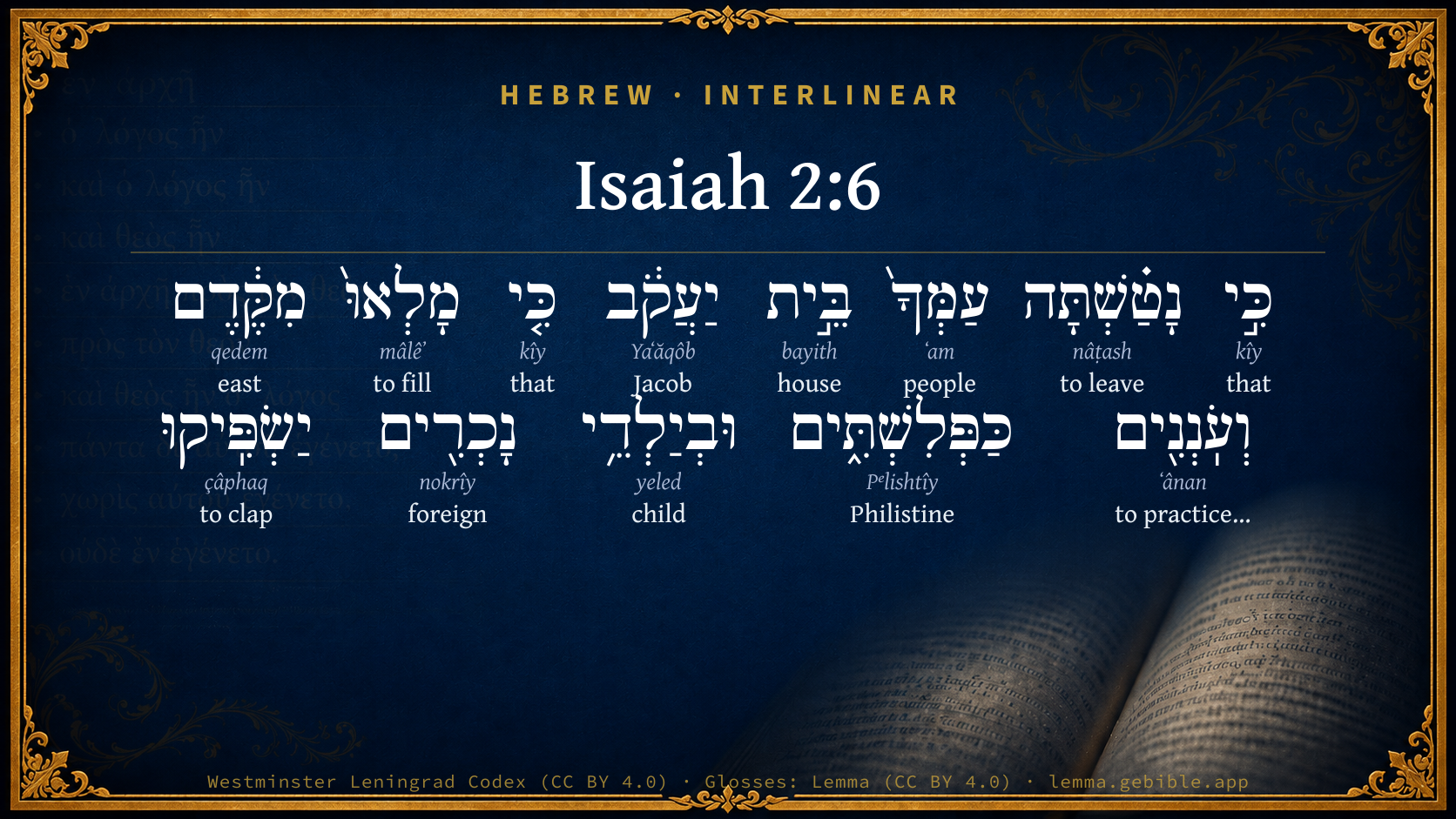
Hebrew (Westminster Leningrad Codex) Isaiah 2:6 appears in the Hebrew Old Testament. The text above is from the Westminster Leningrad Codex. Each word links to its Strong’s number, a concise gloss, and parsing drawn from the Open Scriptures Hebrew Bible morphology. Click any word for its full Brown-Driver-Briggs (BDB) entry.
Download image
Cite this verse

Isaiah 2:6 (World English Bible). Public Domain. Lemma interlinear Bible study tool, https://lemma.gebible.app/v/isaiah/2/6.

Show BibTeX & RIS
BibTeX
RIS
English Translation
For you have forsaken your people, the house of Jacob, Because they are filled from the east, With those who practice divination like the Philistines, And they clasp hands with the children of foreigners.
World English Bible · Public Domain
Download a study sheet

One document with this verse’s original text, its word-by-word gloss line, the meaning frame, cross-references with their text, attributed commentary, and full source and license credits — printable, and it pastes into notes with its structure intact.

This verse Autodidact and up

Study sheet (.html) Plain text (.txt)

A passage Seminary Student

Up to 50 verses in one chapter. A passage sheet keeps up to 6 commentary sources and 12 cross-references per verse, in the order this page ranks them, and says so on the sheet whenever that leaves anything out. Ask for a single verse and you get the Autodidact verse sheet above.

Everything on this page stays free to read, with no account — the sheet is a download of what is already on screen, not access to it.

Want to remove ads? Support Godless Engineer
Compare translations 3

The same verse in 3 English versions, stacked beneath the original-language interlinear above. Click any original word for its lexicon entry.

Each is an independent rendering of the whole verse — the interlinear is not word-aligned to these translations.

Highlighted words mark where these versions differ — a whole-verse word diff, not a word-by-word alignment.

  • World English Bible Public Domain
    For you have forsaken your people, the house of Jacob, Because they are filled from the east, With those who practice divination like the Philistines, And they clasp hands with the children of foreigners.
  • King James Version Public Domain
    Therefore thou hast forsaken thy people the house of Jacob, because they be replenished from the east, and are soothsayers like the Philistines, and they please themselves in the children of strangers.
  • unfoldingWord Literal Text CC BY-SA 4.0
    Now you have abandoned your people, the house of Jacob, because they are full from the east, and soothsayers like the Philistines, and they clap with the children of foreigners.

unfoldingWord Literal Text — © unfoldingWord, licensed CC BY-SA 4.0. Word-aligned USFM3 via Door43 (git.door43.org/unfoldingWord/en_ult).

Versions to compare (up to 4)

3 of 4 selected

Show all 18 translations

Every available English version of this verse, each an independent rendering of the whole verse.

  • World English Bible Public Domain
    For you have forsaken your people, the house of Jacob, Because they are filled from the east, With those who practice divination like the Philistines, And they clasp hands with the children of foreigners.
  • Berean Standard Bible Public Domain
    For You have abandoned Your people, the house of Jacob, because they are filled with influences from the east; they are soothsayers like the Philistines; they strike hands with the children of foreigners.
  • Majority Standard Bible Public Domain
    For You have abandoned Your people, the house of Jacob, because they are filled with influences from the east; they are soothsayers like the Philistines; they strike hands with the children of foreigners.
  • King James Version Public Domain
    Therefore thou hast forsaken thy people the house of Jacob, because they be replenished from the east, and are soothsayers like the Philistines, and they please themselves in the children of strangers.
  • American Standard Version (1901) Public Domain
    For thou hast forsaken thy people the house of Jacob, because they are filled `with customs' from the east, and `are' soothsayers like the Philistines, and they strike hands with the children of foreigners.
  • Revised Version (1885) Public Domain
    For thou hast forsaken thy people the house of Jacob, because they be filled with customs from the east, and are soothsayers like the Philistines, and they strike hands with the children of strangers.
  • Geneva Bible (1599) Public Domain
    Surely thou hast forsaken thy people, the house of Iaakob, because they are full of the East maners, and are sorcerers as the Philistims, and abound with strange children.
  • Douay-Rheims (1899) Public Domain
    For thou hast cast off thy people, the house of Jacob: because they are filled as in times past, and have had soothsayers as the Philistines, and have adhered to strange children.
  • Young's Literal Translation Public Domain
    For Thou hast left Thy people, the house of Jacob. For they have been filled from the east, And `are' sorcerers like the Philistines, And with the children of strangers strike hands.
  • Literal Standard Version CC BY-SA 4.0
    For You have left Your people, the house of Jacob. For they have been filled from the east, || And [are] sorcerers like the Philistines, || And strike hands with the children of strangers.
  • Unlocked Literal Bible CC BY-SA 4.0
    For you have abandoned your people, the house of Jacob, because they are filled with customs from the east and they practice divination like the Philistines, and they shake hands with sons of foreigners.
  • unfoldingWord Literal Text CC BY-SA 4.0
    Now you have abandoned your people, the house of Jacob, because they are full from the east, and soothsayers like the Philistines, and they clap with the children of foreigners.
  • Darby Bible Public Domain
    For thou hast cast off thy people, the house of Jacob, because they are filled [with what comes] from the east, and use auguries like the Philistines, and ally themselves with the children of foreigners.
  • World Messianic Bible Public Domain
    For you have forsaken your people, the house of Jacob, because they are filled from the east, with those who practice divination like the Philistines, and they clasp hands with the children of foreigners.
  • Webster's Bible Public Domain
    Therefore thou hast forsaken thy people the house of Jacob, because they are replenished from the east, and are sooth-sayers like the Philistines, and they please themselves in the children of strangers.
  • Free Bible Version CC BY-SA 4.0
    For you, Lord, have given up on your people the Israelites, because they have adopted pagan practices from the East, they use spells like the Philistines, and make friends with foreigners.
  • Bible in Basic English Public Domain
    For you, O Lord, have given up your people, the family of Jacob, because they are full of the evil ways of the east, and make use of secret arts like the Philistines, and are friends with the children of strange countries.
  • JPS Tanakh (1917) Public Domain
    For Thou hast forsaken Thy people the house of Jacob; for they are replenished from the east, and with soothsayers like the Philistines, and they please themselves in the brood of aliens.

Literal Standard Version (2020), Covenant Press — licensed CC BY-SA 4.0. Text via the HelloAO Bible API (eBible.org). Unlocked Literal Bible (unfoldingWord) — licensed CC BY-SA 4.0. Text via the HelloAO Bible API (eBible.org). unfoldingWord Literal Text — © unfoldingWord, licensed CC BY-SA 4.0. Word-aligned USFM3 via Door43 (git.door43.org/unfoldingWord/en_ult). Free Bible Version, Dr. Jonathan Gallagher — licensed CC BY-SA 4.0. Text via the HelloAO Bible API (eBible.org).

Word by word

More ways to search: Search by grammar → Find every occurrence → Compare this word →

Practice this passage: Drill this verse → Learn its vocabulary →

יַשְׂפִּֽיקוּ
çâphaq
H5606
“to clap”
Verb, Hiphil, Imperfect, 3rd Person, Masculine, Plural
Part of Speech
Verb
Stem
Hiphil
Form
Imperfect
Person
3rd Person
Gender
Masculine
Number
Plural
Full BDB Definition

Origin: a primitive root

TWOT: 1539

( 1Ki 20:10 , Job 27:23 , Is Job 2:6 ) - to clap, slap - (Qal) - to slap, clap - to slap, chastise - to splash, throw up - (Hiphil) to cause to clap
  1. כִּ֣י kîy H3588 “that” Conjunction
  2. נָטַ֗שְׁתָּה nâṭash H5203 “to leave” Verb, Qal, Perfect, 2nd Person, Masculine, Singular
  3. עַמְּךָ֙ ʻam H5971 “people · your” Noun, Common, Masculine, Singular, Construct + Suffix, Personal, 2nd Person, Masculine, Singular
  4. בֵּ֣ית bayith H1004 “house of” Noun, Common, Masculine, Singular, Construct
  5. יַעֲקֹ֔ב Yaʻăqôb H3290 “Jacob” Noun, Proper
  6. כִּ֤י kîy H3588 “that” Conjunction
  7. מָלְאוּ֙ mâlêʼ H4390 “to fill” Verb, Qal, Perfect, 3rd Person, Common, Plural
  8. מִקֶּ֔דֶם qedem H6924 “from · east” Preposition + Noun, Common, Masculine, Singular, Absolute
  9. וְעֹֽנְנִ֖ים ʻânan H6049 “and · practicing sorcery” Conjunction + Verb, Poel, Participle Active, Masculine, Plural, Absolute
  10. כַּפְּלִשְׁתִּ֑ים Pᵉlishtîy H6430 “like/as the · Philistines” Preposition, Determined + Noun, Gentilic, Masculine, Plural, Absolute
  11. וּבְיַלְדֵ֥י yeled H3206 “and · in/at · children of” Conjunction + Preposition + Noun, Common, Masculine, Plural, Construct
  12. נָכְרִ֖ים nokrîy H5237 “foreign” Adjective, Adjective, Masculine, Plural, Absolute

About this verse

These counts appear in no published source. They are computed here, from the morphology-tagged text and Lemma’s own curated glosses. What Lemma adds →

13
words
12
distinct lemmas
Prophets
section

Notable vocabulary

The rarest word here is יַשְׂפִּֽיקוּ to clap H5606 — appearing just 10 times in the whole Hebrew Bible.

Shared distinctive vocabulary

יַשְׂפִּֽיקוּ to clap H5606 occurs in 10 verses of the Hebrew Bible. Also found in:

Grammatical profile

  • 4 verbs
  • 6 nouns
  • 1 adjective
  • 2 conjunctions

Verb forms

  • נָטַ֗שְׁתָּה Qal · Perfect
  • מָלְאוּ֙ Qal · Perfect
  • וְעֹֽנְנִ֖ים Poel · Participle Active
  • יַשְׂפִּֽיקוּ Hiphil · Imperfect

Repetition

A word recurs within this verse — often emphatic in Hebrew:

  • כִּ֣י that H3588 ×2

Hebrew & Septuagint length

In English translation the verse runs 34 words from the Hebrew and 35 from the Septuagint (LXX English) — closely comparable.

A rough comparison of the two English renderings, which tokenize alike — not a word-level alignment.

Word counts can differ between the Hebrew and the Greek without any difference in meaning — e.g. the Hebrew direct-object marker אֵת has no separate Greek word, and Greek often adds the article ὁ.

Cross-references

24

Topical passages linked to Isaiah 2:6 in the Treasury of Scripture Knowledge — connected by theme and wording, ordered by reader-vote popularity; previews shown in the World English Bible.

  • Romans 11:20 True; by their unbelief they were broken off, and you stand by your faith. Don't be conceited, but fear;
  • Deuteronomy 18:10–14 There shall not be found with you anyone who makes his son or his daughter to pass through the fire, one who uses divination, one who practices sorcery, or an enchanter, or a sorcerer,
  • 2 Kings 1:2 Ahaziah fell down through the lattice in his upper chamber that was in Samaria, and was sick: and he sent messengers, and said to them, Go, inquire of Baal Zebub, the god of Ekron, whether I shall recover of this sickness.
  • Exodus 22:18 "You shall not allow a sorceress to live.
  • Exodus 34:16 and you take of their daughters to your sons, and their daughters play the prostitute after their gods, and make your sons play the prostitute after their gods.
  • Leviticus 19:31 "'Don't turn to those who are mediums, nor to the wizards. Don't seek them out, to be defiled by them. I am Yahweh your God.
  • Leviticus 20:6 "'The person that turns to those who are mediums, and to the wizards, to play the prostitute after them, I will even set my face against that person, and will cut him off from among his people.
  • Numbers 23:7 He took up his parable, and said, From Aram has Balak brought me, The king of Moab from the mountains of the East: Come, curse me Jacob, Come, defy Israel.
  • Numbers 25:1–2 Israel abode in Shittim; and the people began to play the prostitute with the daughters of Moab:
  • Deuteronomy 21:11–13 and see among the captives a beautiful woman, and you have a desire to her, and would take her to you as wife;
  • Deuteronomy 31:16–17 Yahweh said to Moses, Behold, you shall sleep with your fathers; and this people will rise up, and play the prostitute after the strange gods of the land, where they go to be among them, and will forsake me, and break my covenant which I have made with them.
  • 1 Kings 11:1–2 Now king Solomon loved many foreign women, together with the daughter of Pharaoh, women of the Moabites, Ammonites, Edomites, Sidonians, and Hittites;
  • 2 Kings 16:7–8 So Ahaz sent messengers to Tiglath Pileser king of Assyria, saying, I am your servant and your son: come up, and save me out of the hand of the king of Syria, and out of the hand of the king of Israel, who rise up against me.
  • 1 Chronicles 10:13 So Saul died for his trespass which he committed against Yahweh, because of the word of Yahweh, which he didn't keep; and also because he asked counsel of one who had a familiar spirit, to inquire [thereby],
  • 2 Chronicles 15:2 and he went out to meet Asa, and said to him, Hear you me, Asa, and all Judah and Benjamin: Yahweh is with you, while you are with him; and if you seek him, he will be found of you; but if you forsake him, he will forsake you.
  • 2 Chronicles 24:20 The Spirit of God came on Zechariah the son of Jehoiada the priest; and he stood above the people, and said to them, Thus says God, Why disobey you the commandments of Yahweh, so that you can't prosper? because you have forsaken Yahweh, he has also forsaken you.
  • Nehemiah 13:23 In those days also saw I the Jews who had married women of Ashdod, of Ammon, [and] of Moab:
  • Psalms 106:35 But mixed themselves with the nations, And learned their works.
  • Proverbs 6:1 My son, if you have become collateral for your neighbor, If you have struck your hands in pledge for a stranger;
  • Isaiah 8:19 When they shall tell you, "Consult with those who have familiar spirits and with the wizards, who chirp and who mutter:" shouldn't a people consult with their God? on behalf of the living [should they consult] with the dead?
  • Isaiah 47:12–13 Stand now with your enchantments, and with the multitude of your sorceries, in which you have labored from your youth; if so be you shall be able to profit, if so be you may prevail.
  • Jeremiah 10:2 Thus says Yahweh, "Don't learn the way of the nations, and don't be dismayed at the signs of the sky; for the nations are dismayed at them.
  • Lamentations 5:20 Why do you forget us forever, [And] forsake us so long time?
  • Romans 11:1–2 I ask then, Did God reject his people? May it never be! For I also am an Israelite, a descendant of Abraham, of the tribe of Benjamin.

Cross-references courtesy of OpenBible.info (CC BY 4.0).

Hebrew and Greek witnesses Masoretic Hebrew ↔ Greek Septuagint

The same verse in the two great witnesses to the Old Testament, shown verse-for-verse.

These are two independent witnesses, not word-aligned to each other, and the Septuagint is shown in lemma (dictionary) form.

Hebrew Isaiah 2:6 Masoretic · Westminster Leningrad Codex

כִּ֣י נָטַ֗שְׁתָּה עַמְּךָ֙ בֵּ֣ית יַעֲקֹ֔ב כִּ֤י מָלְאוּ֙ מִקֶּ֔דֶם וְעֹֽנְנִ֖ים כַּפְּלִשְׁתִּ֑ים וּבְיַלְדֵ֥י נָכְרִ֖ים יַשְׂפִּֽיקוּ

For you have forsaken your people, the house of Jacob, Because they are filled from the east, With those who practice divination like the Philistines, And they clasp hands with the children of foreigners.

World English Bible · Public Domain

Greek LXX Isaiah 2:6 Septuagint · lemma form

ἀναἵημι γάρ ὁ λαός αὐτός ὁ οἶκος ὁ ἰσραήλ ὅτι ἐνπίμπλημι ὡς ὁ ἀπό ἀρχή ὁ χώρα αὐτός κληδονισμός ὡς ὁ ὁ ἀλλόφυλος καί τέκνον πολύς ἀλλόφυλος γίγνομαι αὐτός

For he has forsaken his people the house of Israel, because their land is filled as at the beginning with divinations, as the land of the Philistines, and many strange children were born to them.

LXX2012 (modern English Septuagint) · Public Domain

On this verse, Whedon's Commentary on the Bible discusses the Septuagint’s reading. Read the note in Commentary ↓

Hebrew: Westminster Leningrad Codex (CC BY 4.0). Greek: Septuagint (public domain); English from LXX2012 (modern English Septuagint) (Public Domain). How the Septuagint differs from the Hebrew →

Targum (Aramaic paraphrase)

1

The Targum is the ancient Jewish Aramaic paraphrase of the Hebrew Scriptures — an interpretive translation, not the Hebrew text itself. Onkelos (literal) and Pseudo-Jonathan (expansive) render the Torah, and Jonathan the Prophets. Coverage is partial: where no permissively-licensed English translation exists for a verse, only the Aramaic is shown. This is verse-level text, not a word-by-word alignment to the Hebrew.

  1. Targum Jonathan Prophets (Joshua–Malachi)
    אֲרֵי שְׁבַקְתּוּן דַחֲלָא תַקִיפָא דַהֲוָה פָּרֵיק לְכוֹן דְבֵית יַעֲקֹב אֲרֵי אִתְמְלִיאַת אַרְעֲכוֹן טַעֲוָן כְּמִלְקַדְמִין וְעָנְנִין כִּפְלִשְׁתָּאֵי וּבְנִימוּסֵי עַמְמַיָא אָזְלִין:

    Because ye have forsaken the terrible, the mighty One, who has redeemed you of the house of Jacob, therefore your land is full of idols, as from the beginning; and they have become prognosticated by the clouds, like the Philistines; and they are walking in the laws of the nations.

    Targum Jonathan — Aramaic: “Mikraot Gedolot” (public domain). English: “Sefaria Community Translation” (CC0 1.0 (public-domain dedication)); “London "Chaldee Paraphrase," 1871” (public domain). Text via Sefaria.

Commentary

Notes on Isaiah 2:6 from classic Christian and Jewish commentators (each source and its license shown beneath its notes). The classic Christian expositions comment on the surrounding passage and are grouped to its opening verse, so a note may address several verses; the Jewish commentaries on the Tanakh (Rashi and others) are per-verse, so they appear only where the commentator wrote on this verse.

Lemma curates 59 commentaries, every one of them public domain or Creative Commons licensed, each selected and text-cleaned for this edition rather than reprinted as found. About our sources →

Matthew Henry's Commentary

The calling in of the Gentiles was accompanied with the rejection of the Jews; it was their fall, and the diminishing of them, that was the riches of the Gentiles; and the casting off of them was the reconciling of the world (Rom 11:12-15); and it should seem that these verses have reference to that, and are designed to justify God therein, and yet it is probable that they are primarily intended for the convincing and awakening of the men of that generation in which the prophet lived, it being usual with the prophets to speak of the things that then were, both in mercy and judgment, as types of the things that should be hereafter. Here is,

I. Israel's doom. This is set forth in two words, the first and the last of this paragraph; but they are two dreadful words, and which speak, 1. Their case sad, very sad (Isa 2:6): Therefore thou hast forsaken thy people. Miserable is the condition of that people whom God has forsaken, and great certainly must the provocation be if he forsake those that have been his own people. This was the deplorable case of the Jewish church after they had rejected Christ. Migremus hinc - Let us go hence. Your house is left unto you desolate, Mat 23:38. Whenever any sore calamity came upon the Jews thus far the Lord might be said to forsake them that he withdrew his help and succour from them, else they would not have fallen into the hands of their enemies. But God never leaves any till they first leave him. 2. Their case desperate, wholly desperate (Isa 2:9): Therefore forgive them not. This prophetical prayer amounts to a threatening that they should not be forgiven, and some think it may be read: And thou wilt not forgive them. This refers not to particular persons (many of them repented and were pardoned), but to the body of that nation, against whom an irreversible doom was passed, that they should be wholly cut off and their church quite dismantled, never to be formed into such a body again, nor ever to have their old charter restored to them.

II. Israel's desert of this doom, and the reasons upon which it is grounded. In general, it is sin that brings destruction upon them; it is this, and nothing but this, that provokes God to forsake his people. The particular sins which the prophet specifies are such as abounded among them at that time, which he makes mention of for the conviction of those to whom he then preached, rather than that which afterwards proved the measure-filling sin, their crucifying Christ and persecuting his followers; for the sins of every age contributed towards the making up of the dreadful account at last. And there was a partial and temporary rejection of them by the captivity in Babylon hastening on, which was a type of their final destruction by the Romans, and which the sins here mentioned brought upon them. Their sins were such as directly contradicted all God's kind and gracious designs concerning them.

1. God set them apart for himself, as a peculiar people, distinguished from, and dignified above, all other people (Num 23:9); but they were replenished from the east; they naturalized foreigners, not proselyted, and encouraged them to settle among them, and mingled with them, Hos 7:8. Their country was peopled with Syrians and Chaldeans, Moabites and Ammonites, and other eastern nations, and with them they admitted the fashions and customs of those nations, and pleased themselves in the children of strangers, were fond of them, preferred their country before their own, and thought the more they conformed to them the more polite and refined they were; thus did they profane their crown and their covenant. Note, Those are in danger of being estranged from God who please themselves with those who are strangers to him, for we soon learn the ways of those whose company we love.

2. God gave them his oracles, which they might ask counsel of, not only the scriptures and the seers, but the breast-plate of judgment; but they slighted these, and became soothsayers like the Philistines, introduced their arts of divination, and hearkened to those who by the stars, or the clouds, or the flight of birds, or the entrails of beasts, or other magic superstitions, pretended to discover things secret or foretel things to come. The Philistines were noted for diviners, Sa1 6:2. Note, Those who slight true divinity are justly given up to lying divinations; and those will certainly be forsaken of God who thus forsake him and their own mercies for lying vanities.

3. God encouraged them to put their confidence in him, and assured them that he would be their wealth and strength; but, distrusting his power and promise, they made gold their hope, and furnished themselves with horses and chariots, and relied upon them for their safety, Isa 2:7. God had expressly forbidden even their kings to multiply horses to themselves and greatly to multiply silver and gold, because he would have them to depend upon himself only; but they did not think their interest in God made them a match for their neighbours unless they had as full treasures of silver and gold, and as formidable hosts of chariots and horses, as they had. It is not having silver and gold, horses and chariots, that is a provocation to God, but, (1.) Desiring them insatiably, so that there is no end of the treasures, no end of the chariots, no bounds or limits set to the desire of them. Those shall never have enough in God (who alone is all-sufficient) that never know when they have enough of this world, which at the best is insufficient. (2.) Depending upon them, as if we could not be safe, and easy, and happy, without them, and could not but be so with them.

4. God himself was their God, the sole object of their worship, and he himself instituted ordinances of worship for them; but they slighted both him and his institutions, Isa 2:8. Their land was full of idols; every city had its god (Jer 11:13); and, according to the goodness of their lands, they made goodly images, Hos 10:1. Those that think one God too little will find two too many, and yet hundreds were not sufficient; for those that love idols will multiply them; so sottish were they, and so wretchedly infatuated, that they worshipped the work of their own hands, as if that could be a god to them which was not only a creature, but their creature and that which their own fancies had devised and their own fingers had made. It was an aggravation of their idolatry that God had enriched them with silver and gold, and yet of that silver and gold they made idols; so it was, Jeshurun waxed fat, and kicked, see Hos 2:8.

5. God had advanced them, and put honour upon them; but they basely diminished and disparaged themselves (Isa 2:9): The mean man boweth down to his idol, a thing below the meanest that has any spark of reason left. Sin is a disparagement to the poorest and those of the lowest rank. It becomes the mean man to bow down to his superiors, but it ill becomes him to bow down to the stock of a tree, Isa 44:19. Nor is it only the illiterate and poor-spirited that do this, but even the great men forgets his grandeur and humbles himself to worship idols, deifies men no better than himself, and consecrates stones so much baser than himself. Idolaters are said to debase themselves even to hell, Isa 57:9. What a shame it is that great men think the service of the true God below them and will not stoop to it, and yet will humble themselves to bow down to an idol! Some make this a threatening that the mean men shall be brought down, and the great men humbled, by the judgements of God, when they come with commission.

Matthew Henry's Commentary on the Whole Bible (1708–1710) — public domain (CC PDM 1.0). Text via the HelloAO Bible API.

Trapp's Complete Commentary

John Trapp

Isa 2:6 Therefore thou hast forsaken thy people the house of Jacob, because they be replenished from the east, and [are] soothsayers like the Philistines, and they please themselves in the children of strangers.

Ver. 6. Therefore thou hast forsaken thy people.] Or, But thou hast, &c. By a sad apostrophe {a} to God, he sets forth the Jews’ dereliction and destruction irrecoverable, together with the causes of it, their impiety, cruelty, &c., but especially their contempt of Christ and his kingdom. Let us beware and be warned by their example. {Rom 11:7-10} To be forsaken of God is the greatest mischief. Lay hold upon him, therefore, with Mary Magdalene, and say, Nobiscum, Christe, maneto: Extingui lucem nec patiare tuam.

Because they be replenished from the East.] Or, They are fuller than the East - that is, more superstitious than the Syrians and Mesopotamians, Balaam’s countrymen. Ethnicismum illis improperat. Josephus {b} tells us, that a little before Christ came in the flesh, Herod had brought into Judea many superstitions of the Gentiles; and it appeareth by the first of Maccabees, that the Greeks had their schools at Jerusalem; and by the gospel, that the Pharisees held Pythagoras’s transanimation, and many other pagan traditions.

And are soothsayers like the Philistines.] These were west of Judea. {Isa 9:12} The Syrians before, and the Philistines behind. These were great soothsayers and sorcerers, and the Jews were tainted with that contagion, as sin is more catching than the plague. The vanity of this practice Cicero saw when he said, potest augur augurem {c} videre et non ridere?

And they please themselves {d} in the children of strangers.] They applaud and approve of their customs and commerces. Some think they are there taxed of paederasty, or sodomy, and that they boasted of it, as that odious Johannes a Casa did in print.

{a} Dεινωσις est in apostrophe.

{b} Antiq., lib. xvi. cap. 10.

{c} Augurium, quasi avigerium.

{d} Adhaeserunt. - Vulg. In usu habent. - Chald.

John Trapp, A Commentary or Exposition upon All the Books of the Old and New Testament (1647–1656) — public domain. Text from a community e-Sword module.

The Biblical Illustrator

Joseph S. Exell

Isa_2:6-9

Therefore Thou hast forsaken Thy people

God never forsaken without good reason

Therefore Thou hast forsaken Thy people.

The term is logical God never forsakes His people in any whimsical way: He is not a man, or a son of man, that He should treat His creatures arbitrarily, moodily, renew full of sunshine in relation to them, and now covered with great clouds, without giving any reason for the change. It is a most noticeable feature in Biblical revelation that when God forsakes men He gives the reason for abandoning them. The reason is always moral. God never leaves man because he is little, or weak, or self-distrustful, or friendless, or homeless, or broken hearted; when God forsakes man it is because man has first forsaken Him, broken His laws, defied His sword, challenged His judgment, forsaken with ungrateful abandonment the altar at which the life has received its richest blessing. So, never let us neglect the word therefore in reading concerning Divine judgments. God will never forsake the life that trusts Him. (J. Parker, D. D.)

A forsaken people

Read: for Thou hast cast off . . . they strike hands (make alliances) with the children of strangers. (A. B. Davidson, LL. D.)

God claims the sole sovereignty of the life

When we are forsaken it is because we have forsaken God. Is God to be the companion of idols? Is the Lord to be invited into darkened rooms, that He may be one of the deities of the universe, and take His place in order of seniority or of nominal superiority? Is He to be invited to compete with the fancies of the human brain for the sovereignty of human mind and the arbitrament of human destiny? Herein He is a jealous God. The Lord alone shaft be exalted in that day. If we make gods we must be content with the manufactures which we produce; but we never can persuade the eternal God to sit down with our wooden deities, and hold counsel with the inventions and fictions of a diseased imagination. Choose you this day whom ye will serve. If Baal be God, serve him; if the Lord, serve Him. (J. Parker, D. D.)

God had forsaken them as their Father and Friend

God had forsaken them as their Father and Friend, but He comes to call them to account as their Judge. (Sir E. Strachey, Bart.)

A sad sequence: money leading to idolatry

Observe how the sequence runs: money in abundance: money will buy horses, and horses stand for power: horses will need chariots, and chariots mean dash, speed, ostentation--money, horses, chariots, can men end there? They cannot; and given money, horses, chariots, without a corresponding sanctification, without the inworking of that spirit of self-control which expresses the action of the Holy Ghost, and you compel men to go farther and to Fall their land with idols. The sequence cannot be broken Men may have money, horses, chariots, and the true God; but when men have money, horses, chariots, and no god that is true, they will make gods for themselves, for they must eke out their ostentation by some sort of nominal piety. (J. Parker, D. D.)

Spiritual idolatry

Men will build churches; men must have religious rites and ceremonies; and what can suit the worldly man better than an idol that takes no notice of him, a wooden deity that never troubles him with its disciplinary obligations. (J. Parker, D. D.)

An honoured yet God-forsaken people

I. The house of Jacob is here honoured with the character of THE PEOPLE OF GOD. They were His in a special manner, in consequence of His choosing them for His peculiar people; redeeming them with a strong hand and stretched out arm; and entering into covenant with them, so that they became His property, were called by His name, and professedly devoted to His service.

II. Notwithstanding this intimate connection, GOD HAD FORSAKEN THEM. He took off the restraining influence of His providence, whereby He prevented their enemies from executing their destruction; He removed the hedge of His kind protection, by which they enjoyed the most agreeable safety. He withheld from them His gracious direction, which had attended them In all their fortunes. The Most High hid counsel from them, so that they groped at noon day. He withdrew from them His Divine favour, which had long compassed them as a shield; He denied them His gracious presence and Holy Spirit, which was the beauty and glory of their assemblies, having In reserve for them the most awful temporal calamities. (R. Macculloch.)

The Biblical Illustrator, edited by Joseph S. Exell (c. 1880s–1900s) — public domain. Text from a community e-Sword module.

Joseph Benson's Commentary

Isa 2:6. Therefore — For the following causes; thou hast forsaken thy people — Or, wilt certainly forsake and reject them. The house of Jacob — The body of that nation. The prophet here begins his complaint of the state of the Jewish nation, and “assigns the reason of God’s withdrawing his kindness from those of the present age, (as there would be a more remarkable rejection of them under the gospel,) because of their following the corrupt manners of the idolatrous nations round about them, in seeking to soothsayers and wizards, which God had solemnly and expressly forbidden, Deu 18:14.” — Lowth. Because they are replenished from the east — Or, as the margin reads it, more than the east, which Dr. Waterland interprets, They are fuller of sorceries than the east; and Bishop Lowth, They are filled with divination from the east. The general meaning seems to be, that their land was full of the impious, superstitious, and idolatrous manners of the eastern nations, the Syrians and Chaldeans, and perhaps also they had encouraged these heathen to settle among them, that they might learn their customs. And are soothsayers — Undertaking to discover secret things, and to foretel future, contingent events, by observing the stars, or the clouds, or the flight of birds, and in other ways of divination; like the Philistines — Who were infamous for those practices; of which see one instance, 1Sa 6:2. They please themselves in the children of strangers — They delight in their company and conversation, making leagues, and friendships, and marriages with them. Dr. Waterland renders the clause, They please themselves in the conceptions, or productions, of strangers.

Joseph Benson's Commentary on the Old and New Testaments (1811–1818) — public domain. Text from a community e-Sword module.

Whedon's Commentary on the Bible

Daniel D. Whedon

A PRAYERFUL SIGH, Isa_2:6-9.

6. Therefore — כי, not “therefore,” but for, or because, as if a sad ellipsis precedes, like this: “Well may I earnestly exhort this people.”

Thou hast forsaken… the house of Jacob — This God had before often done, yet with hope, as perhaps he now had hope, of their reform. Rom_2:5. “The house of Jacob” is the family or nation of Israel. In later days, after the first deportations to Assyria of the Israelites, the names Israel and Judah, as now the names Israel and Jacob, were used interchangeably.

Replenished — Or, abound in.

From the east — From Syria, and Chaldea, and Persia, and Arabia. To speak generally, any or all these regions may explain the phrase “from the east.” מקדם, mikkedem, may be rendered “from the east,” or, “more than the east,” or, “from of old time.” A marginal reading has the second, and the Septuagint, the Vulgate, and other Versions, have the last. This meaning is plausible. Then the thought is, They abound, as in old time, in soothsayers; or, have become themselves “soothsayers,” like those in old time.

Like the Philistines — Foreigners in the southwestern part of Palestine, who, by contiguity and association, corrupted the people of Israel.

And they please themselves — They clap their hands in joy of such association; or, they join or strike hands (Gesenius and Delitzsch) with these corrupting neighbours, and form compacts with them.

The question is of much interest how idolatry, under kings so hostile to it as were Uzziah and Jotham, should have had such hold on the people. Doubtless the evil was not legally tolerated, but it pandered to natural passions; and unregenerate individuals, among whom were many men in court circles, were involved in it. Prophets zealously inveighed against the evil, as do preachers of this day against intemperance and licentiousness, because both are certain death to all true religion and political morality.

Daniel D. Whedon (gen. ed.), Commentary on the Old and New Testaments (1874–1909) — public domain. Text from a community e-Sword module.

The Preacher's Complete Homiletical Commentary

Joseph S. Exell (gen. ed.)

GOD’S PEOPLE FORSAKEN

Heb_13:5. I will never leave thee nor forsake thee. Isa_2:6. Thou hast forsaken Thy people the house of Jacob.

How comforting is the Apostle’s assurance! But do not the hope and courage which it inspires die out of us, when we hear this ancient prophet rise and testify, “Thou hast forsaken Thy people”? No! because before there is any light concerning this question in our understanding, our faith tells us there must be a way of harmonising these seemingly conflicting declarations. God must necessarily be faithful to His promise. “I will never leave thee nor forsake thee.” Were God to forsake any of His believing, expecting people, He would do more than forsake them—He would forsake Himself! He would put off His crown and lay aside His sceptre, and become one of ourselves. Then the whole universe would have cause to mourn in sackcloth and ashes; there would no longer be any GOD to whom we could make supplication in our sorrows.

I. The first of these inspired declarations make it plain that God has a people whom He will never forsake. In every distress and tribulation He will be with them. Though all other friends may fail them, God will continue faithful to them. When the most devoted of human friends could not be of any avail, God will be their succour—when bereavement has broken their heart; when persecution or temptations are threatening to sweep them away; in the hour of death.

II. The second of these inspired declarations makes it plain that those who have been accounted the people of God may be forsaken by Him. This is a declaration that would smite us with dismay, and plunge us into saddest confusion, were we to put a full stop where the prophet has put a comma. Why had God forsaken His people, the house of Jacob? Because they had first forsaken Him: they had first voluntarily ceased to be His people. The truth in this matter may perhaps be best apprehended by means of a Scriptural symbol. God compares the union that exists between Him and His people to that which exists between a man and his wife. Will a good husband ever forsake his faithful wife? The bloom and beauty of her youth may have gone; a wasting sickness may have rendered her positively unlovely, but will he forsake her? Never! Her misfortunes will only cause him to cherish her with a tenderer love. But if she be unfaithful to him, what then? Why, then, the whole case may be altered. If he be a merciful as well as a just man, he may seek to reclaim her; but if she be “joined to her lovers,” and persistently heedless of all his claims and her duties, the time will come when he will leave her to her fate. To him she will be as if she were dead. So God is wondrous in His forbearance towards His backsliding people; but if they persist in their apostacy, He will leave them to the gods whom they have chosen (Jdg_10:13-14; Jer_2:28). We see now that between these apostolic and prophetic utterances there is the most perfect harmony. Our discussion of this subject should teach us—

1. Not to found conclusions upon fragments of God’s sayings or doings. His words and His works are mutually explanatory; but we must not cut the explanations short! If we put periods where God has only put commas, we shall be plunged into frightful perplexities; with the words of Scripture on our lips, we shall have most damnable heresies in our hearts. Our study of God’s word must be comprehensive. So also must our study of God’s providence. Let us not be in a hurry to come to conclusions. Wait, and we shall have more light, because we shall not be looking at parts, but at wholes. Our life is being written in clauses, and not till the last is completed shall we be able to interpret the first aright [520]

2. Not to build too much upon past submissions to the Divine will and past enjoyments of the Divine favour “Once in grace always in grace” is an ignis fatuus which has lighted many a soul down to hell. If after being fenced around as a garden of the Lord, and tilled by the great Husbandman, and watered by dews and rains from heaven, we relapse into mere desert ground, we may be sure we are nigh unto cursing (Heb_6:4-8).

3. That those who are humbly and loyally faithful to their Heavenly Friend cannot be too confident of His faithfulness to them. Assuredly He will never forsake them (Isa_43:2). And His presence is all they need. Having Him they have all things (Psa_84:11-12).

[520] The Lord has reasons far beyond our ken for opening a wide door, while he stops the mouth of a useful preacher. John Bunyan would not have done half the good he did, if he had remained preaching in Bedford, instead of being shut up in Bedford prison.—Newton, 1725–1807.

However contradictory the designs of Providence at first appear to be, if we set ourselves to watch God in His works and ways, with care, we shall soon discover that He acts according to some certain scheme or plan.

Were a person altogether unacquainted with architecture to visit some splendid temple in the process of erection, and observe the huge rough stones, and boards and timbers, iron castings, bricks, lime, mortar, lying scattered in confusion all around; were he to see one group of workmen cutting up material here, another digging trenches there; one party raising a staging on this side, another nailing on some boards on that: were he to observe the blocks, the fragments, dust, and rubbish, tools and instruments, all lying in disorder round about him, he might truly say that he could see no plan or system in the business; nor would he be likely to conceive or dream that out of such a chaotic mass of raw material, out of such contradictory labour, there could ever rise a magnificent temple, to reflect undying honour on the architect, and beautify the world!

But let the observer stop, and set himself to watch from day to day the busy work as it goes on; let him patiently examine, not only the minutest details, but also try to obtain a view of the general scope and bearing of the whole, and he will not be long in finding out that some superior mind controls and regulates the movements in accordance with some preconceived plan or system, which is constantly developing itself; and that every stroke of every workman is conducive to the same ultimate effect.

And when he comes to see the “beau ideal” of the builder realised in the fair proportions, in the classic beauty of the noble structure, he then perceives how inconsiderate, how unfair it was in him to decide upon a work in its incipient state, without some knowledge of the plan and the design of it.

God is building up the Christian in accordance with a perfect plan into a majestic temple for the decoration of the eternal city. And though His dealings sometimes seem to be mysterious; though He seems to cut down here and to raise up there, to let the light into this part and to leave it dark in that; though it is hard to tell at times what such material is designed for, what this or that work means, or to conceive how the structure when completed will appear; it is nevertheless quite certain that God acts according to a fixed and unalterable plan; that every stroke we bear, or loss we mourn, is made subservient to the end; and although it is given us here to see only in part, whoever will take the pains to watch with care the course of Providence, will be convinced that it does not move along by chance, but that everything is done by a prospective plan.—E. Nason.

FORSAKEN OF GOD

Isa_2:6. Therefore Thou host forsaken Thy people, &c.

The doctrine of this verse is, that when men forsake God, God forsakes them. There is nothing arbitrary in such divine withdrawals [523] they have always a moral cause; and no man has any right to complain of them (Hos_13:7). Consider

[523] In common conversation, we frequently speak of solar eclipses. But what is called an eclipse of the sun is, in fact, an eclipse of the earth, occasioned by the moon’s transit between the sun and us. This circumstance makes no alteration in the sun itself, but only intercepts our view of it for a time. From whence does darkness of soul, even darkness that may be felt, usually originate? Never from any changeableness in our covenant God, the glory of whose unvarying faithfulness and love shines the same, and can suffer no eclipse. It is when the world gets between our Lord and us, that the light of His countenance is obstructed, and our rejoicing in Him suffers a temporary eclipse.—Salter.

I. When men forsake God. Men forsake God—

(1) when they set their affection on forbidden things;

(2) when they cease to seek Him in prayer and the other means of grace;

(3) when they give themselves up to the practice of sin.

II. When men are forsaken of God. This doom befalls them—

(1) when they are left without that aid of the Holy Spirit, without which they cannot vividly apprehend the truth;

(2) when they are left without the comfort of God’s mercy;

(3) when they are left without earnest desires after God, and consequently a prey to all the evil within and around them.

III. Men may be forsaken of God in the midst of temporal prosperity. There may be a terrible contrast between their spiritual and material condition (Isa_2:6-7). Temporal prosperity is from God; it is designed to lead men to repentance (Rom_2:4); failing to accomplish this, it drives them further from God (Deu_8:11-14); Pro_30:9; Neh_9:25); and when it has this effect upon them, the doom of which our text speaks to us is not far off (Deu_28:48) [526]

[526] When the king removes, the court and all the carriages follow after, and when they are gone, the hangings are taken down; nothing is left behind but bare walls, dust, and rubbish. So, if God removes from a man or a nation, where He kept His court, His graces will not stay behind; and if they be gone, farewell peace, farewell comfort: down goes the hangings of all prosperity; nothing is left behind but confusion and disorder.—Staughton, 1628.

IV. No man need remain thus forsaken of God.

1. God desires to bring all men into fellowship with Himself (Isa_2:3-4).

2. All are invited to come to Him (Isa_2:5).

3. The light of God’s countenance is offered them, especially in Christ, who is “the light of the world.”—John Johnston.

THE MATERIAL AND THE MORAL

Isa_2:6-9. They be replenished from the east, &c.

We have here the indictment which the prophet brings against Israel. It consists of three counts:

1. That the people had adopted the superstitions of the surrounding nations.

2. That the government had accumulated treasure and organised a cavalry force, in direct disobedience to well-known Divine injunctions (Deu_17:16-17).

3. That rich and poor alike had abandoned themselves to idolatry. But these verses may be taken also as Isaiah’s description of Judæa in his day; and so regarding them, we find in them an instructive combination of the material and the moral. According to modern ideas, so far as the description concerns the material, it is exceedingly bright. An observer who regarded only the material—such a man as we can conceive of as being sent out as a “Special Commissioner” by the Daily Telegraph or the New York Herald—would have given a glowing account of Judæa at that period: an overflowing exchequer, a powerful army, evidences of wealth and prosperity on every hand, &c. But the prophet, looking only at what is moral, gives an account that is lurid and dark in the extreme: he sees only cause for lamentation and foreboding, So we reach the first of the lessons on which I intend to insist to-day, viz.,

I. That the most diverse reports may be made truly concerning the same community. St. Paul visited Athens, and we have a touching account of the effect of that city upon him (Act_17:16); to him it presented a pitiable spectacle; but what a different effect would have been produced upon a mere man of culture, and what a different account he would have given of that metropolis of art! What very different accounts might be given of our own country from these two standpoints, the material and the moral!

II. When two reports of a community are given—one materially bright and the other morally dark—it is the latter only that a wise man will regard as important. For

1. It is on the moral condition of a nation, and not on its material prosperity, that its happiness depends. Increase of wealth does not necessarily mean increase of happiness. Frequently it means destruction of happiness; it always does so, when wealth increases faster than intellectual culture and moral restraint. In the absence of this moral restraint wealth is not a blessing, but a curse.

2. The material disassociated from the moral is transient. Vicious prosperity is short-lived. By the luxury born of prosperity the virtues of industry, foresight, and self-denial, on which prosperity depends, are sapped. The health of the nation is lowered. Commerce becomes a gigantic system of gambling. Ruin is soon reached. Hence,

III. Our chief concern as patriots should be to promote the moral well-being of our nation. Those who uplift it in virtue are its true benefactors. All who minister to its material, intellectual, and artistic progress are worthy of gratitude; but most deserving of gratitude are those who inspire it with the fear of God, and with love for His laws. Hence,

IV. Our chief concern as individuals should be for the moral and not for the material. It is a very small matter to add house to house, and field to field: it is a very great thing to add virtue to virtue until we have succeeded in building up a symmetrical and noble moral character. A man’s life—his true well-being depends not upon what he has, but upon what he is [529] And upon this, too, depends his eternal destiny. How childish, therefore, is the almost universal concern for mere material improvement! And how little have those to complain of who find themselves unable to accumulate wealth! The millionaire has soon to leave all his stores, and he speedily reaches a point at which all his bonds and notes become wastepaper. What a contrast between his experience, and that of the man who, having employed his life in a humble and diligent cultivation of virtue, finds that all unconsciously he has been laying all up for himself treasures in heaven! These two courses are open to us—to live for the material, or to live for the moral: which will you choose?

[529] A wise man looks upon men as he does upon horses; and considers their comparisons of title, wealth, and place, but as harness.—Newton, 1725–1807.

In the library of the world, men have hitherto been ranged according to the form, the size, and the binding. The time is coming when they will take rank and order according to their contents and intrinsic merits.—E. Cook.

A man may be outwardly successful all his life long, and die hollow and worthless as a puff-ball; and a man may be externally defeated all his life long, and die in the royalty of a kingdom established within him. That man is a pauper who has only outward success; and that man may be a prince who dies in rags, untended, and unknown in his physical relations to this world. And we ought to take the ideal in the beginning that a man’s true estate of power and riches is to be in himself: not in his dwelling; not in his position; not in his external relations, but in his own essential character. That is the realm in which a man must live, if he is to live as a Christian man.—Beecher.

A TERRIBLE PICTURE

Isa_2:6-22

Here is the “word” (vision) which Isaiah “saw concerning Judah and Jerusalem” (Isa_2:1). The prophet has been enraptured by the wondrous prospect of the distant future, when religion shall be the supreme force of life (Isa_2:2), and all men (Isa_2:2-3), walking in “the light of the Lord,” shall be at peace with each other (Isa_2:4): now he looks down to the present, and how dark and terrible is the picture which he sees before him! He sees—

I. A nation forsaken of God (Isa_2:6). One of the most awful of all spectacles: an engine of tremendous power, without a driver, rushing down a steep incline!

II. A nation pursuing childish superstitions (Isa_2:6): “They be replenished from the east, and are soothsayers like the Philistines.” When a nation forsakes God, this is a common result (Rom_1:21-22). Witness the rapid spread in our own day of “spiritualism” among the sceptical and irreligious classes of England and America.

III. A nation seeking strength and safety in alliances with the enemies of God, allying itself with the very powers which Omnipotent Righteousness was pledged to crush! Instead of dwelling apart, as God intended (Num_23:9; Deu_33:28, &c.), and in dependence upon His protection, the Israelites sought to strengthen themselves by alliances with surrounding nations. “They please themselves with the children of strangers.” The same sin is repeated in these days, when God’s people mix with worldly society for the sake of its “advantages.”

IV. A nation blinded by external prosperity to its real condition and peril (Isa_2:7). Abounding with every evidence of prosperity, how could they suspect that they were forsaken of God, and that a terrible doom was hanging over them? What is our condition, and what are our prospects as a nation? Let us not lay too much stress upon our great national wealth?

V. A nation given over to a debasing idolatry (Isa_2:8; Rom_1:23). A moral degradation extending to all classes (Isa_2:9). Just what we behold in Roman Catholic and Ritualistic churches, where rich and poor alike prostrate themselves before the wheaten wafer which their priest has transformed into a god! The prophet himself now becomes part of the picture, and we have—

VI. The awful spectacle of a good man invoking the vengeance of Heaven upon the nation to which he belongs (Isa_2:10): “Therefore forgive them not.” This was the natural cry of the prophet’s soul, filled with horror and indignation at what he saw. The imprecations of Scripture are the natural (and fitting) utterance of righteousness in view of wickedness. It is only because the tone of our own spiritual life is so low that we are offended at them. From whom, among ourselves, does the cry for the uplifting of the strong arm of human law against the perpetrators of crimes of violence come? Not from the classes most likely to suffer from them, but from the refined and gentle, who, just because of their refinement and gentleness, are inspired by them with disgust and anger. So it is those who are most in sympathy with God who are most likely to burn with holy indignation against such things as the prophet saw. The men who offer such prayers as this, “Forgive them not,” would be the first to reverse it did the offenders give any sign of repentance.

VII. A crushing doom impending over an unsuspecting nation. No sooner has the prophet uttered his prayer, than he sees it was needless, and that the thunderclouds of the Divine anger were already thickly massed over the guilty nation; without any visible sign there was gathering over them a storm that would suddenly break forth with destructive force. Therefore he breaks out into a strain of impassioned warning and appeal to the very men for whose punishment he had prayed (Isa_2:10, &c.)

What lessons shall we learn from our survey of this dark picture?

1. Not to judge of the relations of nations, individuals, or ourselves to God by the test of temporal circumstances. It is an old but gross fallacy that temporal prosperity is a sure sign of the Divine favour (Ecc_9:1-3; Job_21:7-15, &c.) [517] Let us not ask what our circumstances are, but what our character is, and what our conduct has been. If we are unrighteous, temporal prosperity should alarm us, as a sign that God has forsaken us (Heb_12:8).

2. Not to be hasty to impute the temporal prosperity of the wicked to a slumbering of the Divine justice. We need scarcely trouble ourselves to pray for a doom upon the ungodly (Exo_34:7; 2Pe_2:3; Job_21:17-18; Psa_73:18-19; Isa_3:11).

3. Let us remember that we ourselves, as sinners, are exposed to the Divine judgments, and let us “enter into the Rock”—“the Rock of Ages,” that, sheltered in Him, we may be safe when the storms of the final judgment shall burst upon our guilty world.

[517] When the Lord hath set thee up as high as Haman in the court of Ahasuerus, or promoted thee to ride with Joseph in the second chariot of Egypt; were thy stock of cattle exceeding Job’s, “seven thousand sheep, three thousand camels, five hundred yoke of oxen;” did thy wardrobe put down Solomon’s, and thy cupboard of plate Belshazzar’s when the vessels of God’s temple were the ornature,—yet all these are but the gifts of Wisdom’s left hand, and the possessors may be under the malediction of God, and go down to damnation.—Adams, 1654.

The eagles and lions seek their meat of God. But though all the sons of Jacob have good cheer from Joseph, yet Benjamin’s mess exceeds. Esau shall have the prosperity of the earth, but Jacob goes away with the blessing. Ishmael may have outward favours, but the inheritance belongs to Isaac.—Adams, 1654.

The Preacher's Complete Homiletical Commentary (gen. ed. Joseph S. Exell; Funk & Wagnalls, c. 1892) — public domain (pre-1929). A full-Bible homiletical/sermon-outline anthology covering 65 of 66 books (2 John is absent from the source module). Text from a community e-Sword module.

Tyndale Open Study Notes

Tyndale Open Resources

2:6 The Lord had rejected his people to discipline them (8:17). While not permanent, the rejection seriously threatened their expectations of a glorious future. • sorcerers: These practitioners of pagan religion were expressly banned from Israel (Deut 18:10-11). • The Philistines were Israel’s ancient enemies (Isa 9:12; 11:14; 14:29, 31).

Tyndale Open Study Notes — © Tyndale Open Resources, licensed CC BY-SA 4.0. Text via the HelloAO Bible API.

Geneva Bible (1599)

Geneva Bible translators

They altogether gave themselves to the fashions of other nations.

The Prophet seeing the small hope that the Jews would convert, complaineth to God, as though he had utterly forsaken them for their sins.

Full of the corruptions that reigned chiefly in the East parts.

Geneva Bible (1599) marginal notes — public domain. Text via Bolls.life.

Jamieson, Fausset & Brown

Robert Jamieson, A. R. Fausset & David Brown

Therefore--rather, "For": reasons why there is the more need of the exhortation in Isa 2:5.

thou--transition to Jehovah: such rapid transitions are natural, when the mind is full of a subject.

replenished--rather, filled, namely, with the superstitions of the East, Syria, and Chaldea.

soothsayers--forbidden (Deu 18:10-14).

Philistines--southwest of Palestine: antithesis to "the east."

please themselves--rather, join hands with, that is, enter into alliances, matrimonial and national: forbidden (Exo 23:32; Neh 13:23, &c.).

Jamieson, Fausset & Brown — Commentary Critical and Explanatory on the Whole Bible (1871) — public domain (CC PDM 1.0). Text via the HelloAO Bible API.

Adam Clarke's Commentary

Verse 6. They be replenished - "And they multiply"] Seven MSS. and one edition, for ישפיקו yaspiku, read ישפיחו yaspichu, "and have joined themselves to the children of strangers;" that is, in marriage or worship. - Dr. JUBB. So Vulg., adhaeserunt. Compare Isa 14:1. But the very learned professor Chevalier Michaelis has explained the word יספחו yesupachu, Job 30:7, (German translation, note on the place,) in another manner; which perfectly well agrees with that place, and perhaps will be found to give as good a sense here. ספיח saphiach, the noun, means corn springing up, not from the seed regularly sown on cultivated land, but in the untilled field, from the scattered grains of the former harvest. This, by an easy metaphor, is applied to a spurious brood of children irregularly and casually begotten. The Septuagint seem to have understood the verb here in this sense, reading it as the Vulgate seems to have done. This justifies their version, which it is hard to account for in any other manner: και τεκνα πολλα αλλοφυλα εγενηθῃ αυτοις. Compare Ho 5:7, and the Septuagint there. But instead of ובילדי ubeyaldey, "and in the children," two of Kennicott's and eight of De Rossi's MSS. have וכילדי ucheyaldey, "and as the children." And they sin impudently as the children of strangers. See De Rossi.

And are soothsayers - "They are filled with diviners"] Heb. "They are filled from the east;" or "more than the east." The sentence is manifestly imperfect. The Septuagint, Vulgate, and Chaldee, seem to have read כמקדם kemikkedem; and the latter, with another word before it, signifying idols; "they are filled with idols as from of old." Houbigant, for מקדם mikkedem, reads מקסם mikkesem, as Brentius had proposed long ago. I rather think that both words together give us the true reading: מקדם mikkedem, מקסם mikkesem, "with divination from the east;" and that the first word has been by mistake omitted, from its similitude to the second.

Adam Clarke's Commentary on the Bible (1810–1826) — public domain. Text from a community e-Sword/MySword module.

Ellicott's Commentary for English Readers

(6) Therefore thou hast forsaken thy people . . .—Better, For Thou hast . . . This was the sad, dark present, in contrast with the bright future. Jehovah “went not forth” with the armies of Judah (Psa_68:7); and the Syrians, Edomites, and Philistines, possibly the Assyrians also (2Ki_16:9; 2Ch_28:17-20), were laying the lands waste.

Because they be replenished from the east.—The disasters of the time are viewed as chastisements for sin, and the sin consisted in casting off their national allegiance to Jehovah. The “east,” from which they were replenished, with which they filled their thoughts and life, was Syria and Mesopotamia, to whose influence they had yielded, and whose cultus Ahaz had adopted (2Ki_16:10-12).

And are soothsayers like the Philistines.—Literally, cloud-diviners. The word points to the claim of being “storm-raisers,” which has been in all ages one of the boasts of sorcerers. The conquests of Uzziah (2Ch_26:6) had brought Judah into contact with the Philistines, and the oracles at Ekron and elsewhere (2Ki_1:2) attracted the people of Judah. There was, as it were, a mania for divination, and the “diviners” of Philistia (1Sa_6:2) found imitators among the people of Jehovah.

They please themselves in the children of strangers.—Literally, they strike hands with, as meaning, (1) they enter into contracts with, or (2) they make common cause with. The commerce of the people with foreign nations, which had expanded under Uzziah (2Ki_14:22), was, from the prophet’s point of view, the cause of much evil. It was probably conducted, as at an earlier date, chiefly by Phoenician sailors and merchants (1Ki_9:27), and thus opened the way to their impurity of worship and of life (Jon_1:5). The sense of being a peculiar and separate people wore away. The pictures of the “strange woman” and the foreign money-lender of Pro_5:3; Pro_6:1, present two aspects of this evil.

A Bible Commentary for English Readers, edited by Charles John Ellicott (1878–1897) — public domain. Text from a community e-Sword module.

The Cambridge Bible for Schools and Colleges

gen. ed. J. J. S. Perowne

6. Therefore thou hast forsaken] For thou hast rejected—a strong word, used twice (Deu_32:15; Jer_15:6) of Israel’s rejection of Jehovah, more frequently as here. This “rejection” is the counterpart of the “rebellion” of ch. Isa_1:2. replenished from the east] An old and plausible emendation (mqṣm for mqdm) gives the sense “filled with sorcery.” Possibly both words were written (“with sorcery from the east”), one having been dropped in copying because of their resemblance. “The east” would include Arabia, Syria, and Mesopotamia, perhaps also Babylonia, “the classic land of magic.”

soothsayers] It is not certain what particular form of divination is indicated by the name. Some take it as derived from the word for cloud; “cloud-compellers,” i.e. rainmakers. On divination amongst “the Philistines” see 1Sa_6:2; 2Ki_1:2 please themselves in] Lit. strike hands with (R.V.), i.e. “form alliances with.” The expression is not found elsewhere, and the rendering is somewhat uncertain. Dillmann thinks that “children of strangers” must mean “foreign youths,” who were in request as sorcerers, but the wider sense (= “strangers,” simply) seems preferable. It is probably better (with Hitzig) to read bîdê (“with the hands of”) instead of bìyaldê (“with the children of”), rendering simply: “join hands with strangers.”

6–9. The prophet bears witness to Jehovah against Israel. It is very rarely that Isaiah thus addresses himself directly to God.

The Cambridge Bible for Schools and Colleges (gen. ed. J. J. S. Perowne; Cambridge University Press, 1878–1918) — public domain. Text from a community e-Sword module.

John Gill's Exposition

Therefore thou hast forsaken thy people, the house of Jacob,.... These words contain a reason of the divine conduct, in calling the Gentiles, and rejecting the Jews, because of the sins of the latter hereafter mentioned; though some, as the Targum and R. Moses, refer this to the Israelites; and read, "because ye have forsaken", &c. and interpret it of their forsaking the Lord, his worship, and his law. What is hereafter said does not agree with the Jews, literally understood, neither in the times of Isaiah, nor when they returned from Babylon, nor in the times of Christ, nor since the destruction of Jerusalem, or in the latter day, a little before their conversion; for after the Babylonish captivity they were not given to idolatry, nor did they abound in riches, and much less since their dispersion among the nations; nor will this be their case in the latter day: wherefore Kimchi applies the whole to the times of Solomon, when the land abounded with gold and silver, with horses and chariots, and with idolatry also, in the latter part of his life: but it seems best to interpret this of antichrist and his followers, who call themselves the people of God, and the house of Jacob, say they are Jews, but are not, and are of the synagogue of Satan; and are therefore rejected of the Lord, and will be given up to utter ruin and destruction, for the evils found in them, hereafter charged with.

Because they be replenished from the east, or "more than the east" (s); than the eastern people, the Syrians and Chaldeans; that is, were more filled with witchcrafts and sorceries than they, as Kimchi explains it; of the sorceries of the Romish antichrist, see Rev 9:21 the words may be rendered, "because they be full from of old time" (t); or, as of old, or more than they were of old; namely, fuller of idols than formerly; so the Targum paraphrases it,

"because your land is full of idols, as of old;''

and so Rome Papal is as full of idols, or fuller, than Rome Pagan was. Some, as Aben Ezra, understand this of their being filled with the wisdom of the children of the east, Kg1 4:30 and others of the riches of the east:

and are soothsayers like the Philistines: who were a people given to divination and soothsaying, Sa1 6:2 and some of the popes of Rome have studied the black art, and by such wicked means have got into the Papal chair; for under this may be included all evil arts and fallacious methods, by which they have deceived themselves and others:

and they please themselves in the children of strangers; being brought into their convents, monasteries, and nunneries; the priests and nuns vowing celibacy and virginity, and contenting themselves with the children of others: or they love strange flesh, delight in sodomitical practices, and unnatural lusts with boys and men; wherefore Rome is called Sodom and Egypt, Rev 11:8 or they content and delight themselves in the laws, customs, rites, ceremonies, and doctrines of other nations; many of the Gentile notions and practices being introduced into the faith and worship of the church of Rome; wherefore the Papists go by the name of Gentiles, Rev 11:2. The Targum is,

"and they walk in the laws of the people,''

or study strange sciences, and not the statutes and laws of God; so some interpret it, as Ben Melech observes, and who also mentions another sense some give, that they please themselves in images they renew daily.

(s) "prae oriente, vel filiis orientis", Vatablus. (t) , Sept.; "ut olim", Vulg. Lat. Sic Syr. & Ar.

John Gill's Exposition of the Whole Bible (1746–1763) — public domain (CC PDM 1.0). Text via the HelloAO Bible API.

Albert Barnes' Notes on the Bible

Therefore - The prophet proceeds in this and the following verses, to state the reasons of their calamities, and of the judgments that had come upon them. Those judgments he traces to the crimes which he enumerates - crimes growing chiefly out of great commercial prosperity, producing pride, luxury, and idolatry.

Thou hast forsaken - The address is changed from the exhortation to the house of Jacob Isa 2:5 to God, as is frequently the case in the writings of Isaiah. It indicates a state where the mind is full of the subject, and where it expresses itself in a rapid and hurried manner.

Hast forsaken - Hast withdrawn thy protection, and given them over to the calamities and judgments which had come upon them.

They be replenished - Hebrew, They are “full.” That is, these things abound.

From the East - Margin, “More than the East.” The meaning of the expression it is not easy to determine. The word translated “East,” קדם qedem denotes also “antiquity,” or that which is “of old,” as well as the East. Hence, the Septuagint renders it, ‘their land is, as of old, filled.’ The Chaldee, ‘their land is filled with idols as at the beginning.’ Either idea will suit the passage; though our translation more nearly accords with the Hebrew than the others. The “East,” that is, Arabia, Persia, Chaldea, etc., was the country where astrology, soothsaying, and divination particularly abounded; see Dan 2:2; Deu 18:9-11.

And are soothsayers - Our word “soothsayers” means “foretellers, prognosticators,” persons who pretend to predict future events “without inspiration,” differing in this from true prophets. What the Hebrew word means, it is not so easy to determine. The word עננים ‛onenı̂ym may be derived from ענן ‛ânân, “a cloud” - and then would denote those who augur from the appearance of the clouds, a species of divination from certain changes observed in the sky; compare Lev 19:26 : ‘Neither shall ye - observe times.’ 2Ki 21:6. This species of divination was expressly forbidden; see Deu 18:10-12 : ‘There shall not be found among you anyone that useth divination, or an observer of times, or an enchanter,’ etc. Or the word may be derived from עין ‛ayin, “an eye,” and then it will denote those who fascinate, enchant, or bewitch by the eye. It is probable that the word includes “augury, necromancy, and witchcraft,” in general - all which were expressly forbidden by the law of Moses; Deu 18:10-12.

Like the Philistines - The Philistines occupied the land in the southwest part of Palestine. The Septuagint uses the word “foreigners” here, as they do generally, instead of the Philistines.

And they please themselves - The word used here - שׂפק s'âphaq - means literally “to clap the hands” in token of joy. It may also mean, “to join the hands, to shake hands,” and then it will signify that they “joined hands” with foreigners; that is, they made compacts or entered into alliances with them contrary to the law of Moses. The Septuagint seems to understand it of unlawful marriages with the women of surrounding nations - τέκνα πολλὰ ἀλλόφυλλα ἐγενήθη αὐτοῖς tekna polla allophula egenēthē autois; compare Neh 13:23. It means probably, in general, that they entered into improper alliances, whether they were military, matrimonial, or commercial, with the surrounding nations. The words “children of strangers” may mean, with the descendants of the foreigners with whom Moses forbade any alliances. The Jews were to be a separate and special people, and, in order to this, it was necessary to forbid all such foreign alliances; Exo 23:31-32; Exo 34:12-15; Psa 106:3, Psa 106:5; Ezr 9:1-15,

Albert Barnes' Notes on the Bible (1834–1885) — public domain. Text from a community e-Sword/MySword module.

Haydock's Catholic Bible Commentary

Jacob. Thus the converts address God, (Haydock) or the prophet give the reasons of the subversion of the ten tribes. --- Filled. Consecrated as priests. --- Children. Imitating idolatrous nations, (Calmet) and marrying with them, (Calmet; Septuagint; Theodoret) or even giving way to unnatural sins. (St. Jerome) (Menochius) --- The Jews were not utterly cast off till they had put Christ to death. His Church shall never perish. (Worthington)

George Leo Haydock (1774–1849), Haydock's Catholic Family Bible and Commentary, 1859 edition — public domain. Excludes Psalms (Douay-Rheims chapter numbering differs from Protestant) and Deuterocanonical books (Catholic canon only).

Matthew Poole's English Annotations

Therefore; for the following reasons. Or, but, as this particle is oft used. But why do I persuade the Israelites to receive the light of the gospel? my labour is in vain. I foresee they will refuse it; and God, for their many and great sins, will give them up to apostacy and infidelity.

Thou hast forsaken; wilt certainly forsake and reject. The body of that nation.

They be replenished from the east; their land is full of the impious, and superstitious, and idolatrous manners of the Eastern nations, the Syrians and Chaldeans.

Are soothsayers: these undertook to discover secret things, and to foretell future contingent things, by the superstitious observation of the stars, or clouds, or birds, or other ways of divination, which God had severely forbidden. See Lev 19:26. Like the Philistines, who are infamous for those practices; of which see one instance 1Sa 6:2. They please themselves; they delight in their manners, and company, and conversation, making leagues, and friendships, and marriages with them.

In the children of strangers; either,

1. In the children begotten by them upon strange women; or rather,

2. In strangers, as this phrase is used, Neh 9:2; Isa 60:10, and elsewhere.

Matthew Poole's English Annotations on the Holy Bible (1683–1685) — public domain. Text from a community e-Sword/MySword module.

The Pulpit Commentary

Therefore; rather, for. The prophet, in calling upon Israel to "walk in the light of the Lord," implies that they are not so walking. He then proceeds to give the reasons of this. They are not, "for God has forsaken them, or, cast them off." The first reason is because they be replenished from the east (Revised Version, "they be filled with customs from the east); i.e. they have adopted a number of Syrian, Assyrian, and Ammonite superstitions; e.g. high places, images, and "groves," the burning of their children in honor of Moloch, the use of divination and enchantment, etc. (2Ki_15:4 2Ki_16:3, 4 17:10-12, 16, 17, etc.) Most of these practices reached the Israelites from Syria, though many had their origin either in Assyria or Babylonia. Soothsayers, like the Philistines. The "diviners" of the Philistines are mentioned in 1Sa_6:2. By the word here employed, it would seem that they foretold the future from observations on the clouds and the general appearance of the sky. During the reign of Uzziah, the Israelites had been brought into closer contact with the Philistines than usual, through his conquest of several of their cities. (2Ch_26:6) They please themselves in the children of strangers; literally, strike hands with the children of strangers. (comp. Job_27:23) This is thought to refer to striking hands upon a bargain (Cheyne), and to be an allusion to the commercial activity of the reigns of Uzziah and Jotham. (2Ki_14:22 2Ki_16:6) But perhaps it does not mean more than familiarity.

Vers. 6-8. National judgments the result of national sins.

God"s dealings with Israel are to be viewed as a pattern of his dealings with nations generally. He has not two standards of right and wrong, or two rules of action under like circumstances. He is "no respecter of persons." As he dealt with his own peculiar people, so will he deal, so has he always dealt, with the other nations of the world.

I EVERY NATION HAS ITS PROBATION. God proved Israel during the space of above seven hundred years by the laws which he gave them, and the circumstances in which he caused them to be placed. (Exo_15:25 Exo_16:4 Exo_20:20 Deu_8:2, 16 Jud_1:2:22 3:1, 4, etc.) He chastened them by foreign enemies, comforted them by deliverances, warned them by his prophets, afflicted them by famine and pestilence, gave them "times of refreshing." So long as there was any hope of their repentance and reformation, he bore with them, forgave their transgressions, prolonged their time of trial, "destroyed them not." It was only after all the resources of his mercy had been exhausted, and there was "no remedy" left, (2Ch_36:16) that the destruction fell, and the nation ceased to exist. And so it was with the other nations of the earth. God raised them up, set each a work to do, gave them laws, if not by revelation, at any rate through their conscience, and proceeded to "prove them," whether they would work his will or no. Each fell in its turn because it rebelled against God, and persisted in its rebellion, until God could suffer it no more. (See the example of Assyria in Isa_10:5-19)

II THE PROBATION IS CARRIED ON PARTLY BY THE BESTOWAL OF FAVORS. Peace, prosperity, good seasons and rich harvests, a succession of capable monarchs or ministers, and, again, success in war, victories, conquests, and the wealth that sometimes flows in through conquests, are, all of them, blessings which God bestows on nations with the object of trying them. Will they be thankful? Will they make a good use of the favors granted them? Will they maintain their equanimity, and not, like Assyria, be unduly puffed up? The discipline of prosperity is exceedingly trying; and under it nations almost invariably wax wanton and proud. Israel was thus tried in the times of David and Solomon, and also under Uzziah and Jotham. (2Ch_26:6-16 2Ch_27:3-6) Assyria underwent the probation for many centuries, from the time of the king contemporary with Ahab to the great blow received under Sennacherib. Egypt in early days, and Rome in later ones, had even longer periods of unmixed prosperity, and became proportionally "lifted up." It is rarely, indeed, that we find any nation improve under this kind of probation. Almost invariably there is a rapid change for the worse.

III THE PROBATION IS FURTHER CARRIED ON BY THE INFLICTION OF JUDGMENTS. God has many arrows in his quiver, many plagues whereby he can punish nations, as he showed in Egypt (Exodus 7-12.); but three of these stand out from the rest as the especial instruments of his wrath the sword, famine, and pestilence. (See 2Sa_24:13 1Ch_21:12 Eze_34:17. In Eze_14:12-21, "four sore judgments" are mentioned; but "the noisome beast" is clearly not on a par with the other three.) On the employment of the sword to chastise Israel, see Exo_22:24 Lev_26:17-33 Jud_1:3:8, 12 4:2 6:1 13:1 2Ki_17:20 2Ch_36:17; of famine, see Lev_26:19, Lev_26:20, 26-29 Deu_28:22-24 1Ki_18:1-18 Joe_1:4-20 Joe_2:3-11; of pestilence, see Num_16:46-49 2Sa_24:15 Eze_14:19 Eze_38:22. Of these three, famine and pestilence are the minor scourges, and are employed to warn, to terrify, to arouse; war has sometimes the same object, but is especially used to destroy. War destroyed Assyria, (Nah_3:2-15) Babylon, (Jer_1:2-3 Jer_2:1-28 Dan_5:30, Dan_5:31) Media (Herod., 1:127, 128), Egypt, (ibid., Dan_3:11-13) Persia, (Dan_8:3-7, Dan_8:20, Dan_8:21) Greece, Rome. War is still God"s last, most terrible scourge, and will remain such until the happy time, described by Isaiah in vers. 24, arrives.

Vers. 6-21. Retribution and its results.

In this noble prophetic passage, as charged with poetic grandeur as it is full of religious zeal, we have our thought directed to

I Two HEINOUS SINS WHICH BELONG TO EVERY AGE AND CLASS. They are these:

1. Disobedience. The divination to which reference is made (ver. 6) is expressly prohibited in the Law; (Deu_18:10-12) alliance with strangers (ver. 6) is also forbidden; (Exo_34:12 Deu_7:2) the multiplication of silver and gold and of horses (ver. 7), however unobjectionable it may seem to us, was disallowed to the Hebrew nation. (Deu_17:16, Deu_17:17) The Jews would be under strong temptation to disregard these prohibitions; many of the lower ambitions of our nature would urge them to transgression. But the clear, unmistakable "Law of the Lord" pronounced against these things. And as every fact, both of a brighter and a darker kind, admonished them "to obey the voice of the Lord their God," they were "verily guilty" in their disobedience. God requires of men, of every age and land, that they should obey him. He will accept nothing of any kind as a substitute. (1Sa_15:22 Mat_7:21) Our ignorance of his purpose in commanding is no excuse for our disregard of his will. How can such little children as we are expect to fathom the wisdom of the Infinite Father? When we set our poor judgment against his perfect knowledge, our mistaken wishes against his holy will, we fall into the most serious sin. Our obedience is to be intelligent and not mechanical, cheerful and not grudging, instant and not tardy, or it will not be obedience at all.

2. Idolatry. This sin, so grievous in the sight of God, is found in one of three forms.

(1) In its most gross and degrading form, as in Judaea at this period (vers. 8, 9), when both the mean" and the "great" prostrated themselves before the image made with hands; or

(2) in the less gross but still degrading form of superstition in "Christian" rites; or

(3) in that which constitutes its essence, viz. the giving to the creature the thought, the affection, the energy, which are due to the Creator. In this last form we are all under condemnation. We withhold from him whose we are and to whom we owe ourselves and all we have, the devotion and the tribute which we reserve for our neighbors or expend upon ourselves. This is essentially idolatrous.

II DIVINE RETRIBUTION. Here are four features of it.

1. It begins in the withdrawal of Divine favor, "God forsakes his people" (ver. 6). He ceases to make the light of his countenance fall on them; their prosperity wanes, their joy diminishes, their power declines.

2. It may well be dreaded as certain to arrive in time. "Therefore thou wilt not forgive them" (ver. 9). God cannot and will not pardon the repentant, and those who are disobedient or idolatrous may count on the coming of his judgments as the most certain of all future things.

3. It is such that the boldest may well shrink from it. "Enter into the rock, and hide thee... for fear of the Lord," etc. (vers. 10, 19).

(1) When God makes the sins of a man"s life to bring forth their natural and fitting fruits (intemperance, dissoluteness, dishonesty, etc., working themselves out in penury, disease, contempt, etc.);

(2) when God causes special enormities to be followed by extraordinary calamities; or

(3) when he makes the hardened sinner to confront death, judgment, and eternity; then does he come as One who is in "the glory of his majesty, shaking terribly the earth;" then does he manifest his will and his power in such wise that the boldest and most fearless may well shrink and shudder at his appearing. However valiant sin may show itself while the righteous Lord delays to speak and strike, there is an hour coming when it will "call to the rocks to hide it, and to the hills to cover it," when it will tremble and cower at the touch of the hand of the Holy One.

4. It is that which nothing can escape.

(1) No man. "The day of the Lord... every one that is proud," etc. (ver. 12); not only the humble, but the haughty; not the defenseless only, but the strong and well fortified, even those who think themselves most secure, will feel the keen edge of the avenging sword (ver. 17).

(2) Nothing. The cedars of Lebanon and the oaks of Bashan, the mountains and the hills, the treasure-laden ships and the pleasant pictures and even the trusted idols, all shall feel the blow of the mighty hand; nothing too high or too strong to be beyond its reach (vers. 13-18).

III THE ISSUE. The end of Divine judgment is:

1. The humiliation of that which is false and evil. The idols which had been so honored are to be cast to the moles and to the bats (ver. 20). When God appears in judgment there is a great reversal and overthrow. That which was first becomes last; that which was highest in esteem becomes the object of derision and contempt.

2. The exaltation of the Lord himself. "The Lord alone shall be exalted," etc. (ver. 17). And, though we do not gain the thought from these verses, we may add:

3. The salvation of the penitent and the faithful. There is one Rock in which, if we seek its gracious shelter now, we shall then be able to hide, and in whose shadow we shall be safe; "for the mouth of the Lord hath spoken it. C.

The Pulpit Commentary (1880–1919), ed. H.D.M. Spence-Jones & Joseph S. Exell — public domain. Text from a community e-Sword module.

John Wesley's Explanatory Notes

Therefore - For the following reasons. Thou - Wilt certainly forsake and reject. Thy people - The body of that nation. Because - Their land is full of the idolatrous manners of the eastern nations, the Syrians and Chaldeans. Philistines - Who were infamous for those practices. They please - They delight in their company, and conversation, making leagues, and friendships, and marriages with them.

John Wesley, Explanatory Notes Upon the Whole Bible (1754–1765) — public domain. Text via the GEBible commentary corpus.

Keil & Delitzsch

C. F. Keil & F. Delitzsch

"For Thou hast rejected Thy people, the house of Jacob; for they are filled with things from the east, and are conjurors like the Philistines; and with the children of foreigners they go hand in hand." Here again we have "for" (Chi) twice in succession; the first giving the reason for the warning cry, the second vindicating the reason assigned. The words are addressed to Jehovah, not to the people. Saad., Gecatilia, and Rashi adopt the rendering, "Thou has given up thy nationality;" and this rendering is supported by J. D. Michaelis, Hitzig, and Luzzatto. But the word means "people," not "nationality;" and the rendering is inadmissible, and would never have been thought of were it not that there was apparently something strange in so sudden an introduction of an address to God. But in Isa 2:9; Isa 9:2, and other passages, the prophecy takes the form of a prayer. And nâtash (cast off) with âm (people) for its object recals such passages as Psa 94:14 and Sa1 12:22. Jehovah had put away His people, i.e., rejected them, and left them to themselves, for the following reasons: (1.) Because they were "full from the east" (mikkedem: min denotes the source from which a person draws and fills himself, Jer 51:34; Eze 32:6), i.e., full of eastern manners and customs, more especially of idolatrous practices. By "the east" (kedem) we are to understand Arabia as far as the peninsula of Sinai, and also the Aramaean lands of the Euphrates. Under Uzziah and Jotham, whose sway extended to Elath, the seaport town of the Elanitic Gulf, the influence of the south-east predominated; but under Ahaz and Hezekiah, on account of their relations to Asshur, Aram, and Babylon, that of the north-east. The conjecture of Gesenius, that we should read mikkesem, i.e., of soothsaying, it a very natural one; but it obliterates without any necessity the name of the region from which Judah's imitative propensities received their impulse and materials. (2.) They were onenim (= meonenim, Mic 5:11, from the poelonen: Kg2 21:6), probably "cloud-gatherers" or "storm-raisers,"

(Note: There is no force in the explanation "concealing," i.e., practising secret arts; for the meaning "cover" or "conceal" is arbitrarily transferred to the verb onen, from gânan and Cânan, which are supposed to be cognate roots. As a denominative of ânân, the cloud, however (on this name for the clouds, see at Isa 4:5), onen might mean "he gathered auguries from the clouds." Or if we take onen as a synonym of innen in Gen 9:14, it would mean "to raise storms," which would give the rendering νεφοδιῶκται, tempestarii, storm-raisers. The derivation of onen from Ny(i, in the sense of the Arabic 'âna (impf. ya ı̄nu), as it were to ogle, oculo maligno petere et fascinare, founders on annen, the word used in the Targums, which cannot possibly be traced to Ny(i. From a purely philological standpoint, however, there is still another explanation possible. From the idea of coming to meet we get the transitive meaning to hold back, shut in, or hinder, particularly to hold back a horse by the reins (inân), or when applied to sexual relations, 'unna ('unnina, u'inna) )an el-mar'ati, "he is prevented (by magic) from approaching his wife," Beside the Arabic 'innı̄n and ma'nūn (to render sexually impotent by witchcraft), we find the Syriac 'anono used in the same sense.)

like the Philistines (the people conquered by Uzziah, and then again by Hezekiah), among whom witchcraft was carried on in guilds, whilst a celebrated oracle of Baal-Zebub existed at Ekron. (3.) And they make common cause with children of foreigners. This is the explanation adopted by Gesenius, Knobel, and others. Sâphak with Cappaim signifies to clap hands (Job 27:23). The hiphil followed by Beth is only used here in the sense of striking hands with a person. Luzzatto explains it as meaning, "They find satisfaction in the children of foreigners; it is only through them that they are contented;" but this is contrary to the usage of the language, according to which hispik in post-biblical Hebrew signifies either suppeditare or (like saphak in Kg1 20:10) sufficere. Jerome renders it pueris alienis adhaeserunt; but yalde nâc'rim does not mean pueri alieni, boys hired for licentious purposes, but the "sons of strangers" generally (Isa 60:10; Isa 61:5), with a strong emphasis upon their unsanctified birth, the heathenism inherited from their mother's womb. With heathen by birth, the prophet would say, the people of Jehovah made common cause.

Keil & Delitzsch — Biblical Commentary on the Old Testament (1861–1891) — public domain (CC PDM 1.0). Text via the HelloAO Bible API. (Old Testament only.)

J. A. Alexander on Isaiah

Joseph Addison Alexander

The exhortation in v. 5 implied that the Jews were not actually walking in God’s light, but were alienated from Him, a fact which is now explicitly asserted and the reason of it given, viz. illicit intercourse with foreign nations; as evinced by the adoption of their superstitious practices, reliance on their martial and pecuniary aid, and last but worst of all, the worship of their idols. In this verse, the first of these effects is ascribed to intercourse with those eastern countries, which are always represented by the ancients as the cradle of the occult arts and sciences. As if he had said, I thus exhort, O Lord, Thy chosen people, “because Thou hast forsaken Thy people, because they are replenished from the East and (full of) soothsayers like the Philistines, and with the children of strangers they abound.” From the east denotes not mere influence or imitation, but an actual in flux of diviners from that quarter. The Philistines are here mentioned rather by way of comparison than as an actual source of the corruption. That the Jews were familiar with their superstitions may be learned from 1Sa 6:2; 2Ki 1:2. The last verb does not mean they please themselves, but they abound. By children of strangers we are not to understand the fruits, (i.e., doctrines and practices of strangers). It rather means strangers themselves, not strange gods or their children, (i.e., worshippers, but foreigners considered as descendants of a strange stock), and therefore as aliens from the commonwealth of Israel.

Joseph Addison Alexander, The Prophecies of Isaiah (1846–1847; New York: Scribner, 1870–1878) — public domain. Text from a community e-Sword module.

Rashi

Rabbi Shlomo Yitzchaki (Rashi)

For You have forsaken Your people, the house of Jacob The prophet addresses the Shechinah and says, “For until now You have forsaken Your People because of their iniquity.” [Other editions read:] “...that which You have forsaken Your people was because of their iniquity, for they are full of [witchcraft] from the East,” and the entire section, and all the chapters follow one another, until (ch. 5) “I will sing now...” Therefore, in the end of days, when the sinners perish, it will be good for them(Parshandatha). (Another explanation is: The prophet admonishes them and says this to them, “For you have forsaken your people, O house of Jacob...” You have forgotten [the deed of your people—Parshandatha] the good deed through which you became a people, you house of Jacob.)

for they are full...from the east Their hosts have become full of the deeds of the Arameans who dwell in the East, who were sorcerers and used the name of pagan deities. [Other editions read:]...and used the name of defilement [sorcery and demonism—Rashi ad loc.], as we say in Ch. Chelek (Sanh. 91a): “Abraham gave gifts” (Gen. 25:6)He gave them the name of defilement and sent them away to the land of the East [as quoted by Parshandatha].

and with children of gentiles they please themselves They cohabit with the daughters of the heathens and mingle with them, and they would bear children to them, with whom they are always pleased, and they occupy themselves [with them] and long for them and bother with them. This is an expression similar to [that of] (Job 36:18) “lest he incite you because of abundance (בְּשֶׂפֶק)” [debatement in O.F].

Rashi on the Tanakh — English translations: “The Judaica Press complete Tanach with Rashi, translated by A. J. Rosenberg” (CC BY 4.0); “Pentateuch with Rashi's commentary by M. Rosenbaum and A.M. Silbermann, 1929-1934” (public domain); “The Metsudah Tanach series, Lakewood, N.J” (CC BY 4.0); and “The Book of Joshua, Metsudah Publications, 1997” (CC BY 4.0). Text via Sefaria.

Ibn Ezra

Rabbi Abraham ibn Ezra

Thou hast forsaken, etc. Some refer the second person to God, and say that the prophet confesses here before Him that He has justly forsaken them, for they are full of Eastern customs, etc. R. Moses Hakkohen refers it to Israel, and explains accordingly: Thou, O Israel, hast forgotten thy people and its religion.

מלאו According to some, they are enthusiastic; comp. מלא with enthusiasm (Jer. 12:6); I think that it means, they are full, namely, with the wisdom of the children of the East, the Aramæans; comp. Aram in the east, and the Philistines in the west (9:11); the next is, therefore, And are soothsayers like the Philistines. בית יעקב in this verse must then be vocative, like the first (5:5).

ובילדי And with ideas of. And with what they bring forth by thought; for the resultant of any two forces is called נולד ‘ born, product.’ ישפיקו They satisfy themselves. Comp. יִשְׂפׂק ‘it shall suffice’ (1 Kings 20:10), although of a different conjugation; the latter being Kal, the former Hiphil. They are satisfied with secular knowledge, and do not seek for the prophecy, which is the best light.

Ibn Ezra on the Tanakh — English translations: “Sefaria Community Translation” (CC0 1.0 (public-domain dedication)); “Yalkut, Sifsei Chachomim Chumash, Metsudah Publications, 2009” (CC BY 4.0); and “Commentary of Ibn Ezra on Isaiah - trans. by M. Friedlander, 1873” (public domain). Text via Sefaria.

Lesson kit

Teaching starters — assembled from the data on this page, not authored interpretation. Every prompt links to the verse data it draws on. Edit before teaching.

Isaiah, in the Prophets, opens this verse with 13 words (12 distinct Hebrew lemmas). Its most distinctive word is çâphaq (“to clap”). A historical commentator’s framing appears above. Read the whole chapter for the surrounding context.

Discussion questions

  1. How does “to clap” (çâphaq) shape what this verse is saying?
  2. How does Numbers 24:10, which shares the word «to clap», read alongside this verse?
  3. What does the repetition of “that” (2× in this one verse) do in this verse?
  4. The translations on this page render this verse differently — a whole-verse word diff, not a word-by-word alignment. What might account for the different wordings?
  5. «נָטַ֗שְׁתָּה» is a Qal Perfect verb. How does that grammatical form shape the action described?
  6. Compare how Matthew Henry's Commentary and Trapp's Complete Commentary read this verse. Where do they agree or differ?

Things to notice

Reading settings

Reading text

Shown beneath each verse's original-language words.

Old Testament
Old Testament edition

Read the OT as the Masoretic Hebrew (MT) or the Greek Septuagint (LXX).

English shown for the Greek Septuagint (in the Hebrew ↔ Greek comparison).

Comparing translations? Open the Compare panel on any verse page to stack up to four side by side.