
Isaiah 37:26

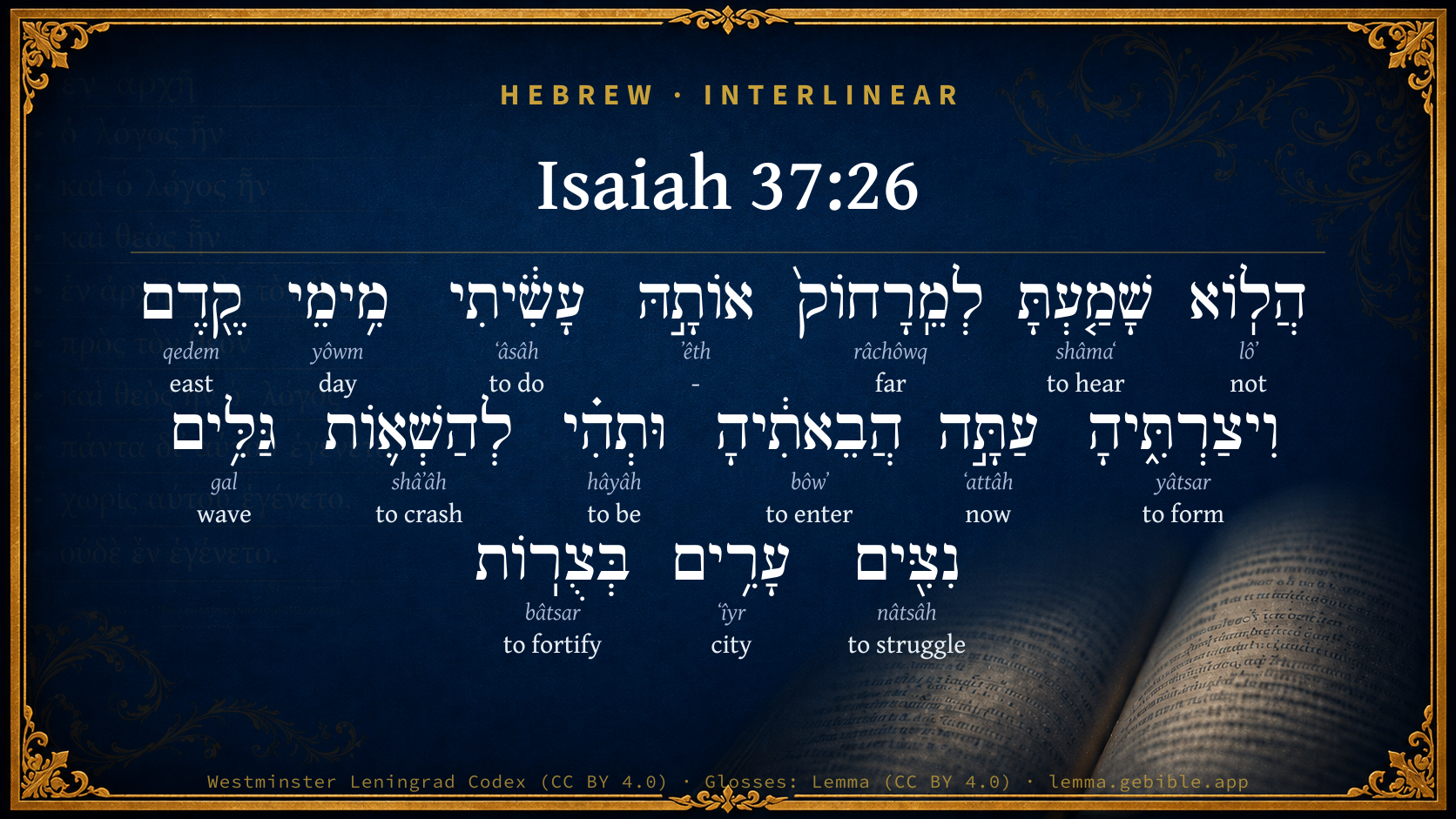
Hebrew (Westminster Leningrad Codex) Isaiah 37:26 appears in the Hebrew Old Testament. The text above is from the Westminster Leningrad Codex. Each word links to its Strong’s number, a concise gloss, and parsing drawn from the Open Scriptures Hebrew Bible morphology. Click any word for its full Brown-Driver-Briggs (BDB) entry.
Download image
Cite this verse

Isaiah 37:26 (World English Bible). Public Domain. Lemma interlinear Bible study tool, https://lemma.gebible.app/v/isaiah/37/26.

Show BibTeX & RIS
BibTeX
RIS
English Translation
Have you not heard how I have done it long ago, and formed it of ancient times? now have I brought it to pass, that it should be your to lay waste fortified cities into ruinous heaps.
World English Bible · Public Domain
Download a study sheet

One document with this verse’s original text, its word-by-word gloss line, the meaning frame, cross-references with their text, attributed commentary, and full source and license credits — printable, and it pastes into notes with its structure intact.

This verse Autodidact and up

Study sheet (.html) Plain text (.txt)

A passage Seminary Student

Up to 50 verses in one chapter. A passage sheet keeps up to 6 commentary sources and 12 cross-references per verse, in the order this page ranks them, and says so on the sheet whenever that leaves anything out. Ask for a single verse and you get the Autodidact verse sheet above.

Everything on this page stays free to read, with no account — the sheet is a download of what is already on screen, not access to it.

Want to remove ads? Support Godless Engineer
Compare translations 3

The same verse in 3 English versions, stacked beneath the original-language interlinear above. Click any original word for its lexicon entry.

Each is an independent rendering of the whole verse — the interlinear is not word-aligned to these translations.

Highlighted words mark where these versions differ — a whole-verse word diff, not a word-by-word alignment.

  • World English Bible Public Domain
    Have you not heard how I have done it long ago, and formed it of ancient times? now have I brought it to pass, that it should be your to lay waste fortified cities into ruinous heaps.
  • King James Version Public Domain
    Hast thou not heard long ago, how I have done it; and of ancient times, that I have formed it? now have I brought it to pass, that thou shouldest be to lay waste defenced cities into ruinous heaps.
  • unfoldingWord Literal Text CC BY-SA 4.0
    Have you not heard? From long ago, I did it; from days of antiquity, I formed it. Now I have brought it, that you should be for devastating fortified cities ruined heaps.

unfoldingWord Literal Text — © unfoldingWord, licensed CC BY-SA 4.0. Word-aligned USFM3 via Door43 (git.door43.org/unfoldingWord/en_ult).

Versions to compare (up to 4)

3 of 4 selected

Show all 18 translations

Every available English version of this verse, each an independent rendering of the whole verse.

  • World English Bible Public Domain
    Have you not heard how I have done it long ago, and formed it of ancient times? now have I brought it to pass, that it should be your to lay waste fortified cities into ruinous heaps.
  • Berean Standard Bible Public Domain
    Have you not heard? Long ago I ordained it; in days of old I planned it. Now I have brought it to pass, that you should crush fortified cities into piles of rubble.
  • Majority Standard Bible Public Domain
    Have you not heard? Long ago I ordained it; in days of old I planned it. Now I have brought it to pass, that you should crush fortified cities into piles of rubble.
  • King James Version Public Domain
    Hast thou not heard long ago, how I have done it; and of ancient times, that I have formed it? now have I brought it to pass, that thou shouldest be to lay waste defenced cities into ruinous heaps.
  • American Standard Version (1901) Public Domain
    Hast thou not heard how I have done it long ago, and formed it of ancient times? now have I brought it to pass, that it should be thine to lay waste fortified cities into ruinous heaps.
  • Revised Version (1885) Public Domain
    Hast thou not heard how I have done it long ago, and formed it of ancient times? now have I brought it to pass, that thou shouldest be to lay waste fenced cities into ruinous heaps.
  • Geneva Bible (1599) Public Domain
    Hast thou not heard howe I haue of olde time made it, and haue formed it long ago? and should I now bring it, that it should be destroyed, and layde on ruinous heapes, as cities defensed?
  • Douay-Rheims (1899) Public Domain
    Hast thou not heard what I have done to him of old? from the days of old I have formed it: and now I have brought it to effect: and it hath come to pass that hills fighting together, and fenced cities should be destroyed.
  • Young's Literal Translation Public Domain
    Hast thou not heard from afar? -- it I did, From days of old -- that I formed it. Now, I have brought it in, And it is to make desolate, Ruinous heaps -- fenced cities,
  • Literal Standard Version CC BY-SA 4.0
    Have you not heard from afar [that] I did it, || From days of old—that I formed it? Now I have brought it in, || And it is to make desolate, || Ruinous heaps—fortified cities,
  • Unlocked Literal Bible CC BY-SA 4.0
    Have you not heard how I determined it long ago and worked it out in ancient times? Now I am bringing it to pass. You are here to reduce impregnable cities into heaps of ruins.
  • unfoldingWord Literal Text CC BY-SA 4.0
    Have you not heard? From long ago, I did it; from days of antiquity, I formed it. Now I have brought it, that you should be for devastating fortified cities ruined heaps.
  • Darby Bible Public Domain
    Hast thou not heard that long ago I did it, and that from ancient days I formed it? Now have I brought it to pass, that thou shouldest lay waste fortified cities [into] ruinous heaps.
  • World Messianic Bible Public Domain
    “‘Have you not heard how I have done it long ago, and formed it in ancient times? Now I have brought it to pass, that it should be yours to destroy fortified cities, turning them into ruinous heaps.
  • Webster's Bible Public Domain
    Hast thou not heard long ago, how I have done it; and of ancient times, that I have formed it? now have I brought it to pass, that thou shouldst be to lay waste fortified cities into ruinous heaps.
  • Free Bible Version CC BY-SA 4.0
    The Lord replies, “Haven't you heard? I decided it long ago; I planned it in the olden days. Now I am making sure it happens—that you are to knock down fortified towns into piles of rubble.
  • Bible in Basic English Public Domain
    Has it not come to your ears how I did it long before, purposing it in times long past? Now I have given effect to my design, so that by you strong towns might be turned into masses of broken walls.
  • JPS Tanakh (1917) Public Domain
    Hast thou not heard? Long ago I made it, in ancient times I fashioned it; now have I brought it to pass, yea, it is done; that fortified cities should be laid waste into ruinous heaps.

Literal Standard Version (2020), Covenant Press — licensed CC BY-SA 4.0. Text via the HelloAO Bible API (eBible.org). Unlocked Literal Bible (unfoldingWord) — licensed CC BY-SA 4.0. Text via the HelloAO Bible API (eBible.org). unfoldingWord Literal Text — © unfoldingWord, licensed CC BY-SA 4.0. Word-aligned USFM3 via Door43 (git.door43.org/unfoldingWord/en_ult). Free Bible Version, Dr. Jonathan Gallagher — licensed CC BY-SA 4.0. Text via the HelloAO Bible API (eBible.org).

Word by word

More ways to search: Search by grammar → Find every occurrence → Compare this word →

Practice this passage: Drill this verse → Learn its vocabulary →

לְהַשְׁא֛וֹת
shâʼâh
H7582
“to crash”
Preposition + Verb, Hiphil, Infinitive Construct
Part of Speech
Preposition + Verb
Stem
Hiphil
Form
Infinitive Construct
Full BDB Definition

Origin: a primitive root

TWOT: 2301

crash, make a din or crash, crash into ruins, be in ruins, be desolated - (Qal) to crash into ruins - (Niphal) - to be ruined - to crash - to be left (a desolation) - (Hiphil) - to cause to crash - to cause to be desolated
  1. הֲלֽוֹא lôʼ H3808 “not” Particle, Interrogative + Particle, Negative
  2. שָׁמַ֤עְתָּ shâmaʻ H8085 “to hear” Verb, Qal, Perfect, 2nd Person, Masculine, Singular
  3. לְמֵֽרָחוֹק֙ râchôwq H7350 “to/for · from · far” Preposition + Preposition + Adjective, Adjective, Masculine, Singular, Absolute
  4. אוֹתָ֣הּ ʼêth H853 “- · her” Particle, Direct Object + Suffix, Personal, 3rd Person, Feminine, Singular
  5. עָשִׂ֔יתִי ʻâsâh H6213 “to do” Verb, Qal, Perfect, 1st Person, Common, Singular
  6. מִ֥ימֵי yôwm H3117 “from · days of” Preposition + Noun, Common, Masculine, Plural, Construct
  7. קֶ֖דֶם qedem H6924 “east” Noun, Common, Masculine, Singular, Absolute
  8. וִיצַרְתִּ֑יהָ yâtsar H3335 “and · to form · her” Conjunction + Verb, Qal, Sequential Perfect, 1st Person, Common, Singular + Suffix, Personal, 3rd Person, Feminine, Singular
  9. עַתָּ֣ה ʻattâh H6258 “now” Adverb
  10. הֲבֵאתִ֔יהָ bôwʼ H935 “to enter · her” Verb, Hiphil, Perfect, 1st Person, Common, Singular + Suffix, Personal, 3rd Person, Feminine, Singular
  11. וּתְהִ֗י hâyâh H1961 “and · to be” Conjunction + Verb, Qal, Jussive, 2nd Person, Masculine, Singular
  12. גַּלִּ֥ים gal H1530 “waves” Noun, Common, Masculine, Plural, Absolute
  13. נִצִּ֖ים nâtsâh H5327 “struggling” Verb, Niphal, Participle Active, Masculine, Plural, Absolute
  14. עָרִ֥ים ʻîyr H5892 “cities” Noun, Common, Feminine, Plural, Absolute
  15. בְּצֻרֽוֹת bâtsar H1219 “fortified” Adjective, Adjective, Feminine, Plural, Absolute

About this verse

These counts appear in no published source. They are computed here, from the morphology-tagged text and Lemma’s own curated glosses. What Lemma adds →

16
words
16
distinct lemmas
Prophets
section

Notable vocabulary

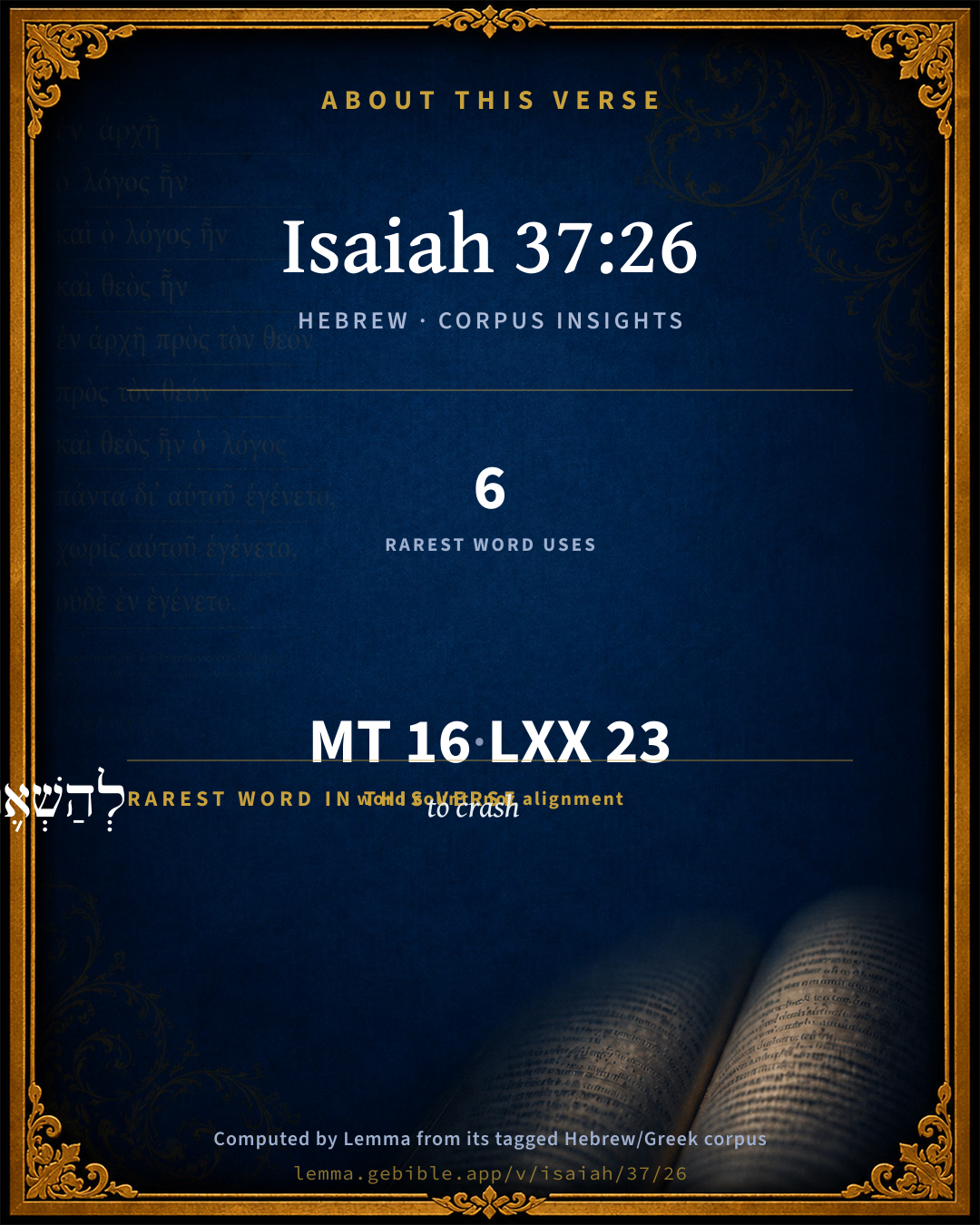
The rarest word here is לְהַשְׁא֛וֹת to crash H7582 — appearing just 6 times in the whole Hebrew Bible.

Shared distinctive vocabulary

לְהַשְׁא֛וֹת to crash H7582 occurs in 5 verses of the Hebrew Bible. Also found in:

Grammatical profile

  • 7 verbs
  • 4 nouns
  • 2 adjectives
  • 1 adverb
  • 2 particles

Verb forms

  • שָׁמַ֤עְתָּ Qal · Perfect
  • עָשִׂ֔יתִי Qal · Perfect
  • וִיצַרְתִּ֑יהָ Qal · Sequential Perfect
  • הֲבֵאתִ֔יהָ Hiphil · Perfect
  • וּתְהִ֗י Qal · Jussive
  • לְהַשְׁא֛וֹת Hiphil · Infinitive Construct
  • נִצִּ֖ים Niphal · Participle Active

Hebrew & Septuagint length

In English translation the verse runs 37 words from the Hebrew and 39 from the Septuagint (LXX English) — closely comparable.

A rough comparison of the two English renderings, which tokenize alike — not a word-level alignment.

Word counts can differ between the Hebrew and the Greek without any difference in meaning — e.g. the Hebrew direct-object marker אֵת has no separate Greek word, and Greek often adds the article ὁ.

In the original languages it is 16 Hebrew tokens and 23 Greek tokens — but the two are counted differently (Hebrew bundles its prefixes and suffixes into one token; the Greek is in lemma form), so that isn’t a like-for-like length.

Cross-references

13

Topical passages linked to Isaiah 37:26 in the Treasury of Scripture Knowledge — connected by theme and wording, ordered by reader-vote popularity; previews shown in the World English Bible.

  • Acts 4:27–28 For truly, in this city against your holy servant, Jesus, whom you anointed, both Herod and Pontius Pilate, with the Gentiles and the people of Israel, were gathered together
  • Acts 2:23 him, being delivered up by the determined counsel and foreknowledge of God, you have taken by the hand of lawless men, crucified and killed;
  • Isaiah 10:15 Shall the axe boast itself against him who hews therewith? Shall the saw magnify itself against him who wields it? as if a rod should wield those who lift it up, [or] as if a staff should lift up [him who is] not wood.
  • Isaiah 46:10–11 declaring the end from the beginning, and from ancient times things that are not [yet] done; saying, My counsel shall stand, and I will do all my pleasure;
  • 1 Peter 2:8 and, "A stone of stumbling, and a rock of offense." For they stumble at the word, being disobedient, whereunto also they were appointed.
  • Isaiah 10:5–6 Ho Assyrian, the rod of my anger, the staff in whose hand is my indignation!
  • Genesis 50:20 As for you, you meant evil against me, but God meant it for good, to bring to pass, as it is this day, to save many people alive.
  • Amos 3:6 Does the trumpet alarm sound in a city, Without the people being afraid? Does evil happen to a city, And Yahweh hasn't done it?
  • Jude 1:4 For there are certain men who crept in secretly, even those who were long ago written about for this condemnation: ungodly men, turning the grace of our God into lasciviousness, and denying our only Master, God, and Lord, Jesus Christ.
  • Psalms 17:13 Arise, Yahweh, Confront him, cast him down. Deliver my soul from the wicked by your sword;
  • Psalms 76:10 Surely the wrath of man praises you. The survivors of your wrath are restrained.
  • Isaiah 25:1–2 Yahweh, you are my God; I will exalt you, I will praise your name; for you have done wonderful things, [even] counsels of old, in faithfulness [and] truth.
  • Isaiah 45:7 I form the light, and create darkness; I make peace, and create evil. I am Yahweh, who does all these things.

Cross-references courtesy of OpenBible.info (CC BY 4.0).

Hebrew and Greek witnesses Masoretic Hebrew ↔ Greek Septuagint

The same verse in the two great witnesses to the Old Testament, shown verse-for-verse.

These are two independent witnesses, not word-aligned to each other, and the Septuagint is shown in lemma (dictionary) form.

Hebrew Isaiah 37:26 Masoretic · Westminster Leningrad Codex

הֲלֽוֹא שָׁמַ֤עְתָּ לְמֵֽרָחוֹק֙ אוֹתָ֣הּ עָשִׂ֔יתִי מִ֥ימֵי קֶ֖דֶם וִיצַרְתִּ֑יהָ עַתָּ֣ה הֲבֵאתִ֔יהָ וּתְהִ֗י לְהַשְׁא֛וֹת גַּלִּ֥ים נִצִּ֖ים עָרִ֥ים בְּצֻרֽוֹת

Have you not heard how I have done it long ago, and formed it of ancient times? now have I brought it to pass, that it should be your to lay waste fortified cities into ruinous heaps.

World English Bible · Public Domain

Greek LXX Isaiah 37:26 Septuagint · lemma form

οὐ οὗτος ἀκούω πάλαι ὅς ἐγώ ποιέω ἐκ ἀρχαῖος ἡμέρα συντάσσω νῦν δέ ἐπιδεικνύω ἐκἐρημόω ἔθνος ἐν ὀχυρός καί ἐνοἰκέω ἐν πόλις ὀχυρός

Have you not heard of these things which I did of old? I appointed them from ancient times; but now have I manifested my purpose of desolating nations in their strong holds, and them that dwell in strong cities.

LXX2012 (modern English Septuagint) · Public Domain

On this verse, Adam Clarke's Commentary discusses the Septuagint’s reading. Read the note in Commentary ↓

Hebrew: Westminster Leningrad Codex (CC BY 4.0). Greek: Septuagint (public domain); English from LXX2012 (modern English Septuagint) (Public Domain). How the Septuagint differs from the Hebrew →

Targum (Aramaic paraphrase)

1

The Targum is the ancient Jewish Aramaic paraphrase of the Hebrew Scriptures — an interpretive translation, not the Hebrew text itself. Onkelos (literal) and Pseudo-Jonathan (expansive) render the Torah, and Jonathan the Prophets. Coverage is partial: where no permissively-licensed English translation exists for a verse, only the Aramaic is shown. This is verse-level text, not a word-by-word alignment to the Hebrew.

  1. Targum Jonathan Prophets (Joshua–Malachi)
    הֲלָא שְׁמַעְתָּא מִלְקַדְמִין מָא עֲבָדִית לְפַרְעֹה מַלְכָּא דְמִצְרַיִם וְאַף עֲלָךְ אִתְנַבִּיאוּ נְבִיֵי יִשְׂרָאֵל וְלָא תַבְתָּא וְדָא חַזְיָא קֳדָמַי מִיוֹמֵי קֳדָם לְמֶעְבַּד לָךְ וְאַף אַתְקֵנְתָּא כְּעַן אַיְתֵיתָה וְדָא הֲוָת לָךְ לְתַקָלָא עַל דַהֲוָאָה קֳדָמָךְ כְּאִתְרְגוּשַׁת גַלִין דִשְׁחוֹ קִרְוִין כְּרִיכָן:

    Hast thou not heard long ago, what I have done to Pharao, king of Egypt? Yea, also, the prophets of Israel have prophesied concerning thee; but thou hast not repented. I contemplated doing this unto thee, since the days of old. I have prepared it, now I will bring it to pass, and it shall be ruin unto thee; because it shall be before thee as the raging of waves, which destroy fortified cities.

    Targum Jonathan — Aramaic: “Mikraot Gedolot” (public domain). English: “Sefaria Community Translation” (CC0 1.0 (public-domain dedication)); “London "Chaldee Paraphrase," 1871” (public domain). Text via Sefaria.

Commentary

Notes on Isaiah 37:26 from classic Christian and Jewish commentators (each source and its license shown beneath its notes). The classic Christian expositions comment on the surrounding passage and are grouped to its opening verse, so a note may address several verses; the Jewish commentaries on the Tanakh (Rashi and others) are per-verse, so they appear only where the commentator wrote on this verse.

Lemma curates 59 commentaries, every one of them public domain or Creative Commons licensed, each selected and text-cleaned for this edition rather than reprinted as found. About our sources →

Tyndale Open Study Notes

Tyndale Open Resources

37:26 I planned for you to crush . . . into heaps of rubble: Assyria was God’s agent of destruction, but the Assyrians did not realize that they were only a tool in God’s hand (see ch 10), fulfilling what God had planned long before (14:24-27).

Tyndale Open Study Notes — © Tyndale Open Resources, licensed CC BY-SA 4.0. Text via the HelloAO Bible API.

Ibn Ezra

Rabbi Abraham ibn Ezra

4. In the book of Kings (19:25) להשות וגו׳ To make equal, etc., to make fenced cities equal to heaps of ruins; in the book of Isaiah (37:26) להשאות to lay waste, etc., to lay waste fenced cities, that they be like heaps of ruins; comp. שואה desolation (10:3); or להשאות is the same as להשות, since א and ו frequently interchange.

Ibn Ezra on the Tanakh — English translations: “Sefaria Community Translation” (CC0 1.0 (public-domain dedication)); “Yalkut, Sifsei Chachomim Chumash, Metsudah Publications, 2009” (CC BY 4.0); and “Commentary of Ibn Ezra on Isaiah - trans. by M. Friedlander, 1873” (public domain). Text via Sefaria.

Geneva Bible (1599)

Geneva Bible translators

Signifying, that God made not his Church to destroy it, but to preserve it: and therefore he saith that he formed it of old, even in his eternal counsel which cannot be changed.

Geneva Bible (1599) marginal notes — public domain. Text via Bolls.life.

Jamieson, Fausset & Brown

Robert Jamieson, A. R. Fausset & David Brown

Reply of God to Sennacherib.

long ago--join, rather, with "I have done it." Thou dost boast that it is all by thy counsel and might: but it is I who, long ago, have ordered it so (Isa 22:11); thou wert but the instrument in My hands (Isa 10:5, Isa 10:15). This was the reason why "the inhabitants were of small power before thee" (Isa 37:27), namely, that I ordered it so; yet thou art in My hands, and I know thy ways (Isa 37:28), and I will check thee (Isa 37:29). Connect also, "I from ancient times have arranged ('formed') it." However, English Version is supported by Isa 33:13; Isa 45:6, Isa 45:21; Isa 48:5.

Jamieson, Fausset & Brown — Commentary Critical and Explanatory on the Whole Bible (1871) — public domain (CC PDM 1.0). Text via the HelloAO Bible API.

Adam Clarke's Commentary

Verse 26. Lay waste defended cities into ruinous heaps - "Lay waste warlike nations; strong fenced cities."] גלים נצים gallim nitstsim. It is not easy to give a satisfactory account of these two words, which have greatly embarrassed all the interpreters, ancient and modern. For גלים gallim I read גוים goyim, as the Septuagint do in this place, εθνη. The word נצים netsim the Vulgate renders in this place compugnantium; in the parallel place, 2Kg 19:25, pugnantium; and the Septuagint μαχιμων, fighting, warlike. This rendering is as well authorized as any other that I know of; and, with the reading of the Septuagint, perfectly clears up the construction. See the margin on all the preceding verses.

Adam Clarke's Commentary on the Bible (1810–1826) — public domain. Text from a community e-Sword/MySword module.

Ellicott's Commentary for English Readers

(26) Hast thou not heard . . .—The speech of Sennacherib ends, and that of Jehovah begins. The adverb “long ago” should be connected with the words that follow. The events of history had all been foreseen and ordered, as in the remote past, by the counsels of Jehovah. Kings and armies were but as His puppets in the drama of the world’s history. The words “hast thou not heard” suggest the thought that Isaiah assumes that Sennacherib had heard of his prophecies, or those of his fore-runners, as to the purposes of Jehovah—an assumption which, looking to the fact that he had ministers who were well acquainted with Hebrew (Isa_36:12), was in itself probable enough.

A Bible Commentary for English Readers, edited by Charles John Ellicott (1878–1897) — public domain. Text from a community e-Sword module.

The Cambridge Bible for Schools and Colleges

gen. ed. J. J. S. Perowne

26. The verse reads, with a slight change of pointing: Hast thou not heard? Long ago have I made it, from the days of old have I formed it: now I bring it to pass, and so hast thou been (able) to lay waste in ruined heaps defenced cities. Cf. ch. Isa_22:11, Isa_44:7, Isa_46:11.

26, 27. In all his successes the Assyrian has been but the unconscious instrument of Jehovah’s eternal purpose. Cf. ch. Isa_10:5-15.

The Cambridge Bible for Schools and Colleges (gen. ed. J. J. S. Perowne; Cambridge University Press, 1878–1918) — public domain. Text from a community e-Sword module.

John Gill's Exposition

But I know thy abode, and thy going out, and thy coming in,.... Where he dwelt, what he did at home, his secret councils, cabals, contrivances, schemes and plans for the compassing of his ends, the subduing of kingdoms, and setting up an universal monarchy; and his going out of Babylon, his marches, and counter marches, and his entrance into the land of Judea; there was not a motion made, or a step taken in the cabinet or camp, but what were known to the Lord; so the Targum,

"thy sitting in council, and thy going out abroad to make war, and thy coming into the land of Israel, are manifest before me:''

and thy rage against me; against his people, against the city that was called by his name, against the temple where he was worshipped, particularly against his servant Hezekiah, because he would not immediately deliver up the city to him. The Targum and Syriac versions render it, "before me"; and then the meaning is, "thy rage", wrath and fury, "is before me": or manifest to me; and which he could restrain at pleasure, as he promises to do in the next verse.

John Gill's Exposition of the Whole Bible (1746–1763) — public domain (CC PDM 1.0). Text via the HelloAO Bible API.

Albert Barnes' Notes on the Bible

Hast thou not heard - This is evidently the language of God addressed to Sennacherib. It is designed to state to him that he was under his control; that this was the reason Isa 37:27 why the inhabitants of the nations had been unable to resist him; that he was entirely in his hands Isa 37:28; and that lie would control him as he pleased Isa 37:29.

Long ago how I have done it - You boast that all this is by your own counsel and power. Yet I have done it; that is, I have purposed, planned, arranged it long ago (compare Isa 22:11).

That thou shouldest be to lay waste - I have raised you up for this purpose, and you have been entirely under my control (see the note at Isa 10:5).

Albert Barnes' Notes on the Bible (1834–1885) — public domain. Text from a community e-Sword/MySword module.

Whedon's Commentary on the Bible

Daniel D. Whedon

26. Through the prophet God now speaks to Sennacherib.

Hast thou not heard — Is it real ignorance on thy part, that Jehovah is the only true God, and has control of Assyria; that she is his instrument, the rod of his anger, (Isa_10:5; Isa_10:15,) to lay waste peoples who submit not to warning and correction? Thou dost boast that it is all by thy command and might, but it is I, who long ago… have done it. (Isa_22:11.) Because I so ordered it, the people were of small power before thee.

Of ancient times… I have formed it — The idea of overruling evil men and their acts is eternal with God. How the Eternal consists with the finite historical, or the absolute with the relative, is doubtless to be forever unknown to men.

Daniel D. Whedon (gen. ed.), Commentary on the Old and New Testaments (1874–1909) — public domain. Text from a community e-Sword module.

The Pulpit Commentary

Hast thou not heard, etc.? An abrupt transition, such as is common in Isaiah. From speaking in the person of Sennacherib, the prophet without warning breaks off, and returns to speaking in the person of Jehovah, as his mouthpiece. "Hast thou not heard," he says, long ago; or rather, that from long ago! have done this?" Art thou so ignorant, so devoid of that light of nature, which should "lighten every man that cometh into the world", (Joh_1:9) as not to know God"s method of governing the world? How that "from long ago," in his eternal counsels, he designs the rise and fall of nations, and the mode in which their destruction is to be brought about? Art thou not aware that conquerors are mere instruments in God"s hands rods of his anger" (Isa_10:5) to work his will, and then to have his will worked upon them in turn? (see Isa_10:6-19) Sennacherib seems to be really reproached for not knowing what he ought to have known, and might have known, if he had listened to the voice of conscience and reason. Now have brought it to pass, etc. All that Sennacherib had done, he had done as God"s instrument, by his permission nay, by his aid. He had been the axe in the hand of the hewer, (Isa_10:15) the saw, the rod, the staff, of God"s indignationIsa 10:5), the executor of his vengeance. The very purpose of his being was that he should "lay waste (certain) defenced cities into ruinous heaps."

The Pulpit Commentary (1880–1919), ed. H.D.M. Spence-Jones & Joseph S. Exell — public domain. Text from a community e-Sword module.

Keil & Delitzsch

C. F. Keil & F. Delitzsch

And yet what he was able to do was not the result of his own power, but of the counsel of God, which he subserved. Fourth turn, "Hast thou not heart? I have done it long ago, from (K. lemin, since) the days of ancient time have I formed it, and now brought it to pass (הבאתיה, K. הביאתיה): that thou shouldst lay waste fortified cities into desolate stone heaps; and their inhabitants, powerless, were terrified, and were put to shame (ובשׁוּ, K. ויּבשׁוּ): became herb of the field and green of the turf, herb of the house-tops, and a corn-field (וּשׁדמה, K. and blighted corn) before the blades." L'mērâcōq (from afar) is not to be connected with the preceding words, but according to the parallel with those which follow. The historical reality, in this instance the Assyrian judgment upon the nations, had had from all eternity an ideal reality in God (see at Isa 22:11). The words are addressed to the Assyrian; and as his instrumentality formed the essential part of the divine purpose, וּתהי does not mean "there should," but "thou shouldest," e!mellej e)chremw=sai (cf., Isa 44:14-15, and Hab 1:17). K. has להשׁות instead of להשׁאות (though not as chethib, in which case it would have to be pointed להשׁות), a singularly syncopated hiphil (for לשׁאות). The point of comparison in the four figures is the facility with which they can be crushed. The nations in the presence of the Assyrian became, as it were, weak, delicate grasses, with roots only rooted in the surface, or like a cornfield with the stalk not yet formed (shedēmâh, Isa 16:8), which could easily be rooted up, and did not need to be cut down with the sickle. This idea is expressed still more strikingly in Kings, "like corn blighted (shedēphâh, compare shiddâpōn, corn-blight) before the shooting up of the stalk;" the Assyrian being regarded as a parching east wind, which destroys the seed before the stalk is formed.

Keil & Delitzsch — Biblical Commentary on the Old Testament (1861–1891) — public domain (CC PDM 1.0). Text via the HelloAO Bible API. (Old Testament only.)

J. A. Alexander on Isaiah

Joseph Addison Alexander

“Hast thou not heard? From afar I have done it, from the days of old, and have formed it. Now I have caused it to come, and, it shall be (or come to pass), to lay waste, (as or into) desolate heaps, fortified cities.” Most writers, ancient and modern, are agreed in applying the first clause, either to express predictions, or to the purpose and decree of God. The sense is then substantially the same with that of Isa 10:5; Isa 10:15, to wit, that the Assyrian had wrought these conquests only as an instrument in the hand of God, who had formed and declared His purpose long before, and was now bringing it to pass. Hast thou not heard? may either be a reference to history and prophecy, or a more general expression of surprise that he could be ignorant of what was so notorious.

Joseph Addison Alexander, The Prophecies of Isaiah (1846–1847; New York: Scribner, 1870–1878) — public domain. Text from a community e-Sword module.

unfoldingWord translationNotes

Door43 World Missions Community

General Information:

This continues Yahweh's message to the king of Assyria.

Have you not heard how ... times?

Yahweh uses this rhetorical question to remind Sennacherib of information that he should already be aware of. This can be written as a statement. AT: "Certainly you have heard how ... times." (See: Rhetorical Question)

You are here to reduce impregnable cities into heaps of ruins

Yahweh had planned for Sennacherib's army to destroy the cities that they had destroyed. This can be stated clearly. AT: "I planned that your army would destroy cities and cause them to become piles of rubble" (See: Assumed Knowledge and Implicit Information)

impregnable

strong and heavily guarded

of little strength

"who are weak"

shattered

broken into small pieces. This is a metaphor for being greatly discouraged. (See: Metaphor)

I am bringing it to pass

The idiom "to bring something to pass" means to cause a specific thing to happen. AT: "I am causing it to happen" or "I am causing these things to take place" (See: Idiom)

They are plants in the field, green grass, the grass on the roof or in the field, before the east wind

This speaks of how weak and vulnerable the cities are before the Assryian army by comparing the cities to grass. AT: "The cities are as weak as the grass in the fields before your armies. They are as weak as the grass that grows on the roofs of houses and is scorched by the hot east wind" (See: Metaphor)

before the east wind

The east wind is hot and dry from the desert and plants die when it blows.

translationWords

ruin

shame

unfoldingWord translationNotes — © Distant Shores Media and the Door43 World Missions Community, licensed CC BY-SA 4.0. Source: git.door43.org/Door43/en_tn.

Rashi

Rabbi Shlomo Yitzchaki (Rashi)

Have you not heard Now why do you boast? This is not yours, for this is a decree that emanated from Me many years ago, that you will exact My recompense from the nations, as the matter is written (supra 10:5): “Woe! Assyria is the rod of My wrath.”

Have you not heard from long ago More than seventy years (correct version as in Parshandatha and Warsaw edition) since Amos prophesied two years before the earthquake (Amos 7:17), “and Israel shall be exiled from upon its land.” Since then, you should have heard that I wrought and prepared this retribution.

in days of yore Since the six days of Creation, that decree that was decreed upon you entered My mind, as it is said (supra 30:33): “For Tophteh is set up from yesterday, that too has been prepared for the king.” Now that I have given you superiority over the nations, I have brought it, that decree, in order that it shall be to make desolate, blossoming hills [of] fortified cities, that you shall slay their inhabitants and they shall remain devoid of people and they shall be prepared for hills where vegetation grows.

Rashi on the Tanakh — English translations: “The Judaica Press complete Tanach with Rashi, translated by A. J. Rosenberg” (CC BY 4.0); “Pentateuch with Rashi's commentary by M. Rosenbaum and A.M. Silbermann, 1929-1934” (public domain); “The Metsudah Tanach series, Lakewood, N.J” (CC BY 4.0); and “The Book of Joshua, Metsudah Publications, 1997” (CC BY 4.0). Text via Sefaria.

Lesson kit

Teaching starters — assembled from the data on this page, not authored interpretation. Every prompt links to the verse data it draws on. Edit before teaching.

Isaiah, in the Prophets, opens this verse with 16 words (16 distinct Hebrew lemmas). Its most distinctive word is shâʼâh (“to crash”). A historical commentator’s framing appears above. Read the whole chapter for the surrounding context.

Discussion questions

  1. What does “to crash” (shâʼâh) contribute to the verse as a whole?
  2. How does 2 Kings 19:25, which shares the word «to crash», read alongside this verse?
  3. The translations on this page render this verse differently — a whole-verse word diff, not a word-by-word alignment. What might account for the different wordings?
  4. «שָׁמַ֤עְתָּ» is a Qal Perfect verb. How does that grammatical form shape the action described?
  5. Compare how Tyndale Open Study Notes and Ibn Ezra read this verse. Where do they agree or differ?

Things to notice

Reading settings

Reading text

Shown beneath each verse's original-language words.

Old Testament
Old Testament edition

Read the OT as the Masoretic Hebrew (MT) or the Greek Septuagint (LXX).

English shown for the Greek Septuagint (in the Hebrew ↔ Greek comparison).

Comparing translations? Open the Compare panel on any verse page to stack up to four side by side.