
Psalms 143:5

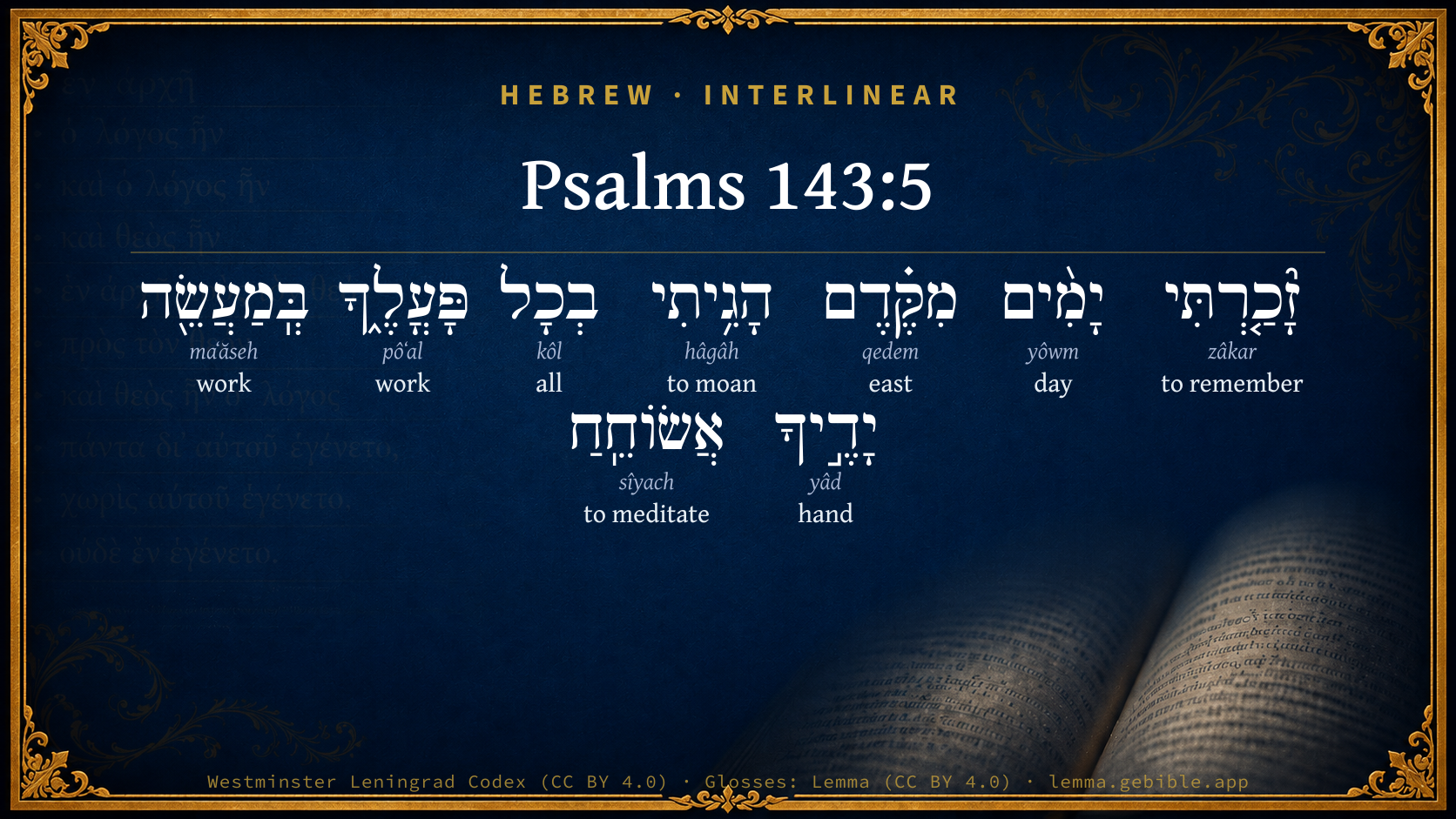
Hebrew (Westminster Leningrad Codex) Psalms 143:5 appears in the Hebrew Old Testament. The text above is from the Westminster Leningrad Codex. Each word links to its Strong’s number, a concise gloss, and parsing drawn from the Open Scriptures Hebrew Bible morphology. Click any word for its full Brown-Driver-Briggs (BDB) entry.
Download image
Cite this verse

Psalms 143:5 (World English Bible). Public Domain. Lemma interlinear Bible study tool, https://lemma.gebible.app/v/psalms/143/5.

Show BibTeX & RIS
BibTeX
RIS
English Translation
I remember the days of old. I meditate on all your doings. I contemplate the work of your hands.
World English Bible · Public Domain
Download a study sheet

One document with this verse’s original text, its word-by-word gloss line, the meaning frame, cross-references with their text, attributed commentary, and full source and license credits — printable, and it pastes into notes with its structure intact.

This verse Autodidact and up

Study sheet (.html) Plain text (.txt)

A passage Seminary Student

Up to 50 verses in one chapter. A passage sheet keeps up to 6 commentary sources and 12 cross-references per verse, in the order this page ranks them, and says so on the sheet whenever that leaves anything out. Ask for a single verse and you get the Autodidact verse sheet above.

Everything on this page stays free to read, with no account — the sheet is a download of what is already on screen, not access to it.

Want to remove ads? Support Godless Engineer
Compare translations 3

The same verse in 3 English versions, stacked beneath the original-language interlinear above. Click any original word for its lexicon entry.

Each is an independent rendering of the whole verse — the interlinear is not word-aligned to these translations.

Highlighted words mark where these versions differ — a whole-verse word diff, not a word-by-word alignment.

  • World English Bible Public Domain
    I remember the days of old. I meditate on all your doings. I contemplate the work of your hands.
  • King James Version Public Domain
    I remember the days of old; I meditate on all thy works; I muse on the work of thy hands.
  • unfoldingWord Literal Text CC BY-SA 4.0
    I remember days from before; I meditate on all your works; I reflect on the works of your hands.

unfoldingWord Literal Text — © unfoldingWord, licensed CC BY-SA 4.0. Word-aligned USFM3 via Door43 (git.door43.org/unfoldingWord/en_ult).

Versions to compare (up to 4)

3 of 4 selected

Show all 18 translations

Every available English version of this verse, each an independent rendering of the whole verse.

  • World English Bible Public Domain
    I remember the days of old. I meditate on all your doings. I contemplate the work of your hands.
  • Berean Standard Bible Public Domain
    I remember the days of old; I meditate on all Your works; I consider the work of Your hands.
  • Majority Standard Bible Public Domain
    I remember the days of old; I meditate on all Your works; I consider the work of Your hands.
  • King James Version Public Domain
    I remember the days of old; I meditate on all thy works; I muse on the work of thy hands.
  • American Standard Version (1901) Public Domain
    I remember the days of old; I meditate on all thy doings; I muse on the work of thy hands.
  • Revised Version (1885) Public Domain
    I remember the days of old; I meditate on all thy doings: I muse on the work of thy hands.
  • Geneva Bible (1599) Public Domain
    Yet doe I remember the time past: I meditate in all thy workes, yea, I doe meditate in the workes of thine hands.
  • Douay-Rheims (1899) Public Domain
    I looked on my right hand, and beheld, and there was no one that would know me. Flight hath failed me: and there is no one that hath regard to my soul.
  • Young's Literal Translation Public Domain
    I have remembered days of old, I have meditated on all Thine acts, On the work of Thy hand I muse.
  • Literal Standard Version CC BY-SA 4.0
    I have remembered days of old, || I have meditated on all Your acts, || I muse on the work of Your hand.
  • Unlocked Literal Bible CC BY-SA 4.0
    I call to mind the old days; I meditate on all your deeds; I reflect on your accomplishments.
  • unfoldingWord Literal Text CC BY-SA 4.0
    I remember days from before; I meditate on all your works; I reflect on the works of your hands.
  • Darby Bible Public Domain
    I remember the days of old: I meditate on all thy doing; I muse on the work of thy hands.
  • World Messianic Bible Public Domain
    I remember the days of old. I meditate on all your doings. I contemplate the work of your hands.
  • Webster's Bible Public Domain
    I remember the days of old, I meditate on all thy works; I muse on the work of thy hands.
  • Free Bible Version CC BY-SA 4.0
    I think of days long ago, and as I meditate I talk to myself about all you have done, I reflect on what you have accomplished.
  • Bible in Basic English Public Domain
    I keep in mind the early days of the past, giving thought to all your acts, even to the work of your hands.
  • JPS Tanakh (1917) Public Domain
    I remember the days of old; I meditate on all Thy doing; I muse on the work of Thy hands.

Literal Standard Version (2020), Covenant Press — licensed CC BY-SA 4.0. Text via the HelloAO Bible API (eBible.org). Unlocked Literal Bible (unfoldingWord) — licensed CC BY-SA 4.0. Text via the HelloAO Bible API (eBible.org). unfoldingWord Literal Text — © unfoldingWord, licensed CC BY-SA 4.0. Word-aligned USFM3 via Door43 (git.door43.org/unfoldingWord/en_ult). Free Bible Version, Dr. Jonathan Gallagher — licensed CC BY-SA 4.0. Text via the HelloAO Bible API (eBible.org).

Word by word

More ways to search: Search by grammar → Find every occurrence → Compare this word →

Practice this passage: Drill this verse → Learn its vocabulary →

אֲשׂוֹחֵֽחַ
sîyach
H7878
“to meditate”
Verb, Polel, Imperfect, 1st Person, Common, Singular
Part of Speech
Verb
Stem
Polel
Form
Imperfect
Person
1st Person
Gender
Common
Number
Singular
Full BDB Definition

Origin: a primitive root

TWOT: 2255

to put forth, mediate, muse, commune, speak, complain, ponder, sing - (Qal) - to complain - to muse, meditate upon, study, ponder - to talk, sing, speak - (Polel) to meditate, consider, put forth thoughts
  1. זָ֘כַ֤רְתִּי zâkar H2142 “to remember” Verb, Qal, Perfect, 1st Person, Common, Singular
  2. יָמִ֨ים yôwm H3117 “days” Noun, Common, Masculine, Plural, Absolute
  3. מִקֶּ֗דֶם qedem H6924 “from · east” Preposition + Noun, Common, Masculine, Singular, Absolute
  4. הָגִ֥יתִי hâgâh H1897 “to moan” Verb, Qal, Perfect, 1st Person, Common, Singular
  5. בְכָל kôl H3605 “in/at · all of” Preposition + Noun, Common, Masculine, Singular, Construct
  6. פָּעֳלֶ֑ךָ pôʻal H6467 “work · your” Noun, Common, Masculine, Singular, Construct + Suffix, Personal, 2nd Person, Masculine, Singular
  7. בְּֽמַעֲשֵׂ֖ה maʻăseh H4639 “in/at · work of” Preposition + Noun, Common, Masculine, Singular, Construct
  8. יָדֶ֣יךָ yâd H3027 “hands · your” Noun, Common, Both, Dual, Construct + Suffix, Personal, 2nd Person, Masculine, Singular

About this verse

These counts appear in no published source. They are computed here, from the morphology-tagged text and Lemma’s own curated glosses. What Lemma adds →

9
words
9
distinct lemmas
Wisdom
section

Notable vocabulary

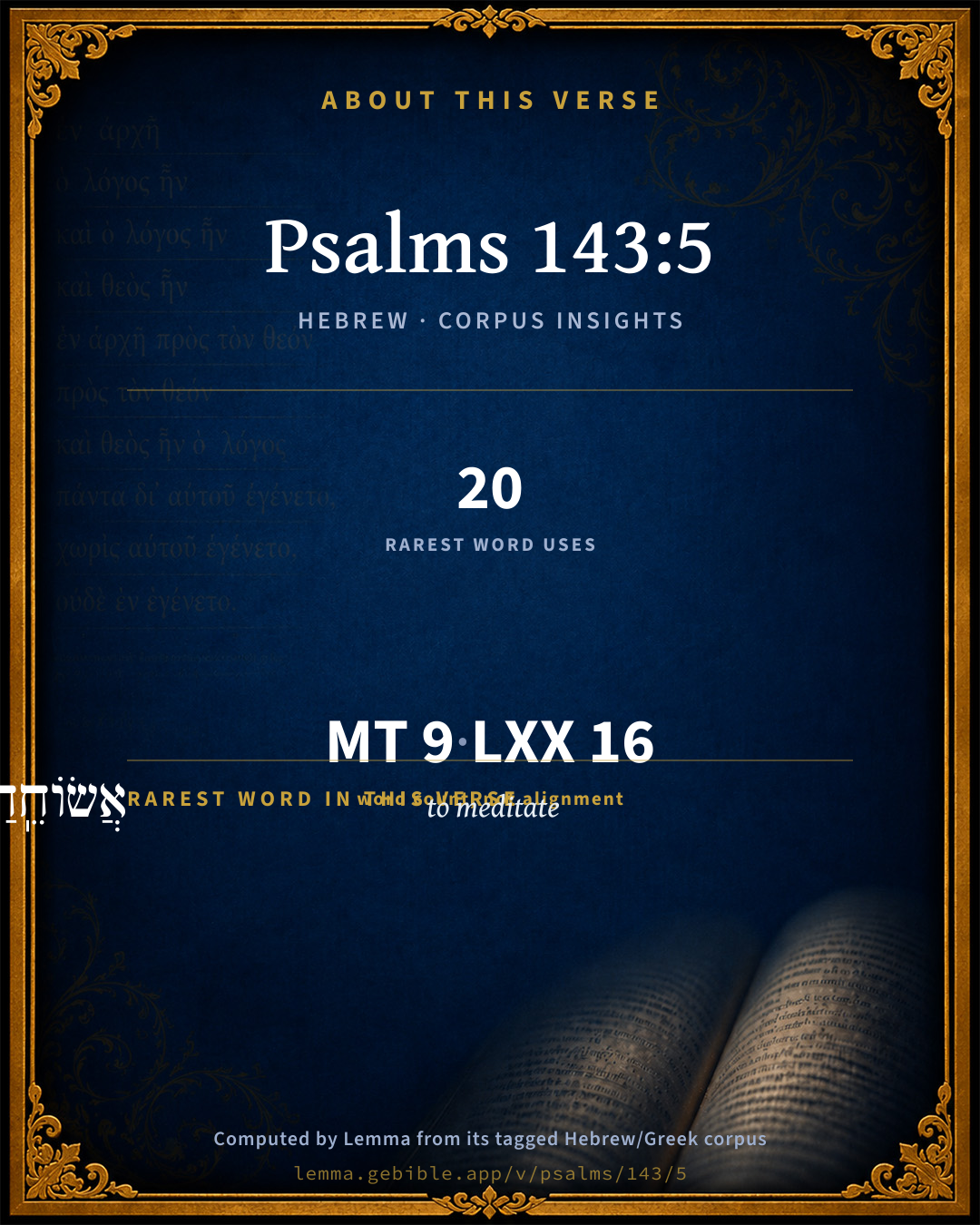
The rarest word here is אֲשׂוֹחֵֽחַ to meditate H7878 — appearing just 20 times in the whole Hebrew Bible.

Shared distinctive vocabulary

אֲשׂוֹחֵֽחַ to meditate H7878 occurs in 20 verses of the Hebrew Bible. Also found in:

Grammatical profile

  • 3 verbs
  • 6 nouns

Verb forms

  • זָ֘כַ֤רְתִּי Qal · Perfect
  • הָגִ֥יתִי Qal · Perfect
  • אֲשׂוֹחֵֽחַ Polel · Imperfect

Hebrew & Septuagint length

In English translation the verse runs 19 words from the Hebrew and 22 from the Septuagint (LXX English) — closely comparable.

A rough comparison of the two English renderings, which tokenize alike — not a word-level alignment.

Word counts can differ between the Hebrew and the Greek without any difference in meaning — e.g. the Hebrew direct-object marker אֵת has no separate Greek word, and Greek often adds the article ὁ.

In the original languages it is 9 Hebrew tokens and 16 Greek tokens — but the two are counted differently (Hebrew bundles its prefixes and suffixes into one token; the Greek is in lemma form), so that isn’t a like-for-like length.

Cross-references

9

Topical passages linked to Psalms 143:5 in the Treasury of Scripture Knowledge — connected by theme and wording, ordered by reader-vote popularity; previews shown in the World English Bible.

  • Psalms 77:10–12 Then I thought, "I will appeal to this: The years of the right hand of the Most High."
  • Psalms 77:5–6 I have considered the days of old, The years of ancient times.
  • 1 Samuel 17:45–50 Then said David to the Philistine, You come to me with a sword, and with a spear, and with a javelin: but I come to you in the name of Yahweh of hosts, the God of the armies of Israel, whom you have defied.
  • Psalms 111:4 He has caused his wonderful works to be remembered. Yahweh is gracious and merciful.
  • Micah 6:5 My people, remember now what Balak king of Moab devised, And what Balaam the son of Beor answered him from Shittim to Gilgal, That you may know the righteous acts of Yahweh."
  • 1 Samuel 17:34–37 David said to Saul, Your servant was keeping his father's sheep; and when there came a lion, or a bear, and took a lamb out of the flock,
  • Isaiah 63:7–14 I will make mention of the loving kindnesses of Yahweh, [and] the praises of Yahweh, according to all that Yahweh has bestowed on us, and the great goodness toward the house of Israel, which he has bestowed on them according to his mercies, and according to the multitude of his loving kindnesses.
  • Deuteronomy 8:2–3 You shall remember all the way which Yahweh your God has led you these forty years in the wilderness, that he might humble you, to prove you, to know what was in your heart, whether you would keep his commandments, or not.
  • Psalms 42:6 My God, my soul is in despair within me. Therefore I remember you from the land of the Jordan, The heights of Hermon, from the hill Mizar.

Cross-references courtesy of OpenBible.info (CC BY 4.0).

Hebrew and Greek witnesses Masoretic Hebrew ↔ Greek Septuagint

The same verse in the two great witnesses to the Old Testament, shown verse-for-verse.

You’re reading Greek Psalm 142 (Hebrew Psalm 143). The Septuagint counts the superscription, so verse numbers can differ from the Hebrew — chapter-level alignment, not verse-by-verse. Numbering follows Rahlfs.

These are two independent witnesses, not word-aligned to each other, and the Septuagint is shown in lemma (dictionary) form.

Hebrew Psalms 143:5 Masoretic · Westminster Leningrad Codex

זָ֘כַ֤רְתִּי יָמִ֨ים מִקֶּ֗דֶם הָגִ֥יתִי בְכָל פָּעֳלֶ֑ךָ בְּֽמַעֲשֵׂ֖ה יָדֶ֣יךָ אֲשׂוֹחֵֽחַ

I remember the days of old. I meditate on all your doings. I contemplate the work of your hands.

World English Bible · Public Domain

Greek LXX Greek Psalm 142:5 Septuagint · lemma form

μιμνήσκω ἡμέρα ἀρχαῖος καί μελετάω ἐν πᾶς ὁ ἔργον σύ ἐν ποίημα ὁ χείρ σύ μελετάω

I remembered the days of old; and I meditated on all your doings: yes, I meditated on the works of your hands.

LXX2012 (modern English Septuagint) · Public Domain

Hebrew: Westminster Leningrad Codex (CC BY 4.0). Greek: Septuagint (public domain); English from LXX2012 (modern English Septuagint) (Public Domain). How the Septuagint differs from the Hebrew →

Commentary

Notes on Psalms 143:5 from classic Christian and Jewish commentators (each source and its license shown beneath its notes). The classic Christian expositions comment on the surrounding passage and are grouped to its opening verse, so a note may address several verses; the Jewish commentaries on the Tanakh (Rashi and others) are per-verse, so they appear only where the commentator wrote on this verse.

Lemma curates 59 commentaries, every one of them public domain or Creative Commons licensed, each selected and text-cleaned for this edition rather than reprinted as found. About our sources →

Trapp's Complete Commentary

John Trapp

Psa 143:5 I remember the days of old; I meditate on all thy works; I muse on the work of thy hands.

Ver. 5. I remember the days of old] Wherein I was delivered from the lion and the bear; yea, from the hand of all mine enemies, and from the hand of Saul, Psa 18:1, title. More than this, Saecula antiquitus praeterita recolo, I run over and ruminate all the ancient monuments of thy mercy to the patriarchs and others; since all that is written was "written for our instruction, that we through patience and comfort of the Scriptures might have hope," Rom 15:4. See Psa 77:4; Psa 77:6.

John Trapp, A Commentary or Exposition upon All the Books of the Old and New Testament (1647–1656) — public domain. Text from a community e-Sword module.

The Biblical Illustrator

Joseph S. Exell

Psa_143:5

I remember the days of old.

The ministry of memory

I. As a necessity of human nature.

1. By the laws of proximity, likeness, contrast, we are every day thrown back on the past, made in some measure to relive the hours that are gone.

2. This necessary action of memory shows--

(1) The conscious unity of human life. However long we have to live, though for ever, from the beginning our life is one.

(2) The wondrous frugality of life. Our spiritual life throws nothing away. Memory manages all with the most sparing economy. It gathers up every fragment, so that nothing is lost.

(3) The growing importance of life. What a world lies behind the old man--nay, within him.

(4) The inevitable retributiveness of life.

II. As a moral obligation of human nature. I remember the days of old. Every man should voluntarily and religiously do this with the past of his life. He should not allow the past to come up to him merely involuntarily, and thus become its victim. He should deal with it so as to make it serve the true interests of his spiritual being. He should make the past--

1. Promote evangelical sorrow within him. The memory of the past must sadden all souls.

2. Promote thanksgiving to God within him. What impressions will the past give man of Gods forbearance--Gods guidance--Gods guardianship--Gods ever-flowing goodness!

3. Promote an invincible purpose to improve. The memory of past disappointments should warn us against extravagant hopes. The memory of abused mercies should lead us to a greater appreciation of our present blessings. The memory of lost years should lead us to turn every hour of the present to a right spiritual account. (Homilist.)

Remembrance of the past

I. The past enables us to know ourselves.

1. We have embodied our character.

2. We have reacted on and moulded them.

3. Hence the past shows what we are.

II. The past is fitted to suggest rules for the guidance of the future conduct.

1. It has brought to light our tendencies.

2. It has shown what is dangerous in our circumstances.

3. It has revealed the temptations before which we are in danger of falling.

III. A consideration of the past will prepare us for the exercise of confession, and will shut us up to Christ.

1. Confession should be minute--history portrayed.

2. This requires a knowledge of the past.

3. A sight of our sin drives to Christ.

4. For this sight we must turn to the past.

IV. The consideration of the past will dispose us to thanksgiving, and will furnish us with materials for praise.

1. Thanksgiving is difficult, and is neglected.

2. It should be minute, ranging from, etc.

3. It should involve lively and strong feeling.

4. The knowledge and the deep feeling are dependent on, etc.

Individuals.

V. The consideration of the past will stimulate us to redeem the time.

1. The whole life of man is short.

2. How much shorter has it become to us!

3. Had it been spent aright, its increased shortness would not be a matter of regret.

4. But only look back!

VI. The consideration of the past will produce deep and solemn impressions of the frailty of man.

1. Look back to your childhood.

2. Where are the companions of your youth? Stages marked by grave-stones--mourner--stranger on earth.

VII. The consideration of the past will show the utter folly of depending on the things of the world for support and enjoyment.

1. Ungodliness is an attempt to dispense with God and still be happy.

2. Each man makes the experiment.

3. You have made it.

4. What is the result? A failure!

VIII. A consideration of the past will confirm the believer in the choice he has made.

1. The most important part of a believers life is that which follows his conversion.

2. In reviewing it--

(1) You see the temporal consequences of your act.

(2) You see the spiritual consequences.

IX. The past will show to the ungodly his eternity.

1. Alas! the sinner is not qualified to see his eternity in his time.

X. The past shows to the believer the comparative measure in which he shall reap hereafter. Between the believers present conduct and future glory--

1. There is no connection of merit.

2. But there is a connection of congruity or fitness. (Jas. Stewart.)

Reflection

1. Reflection signifies to think again on what we have already thought, already conceived, to think on it more circumstantially, more steadily, more expressly, and to do this on set purpose and with consciousness in the design of dwelling longer on these thoughts, in order to dissect and analyze them, to obtain a clearer conception of the matter to which they relate, to study them in their several parts, in their principles and consequences, to compare them with others, to observe their analogies to us and to other objects, and thence to draw conclusions in regard to our conduct or to our happiness.

2. It also signifies, by the repeated representation and consideration of what we have already conceived and know, to endeavour to discover or to understand other things which we either do not yet know, or whereof we have only a dark and confused idea, or in regard to which we are still uncertain, whether they be true or false, thus or otherwise constituted.

3. Reflection has commonly in view the examination of some or all of the following questions: What is the object and the nature of it? What results from thence? Is it true and certain, and why is it so? What relations does it bear to me and my happiness? How should I act towards it? In other words, by reflection and consideration we endeavour to render our conceptions and ideas of objects more clear, more complete, more certain, more interesting and useful to us.

4. The reflecting man endeavours to render the objects, the doctrines whereon he reflects more profitable to him by applying them to his conduct, by deducing from them such principles and rules as may regulate him for the rest of his life. Thus he learns real, practical wisdom, and without that all human reflection is of no great value. (G. J. Zollikofer, D. D.)

I muse on the work of Thy hands.--

Gods works to be appreciated, for they declare Him

I heard of a good man who went down the Rhine, but took care to read a book all the way, for fear he should have his mind taken off from heavenly topics by the beauties of Nature. I confess I do not understand such a spirit--I do not want to do so. If I go into an artists house I do that artist a displeasure if I take no notice of his works under the pretext that I am quite absorbed in himself. Why not enjoy the objects in which our heavenly Father has set forth His wisdom and power? Delight yourself in all your heavenly Fathers handiwork, and make it to be a ladder by which you climb to Himself. (C. H. Spurgeon.)

Delight in Gods works

The same thing will appeal differently to different people according to capacity, sensibility, experience. One may look on a flower with the eye of a florist, another of a market gardener, another of a botanist, another of an artist. William Blake saw angels amid the swaying corn or nestling in a tree. A scene which is dull and uninteresting to the listless eye may be transformed by a touch of creative and interpretative imagination; as James Swetham says, Gerhard Dew threw a glory over our very pickled cabbage. Culture and restraint. (Hugh Black.)

The Biblical Illustrator, edited by Joseph S. Exell (c. 1880s–1900s) — public domain. Text from a community e-Sword module.

Joseph Benson's Commentary

Psa 143:5-6. I remember the days of old — That is, but still, upon a more calm reflection, I consider what thou hast done for thy servants in former times, and likewise what thou hast done for me during the persecutions of Saul, and long before that time, in my younger days, when thou didst deliver me from the greatest danger: see 1Sa 17:34, &c. I stretch forth my hands, &c. — I pray to thee fervently. My soul thirsteth after thee — After thy favour and help; as a thirsty land — For rain.

Joseph Benson's Commentary on the Old and New Testaments (1811–1818) — public domain. Text from a community e-Sword module.

J. A. Alexander on Psalms

Joseph Addison Alexander

5. (Psa 143:5) I remember the days of old; I meditate of all thy doings, of the work of thy hands I muse. He recalls and ponders them not as a source of comfort, as in Psa 44:1-3, but of sorrow, from their painful contrast with his actual condition. See above, on Psa 22:3-5; Psa 77:5, and with the last clause compare Psa 92:5.

Joseph Addison Alexander, The Psalms Translated and Explained (1850) — public domain. Text from a community e-Sword module.

Tyndale Open Study Notes

Tyndale Open Resources

143:5-6 Remembering God’s acts from the past reassures the psalmist of God’s faithfulness (42:4; 63:6; 77:3, 6; 119:55).

Tyndale Open Study Notes — © Tyndale Open Resources, licensed CC BY-SA 4.0. Text via the HelloAO Bible API.

Geneva Bible (1599)

Geneva Bible translators

To wit, thy great benefits of old, and the manifold examples of thy favor towards thine.

Geneva Bible (1599) marginal notes — public domain. Text via Bolls.life.

Adam Clarke's Commentary

Verse 5. I remember the days of old] Thou hast often helped me, often delivered me. I will therefore trust in thee, for thy mercy is not clean gone from me.

Adam Clarke's Commentary on the Bible (1810–1826) — public domain. Text from a community e-Sword/MySword module.

Ellicott's Commentary for English Readers

(5) See Psa_77:5-6.

A Bible Commentary for English Readers, edited by Charles John Ellicott (1878–1897) — public domain. Text from a community e-Sword module.

The Cambridge Bible for Schools and Colleges

gen. ed. J. J. S. Perowne

5. Cp. Psa_77:5; Psa_77:11-12. The recollection of God’s wonderful works of old time deepens his despondency, as he ponders on the contrast; “a sorrow’s crown of sorrow is remembering happier things”: yet it emboldens him to fresh prayer.

thy works … the work of thy hands] Thy work … the doing of thy hands, as in Psa_92:4.

5, 6. The thought of all that God wrought in ancient times makes him long for a fresh manifestation of His power.

The Cambridge Bible for Schools and Colleges (gen. ed. J. J. S. Perowne; Cambridge University Press, 1878–1918) — public domain. Text from a community e-Sword module.

John Gill's Exposition

I remember the days of old,.... Former times he had read and heard of, in which the Lord appeared for his people that trusted in him; or the former part of his own life, his younger days, when the Lord delivered him from the lion and bear, and from the uncircumcised Philistine, whom he slew; and made him victorious in battles, and preserved him from the rage and malice of Saul. If this was written on account of Absalom, those times of deliverance he called to mind, in order to encourage his faith and hope, and cheer his drooping spirits;

I meditate on all thy works; I muse on the work of thy hands; the works of creation and providence, in order to observe the instances of divine power, wisdom, and goodness in them; and from thence fetch arguments, to engage his trust and confidence in the Lord: he both thought of these things within himself, and he "talked" (w) of them to his friends that were with him, as the last of these words used may signify; and all this he did to cheer his own spirit, and the spirits of the men that were with him, in the time of distress and danger.

(w) "loquor", Piscator; "sermocinatus sum", Cocceius; "aut colloquor", Gejerus, Michaelis.

John Gill's Exposition of the Whole Bible (1746–1763) — public domain (CC PDM 1.0). Text via the HelloAO Bible API.

Albert Barnes' Notes on the Bible

I remember the days of old - Former times.

(1) as contrasted with my present condition.

(2) as times when I called upon thee, and thou didst interpose.

(3) as encouraging me now to come to thee, and spread out my case before thee. See Psa 77:5-11, note; Psa 42:4, note.

I meditate on all thy works ... - On what thou hast done; on thy gracious interpositions in the time of trial; on the manifestations of thy power in my behalf, and in behalf of thy people. I call all this to mind, remembering that thou art an unchangeable God; that thou hast the same power still; that thou canst interpose now as thou didst then; and that, as an unchangeable God, thou wilt do it in the same circumstances. I, therefore, come to thee, and pray that thou wilt interpose in my behalf.

Albert Barnes' Notes on the Bible (1834–1885) — public domain. Text from a community e-Sword/MySword module.

Matthew Poole's English Annotations

I remember the days of old, i.e. what thou hast done for thy servants in former times; which he mentions either,

1. As matter of terror, to consider how unlike God now was unto himself and to his former dealings; or,

2. As matter of support from former experience, because God was still the same. Either way it drives him to his prayers, which here follow.

Matthew Poole's English Annotations on the Holy Bible (1683–1685) — public domain. Text from a community e-Sword/MySword module.

The Treasury of David

Charles H. Spurgeon

Ver. 5. I remember the days of old. When we see nothing new which can cheer us, let us think upon old things. We once had merry days, days of deliverance, and joy and thanksgiving; why not again? Jehovah rescued his people in the ages which lie back, centuries ago; wily should he not do the like again? We ourselves have a rich past to look back upon; we have sunny memories, sacred memories, satisfactory memories, and these are as flowers for the bees of faith to visit, from whence they may make honey for present use. I meditate on all thy works. When my own works reproach me, thy works refresh me. If at the first view the deeds of the Lord do not encourage us, let us think them over again, ruminating and considering the histories of divine providence. We ought to take a wide and large view of all God's works; for as a whole they work together for good, and in each part they are worthy of reverent study. I muse on the work of thy hands. This he had done in former days, even in his most trying hours. Creation had been the book in which he read of the wisdom and goodness of the Lord. He repeats his perusal of the page of nature, and counts it a balm for his wounds, a cordial for his cares, to see what the Lord has made by his skilful hands. When the work of our own hand grieves us, let us look to the work of God's hands. Memory, meditation, and musing are here set together as the three graces, ministering grace to a mind depressed and likely to be diseased. As David with his harp played away the evil spirit from Saul, so does he hero chase away gloom from his own soul by holy communion with God.

Ver. 5. I remember the days of old; I meditate, etc. This meditation gives an ease to the overwhelming of my spirits, a comfort to the desolateness of my heart; for I am thinking sometimes upon Jonah, how he was overwhelmed with waters and swallowed up of a whale, and yet at last delivered; sometimes I am thinking of Joseph, how he was bound and left desolate in a pit, and yet at last relieved; and then I meditate thus with myself, Is God's power confined to persons? could he deliver them in their extremities, and can he not deliver me in mine? Sir Richard Baker.

Ver. 5. I meditate on all thy works. Let us look for God in the future more earnestly than we have done in the past, look for him in vineyards and orchards and harvest fields, in the bright plumage of birds, and the delicate bloom of fruit, and the sweet gracefulness of flowers, in the dense foliage of the forest, and the sparse heather of the moor, in the rich luxuriance of fertile valleys, and the rugged grandeur of the everlasting hills, in the merry dance of the rivulet, and the majestic tides of the oceanin the gay colours of the rainbow, and the splendour of the starry heavens, in the gentle radiance of the moon, and the gorgeous light of setting suns, in the clear azure sky, and the weird pageantry of clouds, in the snow mantled wintry landscape, and the brilliant effulgence of a summer's noon, in the virgin loveliness of spring, and in the pensive fading beauty of autumn, let us look for him with an earnest, eager, and unwearied gaze, till we see him to be a God of wisdom as well as power, of love as well as sovereignty, of beauty as well as glory. A. W. Momerie, in "The Origin of Evil, and other Sermons", 1881.

Ver. 5, 6. I meditate. I stretch forth my hands. Meditation is prayer's handmaid to wait on it, both before and after the performance of supplication. It is as the plough before the sower, to prepare the heart for the duty of prayer; and as the harrow after the sower, to cover the seed when 'tis sown. As the hopper feeds the mill with grist, so does meditation supply the heart with matter for prayer. William Gurnall.

Ver. 5-6. I muse on the work of thy hands. I stretch forth my hands unto thee. Hand in hand: or the child of God admiring the work of God's hands, and praying with uplifted hands to be wrought upon by the like power.

Ver. 5. David's method.

1. He gathered materials; facts and evidence concerning God: "I remember."

2. He thought out his subject and arranged his matter: "I meditate."

3. He discoursed thereon, and was brought nearer to God: "I muse" discourse.

4. Let us close by viewing all this as an example for preachers and others. W. B. H.

Psalms 143:6*

Ver. 6. I stretch forth my hands unto thee. He was eager for his God. His thoughts of God kindled in him burning desires, and these led to energetic expressions of his inward longings. As a prisoner whose feet are bound extends his hands in supplication when there is hope of liberty, so does David. My soul thirsteth after thee, as a thirsty land. As the soil cracks, and yawns, and thus opens its mouth in dumb pleadings, so did the Psalmist's soul break with longings. No heavenly shower had refreshed him from the sanctuary: banished from the means of grace, his soul felt parched and dry, and he cried out, "My soul to thee"; nothing would content him but the presence of his God. Not alone did he extend his hands, but his heart was stretched out towards the Lord. He was athirst for the Lord. If he could but feel the presence of his God he would no longer be overwhelmed or dwell in darkness; nay, everything would turn to peace and joy.

Selah. It was time to pause, for the supplication had risen to agony point. Both harp strings and heart strings were strained, and needed a little rest to get them right again for the second half of the song.

Charles H. Spurgeon's The Treasury of David (1869–1885) — public domain. Psalms only. Text from a community e-Sword/MySword module.

Whedon's Commentary on the Bible

Daniel D. Whedon

5. I remember the days of old—This refers to no far antiquity, but only to the deliverances of David’s earlier life in perils with Goliath and with Saul. To have forfeited the mercy that then was his help, makes his present case more intensely painful.

Daniel D. Whedon (gen. ed.), Commentary on the Old and New Testaments (1874–1909) — public domain. Text from a community e-Sword module.

The Pulpit Commentary

I remember the days of old. Still, in the midst of all my troubles, I do not despair remember the days of old the great things which God has done for me in the past. (comp. Psa_77:5, Psa_77:10, Psa_77:11) I meditate on all thy works; or, "on all thy doings." I muse on the work of thy hands. (comp. Psa_77:12)

Vers. 5, 6. God our first Hope and our Last.

The hunger and thirst after righteousness is ultimately a thirst for God. "Observe how he binds himself to God alone, cuts off every other hope from his soul, and, in short, makes his very need a chariot wherewith to mount up to God." "I remember the days of old;" "I spread forth my hands unto thee.

I GOD ALWAYS HAS BEEN OUR HOPE. A good man is here speaking in the name of good men. They can never look back over life, and estimate its scenes of trial and strain, without clearly seeing that their hope was in God, and that God had ever met and satisfied their hope. One thing man has to learn over and over again in the experience of life. It is the untrustworthiness of things and people, and the safe foundation of hope that a man has in God. It is not usually long after a man enters on what may be called a personal experience that he discovers there is no hope to be placed in man. One of the most humiliating and depressing experiences of life is finding our most trusted friend fail us in the hour of need. Then we learn that God is our first and only Hope. Then God does not fail. We may trust him. We find him the "Strength of our heart and our Portion for ever." That experience is repeated again and again as life unfolds.

II GOD ALWAYS WILL BE OUR HOPE. Estimate aright the painful experiences through which we may now be passing; times when our life-erections seem to lie in ruins about us; times when trusted friends fail us; times when the outlook before us is dark; times when the sense of loneliness oppresses us, we look to the right hand and to the left, but there is no helper; they are all times in which we are recovering and reestablishing our hope in God. It is well to remember that we always have that. The soul"s deep rest is in him who is "the same yesterday, and today, and for ever;" always the "Friend of the friendless and the faint." Life rightly viewed is a liberating us from every bond that would keep us from restful, strengthening hope in God. R.T.

The Pulpit Commentary (1880–1919), ed. H.D.M. Spence-Jones & Joseph S. Exell — public domain. Text from a community e-Sword module.

John Wesley's Explanatory Notes

The days - What thou hast done for thy servants in former times.

John Wesley, Explanatory Notes Upon the Whole Bible (1754–1765) — public domain. Text via the GEBible commentary corpus.

unfoldingWord translationNotes

Door43 World Missions Community

call to mind

"think about"

your accomplishments

"all that you have accomplished" or "all the great things you have done"

spread my hands out to you

What one does with one's body here is a metonym for the purpose of doing so. The Israelites would commonly pray while standing with their hands raised and spread out at their sides. AT: "pray to you with my hands lifted up at my sides"

my soul thirsts for you in a parched land

The psalmist speaks of wanting to be with God as if he were in a parched land and he also was about to die of thirst. AT: "I want to be with you the way a person in a parched land who is very thirsty wants water" (See: Metaphor)

my soul thirsts for you

The psalmist desires to know Yahweh. The intensity of his desire to know Yahweh is like one who is very thirsty. AT: "I long for you" (See: Metaphor)

my soul

The soul is a metonym for the person. (See: Synecdoche)

parched land

A land where everything has died because there is no water.

Selah

This may be a musical term that tells people how to sing or play their instruments here. Some translations write the Hebrew word, and some translations do not include it. See how you translated this in Psalms 3:2. (See: Copy or Borrow Words)

translationWords

meditate

works

pray

soul

selah

unfoldingWord translationNotes — © Distant Shores Media and the Door43 World Missions Community, licensed CC BY-SA 4.0. Source: git.door43.org/Door43/en_tn.

Rashi

Rabbi Shlomo Yitzchaki (Rashi)

I remember the days of yore when You performed for us many wondrous miracles.

Rashi on the Tanakh — English translations: “The Judaica Press complete Tanach with Rashi, translated by A. J. Rosenberg” (CC BY 4.0); “Pentateuch with Rashi's commentary by M. Rosenbaum and A.M. Silbermann, 1929-1934” (public domain); “The Metsudah Tanach series, Lakewood, N.J” (CC BY 4.0); and “The Book of Joshua, Metsudah Publications, 1997” (CC BY 4.0). Text via Sefaria.

Lesson kit

Teaching starters — assembled from the data on this page, not authored interpretation. Every prompt links to the verse data it draws on. Edit before teaching.

Psalms, in the Wisdom, opens this verse with 9 words (9 distinct Hebrew lemmas). Its most distinctive word is sîyach (“to meditate”). A historical commentator’s framing appears above. Read the whole chapter for the surrounding context.

Discussion questions

  1. The word sîyach carries the sense “to meditate.” How does it shape the verse?
  2. How does Judges 5:10, which shares the word «to meditate», read alongside this verse?
  3. These translations render this verse differently. What is at stake in choosing one wording over another?
  4. «זָ֘כַ֤רְתִּי» is a Qal Perfect verb. How does that grammatical form shape the action described?
  5. Compare how Trapp's Complete Commentary and The Biblical Illustrator read this verse. Where do they agree or differ?

Things to notice

Reading settings

Reading text

Shown beneath each verse's original-language words.

Old Testament
Old Testament edition

Read the OT as the Masoretic Hebrew (MT) or the Greek Septuagint (LXX).

English shown for the Greek Septuagint (in the Hebrew ↔ Greek comparison).

Comparing translations? Open the Compare panel on any verse page to stack up to four side by side.