
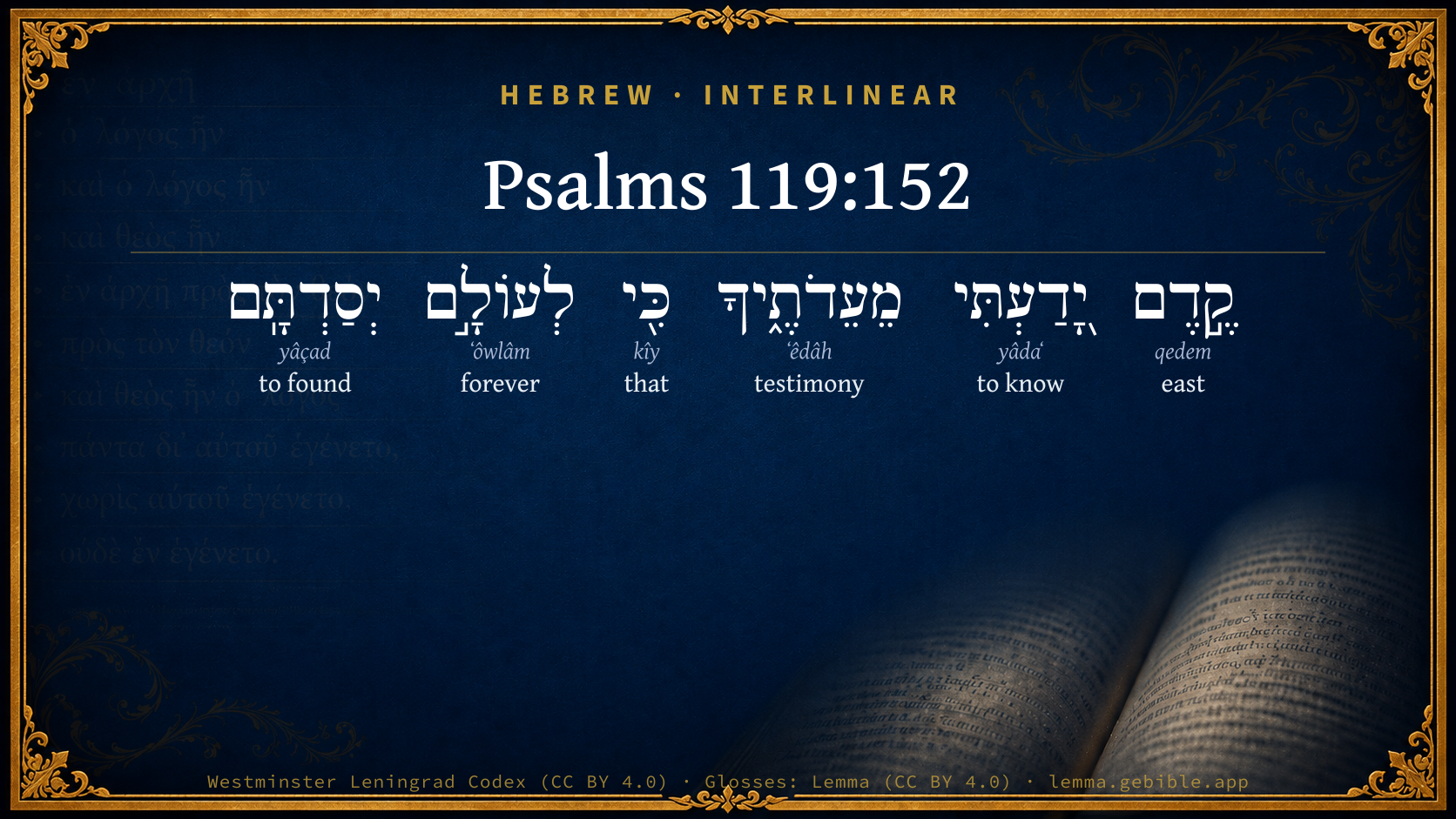
Psalms 119:152

Hebrew (Westminster Leningrad Codex) Psalms 119:152 appears in the Hebrew Old Testament. The text above is from the Westminster Leningrad Codex. Each word links to its Strong’s number, a concise gloss, and parsing drawn from the Open Scriptures Hebrew Bible morphology. Click any word for its full Brown-Driver-Briggs (BDB) entry.
Download image
Cite this verse

Psalms 119:152 (World English Bible). Public Domain. Lemma interlinear Bible study tool, https://lemma.gebible.app/v/psalms/119/152.

Show BibTeX & RIS
BibTeX
RIS
English Translation
Of old I have known from your testimonies, That you have founded them forever.
World English Bible · Public Domain
Download a study sheet

One document with this verse’s original text, its word-by-word gloss line, the meaning frame, cross-references with their text, attributed commentary, and full source and license credits — printable, and it pastes into notes with its structure intact.

This verse Autodidact and up

Study sheet (.html) Plain text (.txt)

A passage Seminary Student

Up to 50 verses in one chapter. A passage sheet keeps up to 6 commentary sources and 12 cross-references per verse, in the order this page ranks them, and says so on the sheet whenever that leaves anything out. Ask for a single verse and you get the Autodidact verse sheet above.

Everything on this page stays free to read, with no account — the sheet is a download of what is already on screen, not access to it.

Want to remove ads? Support Godless Engineer
Compare translations 3

The same verse in 3 English versions, stacked beneath the original-language interlinear above. Click any original word for its lexicon entry.

Each is an independent rendering of the whole verse — the interlinear is not word-aligned to these translations.

Highlighted words mark where these versions differ — a whole-verse word diff, not a word-by-word alignment.

  • World English Bible Public Domain
    Of old I have known from your testimonies, That you have founded them forever.
  • King James Version Public Domain
    Concerning thy testimonies, I have known of old that thou hast founded them for ever.
  • unfoldingWord Literal Text CC BY-SA 4.0
    Long ago, I knew from your testimonies that you have founded them forever. RESH

unfoldingWord Literal Text — © unfoldingWord, licensed CC BY-SA 4.0. Word-aligned USFM3 via Door43 (git.door43.org/unfoldingWord/en_ult).

Versions to compare (up to 4)

3 of 4 selected

Show all 17 translations

Every available English version of this verse, each an independent rendering of the whole verse.

  • World English Bible Public Domain
    Of old I have known from your testimonies, That you have founded them forever.
  • Berean Standard Bible Public Domain
    Long ago I learned from Your testimonies that You have established them forever.
  • Majority Standard Bible Public Domain
    Long ago I learned from Your testimonies that You have established them forever.
  • King James Version Public Domain
    Concerning thy testimonies, I have known of old that thou hast founded them for ever.
  • American Standard Version (1901) Public Domain
    Of old have I known from thy testimonies, That thou hast founded them for ever.
  • Revised Version (1885) Public Domain
    Of old have I known from thy testimonies, that thou hast founded them for ever.
  • Geneva Bible (1599) Public Domain
    I haue knowen long since by thy testimonies, that thou hast established them for euer.
  • Young's Literal Translation Public Domain
    Of old I have known Thy testimonies, That to the age Thou hast founded them!
  • Literal Standard Version CC BY-SA 4.0
    I have known Your testimonies of old, || That You have founded them for all time!
  • Unlocked Literal Bible CC BY-SA 4.0
    Long ago I learned from your covenant decrees that you had set them in place forever.
  • unfoldingWord Literal Text CC BY-SA 4.0
    Long ago, I knew from your testimonies that you have founded them forever. RESH
  • Darby Bible Public Domain
    From thy testimonies, I have known of old that thou hast founded them for ever.
  • World Messianic Bible Public Domain
    Of old I have known from your testimonies, that you have founded them forever. RESH
  • Webster's Bible Public Domain
    Concerning thy testimonies, I have known of old that thou hast founded them for ever.
  • Free Bible Version CC BY-SA 4.0
    Long ago I realized that your laws will last forever. Resh
  • Bible in Basic English Public Domain
    I have long had knowledge that your unchanging word is for ever.
  • JPS Tanakh (1917) Public Domain
    Of old have I known from Thy testimonies that Thou hast founded them for ever.

Literal Standard Version (2020), Covenant Press — licensed CC BY-SA 4.0. Text via the HelloAO Bible API (eBible.org). Unlocked Literal Bible (unfoldingWord) — licensed CC BY-SA 4.0. Text via the HelloAO Bible API (eBible.org). unfoldingWord Literal Text — © unfoldingWord, licensed CC BY-SA 4.0. Word-aligned USFM3 via Door43 (git.door43.org/unfoldingWord/en_ult). Free Bible Version, Dr. Jonathan Gallagher — licensed CC BY-SA 4.0. Text via the HelloAO Bible API (eBible.org).

Word by word

More ways to search: Search by grammar → Find every occurrence → Compare this word →

Practice this passage: Drill this verse → Learn its vocabulary →

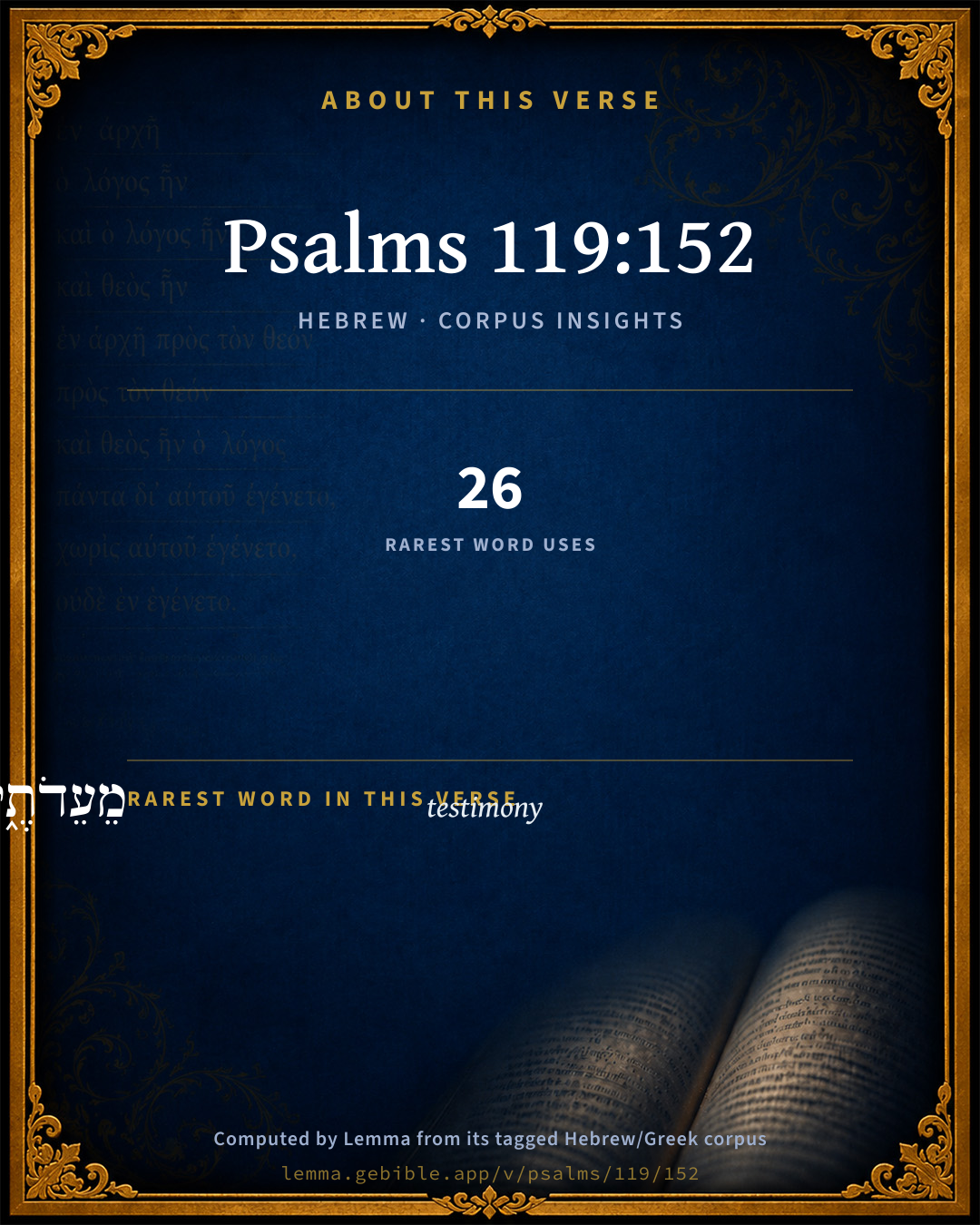
About this verse

These counts appear in no published source. They are computed here, from the morphology-tagged text and Lemma’s own curated glosses. What Lemma adds →

6
words
6
distinct lemmas
Wisdom
section

Shared distinctive vocabulary

מֵעֵדֹתֶ֑יךָ testimony H5713 occurs in 25 verses of the Hebrew Bible. Also found in:

Grammatical profile

  • 2 verbs
  • 3 nouns
  • 1 conjunction

Verb forms

  • יָ֭דַעְתִּי Qal · Perfect
  • יְסַדְתָּֽם Qal · Perfect

Hebrew & Septuagint length

In English translation the verse runs 14 words from the Hebrew and 15 from the Septuagint (LXX English) — closely comparable.

A rough comparison of the two English renderings, which tokenize alike — not a word-level alignment.

Word counts can differ between the Hebrew and the Greek without any difference in meaning — e.g. the Hebrew direct-object marker אֵת has no separate Greek word, and Greek often adds the article ὁ.

Cross-references

6

Topical passages linked to Psalms 119:152 in the Treasury of Scripture Knowledge — connected by theme and wording, ordered by reader-vote popularity; previews shown in the World English Bible.

  • Luke 21:33 Heaven and earth will pass away, but my words will by no means pass away.
  • Psalms 111:7–8 The works of his hands are truth and justice. All his precepts are sure.
  • Ecclesiastes 3:14 I know that whatever God does, it shall be forever. Nothing can be added to it, nor anything taken from it; and God has done it, that men should fear before him.
  • Psalms 119:144 Your testimonies are righteous forever. Give me understanding, that I may live.
  • Psalms 119:160 All of your words are truth. Every one of your righteous ordinances endures forever.
  • Psalms 89:34–37 I will not break my covenant, Nor alter what my lips have uttered.

Cross-references courtesy of OpenBible.info (CC BY 4.0).

Hebrew and Greek witnesses Masoretic Hebrew ↔ Greek Septuagint

The same verse in the two great witnesses to the Old Testament, shown verse-for-verse.

You’re reading Greek Psalm 118 (Hebrew Psalm 119). The Septuagint counts the superscription, so verse numbers can differ from the Hebrew — chapter-level alignment, not verse-by-verse. Numbering follows Rahlfs.

These are two independent witnesses, not word-aligned to each other, and the Septuagint is shown in lemma (dictionary) form.

Hebrew Psalms 119:152 Masoretic · Westminster Leningrad Codex

קֶ֣דֶם יָ֭דַעְתִּי מֵעֵדֹתֶ֑יךָ כִּ֖י לְעוֹלָ֣ם יְסַדְתָּֽם

Of old I have known from your testimonies, That you have founded them forever.

World English Bible · Public Domain

Greek LXX Greek Psalm 118:152 Septuagint · lemma form

κατά ἀρχή γιγνώσκω ἐκ ὁ μαρτύριον σύ ὅτι εἰς ὁ αἰών θεμελιόω αὐτός

I have known of old concerning your testimonies, that you have founded them for ever.

LXX2012 (modern English Septuagint) · Public Domain

On this verse, The Treasury of David discusses the Septuagint’s reading. Read the note in Commentary ↓

Hebrew: Westminster Leningrad Codex (CC BY 4.0). Greek: Septuagint (public domain); English from LXX2012 (modern English Septuagint) (Public Domain). How the Septuagint differs from the Hebrew →

Commentary

Notes on Psalms 119:152 from classic Christian and Jewish commentators (each source and its license shown beneath its notes). The classic Christian expositions comment on the surrounding passage and are grouped to its opening verse, so a note may address several verses; the Jewish commentaries on the Tanakh (Rashi and others) are per-verse, so they appear only where the commentator wrote on this verse.

Lemma curates 59 commentaries, every one of them public domain or Creative Commons licensed, each selected and text-cleaned for this edition rather than reprinted as found. About our sources →

Trapp's Complete Commentary

John Trapp

Psa 119:152 Concerning thy testimonies, I have known of old that thou hast founded them for ever.

Ver. 152. Concerning thy testimonies, &c.] The sempiternity of God’s word is an excellent prop to faith and help in prayer; to those especially who are of long experience, and have well laid up their experiments. David had learned this truth of a child little. See 2Ti 3:17.

John Trapp, A Commentary or Exposition upon All the Books of the Old and New Testament (1647–1656) — public domain. Text from a community e-Sword module.

J. A. Alexander on Psalms

Joseph Addison Alexander

152. (Psa 119:152) Long have I known from thy testimonies (themselves) that thou untoeternity hast founded them. The first word in Hebrew is a noun used adverbially. The precepts of the law describe themselves as everlasting. See Exo 27:21; Exo 28:43; Exo 36:21, Lev 3:17; Lev 6:11; Lev 7:36, Num 10:8.

Joseph Addison Alexander, The Psalms Translated and Explained (1850) — public domain. Text from a community e-Sword module.

Geneva Bible (1599)

Geneva Bible translators

His faith is grounded upon God’s word, that he would ever be at hand when his children be oppressed.

Geneva Bible (1599) marginal notes — public domain. Text via Bolls.life.

Matthew Henry's Commentary

This confirms what he had said in the close of the foregoing verses, All thy commandments are truth; he means the covenant, the word which God has commanded to a thousand generations. This is firm, as true as truth itself. For, 1. God has founded it so; he has framed it for a perpetuity. Such is the constitution of it, and so well ordered is it in all things, that it cannot but be sure. The promises are founded for ever, so that when heaven and earth shall have passed away every iota and tittle of the promise shall stand firm, Co2 1:20. 2. David had found it so, both by a work of God's grace upon his heart (begetting in him a full persuasion of the truth of God's word and enabling him to rely upon it with a full satisfaction) and by the works of his providence on his behalf, fulfilling the promise beyond what he expected. Thus he knew of old, from the days of his youth, ever since he began to look towards God, that the word of God is what one may venture one's all upon. This assurance was confirmed by the observations and experiences of his own life all along, and of others that had gone before him in the ways of God. All that ever dealt with God, and trusted in him will own that they have found him faithful.

Matthew Henry's Commentary on the Whole Bible (1708–1710) — public domain (CC PDM 1.0). Text via the HelloAO Bible API.

Adam Clarke's Commentary

Verse 152. Concerning thy testimonies, I have known of old] קדם ידעתי kedem yedati, "Long ago I have known concerning thy testimonies." Thou hast designed that thy testimonies should bear reference to, and evidence of, those glorious things which thou hast provided for the salvation of men; and that this should be an everlasting testimony. They continue, and Christ is come.

ANALYSIS OF LETTER KOPH. - Nineteenth Division

I. The psalmist is earnest in his prayers for deliverance.

II. He shows the end for which he desires it.

III. The necessity of its being speedy, as his enemies were at hand.

I. 1. His prayer was earnest; it was a cry, rather than a petition.

2. It was sincere: "I cried with my whole heart." There was no hypocrisy in it.

3. It was in season: "I prevented the dawning of the morning."

4. It was out of season: "Mine eyes prevent the night-watches."

What he prayed for, -

1. Audience: "Hear me, O Lord."

2. Deliverance: "Save me."

3. Increase of grace: "Quicken me."

II. The end for which he prayed.

1. That he might keep God's statutes.

2. That he might keep his testimonies. See the explanation of these words at the beginning of this Psalm.

3. That he might meditate on God's word.

4. That he might increase in the life of God.

The arguments he uses: -

1. His faith and hope. I cried, because I waited and hoped in thy word.

2. God's mercy. According to thy loving-kindness.

3. The danger he was in from his pursuing enemies. - 1. They draw nigh. 2. They are mischievously bent. 3. They are most impious men. Far from the law of God; they despised and hated it.

III. Near as they may be to destroy, thou art nearer to save.

1. "Thou art near:" They cannot come where thou art not.

2. "All thy commandments are truth:" And thou hast commanded us to trust in thee; and therefore we shall not fear evil. Thou wilt support thy servants, and destroy thine enemies.

He concludes with an acclamation: -

1. "Concerning thy testimonies:" Thy will, which thou hast testified in thy word.

2. "I have known of old:" Ever since I looked into them, began to study and practice them.

3. "That thou hast founded them for ever:" They are of eternal truth, immutable and indispensable. And this is the anchor of our souls, that we may not be carried away by trials and temptations. Not one tittle of God's truth has ever failed any of his sincere followers. No one promise of his that has been sought by faith in Christ has ever been unfulfilled. Blessed be God!

Adam Clarke's Commentary on the Bible (1810–1826) — public domain. Text from a community e-Sword/MySword module.

John Calvin's Commentaries

152. I have known from thy testimonies “De testimoniis tuis.” — Lat.

Walford’s rendering is, “I have known thy testimonies long since.” Phillips translates “of old;” and gives this explanation, “I have been acquainted with thy testimonies ever since I have possessed any knowledge, i.e. as soon as I came to years of reflection.

‘From a child thou hast known the holy scriptures.’ 2 Timothy 3:15.”

Thou hast established them for ever. That is, thy revelations are unalterable and everlasting, as the attributes of their great Author, and can never fail those who rely upon them, in time, or in eternity.” — Warner on the Psalter.

John Calvin's Commentaries (1540-1563) — public domain. Text from the Calvin Translation Society English edition (1840s-50s) via the Christian Classics Ethereal Library (ccel.org). Calvin's coverage is partial (roughly two-thirds of the Bible); uncommented books and verses are honest gaps, never fabricated. The 19th-century editor's footnotes and remarks are omitted so the notes are faithfully Calvin's own voice.

Ellicott's Commentary for English Readers

(152) The more obvious rendering of this verse is, Of old I was instructed out of Thy testimonies, for—not for a brief time, but for ever—Thou didst found them, where for ever expresses indefinite past as well as indefinite future.

A Bible Commentary for English Readers, edited by Charles John Ellicott (1878–1897) — public domain. Text from a community e-Sword module.

The Cambridge Bible for Schools and Colleges

gen. ed. J. J. S. Perowne

152. Of old have I known from thy testimonies, that &c. (R.V.). Men may affirm or act as if they believed that God’s laws are obsolete: but from the study of those laws themselves the Psalmist has long ago learnt their eternal validity; and his deeply rooted convictions cannot be shaken by the contempt or the threats of his enemies.

The Cambridge Bible for Schools and Colleges (gen. ed. J. J. S. Perowne; Cambridge University Press, 1878–1918) — public domain. Text from a community e-Sword module.

John Gill's Exposition

Great are thy tender mercies, O Lord,.... Not his providential mercies only, which are many and undeserved, and constantly repeated; but his special mercies in Christ, which flow from the tenderness of his heart; and his merciful lovingkindness to his people, and which are great or many (f), as to quantity; there being a multitude of them, not to be reckoned up: and for quality they are wonderful beyond expression and conception; proceed from unmerited love, rich, free, sovereign grace, and last for ever;

quicken me according to that judgments; See Gill on Psa 119:149.

(f) "multae", Pagninus, Montanus, Musculus, Michaelis.

John Gill's Exposition of the Whole Bible (1746–1763) — public domain (CC PDM 1.0). Text via the HelloAO Bible API.

Albert Barnes' Notes on the Bible

Concerning thy testimonies - In regard to all that thou hast testified to as true and best. Every command of God is in fact a testimony of his as to what is right; every promise is a testimony of his own purpose in regard to mankind.

I have known of old - The word used here is a noun, and means properly, “the front,” what is “before;” then, the East; then, what pertains to olden time or ancient days - “before” the present. The meaning here is, that he had known this “before” what had now occurred; it was not a new thing - a new experience. It was deeply impressed on his mind as the result of all his reflection and observation.

That thou hast founded them for ever - “From” eternity, and “for” eternity. They were laid in the eternity past; they will continue in the eternity to come. They are based on eternal principles of right; they will never be changed. Such a conviction will do much to keep the soul steady and firm in the trials and uncertainties of life. Whatever may change, God’s law does not change; whatever is new, that is not new; whatever will vanish away, that will remain.

Albert Barnes' Notes on the Bible (1834–1885) — public domain. Text from a community e-Sword/MySword module.

Matthew Poole's English Annotations

Known of old, by my own long experience, ever since I arrived at any knowledge in those matters.

That thou hast founded them for ever; that thou hast established them upon sure and everlasting foundations.

Matthew Poole's English Annotations on the Holy Bible (1683–1685) — public domain. Text from a community e-Sword/MySword module.

The Treasury of David

Charles H. Spurgeon

Ver. 152. Concerning thy testimonies, I have known of old that thou hast founded them for ever. David found of old that God had founded them of old, and that they Would stand firm throughout all ages. It is a very blessed thing to be so early taught of God that we know substantial doctrines even from our youth. Those who think that David was a young man when he wrote this psalm will find it rather difficult to reconcile this verse with the theory; it is much more probable that he was now grown grey, and was looking back upon what he had known long before. He knew at the very first that the doctrines of God's word were settled before the world began, that they had never altered, and never could by any possibility be altered. He had begun by building on a rock, by seeing that God's testimonies were "founded", that is, grounded, laid as foundations, settled and established; and that with a view to all the ages that should come, during all the changes that should intervene. It was because David knew this that he had such confidence in prayer, and was so importunate in it. It is sweet to plead immutable promises with an immutable God. It was because of this theft David learned to hope: a man cannot have much expectation from a changing friend, but he may well have confidence in a God who cannot change. It was because of this that he delighted in being near the Lord, for it is a most blessed thing to keep up close intercourse with a Friend who never varies. Let those who choose follow at the heels of the modern school and look for fresh light to break forth which will put the old light out of countenance; we are satisfied with the truth which is old as the hills and as fixed as the great mountains. Let "cultured intellects" invent another god, more gentle and effeminate than the God of Abraham; we are well content to worship Jehovah, who is eternally the same. Things everlastingly established are the joy of established saints. Bubbles please boys, but men prize those things which are solid and substantial, with a foundation and a bottom to them which will bear the test of the ages.

Ver. 152. This portion of our psalm endeth with the triumph of faith over all dangers and temptations. "Concerning thy testimonies, " the revelations of thy will, thy counsels for the salvation of thy servants, "I have known of old, "by faith, and by my own experience, as well as that of others, "that thou hast founded them for ever"; they are unalterable and everlasting as the attributes of their great Author, and can never fail those who rely upon them, in time or in eternity. George Horne.

Ver. 152. I have known of old. It was not a late persuasion, or a thing that he was now to learn; he always knew it since he knew anything of God, that God had owned his word as the constant rule of his proceedings with creatures, in that God had so often made good his word to him, not only by present and late, but by old and ancient experiences. Well, then, David's persuasion of the truth and unchangeableness of the word was not a sudden humour, or a present fit, or a persuasion of a few days' standing; but he was confirmed in it by long experience. One or two experiences had been no trial of the truth of the word, they might seem but a good hit; but his word ever proveth true, not once or twice, but always; what we say "of old, "the Septuagint reads kat adxas, "from the beginnings"; that is, either

1. From my tender years. Timothy knew the Scriptures from a child (2Ti 3:15); so David very young was acquainted with God and his truth.

2. Or, from the first time that he began to be serious, or to mind the word in good earnest, or to be a student either in God's word or works, by comparing providences and promises, he found concerning his testimonies that "God had founded them for ever."

3. Lastly, "of old" may be what I have heard of all foregoing ages, their experience as well as mine: "Our fathers trusted in thee: they trusted, and thou didst deliver them. They cried unto thee, and were delivered: they trusted in thee, and were not confounded:" Ps 22:4, 5. Thomas Manton.

Ver. 152. Let us mark this eternal basis of "the testimonies of God." The whole plan of redemption was emphatically "founded for ever": the Saviour was "foreordained before the foundation of the world." The people of God were "chosen in Christ before the world began." The great Author "declares the end from the beginning, "and thus clears his dispensations from any charge of mutability or contingency. Every event in the church is fixed, permitted, and provided for not in the passing moment of time; but in the counsels of eternity. When, therefore, the testimonies set forth God's faithful engagements with his people of old, the recollection that they are "founded for ever" gives us a present and unchangeable interest in them. And when we see that they are grounded upon the oath and promise of God the two "immutable things, in which it is impossible for God to lie" we may truly "have strong consolation" in venturing every hope for eternity upon this rock; nor need we be dismayed to see all our earthly dependencies "the world, and the lust, and the fashion of it passing away" before us. Charles Bridges.

Ver. 152. Knowledge of the word.

1. It is well to know it as God's own word.

2. As founded in truth.

3. As founded forever.

4. The earlier we know this the better.

Psalms 119:153*

In this section the Psalmist seems to draw still nearer to God in prayer, and to state his case and to invoke the divine help with more of boldness and expectation. It is a pleading passage, and the key word of it is, "Consider." With much boldness he pleads his intimate union with the Lord's cause as a reason why he should be aided. The special aid that he seeks is personal quickening, for which he cries to the Lord again and again.

Charles H. Spurgeon's The Treasury of David (1869–1885) — public domain. Psalms only. Text from a community e-Sword/MySword module.

The Pulpit Commentary

Concerning thy testimonies, I have known of old that thou hast founded them forever; rather, from thy testimonies. The study of God"s commandments has long ago convinced the psalmist that they are no passing or temporary enactments, but eternal laws, decreed and laid down forever. The "testimonies" spoken of are, of course, the moral precepts of the Law, not its economical or political enactments.

The Pulpit Commentary (1880–1919), ed. H.D.M. Spence-Jones & Joseph S. Exell — public domain. Text from a community e-Sword module.

John Wesley's Explanatory Notes

Of old - By long experience. Founded - Thou hast established them upon everlasting foundations.

John Wesley, Explanatory Notes Upon the Whole Bible (1754–1765) — public domain. Text via the GEBible commentary corpus.

Rashi

Rabbi Shlomo Yitzchaki (Rashi)

From before, I knew from Your testimonies Before the thing came about, I knew it from Your testimonies. Before they inherited the land, You commanded them about the first fruits, heave offerings, and tithes, and before You gave them rest from their enemies, You commanded them (Deut. 25:19): “And it will be, when the Lord Your God gives you rest, etc.” to appoint a king, to annihilate Amalek, and to build the Temple.

to the world For You established Your testimonies concerning all things destined to be until the end of the world.

Rashi on the Tanakh — English translations: “The Judaica Press complete Tanach with Rashi, translated by A. J. Rosenberg” (CC BY 4.0); “Pentateuch with Rashi's commentary by M. Rosenbaum and A.M. Silbermann, 1929-1934” (public domain); “The Metsudah Tanach series, Lakewood, N.J” (CC BY 4.0); and “The Book of Joshua, Metsudah Publications, 1997” (CC BY 4.0). Text via Sefaria.

Lesson kit

Teaching starters — assembled from the data on this page, not authored interpretation. Every prompt links to the verse data it draws on. Edit before teaching.

Psalms, in the Wisdom, opens this verse with 6 words (6 distinct Hebrew lemmas). Its most distinctive word is ʻêdâh (“testimony”). A historical commentator’s framing appears above. Read the whole chapter for the surrounding context.

Discussion questions

  1. How does “testimony” (ʻêdâh) shape what this verse is saying?
  2. How does Genesis 21:30, which shares the word «testimony», read alongside this verse?
  3. These translations render this verse differently. What is at stake in choosing one wording over another?
  4. «יָ֭דַעְתִּי» is a Qal Perfect verb. How does that grammatical form shape the action described?
  5. Compare how Trapp's Complete Commentary and J. A. Alexander on Psalms read this verse. Where do they agree or differ?

Things to notice

Reading settings

Reading text

Shown beneath each verse's original-language words.

Old Testament
Old Testament edition

Read the OT as the Masoretic Hebrew (MT) or the Greek Septuagint (LXX).

English shown for the Greek Septuagint (in the Hebrew ↔ Greek comparison).

Comparing translations? Open the Compare panel on any verse page to stack up to four side by side.