Micah 7:20

Hebrew (Westminster Leningrad Codex) Micah 7:20 appears in the Hebrew Old Testament. The text above is from the Westminster Leningrad Codex. Each word links to its Strong’s number, a concise gloss, and parsing drawn from the Open Scriptures Hebrew Bible morphology. Click any word for its full Brown-Driver-Briggs (BDB) entry.
Download image
Cite this verse

Micah 7:20 (World English Bible). Public Domain. Lemma interlinear Bible study tool, https://lemma.gebible.app/v/micah/7/20.

Show BibTeX & RIS
BibTeX
RIS
English Translation
You will give truth to Jacob, and mercy to Abraham, As you have sworn to our fathers from the days of old.
World English Bible · Public Domain
Download a study sheet

One document with this verse’s original text, its word-by-word gloss line, the meaning frame, cross-references with their text, attributed commentary, and full source and license credits — printable, and it pastes into notes with its structure intact.

This verse Autodidact and up

Study sheet (.html) Plain text (.txt)

A passage Seminary Student

Up to 50 verses in one chapter. A passage sheet keeps up to 6 commentary sources and 12 cross-references per verse, in the order this page ranks them, and says so on the sheet whenever that leaves anything out. Ask for a single verse and you get the Autodidact verse sheet above.

Everything on this page stays free to read, with no account — the sheet is a download of what is already on screen, not access to it.

Want to remove ads? Support Godless Engineer
Compare translations 3

The same verse in 3 English versions, stacked beneath the original-language interlinear above. Click any original word for its lexicon entry.

Each is an independent rendering of the whole verse — the interlinear is not word-aligned to these translations.

Highlighted words mark where these versions differ — a whole-verse word diff, not a word-by-word alignment.

  • World English Bible Public Domain
    You will give truth to Jacob, and mercy to Abraham, As you have sworn to our fathers from the days of old.
  • King James Version Public Domain
    Thou wilt perform the truth to Jacob, and the mercy to Abraham, which thou hast sworn unto our fathers from the days of old.
  • unfoldingWord Literal Text CC BY-SA 4.0
    You will give truth to Jacob and covenant faithfulness to Abraham, as you swore to our ancestors in ancient days.

unfoldingWord Literal Text — © unfoldingWord, licensed CC BY-SA 4.0. Word-aligned USFM3 via Door43 (git.door43.org/unfoldingWord/en_ult).

Versions to compare (up to 4)

3 of 4 selected

Show all 18 translations

Every available English version of this verse, each an independent rendering of the whole verse.

  • World English Bible Public Domain
    You will give truth to Jacob, and mercy to Abraham, As you have sworn to our fathers from the days of old.
  • Berean Standard Bible Public Domain
    You will show faithfulness to Jacob and loving devotion to Abraham, as You swore to our fathers from the days of old.
  • Majority Standard Bible Public Domain
    You will show faithfulness to Jacob and loving devotion to Abraham, as You swore to our fathers from the days of old.
  • King James Version Public Domain
    Thou wilt perform the truth to Jacob, and the mercy to Abraham, which thou hast sworn unto our fathers from the days of old.
  • American Standard Version (1901) Public Domain
    Thou wilt perform the truth to Jacob, `and' the lovingkindness to Abraham, which thou hast sworn unto our fathers from the days of old.
  • Revised Version (1885) Public Domain
    Thou wilt perform the truth to Jacob, and the mercy to Abraham, which thou hast sworn unto our fathers from the days of old.
  • Geneva Bible (1599) Public Domain
    Thou wilt perfourme thy trueth to Iaakob, and mercie to Abraham, as thou hast sworne vnto our fathers in olde time.
  • Douay-Rheims (1899) Public Domain
    Thou wilt perform the truth of Jacob, the mercy to Abraham: which thou hast sworn to our fathers from the days of old.
  • Young's Literal Translation Public Domain
    Thou givest truth to Jacob, kindness to Abraham, That thou hast sworn to our fathers, from the days of antiquity!
  • Literal Standard Version CC BY-SA 4.0
    You give truth to Jacob, kindness to Abraham, || That You have sworn to our fathers, from the days of antiquity!
  • Unlocked Literal Bible CC BY-SA 4.0
    You will give truth to Jacob and covenant faithfulness to Abraham, as you swore to our ancestors in ancient days.
  • unfoldingWord Literal Text CC BY-SA 4.0
    You will give truth to Jacob and covenant faithfulness to Abraham, as you swore to our ancestors in ancient days.
  • Darby Bible Public Domain
    Thou wilt perform truth to Jacob, loving-kindness to Abraham, which thou hast sworn unto our fathers, from the days of old.
  • World Messianic Bible Public Domain
    You will give truth to Jacob, and mercy to Abraham, as you have sworn to our fathers from the days of old.
  • Webster's Bible Public Domain
    Thou wilt perform the truth to Jacob, and the mercy to Abraham, which thou hast sworn to our fathers from the days of old.
  • Free Bible Version CC BY-SA 4.0
    You will give your trustworthy truth to the people of Jacob, your faithful love to the people of Abraham, as you promised our forefathers long ago.
  • Bible in Basic English Public Domain
    You will make clear your good faith to Jacob and your mercy to Abraham, as you gave your oath to our fathers from times long past.
  • JPS Tanakh (1917) Public Domain
    Thou wilt show faithfulness to Jacob, mercy to Abraham, as Thou hast sworn unto our fathers from the days of old.

Literal Standard Version (2020), Covenant Press — licensed CC BY-SA 4.0. Text via the HelloAO Bible API (eBible.org). Unlocked Literal Bible (unfoldingWord) — licensed CC BY-SA 4.0. Text via the HelloAO Bible API (eBible.org). unfoldingWord Literal Text — © unfoldingWord, licensed CC BY-SA 4.0. Word-aligned USFM3 via Door43 (git.door43.org/unfoldingWord/en_ult). Free Bible Version, Dr. Jonathan Gallagher — licensed CC BY-SA 4.0. Text via the HelloAO Bible API (eBible.org).

Word by word

More ways to search: Search by grammar → Find every occurrence → Compare this word →

Practice this passage: Drill this verse → Learn its vocabulary →

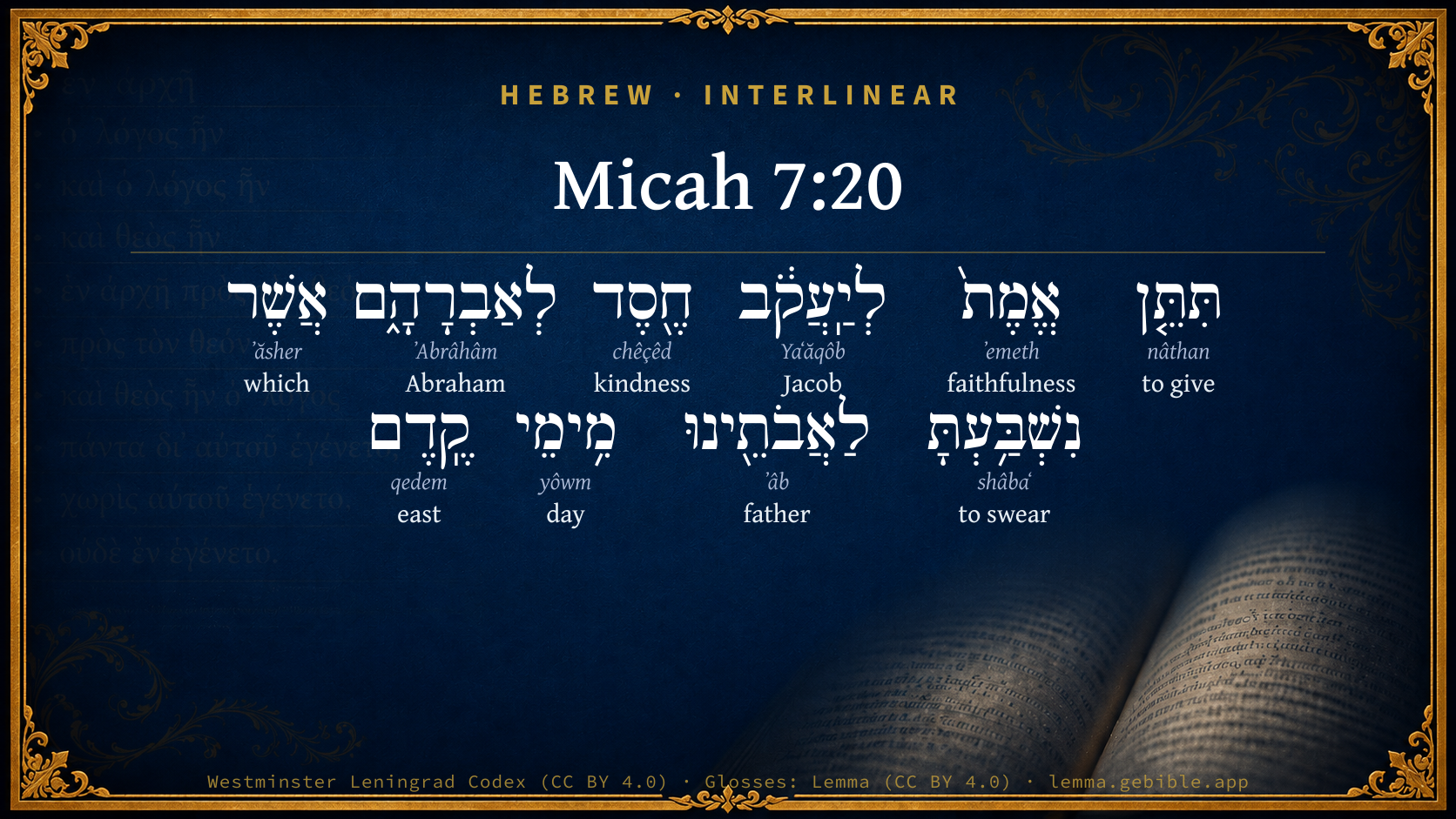
קֶֽדֶם
qedem
H6924
“east”
Noun, Common, Masculine, Singular, Absolute
Part of Speech
Noun
Type
Common
Gender
Masculine
Number
Singular
State
Absolute
Full BDB Definition

Origin: from H6923

TWOT: 1988a

east, antiquity, front, that which is before, aforetime (noun masculine) - front, from the front or east, in front, mount of the East - ancient time, aforetime, ancient, from of old, earliest time - anciently, of old (adverb) - beginning - east - eastward, to or toward the East (adverb)
  1. תִּתֵּ֤ן nâthan H5414 “to give” Verb, Qal, Imperfect, 2nd Person, Masculine, Singular
  2. אֱמֶת֙ ʼemeth H571 “faithfulness” Noun, Common, Feminine, Singular, Absolute
  3. לְיַֽעֲקֹ֔ב Yaʻăqôb H3290 “to/for · Jacob” Preposition + Noun, Proper
  4. חֶ֖סֶד chêçêd H2617 “kindness” Noun, Common, Masculine, Singular, Absolute
  5. לְאַבְרָהָ֑ם ʼAbrâhâm H85 “to/for · Abraham” Preposition + Noun, Proper
  6. אֲשֶׁר ʼăsher H834 “which” Particle, Relative
  7. נִשְׁבַּ֥עְתָּ shâbaʻ H7650 “to swear” Verb, Niphal, Perfect, 2nd Person, Masculine, Singular
  8. לַאֲבֹתֵ֖ינוּ ʼâb H1 “to/for · fathers · our” Preposition + Noun, Common, Masculine, Plural, Construct + Suffix, Personal, 1st Person, Common, Plural
  9. מִ֥ימֵי yôwm H3117 “from · days of” Preposition + Noun, Common, Masculine, Plural, Construct

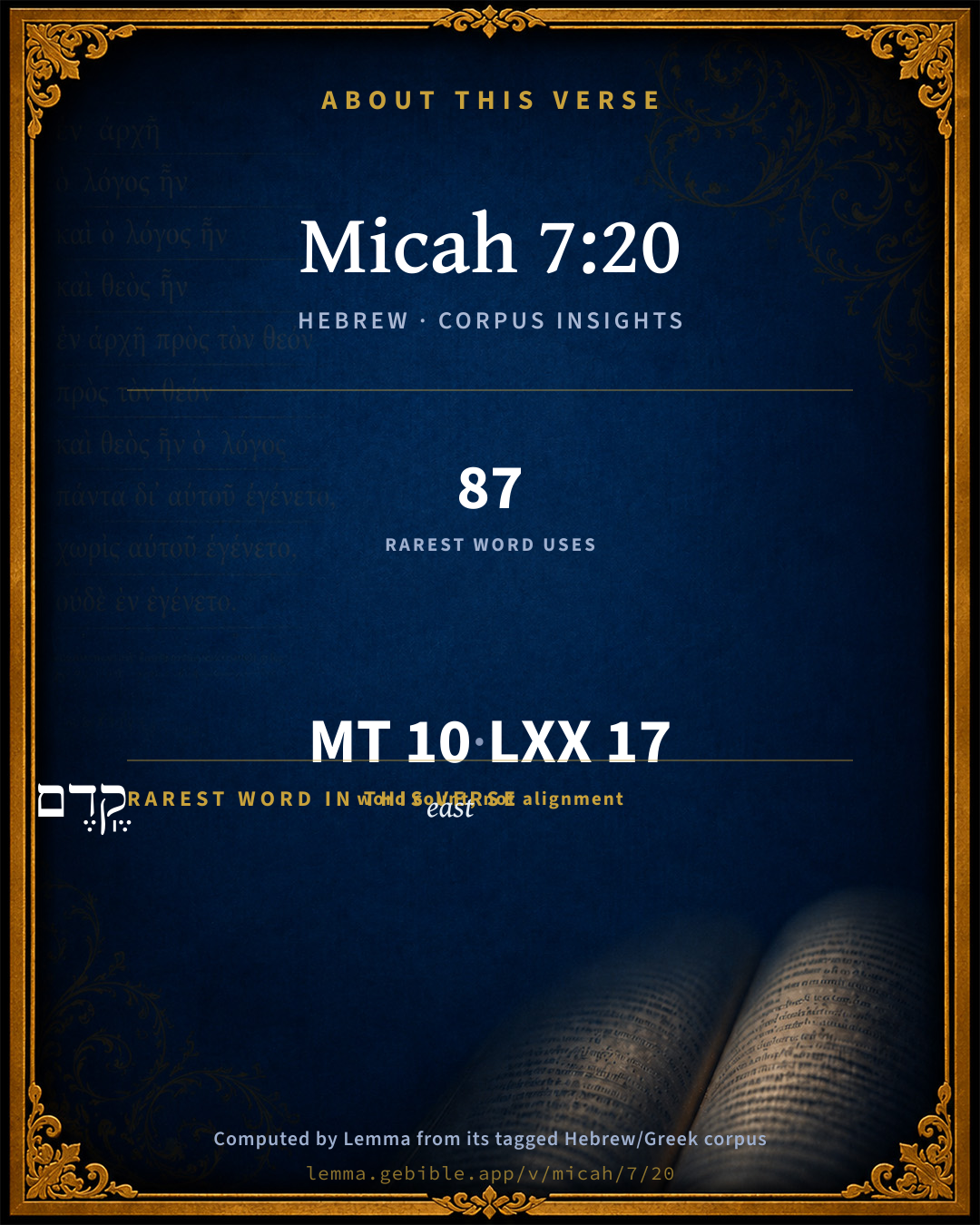
About this verse

These counts appear in no published source. They are computed here, from the morphology-tagged text and Lemma’s own curated glosses. What Lemma adds →

10
words
10
distinct lemmas
Prophets
section

Grammatical profile

  • 2 verbs
  • 7 nouns
  • 1 particle

Verb forms

  • תִּתֵּ֤ן Qal · Imperfect
  • נִשְׁבַּ֥עְתָּ Niphal · Perfect

Hebrew & Septuagint length

In English translation the verse runs 22 words from the Hebrew and 22 from the Septuagint (LXX English) — the same length.

A rough comparison of the two English renderings, which tokenize alike — not a word-level alignment.

Word counts can differ between the Hebrew and the Greek without any difference in meaning — e.g. the Hebrew direct-object marker אֵת has no separate Greek word, and Greek often adds the article ὁ.

In the original languages it is 10 Hebrew tokens and 17 Greek tokens — but the two are counted differently (Hebrew bundles its prefixes and suffixes into one token; the Greek is in lemma form), so that isn’t a like-for-like length.

Cross-references

13

Topical passages linked to Micah 7:20 in the Treasury of Scripture Knowledge — connected by theme and wording, ordered by reader-vote popularity; previews shown in the World English Bible.

  • Genesis 28:13–14 Behold, Yahweh stood above it, and said, "I am Yahweh, the God of Abraham your father, and the God of Isaac. The land whereon you lie, to you will I give it, and to your seed.
  • Luke 1:72–74 To show mercy towards our fathers, To remember his holy covenant,
  • Genesis 12:2–3 I will make of you a great nation. I will bless you, and make your name great. You will be a blessing.
  • Genesis 17:7–8 I will establish my covenant between me and you and your seed after you throughout their generations for an everlasting covenant, to be a God to you and to your seed after you.
  • Genesis 22:16–18 and said, "I have sworn by myself, says Yahweh, because you have done this thing, and have not withheld your son, your only son,
  • Genesis 26:3–4 Sojourn in this land, and I will be with you, and will bless you. For to you, and to your seed, I will give all these lands, and I will establish the oath which I swore to Abraham your father.
  • Deuteronomy 7:8 but because Yahweh loves you, and because he would keep the oath which he swore to your fathers, has Yahweh brought you out with a mighty hand, and redeemed you out of the house of bondage, from the hand of Pharaoh king of Egypt.
  • Psalms 105:8–10 He has remembered his covenant forever, The word which he commanded to a thousand generations,
  • Jeremiah 33:25–26 Thus says Yahweh: If my covenant of day and night fails, if I have not appointed the ordinances of heaven and earth;
  • Luke 1:54–55 He has given help to Israel, his servant, that he might remember mercy,
  • Acts 3:25–26 You are the children of the prophets, and of the covenant which God made with our fathers, saying to Abraham, 'In your seed will all the families of the earth be blessed.'
  • Hebrews 6:13–18 For when God made a promise to Abraham, since he could swear by none greater, he swore by himself,
  • Romans 11:26–31 and so all Israel will be saved. Even as it is written, "There will come out of Zion the Deliverer, And he will turn away ungodliness from Jacob.

Cross-references courtesy of OpenBible.info (CC BY 4.0).

Hebrew and Greek witnesses Masoretic Hebrew ↔ Greek Septuagint

The same verse in the two great witnesses to the Old Testament, shown verse-for-verse.

These are two independent witnesses, not word-aligned to each other, and the Septuagint is shown in lemma (dictionary) form.

Hebrew Micah 7:20 Masoretic · Westminster Leningrad Codex

תִּתֵּ֤ן אֱמֶת֙ לְיַֽעֲקֹ֔ב חֶ֖סֶד לְאַבְרָהָ֑ם אֲשֶׁר נִשְׁבַּ֥עְתָּ לַאֲבֹתֵ֖ינוּ מִ֥ימֵי קֶֽדֶם

You will give truth to Jacob, and mercy to Abraham, As you have sworn to our fathers from the days of old.

World English Bible · Public Domain

Greek LXX Micah 7:20 Septuagint · lemma form

δίδωμι ἀλήθεια ὁ ἰακώβ ἔλεος ὁ ἀβραάμ καθότι ὄμνυμι ὁ πατήρ ἐγώ κατά ὁ ἡμέρα ὁ ἔμπροσθεν

He shall give blessings truly to Jacob, and mercy to Abraam, as you swore to our fathers, according to the former days.

LXX2012 (modern English Septuagint) · Public Domain

Hebrew: Westminster Leningrad Codex (CC BY 4.0). Greek: Septuagint (public domain); English from LXX2012 (modern English Septuagint) (Public Domain). How the Septuagint differs from the Hebrew →

Targum (Aramaic paraphrase)

1

The Targum is the ancient Jewish Aramaic paraphrase of the Hebrew Scriptures — an interpretive translation, not the Hebrew text itself. Onkelos (literal) and Pseudo-Jonathan (expansive) render the Torah, and Jonathan the Prophets. Coverage is partial: where no permissively-licensed English translation exists for a verse, only the Aramaic is shown. This is verse-level text, not a word-by-word alignment to the Hebrew.

  1. Targum Jonathan Prophets (Joshua–Malachi)
    תִּתְיְהֵיב קוּשְׁטֵיהּ דְיַעֲקֹב לִבְנוֹהִי כְּמָא דְקַיֵמְתָּא לֵיהּ בְּבֵית אֵל טַבְוָת אַבְרָהָם לְזַרְעֵיהּ בַּתְרוֹהִי כְּמָא דְקַיֵמְתָּא לֵיהּ בֵּין בַּתְרַיָא תִּדְכַּר לָנָא עֲקֵידַת יִצְחָק דְאִתְעֲקֵד עַל גַבֵּי מַדְבְּחָא קֳדָמָךְ תַּעֲבֵיד עִמָנָא טַבְוָן דְקַיֵמְתָּא לְאַבְהָתָנָא מִיוֹמֵי קֶדֶם:

    (no public-domain English translation for this verse)

    Targum Jonathan — Aramaic: “Mikraot Gedolot” (public domain). English: “Sefaria Community Translation” (CC0 1.0 (public-domain dedication)); “London "Chaldee Paraphrase," 1871” (public domain). Text via Sefaria.

Commentary

Notes on Micah 7:20 from classic Christian and Jewish commentators (each source and its license shown beneath its notes). The classic Christian expositions comment on the surrounding passage and are grouped to its opening verse, so a note may address several verses; the Jewish commentaries on the Tanakh (Rashi and others) are per-verse, so they appear only where the commentator wrote on this verse.

Lemma curates 59 commentaries, every one of them public domain or Creative Commons licensed, each selected and text-cleaned for this edition rather than reprinted as found. About our sources →

Trapp's Complete Commentary

John Trapp

Mic 7:20 Thou wilt perform the truth to Jacob, [and] the mercy to Abraham, which thou hast sworn unto our fathers from the days of old.

Ver. 20. Thou wilt perform the truth to Jacob, and the mercy to Abraham] Heb. Thou wilt give; for all is of free gift. His love moved God to promise, his truth binds him to perform; 2Sa 7:18; 2Sa 7:21, "For thy word’s sake, and according to thine own heart, hast thou done all these things." Having made himself a voluntary debtor to his people, he will come off fairly with them; and not be worse than his word, but better. Hence, Rev 10:1, Christ is said to have a rainbow upon his head; to show that he is faithful and constant in his promises, and that tempests should blow over, the sky be cleared. "For this is as the waters of Noah unto me," saith the Lord: "for as I have sworn that the waters of Noah should no more go over the earth; so have I sworn that I would not be wroth with thee, nor rebuke thee. For the mountains shall depart," &c., Isa 54:9-10. God hath hitherto kept promise, with nights and days, Jer 33:20; Jer 33:25, that one shall succeed the other; therefore much more will he keep promise with his people.

Which thou hast sworn unto our fathers] And, in them, to us, by virtue of the covenant. So he spake with us, when he spake with Jacob at Bethel, Hos 12:4; and that the promises sworn to the fathers of the Old Testament belong also to us of the New, see Luk 1:55; Luk 1:73-74. Now, that God swore at any time to them, or us, he did it for our sakes doubtless; "that by two immutable things, in which it was impossible for God to lie, we might have a strong consolation, who have fled for refuge to lay hold upon the hope set before us," Heb 6:17-18. {See Trapp on "Heb 6:17"} {See Trapp on "Heb 6:18"}

Gloria Deo in excelsis.

John Trapp, A Commentary or Exposition upon All the Books of the Old and New Testament (1647–1656) — public domain. Text from a community e-Sword module.

Joseph Benson's Commentary

Mic 7:20. Thou wilt perform the truth to Jacob — Thou wilt perform to his posterity what thou didst promise to Jacob. And the mercy to Abraham — As the promises given to Abraham were made to him and to his seed after him, so the Scriptures speak of the blessings bestowed upon his children, as if they were actually made good to him their progenitor. Among the promises made to Abraham and the other patriarchs, one important one was, that their seed should possess the land of Canaan. This promise, with those of a spiritual nature, will receive its final accomplishment in the conversion and restoration of the Jewish nation in the latter times. That people are said to be beloved for their fathers’ sakes, Rom 11:28; and therefore we have reason to expect, that the mercies promised to their fathers will be made good to them, in God’s due time; for the gifts and callings of God are without repentance, Rom 11:29.

Joseph Benson's Commentary on the Old and New Testaments (1811–1818) — public domain. Text from a community e-Sword module.

Geneva Bible (1599)

Geneva Bible translators

The Church is assured, that God will declare in effect the truth of his merciful promise, which he had made of old to Abraham, and to all that should apprehend the promise by faith.

Geneva Bible (1599) marginal notes — public domain. Text via Bolls.life.

Jamieson, Fausset & Brown

Robert Jamieson, A. R. Fausset & David Brown

perform the truth--the faithful promise.

to Jacob . . . Abraham--Thou shalt make good to their posterity the promise made to the patriarchs. God's promises are called "mercy," because they flow slowly from grace; "truth," because they will be surely performed (Luk 1:72-73; Th1 5:24).

sworn unto our fathers-- (Psa 105:9-10). The promise to Abraham is in Gen 12:2; to Isaac, in Gen 26:24; to Jacob, in Gen 28:13. This unchangeable promise implied an engagement that the seed of the patriarchs should never perish, and should be restored to their inheritance as often as they turned wholly to God (Deu 30:1-2).

Next: Nahum Introduction

Jamieson, Fausset & Brown — Commentary Critical and Explanatory on the Whole Bible (1871) — public domain (CC PDM 1.0). Text via the HelloAO Bible API.

Adam Clarke's Commentary

Verse 20. Thou wilt perform the truth to Jacob] The promises which he has made to Jacob and his posterity. Not one of them can ever fall to the ground. "And the mercy to Abraham, which thou hast sworn;" viz., that "in his Seed all the families of the earth should be blessed;" that the Messiah should come from ABRAHAM, through his son ISAAC, by JACOB and DAVID; be a light to lighten the Gentiles, and the glory of his people Israel. And this promise, and this oath, God has most signally fulfilled by the incarnation of Christ, who was sent to bless us by turning away every one of us from his iniquities; and for this purpose he was delivered for our offenses, and rose again for our justification; and repentance and remission of sins are preached in his name to all nations. The proclamation was first made at Jerusalem; and that the prophet refers to this, is evident from the use made of these words by Zacharias, the father of John the Baptist, when, under the full afflatus of the Spirit of God, he quoted this prophecy of Micah, as fulfilled in the incarnation of Christ, Lu 1:72-73. The Chaldee paraphrases this last verse with spirit and propriety: "Thou wilt give the truth to Jacob his son, as thou hast promised by oath to him in Beth-el. And the mercy to Abraham and to his seed after him, as thou didst swear to him amidst the divisions. Thou wilt be mindful of us on account of the binding of Isaac, who was bound upon the altar before thee.

And thou wilt do us that good, which, from the most ancient days, thou hast promised to our fathers by an oath." Between the divisions, refers to the covenant made between God and Abraham, Ge 15:9-11; Ge 15:17-18. Well might the prophet exult in his challenge to earth and hell. WHO IS A GOD LIKE UNTO THEE! Hell is speechless, earth is dumb. Infidels dare not open their mouths!!! Hallelujah! מי אל כמוך mi El camocha! JESUS is the mighty God and Saviour, pardoning iniquity, transgression, and sin, and saving to the uttermost all that come unto God through him. Blessed be God! Reader, lay this to heart.

Adam Clarke's Commentary on the Bible (1810–1826) — public domain. Text from a community e-Sword/MySword module.

John Calvin's Commentaries

The faithful confirm here the former truth, that God had deposited his covenant with them, which could not be made void: and hence also shines forth more clearly what I have said before, that the faithful do not learn by their own understanding what sort of Being God is, but embrace the mercy which he offers in his own word. Except God then speaks, we cannot form in our own minds any idea of his grace but what is uncertain and vanishing; but when he declares that he will be merciful to us, then every doubt is removed. This is now the course which the Prophet pursues.

He says, Thou wilt give truth to Jacob, mercy to Abraham, which thou hast sworn to our fathers; as though he said, “We do not presumptuously invent any thing out of our own minds, but receive what thou hast once testified to us; for thy will has been made known to us in thy word: relying then on thy favor, we are persuaded as to thy gratuitous pardon, though we are in many respects guilty before thee.” We now then understand the design of the Prophet.

As to the words, it is not necessary to dwell on them, for we have elsewhere explained this form of speaking. There are here two expressions by which the Prophet characterizes the covenant of God. Truth is mentioned, and mercy is mentioned. With respect to order, the mercy of God precedes; for he is not induced otherwise to adopt us than through his goodness alone: but as God of his own will has with so great kindness received us, so he is true and faithful in his covenant. If then we desire to know the character of God’s covenant, by which he formerly chose the Jews, and at this day adopts us as his people, these two things must be understood, that God freely offers himself to us, and that he is constant and true, he repents not, as Paul says, as to his covenant: The gifts and calling of God, he says, are without repentance, (Romans 11:29;) and he refers to the covenant, by which God adopted the children of Abraham.

He says now, Thou wilt give, that is, show in reality; for this, to give, is, as it were, to exhibit in effect or really. Thou will then give, that is, openly show, that thou hast not been in vain so kind to us and ours, in receiving them into favor. How so? Because the effect of thy goodness and truth appears to us.

Thou hast then sworn to our fathers from the days of old. The faithful take for granted that God had promised to the fathers that his covenant would be perpetual; for he did not only say to Abraham, I will be thy God, but he also added, and of thy seed for ever. Since, then, the faithful knew that the covenant of God was to be perpetual and inviolable, and also knew that it was to be continued from the fathers to their children, and that it was once promulgated for this end, that the fathers might deliver it as by the hand to their children; they therefore doubted not but that it would be perpetual. How so? for thou hast sworn to our fathers; that is, they knew that God not only promised, but that having interposed an oath, by which God designed to confirm that covenant, he greatly honored it, that it might be unhesitatingly received by the chosen people. As then the faithful knew that God in a manner bound himself to them, they confidently solicited him, really to show himself to be such as he had declared he would be to his own elect.

John Calvin's Commentaries (1540-1563) — public domain. Text from the Calvin Translation Society English edition (1840s-50s) via the Christian Classics Ethereal Library (ccel.org). Calvin's coverage is partial (roughly two-thirds of the Bible); uncommented books and verses are honest gaps, never fabricated. The 19th-century editor's footnotes and remarks are omitted so the notes are faithfully Calvin's own voice.

Ellicott's Commentary for English Readers

(20) Thou wilt perform.—The closing words in the prophecy of Micah are gloriously taken up some centuries later by Zechariah: “As He spake by the mouth of His holy prophets, which have been since the world began: that we should be saved from our enemies, and from the hand of all that hate us, to perform the mercy promised to our fathers, and to remember His holy covenant, the oath which He sware to our father Abraham, that He would grant unto us, that we being delivered out of the hand of our enemies, might serve Him without fear, in holiness and righteousness before Him, all the days of our life” (Luk_1:54-55).

A Bible Commentary for English Readers, edited by Charles John Ellicott (1878–1897) — public domain. Text from a community e-Sword module.

The Cambridge Bible for Schools and Colleges

gen. ed. J. J. S. Perowne

20. Thou wilt perform the truth to Jacob …] For the saints of old still ‘live unto God’ (i.e. in the sight of God they are alive), and still take an interest in the affairs of their successors; comp. Jer_31:15, Luk_16:25-31, Joh_8:56, Rev_6:9-11. This was not only a popular belief at the Christian era (comp. Mat_27:47; Mat_27:49), but is endorsed by our Lord and by the New Testament writers. ‘Truth’ here means ‘faithfulness;’ the promises alluded to are such as Gen_22:16-18; Gen_28:13-14.

The Cambridge Bible for Schools and Colleges (gen. ed. J. J. S. Perowne; Cambridge University Press, 1878–1918) — public domain. Text from a community e-Sword module.

John Gill's Exposition

Thou wilt perform the truth to Jacob,.... That is, the promise made to Jacob, the Lord would faithfully perform and make good to his posterity, natural and spiritual, especially to those who are Israelites indeed;

and the mercy to Abraham; the gracious promises made to him, which sprung from mere grace and mercy; all respecting his natural and spiritual seed; and especially the promise of the coming of the Messiah, that seed of his in which all nations of the earth were to be blessed; and which is the eminent instance of the mercy and grace of God to Jews and Gentiles, that walk in the steps of Abraham; see Luk 1:68;

which thou hast sworn unto our fathers from the days of old; or the promises both of multiplying the seed of Abraham, and of giving them the land of Canaan, and of the Messiah springing from them, were confirmed by an oath, Gen 22:16. The Targum is,

"thou wilt give the truth of Jacob to his sons, as thou hast sworn to him in Bethel; the goodness of Abraham to his seed after him, as thou hast sworn to him between the pieces; thou wilt remember to us the binding of Isaac, who was bound upon the altar before thee; thou wilt do with us the good things which thou hast sworn to our fathers, from the days of old;''

which Kimchi interprets of the three fathers, Abraham, Isaac, and Jacob.

Next: Nahum Introduction

John Gill's Exposition of the Whole Bible (1746–1763) — public domain (CC PDM 1.0). Text via the HelloAO Bible API.

Albert Barnes' Notes on the Bible

Thou wilt perform the truth to Jacob and the mercy to Abraham - What was free mercy to Abraham, became, when God had once promised it, His truth. Abraham also stands for all those, who in him and his Seed should be blessed, those who were “aliens from the commonwealth of Israel, and strangers from the covenants of promise, having no hope, and without God in the world” Eph 2:12, in no covenant or relation with God, as well as those who were the children of the faith; pagan, as well as Jews. Jacob represents these who were immediately his children, such of the children of Israel, as were also the true Israel and children of faithful Abraham. In both ways the gift to Abraham was mercy, to Jacob, truth. So also Paul saith, “Jesus Christ was a Minister of the circumcision for the truth of God, to confirm the promises made to the fathers, and that the Gentiles might glorify God for His mercy.” Rom 15:8-9 yet mercy and truth Psa 25:10, together, are all the paths of the Lord; they “met together” Psa 85:10 in Christ; yea Christ Himself is full of Mercy as well as “Truth” Joh 1:14 : and woe were it to that soul to whom He were Truth without mercy. Rup.: “For to be saved, we look not so much to the truth of the Judge as to the mercy of the Redeemer.” And mercy, in the counsel of God, reacheth wider than truth; for truth is given to Jacob, the father of one nation, Israel; but mercy to Abraham, “the father of many nations” Gen 17:5; Rom 4:17. Isaac, it may be, is not here mentioned, because all to whom the blessing should come are already spoken of in Jacob and Abraham; in Jacob, all to whom the promise was first made; in Abraham, all nations of the world who should be blessed in his Seed, through the mercy of God overflowing the bounds of that covenant. Isaac is, in his sacrifice, chiefly a type of our Lord Himself.

Which Thou hast sworn unto our fathers - “That by two immutable things, in which it was impossible for God to lie, we might have a strong consolation” Heb 6:18.

From the days of old - Alb.: From eternity, in the counsel of God; in promise, from the foundation of the world, as is said in the hymn of Zacharias, “As He spake by the mouth of His holy prophets, which have been since the world began” Luk 1:70. Pococke: The inspired hymns of the Blessed Virgin Mary and of Zachariah take up the words of the prophet, and shew that they are already fulfilled in Christ, although they shall be more and more fulfilled unto the world’s end, as Jew and Gentile are brought into His fold; “He remembering His mercy, as He spake to our fathers, to Abraham and to his seed forever” Luk 1:54-55. “To perform the mercy promised to our fathers, and to remnember His holy covenant, the oath which He sware to our father Abraham that He would grant unto us” Luk 1:72-74.

“I too,” Jerome subjoins, “sealing the labor of my little work by calling upon the Lord, will say at the close of this tract, O God, who is like unto Thee? Take away the iniquity of Thy servant, pass by the sin of my decayed soul, and send not Thine anger upon me, nor rebuke me in Thy indignation; for Thou art full of pity and great are Thy mercies. Rcturn and have mercy upon me; drown mine iniquities, and cast them into the depth of the sea, that the bitterness of sin may perish in the bitter waters. Grant the truth which Thou didst promise to Thy servant Jacob, and the mercy which Thou didst pledge to Abraham Thy friend, and free my soul, as Thou didst sware to my fathers in the days of old; “As I live, saith the Lord God, I have no pleasure in the death of the wicked, but that the wicked turn from his way and live. Then shall mine enemy see and be crowned with confusion, who now saith unto me, where is now thy God?” Eze 33:11. Amen, Amen, O Good Lord Jesus.

Albert Barnes' Notes on the Bible (1834–1885) — public domain. Text from a community e-Sword/MySword module.

Haydock's Catholic Bible Commentary

Truth, performing what he had promised out of mercy to Abraham. (Worthington)

George Leo Haydock (1774–1849), Haydock's Catholic Family Bible and Commentary, 1859 edition — public domain. Excludes Psalms (Douay-Rheims chapter numbering differs from Protestant) and Deuterocanonical books (Catholic canon only).

Matthew Poole's English Annotations

Thou, O God of mercy, wisdom, power, and faithfulness, whoever are honoured with being thine instruments and servants in doing somewhat herein, the work is thine, thou wilt raise up a deliverer, Cyrus shall be thine anointed to do this great work.

Wilt perform, Heb. give, actually bestow what thou hast in mercy promised.

The truth; nothing so certain as the word of God, it is the truth by way of eminency, his promise is yea and amen.

To Jacob; the posterity of Jacob; he was that plain-hearted man who now gives name to all the upright and honest among his seed, which God will never finally cast off; though now carried captive, they shall be restored, rebuilt, and re-established, shall flourish, as Mic 7:10-12, and this as they are a type of a more gloriously redeemed people.

The mercy: it was mere grace in God to promise Abraham and his seed such excellent privileges, which Abraham’s natural seed did inherit; but both this seed and this mercy looked beyond the natural descendants of Abraham, and beyond their return to the land of Canaan whence they were carried. The mercy to Abraham was, that in his seed all nations should be blessed and holpen, Luk 1:51,55,68.

To Abraham; not only as father to Israel after the flesh, but to him as father of the faithful.

Which thou hast sworn; not that there was on God’s part any need of such confirmation, but that on our part all doubt might be removed, and we by the immutable things of God might have strong consolation, as Heb 6:18.

Unto our fathers; because this mercy was frequently repeated in the promises to the fathers after Abraham’s time, by which promises a mercy to be perpetuated in Abraham’s seed, till the redemption of the Israel of God by the Messiah, (of which all temporal deliverances of Israel were figures,) should be effected. From the days of old; ever since Abraham’s days, and God’s gracious adopting his seed to be the peculiar people of God: into this we do, as Israel did, resolve our assurance of final deliverance. Amen.

Matthew Poole's English Annotations on the Holy Bible (1683–1685) — public domain. Text from a community e-Sword/MySword module.

The Pulpit Commentary

Thou wilt perform (literally, give) the truth to Jacob, and the mercy to Abraham. Jacob and Abraham are mentioned as the chiefs and representatives of the chosen family; and "the truth" (i.e. God"s faithfulness to his promises) and "mercy" are equally given to both, separately assigned only for the sake of the parallelism. Knabenbaner compares such passages as Psa_114:1, "When Israel went forth out of Egypt, the house of Jacob from a people of strange language". (Isa_41:8 Isa_63:16, etc.) The general meaning, therefore, is that God will perform the promises made to the forefathers, as Luk_1:72, etc. Hast sworn, as in Gen_22:16. etc.; Gen_28:13, etc.; Deu_7:12. With the close of the ode Hengstenberg compares Rom_11:33-36. Thus the checkered prophecy ends with the glow of faith and happy hope.

The Divine promises and their fulfilment.

These words bear upon them the impress of deep human experience. They form the crowning testimony of a man who had long proved the reality of that which they affirm. In closing his book of prophecy he would, with all his heart and soul, affix his seal to the bright declaration that God is ever faithful and true. Jehovah was to him a living reality, the centre of his affections and the strength of his heart. "He endured as seeing him who is invisible." And Divine, indeed, is that trust in the eternal Lord which fires the soul and nerves it for entering into "the holy war;" which stands the warrior in good stead, and proves invulnerable whilst he engages in the strife; and which also, when the good soldier, having fought well and grown grey in the service, begins to lay aside his armour and quietly to await the summons to the presence and joy of the Lord he has served, proves his consolation and support. Micah doubtless had in mind the rich promises given by God, first to Abraham, and then reiterated to Jacob, that they should be blessed and multiplied, and that through their line lasting blessings should flow to all the families of the earth. (Gen_22:16-18 Gen_28:13, Gen_28:14) Notice

I HE REPRESENTS THE DIVINE PROMISES AS CHARACTERIZED BY "MERCY" AND "TRUTH." "The truth to Jacob, and the mercy to Abraham" (ver. 20). The expression is, at first sight, rather peculiar; yet it may easily be explained. By "mercy" we understand favour shown to the undeserving. Grand hero as Abraham was, there was nothing in him to merit such distinguishing honour as was conferred upon him. The choice was altogether traceable to the abounding mercy and grace of God. So also with Jacob, who, at the outset of his career, was about as unlovely as man could well be. Then why, it may be asked, the change in the form of expression? Why not "the mercy to Abraham" and the mercy to Jacob"? Why "the mercy to Abraham and the "truth to Jacob"? Simply to introduce the additional thought of "truth." "Truth" here means the bringing into clearer light that which had been partially hinted at. "What was free mercy to Abraham became, when God had once promised it, his truth" (Pusey). And his revelation of truth became clearer and brighter, until at length he appeared in whom both "grace and truth" came in their unveiled clearness and their unrestricted fulness.

II HE TRACES THESE DIVINE PROMISES AS HAVING THEIR SOURCE AND SPRING IN THE ETERNAL LOVE OF GOD." From the days of old" i.e. from eternity, God has cherished the loving purpose of enriching us thus. It is not "a modern project, but an ancient charter.

III HE REJOICES IN THE ASSURANCE THAT THESE DIVINE PROMISES SHALL BE UNDOUBTEDLY FULFILLED. "Thou wilt perform," etc. This assurance rested on the Divine pledge ("which thou hast sworn unto our fathers"), and which the faithful Promiser is both able and willing to redeem. "He cannot deny himself". (2Ti_2:13) In building the temple of Solomon two pillars were set up in the porch of the edifice the left one being called Boaz, i.e. "In God is strength;" and the other on the right being named Jachin, i.e. "He will establish thus beautifully associating together the thoughts of God"s ability and his willing resolve to bless. Let these thoughts dwell in our minds respecting him, for on these pillars our faith and hope may ever securely rest.

The Pulpit Commentary (1880–1919), ed. H.D.M. Spence-Jones & Joseph S. Exell — public domain. Text from a community e-Sword module.

Rashi

Rabbi Shlomo Yitzchaki (Rashi)

You shall give the truth of Jacob—Jonathan paraphrases: You shall give the truth of Jacob to his sons, as You swore to him in Bethel; the loving-kindness of Abraham to his seed after him, as you swore to him ‘between the parts.’ You shall remember for us the binding of Isaac, etc. Give us the truth that You promised Jacob. Cause to come true Your word that You promised Jacob (Gen. 28: 15): “For I will not forsake you.”

the loving-kindness of Abraham The reward for the loving- kindness of Abraham, [out of] which he commanded his sons to keep the way of the Lord: to perform righteousness and justice. Therefore, it does not say, “And the loving-kindness,” but “the loving- kindness.” The truth - that you will make come true the promise to Jacob - that will be the payment of the reward for Abraham’s loving-kindness.

which you swore—at the binding of Isaac, (Gen 22:16) “I swore by Myself, says the Lord, that because you did this thing, etc.”

Rashi on the Tanakh — English translations: “The Judaica Press complete Tanach with Rashi, translated by A. J. Rosenberg” (CC BY 4.0); “Pentateuch with Rashi's commentary by M. Rosenbaum and A.M. Silbermann, 1929-1934” (public domain); “The Metsudah Tanach series, Lakewood, N.J” (CC BY 4.0); and “The Book of Joshua, Metsudah Publications, 1997” (CC BY 4.0). Text via Sefaria.

Lesson kit

Teaching starters — assembled from the data on this page, not authored interpretation. Every prompt links to the verse data it draws on. Edit before teaching.

Micah, in the Prophets, opens this verse with 10 words (10 distinct Hebrew lemmas). Its most distinctive word is qedem (“east”). A historical commentator’s framing appears above. Read the whole chapter for the surrounding context.

Discussion questions

  1. How does “east” (qedem) shape what this verse is saying?
  2. How does Genesis 28:13–14, which shares this passage’s theme, read alongside this verse?
  3. These translations render this verse differently. What is at stake in choosing one wording over another?
  4. «תִּתֵּ֤ן» is a Qal Imperfect verb. How does that grammatical form shape the action described?
  5. Compare how Trapp's Complete Commentary and Joseph Benson's Commentary read this verse. Where do they agree or differ?

Things to notice

Reading settings

Reading text

Shown beneath each verse's original-language words.

Old Testament
Old Testament edition

Read the OT as the Masoretic Hebrew (MT) or the Greek Septuagint (LXX).

English shown for the Greek Septuagint (in the Hebrew ↔ Greek comparison).

Comparing translations? Open the Compare panel on any verse page to stack up to four side by side.