
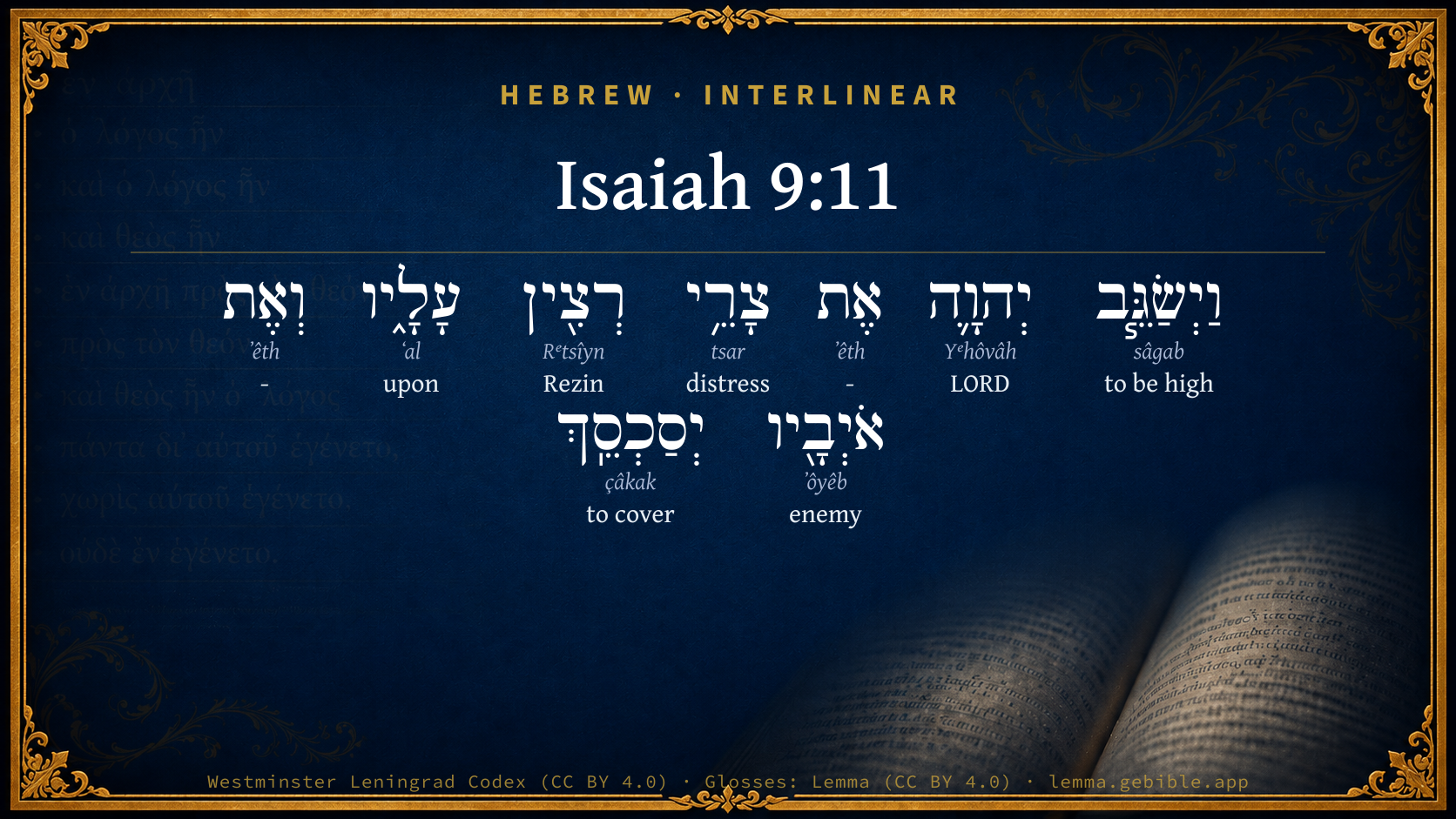
Isaiah 9:11

Hebrew (Westminster Leningrad Codex) Isaiah 9:11 appears in the Hebrew Old Testament. The text above is from the Westminster Leningrad Codex. Each word links to its Strong’s number, a concise gloss, and parsing drawn from the Open Scriptures Hebrew Bible morphology. Click any word for its full Brown-Driver-Briggs (BDB) entry.
Download image
Cite this verse

Isaiah 9:11 (World English Bible). Public Domain. Lemma interlinear Bible study tool, https://lemma.gebible.app/v/isaiah/9/11.

Show BibTeX & RIS
BibTeX
RIS
English Translation
Therefore Yahweh will set up on high against him the adversaries of Rezin, and will stir up his enemies,
World English Bible · Public Domain
Download a study sheet

One document with this verse’s original text, its word-by-word gloss line, the meaning frame, cross-references with their text, attributed commentary, and full source and license credits — printable, and it pastes into notes with its structure intact.

This verse Autodidact and up

Study sheet (.html) Plain text (.txt)

A passage Seminary Student

Up to 50 verses in one chapter. A passage sheet keeps up to 6 commentary sources and 12 cross-references per verse, in the order this page ranks them, and says so on the sheet whenever that leaves anything out. Ask for a single verse and you get the Autodidact verse sheet above.

Everything on this page stays free to read, with no account — the sheet is a download of what is already on screen, not access to it.

Want to remove ads? Support Godless Engineer
Compare translations 3

The same verse in 3 English versions, stacked beneath the original-language interlinear above. Click any original word for its lexicon entry.

Each is an independent rendering of the whole verse — the interlinear is not word-aligned to these translations.

Highlighted words mark where these versions differ — a whole-verse word diff, not a word-by-word alignment.

  • World English Bible Public Domain
    Therefore Yahweh will set up on high against him the adversaries of Rezin, and will stir up his enemies,
  • King James Version Public Domain
    Therefore the LORD shall set up the adversaries of Rezin against him, and join his enemies together;
  • unfoldingWord Literal Text CC BY-SA 4.0
    For Yahweh has raised up the adversaries of Rezin against him, and he has spurred on his enemies,

unfoldingWord Literal Text — © unfoldingWord, licensed CC BY-SA 4.0. Word-aligned USFM3 via Door43 (git.door43.org/unfoldingWord/en_ult).

Versions to compare (up to 4)

3 of 4 selected

Show all 18 translations

Every available English version of this verse, each an independent rendering of the whole verse.

  • World English Bible Public Domain
    Therefore Yahweh will set up on high against him the adversaries of Rezin, and will stir up his enemies,
  • Berean Standard Bible Public Domain
    The LORD has raised up the foes of Rezin against him and joined his enemies together.
  • Majority Standard Bible Public Domain
    The LORD has raised up the foes of Rezin against him and joined his enemies together.
  • King James Version Public Domain
    Therefore the LORD shall set up the adversaries of Rezin against him, and join his enemies together;
  • American Standard Version (1901) Public Domain
    Therefore Jehovah will set up on high against him the adversaries of Rezin, and will stir up his enemies,
  • Revised Version (1885) Public Domain
    Therefore the LORD shall set up on high against him the adversaries of Rezin, and shall stir up his enemies;
  • Geneva Bible (1599) Public Domain
    Neuerthelesse the Lord will raise vp the aduersaries of Rezin against him, and ioyne his enemies together.
  • Douay-Rheims (1899) Public Domain
    And the Lord shall set up the enemies of Rasin over him, and shall bring on his enemies in a crowd:
  • Young's Literal Translation Public Domain
    And Jehovah setteth the adversaries of Rezin on high above him, And his enemies he joineth together,
  • Literal Standard Version CC BY-SA 4.0
    And YHWH sets the adversaries of Rezin on high above him, || And he joins his enemies together,
  • Unlocked Literal Bible CC BY-SA 4.0
    Therefore Yahweh will raise up against him Rezin, his adversary, and will stir up his enemies,
  • unfoldingWord Literal Text CC BY-SA 4.0
    For Yahweh has raised up the adversaries of Rezin against him, and he has spurred on his enemies,
  • Darby Bible Public Domain
    And Jehovah will set up the adversaries of Rezin against him, and arm his enemies,
  • World Messianic Bible Public Domain
    Therefore the LORD will set up on high against him the adversaries of Rezin, and will stir up his enemies,
  • Webster's Bible Public Domain
    Therefore the LORD will set up the adversaries of Rezin against him, and join his enemies together;
  • Free Bible Version CC BY-SA 4.0
    But the Lord has strengthened Rezin's enemies against Israel and has encouraged them.
  • Bible in Basic English Public Domain
    For this cause the Lord has made strong the haters of Israel, driving them on to make war against him;
  • JPS Tanakh (1917) Public Domain
    (9-10) Therefore the LORD doth set upon high the adversaries of Rezin against him, and spur his enemies;

Literal Standard Version (2020), Covenant Press — licensed CC BY-SA 4.0. Text via the HelloAO Bible API (eBible.org). Unlocked Literal Bible (unfoldingWord) — licensed CC BY-SA 4.0. Text via the HelloAO Bible API (eBible.org). unfoldingWord Literal Text — © unfoldingWord, licensed CC BY-SA 4.0. Word-aligned USFM3 via Door43 (git.door43.org/unfoldingWord/en_ult). Free Bible Version, Dr. Jonathan Gallagher — licensed CC BY-SA 4.0. Text via the HelloAO Bible API (eBible.org).

Word by word

More ways to search: Search by grammar → Find every occurrence → Compare this word →

Practice this passage: Drill this verse → Learn its vocabulary →

About this verse

These counts appear in no published source. They are computed here, from the morphology-tagged text and Lemma’s own curated glosses. What Lemma adds →

9
words
8
distinct lemmas
Prophets
section

Notable vocabulary

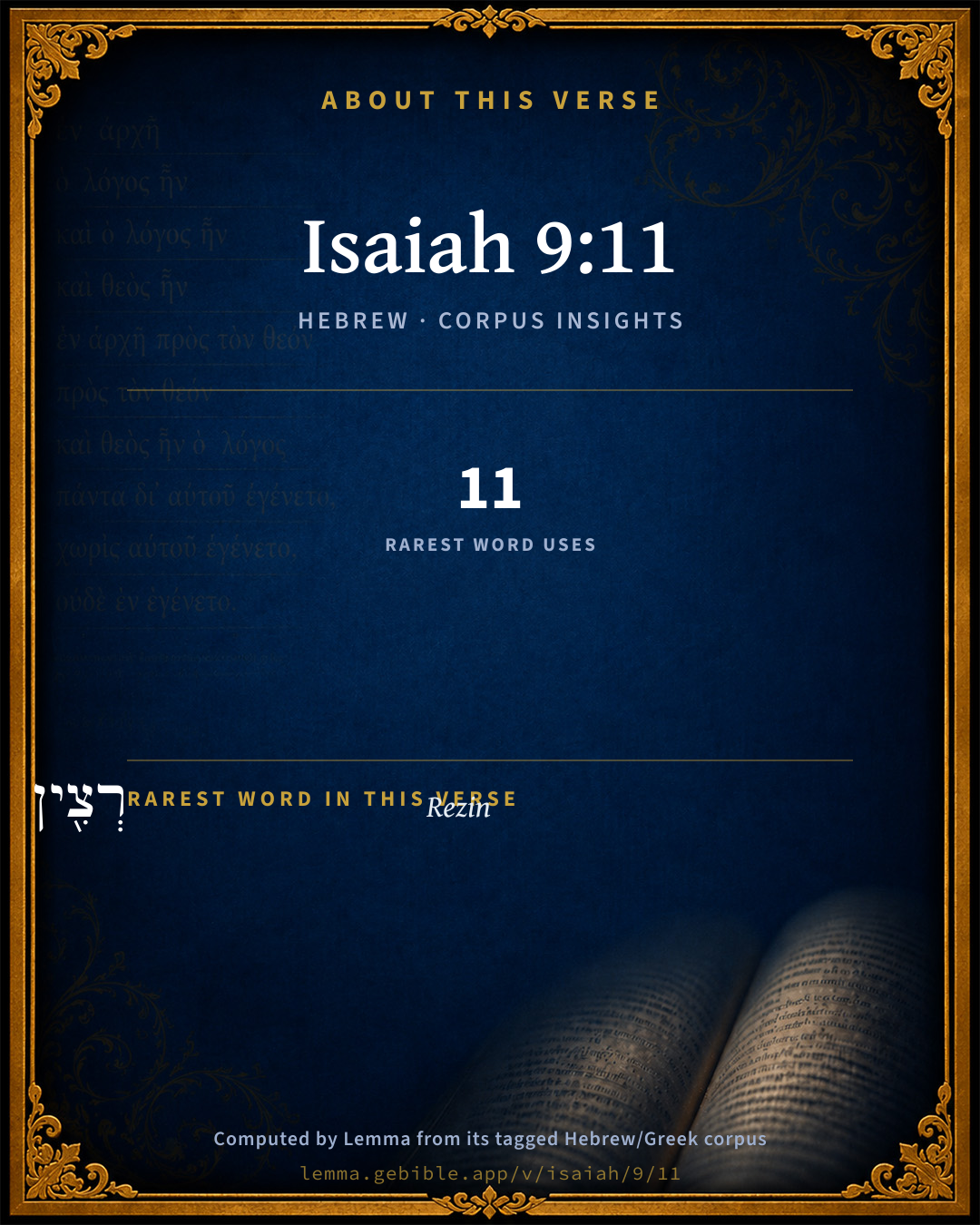
The rarest word here is רְצִ֖ין Rezin H7526 — appearing just 11 times in the whole Hebrew Bible.

Shared distinctive vocabulary

רְצִ֖ין Rezin H7526 occurs in 11 verses of the Hebrew Bible. Also found in:

Grammatical profile

  • 3 verbs
  • 3 nouns
  • 1 preposition
  • 2 particles

Verb forms

  • וַיְשַׂגֵּ֧ב Piel · Sequential Imperfect
  • אֹיְבָ֖יו Qal · Participle Active
  • יְסַכְסֵֽךְ Pilpel · Imperfect

Hebrew & Septuagint length

In English translation the verse runs 19 words from the Hebrew and 19 from the Septuagint (LXX English) — the same length.

A rough comparison of the two English renderings, which tokenize alike — not a word-level alignment.

Word counts can differ between the Hebrew and the Greek without any difference in meaning — e.g. the Hebrew direct-object marker אֵת has no separate Greek word, and Greek often adds the article ὁ.

Cross-references

6

Topical passages linked to Isaiah 9:11 in the Treasury of Scripture Knowledge — connected by theme and wording, ordered by reader-vote popularity; previews shown in the World English Bible.

  • 2 Kings 15:29 In the days of Pekah king of Israel came Tiglath Pileser king of Assyria, and took Ijon, and Abel Beth Maacah, and Janoah, and Kedesh, and Hazor, and Gilead, and Galilee, all the land of Naphtali; and he carried them captive to Assyria.
  • 2 Kings 16:9 The king of Assyria listened to him; and the king of Assyria went up against Damascus, and took it, and carried [the people of] it captive to Kir, and killed Rezin.
  • Isaiah 7:8 For the head of Syria is Damascus, and the head of Damascus is Rezin; and within sixty-five years Ephraim shall be broken in pieces, so that it shall not be a people;
  • Isaiah 8:4–7 For before the child shall have knowledge to cry, My father, and, My mother, the riches of Damascus and the spoil of Samaria shall be carried away before the king of Assyria.
  • Isaiah 10:9–11 Isn't Calno as Carchemish? Isn't Hamath as Arpad? Isn't Samaria as Damascus?
  • Isaiah 17:1–5 The burden of Damascus. Behold, Damascus is taken away from being a city, and it shall be a ruinous heap.

Cross-references courtesy of OpenBible.info (CC BY 4.0).

Hebrew and Greek witnesses Masoretic Hebrew ↔ Greek Septuagint

The same verse in the two great witnesses to the Old Testament, shown verse-for-verse.

These are two independent witnesses, not word-aligned to each other, and the Septuagint is shown in lemma (dictionary) form.

Hebrew Isaiah 9:11 Masoretic · Westminster Leningrad Codex

וַיְשַׂגֵּ֧ב יְהוָ֛ה אֶת צָרֵ֥י רְצִ֖ין עָלָ֑יו וְאֶת אֹיְבָ֖יו יְסַכְסֵֽךְ

Therefore Yahweh will set up on high against him the adversaries of Rezin, and will stir up his enemies,

World English Bible · Public Domain

Greek LXX Isaiah 9:11 Septuagint · lemma form

συρία ἀπό ἥλιος ἀνατολή καί ὁ ἕλλην ἀπό ἥλιος δυσμή ὁ καταἐσθίω ὁ ἰσραήλ ὅλος ὁ στόμα ἐπί οὗτος πᾶς οὐ ἀποστρέφω ὁ θυμός ἀλλά ἔτι ὁ χείρ ὑψηλός

And God shall dash down them that rise up against him on mount Sion, and shall scatter his enemies;

LXX2012 (modern English Septuagint) · Public Domain

On this verse, Adam Clarke's Commentary discusses the Septuagint’s reading. Read the note in Commentary ↓

Hebrew: Westminster Leningrad Codex (CC BY 4.0). Greek: Septuagint (public domain); English from LXX2012 (modern English Septuagint) (Public Domain). How the Septuagint differs from the Hebrew →

Targum (Aramaic paraphrase)

1

The Targum is the ancient Jewish Aramaic paraphrase of the Hebrew Scriptures — an interpretive translation, not the Hebrew text itself. Onkelos (literal) and Pseudo-Jonathan (expansive) render the Torah, and Jonathan the Prophets. Coverage is partial: where no permissively-licensed English translation exists for a verse, only the Aramaic is shown. This is verse-level text, not a word-by-word alignment to the Hebrew.

  1. Targum Jonathan Prophets (Joshua–Malachi)
    אֲרַם מִמַדִינְחָא וּפְלִשְׁתָּאֵי מִמַעֲרָבָא וּבְזוֹ יַת נִכְסֵי יִשְׂרָאֵל בְּכָל אֲתָר בְּכָל דָא לָא תָבוּ מֵחוֹבֵיהוֹן דִתוּב רוּגְזֵיהּ מִנְהוֹן וְעַד כְּעַן מַתְקְפִין מַרְדֵיהוֹן וְעוֹד מָחָתֵיהּ עֲתִידָא לְאִתְפְּרַע מִנְהוֹן:

    The Syrians from the east, and the Philistines from the west; and they shall spoil the treasures of Israel in every place. For all this they do not turn away from their sins, that His anger might turn away from them; but still they hold fast their rebellion, and yet His stroke will be to take vengeance on them.

    Targum Jonathan — Aramaic: “Mikraot Gedolot” (public domain). English: “Sefaria Community Translation” (CC0 1.0 (public-domain dedication)); “London "Chaldee Paraphrase," 1871” (public domain). Text via Sefaria.

Commentary

Notes on Isaiah 9:11 from classic Christian and Jewish commentators (each source and its license shown beneath its notes). The classic Christian expositions comment on the surrounding passage and are grouped to its opening verse, so a note may address several verses; the Jewish commentaries on the Tanakh (Rashi and others) are per-verse, so they appear only where the commentator wrote on this verse.

Lemma curates 59 commentaries, every one of them public domain or Creative Commons licensed, each selected and text-cleaned for this edition rather than reprinted as found. About our sources →

Trapp's Complete Commentary

John Trapp

Isa 9:11 Therefore the LORD shall set up the adversaries of Rezin against him, and join his enemies together;

Ver. 11. Therefore the Lord shall set up the adversaries of Rezin.] In whom ye trust. He shall shortly be destroyed by the Assyrian, {2Ki 16:9} and then your hopes shall hop headless, and make you ashamed.

And join his enemies together.] Heb., Mingle them - viz., in confederacy and agreement against him, though otherwise at odds among themselves.

John Trapp, A Commentary or Exposition upon All the Books of the Old and New Testament (1647–1656) — public domain. Text from a community e-Sword module.

The Biblical Illustrator

Joseph S. Exell

Isa_9:11

Therefore the Lord shall set up the adversaries of Rezin against him

Oppositions

The Lord shall set up the adversaries.

This accounts for many oppositions which otherwise would be without explanation. We wonder why such and such people should be opposed to us. Ask them questions about this opposition, and they will confess themselves bewildered; they daily look round for causes, and find none; yet they say they cannot restrain the dislike, and they must force it into forms of opposition about whose urgency and determinateness there can be no mistake. How is all this? Is it not the Lord reigning even here? God means to chasten us, to make us feel that there are other people in the world beside ourselves, and that we have no right to all the room, and no claim that can be maintained to all the property. Thus we teach one another by sometimes opposing one another. We are brought to chastening and sobriety and refinement by attritions and oppositions that are, from a human point of view, utterly unaccountable. The Bible never hesitates to trace the whole set and meaning of providence to the Lord Himself: He sends the plague, the pestilence, the darkness, all the flies and frogs that desolated old Egypt; He still is the Author of gale., and flood, and famine, and pestilence We have amused ourselves by deceiving ourselves, by discovering a thousand secondary causes, and seeking, piously or impiously, to relieve providence of the responsibility of the great epidemic. Within given limits all we say may be perfectly true; we are great in phenomena, we have a genius in the arrangement of detail; but, after all, above all, and beneath all, is the mysterious life, the omnipotence of God, the judgment between right and wrong that plays upon the universe as upon an obedient instrument,--now evoking from It black frowning thunder, and now making it tremble with music that children love, and that sweetest mothers want all their canes to hear. (J. Parker, D. D.)

The Biblical Illustrator, edited by Joseph S. Exell (c. 1880s–1900s) — public domain. Text from a community e-Sword module.

Tyndale Open Study Notes

Tyndale Open Resources

9:11 Rezin’s enemies were the Assyrians (7:4, 17; 8:4). Rezin was king of Syria (see ch 7).

Tyndale Open Study Notes — © Tyndale Open Resources, licensed CC BY-SA 4.0. Text via the HelloAO Bible API.

Geneva Bible (1599)

Geneva Bible translators

Rezin king of Syria, who was in league with Israel, was slain by the Assyrians, after whose death Aram, that is, the Syrians were against Israel, which on the other side were assailed by the Philistines.

Geneva Bible (1599) marginal notes — public domain. Text via Bolls.life.

Jamieson, Fausset & Brown

Robert Jamieson, A. R. Fausset & David Brown

adversaries of Rezin--the Assyrians, who shall first attack Damascus, shall next advance "against him" (Ephraim). This is the punishment of Ephraim's pride in making light (Isa 9:10) of the judgment already inflicted by God through Tiglath-pileser (Kg2 15:29). A second Assyrian invasion (see on Isa 7:1) shall follow. The reading "princes" for "adversaries" in uncalled for.

join--rather, "arm"; cover with armor [MAURER].

his--Rezin's.

Jamieson, Fausset & Brown — Commentary Critical and Explanatory on the Whole Bible (1871) — public domain (CC PDM 1.0). Text via the HelloAO Bible API.

Adam Clarke's Commentary

Verse 11. The adversaries of Rezin against him - "The princes of Retsin against him"] For צרי tsarey, enemies, Houbigant, by conjecture, reads שרי sarey, princes; which is confirmed by thirty of Kennicott's and De Rossi's MSS., (two ancient,) one of my own, ancient; and nine more have צ tsaddi, upon a rasure, and therefore had probably at first שרי sarey. The princes of Retsin, the late ally of Israel, that is, the Syrians, expressly named in the next verse, shall now be excited against Israel.

The Septuagint in this place give us another variation; for רצין Retsin, they read הר ציון har tsiyon, ορος σιων, Mount Sion, of which this may be the sense; but JEHOVAH shall set up the adversaries of Mount Sion against him, (i.e., against Israel,) and will strengthen his enemies together; the Syrians, the Philistines, who are called the adversaries of Mount Sion. See Simonis Lex. in voce סכך sachach.

Adam Clarke's Commentary on the Bible (1810–1826) — public domain. Text from a community e-Sword/MySword module.

Ellicott's Commentary for English Readers

(11) Therefore the Lord shall set up the adversaries . . .—The Hebrew tenses are in the past (has set up), but probably as representing the prophet’s visions of an accomplished future. The “adversaries” of the text can hardly be any other than the Assyrians; yet the context that follows clearly points to an attack on Ephraim in which the armies of Rezin were to be conspicuous. The natural explanation is that Syria, after the conquest by the Assyrian king (2Ki_16:9), was compelled to take part in a campaign against Samaria. The reading of the text may be retained with this explanation, and the sentence paraphrased thus, “Jehovah will stir up the adversaries of Rezin (the Assyrians who have conquered Syria) against him (Ephraim and the inhabitant of Samaria), and shall join his enemies against him, and those enemies shall include the very nations on whose support he had counted, the Syrians and the Philistines” (Psa_83:7-8). The latter people were, it is true, enemies to Judah (2Ch_28:18), but their hostilities extended to the northern kingdom also.

A Bible Commentary for English Readers, edited by Charles John Ellicott (1878–1897) — public domain. Text from a community e-Sword module.

The Cambridge Bible for Schools and Colleges

gen. ed. J. J. S. Perowne

11. Therefore the Lord shall set up] Transl. And (so) Jehovah exalted. The adversaries of Rezin must, if the text be correct, denote the Assyrians. But this is not a natural designation (especially if the prophecy was written before the Syro-Ephraimitish coalition); and it is inconsistent with Isa_9:12, unless, indeed, we suppose that there Syrians are referred to as auxiliaries in the Assyrian army, which is extremely improbable. Several codd. read “princes of Rezin”; but this is hardly less objectionable. It seems necessary to delete “Rezin” as a gloss and read simply his (Israel’s) adversaries.

and join … together] Rather, and stirred up his enemies (frequentative impf.) cf. ch. Isa_19:2.

11, 12. The first blow of Jehovah’s hand—loss of territory.

The Cambridge Bible for Schools and Colleges (gen. ed. J. J. S. Perowne; Cambridge University Press, 1878–1918) — public domain. Text from a community e-Sword module.

John Gill's Exposition

Therefore the Lord shall set up the adversaries of Rezin against him,.... Set them up on high, as the word (a) signifies; exalt them above him, and make them superior to him, and conquerors of him, meaning the Assyrians; who, being sent for by Ahab, went up against Damascus, took it, and carried the people captive, and slew Rezin the king of Syria, the head of which was Damascus, Kg2 16:7 this is mentioned, because the Israelites put great trust and confidence in this prince, with whom they were in alliance; and this is said to abate their pride, arrogance, and haughtiness, before expressed:

and join his enemies together; or mix them; the Assyrian army, consisting of a mixture of various nations; or "stir" them "up", as the Targum; instigate them against him. Some understand the whole of Israel, against whom the adversaries of Rezin, namely, the Assyrians, would come, as they did, and invade their land, and carry them captive; with whom were various other people, as follows.

(a) "elevabit, sive extollet", Forerius.

John Gill's Exposition of the Whole Bible (1746–1763) — public domain (CC PDM 1.0). Text via the HelloAO Bible API.

Albert Barnes' Notes on the Bible

Therefore - This verse indicates the punishment that would come upon them for their pride.

The Lord shall set up - Hebrew, ‘Shall exalt.’ That is, they shall overcome and subdue him.

The adversaries of Rezin - King of Syria, Isa 7:1. It should be observed here, that twenty-one manuscripts, instead of adversaries, read princes of Rezin. The sense seems to require this; as in the following verse, it is said that the Syrians will be excited against them.

Against him - Against Ephraim.

And join his enemies together - Hebrew, ‘Mingle them together.’ They shall be excited into wild and agitated commotion, and shall pour down together on the land and devour it. In what way this would be done is specified in Isa 9:12.

Albert Barnes' Notes on the Bible (1834–1885) — public domain. Text from a community e-Sword/MySword module.

Haydock's Catholic Bible Commentary

Him. Israel. Salmanasar came to ruin the kingdom. (Calmet)

George Leo Haydock (1774–1849), Haydock's Catholic Family Bible and Commentary, 1859 edition — public domain. Excludes Psalms (Douay-Rheims chapter numbering differs from Protestant) and Deuterocanonical books (Catholic canon only).

Matthew Poole's English Annotations

Therefore; to chastise your pride, and defeat your hopes and resolutions.

Set up, Heb. exalt; advance their power, and give them success against him.

The adversaries of Rezin; the Assyrians, who, presently after this prophecy, fought and prevailed against him, 2Ki 16:7. He mentions Rezin, partly because he was confederate with Ephraim, and so his enemies were their enemies also, and partly because the Israelites trusted to his powerful assistance.

Against him; either,

1. Against Rezin last mentioned; or rather,

2. Against Ephraim or Israel, who may easily be understood either from the foregoing or following verse; for against them this prophecy is directed, and of them he speaks both in the next clause of this verse, and in the next verse; and it seems reasonable that him in this clause, and his in the next clause, should be understood of the same persons.

Join, Heb. mingle, i.e. unite them so that they shall agree together to fight against Israel, and shall invade him from several quarters.

His; not Rezin’s, but Ephraim’s, as appears from the next verse, which is added to explain this clause.

Matthew Poole's English Annotations on the Holy Bible (1683–1685) — public domain. Text from a community e-Sword/MySword module.

Whedon's Commentary on the Bible

Daniel D. Whedon

11. Therefore — A consequence fearful to Israel opens up.

The Lord shall set up — The expression means, Hath exalted against him.

Adversaries of Rezin — These were either the Assyrians, or the allied Syrians, (now subject to Assyria,) after the overthrow of Rezin their king.

Daniel D. Whedon (gen. ed.), Commentary on the Old and New Testaments (1874–1909) — public domain. Text from a community e-Sword module.

The Pulpit Commentary

Therefore the Lord shall set up the adversaries of Rezin against him. "Against him" means "against Ephraim," or the kingdom of Israel. "The adversaries of Rezin" could only be the Assyrians; but these seem precluded by the next verse, which mentions only "Syrians" and Philistines." Hence many critics accept the variant reading of several manuscripts sarey for tsarey which gives the sense of "the princes of Rezin" (so Lowth, Ewald, Houbigant, Weir, Cheyne).

The Pulpit Commentary (1880–1919), ed. H.D.M. Spence-Jones & Joseph S. Exell — public domain. Text from a community e-Sword module.

John Wesley's Explanatory Notes

Therefore - To chastise your pride, and defeat your hopes. Set up - The Assyrians, who, presently after this prophecy, prevailed against him, 2 Kings xvi, 7. He mentions Rezin, because he was confederate with Ephraim. Join - So that they shall invade him from several quarters. His - Not Rezin's, but Ephraim.

John Wesley, Explanatory Notes Upon the Whole Bible (1754–1765) — public domain. Text via the GEBible commentary corpus.

J. A. Alexander on Isaiah

Joseph Addison Alexander

Here begins a second stage in the progress of God’s judgments. He had sent a warning prophecy before (v. 8), and they had been taught its meaning by experience (v. 9), but without effect upon their proud self-confidence. “And (now) Jehovah raises up above him (i.e., Ephraim) the (victorious) enemies of Rezin (his late ally), and (besides these) he will instigate his own (accustomed) enemies (to wit, those mentioned in the next verse).” They who were to conquer Israel are called the enemies of Rezin, to remind the Israelites of their alliance with him, and to intimate that they who had so lately conquered Syria were soon to conquer Israel.

Joseph Addison Alexander, The Prophecies of Isaiah (1846–1847; New York: Scribner, 1870–1878) — public domain. Text from a community e-Sword module.

unfoldingWord translationNotes

Door43 World Missions Community

Therefore Yahweh will raise up against him Rezin, his adversary

Here "Rezin" represents himself and his army. AT: "Therefore, Yahweh will bring Rezin and his army against the people of Israel" (See: Synecdoche)

Rezin

This is the name of a man. See how you translated Rezin in Isaiah 7:1. (See: How to Translate Names)

will stir up his enemies

The phrase "stir up" is an idiom that means to incite them to attack. AT: "Yahweh will cause Israel's enemies to attack" (See: Idiom)

They will devour Israel with open mouth

"Devour" is how wild animals eat their prey. AT: "Like a wild beast eating its prey, the army of the enemy will destroy the people of Israel" (See: Metaphor)

In all these things, his anger does not subside; instead, his hand

"Even though all these things have happened, he is still angry, and his hand." See how you translated this in Isaiah 5:25.

his hand is still stretched out

Isaiah speaks as if Yahweh were a person about to hit another person with his fist. This is a metaphor for Yahweh punishing Israel. See how you translated this in Isaiah 5:25. AT: "he will still be ready to punish them" (See: Metaphor)

translationWords

Yahweh

adversary

Aram

Philistines

devour

Israel

anger

hand

unfoldingWord translationNotes — © Distant Shores Media and the Door43 World Missions Community, licensed CC BY-SA 4.0. Source: git.door43.org/Door43/en_tn.

Rashi

Rabbi Shlomo Yitzchaki (Rashi)

Aram from the east Aram harmed them from the east in the days of Jehoahaz and Joash, and the Philistines harmed them from the west, for the Philistines are west of them.

despite all this...and His hand is still outstretched until He brings Sennacherib upon them. Alternatively: Aram from the east and the Philistines from the west were wreaking destruction in Judah in the days of Ahaz, as is explained in Chronicles (II 28:18), and over Israel and Judah as well, Isaiah was lamenting because of these misfortunes.

Rashi on the Tanakh — English translations: “The Judaica Press complete Tanach with Rashi, translated by A. J. Rosenberg” (CC BY 4.0); “Pentateuch with Rashi's commentary by M. Rosenbaum and A.M. Silbermann, 1929-1934” (public domain); “The Metsudah Tanach series, Lakewood, N.J” (CC BY 4.0); and “The Book of Joshua, Metsudah Publications, 1997” (CC BY 4.0). Text via Sefaria.

Ibn Ezra

Rabbi Abraham ibn Ezra

The Syrians, etc. The Syrians in the east of Israel will join Assyria to do evil to Israel.

And the Philistines, etc. They are in the west of Palestine.

Ibn Ezra on the Tanakh — English translations: “Sefaria Community Translation” (CC0 1.0 (public-domain dedication)); “Yalkut, Sifsei Chachomim Chumash, Metsudah Publications, 2009” (CC BY 4.0); and “Commentary of Ibn Ezra on Isaiah - trans. by M. Friedlander, 1873” (public domain). Text via Sefaria.

Lesson kit

Teaching starters — assembled from the data on this page, not authored interpretation. Every prompt links to the verse data it draws on. Edit before teaching.

Isaiah, in the Prophets, opens this verse with 9 words (8 distinct Hebrew lemmas). Its most distinctive word is Rᵉtsîyn (“Rezin”). A historical commentator’s framing appears above. Read the whole chapter for the surrounding context.

Discussion questions

  1. How does “Rezin” (Rᵉtsîyn) shape what this verse is saying?
  2. 2 Kings 15:37 shares the word «Rezin» with this verse. How do the two illuminate each other?
  3. These translations render this verse differently; the difference is in the English rendering, not the original. What questions does that raise?
  4. The verb «וַיְשַׂגֵּ֧ב» is Piel Sequential Imperfect. How does its form color the action?
  5. Reading how Trapp's Complete Commentary and The Biblical Illustrator read this verse, where do the two commentators agree and where do they part?

Things to notice

Reading settings

Reading text

Shown beneath each verse's original-language words.

Old Testament
Old Testament edition

Read the OT as the Masoretic Hebrew (MT) or the Greek Septuagint (LXX).

English shown for the Greek Septuagint (in the Hebrew ↔ Greek comparison).

Comparing translations? Open the Compare panel on any verse page to stack up to four side by side.