Joshua 19:13

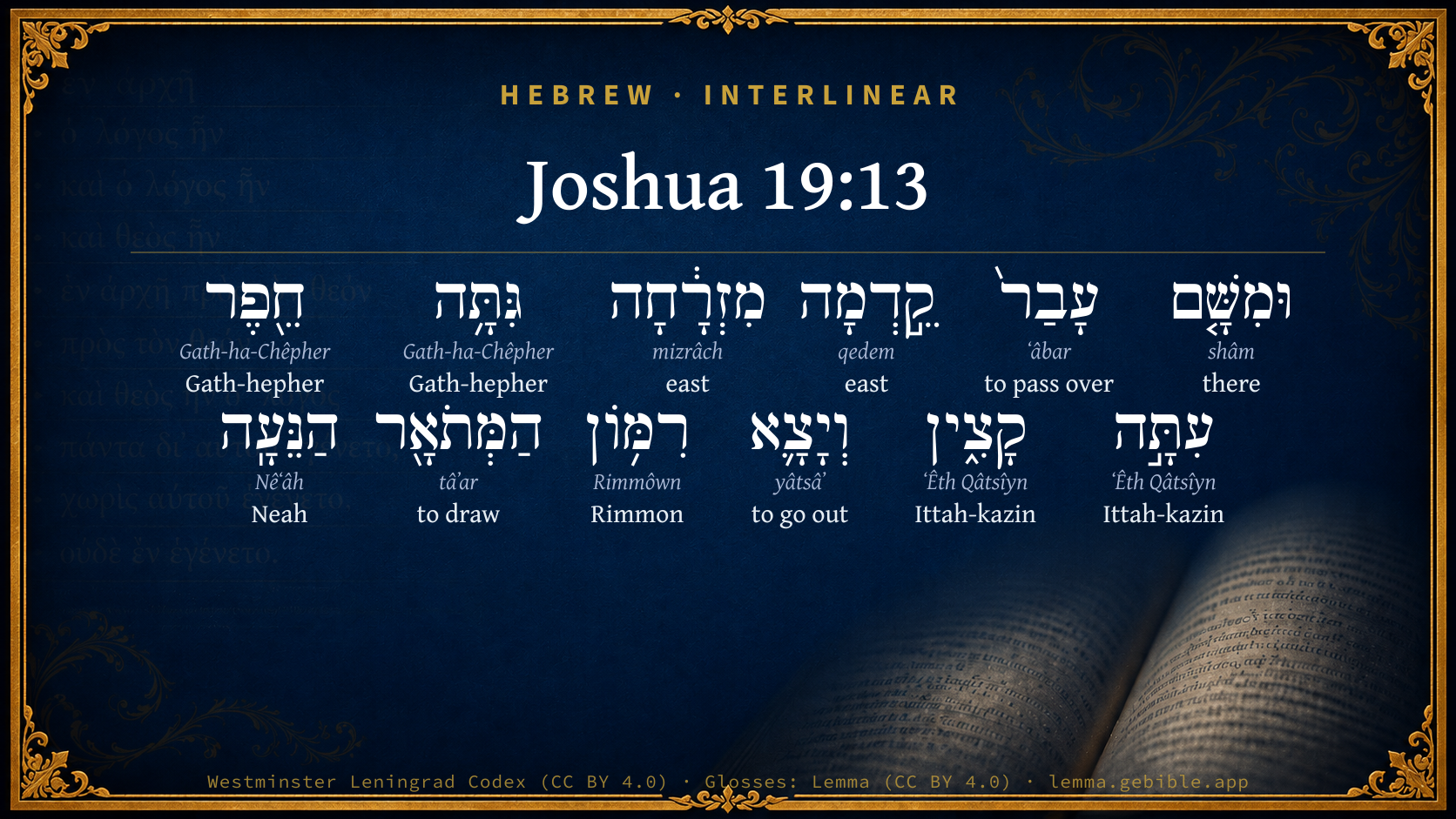
Hebrew (Westminster Leningrad Codex) Joshua 19:13 appears in the Hebrew Old Testament. The text above is from the Westminster Leningrad Codex. Each word links to its Strong’s number, a concise gloss, and parsing drawn from the Open Scriptures Hebrew Bible morphology. Click any word for its full Brown-Driver-Briggs (BDB) entry.
Download image
Cite this verse

Joshua 19:13 (World English Bible). Public Domain. Lemma interlinear Bible study tool, https://lemma.gebible.app/v/joshua/19/13.

Show BibTeX & RIS
BibTeX
RIS
English Translation
and from there it passed along eastward to Gath Hepher, to Eth-kazin; and it went out at Rimmon which stretches to Neah;
World English Bible · Public Domain
Highlights
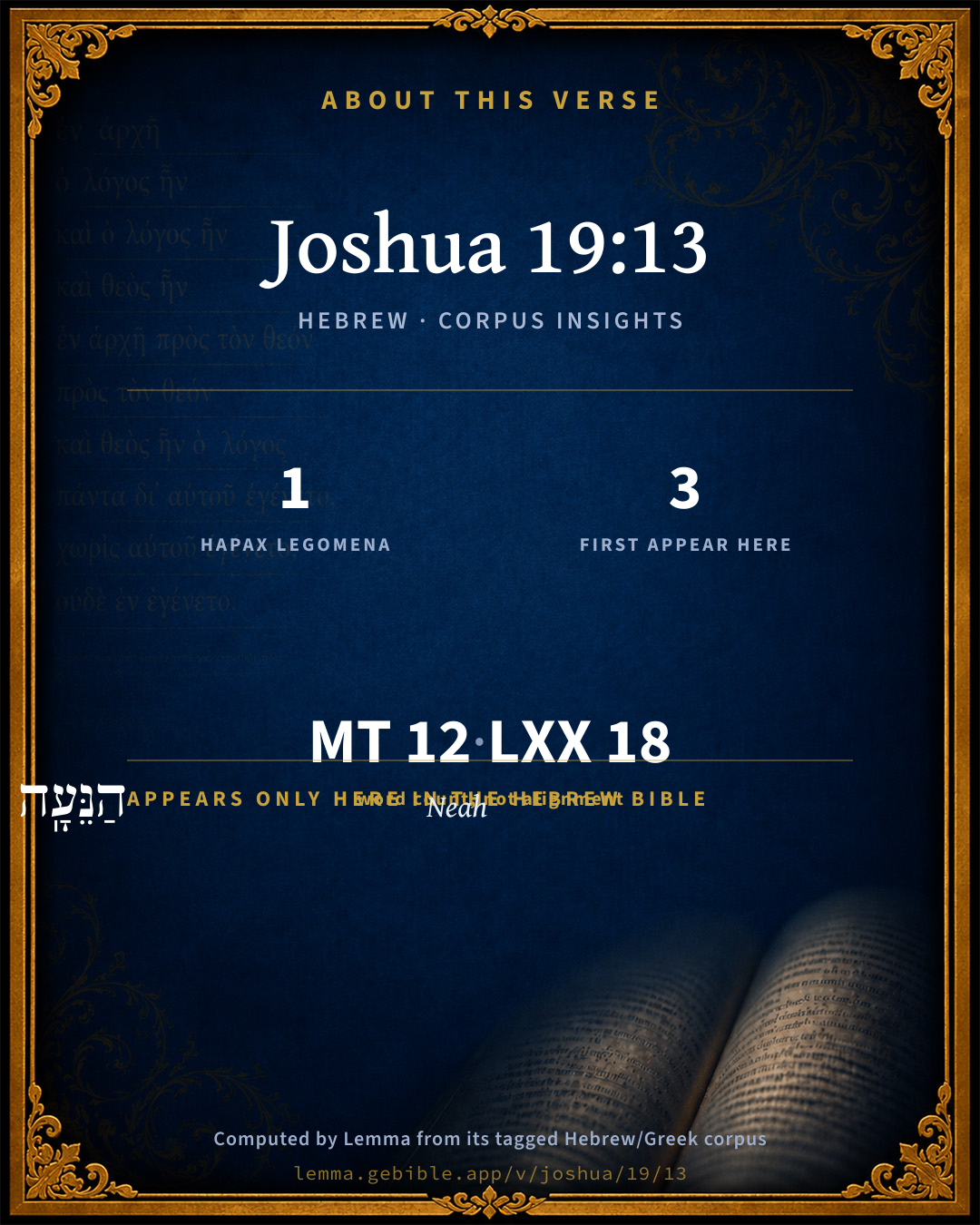
  • 1 hapax legomenon — only here in the Hebrew Bible
  • 3 first appearances in the Hebrew Bible
Full analysis ↓
Download a study sheet

One document with this verse’s original text, its word-by-word gloss line, the meaning frame, cross-references with their text, attributed commentary, and full source and license credits — printable, and it pastes into notes with its structure intact.

This verse Autodidact and up

Study sheet (.html) Plain text (.txt)

A passage Seminary Student

Up to 50 verses in one chapter. A passage sheet keeps up to 6 commentary sources and 12 cross-references per verse, in the order this page ranks them, and says so on the sheet whenever that leaves anything out. Ask for a single verse and you get the Autodidact verse sheet above.

Everything on this page stays free to read, with no account — the sheet is a download of what is already on screen, not access to it.

Want to remove ads? Support Godless Engineer
Compare translations 3

The same verse in 3 English versions, stacked beneath the original-language interlinear above. Click any original word for its lexicon entry.

Each is an independent rendering of the whole verse — the interlinear is not word-aligned to these translations.

Highlighted words mark where these versions differ — a whole-verse word diff, not a word-by-word alignment.

  • World English Bible Public Domain
    and from there it passed along eastward to Gath Hepher, to Eth-kazin; and it went out at Rimmon which stretches to Neah;
  • King James Version Public Domain
    And from thence passeth on along on the east to Gittahhepher, to Ittahkazin, and goeth out to Remmonmethoar to Neah;
  • unfoldingWord Literal Text CC BY-SA 4.0
    And from there it passed over eastward, toward the sunrise, Gath Hepher, Eth Kazin. And it went out Rimmon, being turned Neah.

unfoldingWord Literal Text — © unfoldingWord, licensed CC BY-SA 4.0. Word-aligned USFM3 via Door43 (git.door43.org/unfoldingWord/en_ult).

Versions to compare (up to 4)

3 of 4 selected

Show all 18 translations

Every available English version of this verse, each an independent rendering of the whole verse.

  • World English Bible Public Domain
    and from there it passed along eastward to Gath Hepher, to Eth-kazin; and it went out at Rimmon which stretches to Neah;
  • Berean Standard Bible Public Domain
    From there it crossed eastward to Gath-hepher and to Eth-kazin; it extended to Rimmon and curved around toward Neah.
  • Majority Standard Bible Public Domain
    From there it crossed eastward to Gath-hepher and to Eth-kazin; it extended to Rimmon and curved around toward Neah.
  • King James Version Public Domain
    And from thence passeth on along on the east to Gittahhepher, to Ittahkazin, and goeth out to Remmonmethoar to Neah;
  • American Standard Version (1901) Public Domain
    and from thence it passed along eastward to Gath-hepher, to Eth-kazin; and it went out at Rimmon which stretcheth unto Neah;
  • Revised Version (1885) Public Domain
    and from thence it passed along eastward to Gath-hepher, to Ethkazin; and it went out at Rimmon which stretcheth unto Neah;
  • Geneva Bible (1599) Public Domain
    And from thence goeth along Eastwarde towarde the sunne rising to Gittah-hepher to Ittah-kazin, and goeth foorth to Rimmon, and turneth to Neah.
  • Douay-Rheims (1899) Public Domain
    And it passeth along from thence to the east side of Gethhepher and Thacasin: and goeth out to Remmon, Amthar and Noa.
  • Young's Literal Translation Public Domain
    and thence it hath passed over eastward, to the east, to Gittah-Hepher, `to' Ittah-Kazin, and gone out `to' Rimmon-Methoar to Neah;
  • Literal Standard Version CC BY-SA 4.0
    and there it has passed over eastward, to the east, to Gittah-Hepher, [to] Ittah-Kazin, and gone out [to] Rimmon-Methoar to Neah;
  • Unlocked Literal Bible CC BY-SA 4.0
    From there it passed on eastward to Gath Hepher, and then to Eth Kazin; next it went to Rimmon and turned toward Neah.
  • unfoldingWord Literal Text CC BY-SA 4.0
    And from there it passed over eastward, toward the sunrise, Gath Hepher, Eth Kazin. And it went out Rimmon, being turned Neah.
  • Darby Bible Public Domain
    and from thence it passed eastward toward the sun-rising to Gath-Hepher, to Eth-kazin, and went out to Rimmon which reaches to Neah;
  • World Messianic Bible Public Domain
    From there it passed along eastward to Gath Hepher, to Ethkazin; and it went out at Rimmon which stretches to Neah.
  • Webster's Bible Public Domain
    And from thence passeth along on the east to Gittah-hepher, to Ittah-kazin, and goeth out to Remmon-methoar to Neah;
  • Free Bible Version CC BY-SA 4.0
    From there it ran east to Gath-hepher, Eth-kazin, and on to Rimmon, and turned towards Neah.
  • Bible in Basic English Public Domain
    And from there it goes on east to Gath-hepher, to Eth-kazin; ending at Rimmon which goes as far as Neah;
  • JPS Tanakh (1917) Public Domain
    And from thence it passed along eastward to Gath-hepher, to Ethkazin; and it went out at Rimmon-methoar unto Neah.

Literal Standard Version (2020), Covenant Press — licensed CC BY-SA 4.0. Text via the HelloAO Bible API (eBible.org). Unlocked Literal Bible (unfoldingWord) — licensed CC BY-SA 4.0. Text via the HelloAO Bible API (eBible.org). unfoldingWord Literal Text — © unfoldingWord, licensed CC BY-SA 4.0. Word-aligned USFM3 via Door43 (git.door43.org/unfoldingWord/en_ult). Free Bible Version, Dr. Jonathan Gallagher — licensed CC BY-SA 4.0. Text via the HelloAO Bible API (eBible.org).

Word by word

More ways to search: Search by grammar → Find every occurrence → Compare this word →

Practice this passage: Drill this verse → Learn its vocabulary →

הַנֵּעָֽה
Nêʻâh
H5269
“the · Neah”
Particle, Definite Article + Noun, Proper
Part of Speech
Particle + Noun
Type
Proper
Full BDB Definition

Origin: from H5128

TWOT: None

Neah = "shaking" - a boundary mark of the territory of Zebulun; site unknown
  1. וּמִשָּׁ֤ם shâm H8033 “and · from · there” Conjunction + Preposition + Adverb
  2. עָבַר֙ ʻâbar H5674 “to pass over” Verb, Qal, Perfect, 3rd Person, Masculine, Singular
  3. קֵ֣דְמָה qedem H6924 “east · toward” Noun, Common, Masculine, Singular, Absolute + Suffix, Demonstrative
  4. מִזְרָ֔חָה mizrâch H4217 “east · toward” Noun, Common, Masculine, Singular, Absolute + Suffix, Demonstrative
  5. גִּתָּ֥ה Gath-ha-Chêpher H1662 “Gath-hepher · toward” Noun, Proper + Suffix, Demonstrative
  6. חֵ֖פֶר Gath-ha-Chêpher H1662 “Gath-hepher” Noun, Proper
  7. עִתָּ֣ה ʻÊth Qâtsîyn H6278 “Ittah-kazin” Noun, Proper
  8. קָצִ֑ין ʻÊth Qâtsîyn H6278 “Ittah-kazin” Noun, Proper
  9. וְיָצָ֛א yâtsâʼ H3318 “and · to go out” Conjunction + Verb, Qal, Perfect, 3rd Person, Masculine, Singular
  10. רִמּ֥וֹן Rimmôwn H7417 “Rimmon” Noun, Proper
  11. הַמְּתֹאָ֖ר tâʼar H8388 “the · drawn” Particle, Definite Article + Verb, Pual, Participle Passive, Masculine, Singular, Absolute

About this verse

These counts appear in no published source. They are computed here, from the morphology-tagged text and Lemma’s own curated glosses. What Lemma adds →

12
words
10
distinct lemmas
Historical
section

Notable vocabulary

1 hapax legomenon — a word that appears only here in the entire Hebrew Bible:

  • הַנֵּעָֽה Neah H5269

First appearance in Scripture

These words make their first canonical appearance in the Hebrew Bible here:

  • גִּתָּ֥ה Gath-hepher H1662
  • עִתָּ֣ה Ittah-kazin H6278
  • הַנֵּעָֽה Neah H5269

Grammatical profile

  • 3 verbs
  • 8 nouns
  • 1 adverb

Verb forms

  • עָבַר֙ Qal · Perfect
  • וְיָצָ֛א Qal · Perfect
  • הַמְּתֹאָ֖ר Pual · Participle Passive

Repetition

Words recur within this verse — often emphatic in Hebrew:

  • גִּתָּ֥ה Gath-hepher H1662 ×2
  • עִתָּ֣ה Ittah-kazin H6278 ×2

Hebrew & Septuagint length

In English translation the verse runs 22 words from the Hebrew and 25 from the Septuagint (LXX English) — closely comparable.

A rough comparison of the two English renderings, which tokenize alike — not a word-level alignment.

Word counts can differ between the Hebrew and the Greek without any difference in meaning — e.g. the Hebrew direct-object marker אֵת has no separate Greek word, and Greek often adds the article ὁ.

In the original languages it is 12 Hebrew tokens and 18 Greek tokens — but the two are counted differently (Hebrew bundles its prefixes and suffixes into one token; the Greek is in lemma form), so that isn’t a like-for-like length.

Cross-references

1

Topical passages linked to Joshua 19:13 in the Treasury of Scripture Knowledge — connected by theme and wording, ordered by reader-vote popularity; previews shown in the World English Bible.

  • 2 Kings 14:25 He restored the border of Israel from the entrance of Hamath to the sea of the Arabah, according to the word of Yahweh, the God of Israel, which he spoke by his servant Jonah the son of Amittai, the prophet, who was of Gath Hepher.

Cross-references courtesy of OpenBible.info (CC BY 4.0).

Hebrew and Greek witnesses Masoretic Hebrew ↔ Greek Septuagint

The same verse in the two great witnesses to the Old Testament, shown verse-for-verse.

These are two independent witnesses, not word-aligned to each other, and the Septuagint is shown in lemma (dictionary) form.

Hebrew Joshua 19:13 Masoretic · Westminster Leningrad Codex

וּמִשָּׁ֤ם עָבַר֙ קֵ֣דְמָה מִזְרָ֔חָה גִּתָּ֥ה חֵ֖פֶר עִתָּ֣ה קָצִ֑ין וְיָצָ֛א רִמּ֥וֹן הַמְּתֹאָ֖ר הַנֵּעָֽה

and from there it passed along eastward to Gath Hepher, to Eth-kazin; and it went out at Rimmon which stretches to Neah;

World English Bible · Public Domain

Greek LXX Joshua 19:13 Septuagint · lemma form

καί ἐκεῖθεν περιἔρχομαι ἐκ ἐναντίος ἐπί ἀνατολή ἐπί γεβερε ἐπί πόλις κατασεμ καί διαἔρχομαι ἐπί ρεμμωνα αμαθαρ αοζα

And thence it shall come round in the opposite direction eastward to Gebere to the city of Catasem, and shall go on to Remmonaa Matharaoza.

LXX2012 (modern English Septuagint) · Public Domain

Hebrew: Westminster Leningrad Codex (CC BY 4.0). Greek: Septuagint (public domain); English from LXX2012 (modern English Septuagint) (Public Domain). How the Septuagint differs from the Hebrew →

Targum (Aramaic paraphrase)

1

The Targum is the ancient Jewish Aramaic paraphrase of the Hebrew Scriptures — an interpretive translation, not the Hebrew text itself. Onkelos (literal) and Pseudo-Jonathan (expansive) render the Torah, and Jonathan the Prophets. Coverage is partial: where no permissively-licensed English translation exists for a verse, only the Aramaic is shown. This is verse-level text, not a word-by-word alignment to the Hebrew.

  1. Targum Jonathan Prophets (Joshua–Malachi)
    וּמִתַּמָן עֲבַר לִקְדוּמָא מַדִינְחָא גִתָּה חֵפֶר עִתָּה קָצִין וְנָפֵיק לְרִמוֹן דִמְתוֹאַר וּמִתַּמָן מִסְתְּחַר לְנֵעָה:

    (no public-domain English translation for this verse)

    Targum Jonathan — Aramaic: “Mikraot Gedolot” (public domain). English: “Sefaria Community Translation” (CC0 1.0 (public-domain dedication)); “London "Chaldee Paraphrase," 1871” (public domain). Text via Sefaria.

Commentary

Notes on Joshua 19:13 from classic Christian and Jewish commentators (each source and its license shown beneath its notes). The classic Christian expositions comment on the surrounding passage and are grouped to its opening verse, so a note may address several verses; the Jewish commentaries on the Tanakh (Rashi and others) are per-verse, so they appear only where the commentator wrote on this verse.

Lemma curates 59 commentaries, every one of them public domain or Creative Commons licensed, each selected and text-cleaned for this edition rather than reprinted as found. About our sources →

Trapp's Complete Commentary

John Trapp

Jos 19:13 And from thence passeth on along on the east to Gittahhepher, to Ittahkazin, and goeth out to Remmonmethoar to Neah;

Ver. 13. To Gittahhepher.] Jonah the prophet’s birthplace, {2Ki 14:25} and therefore the better thought of by God. {Psa 87:6} {See Trapp on "Psa 87:6"}

John Trapp, A Commentary or Exposition upon All the Books of the Old and New Testament (1647–1656) — public domain. Text from a community e-Sword module.

Tyndale Open Study Notes

Tyndale Open Resources

19:13 Gath-hepher was the hometown of the prophet Jonah (2 Kgs 14:25).

Tyndale Open Study Notes — © Tyndale Open Resources, licensed CC BY-SA 4.0. Text via the HelloAO Bible API.

Adam Clarke's Commentary

Verse 13. Gittah-hepher] The same as Gath-hepher, the birth-place of the prophet Jonah.

Adam Clarke's Commentary on the Bible (1810–1826) — public domain. Text from a community e-Sword/MySword module.

Ellicott's Commentary for English Readers

(13) Remmon-methoar to Neah.—Better, Remmon that stretcheth to Neah. Remmon is identified as Rummâneh, due north of Gittah-hepher (sheet 6).

A Bible Commentary for English Readers, edited by Charles John Ellicott (1878–1897) — public domain. Text from a community e-Sword module.

The Cambridge Bible for Schools and Colleges

gen. ed. J. J. S. Perowne

13. to Gittah-hepher] From Japhia the border ran still in an easterly direction, “toward the rising of the sun,” “to Gittah-hepher, to Ittah-kazin, and went out unto Remmon, which stretches to Neah.”

Gittah-hepher] or Gath-hepher, was not far from Yâfa, and has been identified with the modern el-Meshhad, about five miles from Nazareth on the north-east. It is celebrated as the birthplace of the prophet Jonah (2Ki_14:25).

Ittah-kazin] is unknown.

Remmon-methoar] See the margin here, “which is drawn;” it means that the border went out unto Remmon, which is “marked off to,” or “stretched out to” Neah. Remmon or Rimmon is marked on Mr Grove’s map at Rummâneh, about seven miles to the north of Nazareth. See Robinson’s Bib. Res. iii. 195. Neah has not yet been identified.

The Cambridge Bible for Schools and Colleges (gen. ed. J. J. S. Perowne; Cambridge University Press, 1878–1918) — public domain. Text from a community e-Sword module.

John Gill's Exposition

And the border compasseth it from the north side to Hannathon,.... This is the northern border of the tribe, which took a circuit from the last place to this; of which and the following place we have no account; Jerom only makes mention of them as in the tribe of Zebulun:

and the outgoings thereof are in the valley of Jiphthahel; here the northern border ended, which, Masius conjectures, was part of the valley of Carmel.

John Gill's Exposition of the Whole Bible (1746–1763) — public domain (CC PDM 1.0). Text via the HelloAO Bible API.

Albert Barnes' Notes on the Bible

Gittah (or Gath)- hepher, the birthplace of the prophet Jonah 2Ki 14:25, is probably the modern village of El-Meshhad, where the tomb of the prophet is still shown, a short way from Nazareth, on the road to Tiberias.

Remmon-methoar to Neah - Read “and goeth out to Remmon, which reacheth to Neah.” (See the margin.) Rimmon, a Levitical city Jos 21:35; 1Ch 6:77 is probably the modern “Rummaneh,” in the plain of “El Buttauf,” about six miles north of Nazareth.

Albert Barnes' Notes on the Bible (1834–1885) — public domain. Text from a community e-Sword/MySword module.

Haydock's Catholic Bible Commentary

Geth-hepher, the birth-place of Jonas, 4 Kings xiv. 25. See chap. xii. 17.

George Leo Haydock (1774–1849), Haydock's Catholic Family Bible and Commentary, 1859 edition — public domain. Excludes Psalms (Douay-Rheims chapter numbering differs from Protestant) and Deuterocanonical books (Catholic canon only).

Whedon's Commentary on the Bible

Daniel D. Whedon

13. Gittah-hepher was the birthplace of the prophet Jonah. 2Ki_14:25. Modern monastic tradition identifies it with el-Meshad, one of the many Moslem tombs of Jonah, about five miles northeast of Nazareth. Remmon, Robinson conjectures, is Rummanneh, seven miles north of Nazareth. Methoar is not a proper name, but a participle, which may be rendered as in the margin, which is drawn, or, with Gesenius, which stretches or extends, to Neah. The site of Neah is unknown.

[14. The border… on the north side — The northern border cannot be accurately traced, for Hannathon, the only city named, is unknown, and the identification of the valley of Jiphthah-el with the great Wady Abilin, as Robinson proposes, is hardly a settled thing. But regarding the identity as established, all we know of the northern border of Zebulun is, that it terminated on the west in the Wady Abilin. The western border is not given here at all, but is vaguely intimated in Jos_19:27, where a boundary of Asher is described.

Daniel D. Whedon (gen. ed.), Commentary on the Old and New Testaments (1874–1909) — public domain. Text from a community e-Sword module.

The Pulpit Commentary

Gittah-hepher. Or, Gathhepher (1Ki_14:25) was the birth place of the prophet Jonah. Now el-Mesh-hed, where the tomb of Jonah is still shown. The Rabbinical writers and the Onomasticon mention this tradition.

The Pulpit Commentary (1880–1919), ed. H.D.M. Spence-Jones & Joseph S. Exell — public domain. Text from a community e-Sword module.

Rashi

Rabbi Shlomo Yitzchaki (Rashi)

East of Gitoh-cheifer. To the east of Gat-hacheifer which is the name of the city of [the prophet] Yonah ben Amtai.

Ittoh-kotzin. This was the name of the city.

It circled around to Neioh. [From Rimmon] it circled to Neioh. In other words, from there, the boundary circled around to Neioh. Targum Yonason also explains it this way: “It extended to Rimmon, and from there it circled to Neioh.”

Rashi on the Tanakh — English translations: “The Judaica Press complete Tanach with Rashi, translated by A. J. Rosenberg” (CC BY 4.0); “Pentateuch with Rashi's commentary by M. Rosenbaum and A.M. Silbermann, 1929-1934” (public domain); “The Metsudah Tanach series, Lakewood, N.J” (CC BY 4.0); and “The Book of Joshua, Metsudah Publications, 1997” (CC BY 4.0). Text via Sefaria.

Lesson kit

Teaching starters — assembled from the data on this page, not authored interpretation. Every prompt links to the verse data it draws on. Edit before teaching.

Joshua, in the Historical, opens this verse with 12 words (10 distinct Hebrew lemmas). Its most distinctive word is Nêʻâh (“Neah”). A historical commentator’s framing appears above. Read the whole chapter for the surrounding context.

Discussion questions

  1. The word Nêʻâh carries the sense “Neah.” How does it shape the verse?
  2. This verse holds 1 word here found nowhere else in the Hebrew Bible. What might the rare word draw attention to?
  3. 3 words here appear for the first time in Scripture. What is being introduced at this debut?
  4. 2 Kings 14:25 shares this passage’s theme. How do the two illuminate each other?
  5. “Gath-hepher” occurs 2× in this one verse. What is the effect of the repetition?
  6. The translations on this page render this verse differently — a whole-verse word diff, not a word-by-word alignment. What might account for the different wordings?
  7. The verb «עָבַר֙» is Qal Perfect. How does its form color the action?
  8. Reading how Trapp's Complete Commentary and Tyndale Open Study Notes read this verse, where do the two commentators agree and where do they part?

Things to notice

  • 1 word in this verse appears nowhere else in the Hebrew Bible.
  • 3 words make their first canonical appearance in Scripture here.
  • This verse counts 12 Hebrew ↔ 18 Greek words.
  • These translations choose different wording for 25 words in this verse.
  • “Gath-hepher” occurs 2× in this single verse.

Reading settings

Reading text

Shown beneath each verse's original-language words.

Old Testament
Old Testament edition

Read the OT as the Masoretic Hebrew (MT) or the Greek Septuagint (LXX).

English shown for the Greek Septuagint (in the Hebrew ↔ Greek comparison).

Comparing translations? Open the Compare panel on any verse page to stack up to four side by side.