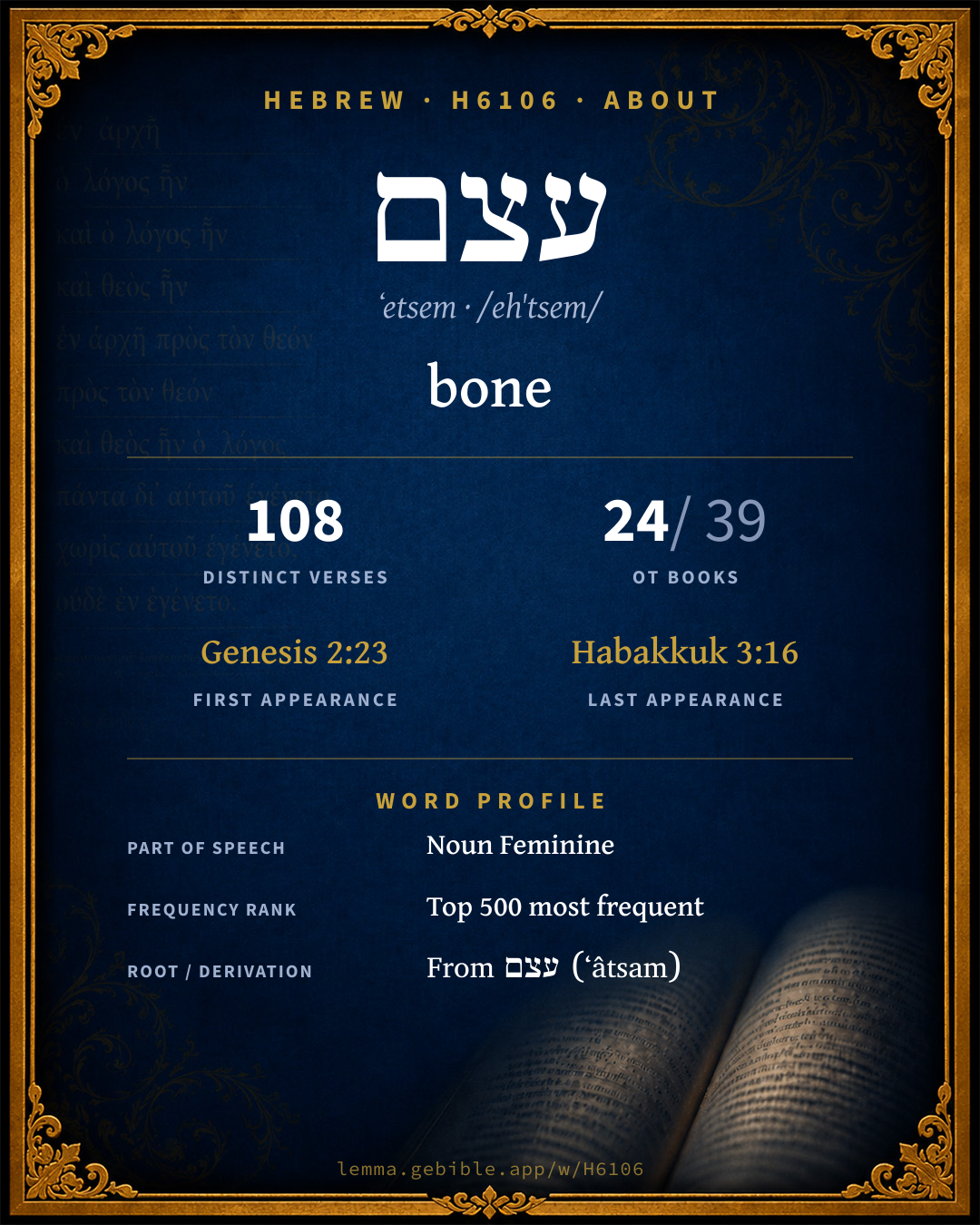
עֶ֫צֶם
bone
also: essence, substance fuller range ↓
Full lexicon entry — Brown-Driver-Briggs (BDB)
From Brown-Driver-Briggs (BDB)
Where this word appears
See every Construct-state word in the Hebrew Bible →
Grammar key — what these labels mean
Part of speech
- Noun
- A naming word — a person, place, thing, or idea.
Noun type
- Common
- A common noun — a general class of person, place, or thing (“king,” “city,” “water”), not a specific name.
State
- Construct
- A noun bound to a following noun in a possessive / “of” relationship (the construct chain).
- Absolute
- The independent form of a noun, not bound to a following word.
Gender
- Feminine
- Grammatically feminine.
Number
- Plural
- More than one (in Hebrew, generally three or more).
- Singular
- One.
5 verses where H6106 appears in the Construct state in the Book of Exodus. Filtered view — show all forms. Click any verse to open its interlinear word-by-word view. Verse text shown in the World English Bible for context — . Each verse’s Hebrew form is shown with its reference; the English is not keyword-highlighted, since the data carries no word-level English alignment. Use “Compare translations” on any verse to read it across multiple English versions. This concordance covers the Hebrew Bible; Septuagint (Greek Old Testament) occurrences are not indexed here.
Exodus
- Exodus 12:17 בְּ/עֶ֨צֶם֙ prep + n c fs cs You shall observe the feast of unleavened bread; for in this same day have I brought your hosts out of the land of Egypt: therefore shall you observe this day throughout your generations by an ordinance forever.
- Exodus 12:41 בְּ/עֶ֨צֶם֙ prep + n c fs cs It happened at the end of four hundred thirty years, even the same day it happened, that all the hosts of Yahweh went out from the land of Egypt.
- Exodus 12:51 בְּ/עֶ֖צֶם prep + n c fs cs It happened the same day, that Yahweh brought the children of Israel out of the land of Egypt by their hosts.
- Exodus 13:19 עַצְמ֥וֹת עַצְמֹתַ֛/י n c fp cs n c fp cs + sfx pers 1cs Moses took the bones of Joseph with him, for he had made the children of Israel swear, saying, "God will surely visit you, and you shall carry up my bones away from here with you."
- Exodus 24:10 וּ/כְ/עֶ֥צֶם conj + prep + n c fs cs They saw the God of Israel. Under his feet was like a paved work of sapphire stone, like the skies for clearness.
About this entry
At a glance — auto-summarized from this page’s data, not written by a person. Every figure links to its source below. This summary describes the numbers; it doesn’t interpret them.
עצם (ʻetsem) is a Hebrew noun most often rendered “bone.” Beyond its headline sense, its full sense range takes in “essence” and “substance”. It turns up in 108 verses across 24 books, a common footprint. Scripture first uses it in Genesis 2:23. It clusters with עצם, עצום and עצם under a shared root. The sections below give every sense, occurrence, and version rendering.
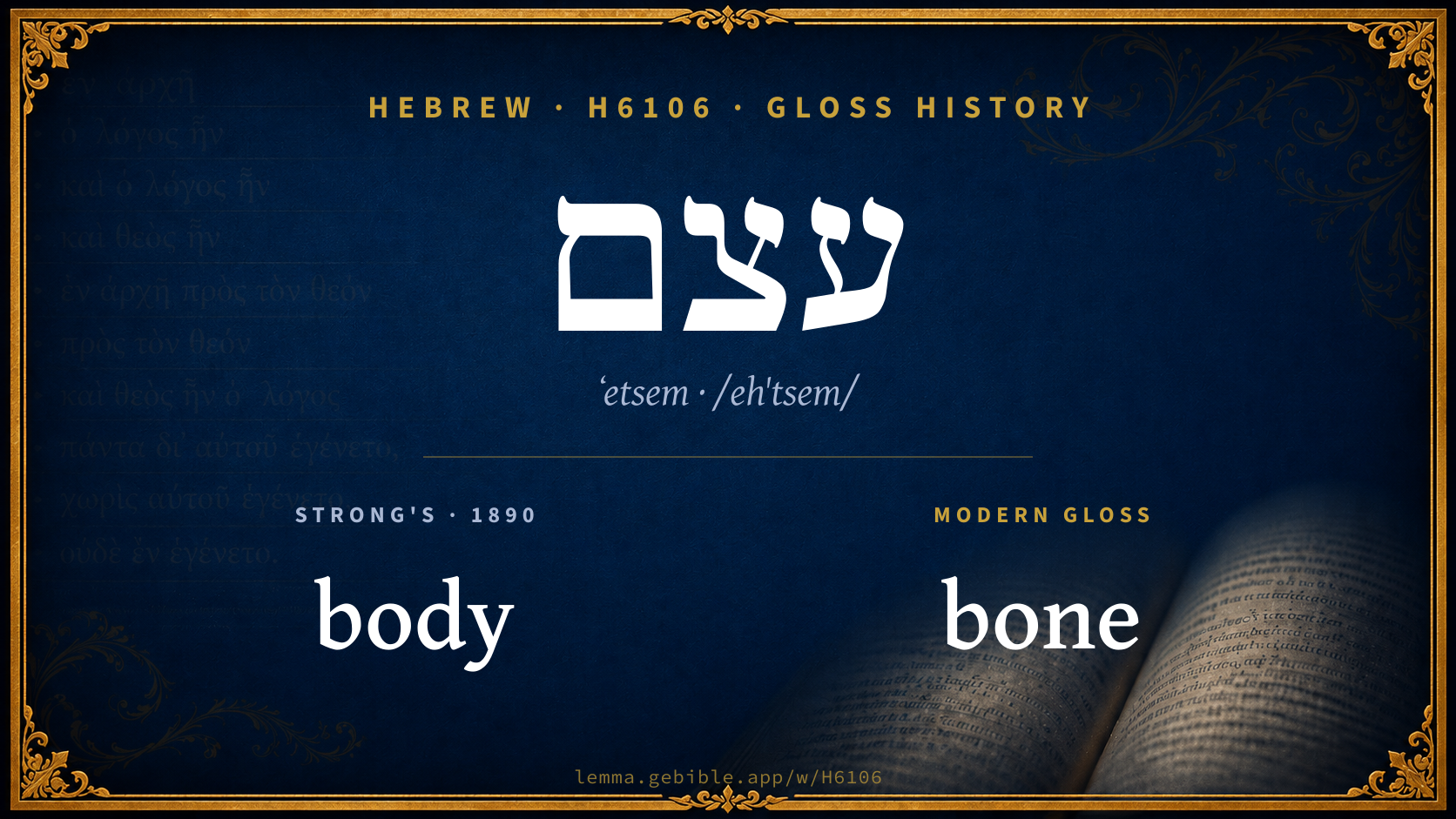
Gloss history
Strong's 1890 vs modern scholarship
About this word
Strong's H6106 catalogs a Hebrew word from the Hebrew Old Testament.
These counts are not copied from any lexicon or concordance. They are computed here, from the morphology-tagged Hebrew Old Testament. What Lemma adds →
- 108
- distinct verses
- The word appears in 108 distinct verses.
- 24 / 39
- OT books
- The word appears in 24 of 39 Old Testament books.
- #351
- by frequency
- Top 500 most frequent Hebrew words (rank 351 of 8,640 Hebrew words by occurrence).
View all 108 occurrences in the concordance →
By section of the Old Testament
By traditional corpus
Conventional, traditional groupings — biblical authorship is debated, so this is a traditional corpus grouping, not an authorship claim. Each share is this word’s portion of its verses in that division of the Hebrew canon. Each figure is a share of the word’s 108 distinct verses.
- Prophets (Nevi'im) 45 verses · 42%
- Writings (Ketuvim) 41 verses · 38%
- Torah (Pentateuch) 22 verses · 20%
How translations render this word
Counts come from each version’s own published word-to-Strong’s tagging or interlinear alignment — an approximate guide to how each version renders this word, not a word-level alignment the data otherwise carries. Because each total is that version’s own tagged count, the per-version totals vary from one another and need not match the appearance or distinct-verse counts above. These counts may also differ from a printed concordance because Lemma counts each distinctly tagged rendering and does not collapse phrase taggings into a single head-word total. This is a fixed set of word-tagged versions (KJV, ASV, BSB, ULT) and does not change with the reading translation you choose elsewhere. Each version’s license is shown beside its name below (and on Sources).
BDB lists this Strong’s number as 2 distinct words (homographs). Each count above pools all of them and is not split by sense — see the Senses section below. A low-frequency rendering may belong to a different one of those words, not the primary meaning.
- King James Version†: Bones 74×, Bone 8×, Selfsame 8×
- American Standard Version†: Bones 57×, Selfsame 10×, All my bones 5×
- Berean Standard Bible†: Bones 79×, Very 9×, Blood 6×
- unfoldingWord Literal Text†: Bones 63×, Bones of 20×, Bone 16×
King James Version Public Domain
Renders H6106 across 126† tagged occurrences — most commonly:
Plus 24 renderings that appear only once — usually multi-word phrases or single function words the recovered tagging swept in, not distinct renderings.
American Standard Version Public Domain
Renders H6106 across 125† tagged occurrences — most commonly:
Plus 41 renderings that appear only once — usually multi-word phrases or single function words the recovered tagging swept in, not distinct renderings.
Berean Standard Bible Public Domain
Renders H6106 across 115† tagged occurrences — most commonly:
Plus 10 renderings that appear only once — usually multi-word phrases or single function words the recovered tagging swept in, not distinct renderings. Not rendered by a distinct English word in 11 further occurrences.
unfoldingWord Literal Text CC BY-SA 4.0
Renders H6106 across 145† tagged occurrences — most commonly:
Plus 11 renderings that appear only once — usually multi-word phrases or single function words the recovered tagging swept in, not distinct renderings.
8 senses and sub-senses in the full BDB
What do BDB’s symbols mean?
BDB uses these scholarly abbreviations:
| Symbol | Meaning |
|---|---|
| 𝔊 | the Septuagint (the ancient Greek translation, LXX) |
| 𝔙 | the Vulgate (the Latin translation) |
| 𝔖 | the Syriac version (the Peshitta) |
| 𝔗 | the Targum (the Aramaic translation) |
| ψ | the Psalms |
| √ | root (the underlying root or stem) |
| ‖ | parallel passage (a synonymous or contrasted parallel) |
| † | the dagger: every passage where the word occurs is cited |
The 8 senses and sub-senses the full Brown-Driver-Briggs lexicon distinguishes for this word, in lexicon order (not ranked by frequency), with BDB’s own verbatim wording and sub-sense lettering. Shown in Hebrew script with BDB’s own scholarly abbreviations. The condensed entry is in the Lexicon Entry tab. See also the Forms in the corpus table below.
עצם I
- 1. bone:
- a. of living pers. Mi 3:2, 3 (hyperb.), Jb 10:11; 19:20 La 4:8 ψ 102:6; Ec 11:5 +; fig. of close relationship †עֶצֶם מֵעֲצָמַי Gn 2:23, cf. 29:14 (both J), Ju 9:2; 2 S 5:1 = 1 Ch 11:1; 2 S 19:13, 14 (all + בָּשָׂר). e.g. Micah 3:2
- b. ע׳ + בָּשָׂר = body, Jb 2:5; pl. = bodily frame Je 20:9 (sim.), limbs, members, לַעֲצָמֶיהָ Ju 19:29 i.e. limb by limb (GFM); as seat of vigour Jb 20:11, etc. e.g. Job 2:5
- c. (poet.) as seat of disease and pain Jb 30:17, 30 and (especially of personif. Isr.) ψ 22:15; 31:11; 102:4; La 1:13; Hb 3:16 +. e.g. Job 30:17
- d. pl. as representing entire person = one’s whole being, (especially of personif. Isr.) ψ 6:3 (‖ נֶפֶשׁ v 4), 35:10 (‖ נֶפֶשׁ v 9), Is 66:14; of individ. (incl. physical and moral) Pr 3:8; 14:30; 15:30; 16:24. e.g. Psalms 6:3
- e. sg. = external body La 4:7 Ew Th al., but dub.; Bi Bu bones (= branches) of coral (פְּנִינִים); Löhr עוֹרָם their skin. f. especially of dead Nu 19:16, 18 (P), Ez 37:1 +; often (pl.) = remains Am 6:10; Gn 50:25; Ex 13:19(×2); Jos 24:32 (all E) 2 S 21:12, 13 +. e.g. Lamentations 4:7
- 2. bone of animal Ex 12:46 Nu 9:12 (both P); Ez 24:4, 5 (symbol.); of (living) hippopot. Jb 40:18. e.g. Exodus 12:46
- 3. sg. substance, self (cf. גֶּרֶם 3): כְּע׳ הַשָּׁמַיִם Ex 24:10 (JE), like the substance of the sky = the sky itself; בְּע׳ תֻּמּוֹ Jb 21:23 i.e. full prosperity; especially אֶת־ע׳ הַיוֹם הַזֶּה Ez 24:2 this selfsame day, בְּע׳ וגו׳ 24:2; 40:1; Gn 7:13; 17:23, 26; Ex 12:17, 41, 51; Lv 23:21, 28, 29, 30 Dt 32:48; Jos 5:11 (all P) Ez 40:1, עַד־ע׳ וגו׳ Ez 2:3; Lv 23:14 (P), Jos 10:27 (R).—Ez 24:5a read הָעֵצִים (Bö Ew al.); v 10 del. הָעֲצָמוֹת (Co Toy); Jb 7:15 read מֵעַצְּבוֹתָ֑י (Reiske Me Bu Du al.); ψ 53:6 read perhaps מֵעֲצַת (cf. ‖ ψ 14:6 Bae; v. Hup Che al.); 69:5 read מֵעַצְמוֹתַי (for MT מַצְמִיתַי), 𝔖 Ol Che Bae al. e.g. Exodus 24:10
עצם II loc. Ασομ, etc., in Negeb of Judah, עָ֑צֶם Jos 15
Senses from the full Brown-Driver-Briggs lexicon (Brown, Driver, Briggs; Oxford 1906 — public domain), digitized via Sefaria, supplemented by the OpenScriptures HebrewLexicon (CC BY 4.0). Full attribution on Sources.
Word origin
I. n.f. ψ 35:10; Jb 19:20 (c. pron. masc. Ez 37:5, 6 etc., cf. Albr.ZAW xvi (1896), 73) bone, substance, self;—abs. ע׳ Gn 2:23 +; עָ֑צֶם Pr 15:30; 16:24; cstr. עֶצֶם Ex 24:10 +; sf. עַצְמִי Jb 19:20 +, etc.; pl. עֲצָמוֹת 2 K 23:16 +; cstr. עַצְמוֹת Jos 24:22 +; sf. עַצְמֹתַי Jb 4:14 +, etc.; also עֲצָמִים Ez 24:4 +, sf. עֲצָמַי Gn 2:23 +, etc.;—
II. n.pr.loc. Ασομ, etc., in Negeb of Judah, עָ֑צֶם Jos 15:29, Simeon 19:3 1 Ch 4:29 (עֶצֶם).
— Brown-Driver-Briggs (Oxford 1906, public domain), digitized via Sefaria, supplemented by the OpenScriptures HebrewLexicon (CC BY 4.0). See Sources.
Derived from עצם (ʻâtsam) (H6105) — to be mighty.
Jastrow Dictionary
A second Hebrew/Aramaic lexicon for comparison, covering Aramaic and post-biblical (Talmudic, Targumic, Midrashic) usage that the biblical-Hebrew BDB does not. Matched by lemma rather than by Strong’s number, so a lemma may carry more than one Jastrow headword (shown separately below), and the entries cover usage well beyond the Bible.
עָצַם
- (b. h.)
- 1. to press; to close (the eyes). Yalk. Is. 304 זה העוֹצֵם עיניו כשעומדות וכ׳ he who closes his eyes when (he sees) Israelitish girls stand washing. Sifra K’dosh., Par. 3, ch. VII יַעֲצוֹם, v. infra.
- 2. [to be compressed, hard,] to be strong, v. עָצוּם a. עֶצֶם.
- 3. (denom. of עֶצֶם) to acquire, possess. Gen. R. s. 64 שעָצַמְתָּ, v. עֶצֶם.
- to close (the eyes). Kidd. 32ᵇ יכול יַעֲצִים עיניו וכ׳ perhaps a man might think, he will close his eyes and pretend not to see him (the old man); Yalk. Lev. 617; Sifra l. c. יעצום. Sabb. XXIII, 5 מַעֲצִים, v. עָמַץ.
- to close (a dead body’s eyes), v. עָמַץ.
- 1. to be closed, v. עָמַץ.
- 2. to be headstrong towards one another. Snh. 31ᵇ שנים שנִתְעַצְּמוּ בדין וכ׳ if both parties to a law-suit are stubborn, one saying, let us go to law here, and the other saying, let us go to the circuit court.
- 3. v. עִיצּוּם 3) to fortify each other, i.e. to enter an agreement with the condition of forfeiture. Tosef. B. Mets. I, 16 שנים שנתעצמו זה בזה ואמר וכ׳ if two made an agreement wherein one said, if I do not come &c.
עֶצֶם
- preced.) [strength,]
- 1. bone. Tosef. Sabb. VII (VIII), 21 עמד ע׳ בגרונו if a bone sticks in one’s throat; Sabb. 67ᵃ. Pes. VII, 11 השובר את הע׳ וכ׳ he who breaks a bone of the Passover sacrifice. Ib. 12 שאין בו משום שבירת הע׳ because the prohibition to break a bone does not apply to it; a. v. fr.—Pl. עֲצָמוֹת. Ib. 10. Ib. VIII, 8 והמלקט לו ע׳ he who has the bones (of a parent) collected, v. לָקַט; a. v. fr.
- 2. substance, essence, self (v. עִיצּוּם). Ab. I, 14 וכשאני לעַצְמִי וכ׳ and if I am (I care) for myself only, what am I? Ib. II, 13 אל תהי רשע בפני עַצְמֶךָ be not a wicked man in thine own sight (despair not of thyself). Ber. 43ᵃ; Tosef. ib. IV, 8 כל אחד ואחד מברך לעַצְמוֹ each says the blessing for himself. Zeb. VIII, 10 כשהוא בעצמו when it (the addition to, or the diminution from the prescribed action) stands by itself (is clearly visible); R. Hash. 28ᵇ; Erub. 100ᵃ. Sifré Deut. 19 לא מעַצְמִי אני וכ׳ I did not say that of my own accord (as my idea), but at the command of God. Num. R. s. 20; Tanḥ. Bal. 13 בקש לילך לעצמו וכ׳ he wanted to go to himself (go home); a. v. fr.—Pl. constr. עַצְמֵי. Sifré Deut. 16 לשעבר … עַצְמֵיכֶם וכ׳ in the past you were your own masters, now you are servants and subjects of the community; a. fr.
- 3. substance, wealth, esp. live stock. Yalk. Gen. 111 (ref. to וַעֲבֻדָּה, Gen. XXVI, 14) וַעֲבָדָהּ כתיב אם אין אדם נעשה כעבד לעַצְמוֹ וכ׳ it may be read ‘and he shall serve it’, unless a man become like a slave to his stock, he does not own it; Gen. R. s. 64 כמו עבד לעבדו (read לעצמו; cmp. Snh. 58ᵇ).—Pl. as ab. Gen. R. l. c. (ref. to עצמת ממנו, Gen. XXVI, 16) כל אותן ע׳ שעצמת ממני היה לך all these possessions (herds and flocks) which thou hast obtained, are they not from us?; Yalk. l. c. עֲצוּמוֹת. e.g. Genesis 26:14
A Dictionary of the Targumim, the Talmud Babli and Yerushalmi, and the Midrashic Literature (Marcus Jastrow; London, Luzac, 1903) — Public Domain. Digitized via Sefaria. Digitized via Sefaria. Full attribution on Sources.
Forms in the corpus
The 93 distinct written forms H6106 takes in the Hebrew Bible, most frequent first — each parse links to that state’s occurrences in the concordance. Hebrew forms include their vowel points and cantillation, so a single lemma takes many written forms.
The 60 most common forms are shown; 33 rarer forms follow in the full concordance.
Same root — word family
Other BDB entries built from the same root as H6106, grouped by Strong’s listed origin. These share a root / origin per the lexicon — not necessarily a shared meaning. Each links to that word’s own entry.
Derives from
Shares the same root
Proper names from this root
People and places named from this root — a name, not an additional meaning of the word.
Compare all same-root words → Showing 4 of 6 — not the complete family. 1 of the same-root words is a proper name (a person or place). They share a root, not necessarily a meaning.
Septuagint verse parallels
This word appears in 104 verses that also exist in the Greek Old Testament (Septuagint), out of the 108 Hebrew verses it occurs in. You can read those verses in Greek by switching the Old Testament edition to the Septuagint.
Read these verses in the Septuagint
- Genesis 2:23
- Exodus 12:17
- Leviticus 23:14
- Numbers 9:12
- Deuteronomy 32:48
- Joshua 5:11
- Judges 9:2
- 1 Samuel 31:13
- 2 Samuel 5:1
- 1 Kings 13:2
- 2 Kings 13:21
- 1 Chronicles 10:12
This is a verse-level parallel only — the same verses exist in both the Hebrew and Greek Old Testaments. No word-level Hebrew↔Greek correspondence is claimed: the data carries no such alignment, so no Greek word is shown as this Hebrew word’s translation. Coverage is not total — the Septuagint omits the deuterocanon and renumbers the Psalms, so some Hebrew verses have no direct Greek parallel.