
Psalms 6:3

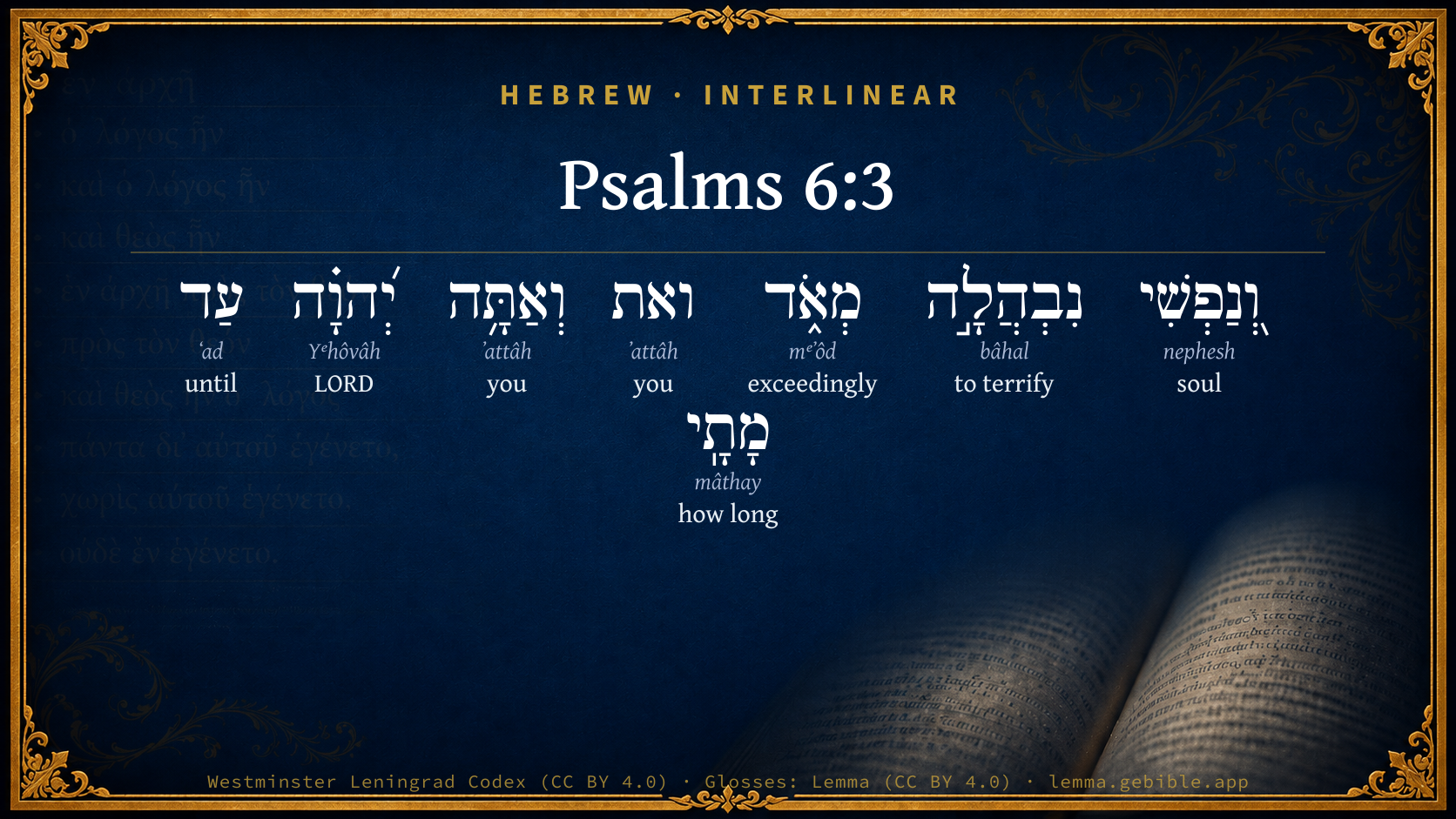
Hebrew (Westminster Leningrad Codex) Psalms 6:3 appears in the Hebrew Old Testament. The text above is from the Westminster Leningrad Codex. Each word links to its Strong’s number, a concise gloss, and parsing drawn from the Open Scriptures Hebrew Bible morphology. Click any word for its full Brown-Driver-Briggs (BDB) entry.
Download image
Cite this verse

Psalms 6:3 (World English Bible). Public Domain. Lemma interlinear Bible study tool, https://lemma.gebible.app/v/psalms/6/3.

Show BibTeX & RIS
BibTeX
RIS
English Translation
My soul is also in great anguish. But you, Yahweh--how long?
World English Bible · Public Domain
Download a study sheet

One document with this verse’s original text, its word-by-word gloss line, the meaning frame, cross-references with their text, attributed commentary, and full source and license credits — printable, and it pastes into notes with its structure intact.

This verse Autodidact and up

Study sheet (.html) Plain text (.txt)

A passage Seminary Student

Up to 50 verses in one chapter. A passage sheet keeps up to 6 commentary sources and 12 cross-references per verse, in the order this page ranks them, and says so on the sheet whenever that leaves anything out. Ask for a single verse and you get the Autodidact verse sheet above.

Everything on this page stays free to read, with no account — the sheet is a download of what is already on screen, not access to it.

Want to remove ads? Support Godless Engineer
Compare translations 3

The same verse in 3 English versions, stacked beneath the original-language interlinear above. Click any original word for its lexicon entry.

Each is an independent rendering of the whole verse — the interlinear is not word-aligned to these translations.

Highlighted words mark where these versions differ — a whole-verse word diff, not a word-by-word alignment.

  • World English Bible Public Domain
    My soul is also in great anguish. But you, Yahweh--how long?
  • King James Version Public Domain
    My soul is also sore vexed: but thou, O LORD, how long?
  • unfoldingWord Literal Text CC BY-SA 4.0
    And my soul is very disturbed. And you, Yahweh, until when?

unfoldingWord Literal Text — © unfoldingWord, licensed CC BY-SA 4.0. Word-aligned USFM3 via Door43 (git.door43.org/unfoldingWord/en_ult).

Versions to compare (up to 4)

3 of 4 selected

Show all 18 translations

Every available English version of this verse, each an independent rendering of the whole verse.

  • World English Bible Public Domain
    My soul is also in great anguish. But you, Yahweh--how long?
  • Berean Standard Bible Public Domain
    My soul is deeply distressed. How long, O LORD, how long?
  • Majority Standard Bible Public Domain
    My soul is deeply distressed. How long, O LORD, how long?
  • King James Version Public Domain
    My soul is also sore vexed: but thou, O LORD, how long?
  • American Standard Version (1901) Public Domain
    My soul also is sore troubled: And thou, O Jehovah, how long?
  • Revised Version (1885) Public Domain
    My soul also is sore vexed: and thou, O LORD, how long?
  • Geneva Bible (1599) Public Domain
    My soule is also sore troubled: but Lord how long wilt thou delay?
  • Douay-Rheims (1899) Public Domain
    Have mercy on me, O Lord, for I am weak: heal me, O Lord, for my bones are troubled.
  • Young's Literal Translation Public Domain
    And my soul hath been troubled greatly, And Thou, O Jehovah, till when?
  • Literal Standard Version CC BY-SA 4.0
    And my soul has been troubled greatly, || And You, O YHWH, until when?
  • Unlocked Literal Bible CC BY-SA 4.0
    My soul also is very troubled. But you, Yahweh—how long will this continue?
  • unfoldingWord Literal Text CC BY-SA 4.0
    And my soul is very disturbed. And you, Yahweh, until when?
  • Darby Bible Public Domain
    And my soul trembleth exceedingly: and thou, Jehovah, till how long?
  • World Messianic Bible Public Domain
    My soul is also in great anguish. But you, LORD—how long?
  • Webster's Bible Public Domain
    \\6:2\\Have mercy upon me, O LORD; for I am weak: O LORD, heal me; for my bones are agitated.
  • Free Bible Version CC BY-SA 4.0
    I'm shaking all over in fear. How long will it be, Lord, before you do something?
  • Bible in Basic English Public Domain
    My soul is in bitter trouble; and you, O Lord, how long?
  • JPS Tanakh (1917) Public Domain
    (6-4) My soul also is sore affrighted; and Thou, O LORD, how long?

Literal Standard Version (2020), Covenant Press — licensed CC BY-SA 4.0. Text via the HelloAO Bible API (eBible.org). Unlocked Literal Bible (unfoldingWord) — licensed CC BY-SA 4.0. Text via the HelloAO Bible API (eBible.org). unfoldingWord Literal Text — © unfoldingWord, licensed CC BY-SA 4.0. Word-aligned USFM3 via Door43 (git.door43.org/unfoldingWord/en_ult). Free Bible Version, Dr. Jonathan Gallagher — licensed CC BY-SA 4.0. Text via the HelloAO Bible API (eBible.org).

Word by word

More ways to search: Search by grammar → Find every occurrence → Compare this word →

Practice this passage: Drill this verse → Learn its vocabulary →

נִבְהֲלָ֣ה
bâhal
H926
“to terrify”
Verb, Niphal, Perfect, 3rd Person, Feminine, Singular
Part of Speech
Verb
Stem
Niphal
Form
Perfect
Person
3rd Person
Gender
Feminine
Number
Singular
Full BDB Definition

Origin: a primitive root

TWOT: 207

to disturb, alarm, terrify, hurry, be disturbed, be anxious, be afraid, be hurried, be nervous - (Niphal) - to be disturbed, dismayed, terrified, anxious - to be in haste, be hasty - (Piel) - to make haste, act hastily, be hurried, be hastened - to dismay, terrify - (Pual) - to hasten - hastened, hastily gained (participle) - (Hiphil) - to hasten, hurry, make haste - to dismay, terrify
  1. וְ֭נַפְשִׁי nephesh H5315 “and · soul · my” Conjunction + Noun, Common, Both, Singular, Construct + Suffix, Personal, 1st Person, Common, Singular
  2. מְאֹ֑ד mᵉʼôd H3966 “exceedingly” Adverb
  3. ואת ʼattâh H859 “and · you” Conjunction + Pronoun, Personal, 2nd Person, Masculine, Singular
  4. וְאַתָּ֥ה ʼattâh H859 “and · you” Conjunction + Pronoun, Personal, 2nd Person, Masculine, Singular
  5. יְ֝הוָ֗ה Yᵉhôvâh H3068 “LORD” Noun, Proper
  6. עַד ʻad H5704 “until” Preposition
  7. מָתָֽי mâthay H4970 “how long” Particle, Interrogative

About this verse

These counts appear in no published source. They are computed here, from the morphology-tagged text and Lemma’s own curated glosses. What Lemma adds →

8
words
7
distinct lemmas
Wisdom
section

Shared distinctive vocabulary

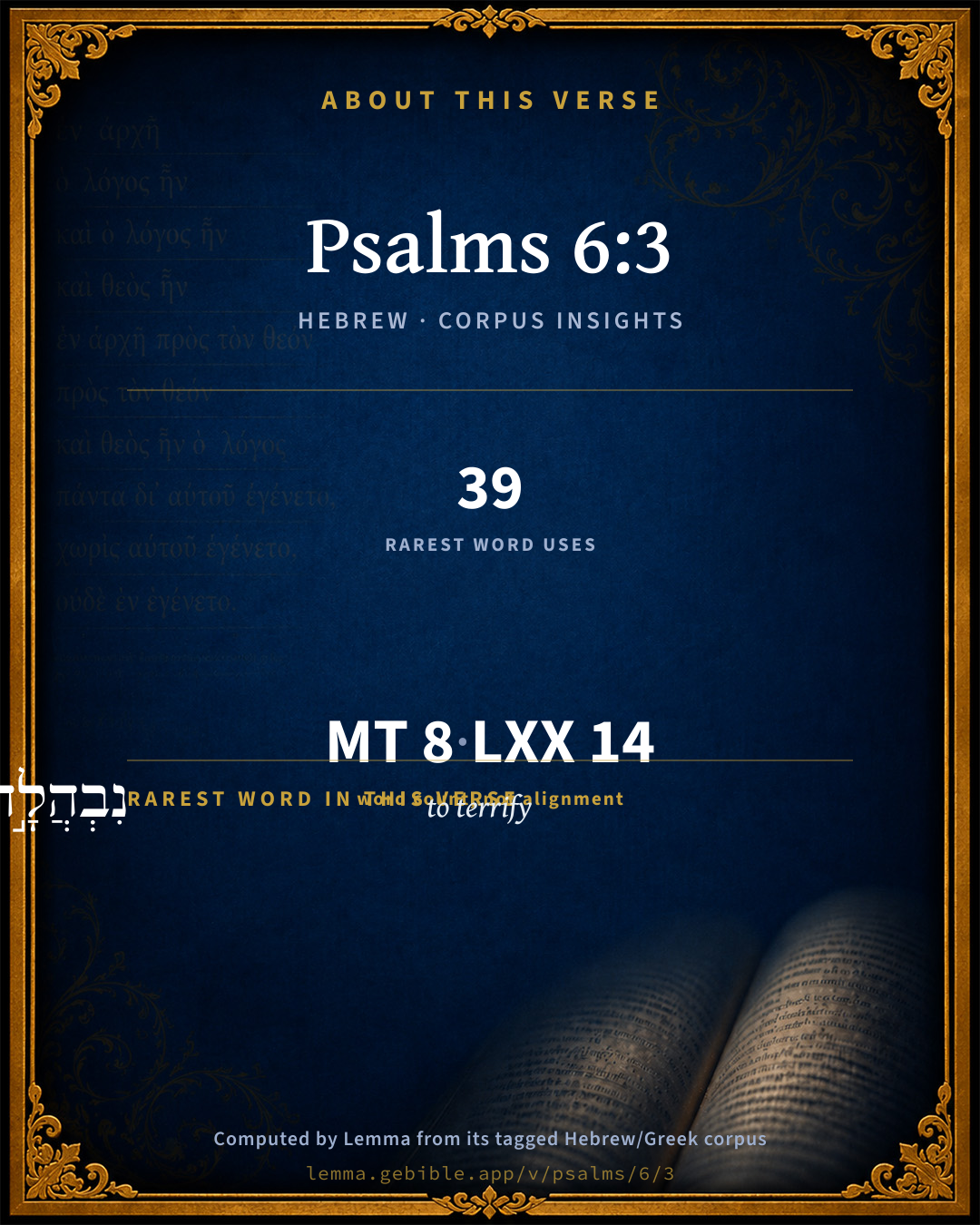
נִבְהֲלָ֣ה to terrify H926 occurs in 39 verses of the Hebrew Bible. Also found in:

Grammatical profile

  • 1 verb
  • 2 nouns
  • 2 pronouns
  • 1 preposition
  • 1 adverb
  • 1 particle

Verb forms

  • נִבְהֲלָ֣ה Niphal · Perfect

Repetition

A word recurs within this verse — often emphatic in Hebrew:

  • ואת you H859 ×2

Hebrew & Septuagint length

In English translation the verse runs 11 words from the Hebrew and 12 from the Septuagint (LXX English) — closely comparable.

A rough comparison of the two English renderings, which tokenize alike — not a word-level alignment.

Word counts can differ between the Hebrew and the Greek without any difference in meaning — e.g. the Hebrew direct-object marker אֵת has no separate Greek word, and Greek often adds the article ὁ.

In the original languages it is 8 Hebrew tokens and 14 Greek tokens — but the two are counted differently (Hebrew bundles its prefixes and suffixes into one token; the Greek is in lemma form), so that isn’t a like-for-like length.

Cross-references

13

Topical passages linked to Psalms 6:3 in the Treasury of Scripture Knowledge — connected by theme and wording, ordered by reader-vote popularity; previews shown in the World English Bible.

  • Psalms 90:13 Relent, Yahweh! How long? Have compassion on your servants!
  • John 12:27 "Now my soul is troubled. What shall I say? 'Father, save me from this time?' But for this cause I came to this time.
  • Psalms 13:1–2 How long, Yahweh? Will you forget me forever? How long will you hide your face from me?
  • Psalms 42:5 Why are you in despair, my soul? Why are you disturbed within me? Hope in God! For I shall still praise him for the saving help of his presence.
  • Psalms 42:11 Why are you in despair, my soul? Why are you disturbed within me? Hope in God! For I shall still praise him, The saving help of my countenance, and my God.
  • Psalms 77:2–3 In the day of my trouble I sought the Lord. My hand was stretched out in the night, and didn't get tired. My soul refused to be comforted.
  • Luke 18:7 Won't God avenge his chosen ones, who are crying out to him day and night, and yet he exercises patience with them?
  • Psalms 22:14 I am poured out like water. All my bones are out of joint. My heart is like wax; It is melted within me.
  • Psalms 31:9–10 Have mercy on me, Yahweh, for I am in distress. My eye, my soul, and my body waste away with grief.
  • Psalms 38:8 I am faint and severely bruised. I have groaned by reason of the anguish of my heart.
  • Psalms 77:7 "Will the Lord reject us forever? Will he be favorable no more?
  • Proverbs 18:14 A man's spirit will sustain him in sickness, But a crushed spirit, who can bear?
  • Matthew 26:38 Then he said to them, "My soul is exceedingly sorrowful, even to death. Stay here, and watch with me."

Cross-references courtesy of OpenBible.info (CC BY 4.0).

Hebrew and Greek witnesses Masoretic Hebrew ↔ Greek Septuagint

The same verse in the two great witnesses to the Old Testament, shown verse-for-verse.

You’re reading Greek Psalm 6 (Hebrew Psalm 6). The Septuagint counts the superscription, so verse numbers can differ from the Hebrew — chapter-level alignment, not verse-by-verse. Numbering follows Rahlfs.

These are two independent witnesses, not word-aligned to each other, and the Septuagint is shown in lemma (dictionary) form.

Hebrew Psalms 6:3 Masoretic · Westminster Leningrad Codex

וְ֭נַפְשִׁי נִבְהֲלָ֣ה מְאֹ֑ד ואת וְאַתָּ֥ה יְ֝הוָ֗ה עַד מָתָֽי

My soul is also in great anguish. But you, Yahweh--how long?

World English Bible · Public Domain

Greek LXX Greek Psalm 6:3 Septuagint · lemma form

ἐλεέω ἐγώ κύριος ὅτι ἀσθενής εἰμί ἰάομαι ἐγώ κύριος ὅτι ταράσσω ὁ ὀστέον ἐγώ

My soul also is grievously vexed: but you, O Lord, how long?

LXX2012 (modern English Septuagint) · Public Domain

On this verse, The Cambridge Bible for Schools and Colleges discusses the Septuagint’s reading. Read the note in Commentary ↓

Hebrew: Westminster Leningrad Codex (CC BY 4.0). Greek: Septuagint (public domain); English from LXX2012 (modern English Septuagint) (Public Domain). How the Septuagint differs from the Hebrew →

Commentary

Notes on Psalms 6:3 from classic Christian and Jewish commentators (each source and its license shown beneath its notes). The classic Christian expositions comment on the surrounding passage and are grouped to its opening verse, so a note may address several verses; the Jewish commentaries on the Tanakh (Rashi and others) are per-verse, so they appear only where the commentator wrote on this verse.

Lemma curates 59 commentaries, every one of them public domain or Creative Commons licensed, each selected and text-cleaned for this edition rather than reprinted as found. About our sources →

Trapp's Complete Commentary

John Trapp

Psa 6:3 My soul is also sore vexed: but thou, O LORD, how long?

Ver. 3. My soul is also sore vexed] This was worse than all the rest. A light load to a raw shoulder is very grievous; a little water in a leaden vessel is heavy, so is a little outward grief to a laden soul. Hence Job so complaineth; and Jeremiah prayeth, Be not thou a terror unto me, O Lord; and then I much matter not what becomes of me.

But thou, O Lord, how long] sc. Wilt thou stand off, and not haste to my help? This is plena affectus reticentia, an emphatic and affectionate aposiopesis, such as is ordinary with those that are in pain and durance.

John Trapp, A Commentary or Exposition upon All the Books of the Old and New Testament (1647–1656) — public domain. Text from a community e-Sword module.

The Biblical Illustrator

Joseph S. Exell

Psa_6:3

My soul is sore vexed.

Yoke fellows in sin, yoke fellows in punishment

Yoke fellows in sin are yoke fellows in pain; the soul is punished for informing, the body for performing, and as both the informer and performer, the cause and the instrument, so shall the stirrer up of sin and executor be punished. (A. Symson, B. D.)

But Thou, O Lord, how long?--

The delays of God

1. That there is an appointed time, which God hath measured, for the crosses of all His children, before which time they shall not be delivered, and for which they must patiently attend, not thinking to prescribe time to God for their delivery or limit the Holy One of Israel. The Israelites remained in Egypt till the complete number of 430 years were accomplished. Joseph was three years and more in the prison till the appointed time of his delivery came. The Jews remained 70 years in Babylon. So that as the physician appointeth certain times to the patient, both wherein he must fast and be dieted, and wherein he must take recreation: so God knoweth the convenient times both of our humiliation and exaltation.

2. See the impatiency of our natures in our miseries, our flesh still rebelling against the Spirit, which oftentimes forgetteth itself so far that it will enter into reasoning with God, and quarrelling with Him, as we may read of Job, Jonas, etc., and here also of David.

3. Albeit the Lord delay His coming to relieve His saints, yet He hath great cause if we ponder it; for, when we were in the heat of our sins, many times He cried by the mouth of His prophets, O fools, how long will you continue in your folly? and we would not hear. And therefore, when we are in the heat of our pains, thinking long, yea, every day a year till we are delivered, no wonder it is if God will not hear. Let us consider with ourselves the just dealing of God with us, that as He cried, and we would not hear; so now we cry, and He will not hear. (A. Symson, B. D.)

Broken prayers

I. An instance of what may be called a broken prayer. Dr. Maclaren calls it daring and pregnant in its incompleteness. Is it not natural that prayer should often be incomplete? The man who has never broken down in his prayer has hardly yet learned to pray.

1. Prayer must be broken at times, because some petitions we would offer we may not. Prayer has sometimes to be restrained.

2. Because we cannot tell how to pray. True piety has its dilemmas. What may precisely meet our need cannot always be defined.

3. Because words cannot compass our desires. The intensest feelings of our hearts cannot find adequate expression.

II. Broken prayers may be the most earnest expressions of the soul. The Psalmists very earnestness brings him to a standstill. Such a break is the safety valve of the impassioned soul. Prayer is often most sincere when it is least eloquent. A sob may be a real prayer.

III. That prayers are broken does not prevent them from being heard and answered. If this Psalm opens amid the thick gloom of troublous misgiving, it does not close till a new light has chased these shadows away. However poor and faltering our own words, we shall not be disappointed about an answer. God can interpret the prayer that has never even found utterance. When a man begins to pray, however brokenly, light is not far off. (G. Edward Young.)

The Biblical Illustrator, edited by Joseph S. Exell (c. 1880s–1900s) — public domain. Text from a community e-Sword module.

Joseph Benson's Commentary

Psa 6:3. My soul is sore vexed — Partly by sympathy with my body, and partly with the burden of my sins, and the sense of thine anger, and my own danger and misery. O Lord, how long? — Wilt thou suffer me to lie and languish in this condition? or, as the Chaldee paraphrast supplies the ellipses, How long wilt thou defer to give me some refreshment?

Joseph Benson's Commentary on the Old and New Testaments (1811–1818) — public domain. Text from a community e-Sword module.

J. A. Alexander on Psalms

Joseph Addison Alexander

4. (Psa 6:3). The Psalmist himself guards against the error of supposing that his worst distresses were corporeal. And my soul, as well as my body, or more than my body, which merely sympathizes with it, is greatly agitated, terror-stricken, the same word that was applied to the bones in the preceding verse. The description of his suffering is then interrupted by another apostrophe to God. And thou, O Lord, Jehovah, until when, how long? The sentence is left to be completed by the reader: how long wilt thou leave me thus to suffer? how long before thou wilt appear for my deliverance? This question, in its Latin form, Domine quousque, was Calvin's favourite ejaculation in his times of suffering, and especially of painful sickness.

Joseph Addison Alexander, The Psalms Translated and Explained (1850) — public domain. Text from a community e-Sword module.

Geneva Bible (1599)

Geneva Bible translators

His conscience is also touched with the fear of God’s judgment.

Geneva Bible (1599) marginal notes — public domain. Text via Bolls.life.

Jamieson, Fausset & Brown

Robert Jamieson, A. R. Fausset & David Brown

how long?--shall this be so (compare Psa 79:5).

but--or, "and."

thou--The sentence is incomplete as expressive of strong emotion.

Jamieson, Fausset & Brown — Commentary Critical and Explanatory on the Whole Bible (1871) — public domain (CC PDM 1.0). Text via the HelloAO Bible API.

Adam Clarke's Commentary

Verse 3. How long?] How long shall I continue under this malady? How long will it be before thou speak peace to my troubled heart?

Adam Clarke's Commentary on the Bible (1810–1826) — public domain. Text from a community e-Sword/MySword module.

John Calvin's Commentaries

3. And thou, O Jehovah, how long? This elliptical form of expression serves to express more strongly the vehemence of grief, which not only holds the minds of men bound up, but likewise their tongues, breaking and cutting short their speech in the middle of the sentence. The meaning, however, in this abrupt expression is doubtful. Some, to complete the sentence, supply the words, Wilt thou afflict me, or continue to chasten me? Others read, How long wilt thou delay thy mercy? But what is stated in the next verse shows that this second sense is the more probable, for he there prays to the Lord to look upon him with an eye of favor and compassion. He, therefore, complains that God has now forsaken him, or has no regard to him, just as God seems to be far of from us whenever his assistance or grace does not actually manifest itself in our behalf. God, in his compassion towards us, permits us to pray to him to make haste to succor us; but when we have freely complained of his long delay, that our prayers or sorrow, on this account, may not pass beyond bounds we must submit our case entirely to his will, and not wish him to make greater haste than shall seem good to him.

John Calvin's Commentaries (1540-1563) — public domain. Text from the Calvin Translation Society English edition (1840s-50s) via the Christian Classics Ethereal Library (ccel.org). Calvin's coverage is partial (roughly two-thirds of the Bible); uncommented books and verses are honest gaps, never fabricated. The 19th-century editor's footnotes and remarks are omitted so the notes are faithfully Calvin's own voice.

Ellicott's Commentary for English Readers

(3) But thou, O Lord, how long?—Comp. Psa_90:13. This is “belief in unbelief.” Domine quousque was Calvin’s motto. The most intense grief, it was said, could never extract from him another word. In its national form this faith amid despair is shown in Zec_1:12. (Comp Rev_6:10.)

A Bible Commentary for English Readers, edited by Charles John Ellicott (1878–1897) — public domain. Text from a community e-Sword module.

The Cambridge Bible for Schools and Colleges

gen. ed. J. J. S. Perowne

3. Mind as well as body, the inner self as well as its outer organism, is dismayed. Our Lord appropriates these words, in view of His approaching Passion (Joh_12:27), using the Greek word (ταράσσειν) employed by the LXX.

how long?] Cp. Psa_90:13. How pregnant is the aposiopesis! How long wilt Thou be angry? How long wilt Thou hide Thy face and refuse to hear me? Cp. Psa_13:1.

It is recorded of Calvin in his last painful illness that he uttered no word of complaint unworthy of a Christian man; only raising his eyes to heaven he would say Usquequo Domine (Lord, how long?) for even when he was in health, this was a kind of watchword with him, in reference to the troubles of the brethren (Vita: Opp. Tom. 1).

The Cambridge Bible for Schools and Colleges (gen. ed. J. J. S. Perowne; Cambridge University Press, 1878–1918) — public domain. Text from a community e-Sword module.

John Gill's Exposition

My soul is also sore vexed,.... Or "exceedingly troubled" (c), and even frightened and thrown into a consternation with indwelling sin, and on account of actual transgressions, and by reason of the hidings of God's face, and through the temptations of Satan, and because of the fear of death; to which Old Testament saints were very incident.

But thou, O Lord, how long? it is an abrupt expression, the whole he designed is not spoken, being hindered through the grief and sorrow with which his heart was overwhelmed; and is to be supplied after this manner,

"shall I have refreshment?''

as the Chaldee paraphrase; or,

"wilt thou look and not heal me?''

as Jarchi; or

"my soul be troubled?''

as Aben Ezra; or

"shall I be afflicted, and thou wilt not heal me?''

as Kimchi; or

"wilt thou afflict me, and not arise to my help?''

see Psa 13:1.

(c) "turbata est valde", V. L. "conturbata", Junius & Tremellius, Piscator; "territa valde": Pagninus, Montanus; "consternata valde", Cocceius.

John Gill's Exposition of the Whole Bible (1746–1763) — public domain (CC PDM 1.0). Text via the HelloAO Bible API.

Albert Barnes' Notes on the Bible

My soul is also sore vexed - The word “soul” here is used in the sense in which it is commonly with us, as denoting the mind. The idea is, that his sorrows were not merely those of the bodily frame. They had a deeper seat than even the bones. His mind, his soul, was full of anguish also, in view of the circumstances which surrounded him, and which had brought on these bodily afflictions.

But thou, O Lord - This is a broken sentence, as if he had commenced an address to God, but did not complete it. It is as if he had said, “Here I suffer and languish; my sorrows are deep and unmitigated; as for thee, O Lord” - as if he were about to say that he had hoped God would interpose; or, that his dealings were mysterious; or, that they seemed strange or severe; but he ends the sentence by no language of complaint or complaining, but by simply asking “how long” these sorrows were to continue.

How long? - That is, how long wilt thou leave me thus to suffer? How long shall my unmitigated anguish continue? How long will it be ere thou wilt interpose to relieve me? The language implies that in his apprehension it was already a long time - as time usually seems long to a sufferer (compare Job 7:2-4), and that he was constantly looking out for God to interpose and help him. This is language such as all persons may be inclined to use on beds of pain and languishing. It seems indeed long to them now; it will, however, seem short when they look back upon it from the glories of the heavenly world. Compare 2Co 4:17-18.

Albert Barnes' Notes on the Bible (1834–1885) — public domain. Text from a community e-Sword/MySword module.

Matthew Poole's English Annotations

My soul is also sore vexed; partly by sympathy with my body; and partly with the burden of my sins, and the sense of thine anger, and my own danger and misery.

How long wilt thou suffer me to lie and languish in this condition? It is a figure called aposiopesis, very agreeable to men in pain or anguish, who use to cut their words short.

Matthew Poole's English Annotations on the Holy Bible (1683–1685) — public domain. Text from a community e-Sword/MySword module.

The Treasury of David

Charles H. Spurgeon

Ver. 3. O Lord, heal me; for my bones are vexed. Here he prays for healing, not merely the mitigation of the ills he endured, but their entire removal, and the curing of the wounds which had arisen therefrom. His bones were "shaken," as the Hebrew has it. His terror had become so great that his very bones shook; not only did his flesh quiver, but the bones, the solid pillars of the house of manhood, were made to tremble. "My bones are shaken." Ah, when the soul has a sense of sin, it is enough to make the bones shake; it is enough to make a man's hair stand up on end to see the flames of hell beneath him, an angry God above him, and danger and doubt surrounding him. Well might he say, "My bones are shaken." Lest, however, we should imagine that it was merely bodily sickness although bodily sickness might be the outward sign the Psalmist goes on to say,

My soul is also sore vexed. Soul-trouble is the very soul of trouble. It matters not that the bones shake if the soul be firm, but when the soul itself is also sore vexed this is agony indeed.

But thou, O Lord, how long? This sentence ends abruptly, for words failed, and grief drowned the little comfort which dawned upon him. The Psalmist had still, however, some hope; but that hope was only in his God. He therefore cries, "O Lord, how long?" The coming of Christ into the soul in his priestly robes of grace is the grand hope of the penitent soul; and, indeed, in some form or other, Christ's appearance is, and ever has been, the hope of the saints.

Calvin's favourite exclamation was, "Domine usquequo"O Lord, how long? Nor could his sharpest pains, during a life of anguish, force from him any other word. Surely this is the cry of the saints under the altar, "O Lord, how long?" And this should be the cry of the saints waiting for the millennial glories, "Why are his chariots so long in coming; Lord, how long?" Those of us who have passed through conviction of sin knew what it was to count our minutes hours, and our hours years, while mercy delayed its coming. We watched for the dawn of grace, as they that watch for the morning. Earnestly did our anxious spirits ask, "O Lord, how long?"

Ver. 3. My soul. Yokefellows in sin are yokefellows in pain; the soul is punished for informing, the body for performing, and as both the informer and performer, the cause and the instrument, so shall the stirrer up of sin and the executor of it be punished. John Donne.

Ver. 3. O Lord, how long? Out of this we have three things to observe; first, that there is an appointed time which God hath measured for the crosses of all his children, before which time they shall not be delivered, and for which they must patiently attend, not thinking to prescribe time to God for their delivery, or limit the Holy One of Israel. The Israelites remained in Egypt till the complete number of four hundred and thirty years were accomplished. Joseph was three years and more in the prison till the appointed time of his delivery came. The Jews remained seventy years in Babylon. So that as the physician appointeth certain times to the patient, both wherein he must fast, and be dieted, and wherein he must take recreation, so God knoweth the convenient times both of our humiliation and exaltation. Next, see the impatiency of our nature in our miseries, our flesh still rebelling against the Spirit, which oftentimes forgetteth itself so far, that it will enter into reasoning with God, and quarrelling with him, as we may read in Job, Jonas, etc., and here also of David. Thirdly, albeit the Lord delay his coming to relieve his saints, yet hath he great cause if we could ponder it; for when we were in the heat of our sins, many times he cried by the mouth of his prophets and servants, "O fools, how long will you continue in your folly?" And we would not hear; and therefore when we are in the heat of our pains, thinking long, yea, every day a year till we be delivered, no wonder is it if God will not hear; let us consider with ourselves the just dealing of God with us; that as he cried and we would not hear, so now we cry, and he will not hear. A. Symson.

Ver. 3. O Lord, how long? As the saints in heaven have their usque quo, how long, Lord, holy and true, before thou begin to execute judgment? So, the saints on earth have their usque quo. How long, Lord, before thou take off the execution of this judgment upon us? For, our deprecatory prayers are not mandatory, they are not directory, they appoint not God his ways, nor times; but as our postulatory prayers are, they also are submitted to the will of God, and have all in them that ingredient, that herb of grace, which Christ put into his own prayer, that veruntamen, yet not my will, but thy will be fulfilled; and they have that ingredient which Christ put into our prayer, fiat voluntas, thy will be done in earth as it is in heaven; in heaven there is no resisting of his will; yet in heaven there is a soliciting, a hastening, an accelerating of the judgment, and the glory of the resurrection; so though we resist not his corrections here upon the earth, we may humbly present to God the sense which we have of his displeasure, for this sense and apprehension of his corrections is one of the principal reasons why he sends them; he corrects us therefore that we might be sensible of his corrections; that when we, being humbled under his hand, have said with his prophet, "I will bear the wrath of the Lord, because I have sinned against him" (Mic 7:9), he may be pleased to say to his correcting angel, as he did to his destroying angel, This is enough, and so burn his rod now, as he put up his sword then. John Donne.

Ver. 3. The impatience of sorrow; its sins, mischief, and cure.

Ver. 3. A fruitful topic may be found in considering the question, How long will God continue afflictions to the righteous?

Charles H. Spurgeon's The Treasury of David (1869–1885) — public domain. Psalms only. Text from a community e-Sword/MySword module.

Whedon's Commentary on the Bible

Daniel D. Whedon

3, 4. My soul is… sore vexed—Causes of mental, not less than of physical, trouble existed. Body and soul lay under the consuming force of the wrathful judgment. The word used to describe the effect upon his bones (“vexed, troubled”) is the same as defines the state of his soul. Delitzsch gives the sense of outward overthrow and inward consternation, the effect of fright, which disconcerts one, and of excitement, that deprives one of self-control.

How long—Literally, till when? The interrogation is emphatic, and supposes the answer delayed, and the evil complained of such as cannot long be endured. See Exo_10:3; Psa_90:13; Isa_6:11. With this the perfect tense of the preceding verb (my soul has been vexed) agrees, as also the earnest return, (Psa_6:4,) as if God had gone away from him. Compare 2Co_4:8 : “Perplexed, but not in despair.”

Daniel D. Whedon (gen. ed.), Commentary on the Old and New Testaments (1874–1909) — public domain. Text from a community e-Sword module.

The Pulpit Commentary

My soul is also sore vexed. It is not, however, the body alone which suffers; the soul also is vexed, and vexed greatly (daom). Clearly the main emphasis is intended to be laid on the mental suffering. But thou, O Lord, how long! We may fill up the ellipse in various ways: "How long wilt thou look on?" "How long wilt thou hide thyself?" "How long wilt thou be angry?". (see Psa_34:17 Psa_79:5 Psa_89:46) Or again, "How long shall I cry, and thou wilt not hear?". (Hab_1:2) The cry is that of one wearied out with long suffering. (comp. Psa_90:13)

The Pulpit Commentary (1880–1919), ed. H.D.M. Spence-Jones & Joseph S. Exell — public domain. Text from a community e-Sword module.

unfoldingWord translationNotes

Door43 World Missions Community

very troubled

"terrified" or "worried"

how long will this continue?

David uses this question to show that he does not want to continue feeling weak and troubled. AT: please, do not let this continue!" (See: Rhetorical Question)

Return, Yahweh

David speaks of God being kind to him as God returning to him. AT: "Yahweh, come back to me" or "Have mercy on me, Yahweh" (See: Metaphor)

Save me because of your covenant faithfulness

The abstract noun "faithfulness" can be translated as an adjective. AT: "Save me because you are faithful to your covenant" (See: Abstract Nouns)

For in death there is no remembrance of you. In Sheol who will give you thanks?

These two sentences express similar meanings. (See: Parallelism)

For in death there is no remembrance of you

The abstract noun "remembrance" represents praise. AT: "For when people die, they no longer praise you" (See: Metonymy and Abstract Nouns)

In Sheol who will give you thanks?

David uses this question to emphasize that no one in Sheol thanks God. AT: "No one in Sheol will give you thanks!" or "The dead cannot praise you!" (See: Rhetorical Question)

translationWords

soul

save

covenant faithfulness

die

Hades

unfoldingWord translationNotes — © Distant Shores Media and the Door43 World Missions Community, licensed CC BY-SA 4.0. Source: git.door43.org/Door43/en_tn.

Rashi

Rabbi Shlomo Yitzchaki (Rashi)

languish אמלל, devastated, and poor in strength, konfondouc in Old French, confounded, perplexed as “these feeble Jews (האמללים),” of Ezra (Neh. 3:34).

Rashi on the Tanakh — English translations: “The Judaica Press complete Tanach with Rashi, translated by A. J. Rosenberg” (CC BY 4.0); “Pentateuch with Rashi's commentary by M. Rosenbaum and A.M. Silbermann, 1929-1934” (public domain); “The Metsudah Tanach series, Lakewood, N.J” (CC BY 4.0); and “The Book of Joshua, Metsudah Publications, 1997” (CC BY 4.0). Text via Sefaria.

Radak

Rabbi David Kimhi (Radak)

Have mercy upon me, Lord, for I am feeble (withered): – אֻמְלַל (feeble, withered) has the force of an adjective although written with a pathah; and a similar example is (the passage): “A heart deceived (הוּתַל) hath turned him aside” (Is. 44:20); and it (אֻמְלַל) has the sense of “uprooting” and “cutting off,” as (in the passage): “And she that hath many children is withered away” (languisheth) (1 Sam. 2:5); “these feeble Jews” (Neh. 3:34); “she that hath borne seven is withered away” (languisheth) (Jer. 15:9); and (other) similar passages.

O Lord, heal me; for my bones are vexed He means his body. He says my bones, because they are the foundation of the body; or he speaks of the pain of his limbs.

Radak on the Tanakh — English translations: “Sefaria Community Translation” (CC0 1.0 (public-domain dedication)); “Eliyahu Munk, HaChut Hameshulash” (CC BY 4.0); “Rabbi Mike Feuer, Jerusalem Anthology” (CC BY 4.0); and “R. David Kimhi on the first book of Psalms, Translated by R.G. Finch, London, 1919” (public domain). Text via Sefaria.

Lesson kit

Teaching starters — assembled from the data on this page, not authored interpretation. Every prompt links to the verse data it draws on. Edit before teaching.

Psalms, in the Wisdom, opens this verse with 8 words (7 distinct Hebrew lemmas). Its most distinctive word is bâhal (“to terrify”). A historical commentator’s framing appears above. Read the whole chapter for the surrounding context.

Discussion questions

  1. What does “to terrify” (bâhal) contribute to the verse as a whole?
  2. How does Genesis 45:3, which shares the word «to terrify», read alongside this verse?
  3. What does the repetition of “you” (2× in this one verse) do in this verse?
  4. These translations render this verse differently. What is at stake in choosing one wording over another?
  5. «נִבְהֲלָ֣ה» is a Niphal Perfect verb. How does that grammatical form shape the action described?
  6. Compare how Trapp's Complete Commentary and The Biblical Illustrator read this verse. Where do they agree or differ?

Things to notice

Reading settings

Reading text

Shown beneath each verse's original-language words.

Old Testament
Old Testament edition

Read the OT as the Masoretic Hebrew (MT) or the Greek Septuagint (LXX).

English shown for the Greek Septuagint (in the Hebrew ↔ Greek comparison).

Comparing translations? Open the Compare panel on any verse page to stack up to four side by side.