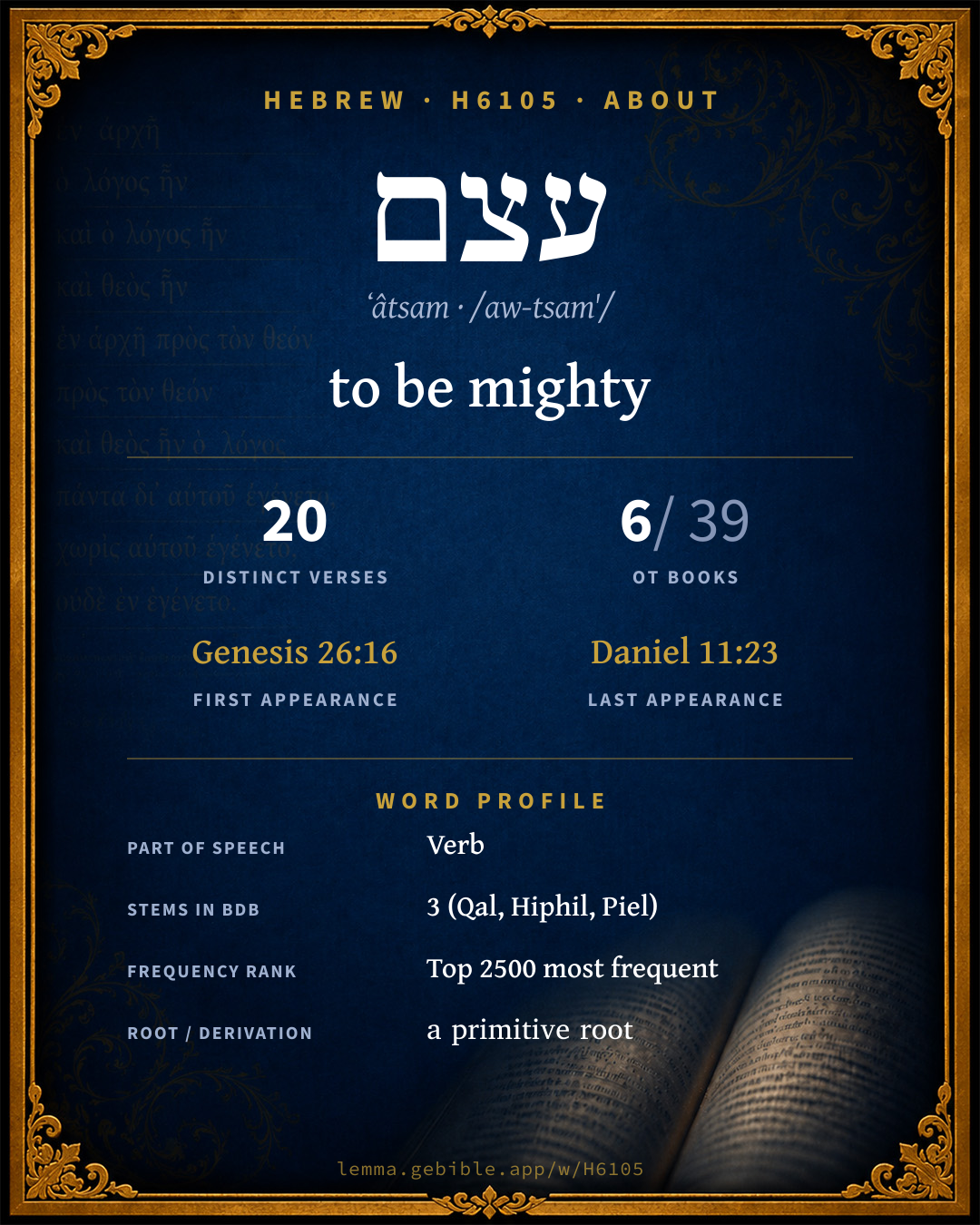
עצם
to be mighty
‘to be mighty’ is one of 2 main senses fuller range ↓
Full lexicon entry — Brown-Driver-Briggs (BDB)
From Brown-Driver-Briggs (BDB)
Where this word appears
See every Qal verb in the Hebrew Bible →
Grammar key — what these labels mean
Part of speech
- Verb
- An action or state-of-being word.
Stem
- Qal
- The basic, simple active stem — the plain form of the verb (“he wrote”). Here: ‘be mighty’
- Hiphil
- The causative active stem (“he caused / brought about”).
- Piel
- An intensive or resultative active stem.
Form
- Perfect
- A completed action or state — Hebrew marks aspect (completeness) more than strict tense (“he wrote”).
- Sequential Perfect
- A perfect with prefixed waw continuing a preceding imperfect or command (waw-consecutive perfect).
- Sequential Imperfect
- An imperfect with prefixed waw — the standard past-narrative form (waw-consecutive imperfect).
- Infinitive Construct
- A bound verbal noun, frequently with prepositions (“to write / in writing”).
- Participle Active
- A verbal adjective expressing ongoing or characteristic action (“writing / one who writes”).
State
- Absolute
- The independent form of a noun, not bound to a following word.
Person
- 3rd Person
- The one spoken about (“he / she / it / they”).
- 2nd Person
- The one addressed (“you”).
Gender
- Common
- Either gender — not distinguished for this form.
- Masculine
- Grammatically masculine.
Number
- Plural
- More than one (in Hebrew, generally three or more).
- Singular
- One.
Grammatical forms 9 distinct
- Verb, Qal, Perfect, 3rd Person, Common, Plural 10 times (50%)
- Verb, Qal, Sequential Perfect, 3rd Person, Masculine, Singular 2 times (10%)
- Verb, Qal, Sequential Imperfect, 3rd Person, Masculine, Plural 2 times (10%)
- Verb, Qal, Infinitive Construct 1 time (5%)
- Verb, Hiphil, Sequential Imperfect, 3rd Person, Masculine, Singular 1 time (5%)
- Verb, Piel, Sequential Imperfect, 3rd Person, Masculine, Singular 1 time (5%)
- Verb, Qal, Participle Active, Masculine, Singular, Absolute 1 time (5%)
- Verb, Piel, Perfect, 3rd Person, Masculine, Singular 1 time (5%)
+1 more form (1 occurrence)
Parsed forms decoded from the imported morphology (morphhb / Westminster Leningrad Codex — WLC text public domain, morphhb tagging CC BY 4.0), counted across 20 parsed occurrences — not distinct verses.
Every verse where H6105 appears — 20 distinct verses across 6 books. Click any verse to open its interlinear word-by-word view. Verse text shown in the World English Bible for context — . Each verse’s Hebrew form is shown with its reference; the English is not keyword-highlighted, since the data carries no word-level English alignment. Use “Compare translations” on any verse to read it across multiple English versions. This concordance covers the Hebrew Bible; Septuagint (Greek Old Testament) occurrences are not indexed here.
Genesis 1 verse
Exodus 2 verses
- Exodus 1:7 וַ/יַּֽעַצְמ֖וּ conj + Qal wimpf 3mp The children of Israel were fruitful, and increased abundantly, and multiplied, and grew exceedingly mighty; and the land was filled with them.
- Exodus 1:20 וַ/יַּֽעַצְמ֖וּ conj + Qal wimpf 3mp God dealt well with the midwives, and the people multiplied, and grew very mighty.
Psalms 6 verses
- Psalms 38:19 עָצֵ֑מוּ Qal pf 3cp But my enemies are vigorous and many. Those who hate me without reason are numerous.
- Psalms 40:5 עָ֝צְמ֗וּ Qal pf 3cp Many, Yahweh, my God, are the wonderful works which you have done, And your thoughts which are toward us. They can't be set in order to you; If I would declare and speak of them, they are more than can be numbered.
- Psalms 40:12 עָצְמ֥וּ Qal pf 3cp For innumerable evils have surrounded me. My iniquities have overtaken me, so that I am not able to look up. They are more than the hairs of my head. My heart has failed me.
- Psalms 69:4 עָצְמ֣וּ Qal pf 3cp Those who hate me without a cause are more than the hairs of my head. Those who want to cut me off, being my enemies wrongfully, are mighty. I have to restore what I didn't take away.
- Psalms 105:24 וַ֝/יַּֽעֲצִמֵ/הוּ conj + Hiphil wimpf 3ms + sfx pers 3ms He increased his people greatly, And made them stronger than their adversaries.
- Psalms 139:17 עָ֝צְמוּ Qal pf 3cp How precious to me are your thoughts, God! How vast is the sum of them!
Isaiah 3 verses
- Isaiah 29:10 וַ/יְעַצֵּ֖ם conj + Piel wimpf 3ms For Yahweh has poured out on you the spirit of deep sleep, and has closed your eyes, the prophets; and your heads, the seers, has he covered.
- Isaiah 31:1 עָצְמ֣וּ Qal pf 3cp Woe to those who go down to Egypt for help, and rely on horses, and trust in chariots because they are many, and in horsemen because they are very strong, but they don't look to the Holy One of Israel, neither seek Yahweh!
- Isaiah 33:15 וְ/עֹצֵ֥ם conj + Qal ptcp.act ms He who walks righteously, and speaks blamelessly; he who despises the gain of oppressions, who shakes his hands from taking a bribe, who stops his ears from hearing of blood, and shuts his eyes from looking on evil:
Jeremiah 5 verses
- Jeremiah 5:6 עָצְמ֖וּ Qal pf 3cp Therefore a lion out of the forest shall kill them, a wolf of the evenings shall destroy them, a leopard shall watch against their cities; everyone who goes out there shall be torn in pieces; because their transgressions are many, [and] their backsliding is increased.
- Jeremiah 15:8 עָֽצְמוּ Qal pf 3cp Their widows are increased to me above the sand of the seas; I have brought on them against the mother of the young men a destroyer at noonday: I have caused anguish and terrors to fall on her suddenly.
- Jeremiah 30:14 עָצְמ֖וּ Qal pf 3cp All your lovers have forgotten you; they don't seek you: for I have wounded you with the wound of an enemy, with the chastisement of a cruel one, for the greatness of your iniquity, because your sins were increased.
- Jeremiah 30:15 עָֽצְמוּ֙ Qal pf 3cp Why cry you for your hurt? your pain is incurable: for the greatness of your iniquity, because your sins were increased, I have done these things to you.
- Jeremiah 50:17 עִצְּמ֔/וֹ Piel pf 3ms + sfx pers 3ms Israel is a hunted sheep; the lions have driven him away: first, the king of Assyria devoured him; and now at last Nebuchadrezzar king of Babylon has broken his bones.
Daniel 3 verses
- Daniel 8:8 וּ/כְ/עָצְמ֗/וֹ conj + prep + Qal inf.cs + sfx pers 3ms The male goat magnified himself exceedingly: and when he was strong, the great horn was broken; and instead of it there came up four notable [horns] toward the four winds of the sky.
- Daniel 8:24 וְ/עָצַ֤ם conj + Qal wpf 3ms His power shall be mighty, but not by his own power; and he shall destroy wonderfully, and shall prosper and do [his pleasure]; and he shall destroy the mighty ones and the holy people.
- Daniel 11:23 וְ/עָצַ֖ם conj + Qal wpf 3ms After the league made with him he shall work deceitfully; for he shall come up, and shall become strong, with a small people.
About this entry
At a glance — auto-summarized from this page’s data, not written by a person. Every figure links to its source below. This summary describes the numbers; it doesn’t interpret them.
The Hebrew verb עצם centers on the idea of “to be mighty.” First canonically at Genesis 26:16, it enters the text early. It turns up in 20 verses across 6 books, an uncommon footprint. The word gravitates to Psalms (30%), then Jeremiah and Isaiah. Read the stem: it spans 3 stems, including Qal and Hiphil. Dig into 20-verse concordance and the renderings breakdown below.
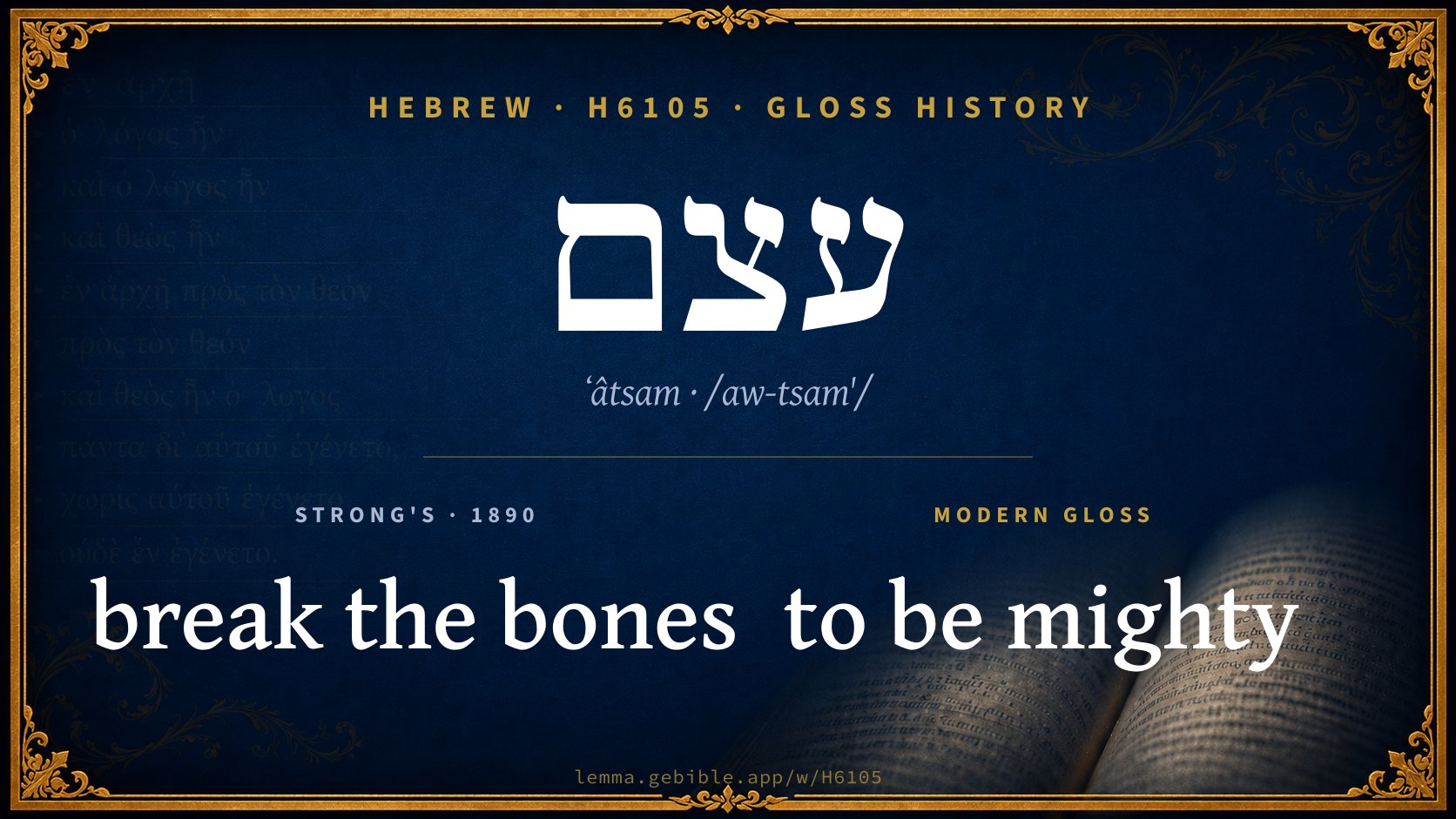
Gloss history
Strong's 1890 vs modern scholarship
About this word
Strong's H6105 catalogs a Hebrew word from the Hebrew Old Testament.
These counts are not copied from any lexicon or concordance. They are computed here, from the morphology-tagged Hebrew Old Testament. What Lemma adds →
- 20
- distinct verses
- The word appears in 20 distinct verses.
- 6 / 39
- OT books
- The word appears in 6 of 39 Old Testament books.
- #1,513
- by frequency
- Top 2500 most frequent Hebrew words (rank 1,513 of 8,640 Hebrew words by occurrence).
View all 20 occurrences in the concordance →
By section of the Old Testament
By traditional corpus
Conventional, traditional groupings — biblical authorship is debated, so this is a traditional corpus grouping, not an authorship claim. Each share is this word’s portion of its verses in that division of the Hebrew canon. Each figure is a share of the word’s 20 distinct verses.
- Writings (Ketuvim) 9 verses · 45%
- Prophets (Nevi'im) 8 verses · 40%
- Torah (Pentateuch) 3 verses · 15%
How translations render this word
Counts come from each version’s own published word-to-Strong’s tagging or interlinear alignment — an approximate guide to how each version renders this word, not a word-level alignment the data otherwise carries. Because each total is that version’s own tagged count, the per-version totals vary from one another and need not match the appearance or distinct-verse counts above. These counts may also differ from a printed concordance because Lemma counts each distinctly tagged rendering and does not collapse phrase taggings into a single head-word total. This is a fixed set of word-tagged versions (KJV, ASV, BSB, ULT) and does not change with the reading translation you choose elsewhere. Each version’s license is shown beside its name below (and on Sources).
BDB lists this Strong’s number as 2 distinct words (homographs). Each count above pools all of them and is not split by sense — see the Senses section below. A low-frequency rendering may belong to a different one of those words, not the primary meaning.
- King James Version†: Are increased 2×, Mighty 2×, They are more 2×
- American Standard Version†: Are increased 2×, Mighty 2×, Were increased 2×
- Berean Standard Bible†: Numerous 4×, More numerous 2×
- unfoldingWord Literal Text†: Are 1×, Are mighty 1×, Are numerous 1×
King James Version Public Domain
Renders H6105 across 20† tagged occurrences — most commonly:
Plus 12 renderings that appear only once — usually multi-word phrases or single function words the recovered tagging swept in, not distinct renderings.
American Standard Version Public Domain
Renders H6105 across 20† tagged occurrences — most commonly:
Plus 14 renderings that appear only once — usually multi-word phrases or single function words the recovered tagging swept in, not distinct renderings.
Berean Standard Bible Public Domain
Renders H6105 across 18† tagged occurrences — most commonly:
Plus 12 renderings that appear only once — usually multi-word phrases or single function words the recovered tagging swept in, not distinct renderings. Not rendered by a distinct English word in 2 further occurrences.
unfoldingWord Literal Text CC BY-SA 4.0
Renders H6105 across 20† tagged occurrences — most commonly:
Plus other, less common renderings.
Senses in the full BDB
Hebrew verbs can shift meaning by stem (binyan): Qal is the basic action, Niphal is often passive or reflexive, Piel often intensifies or makes it factitive, and Hiphil is typically causative. The senses below are grouped under the stem BDB assigns to each.
What do BDB’s symbols mean?
BDB uses these scholarly abbreviations:
| Symbol | Meaning |
|---|---|
| 𝔊 | the Septuagint (the ancient Greek translation, LXX) |
| 𝔙 | the Vulgate (the Latin translation) |
| 𝔖 | the Syriac version (the Peshitta) |
| 𝔗 | the Targum (the Aramaic translation) |
| ψ | the Psalms |
| √ | root (the underlying root or stem) |
| ‖ | parallel passage (a synonymous or contrasted parallel) |
| † | the dagger: every passage where the word occurs is cited |
The 5 senses and sub-senses the full Brown-Driver-Briggs lexicon distinguishes for this word, in lexicon order (not ranked by frequency), with BDB’s own verbatim wording and sub-sense lettering. Shown in Hebrew script with BDB’s own scholarly abbreviations. The condensed entry is in the Lexicon Entry tab. See also the Forms in the corpus table below.
עצם I be vast, mighty, numerous
Qal
- 1. be mighty
- 2. be numerous
Hiphil
- . make strong
עצם II shut the eyes
Qal
- shutteth his eyes from seeing
Piel
- . he hath tightly shut your eyes
Senses from the full Brown-Driver-Briggs lexicon (Brown, Driver, Briggs; Oxford 1906 — public domain), digitized via Sefaria, supplemented by the OpenScriptures HebrewLexicon (CC BY 4.0). Full attribution on Sources.
Word origin
I. [ עָצֹם ], עָצַם vb. be vast, mighty, numerous
II. [ עָצַם ] vb. shut the eyes
— Brown-Driver-Briggs (Oxford 1906, public domain), digitized via Sefaria, supplemented by the OpenScriptures HebrewLexicon (CC BY 4.0). See Sources.
Origin: a primitive root
Jastrow Dictionary
A second Hebrew/Aramaic lexicon for comparison, covering Aramaic and post-biblical (Talmudic, Targumic, Midrashic) usage that the biblical-Hebrew BDB does not. Matched by lemma rather than by Strong’s number, so a lemma may carry more than one Jastrow headword (shown separately below), and the entries cover usage well beyond the Bible.
עָצַם
- (b. h.)
- 1. to press; to close (the eyes). Yalk. Is. 304 זה העוֹצֵם עיניו כשעומדות וכ׳ he who closes his eyes when (he sees) Israelitish girls stand washing. Sifra K’dosh., Par. 3, ch. VII יַעֲצוֹם, v. infra.
- 2. [to be compressed, hard,] to be strong, v. עָצוּם a. עֶצֶם.
- 3. (denom. of עֶצֶם) to acquire, possess. Gen. R. s. 64 שעָצַמְתָּ, v. עֶצֶם.
- to close (the eyes). Kidd. 32ᵇ יכול יַעֲצִים עיניו וכ׳ perhaps a man might think, he will close his eyes and pretend not to see him (the old man); Yalk. Lev. 617; Sifra l. c. יעצום. Sabb. XXIII, 5 מַעֲצִים, v. עָמַץ.
- to close (a dead body’s eyes), v. עָמַץ.
- 1. to be closed, v. עָמַץ.
- 2. to be headstrong towards one another. Snh. 31ᵇ שנים שנִתְעַצְּמוּ בדין וכ׳ if both parties to a law-suit are stubborn, one saying, let us go to law here, and the other saying, let us go to the circuit court.
- 3. v. עִיצּוּם 3) to fortify each other, i.e. to enter an agreement with the condition of forfeiture. Tosef. B. Mets. I, 16 שנים שנתעצמו זה בזה ואמר וכ׳ if two made an agreement wherein one said, if I do not come &c.
עֶצֶם
- preced.) [strength,]
- 1. bone. Tosef. Sabb. VII (VIII), 21 עמד ע׳ בגרונו if a bone sticks in one’s throat; Sabb. 67ᵃ. Pes. VII, 11 השובר את הע׳ וכ׳ he who breaks a bone of the Passover sacrifice. Ib. 12 שאין בו משום שבירת הע׳ because the prohibition to break a bone does not apply to it; a. v. fr.—Pl. עֲצָמוֹת. Ib. 10. Ib. VIII, 8 והמלקט לו ע׳ he who has the bones (of a parent) collected, v. לָקַט; a. v. fr.
- 2. substance, essence, self (v. עִיצּוּם). Ab. I, 14 וכשאני לעַצְמִי וכ׳ and if I am (I care) for myself only, what am I? Ib. II, 13 אל תהי רשע בפני עַצְמֶךָ be not a wicked man in thine own sight (despair not of thyself). Ber. 43ᵃ; Tosef. ib. IV, 8 כל אחד ואחד מברך לעַצְמוֹ each says the blessing for himself. Zeb. VIII, 10 כשהוא בעצמו when it (the addition to, or the diminution from the prescribed action) stands by itself (is clearly visible); R. Hash. 28ᵇ; Erub. 100ᵃ. Sifré Deut. 19 לא מעַצְמִי אני וכ׳ I did not say that of my own accord (as my idea), but at the command of God. Num. R. s. 20; Tanḥ. Bal. 13 בקש לילך לעצמו וכ׳ he wanted to go to himself (go home); a. v. fr.—Pl. constr. עַצְמֵי. Sifré Deut. 16 לשעבר … עַצְמֵיכֶם וכ׳ in the past you were your own masters, now you are servants and subjects of the community; a. fr.
- 3. substance, wealth, esp. live stock. Yalk. Gen. 111 (ref. to וַעֲבֻדָּה, Gen. XXVI, 14) וַעֲבָדָהּ כתיב אם אין אדם נעשה כעבד לעַצְמוֹ וכ׳ it may be read ‘and he shall serve it’, unless a man become like a slave to his stock, he does not own it; Gen. R. s. 64 כמו עבד לעבדו (read לעצמו; cmp. Snh. 58ᵇ).—Pl. as ab. Gen. R. l. c. (ref. to עצמת ממנו, Gen. XXVI, 16) כל אותן ע׳ שעצמת ממני היה לך all these possessions (herds and flocks) which thou hast obtained, are they not from us?; Yalk. l. c. עֲצוּמוֹת. e.g. Genesis 26:14
A Dictionary of the Targumim, the Talmud Babli and Yerushalmi, and the Midrashic Literature (Marcus Jastrow; London, Luzac, 1903) — Public Domain. Digitized via Sefaria. Digitized via Sefaria. Full attribution on Sources.
Forms in the corpus
The 17 distinct written forms H6105 takes in the Hebrew Bible, most frequent first — each parse links to that stem’s occurrences in the concordance. Hebrew forms include their vowel points and cantillation, so a single lemma takes many written forms.
Same root — word family
Other BDB entries built from the same root as H6105, grouped by Strong’s listed origin. These share a root / origin per the lexicon — not necessarily a shared meaning. Each links to that word’s own entry.
Derived from this word
Compare all same-root words → Showing 4 of 5 — not the complete family. They share a root, not necessarily a meaning.
Septuagint verse parallels
This word appears in 17 verses that also exist in the Greek Old Testament (Septuagint), out of the 20 Hebrew verses it occurs in. You can read those verses in Greek by switching the Old Testament edition to the Septuagint.
Read these verses in the Septuagint
This is a verse-level parallel only — the same verses exist in both the Hebrew and Greek Old Testaments. No word-level Hebrew↔Greek correspondence is claimed: the data carries no such alignment, so no Greek word is shown as this Hebrew word’s translation. Coverage is not total — the Septuagint omits the deuterocanon and renumbers the Psalms, so some Hebrew verses have no direct Greek parallel.