
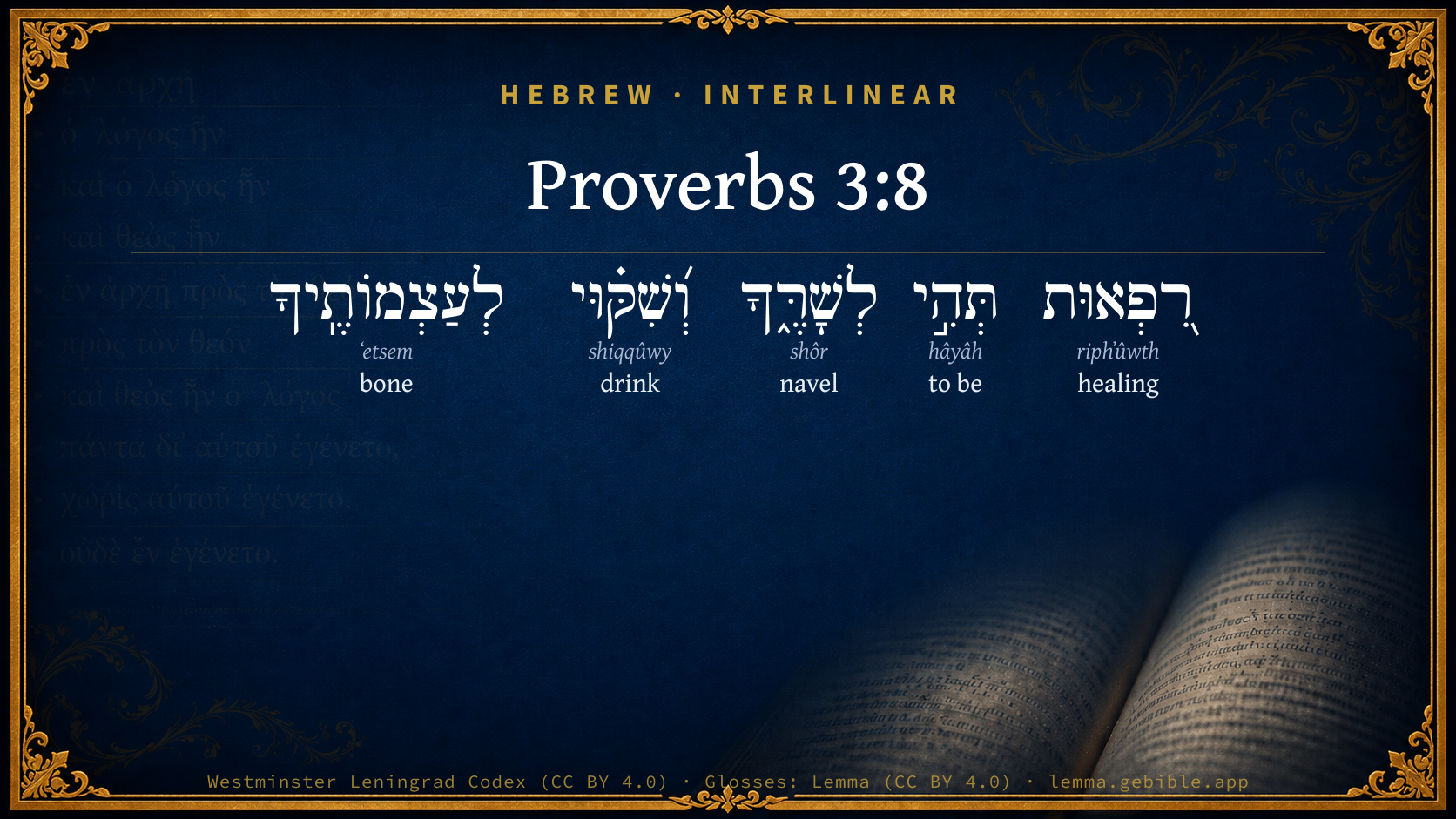
Proverbs 3:8

Hebrew (Westminster Leningrad Codex) Proverbs 3:8 appears in the Hebrew Old Testament. The text above is from the Westminster Leningrad Codex. Each word links to its Strong’s number, a concise gloss, and parsing drawn from the Open Scriptures Hebrew Bible morphology. Click any word for its full Brown-Driver-Briggs (BDB) entry.
Download image
Cite this verse

Proverbs 3:8 (World English Bible). Public Domain. Lemma interlinear Bible study tool, https://lemma.gebible.app/v/proverbs/3/8.

Show BibTeX & RIS
BibTeX
RIS
English Translation
It will be health to your body, And nourishment to your bones.
World English Bible · Public Domain
Highlights
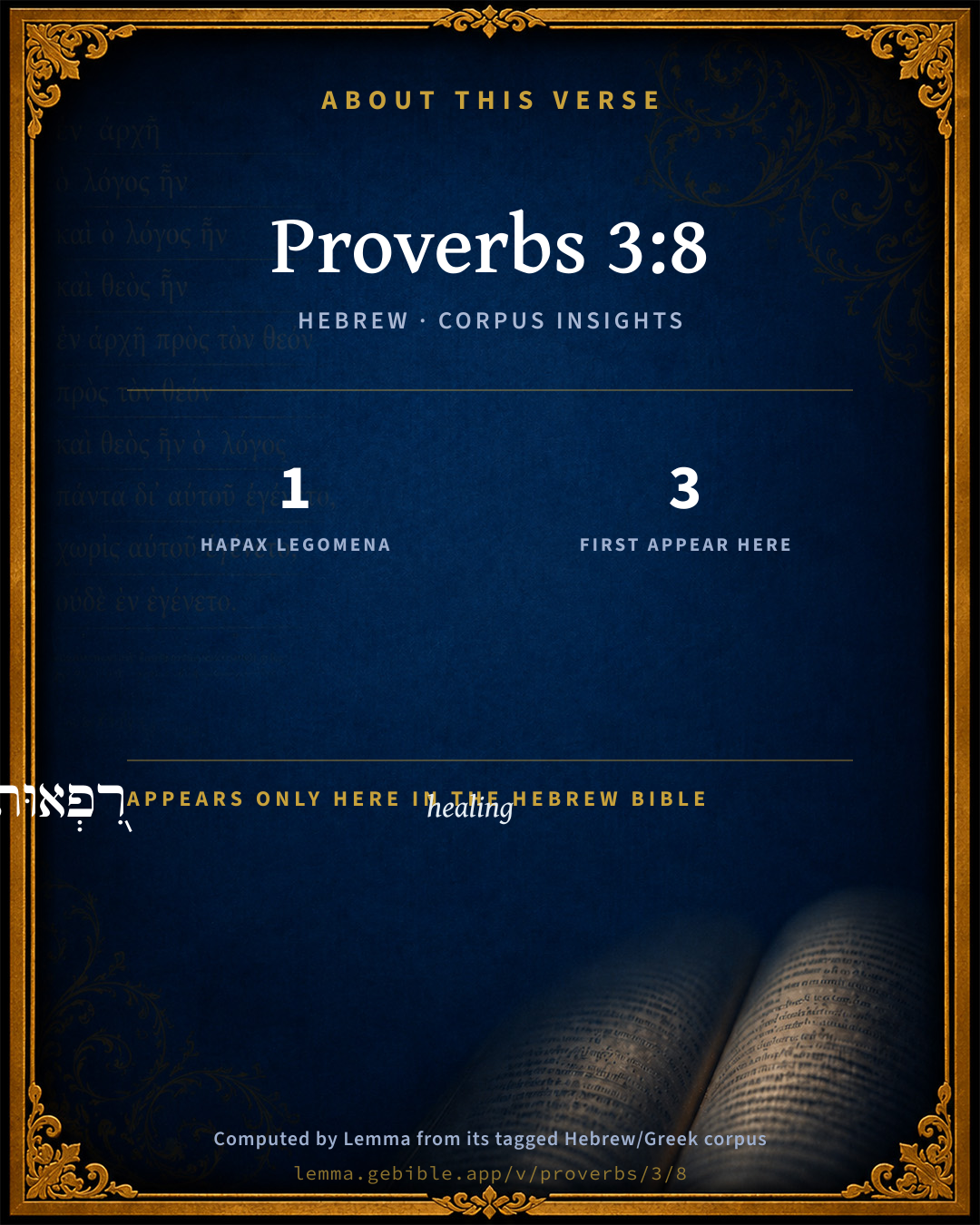
  • 1 hapax legomenon — only here in the Hebrew Bible
  • 3 first appearances in the Hebrew Bible
Full analysis ↓
Download a study sheet

One document with this verse’s original text, its word-by-word gloss line, the meaning frame, cross-references with their text, attributed commentary, and full source and license credits — printable, and it pastes into notes with its structure intact.

This verse Autodidact and up

Study sheet (.html) Plain text (.txt)

A passage Seminary Student

Up to 50 verses in one chapter. A passage sheet keeps up to 6 commentary sources and 12 cross-references per verse, in the order this page ranks them, and says so on the sheet whenever that leaves anything out. Ask for a single verse and you get the Autodidact verse sheet above.

Everything on this page stays free to read, with no account — the sheet is a download of what is already on screen, not access to it.

Want to remove ads? Support Godless Engineer
Compare translations 3

The same verse in 3 English versions, stacked beneath the original-language interlinear above. Click any original word for its lexicon entry.

Each is an independent rendering of the whole verse — the interlinear is not word-aligned to these translations.

Highlighted words mark where these versions differ — a whole-verse word diff, not a word-by-word alignment.

  • World English Bible Public Domain
    It will be health to your body, And nourishment to your bones.
  • King James Version Public Domain
    It shall be health to thy navel, and marrow to thy bones.
  • unfoldingWord Literal Text CC BY-SA 4.0
    It will be healing for your navel and refreshment for your bones.

unfoldingWord Literal Text — © unfoldingWord, licensed CC BY-SA 4.0. Word-aligned USFM3 via Door43 (git.door43.org/unfoldingWord/en_ult).

Versions to compare (up to 4)

3 of 4 selected

Show all 18 translations

Every available English version of this verse, each an independent rendering of the whole verse.

  • World English Bible Public Domain
    It will be health to your body, And nourishment to your bones.
  • Berean Standard Bible Public Domain
    This will bring healing to your body and refreshment to your bones.
  • Majority Standard Bible Public Domain
    This will bring healing to your body and refreshment to your bones.
  • King James Version Public Domain
    It shall be health to thy navel, and marrow to thy bones.
  • American Standard Version (1901) Public Domain
    It will be health to thy navel, And marrow to thy bones.
  • Revised Version (1885) Public Domain
    It shall be health to thy navel, and marrow to thy bones.
  • Geneva Bible (1599) Public Domain
    So health shalbe vnto thy nauel, and marowe vnto thy bones.
  • Douay-Rheims (1899) Public Domain
    For it shall be health to thy navel, and moistening to thy bones.
  • Young's Literal Translation Public Domain
    Healing it is to thy navel, And moistening to thy bones.
  • Literal Standard Version CC BY-SA 4.0
    It is healing to your navel, || And moistening to your bones.
  • Unlocked Literal Bible CC BY-SA 4.0
    It will be healing to your flesh and refreshment for your body.
  • unfoldingWord Literal Text CC BY-SA 4.0
    It will be healing for your navel and refreshment for your bones.
  • Darby Bible Public Domain
    it shall be health for thy navel, and moisture for thy bones.
  • World Messianic Bible Public Domain
    It will be health to your body, and nourishment to your bones.
  • Webster's Bible Public Domain
    It shall be health to thy navel, and marrow to thy bones.
  • Free Bible Version CC BY-SA 4.0
    Then you will be healed and made strong.
  • Bible in Basic English Public Domain
    This will give strength to your flesh, and new life to your bones.
  • JPS Tanakh (1917) Public Domain
    It shall be health to thy navel, and marrow to thy bones.

Literal Standard Version (2020), Covenant Press — licensed CC BY-SA 4.0. Text via the HelloAO Bible API (eBible.org). Unlocked Literal Bible (unfoldingWord) — licensed CC BY-SA 4.0. Text via the HelloAO Bible API (eBible.org). unfoldingWord Literal Text — © unfoldingWord, licensed CC BY-SA 4.0. Word-aligned USFM3 via Door43 (git.door43.org/unfoldingWord/en_ult). Free Bible Version, Dr. Jonathan Gallagher — licensed CC BY-SA 4.0. Text via the HelloAO Bible API (eBible.org).

Word by word

More ways to search: Search by grammar → Find every occurrence → Compare this word →

Practice this passage: Drill this verse → Learn its vocabulary →

About this verse

These counts appear in no published source. They are computed here, from the morphology-tagged text and Lemma’s own curated glosses. What Lemma adds →

5
words
5
distinct lemmas
Wisdom
section

Notable vocabulary

1 hapax legomenon — a word that appears only here in the entire Hebrew Bible:

  • רִ֭פְאוּת healing H7500

First appearance in Scripture

These words make their first canonical appearance in the Hebrew Bible here:

  • רִ֭פְאוּת healing H7500
  • לְשָׁרֶּ֑ךָ navel H8270
  • וְ֝שִׁקּ֗וּי drink H8250

Shared distinctive vocabulary

לְשָׁרֶּ֑ךָ navel H8270 occurs in 2 verses of the Hebrew Bible. Also found in:

Grammatical profile

  • 1 verb
  • 4 nouns

Verb forms

  • תְּהִ֣י Qal · Jussive

Hebrew & Septuagint length

In English translation the verse runs 12 words from the Hebrew and 14 from the Septuagint (LXX English) — closely comparable.

A rough comparison of the two English renderings, which tokenize alike — not a word-level alignment.

Word counts can differ between the Hebrew and the Greek without any difference in meaning — e.g. the Hebrew direct-object marker אֵת has no separate Greek word, and Greek often adds the article ὁ.

Cross-references

7

Topical passages linked to Proverbs 3:8 in the Treasury of Scripture Knowledge — connected by theme and wording, ordered by reader-vote popularity; previews shown in the World English Bible.

  • Proverbs 4:22 For they are life to those who find them, And health to their whole body.
  • Psalms 147:3 He heals the broken in heart, And binds up their wounds.
  • Proverbs 16:24 Pleasant words are a honeycomb, Sweet to the soul, and health to the bones.
  • Job 21:24 His pails are full of milk. The marrow of his bones is moistened.
  • Ezekiel 16:4–5 As for your birth, in the day you were born your navel was not cut, neither were you washed in water to cleanse you; you weren't salted at all, nor swaddled at all.
  • Isaiah 1:6 From the sole of the foot even to the head there is no soundness in it: Wounds, welts, and open sores. They haven't been closed, neither bandaged, neither soothed with oil.
  • Jeremiah 30:12–13 For thus says Yahweh, Your hurt is incurable, and your wound grievous.

Cross-references courtesy of OpenBible.info (CC BY 4.0).

Hebrew and Greek witnesses Masoretic Hebrew ↔ Greek Septuagint

The same verse in the two great witnesses to the Old Testament, shown verse-for-verse.

These are two independent witnesses, not word-aligned to each other, and the Septuagint is shown in lemma (dictionary) form.

Hebrew Proverbs 3:8 Masoretic · Westminster Leningrad Codex

רִ֭פְאוּת תְּהִ֣י לְשָׁרֶּ֑ךָ וְ֝שִׁקּ֗וּי לְעַצְמוֹתֶֽיךָ

It will be health to your body, And nourishment to your bones.

World English Bible · Public Domain

Greek LXX Proverbs 3:8 Septuagint · lemma form

τότε ἴασις εἰμί ὁ σῶμα σύ καί ἐπιμέλεια ὁ ὀστέον σύ

Then shall there be health to your body, and good keeping to your bones.

LXX2012 (modern English Septuagint) · Public Domain

On this verse, The Cambridge Bible for Schools and Colleges discusses the Septuagint’s reading. Read the note in Commentary ↓

Hebrew: Westminster Leningrad Codex (CC BY 4.0). Greek: Septuagint (public domain); English from LXX2012 (modern English Septuagint) (Public Domain). How the Septuagint differs from the Hebrew →

Commentary

Notes on Proverbs 3:8 from classic Christian and Jewish commentators (each source and its license shown beneath its notes). The classic Christian expositions comment on the surrounding passage and are grouped to its opening verse, so a note may address several verses; the Jewish commentaries on the Tanakh (Rashi and others) are per-verse, so they appear only where the commentator wrote on this verse.

Lemma curates 59 commentaries, every one of them public domain or Creative Commons licensed, each selected and text-cleaned for this edition rather than reprinted as found. About our sources →

Trapp's Complete Commentary

John Trapp

Pro 3:8 It shall be health to thy navel, and marrow to thy bones.

Ver. 8. It shall be health to thy navel.] That is, Thou shalt be in good plight both for the outward and inward man: Thy bones full of marrow, thy breasts full of milk, thy spirit also lively and lifted up in the ways of the Lord. And as it is with children in the womb (for to these is the allusion here), that by the navel nourishment is ministered unto them, yea, even to the strengthening of the inward parts: so the godly in the Church are fed and bred by the faith and fear of God. And as without marrow in the bones, no part of man, no, not that which is of greatest value and force, is able to do any thing: {a} so the strength that they have from God, is as the marrow which strengtheneth the bones, and maketh them apt to do good things. And as a man that hath his bones filled with marrow, and hath abundance of good blood and fresh spirits in his body, can endure to go with less clothes than another, because he is well lined within: so it is with a heart that hath a great deal of grace and peace; he will go through difficulties and troubles, though outward comforts fail him. It is recorded of Mr Saunders, martyr, {b} that himself should tell the party that lay in the same bed with him in prison, that even in the time of his examination before Stephen Gardiner, he was wonderfully comforted, not only in spirit, but also in body, he received a certain taste of that holy communion of saints, while a most pleasant refreshing did issue from every part and member of the body to the seat and place of the heart, and from thence did ebb and flow to and fro unto all the parts again.

{a} Munster, Mercer, T. W., and others, in loc.

{b} Acts and Mon., fol. 1358.

John Trapp, A Commentary or Exposition upon All the Books of the Old and New Testament (1647–1656) — public domain. Text from a community e-Sword module.

Tyndale Open Study Notes

Tyndale Open Resources

3:8 Healing and strength mean enjoying physical vitality as God’s reward for following wisdom’s way.

Tyndale Open Study Notes — © Tyndale Open Resources, licensed CC BY-SA 4.0. Text via the HelloAO Bible API.

Geneva Bible (1599)

Geneva Bible translators

By this part he comprehendeth the whole body, as by health he meaneth all the benefits promised in the Law both corporal and spiritual.

Geneva Bible (1599) marginal notes — public domain. Text via Bolls.life.

Jamieson, Fausset & Brown

Robert Jamieson, A. R. Fausset & David Brown

It--This conduct.

health--(Compare Margin).

to thy navel--for all the organs of nourishment.

marrow--(Compare Margin).

bones--frame of body. True piety promotes bodily health.

Jamieson, Fausset & Brown — Commentary Critical and Explanatory on the Whole Bible (1871) — public domain (CC PDM 1.0). Text via the HelloAO Bible API.

Adam Clarke's Commentary

Verse 8. It shall be health to thy navel] We need not puzzle ourselves to find out what we may suppose to be a more delicate meaning for the original word שר shor than navel; for I am satisfied a more proper cannot be found. It is well known that it is by the umbilical cord that the fetus receives its nourishment all the time it is in the womb of the mother. It receives nothing by the mouth, nor by any other means: by this alone all nourishment is received, and the circulation of the blood kept up. When, therefore, the wise man says, that "trusting in the Lord with the whole heart, and acknowledging him in all a man's ways, c., shall be health to the navel, and marrow to the bones" he in effect says, that this is as essential to the life of God in the soul of man, and to the continual growth in grace, as the umbilical cord is to the life and growth of the fetus in the womb. Without the latter, no human being could ever exist or be born; without the former, no true religion can ever be found. Trust or faith in God is as necessary to derive grace from him to nourish the soul, and cause it to grow up unto eternal life, as the navel string or umbilical cord is to the human being in the first stage of its existence. I need not push this illustration farther: the good sense of the reader will supply what he knows. I might add much on the subject.

And marrow to thy bones.] This metaphor is not less proper than the preceding. All the larger bones of the body have either a large cavity, or they are spongious, and full of little cells: in both the one and the other the oleaginous substance, called marrow, is contained in proper vesicles, like the fat. In the larger bones, the fine oil, by the gentle heat of the body, is exhaled through the pores of its small vesicles, and enters some narrow passages which lead to certain fine canals excavated in the substance of the bone, that the marrow may supply the fibres of the bones, and render them less liable to break. Blood-vessels also penetrate the bones to supply this marrow and this blood; and consequently the marrow is supplied in the infant by means of the umbilical cord. From the marrow diffused, as mentioned above, through the bones, they derive their solidity and strength. A simple experiment will cast considerable light on the use of the marrow to the bones: - Calcine a bone, so as to destroy all the marrow from the cells, you will find it exceedingly brittle. Immerse the same bone in oil so that the cells may be all replenished, which will be done in a few minutes; and the bone reacquires a considerable measure of its solidity and strength; and would acquire the whole, if the marrow could be extracted without otherwise injuring the texture of the bone. After the calcination, the bone may be reduced to powder by the hand; after the impregnation with the oil, it becomes hard, compact, and strong. What the marrow is to the support and strength of the bones, and the bones to the support and strength of the body; that, faith in God, is to the support, strength, energy, and salvation of the soul. Behold, then, the force and elegance of the wise man's metaphor. Some have rendered the last clause, a lotion for the bones. What is this? How are the bones washed? What a pitiful destruction of a most beautiful metaphor!

Adam Clarke's Commentary on the Bible (1810–1826) — public domain. Text from a community e-Sword/MySword module.

Ellicott's Commentary for English Readers

(8) Navel.—As being the centre, and so the most important part of the body. (Comp. the epithet applied to Delphi, “navel of the earth.”)

Marrow.—Literally, watering: i.e., refreshing. (Comp. Job_21:24.) For the opposite condition, “dryness of the bones, comp. Pro_17:22.

A Bible Commentary for English Readers, edited by Charles John Ellicott (1878–1897) — public domain. Text from a community e-Sword module.

The Cambridge Bible for Schools and Colleges

gen. ed. J. J. S. Perowne

8. health] By an eternal law the moral condition and the physical are linked together; the mens sana promotes the corpus sanum.

“Godliness is profitable unto all things, having promise of the life that now is.” 1Ti_4:8.

to thy navel] So R.V. The LXX. give to thy body, τῷ σώματί σου (comp. Pro_4:22), reading, as Ewald conjectures, a Heb. word which differs by a single letter (which has dropped out) from our present Heb. text Their rendering, however, may be only a free translation, of the nature of a gloss, of the Heb. as it now stands.

marrow] Lit. moistening. Vulg. irrigatio. The moisture and freshness of a healthy and well-nourished body are indicated. Comp. “The marrow of his bones is moistened,” Job_21:24, R.V., and for the contrary effect of disease and suffering, Job_30:30; Psa_102:3.

The Cambridge Bible for Schools and Colleges (gen. ed. J. J. S. Perowne; Cambridge University Press, 1878–1918) — public domain. Text from a community e-Sword module.

John Gill's Exposition

It shall be health to thy navel,.... That part of the body which is the knot of the intestines; and may be put for the bowels and inward parts, which being sound, the body is in health; and these may be put for the whole body: and so the Septuagint version renders it, "to thy body"; and this may be put for the whole person. And the sense is, either wisdom, as Jarchi; the doctrine of wisdom, the Gospel; which teaches men to trust in the Lord, and not in themselves, to apply to him for wisdom, and not lean to their own understanding; this contributes much to a man's spiritual health and welfare: or else the fear of the Lord is of this use to men, both in soul and body; since by it they depart from those sins which bring diseases upon the body; and are influenced by it to the exercise of such graces, and the discharge of such duties, as are the means of keeping the soul in good plight;

and marrow to thy bones; or, "watering" (m) to them: that which irrigates and moistens them, and makes and keeps them strong and solid: see Job 21:24. What marrow is to the bones, that is wisdom, or the fear of God, to the souls of men; the means of establishing and strengthening them against sin, and snares and temptations, and to do the will and work of God.

(m) "irrigatio", V. L. Montanus, Tigurine version, Vatablus, Junius & Tremellius, Piscator, Cocceius, Amama, Schultens.

John Gill's Exposition of the Whole Bible (1746–1763) — public domain (CC PDM 1.0). Text via the HelloAO Bible API.

Albert Barnes' Notes on the Bible

Navel - The central region of the body is taken as the representative of all the vital organs. For “health” we should read healing, or, as in the marg. There is probably a reference to the local applications used by the surgery of the period as means of healing.

Albert Barnes' Notes on the Bible (1834–1885) — public domain. Text from a community e-Sword/MySword module.

Haydock's Catholic Bible Commentary

Bones. Thou shalt enjoy perfect health.

George Leo Haydock (1774–1849), Haydock's Catholic Family Bible and Commentary, 1859 edition — public domain. Excludes Psalms (Douay-Rheims chapter numbering differs from Protestant) and Deuterocanonical books (Catholic canon only).

Matthew Poole's English Annotations

To thy navel, i.e. to thy body, which is signified by the navel, which is a noble and useful part of the body, by which the infant receives nourishment in the womb, and which is the ligament or bond by which the bowels, a principal part of the body, are united together and preserved.

Marrow is the nourishment and strength of the bones, and a great preserver and prolonger of life, as the decay of it is a chief cause of the weakness, and dryness, and decay of the body. The sense of the verse is, This wisdom or fear of God is not only useful to the salvation of the soul, but also to the health and welfare of the body, both as it prevents those diseases and distempers which are oft procured by sinful lusts and passions, and as it giveth us an interest in all God’s promises, and putteth us under the care of his special providence.

Matthew Poole's English Annotations on the Holy Bible (1683–1685) — public domain. Text from a community e-Sword/MySword module.

Whedon's Commentary on the Bible

Daniel D. Whedon

8. Health to thy navel — Rather, restoration to thy sinew, (sing. coll.,) and moistening (refreshment) to thy bones. The word שׁר, (shor,) rendered navel in E.V., literally means a cord, and is sometimes, as in Eze_16:4, applied to the umbilical cord; but in other places it seems to be used for sinews, muscles, or tendons of the body, or of a particular part of it, as Job_40:16, where the rendering probably should be, “the muscles of the belly.” In this place the word stands in parallelism with bones, and probably means the firmer muscular or tendinous parts, in contradistinction to the bony or more solid parts. Taken together, the terms mean the body. The muscles, sinews, or tendons, are the “cordage” of the body, by which the bones are both held in their places and moved. In order to sound health and longevity these need continual renovation, to repair and compensate the waste always taking place. This restoration is made by the proper distribution of the vital fluids to every part, perfectly irrigating the whole body, even the bones. This seems to be the imagery of the text, and the sentiment is, that piety and high mental cultivation, which are always in this book supposed to go hand in hand, tend to the preservation of health and the prolonging of life — a fact which observation and experience have abundantly demonstrated. The average period of human life is greatly extended by the march of Christian civilization and enlightenment. That restraint (musar, discipline, see note, Pro_1:2) which true religion, whether Mosaic or Christian, throws upon the passions and appetites — that moderation and temperance which it enjoins in the use of earthly good — that knowledge of physical laws which it promotes — that serenity of mind which it inspires — as also that sacredness with which it invests life — all tend to the prolongation and happiness of earthly existence.

Daniel D. Whedon (gen. ed.), Commentary on the Old and New Testaments (1874–1909) — public domain. Text from a community e-Sword module.

The Pulpit Commentary

It shall be health to thy navel, and marrow to thy bones. A metaphorical expression, denoting the complete spiritual health which shall follow from fearing the Lord and departing from evil. Health, (riph"uth); properly, healing; LXX, iasiv ; Vulgate, sanitas; so Syriac and Arabic. The Targum Jonathan has medicina, "medicine," as the margin. The root rapha is properly "to sew together," and the secondary meaning, "to heal," is taken from the healing of a wound by sewing it up. Delitzsch, however, thinks riph"uth is not to be taken as a restoration from sickness, but as a raising up from enfeebled health, or a confirming of the strength which already exists. There shall be a continuance of health. Gesenius translates "refreshment." To thy navel (l"shor"rekha); Vulgate, umbilico tuo; so Targum Jonathan. Shor is "the navel," here used synecdochically for the whole body, just as "head" is put for the whole man, (Jud_1:5:30) "mouth" for the whole person speaking, (Pro_8:13) and "slow bellies" for depraved gluttons (Tit_1:12) (Gejerus, Umbreit). The idea is expressed in the LXX, Syriac, and Arabic by "to thy body" (tw swmati sou ; corpori tuo). The navel is here regarded as the centre of vital strength. For the word, see Son_7:2 Eze_16:4. This is the only place in the Proverbs where this word is found. Gesenius, however, takes shor, or l"shor"rekha, as standing collectively for the nerves, in which, he says, is the seat of strength, and translates accordingly, "Health (i.e. refreshment) shall it be to thy nerves." Marrow (shik"kuy); literally, watering or moistening, as in the margin; Vulgate, irrigatio. Moistening is imparted to the bones by the marrow, and thus they are strengthened: "His bones are moistened with marrow".Where (Job_21:24) there is an absence of marrow the drying up of the bones ensues, and hence their strength is impaired, and a general debility of the system sets in they "wax old". (Psa_32:3) The effect of a broken spirit is thus described: "A broken spirit drieth up the bones". (Pro_17:22) The physiological fact here brought forward is borne witness to by Cicero, "In Tusc.:" "In visceribus atque medullis omne bonum condidisse naturam" (cf. Plato). The meaning of the passage is that, as health to the navel and marrow to the bones stand as representatives of physical strength, so the fear of the Lord, etc., is the spiritual strength of God"s children.

The Pulpit Commentary (1880–1919), ed. H.D.M. Spence-Jones & Joseph S. Exell — public domain. Text from a community e-Sword module.

John Wesley's Explanatory Notes

Navel - To thy body, which is signified by one part of it. Marrow - Which is the nourishment and strength of the bones.

John Wesley, Explanatory Notes Upon the Whole Bible (1754–1765) — public domain. Text via the GEBible commentary corpus.

Rashi

Rabbi Shlomo Yitzchaki (Rashi)

It shall be healing for your navel Heb. לשרך. The wisdom shall be healing. שרך is like (Song 7:4): שררך, which means, your navel.

and marrow for your bones Heb. ושקוי, lit. moisture. That is the marrow, as the matter is stated (Job 21:24): “and the marrow of his bones is moistened.”

Rashi on the Tanakh — English translations: “The Judaica Press complete Tanach with Rashi, translated by A. J. Rosenberg” (CC BY 4.0); “Pentateuch with Rashi's commentary by M. Rosenbaum and A.M. Silbermann, 1929-1934” (public domain); “The Metsudah Tanach series, Lakewood, N.J” (CC BY 4.0); and “The Book of Joshua, Metsudah Publications, 1997” (CC BY 4.0). Text via Sefaria.

Lesson kit

Teaching starters — assembled from the data on this page, not authored interpretation. Every prompt links to the verse data it draws on. Edit before teaching.

Proverbs, in the Wisdom, opens this verse with 5 words (5 distinct Hebrew lemmas). Its most distinctive word is riphʼûwth (“healing”). A historical commentator’s framing appears above. Read the whole chapter for the surrounding context.

Discussion questions

  1. How does “healing” (riphʼûwth) shape what this verse is saying?
  2. This verse holds 1 word here found nowhere else in the Hebrew Bible. What might the rare word draw attention to?
  3. 3 words here appear for the first time in Scripture. What is being introduced at this debut?
  4. Ezekiel 16:4 shares the word «navel» with this verse. How do the two illuminate each other?
  5. These translations render this verse differently. What is at stake in choosing one wording over another?
  6. The verb «תְּהִ֣י» is Qal Jussive. How does its form color the action?
  7. Reading how Trapp's Complete Commentary and Tyndale Open Study Notes read this verse, where do the two commentators agree and where do they part?

Things to notice

  • 1 word in this verse appears nowhere else in the Hebrew Bible.
  • 3 words make their first canonical appearance in Scripture here.
  • These translations choose different wording for 9 words in this verse.
  • 5 distinct Hebrew lemmas span 5 words in this verse.

Reading settings

Reading text

Shown beneath each verse's original-language words.

Old Testament
Old Testament edition

Read the OT as the Masoretic Hebrew (MT) or the Greek Septuagint (LXX).

English shown for the Greek Septuagint (in the Hebrew ↔ Greek comparison).

Comparing translations? Open the Compare panel on any verse page to stack up to four side by side.