Ezekiel 37:4

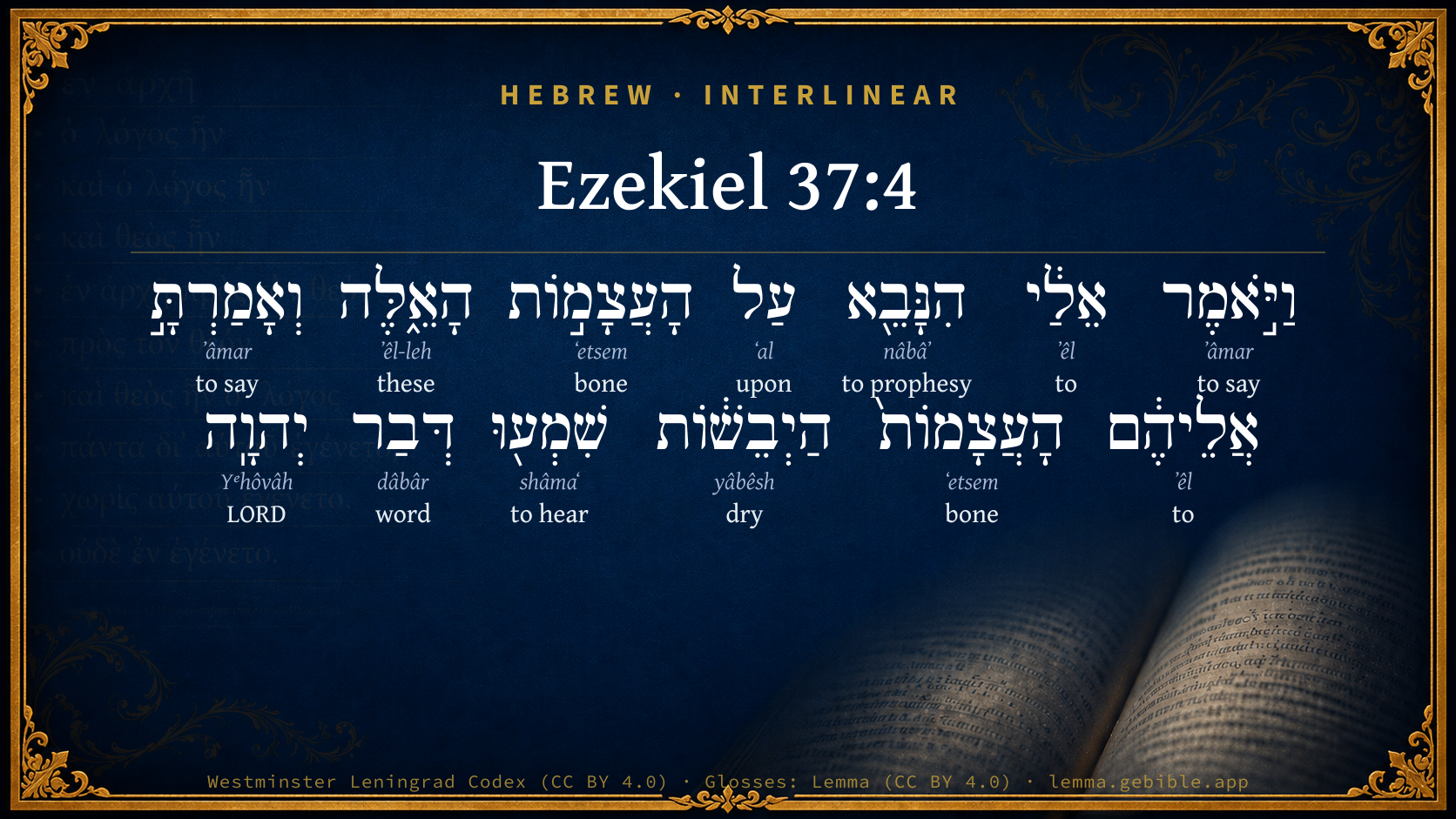
Hebrew (Westminster Leningrad Codex) Ezekiel 37:4 appears in the Hebrew Old Testament. The text above is from the Westminster Leningrad Codex. Each word links to its Strong’s number, a concise gloss, and parsing drawn from the Open Scriptures Hebrew Bible morphology. Click any word for its full Brown-Driver-Briggs (BDB) entry.
Download image
Cite this verse

Ezekiel 37:4 (World English Bible). Public Domain. Lemma interlinear Bible study tool, https://lemma.gebible.app/v/ezekiel/37/4.

Show BibTeX & RIS
BibTeX
RIS
English Translation
Again he said to me, Prophesy over these bones, and tell them, you dry bones, hear the word of Yahweh.
World English Bible · Public Domain
Download a study sheet

One document with this verse’s original text, its word-by-word gloss line, the meaning frame, cross-references with their text, attributed commentary, and full source and license credits — printable, and it pastes into notes with its structure intact.

This verse Autodidact and up

Study sheet (.html) Plain text (.txt)

A passage Seminary Student

Up to 50 verses in one chapter. A passage sheet keeps up to 6 commentary sources and 12 cross-references per verse, in the order this page ranks them, and says so on the sheet whenever that leaves anything out. Ask for a single verse and you get the Autodidact verse sheet above.

Everything on this page stays free to read, with no account — the sheet is a download of what is already on screen, not access to it.

Want to remove ads? Support Godless Engineer
Compare translations 3

The same verse in 3 English versions, stacked beneath the original-language interlinear above. Click any original word for its lexicon entry.

Each is an independent rendering of the whole verse — the interlinear is not word-aligned to these translations.

Highlighted words mark where these versions differ — a whole-verse word diff, not a word-by-word alignment.

  • World English Bible Public Domain
    Again he said to me, Prophesy over these bones, and tell them, you dry bones, hear the word of Yahweh.
  • King James Version Public Domain
    Again he said unto me, Prophesy upon these bones, and say unto them, O ye dry bones, hear the word of the LORD.
  • unfoldingWord Literal Text CC BY-SA 4.0
    Then he said to me, “Prophesy over these bones and say to them, ‘Dry bones. Listen to the word of Yahweh.

unfoldingWord Literal Text — © unfoldingWord, licensed CC BY-SA 4.0. Word-aligned USFM3 via Door43 (git.door43.org/unfoldingWord/en_ult).

Versions to compare (up to 4)

3 of 4 selected

Show all 18 translations

Every available English version of this verse, each an independent rendering of the whole verse.

  • World English Bible Public Domain
    Again he said to me, Prophesy over these bones, and tell them, you dry bones, hear the word of Yahweh.
  • Berean Standard Bible Public Domain
    And He said to me, “Prophesy concerning these bones and tell them, ‘Dry bones, hear the word of the LORD!
  • Majority Standard Bible Public Domain
    And He said to me, “Prophesy concerning these bones and tell them, ‘Dry bones, hear the word of the LORD!
  • King James Version Public Domain
    Again he said unto me, Prophesy upon these bones, and say unto them, O ye dry bones, hear the word of the LORD.
  • American Standard Version (1901) Public Domain
    Again he said unto me, Prophesy over these bones, and say unto them, O ye dry bones, hear the word of Jehovah.
  • Revised Version (1885) Public Domain
    Again he said unto me, Prophesy over these bones, and say unto them, O ye dry bones, hear the word of the LORD.
  • Geneva Bible (1599) Public Domain
    Againe he sayde vnto me, Prophecie vpon these bones and say vnto them, O ye dry bones, heare the word of the Lord.
  • Douay-Rheims (1899) Public Domain
    And he said to me: Prophesy concerning these bones; and say to them: Ye dry bones, hear the word of the Lord.
  • Young's Literal Translation Public Domain
    And He saith unto me, `Prophesy concerning these bones, and thou hast said unto them: O dry bones, hear a word of Jehovah:
  • Literal Standard Version CC BY-SA 4.0
    And He says to me, “Prophesy concerning these bones, and you have said to them, O dry bones, hear a word of YHWH!
  • Unlocked Literal Bible CC BY-SA 4.0
    Then he said to me, “Prophesy over these bones and say to them, 'Dry bones. Listen to the word of Yahweh.
  • unfoldingWord Literal Text CC BY-SA 4.0
    Then he said to me, “Prophesy over these bones and say to them, ‘Dry bones. Listen to the word of Yahweh.
  • Darby Bible Public Domain
    And he said unto me, Prophesy over these bones, and say unto them, Ye dry bones, hear the word of Jehovah.
  • World Messianic Bible Public Domain
    Again he said to me, “Prophesy over these bones, and tell them, ‘You dry bones, hear the LORD’s word.
  • Webster's Bible Public Domain
    Again he said to me, Prophesy upon these bones, and say to them, O ye dry bones, hear the word of the LORD.
  • Free Bible Version CC BY-SA 4.0
    He told me, “Prophesy to these bones and tell them, Dry bones, listen to this message from the Lord!
  • Bible in Basic English Public Domain
    And again he said to me, Be a prophet to these bones, and say to them, O you dry bones, give ear to the word of the Lord.
  • JPS Tanakh (1917) Public Domain
    Then He said unto me: 'Prophesy over these bones, and say unto them: O ye dry bones, hear the word of the LORD:

Literal Standard Version (2020), Covenant Press — licensed CC BY-SA 4.0. Text via the HelloAO Bible API (eBible.org). Unlocked Literal Bible (unfoldingWord) — licensed CC BY-SA 4.0. Text via the HelloAO Bible API (eBible.org). unfoldingWord Literal Text — © unfoldingWord, licensed CC BY-SA 4.0. Word-aligned USFM3 via Door43 (git.door43.org/unfoldingWord/en_ult). Free Bible Version, Dr. Jonathan Gallagher — licensed CC BY-SA 4.0. Text via the HelloAO Bible API (eBible.org).

Word by word

More ways to search: Search by grammar → Find every occurrence → Compare this word →

Practice this passage: Drill this verse → Learn its vocabulary →

הַיְבֵשׁ֔וֹת
yâbêsh
H3002
“the · dry”
Particle, Definite Article + Adjective, Adjective, Feminine, Plural, Absolute
Part of Speech
Particle + Adjective
Type
Adjective
Gender
Feminine
Number
Plural
State
Absolute
Full BDB Definition

Origin: from H3001

TWOT: 837a

dry - dried
  1. וַיֹּ֣אמֶר ʼâmar H559 “and · to say” Conjunction + Verb, Qal, Sequential Imperfect, 3rd Person, Masculine, Singular
  2. אֵלַ֔י ʼêl H413 “to · me” Preposition + Suffix, Personal, 1st Person, Common, Singular
  3. הִנָּבֵ֖א nâbâʼ H5012 “prophesy” Verb, Niphal, Imperative, 2nd Person, Masculine, Singular
  4. עַל ʻal H5921 “upon” Preposition
  5. הָעֲצָמ֣וֹת ʻetsem H6106 “the · bones” Particle, Definite Article + Noun, Common, Feminine, Plural, Absolute
  6. הָאֵ֑לֶּה ʼêl-leh H428 “the · these” Particle, Definite Article + Pronoun, Demonstrative, Common, Plural
  7. וְאָמַרְתָּ֣ ʼâmar H559 “and · to say” Conjunction + Verb, Qal, Sequential Perfect, 2nd Person, Masculine, Singular
  8. אֲלֵיהֶ֔ם ʼêl H413 “to · them” Preposition + Suffix, Personal, 3rd Person, Masculine, Plural
  9. הָעֲצָמוֹת֙ ʻetsem H6106 “the · bones” Particle, Definite Article + Noun, Common, Feminine, Plural, Absolute
  10. שִׁמְע֖וּ shâmaʻ H8085 “hear” Verb, Qal, Imperative, 2nd Person, Masculine, Plural
  11. דְּבַר dâbâr H1697 “word of” Noun, Common, Masculine, Singular, Construct
  12. יְהוָֽה Yᵉhôvâh H3068 “LORD” Noun, Proper

About this verse

These counts appear in no published source. They are computed here, from the morphology-tagged text and Lemma’s own curated glosses. What Lemma adds →

13
words
10
distinct lemmas
Prophets
section

Notable vocabulary

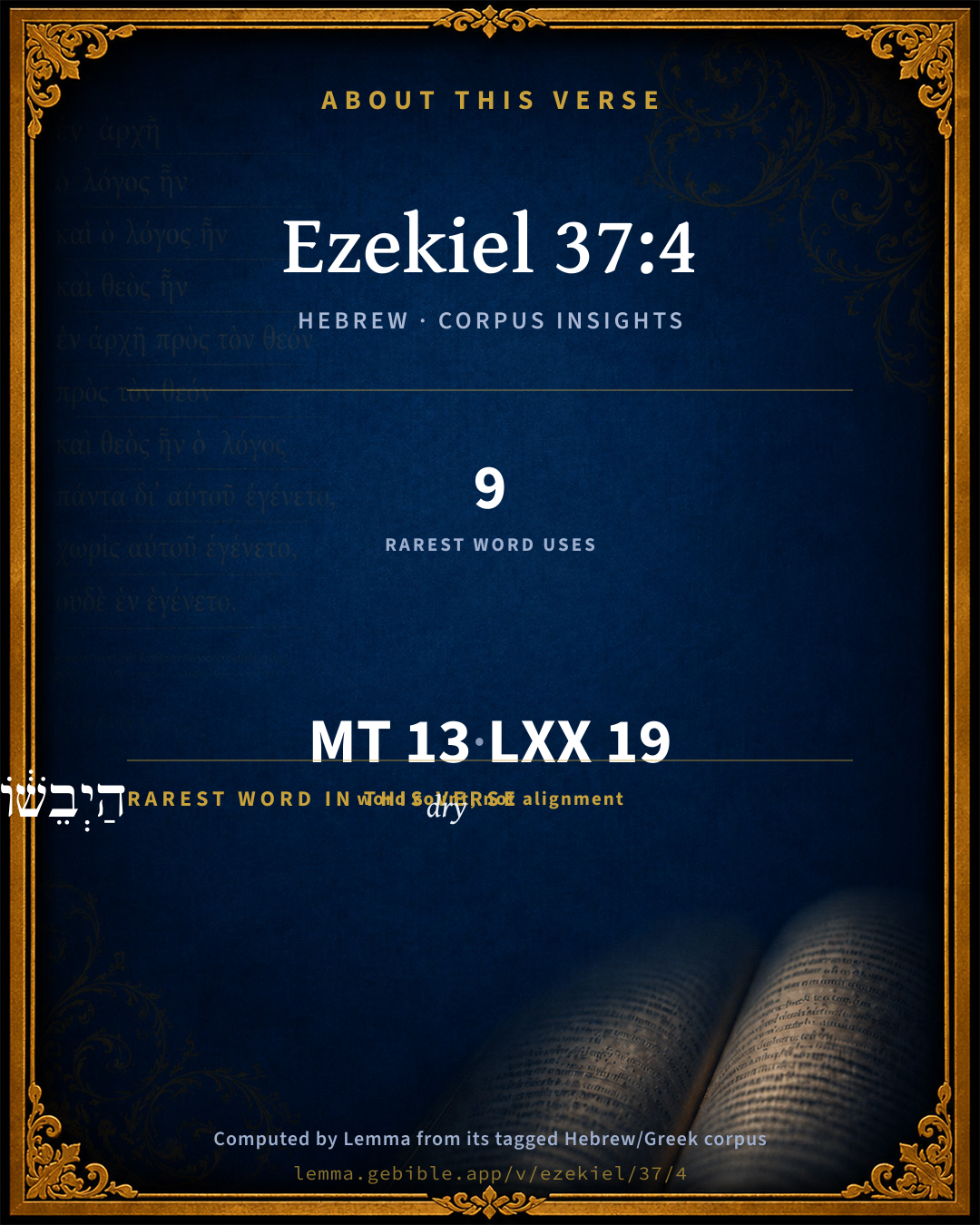
The rarest word here is הַיְבֵשׁ֔וֹת dry H3002 — appearing just 9 times in the whole Hebrew Bible.

Shared distinctive vocabulary

הַיְבֵשׁ֔וֹת dry H3002 occurs in 9 verses of the Hebrew Bible. Also found in:

Grammatical profile

  • 4 verbs
  • 4 nouns
  • 1 adjective
  • 1 pronoun
  • 3 prepositions

Verb forms

  • וַיֹּ֣אמֶר Qal · Sequential Imperfect
  • הִנָּבֵ֖א Niphal · Imperative
  • וְאָמַרְתָּ֣ Qal · Sequential Perfect
  • שִׁמְע֖וּ Qal · Imperative

Repetition

Words recur within this verse — often emphatic in Hebrew:

  • וַיֹּ֣אמֶר to say H559 ×2
  • הָעֲצָמ֣וֹת bone H6106 ×2
  • אֵלַ֔י to H413 ×2

Hebrew & Septuagint length

In English translation the verse runs 20 words from the Hebrew and 24 from the Septuagint (LXX English) — closely comparable.

A rough comparison of the two English renderings, which tokenize alike — not a word-level alignment.

Word counts can differ between the Hebrew and the Greek without any difference in meaning — e.g. the Hebrew direct-object marker אֵת has no separate Greek word, and Greek often adds the article ὁ.

In the original languages it is 13 Hebrew tokens and 19 Greek tokens — but the two are counted differently (Hebrew bundles its prefixes and suffixes into one token; the Greek is in lemma form), so that isn’t a like-for-like length.

Cross-references

13

Topical passages linked to Ezekiel 37:4 in the Treasury of Scripture Knowledge — connected by theme and wording, ordered by reader-vote popularity; previews shown in the World English Bible.

  • John 5:25 Most assuredly, I tell you, the hour comes, and now is, when the dead will hear the Son of God's voice; and those who hear will live.
  • John 5:28–29 Don't marvel at this, for the hour comes, in which all that are in the tombs will hear his voice,
  • Matthew 21:21 Jesus answered them, "Most assuredly I tell you, if you have faith, and don't doubt, you will not only do what is done to the fig tree, but even if you told this mountain, 'Be taken up and cast into the sea,' it would be done.
  • Ezekiel 36:1 You, son of man, prophesy to the mountains of Israel, and say, You mountains of Israel, hear the word of Yahweh.
  • Jeremiah 22:29 O earth, earth, earth, hear the word of Yahweh.
  • Isaiah 26:19 Your dead shall live; my dead bodies shall arise. Awake and sing, you who dwell in the dust; for your dew is [as] the dew of herbs, and the earth shall cast forth the dead.
  • Ezekiel 37:11 Then he said to me, Son of man, these bones are the whole house of Israel: behold, they say, Our bones are dried up, and our hope is lost; we are clean cut off.
  • John 2:5 His mother said to the servants, "Whatever he says to you, do it."
  • Numbers 20:8 Take the rod, and assemble the congregation, you, and Aaron your brother, and speak you to the rock before their eyes, that it give forth its water; and you shall bring forth to them water out of the rock; so you shall give the congregation and their cattle drink.
  • 1 Kings 13:2 He cried against the altar by the word of Yahweh, and said, altar, altar, thus says Yahweh: Behold, a son shall be born to the house of David, Josiah by name; and on you shall he sacrifice the priests of the high places who burn incense on you, and men's bones shall they burn on you.
  • Isaiah 42:18 Hear, you deaf; and look, you blind, that you may see.
  • Ezekiel 37:15–16 The word of Yahweh came again to me, saying,
  • Micah 6:2 Hear, you mountains, Yahweh's controversy, And you enduring foundations of the earth; For Yahweh has a controversy with his people, And he will contend with Israel.

Cross-references courtesy of OpenBible.info (CC BY 4.0).

Hebrew and Greek witnesses Masoretic Hebrew ↔ Greek Septuagint

The same verse in the two great witnesses to the Old Testament, shown verse-for-verse.

These are two independent witnesses, not word-aligned to each other, and the Septuagint is shown in lemma (dictionary) form.

Hebrew Ezekiel 37:4 Masoretic · Westminster Leningrad Codex

וַיֹּ֣אמֶר אֵלַ֔י הִנָּבֵ֖א עַל הָעֲצָמ֣וֹת הָאֵ֑לֶּה וְאָמַרְתָּ֣ אֲלֵיהֶ֔ם הָעֲצָמוֹת֙ הַיְבֵשׁ֔וֹת שִׁמְע֖וּ דְּבַר יְהוָֽה

Again he said to me, Prophesy over these bones, and tell them, you dry bones, hear the word of Yahweh.

World English Bible · Public Domain

Greek LXX Ezekiel 37:4 Septuagint · lemma form

καί εἶπον πρός ἐγώ προφητεύω ἐπί ὁ ὀστέον οὗτος καί εἶπον αὐτός ὁ ὀστέον ὁ ξηρός ἀκούω λόγος κύριος

And he said to me, Prophesy upon these bones, and you shall say to them, You⌃ dry bones, hear the word of the Lord.

LXX2012 (modern English Septuagint) · Public Domain

Hebrew: Westminster Leningrad Codex (CC BY 4.0). Greek: Septuagint (public domain); English from LXX2012 (modern English Septuagint) (Public Domain). How the Septuagint differs from the Hebrew →

Targum (Aramaic paraphrase)

1

The Targum is the ancient Jewish Aramaic paraphrase of the Hebrew Scriptures — an interpretive translation, not the Hebrew text itself. Onkelos (literal) and Pseudo-Jonathan (expansive) render the Torah, and Jonathan the Prophets. Coverage is partial: where no permissively-licensed English translation exists for a verse, only the Aramaic is shown. This is verse-level text, not a word-by-word alignment to the Hebrew.

  1. Targum Jonathan Prophets (Joshua–Malachi)
    וַאֲמַר לִי אִתְנַבֵּי עַל גַרְמַיָא הָאִלֵין וְתֵימַר לְהוֹן גַרְמַיָא יְבֵישַׁיָא קַבִּילוּ פִּתְגָמָא דַיָי:

    (no public-domain English translation for this verse)

    Targum Jonathan — Aramaic: “Mikraot Gedolot” (public domain). English: “Sefaria Community Translation” (CC0 1.0 (public-domain dedication)); “London "Chaldee Paraphrase," 1871” (public domain). Text via Sefaria.

Commentary

Notes on Ezekiel 37:4 from classic Christian and Jewish commentators (each source and its license shown beneath its notes). The classic Christian expositions comment on the surrounding passage and are grouped to its opening verse, so a note may address several verses; the Jewish commentaries on the Tanakh (Rashi and others) are per-verse, so they appear only where the commentator wrote on this verse.

Lemma curates 59 commentaries, every one of them public domain or Creative Commons licensed, each selected and text-cleaned for this edition rather than reprinted as found. About our sources →

Trapp's Complete Commentary

John Trapp

Eze 37:4 Again he said unto me, Prophesy upon these bones, and say unto them, O ye dry bones, hear the word of the LORD.

Ver. 4. Prophesy upon these bones.] Be thou the interpreter of my will, who by mine all-powerful word do quicken the dead, and call things that are not as if they were. {Rom 4:17}

And say unto them, O ye dry bones.] Together with God’s word many times there goeth forth a power; {Luk 5:17} as when he said, Lazarus, come forth. {Joh 11:43} So it is in the first resurrection, and so it shall be at the last. {Joh 5:25; Joh 5:28-29 {See Trapp on "Joh 5:25"} {See Trapp on "Joh 5:28"} {See Trapp on "Joh 5:29"}

John Trapp, A Commentary or Exposition upon All the Books of the Old and New Testament (1647–1656) — public domain. Text from a community e-Sword module.

Joseph Benson's Commentary

Eze 37:4-6. Again he said, Prophesy upon these bones — Here sense and understanding are attributed to the dry bones; and as these bones signified the captive Jews, they are with strict propriety called upon to hear the word of the Lord. But this is also to be considered, as has been intimated on Eze 37:1, a prophetical representation of that voice of the Son of God which quickens and raises to spiritual life such as are dead in sin; and which all that are in their graves shall hear at the last day, and shall come forth out of them. Thus saith the Lord, I will cause breath to enter into you, &c. — The breath of life, as it is expressed Gen 2:7. And I will lay sinews upon you, &c. — All the expressions made use of here are such as describe the resurrection of a dead body.

Joseph Benson's Commentary on the Old and New Testaments (1811–1818) — public domain. Text from a community e-Sword module.

Tyndale Open Study Notes

Tyndale Open Resources

37:4-6 It was God’s will that these bones should live. His will was mediated through the prophetic message that Ezekiel was to speak . . . to these bones, declaring that they should be restored into living, breathing bodies again, complete with flesh and muscles and breath. • The word translated breath can also be translated “spirit” or “wind,” a play on words that continues throughout this chapter.

Tyndale Open Study Notes — © Tyndale Open Resources, licensed CC BY-SA 4.0. Text via the HelloAO Bible API.

Jamieson, Fausset & Brown

Robert Jamieson, A. R. Fausset & David Brown

Prophesy--Proclaim God's quickening word to them. On account of this innate power of the divine word to effect its end, prophets are said to do that which they prophesy as about to be done (Jer 1:10).

Jamieson, Fausset & Brown — Commentary Critical and Explanatory on the Whole Bible (1871) — public domain (CC PDM 1.0). Text via the HelloAO Bible API.

Adam Clarke's Commentary

Verse 4. Prophesy upon these bones]; Declare to your miserable countrymen the gracious designs of the Lord; show them that their state, however deplorable, is not hopeless.

Adam Clarke's Commentary on the Bible (1810–1826) — public domain. Text from a community e-Sword/MySword module.

Ellicott's Commentary for English Readers

(4) Prophesy upon these bones.—“Prophesy” is here used (as frequently) in its original sense of “speak on God’s behalf,” and does not convey the idea of prediction.

A Bible Commentary for English Readers, edited by Charles John Ellicott (1878–1897) — public domain. Text from a community e-Sword module.

John Gill's Exposition

Again he said unto me, prophesy upon these bones,.... Or, "over these bones" (t); or, "concerning these bones" (u); foretell that they shall live; tell others of it, and them also:

and say unto them, O ye dry bones, hear the word of the Lord; the word of prophecy concerning you, as the Jews did in Babylon: so unconverted sinners may be preached unto, and their lost and miserable estate in which they are, like dry bones, may be set before them: they may be called upon to attend the external ministry of the word; and they are capable of hearing it with their bodily ears; though it is not profitable to them, for want of faith, yet faith comes hereby; and therefore it is right to attend upon the means, and hear the word.

(t) "super ossa haec", Starckius. (u) "De ossibus istis", Junius & Tremellius, Polanus, Piscator.

John Gill's Exposition of the Whole Bible (1746–1763) — public domain (CC PDM 1.0). Text via the HelloAO Bible API.

Albert Barnes' Notes on the Bible

Prophesy - Not in the sense of predicting what was to come to pass, but simply in that of speaking under the inspiration of God. In Eze 37:5, not “I will cause,” but I cause or am causing.

Albert Barnes' Notes on the Bible (1834–1885) — public domain. Text from a community e-Sword/MySword module.

Matthew Poole's English Annotations

The prophet had spoken often to things that could as little hear as these bones could, yet when they are deaf to a prophet, they will hear the prophet’s God.

Ye dry bones, hear: alas, what, dry bones hear! no, not a syllable of this word.

The word of the Lord; but this they will hear, observe, and obey it; his voice who calls things that are not, and makes them to be gives being by his word.

Matthew Poole's English Annotations on the Holy Bible (1683–1685) — public domain. Text from a community e-Sword/MySword module.

The Pulpit Commentary

Prophesy upon (or, over) then bones. This instruction which shows Jehovah regarded the prophet"s answer as equivalent to an admission that the revivification of the bones lay within his (Jehovah"s) power was not a mere command to predict, as in Eze_6:2 and Eze_11:4, but an injunction to utter the Divine word through which the miracle (of creation, as it really was) should be performed. "The significance of the command lies in the fact that it taught the prophet that he was himself to be instrumental in the great work of resuscitation. He who had been so often troubled with the sense of impotence and failure, who had heard the people say of him, "Both he not speak parables?" who had been to them as the lovely song of one that hath a pleasant voice, and nothing more than that, was at last to learn that the word of the Lord," spoken by his lips, was mighty, and would not return to him void" (Plumptre).

Vers. 4, 9. Prophesying to the dry bones and to the wind.

I PROPHESYING TO THE DRY BONES. Ezekiel beholds the dismal sight of a valley of dry bones. It is a scene of silent desolation. No picture of death could be more complete. The human remains are not even covered with flesh. He sees bones, not corpses. The bones are dry the vultures have picked them clean, and they have been left to bleach in the sun. They are not even lying in their natural order as ranks of complete skeletons. They are scattered about. The unclean scavengers that have been at work among them have ruthlessly torn them joint from joint, and mixed them up in apparently hopeless confusion. Was there ever a scene of more perfect and utter deadness? Yet the prophet is required to preach to these dry bones! St. Peter preaching to the fishes and St. Francis preaching to the birds had at least living audiences, though soulless ones. But here we have a preacher to dry bones. What is most remarkable is that the preaching is effective. An awful scene is witnessed the bones shake and move and fit themselves together, and flesh, sinews, and skin cover them. All this is illustrative of much preaching to men, and it contains a great encouragement for the preacher. Some audiences are almost like Ezekiel"s valley. They are cold, dead, utterly indifferent. These people are, indeed, as so many dry bones. The preacher despairs of doing any good to them. So long as he despairs he will do no good. If Ezekiel had not had obedience, faith, and energy, he would not have taken the trouble to preach to the bones; and then the great resurrection would not have taken place. It is our duty to preach to aft, despairing of no one. We are to sow beside all waters. God can quicken the dead. Note that Ezekiel"s preaching was prophesying, i.e. , it was speaking as God"s messenger and in his power. This is the only preaching that will succeed with the indifferent. The preacher to the godless must be a prophet. He must speak God"s truth in God"s strength. Mere reasoning or persuading is not sufficient. But prophesying does succeed again and again with the most obdurate. It stirs dry bones.

II PROPHESYING TO THE WIND. Ezekiel had a measure of success a wonderful success it appeared to be. The bones fitted themselvestogether and were clothed with flesh. Still they were not alive. All the result attained hitherto is that the scattered skeletons have become compact corpses. But this is but a valley of death. Now, the first preaching has done its work. It is useless merely to repeat it. A new thing must be tried. Ezekiel must prophesy to the wind to breathe on the slain, and make them live. When he does this the wind comes, and there stands up an exceeding great army of living men. The wind is here regarded as the power of life. It is typical of the Spirit of God. (Joh_3:8) Life can only come from God"s Spirit. The most stirring preaching will not create it. We may preach God"s truth in God"s strength, and good results may follow, but not the new birth of the Divine life unless the Spirit of God comes and produces it.

Preaching does not regenerate. After prophesying to the bones Ezekiel must prophesy to the wind. Preaching must be followed by prayer. The preacher must call down the power of God to his aid if his work is to issue in living results. We need more prophesying to the wind. If life is to take possession of dead souls, we must pray more for the coming of the quickening Spirit. He does come in response to prayer. If the first kind of prophesying is not barren, assuredly the second will not be. When God"s Spirit is invoked in the preaching of God"s Word, exceeding great armies of souls may rise from the death of sin.

Vers. 4-10. The call to life.

The sublimity of this vision is the sublimity, not of imagination, but of truth. But it was truth that was not open to every mind; it was truth discerned by an intellect quickened into supernatural insight and comprehension by the Divine Source alike of truth and of life.

I THE MINISTRY OF PROPHECY.

1. It presumes intelligent natures to which the appeal is made.

2. It presumes a Supreme Authority by which the prophet is selected, fitted, and guided in the discharge of his &rice. ;

3. It presumes a ministerial nature and character, on the one side open to communications from God, on the other side sympathetic with those for whose benefit such communications are vouchsafed.

4. It presumes an occasion and circumstances, suggesting the fulfillment of a spiritual mission.

II THE POWER AND AUTHORITY OF THE LIVING GOD ACCOMPANYING TRUE PROPHECY.

1. The prophet speaks at the Divine command. There are times when he is silent, and times when he utters the thoughts, the warnings, the exhortations, that are in him. When the command is given, then the silence is broken.

2. The prophet utters a Divine message. He speaks for God, and they who listen to him hear the voice of God.

3. His utterances are therefore altogether without regard to what men would call probabilities or even possibilities. Nothing could have been further from all human likelihood than that anything should follow upon such a ministry as that here described. The prophet was directed to address "dry bones," and to summon dry bones to "hear the word of the Lord!" Had he been other than a prophet, he would have deemed such a mission an absurdity. "God"s ways are not our ways, neither our thoughts his thoughts.

4. A higher than human wisdom and might breathe in the utterances of the prophet. The dignity of his attitude, the sublimity of his thoughts, are not of this world. He must be either a pretender and a fanatic, or else a representative of God himself, who can make use of such language as Ezekiel records himself to have used: "Thus saith the Lord God unto these bones; Behold, I will cause breath to enter into you, and ye shall live.

III THE MOVEMENT EFFECTED BY THE AGENCY OF PROPHECY. In this impressive vision the prophet witnessed the power of the words he was directed to utter. A thundering noise and an earthquake followed his prophesying, and to his own amazement he saw bones come together bone to his bone; he saw the bones clothed with sinews, flesh, and skin. This marvelous transformation was still unaccompanied by life. Surely a revelation to us of the great things that may be and are effected through the instrumentality of a personal and spiritual agency, which yet fall short of the highest and most beautiful and blessed of all effects, viz. spiritual vitality itself. Is it not still and ever the case that by human agencies men are taught, admonished, trained to habits of rectitude, encouraged in a useful life, by a Divine Power indeed for all good of every grade is from God but by an exercise of power which is yet inferior to the highest of all?

IV THE NEW LIFE WHICH IS, IN CONSONANCE WITH PROPHECY, BREATHED BY DIVINE SPIRIT. The result of the summons to the breath from the four winds was at once and most wonderfully apparent. The dry bones lived, and stood up upon their feet, an exceeding great army! It is impossible to believe that the significance of this glorious conclusion to the vision is exhausted by the restoration of the sons of Israel to their native soil and ancient inheritance. We have the authority of the prophet himself for believing that in this event there was a fulfillment of the vision. And it probably seemed to many observers almost as incredible that the Jews should be bought back from their captivity and should as a nation again live and prosper, as that the bones of the dead, strewn upon a battle-field, should be restored to life and should become again an army of mighty warriors. To the mind that thinks deeply and justly it will seem still more surprising that our humanity, sunk in the slumber and the death of sin, should awake to newness of life, should receive the Spirit of God, and should become his living army of truth and righteousness. It was the purpose of Christ"s coming that we might have life, and that in abundance. It is the Spirit that quickeneth. Thus it may be said that the production, fullness, and increase of spiritual life is the main result of the advent of the Savior and the gift of the Holy Ghost.

V THE TRANSFORMATION AND CONTRAST BROUGHT ABOUT IN FULFILMENT OF PROPHECY. God speaks by his herald and representative, and his word is a word of power. The disjointed and sundered are united, the dry bones are clothed with flesh, the dead live, movement and the glad sound of life follow the stillness and the silence of the grave. An army of the living God is fashioned out of material the most unlikely. Thus the presence and operation of the Eternal is made manifest, the flagging faith of men is revived, and the future of humanity is irradiated with immortal hope. T.

The Pulpit Commentary (1880–1919), ed. H.D.M. Spence-Jones & Joseph S. Exell — public domain. Text from a community e-Sword module.

unfoldingWord translationNotes

Door43 World Missions Community

General Information:

Yahweh speaks to Ezekiel.

Listen to the word of Yahweh

"Listen to Yahweh's message"

Behold

"Look" or "Listen" or "Pay attention to what I am about to tell you"

to put breath into you

The noun "breath" can be stated as the verb "breathe." AT: "I will cause you to breathe"

breath

The Hebrew word translated as "breath" in these verses is translated as "spirit" by a few modern versions. It is also translated as "wind" in Ezekiel 37:9.

sinews

the tissue that connects muscles to bones

know that I am Yahweh

When Yahweh says that people will know that he is Yahweh, he is implying that they will know that he is the one true God who has supreme authority and power. See how you translated this in Ezekiel 6:7. AT: "understand that I am Yahweh, the one true God" or "realize that I, Yahweh, have supreme power and authority" (See: Assumed Knowledge and Implicit Information)

translationWords

prophet

word of God

spirit

flesh

breath

know

unfoldingWord translationNotes — © Distant Shores Media and the Door43 World Missions Community, licensed CC BY-SA 4.0. Source: git.door43.org/Door43/en_tn.

Lesson kit

Teaching starters — assembled from the data on this page, not authored interpretation. Every prompt links to the verse data it draws on. Edit before teaching.

Ezekiel, in the Prophets, opens this verse with 13 words (10 distinct Hebrew lemmas). Its most distinctive word is yâbêsh (“dry”). A historical commentator’s framing appears above. Read the whole chapter for the surrounding context.

Discussion questions

  1. The word yâbêsh carries the sense “dry.” How does it shape the verse?
  2. How does Numbers 6:3, which shares the word «dry», read alongside this verse?
  3. What does the repetition of “to say” (2× in this one verse) do in this verse?
  4. These translations render this verse differently. What is at stake in choosing one wording over another?
  5. «וַיֹּ֣אמֶר» is a Qal Sequential Imperfect verb. How does that grammatical form shape the action described?
  6. Compare how Trapp's Complete Commentary and Joseph Benson's Commentary read this verse. Where do they agree or differ?

Things to notice

Reading settings

Reading text

Shown beneath each verse's original-language words.

Old Testament
Old Testament edition

Read the OT as the Masoretic Hebrew (MT) or the Greek Septuagint (LXX).

English shown for the Greek Septuagint (in the Hebrew ↔ Greek comparison).

Comparing translations? Open the Compare panel on any verse page to stack up to four side by side.