Ezekiel 24:5

Hebrew (Westminster Leningrad Codex) Ezekiel 24:5 appears in the Hebrew Old Testament. The text above is from the Westminster Leningrad Codex. Each word links to its Strong’s number, a concise gloss, and parsing drawn from the Open Scriptures Hebrew Bible morphology. Click any word for its full Brown-Driver-Briggs (BDB) entry.
Download image
Cite this verse

Ezekiel 24:5 (World English Bible). Public Domain. Lemma interlinear Bible study tool, https://lemma.gebible.app/v/ezekiel/24/5.

Show BibTeX & RIS
BibTeX
RIS
English Translation
Take the choice of the flock, and also a pile [of wood] for the bones under [the caldron]; make it boil well; yes, let the bones of it be boiled in the midst of it.
World English Bible · Public Domain
Highlights Full analysis ↓
Download a study sheet

One document with this verse’s original text, its word-by-word gloss line, the meaning frame, cross-references with their text, attributed commentary, and full source and license credits — printable, and it pastes into notes with its structure intact.

This verse Autodidact and up

Study sheet (.html) Plain text (.txt)

A passage Seminary Student

Up to 50 verses in one chapter. A passage sheet keeps up to 6 commentary sources and 12 cross-references per verse, in the order this page ranks them, and says so on the sheet whenever that leaves anything out. Ask for a single verse and you get the Autodidact verse sheet above.

Everything on this page stays free to read, with no account — the sheet is a download of what is already on screen, not access to it.

Want to remove ads? Support Godless Engineer
Compare translations 3

The same verse in 3 English versions, stacked beneath the original-language interlinear above. Click any original word for its lexicon entry.

Each is an independent rendering of the whole verse — the interlinear is not word-aligned to these translations.

Highlighted words mark where these versions differ — a whole-verse word diff, not a word-by-word alignment.

  • World English Bible Public Domain
    Take the choice of the flock, and also a pile [of wood] for the bones under [the caldron]; make it boil well; yes, let the bones of it be boiled in the midst of it.
  • King James Version Public Domain
    Take the choice of the flock, and burn also the bones under it, and make it boil well, and let them seethe the bones of it therein.
  • unfoldingWord Literal Text CC BY-SA 4.0
    Take the best of the flock and pile up the bones under it. Bring it to a boil and cook the bones in it.

unfoldingWord Literal Text — © unfoldingWord, licensed CC BY-SA 4.0. Word-aligned USFM3 via Door43 (git.door43.org/unfoldingWord/en_ult).

Versions to compare (up to 4)

3 of 4 selected

Show all 18 translations

Every available English version of this verse, each an independent rendering of the whole verse.

  • World English Bible Public Domain
    Take the choice of the flock, and also a pile [of wood] for the bones under [the caldron]; make it boil well; yes, let the bones of it be boiled in the midst of it.
  • Berean Standard Bible Public Domain
    Take the choicest of the flock and pile the fuel beneath it. Bring it to a boil and cook the bones in it.’
  • Majority Standard Bible Public Domain
    Take the choicest of the flock and pile the fuel beneath it. Bring it to a boil and cook the bones in it.’
  • King James Version Public Domain
    Take the choice of the flock, and burn also the bones under it, and make it boil well, and let them seethe the bones of it therein.
  • American Standard Version (1901) Public Domain
    Take the choice of the flock, and also a pile `of wood' for the bones under `the caldron'; make it boil well; yea, let the bones thereof be boiled in the midst of it.
  • Revised Version (1885) Public Domain
    Take the choice of the flock, and pile also the bones under it: make it boil well; yea, let the bones thereof be seethed in the midst of it.
  • Geneva Bible (1599) Public Domain
    Take one of the best sheepe, and burne also the bones vnder it, and make it boyle well, and seethe the bones of it therein,
  • Douay-Rheims (1899) Public Domain
    Take the fattest of the flock, and lay together piles of bones under it: the seething thereof is boiling hot, and the bones thereof are thoroughly sodden in the midst of it.
  • Young's Literal Translation Public Domain
    The choice of the flock to take, And also to pile of the bones under it, Boil it thoroughly, yea, cook its bones in its midst.
  • Literal Standard Version CC BY-SA 4.0
    To take the choice of the flock, || And also to pile the bones under it, || Boil it thoroughly, indeed, cook its bones in its midst.
  • Unlocked Literal Bible CC BY-SA 4.0
    Take the best of the flock and pile up the bones under it. Bring it to a boil and cook the bones in it.
  • unfoldingWord Literal Text CC BY-SA 4.0
    Take the best of the flock and pile up the bones under it. Bring it to a boil and cook the bones in it.
  • Darby Bible Public Domain
    take the choice of the flock; and also [put] a pile of wood under it, for the bones; make it boil well, and let the bones of it seethe therein.
  • World Messianic Bible Public Domain
    Take the choice of the flock, and also a pile of wood for the bones under the cauldron. Make it boil well. Yes, let its bones be boiled within it.”
  • Webster's Bible Public Domain
    Take the choice of the flock, and burn also the bones under it, and make it boil well, and let them boil its bones in it.
  • Free Bible Version CC BY-SA 4.0
    Choose the best animal from the flock. Pile up the fuel underneath it. Get it boiling and cook the bones in it.
  • Bible in Basic English Public Domain
    Take the best of the flock, put much wood under it: see that its bits are boiling well; let the bones be cooked inside it.
  • JPS Tanakh (1917) Public Domain
    Take the choice of the flock, and pile also the bones under it; make it boil well, that the bones thereof may also be seethed in the midst of it.

Literal Standard Version (2020), Covenant Press — licensed CC BY-SA 4.0. Text via the HelloAO Bible API (eBible.org). Unlocked Literal Bible (unfoldingWord) — licensed CC BY-SA 4.0. Text via the HelloAO Bible API (eBible.org). unfoldingWord Literal Text — © unfoldingWord, licensed CC BY-SA 4.0. Word-aligned USFM3 via Door43 (git.door43.org/unfoldingWord/en_ult). Free Bible Version, Dr. Jonathan Gallagher — licensed CC BY-SA 4.0. Text via the HelloAO Bible API (eBible.org).

Word by word

More ways to search: Search by grammar → Find every occurrence → Compare this word →

Practice this passage: Drill this verse → Learn its vocabulary →

רְתָחֶ֔יהָ
rethach
H7571
“boilings · her”
Noun, Common, Masculine, Plural, Construct + Suffix, Personal, 3rd Person, Feminine, Singular
Part of Speech
Noun
Type
Common
Gender
Masculine
Number
Plural
State
Construct
Full BDB Definition

Origin: from H7570

TWOT: 2225a

boiling
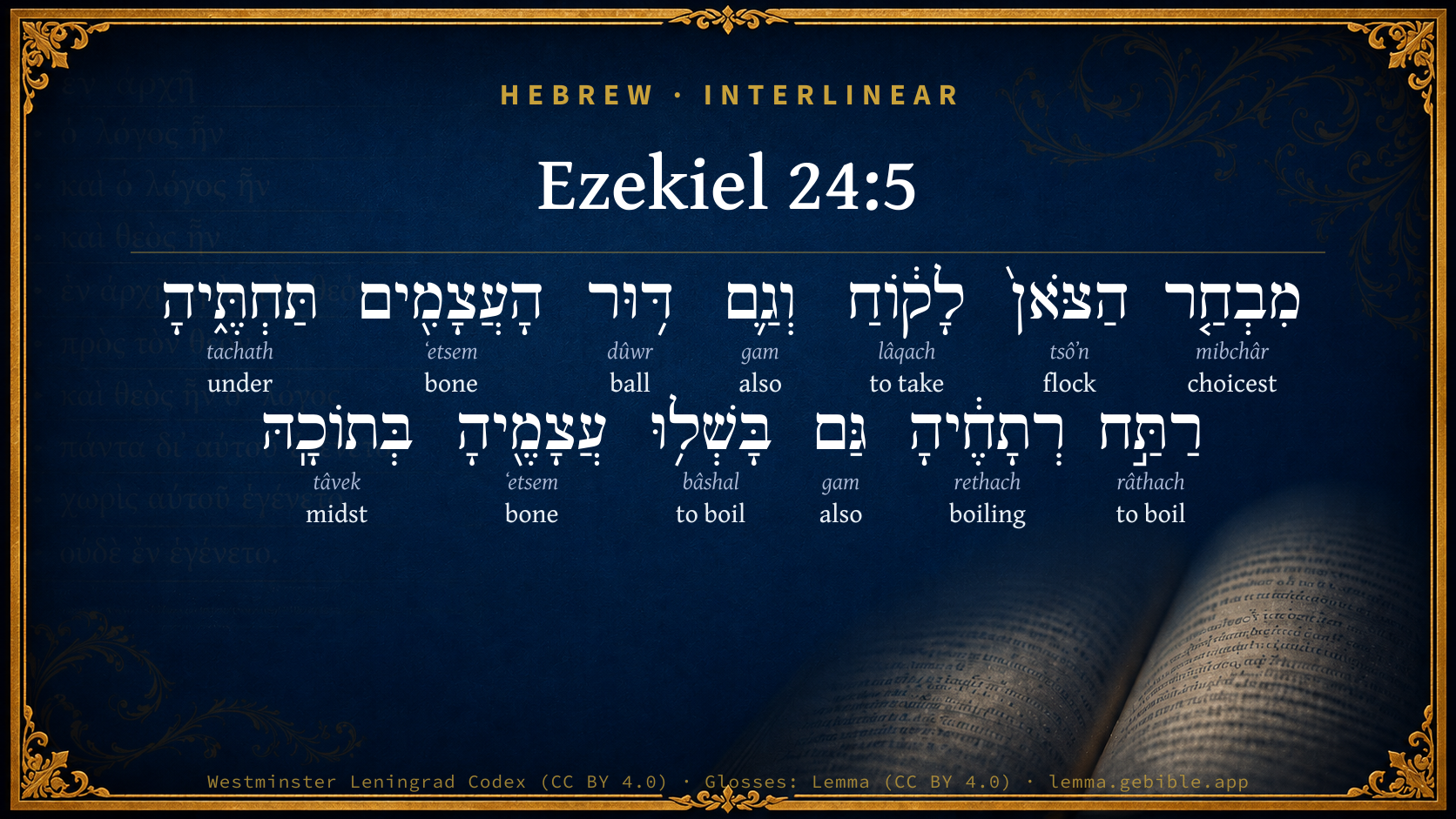
  1. מִבְחַ֤ר mibchâr H4005 “choicest of” Noun, Common, Masculine, Singular, Construct
  2. הַצֹּאן֙ tsôʼn H6629 “the · flock” Particle, Definite Article + Noun, Common, Both, Singular, Absolute
  3. לָק֔וֹחַ lâqach H3947 “to take” Verb, Qal, Infinitive Absolute
  4. וְגַ֛ם gam H1571 “and · also” Conjunction + Particle, Accusative
  5. דּ֥וּר dûwr H1754 “ball” Verb, Qal, Imperative, 2nd Person, Masculine, Singular
  6. הָעֲצָמִ֖ים ʻetsem H6106 “the · bones” Particle, Definite Article + Noun, Common, Feminine, Plural, Absolute
  7. תַּחְתֶּ֑יהָ tachath H8478 “under · her” Preposition + Suffix, Personal, 3rd Person, Feminine, Singular
  8. רַתַּ֣ח râthach H7570 “boil” Verb, Piel, Imperative, 2nd Person, Masculine, Singular
  9. גַּם gam H1571 “also” Particle, Accusative
  10. בָּשְׁל֥וּ bâshal H1310 “to boil” Verb, Qal, Perfect, 3rd Person, Common, Plural
  11. עֲצָמֶ֖יהָ ʻetsem H6106 “bones · her” Noun, Common, Feminine, Plural, Construct + Suffix, Personal, 3rd Person, Feminine, Singular
  12. בְּתוֹכָֽהּ tâvek H8432 “in/at · midst · her” Preposition + Noun, Common, Masculine, Singular, Construct + Suffix, Personal, 3rd Person, Feminine, Singular

About this verse

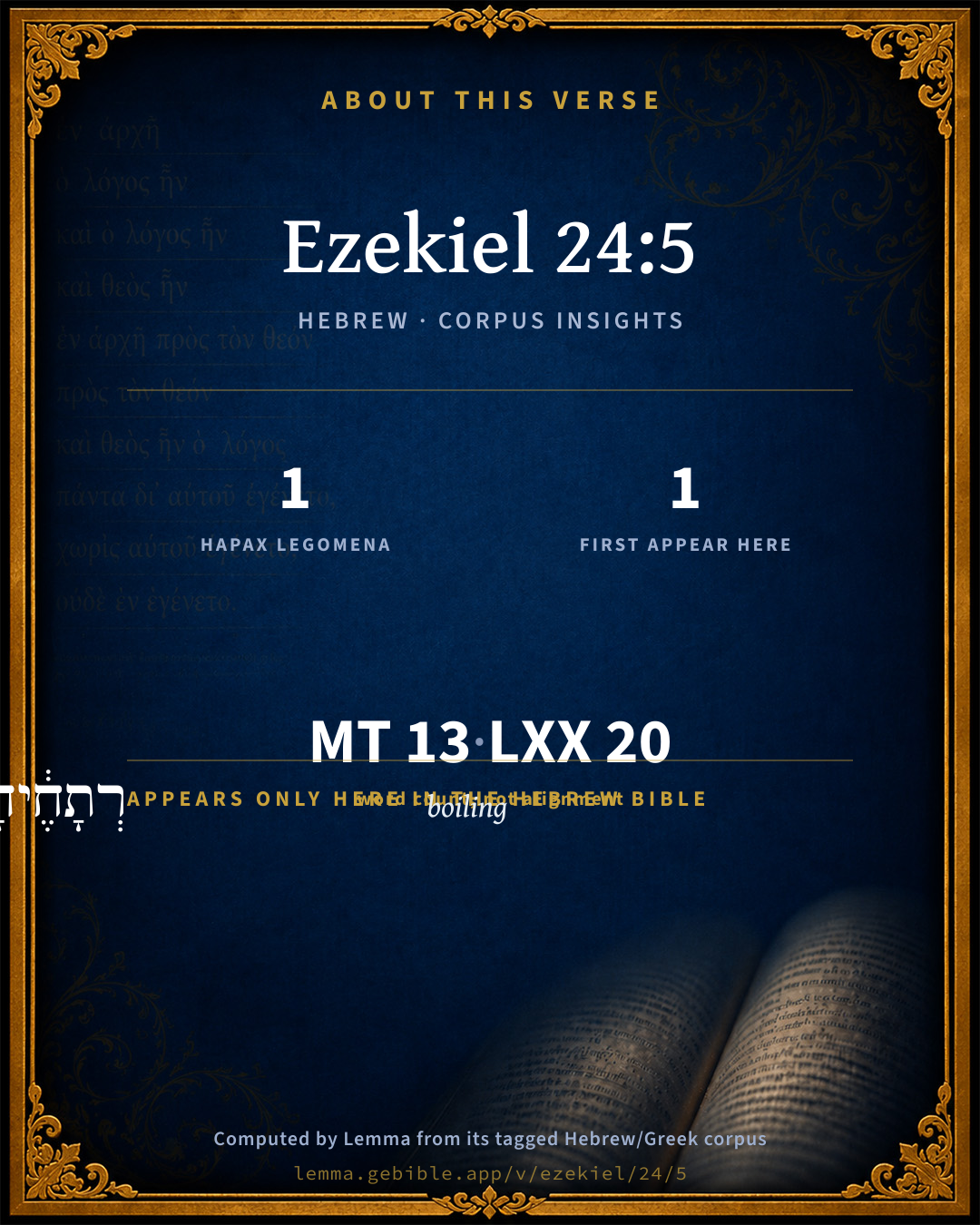
These counts appear in no published source. They are computed here, from the morphology-tagged text and Lemma’s own curated glosses. What Lemma adds →

13
words
11
distinct lemmas
Prophets
section

Notable vocabulary

1 hapax legomenon — a word that appears only here in the entire Hebrew Bible:

  • רְתָחֶ֔יהָ boiling H7571

First appearance in Scripture

This word makes its first canonical appearance in the Hebrew Bible here:

  • רְתָחֶ֔יהָ boiling H7571

Shared distinctive vocabulary

דּ֥וּר ball H1754 occurs in 3 verses of the Hebrew Bible. Also found in:

Grammatical profile

  • 4 verbs
  • 6 nouns
  • 1 preposition
  • 2 particles

Verb forms

  • לָק֔וֹחַ Qal · Infinitive Absolute
  • דּ֥וּר Qal · Imperative
  • רַתַּ֣ח Piel · Imperative
  • בָּשְׁל֥וּ Qal · Perfect

Repetition

Words recur within this verse — often emphatic in Hebrew:

  • וְגַ֛ם also H1571 ×2
  • הָעֲצָמִ֖ים bone H6106 ×2

Hebrew & Septuagint length

In English translation the verse runs 35 words from the Hebrew and 23 from the Septuagint (LXX English) — the Septuagint runs noticeably shorter here. See the side-by-side →

A rough comparison of the two English renderings, which tokenize alike — not a word-level alignment.

Word counts can differ between the Hebrew and the Greek without any difference in meaning — e.g. the Hebrew direct-object marker אֵת has no separate Greek word, and Greek often adds the article ὁ.

In the original languages it is 13 Hebrew tokens and 20 Greek tokens — but the two are counted differently (Hebrew bundles its prefixes and suffixes into one token; the Greek is in lemma form), so that isn’t a like-for-like length.

Cross-references

8

Topical passages linked to Ezekiel 24:5 in the Treasury of Scripture Knowledge — connected by theme and wording, ordered by reader-vote popularity; previews shown in the World English Bible.

  • Jeremiah 52:10 The king of Babylon killed the sons of Zedekiah before his eyes: he killed also all the princes of Judah in Riblah.
  • Jeremiah 52:24–27 The captain of the guard took Seraiah the chief priest, and Zephaniah the second priest, and the three keepers of the threshold:
  • Jeremiah 39:6 Then the king of Babylon killed the sons of Zedekiah in Riblah before his eyes: also the king of Babylon killed all the nobles of Judah.
  • Ezekiel 20:47 and tell the forest of the South, Hear the word of Yahweh: Thus says the Lord Yahweh, Behold, I will kindle a fire in you, and it shall devour every green tree in you, and every dry tree: the flaming flame shall not be quenched, and all faces from the south to the north shall be burnt thereby.
  • Ezekiel 24:9–10 Therefore thus says the Lord Yahweh: Woe to the bloody city! I also will make the pile great.
  • Ezekiel 34:16–17 I will seek that which was lost, and will bring back that which was driven away, and will bind up that which was broken, and will strengthen that which was sick: but the fat and the strong I will destroy; I will feed them in justice.
  • Ezekiel 34:20 Therefore thus says the Lord Yahweh to them: Behold, I, even I, will judge between the fat sheep and the lean sheep.
  • Revelation 19:20 The beast was taken, and with him the false prophet who worked the signs in his sight, with which he deceived those who had received the mark of the beast and those who worshiped his image. These two were thrown alive into the lake of fire that burns with sulfur.

Cross-references courtesy of OpenBible.info (CC BY 4.0).

Hebrew and Greek witnesses Masoretic Hebrew ↔ Greek Septuagint

The same verse in the two great witnesses to the Old Testament, shown verse-for-verse.

Here the Septuagint runs noticeably shorter than the Hebrew — LXX2012 (modern English Septuagint) 23 words vs World English Bible 35. A rough length comparison of the two English translations, not a word-level alignment — read both below.

These are two independent witnesses, not word-aligned to each other, and the Septuagint is shown in lemma (dictionary) form.

Hebrew Ezekiel 24:5 Masoretic · Westminster Leningrad Codex

מִבְחַ֤ר הַצֹּאן֙ לָק֔וֹחַ וְגַ֛ם דּ֥וּר הָעֲצָמִ֖ים תַּחְתֶּ֑יהָ רַתַּ֣ח רְתָחֶ֔יהָ גַּם בָּשְׁל֥וּ עֲצָמֶ֖יהָ בְּתוֹכָֽהּ

Take the choice of the flock, and also a pile [of wood] for the bones under [the caldron]; make it boil well; yes, let the bones of it be boiled in the midst of it.

World English Bible · Public Domain

Greek LXX Ezekiel 24:5 Septuagint · lemma form

ἐκ ἐπίλεκτος κτῆνος λαμβάνω καί ὑποκαίω ὁ ὀστέον ὑποκάτω αὐτός ζέω ζέω καί ἅπτομαι ὁ ὀστέον αὐτός ἐν μέσος αὐτός

which are taken from choice cattle, and burn the bones under them: her bones are boiled and cooked in the midst of her.

LXX2012 (modern English Septuagint) · Public Domain

Hebrew: Westminster Leningrad Codex (CC BY 4.0). Greek: Septuagint (public domain); English from LXX2012 (modern English Septuagint) (Public Domain). How the Septuagint differs from the Hebrew →

Targum (Aramaic paraphrase)

1

The Targum is the ancient Jewish Aramaic paraphrase of the Hebrew Scriptures — an interpretive translation, not the Hebrew text itself. Onkelos (literal) and Pseudo-Jonathan (expansive) render the Torah, and Jonathan the Prophets. Coverage is partial: where no permissively-licensed English translation exists for a verse, only the Aramaic is shown. This is verse-level text, not a word-by-word alignment to the Hebrew.

  1. Targum Jonathan Prophets (Joshua–Malachi)
    מַלְכֵי עַמְמִין קָרִיב וְאַף טַקֵיס סוּמְכְוָתָהָא עִמְהוֹן אַבַּע זִמְנָהּ אַף יִתְרְמוֹן קְטִילָהָא בְּגַוָהּ:

    (no public-domain English translation for this verse)

    Targum Jonathan — Aramaic: “Mikraot Gedolot” (public domain). English: “Sefaria Community Translation” (CC0 1.0 (public-domain dedication)); “London "Chaldee Paraphrase," 1871” (public domain). Text via Sefaria.

Commentary

Notes on Ezekiel 24:5 from classic Christian and Jewish commentators (each source and its license shown beneath its notes). The classic Christian expositions comment on the surrounding passage and are grouped to its opening verse, so a note may address several verses; the Jewish commentaries on the Tanakh (Rashi and others) are per-verse, so they appear only where the commentator wrote on this verse.

Lemma curates 59 commentaries, every one of them public domain or Creative Commons licensed, each selected and text-cleaned for this edition rather than reprinted as found. About our sources →

Trapp's Complete Commentary

John Trapp

Eze 24:5 Take the choice of the flock, and burn also the bones under it, [and] make it boil well, and let them seethe the bones of it therein.

Ver. 5. Take the choice of the flock.] The king and his peers.

And burn also the bones.] The dry bones, the common people, for these will burn like wood.

And let him seethe the bones.] The choice bones. {Eze 24:4}

John Trapp, A Commentary or Exposition upon All the Books of the Old and New Testament (1647–1656) — public domain. Text from a community e-Sword module.

Geneva Bible (1599)

Geneva Bible translators

Or, heap.

Meaning, of the innocents, whom they had slain, who were the cause of the kindling of God’s wrath against them.

Geneva Bible (1599) marginal notes — public domain. Text via Bolls.life.

Jamieson, Fausset & Brown

Robert Jamieson, A. R. Fausset & David Brown

burn . . . bones--rather, "pile the bones." Literally, "Let there be a round pile of the bones."

therein--literally, "in the midst of it."

Jamieson, Fausset & Brown — Commentary Critical and Explanatory on the Whole Bible (1871) — public domain (CC PDM 1.0). Text via the HelloAO Bible API.

Adam Clarke's Commentary

Verse 5. Make it boil well] Let it boil over, that its own scum may augment the fire, that the bones - the soldiers, may be seethed therein. Let its contentions, divided counsels, and disunion be the means of increasing its miseries, רתח רתחיה rattach rethacheyha, let it bubble its bubbling; something like that of the poet: -

"Bubble, bubble, toil and trouble:

Fire burn, and cauldron bubble."

Very like the noise made by ebullition, when a pot of thick broth, "sleek and slab," is set over a fierce fire. Such was that here represented, in which all the flesh, the fat and the bones were to be boiled, and generally dissolved together.

Adam Clarke's Commentary on the Bible (1810–1826) — public domain. Text from a community e-Sword/MySword module.

Ellicott's Commentary for English Readers

(5) Burn also the bones under it.—It is uncertain whether this is or is not the exact sense. The word for “burn” means, as is shown in the margin, heap, and is a noun. This is taken by many with a verb implied, in the sense of “make a heap of wood to burn the bones.” On the other hand, the sense of the text is that given in most of the ancient versions, and it is certain that bones, before the fat is extracted, may be used for fuel. It is better, therefore, to translate quite literally, heap the bones under it, leaving the same ambiguity as in the original as to whether the bones are to be burned upon the fuel or themselves used for fuel. In either case, the bones are those which are left after “the good pieces” have been put into the cauldron. No part of the people shall escape; the refuse alike with the choice is doomed to destruction.

A Bible Commentary for English Readers, edited by Charles John Ellicott (1878–1897) — public domain. Text from a community e-Sword module.

The Cambridge Bible for Schools and Colleges

gen. ed. J. J. S. Perowne

5. burn also the bones] a pile also of wood under it. If “pile” could be read as a verb, and pile also wood, the construction would be easier. In spite of the versions wood must be substituted for “bones.”

make it boil well] Lit. make boil its boilings. The word “boilings” does not occur again; possibly by changing a letter “boil its pieces,” parallel to its bones in next clause.

let them seethe] let the bones thereof be seethed. Naturally here and Eze_24:4 “bones” include the flesh upon them. They are those of such parts as leg and shoulder.

The Cambridge Bible for Schools and Colleges (gen. ed. J. J. S. Perowne; Cambridge University Press, 1878–1918) — public domain. Text from a community e-Sword module.

John Gill's Exposition

Take the choice of the flock,.... King, princes, nobles, magistrates, priests and rulers of the people:

and burn also the bones under it: or, "put a pile of bones under it" (u); the bones of them that are slain in it; denoting the great slaughter of them; or the bones of the innocent that had been murdered in it; which were the cause of these judgments coming upon them; and caused the wrath of God to burn the more hotly against them; or the bones of the wicked:

and make it boil well; the pot; that the water may be very hot and boiling; denoting the severity of the judgments of God in the city, to the destruction of many by sword, famine, and pestilence:

and let them seethe the bones of it therein; that the strongest among them may be weakened and destroyed by the length and severity of the siege, and the judgments attending it. The Targum is,

"bring near the kings of the people, and even join auxiliaries with them; hasten the time of it yea, let her slain be cast in the midst of her.''

(u) "pyram ossium sub ipsa", Junius & Tremellius, Piscator, Starckius. "rogus, strues materiae combustibililis rotunda", Stockius, p. 223.

John Gill's Exposition of the Whole Bible (1746–1763) — public domain (CC PDM 1.0). Text via the HelloAO Bible API.

Albert Barnes' Notes on the Bible

Burn - Rather, as in margin; the bones would serve for fuel.

Albert Barnes' Notes on the Bible (1834–1885) — public domain. Text from a community e-Sword/MySword module.

Haydock's Catholic Bible Commentary

The, &c. Literally, "its boiling has grown hot;" the citizens suffer terribly. --- Bones. Hebrew hatsamim, (Haydock) may denote the more solid meat.

George Leo Haydock (1774–1849), Haydock's Catholic Family Bible and Commentary, 1859 edition — public domain. Excludes Psalms (Douay-Rheims chapter numbering differs from Protestant) and Deuterocanonical books (Catholic canon only).

Matthew Poole's English Annotations

Take the choice; pick out the very best in the flock, that is, the greatest, richest, most powerful for authority and interest in the nation and city.

Burn; or, heap together in order to burn, to make a fire with.

The bones; not of the pieces to be boiled, but the bones of the many innocents murdered in Jerusalem and in the land; for their blood crieth for vengeance, and their bones, scattered on the face of the earth, will both make and maintain this fire.

Make it boil well; let the fire be so great, and the pot so long over, till all within it be boiled thoroughly, till all the strength and marrow be wasted, and the very flesh drop to pieces; so shall this people be wasted by this judgment. Seethe the bones: see Eze 24:4; this is doubled to assure us, however the meaner sort did, the more considerable part of the Jews should not escape. In this allegory there may lie couched an exact correspondence between the sins and punishments of this people; their sin was the slaying the best, or by oppressing them broke their bones, boiled out the marrow, sucked them dry; and now God will retaliate to these men.

Matthew Poole's English Annotations on the Holy Bible (1683–1685) — public domain. Text from a community e-Sword/MySword module.

Whedon's Commentary on the Bible

Daniel D. Whedon

5. Burn also the bones — R.V., “pile also the bones under it.” Great critics, like Smend and Cornill, read “wood” instead of “bones,” but this is opposed to all the versions. Bones were sometimes used as fuel in case of extremity. The prophet has pictured the land as being desolated by fire and covered with the bones of the slain. Did he mean to suggest that the bones of their own kinsmen slain in the defense of the city should be fuel which would make the Jerusalem pot boil? At any rate the use of bones vividly suggests a state of siege.

Daniel D. Whedon (gen. ed.), Commentary on the Old and New Testaments (1874–1909) — public domain. Text from a community e-Sword module.

The Pulpit Commentary

Burn also the bones under it; better, with the Vulgate and Revised Version, pile the bones. The bones of animals were often used as fuel. Currey quotes an interesting passage from Livingstone"s "Last Journal," 1. p. 347, narrating how, when the supply of ordinary fuel failed, he made his steamer work with the bones of elephants. See a like practice among the Scythians (Herod., 4:61).

The Pulpit Commentary (1880–1919), ed. H.D.M. Spence-Jones & Joseph S. Exell — public domain. Text from a community e-Sword module.

John Wesley's Explanatory Notes

The bones - Not of the pieces to be boiled, but of the many innocents murdered in Jerusalem; for their blood crieth for vengeance, and their bones scattered on the face of the earth, will both make and maintain this fire.

John Wesley, Explanatory Notes Upon the Whole Bible (1754–1765) — public domain. Text via the GEBible commentary corpus.

Rashi

Rabbi Shlomo Yitzchaki (Rashi)

Take the choice of the flocks You, Nebuchadnezzar, take the choicest of your armies around it. So did Jonathan render, but this does not fit with the idea of the pot. This must therefore be interpreted to mean that the choicest of Israel will come and enter into its midst.

and also arrange the limbs under it [Heb. דוּר,] an expression of arranging, and so (Isa. 22:18): “He shall wind you around like a turban, like a surrounding wall (כַּדוּר),” a row of surrounding troops. A row (דוּרָה) is translated into Aramaic as דַּרָא. However, Menachem explains it (p. 67) as (verse 9): “Even I shall enlarge the fire (הַמְדוּרָה).”

make it boil well After they all are inside it, the siegeworks and the armaments will come near the city.

Rashi on the Tanakh — English translations: “The Judaica Press complete Tanach with Rashi, translated by A. J. Rosenberg” (CC BY 4.0); “Pentateuch with Rashi's commentary by M. Rosenbaum and A.M. Silbermann, 1929-1934” (public domain); “The Metsudah Tanach series, Lakewood, N.J” (CC BY 4.0); and “The Book of Joshua, Metsudah Publications, 1997” (CC BY 4.0). Text via Sefaria.

Lesson kit

Teaching starters — assembled from the data on this page, not authored interpretation. Every prompt links to the verse data it draws on. Edit before teaching.

Ezekiel, in the Prophets, opens this verse with 13 words (11 distinct Hebrew lemmas). Its most distinctive word is rethach (“boiling”). The Greek Septuagint runs shorter here. A historical commentator’s framing appears above. Read the whole chapter for the surrounding context.

Discussion questions

  1. How does “boiling” (rethach) shape what this verse is saying?
  2. This verse holds 1 word here found nowhere else in the Hebrew Bible. What might the rare word draw attention to?
  3. The word “boiling” first appears here in Scripture. What is being introduced at this debut?
  4. Isaiah 22:18 shares the word «ball» with this verse. How do the two illuminate each other?
  5. “also” occurs 2× in this one verse. What is the effect of the repetition?
  6. Compared with the Hebrew, the Septuagint runs shorter here. What questions does that raise?
  7. These translations render this verse differently. What is at stake in choosing one wording over another?
  8. The verb «לָק֔וֹחַ» is Qal Infinitive Absolute. How does its form color the action?

Things to notice

  • 1 word in this verse appears nowhere else in the Hebrew Bible.
  • 1 word makes its first canonical appearance in Scripture here.
  • This verse counts 13 Hebrew ↔ 20 Greek words.
  • These translations choose different wording for 18 words in this verse.
  • “also” occurs 2× in this single verse.

Reading settings

Reading text

Shown beneath each verse's original-language words.

Old Testament
Old Testament edition

Read the OT as the Masoretic Hebrew (MT) or the Greek Septuagint (LXX).

English shown for the Greek Septuagint (in the Hebrew ↔ Greek comparison).

Comparing translations? Open the Compare panel on any verse page to stack up to four side by side.