
Deuteronomy 32:48

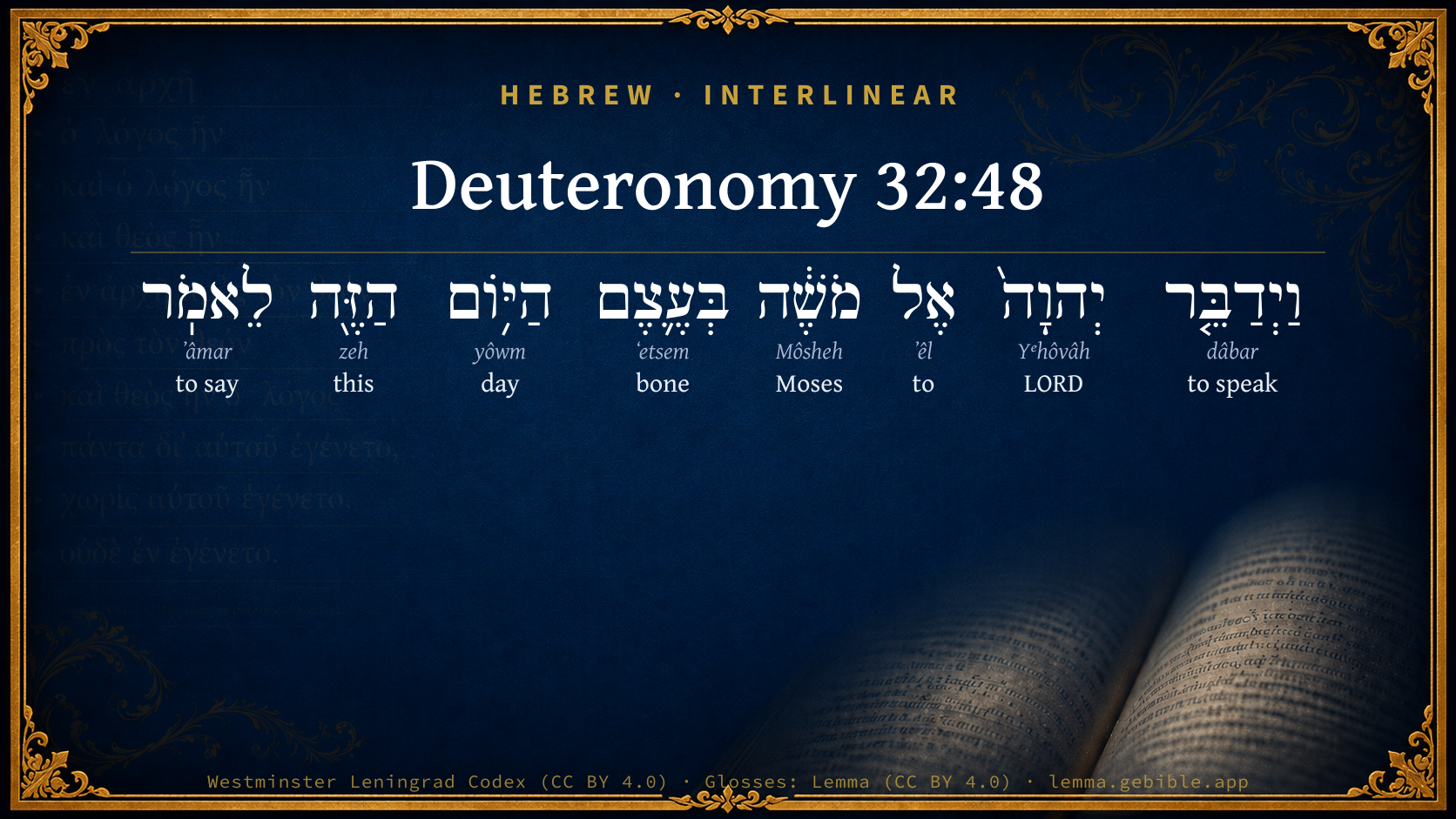
Hebrew (Westminster Leningrad Codex) Deuteronomy 32:48 appears in the Hebrew Old Testament. The text above is from the Westminster Leningrad Codex. Each word links to its Strong’s number, a concise gloss, and parsing drawn from the Open Scriptures Hebrew Bible morphology. Click any word for its full Brown-Driver-Briggs (BDB) entry.
Download image
Cite this verse

Deuteronomy 32:48 (World English Bible). Public Domain. Lemma interlinear Bible study tool, https://lemma.gebible.app/v/deuteronomy/32/48.

Show BibTeX & RIS
BibTeX
RIS
English Translation
Yahweh spoke to Moses that same day, saying,
World English Bible · Public Domain
Download a study sheet

One document with this verse’s original text, its word-by-word gloss line, the meaning frame, cross-references with their text, attributed commentary, and full source and license credits — printable, and it pastes into notes with its structure intact.

This verse Autodidact and up

Study sheet (.html) Plain text (.txt)

A passage Seminary Student

Up to 50 verses in one chapter. A passage sheet keeps up to 6 commentary sources and 12 cross-references per verse, in the order this page ranks them, and says so on the sheet whenever that leaves anything out. Ask for a single verse and you get the Autodidact verse sheet above.

Everything on this page stays free to read, with no account — the sheet is a download of what is already on screen, not access to it.

Want to remove ads? Support Godless Engineer
Compare translations 3

The same verse in 3 English versions, stacked beneath the original-language interlinear above. Click any original word for its lexicon entry.

Each is an independent rendering of the whole verse — the interlinear is not word-aligned to these translations.

Highlighted words mark where these versions differ — a whole-verse word diff, not a word-by-word alignment.

  • World English Bible Public Domain
    Yahweh spoke to Moses that same day, saying,
  • King James Version Public Domain
    And the LORD spake unto Moses that selfsame day, saying,
  • unfoldingWord Literal Text CC BY-SA 4.0
    And Yahweh spoke to Moses on this same day, saying,

unfoldingWord Literal Text — © unfoldingWord, licensed CC BY-SA 4.0. Word-aligned USFM3 via Door43 (git.door43.org/unfoldingWord/en_ult).

Versions to compare (up to 4)

3 of 4 selected

Show all 18 translations

Every available English version of this verse, each an independent rendering of the whole verse.

  • World English Bible Public Domain
    Yahweh spoke to Moses that same day, saying,
  • Berean Standard Bible Public Domain
    On that same day the LORD said to Moses,
  • Majority Standard Bible Public Domain
    On that same day the LORD said to Moses,
  • King James Version Public Domain
    And the LORD spake unto Moses that selfsame day, saying,
  • American Standard Version (1901) Public Domain
    And Jehovah spake unto Moses that selfsame day, saying,
  • Revised Version (1885) Public Domain
    And the LORD spake unto Moses that selfsame day, saying,
  • Geneva Bible (1599) Public Domain
    And the Lord spake vnto Moses the selfe same day, saying,
  • Douay-Rheims (1899) Public Domain
    And the Lord spoke to Moses the same day, saying:
  • Young's Literal Translation Public Domain
    And Jehovah speaketh unto Moses, in this self-same day, saying,
  • Literal Standard Version CC BY-SA 4.0
    And YHWH speaks to Moses on this very same day, saying,
  • Unlocked Literal Bible CC BY-SA 4.0
    Yahweh spoke to Moses on that same day and said,
  • unfoldingWord Literal Text CC BY-SA 4.0
    And Yahweh spoke to Moses on this same day, saying,
  • Darby Bible Public Domain
    And Jehovah spoke to Moses that same day, saying,
  • World Messianic Bible Public Domain
    The LORD spoke to Moses that same day, saying,
  • Webster's Bible Public Domain
    And the LORD spoke to Moses that same day, saying,
  • Free Bible Version CC BY-SA 4.0
    That same day the Lord told Moses,
  • Bible in Basic English Public Domain
    That same day the Lord said to Moses,
  • JPS Tanakh (1917) Public Domain
    And the LORD spoke unto Moses that selfsame day, saying:

Literal Standard Version (2020), Covenant Press — licensed CC BY-SA 4.0. Text via the HelloAO Bible API (eBible.org). Unlocked Literal Bible (unfoldingWord) — licensed CC BY-SA 4.0. Text via the HelloAO Bible API (eBible.org). unfoldingWord Literal Text — © unfoldingWord, licensed CC BY-SA 4.0. Word-aligned USFM3 via Door43 (git.door43.org/unfoldingWord/en_ult). Free Bible Version, Dr. Jonathan Gallagher — licensed CC BY-SA 4.0. Text via the HelloAO Bible API (eBible.org).

Word by word

More ways to search: Search by grammar → Find every occurrence → Compare this word →

Practice this passage: Drill this verse → Learn its vocabulary →

About this verse

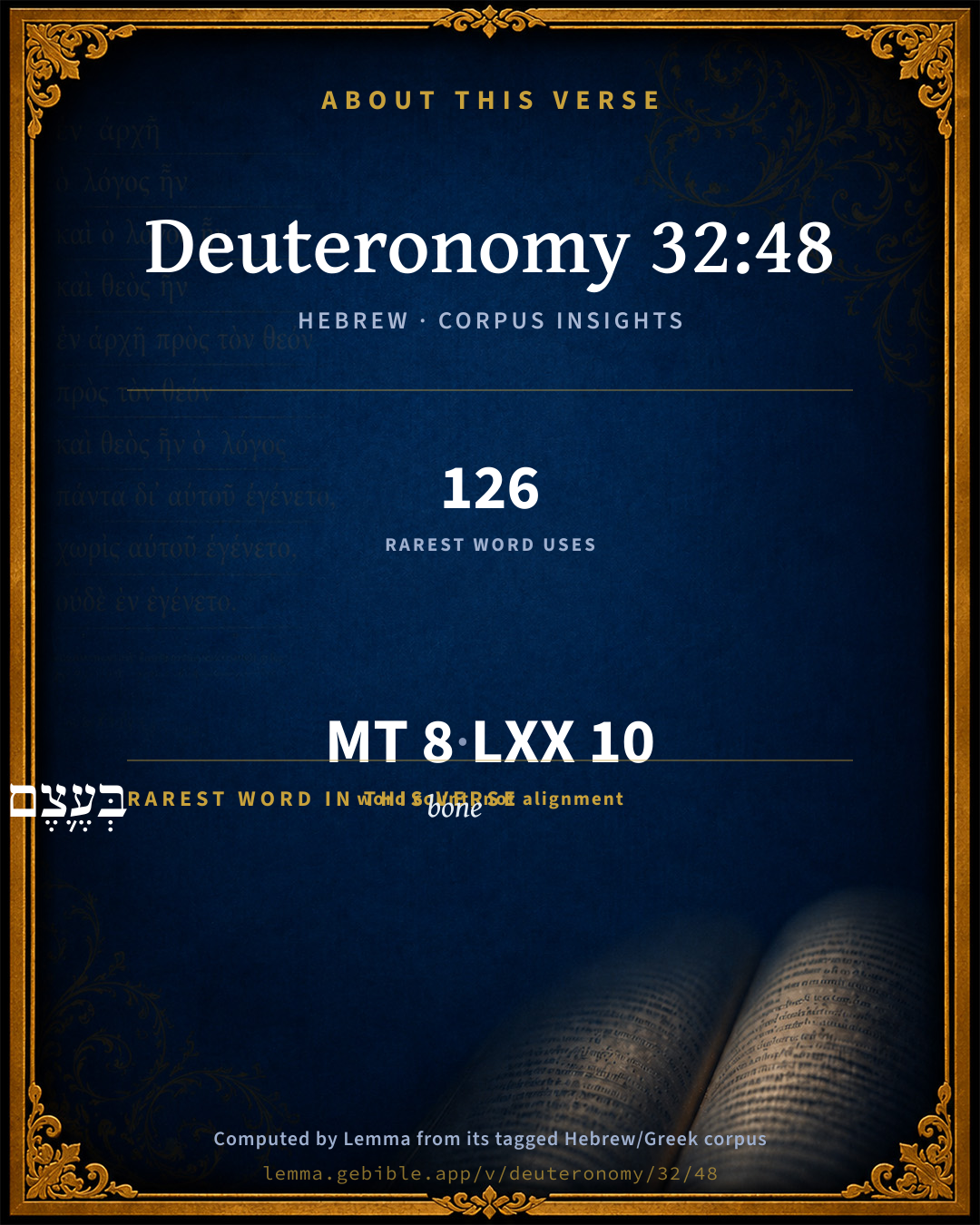
These counts appear in no published source. They are computed here, from the morphology-tagged text and Lemma’s own curated glosses. What Lemma adds →

8
words
8
distinct lemmas
Pentateuch
section

Grammatical profile

  • 2 verbs
  • 4 nouns
  • 1 pronoun
  • 1 preposition

Verb forms

  • וַיְדַבֵּ֤ר Piel · Sequential Imperfect
  • לֵאמֹֽר Qal · Infinitive Construct

Hebrew & Septuagint length

In English translation the verse runs 8 words from the Hebrew and 10 from the Septuagint (LXX English) — closely comparable.

A rough comparison of the two English renderings, which tokenize alike — not a word-level alignment.

Word counts can differ between the Hebrew and the Greek without any difference in meaning — e.g. the Hebrew direct-object marker אֵת has no separate Greek word, and Greek often adds the article ὁ.

In the original languages it is 8 Hebrew tokens and 10 Greek tokens — but the two are counted differently (Hebrew bundles its prefixes and suffixes into one token; the Greek is in lemma form), so that isn’t a like-for-like length.

Cross-references

1

Topical passages linked to Deuteronomy 32:48 in the Treasury of Scripture Knowledge — connected by theme and wording, ordered by reader-vote popularity; previews shown in the World English Bible.

  • Numbers 27:12–13 Yahweh said to Moses, Go up into this mountain of Abarim, and see the land which I have given to the children of Israel.

Cross-references courtesy of OpenBible.info (CC BY 4.0).

Hebrew and Greek witnesses Masoretic Hebrew ↔ Greek Septuagint

The same verse in the two great witnesses to the Old Testament, shown verse-for-verse.

These are two independent witnesses, not word-aligned to each other, and the Septuagint is shown in lemma (dictionary) form.

Hebrew Deuteronomy 32:48 Masoretic · Westminster Leningrad Codex

וַיְדַבֵּ֤ר יְהוָה֙ אֶל מֹשֶׁ֔ה בְּעֶ֛צֶם הַיּ֥וֹם הַזֶּ֖ה לֵאמֹֽר

Yahweh spoke to Moses that same day, saying,

World English Bible · Public Domain

Greek LXX Deuteronomy 32:48 Septuagint · lemma form

καί λαλέω κύριος πρός μωυσῆς ἐν ὁ ἡμέρα οὗτος λέγω

And the Lord spoke to Moses in this day, saying,

LXX2012 (modern English Septuagint) · Public Domain

On this verse, The Pulpit Commentary discusses the Septuagint’s reading. Read the note in Commentary ↓

Hebrew: Westminster Leningrad Codex (CC BY 4.0). Greek: Septuagint (public domain); English from LXX2012 (modern English Septuagint) (Public Domain). How the Septuagint differs from the Hebrew →

Targum (Aramaic paraphrase)

2

The Targum is the ancient Jewish Aramaic paraphrase of the Hebrew Scriptures — an interpretive translation, not the Hebrew text itself. Onkelos (literal) and Pseudo-Jonathan (expansive) render the Torah, and Jonathan the Prophets. Coverage is partial: where no permissively-licensed English translation exists for a verse, only the Aramaic is shown. This is verse-level text, not a word-by-word alignment to the Hebrew.

  1. Targum Onkelos Torah (Genesis–Deuteronomy)
    וּמַלִיל יְיָ עִם מֹשֶׁה בִּכְרַן יוֹמָא הָדֵין לְמֵימָר

    (no public-domain English translation for this verse)

    Targum Onkelos — Aramaic: “Onkelos Genesis” (public domain); “Onkelos Exodus” (public domain); “Onkelos Leviticus” (public domain); “Onkelos Numbers” (public domain); “Onkelos Deuteronomy” (public domain). English: “Sefaria Community Translation” (CC0 1.0 (public-domain dedication)); “J.W. Etheridge. The Targums of Onkelos and Jonathan Ben Uzziel on the Pentateuch. London: Longmans, Green, 1862” (public domain). Text via Sefaria.

  2. Targum Pseudo-Jonathan Torah (Genesis–Deuteronomy)
    וּמַלֵיל יְיָ עִם משֶׁה בְּשַׁבְעָא בְּיַרְחָא דְאָדָר בִּכְרַן יוֹמָא הָדֵין לְמֵימָר

    And the Lord spake with Mosheh on the seventh of the month Adar, on the same day, saying,

    Targum Pseudo-Jonathan — Aramaic: “Targum Jonathan on Genesis” (public domain); “Targum Jonathan on Exodus” (public domain); “Targum Jonathan on Leviticus” (public domain); “Targum Jonathan on Numbers” (public domain); “Targum Jonathan on Deuteronomy” (public domain). English: “The Targum of Jonathan ben Uzziel, trans. J. W. Etheridge, London, 1862” (public domain). Text via Sefaria.

Commentary

Notes on Deuteronomy 32:48 from classic Christian and Jewish commentators (each source and its license shown beneath its notes). The classic Christian expositions comment on the surrounding passage and are grouped to its opening verse, so a note may address several verses; the Jewish commentaries on the Tanakh (Rashi and others) are per-verse, so they appear only where the commentator wrote on this verse.

Lemma curates 59 commentaries, every one of them public domain or Creative Commons licensed, each selected and text-cleaned for this edition rather than reprinted as found. About our sources →

Joseph Benson's Commentary

Deu 32:48-49. That self-same day — Now he had finished his work, why should he desire to live a day longer? He had indeed formerly desired and prayed that he might go over Jordan: but now he is entirely satisfied, and saith no more of that matter. Nebo — A ridge or top of the mountains of Abarim.

Joseph Benson's Commentary on the Old and New Testaments (1811–1818) — public domain. Text from a community e-Sword module.

Jamieson, Fausset & Brown

Robert Jamieson, A. R. Fausset & David Brown

Get thee up . . . and die . . . Because ye trespassed . . . at Meribah--(See on Num 20:13).

Jamieson, Fausset & Brown — Commentary Critical and Explanatory on the Whole Bible (1871) — public domain (CC PDM 1.0). Text via the HelloAO Bible API.

Ellicott's Commentary for English Readers

(48) And the Lord spake unto Moses that selfsame day.—The day in which he spake the song in the ears of all Israel.

A Bible Commentary for English Readers, edited by Charles John Ellicott (1878–1897) — public domain. Text from a community e-Sword module.

The Cambridge Bible for Schools and Colleges

gen. ed. J. J. S. Perowne

48. that selfsame day] A standing phrase of P, e.g. Gen_7:13; Gen_17:23; Gen_17:26, Exo_12:17. Contr. the deuter. this day and the like. The day is that stated in Deu_1:3, also from P; q.v.

48–52. Moses’ Call to Death

He is bidden climb Mt Nebo and view Canaan, and die there like Aaron on Mt Hor, because of his trespass against Jehovah at Ḳadesh. He shall see but not enter the Land.—The language (including the place-names) and the reason given for Moses’ failure to enter the Land, are those of P (see notes below). There is a doublet in Num_27:12-14. Which of the two passages is original and which editorial is doubtful. The additions to this one point to its being the later.

The Cambridge Bible for Schools and Colleges (gen. ed. J. J. S. Perowne; Cambridge University Press, 1878–1918) — public domain. Text from a community e-Sword module.

John Gill's Exposition

And die in the mount whither thou goest up,.... Immediately after having taken a view of the land, expect to die, prepare for it, and willingly and cheerfully submit to it:

and be gathered unto thy people; to the spirits of just men made perfect in heaven, his more immediate and more remote ancestors, the souls of good men; for otherwise there were none that died, and were buried here, before him, and therefore can have no respect to the buryingplace of his people:

as Aaron thy brother died in Mount Hor, and was gathered unto his people; of which Moses was an eyewitness; and which is observed, because there was a great likeness between the death of him, and what Moses was now called to, both as to the place and manner of it; and likewise the cause of it, later mentioned; as also to make death more easy and familiar, and less terrible to him, when he cared to mind how calmly, cheerfully, and comfortably, his brother Aaron died; see Num 20:25.

John Gill's Exposition of the Whole Bible (1746–1763) — public domain (CC PDM 1.0). Text via the HelloAO Bible API.

Whedon's Commentary on the Bible

Daniel D. Whedon

48. That selfsame day — What a close to a day so marked in the history of Israel! The echoes of this grand ode are dying away, the families of Israel are returning to their tents. To Moses, the great leader, comes the divine direction. He is now told, “Get thee up into this mountain;… behold the land of Canaan, which I give unto the children of Israel for a possession: and die in the mount.” Comp. Num_27:12-14.

Daniel D. Whedon (gen. ed.), Commentary on the Old and New Testaments (1874–1909) — public domain. Text from a community e-Sword module.

The Pulpit Commentary

Vers. 48-52. On the day on which Moses rehearsed this song in the hearing of the people, his death was announced to him by God, and the command was again given to him to ascend Mount Nebo, thence to survey the Promised Land, and there to be gathered to his people. The same in substance, the command as given here differs slightly in form and in some minor particulars from that as recorded by Moses himself. (Num_27:12-14)

Vers. 48-52. Death immediately in view.

The utterance of the sublime song which we have just treated on, was the last recorded public act of Moses. His work is all but done. He receives an intimation that the time is nigh at hand for him to "go up and die." The circumstances which gather round that death are most suggestive. The following passages should be compared together: Num_20:12 Num_27:12-14; Deu_1:37 Deu_3:23-28 Deu_4:21, Deu_4:22; Ps 106. Historically, the following points are indicated in this paragraph:

1. Moses recognized the call to die, as well as the call to work, as from God; ver. 48, "The Lord spake," etc.

2. His joy in death would be checked by the remembrance of faults in life (ver. 51). It is by no means clear to us why so severe a sentence was imposed on Moses for one outburst of temper. Dr. Jameson suggests that there may have been other circumstances, which are unrecorded, to account for it. Possibly, however, the phrases, "for your sakes," "for their sakes," furnish a clue to the reason. The people might need thus to be guarded against presumptuous sin.

3. Visions of the glorious land in store for God"s people would be granted him ere he quitted the earth. His joy would be rich, though not unalloyed (ver. 52).

4. The work which he had thus far carried forward must be completed by other hands. This is implied, and elsewhere expressed.

5. Moses, like the saints of God who went before him, must plunge into the unknown realm. He must "be gathered unto his people," as Aaron had been (ver. 50).

6. He would do so under the eye of the same God whom he so long had served. Till the very last he lives in fellowship with God. At the last he will die in fellowship with him.

No Christian expositor can fail to take note of the different aspect which death has to believers, since "life and incorruption" have been brought to light by Jesus Christ. The believer, at death, enters the invisible world. The names for it are "Sheol" and "Hades." The former is a Hebrew word, the latter Greek. Both mean (practically) the same, though they present the mysterious realm of the departed under different aspects. To the Hebrew it is the all-demanding world. To the Greek, the unknown region. In the New Testament (Revised Version) the word Hades is reproduced. But though the word is reproduced, its meaning is changed. The heathen view of Hades was that of a mysterious under-realm of the dead gloomy and without hope. The Jewish view of Sheol (LXX Hades) was also that of a mysterious under-realm gloomy, but with a hope of glory "in the awaking". (Psa_17:15) The Christian view of Hades is that of an invisible realm of departed souls, who are entirely under the mediatorial administration of the Son of God; a region without gloom, of perfect rest and of glorious hope for the believer. "Absent from the body: at home with the Lord." "Whether we live or die, we continue to be the Lord"s." Let us thankfully make use of this new light which Christ has thrown on the death of believers, in meditating on" Christian dying.

I THE CHRISTIAN IS ABSOLUTELY AT THE DISPOSAL OF HIS LORD, FOR WORK OR FOR REST, FOR LIVING OR FOR DYING. (Rev_14:9; Php_1:20) He will be prepared to say, "Lord, it belongs not to my care, whether I die or live." Work is worth doing only so long as Christ has it for us to do. Life is worth living only as we can serve Christ thereby.

II THE CHRISTIAN"S JOY IN DEATH MUST SURELY BE CHECKED AT THE THOUGHT OF NUMBERLESS DEFECTS, FAILURES, AND FAULTS IN LIFE. Whether or no there have been any such serious outbreaks as that of Moses, there must come rushing into memory so much defective work, so much mixed motive, such an utter lack of anything done or said which rose up to even his own ideal, that he would despair of his future, if it were not for the abounding grace of God; and even then, though this grace keeps him from sinking, and he may feel assured that his sin is forgiven, yet it must bring a shade over his spirit to think there has been so much for which he needed forgiveness!

III ACTIVE WORKERS AND LEADERS IN GOD"S CHURCH OFTEN LAY DOWN THEIR WORK WITH A STRANGE FEELING OF INCOMPLETENESS. Moses had brought the people thus far, just to the verge of the Promised Land I He would gladly have finished the work. But it was well for Moses to feel how entirely the work was of God and not of man. How many a worker would like to see this or that controversy closed, this or that Church settled, this publication completed, this convert a little more-established in the faith! But no. It is as God wills, and that will is best.

IV THOUGH GOD SUFFERS THIS SHADE OVER LIFE"S CLOSING HOURS, YET HE OFTEN CHEERS HIS SERVANTS BY BRIGHT VISIONS OF THE GLORY WHICH IS IN STORE FOR THE PEOPLE OF GOD. Ver. 52, "Thou shalt see the land before thee." Yes, and Moses knew that, though he must leave the work incomplete, there was yet a great future for God"s Church, when the wilderness life was over. And so now. However decided may be the sense of unfinished work, with which God"s servants close their earthly career, they have no misgiving as to God"s finding others by whom the work will be carried on, nor have they a doubt as to the future triumphs of Christ and his cause. From the top of faith"s Pisgah, they "see the laud before them," and though it lieth afar off, yet the sight ravishes them. Lo! "a new heaven and a new earth, wherein dwelleth righteousness.

V MEANWHILE, THE SAINT MUST BREATHE HIS LAST BREATH, AND QUIT HIS HOLD OF EARTH, ENTER THE "GATES OF HADES", (Mat_16:18, Greek) AND FIND HIS PLACE, TILL THE LORD COMES, IN THE INVISIBLE WORLD. Like Moses, he must be "gathered to his people;" but he knows a great deal more than it is probable Moses did, of what that means. The words in Rev_1:18 are enough for faith, till God reveals the rest.

VI HE WILL DO SO, LIKE MOSES, UNDER THE EYE AND CARE OF THE SAME GOD WHOM HE HAS SERVED IN LIFE. By directions from God, Moses would go up to die. And what he thought thereon may be gathered from the words of his own blessing. "The eternal God is thy refuge, and underneath are the everlasting arms." Moses would not could not fail to take the comfort of all this for himself. We have a like comfort more clearly given. (1Th_5:10) Once Christ"s we are never out of his hands!

Vers. 48-52. Moses" end J.O. (see De 34)

Vers. 48-52. Death a judgment even to the most faithful servants of God.

After the solemn address to the people, God gives a personal address to Moses. It is about his approaching death. He is to see the land, but not to enter it, because he sanctified not the Lord at the waters of Meribah. It raises, therefore, the whole question of death as the portion even of the most faithful servants of God.

I IT IS SURELY REMARKABLE THAT, WHEN SAVED THROUGH THE MERCY OF GOD IN CHRIST, WE DO NOT BECOME IMMORTAL. Salvation seizes on the spirit, it becomes life through the righteousness of Jesus, but the body is still dead (or mortal) because of sin. (Rom_8:10) Why does salvation take our personality in installments? Save spirit first, and leave the body to the repairs of a resurrection? Can the procedure be vindicated? We think it can. For

II IF WE BECAME PHYSICALLY IMMORTAL THROUGH THE RECEPTION OF SALVATION, A MERCENARY ELEMENT WOULD BE INTRODUCED INTO OUR MOTIVES, AND MEN WOULD SEEK SALVATION TO ESCAPE THE PAIN OF DYING. Under the present arrangement, saint as well as sinner has to pass the dark portal. Dying is made the general lot of man, and, if salvation is desired, it is for spiritual purposes. Just as God does not promise immediate success to our efforts or our prayers, lest we should be tempted to live by sight and not by faith.

III IT IS NOT DESIRABLE THAT, WITH PARDON, WE SHOULD ESCAPE ALL SUFFERING FOR OUR SIN. It is a wise arrangement on God"s part, even when forgiving sinners, to take vengeance on our inventions. (Psa_99:8) For suppose that, in praying for pardon, we escaped all physical consequences of our sin, the result would be that pardon would be used as a great physical agent and factor, and the physical escape would be more thought upon than the spiritual. It is better, therefore, that things should take their course so far as the body is concerned, and that, meanwhile, the spirit should be the chief recipient of the benefit. God does not take the seeds of mortality, therefore, out of our bodies: he leaves them there as sin"s own work; and he gives us the earnest of complete redemption in the resurrection and emancipation of our spirits.

IV IT IS A SPLENDID TEST OF OUR FAITH IN GOD TO BE ASKED TO DIE. For up to the hour of death, we have found persons and things to lean upon in a measure; we have not as yet been left to lean on God alone. But when death comes, we are forced to lean on God only, if we are to have any support at all. God says, "Can you trust me, even when I take away your physical life?" "Though he slay me," said Job, "yet will I trust in him." Death brings us all to this test, and happy are we if we reach the same assurance.

The real is but the half of life; it needs The ideal to make a perfect whole; The sphere of sense is incomplete, and pleads The closer union with the sphere of soul.

Then let us, passing o"er life"s fragile arch, Regard it as a means, and not an end; As but the path of faith on which we march To where all glories of our being tend. R.M. E.

Vers. 48-52. Obedient unto death.

In Moses, Faith had achieved one of her most signal triumphs. From early youth to latest manhood, he had acted and "endured as seeing him who is invisible." No earthly or visible honor had ever enchanted his vision. He had lived very simply "in his Great Taskmaster"s eye." Therefore it was that he submitted to be deprived of the earthly Canaan without a murmur, "for he looked for a city which had foundations, whose builder and maker was God." To him death was but a darksome passage to an enduring home.

I THE GODLY MAN DIES AT GOD"S COMMAND. In this respect, Moses was a type of Christ, and has left us an example deserving our imitation. It should be enough for us to know that God requires it. It is no accident no unforeseen event. Every circumstance touching the believer"s death is wisely arranged by God. "Precious in the sight of the Lord is the death of his saints." Our Elder Brother has passed the dark valley before us, and his presence lights up the once gloomy way. "I will fear no evil, for thou art with me." At the girdle of our Captain hang "the keys of death and of Hades." "He opens, and no man shuts." To the genuine disciple death is no terror. "It is my Father"s voice I hear. I see his beckoning hand. I feel his sustaining arm." "Death is swallowed up in victory.

II THE GODLY MAN"S DEATH IS PARTLY JUDICIAL, PARTLY MERCIFUL. To the full-grown and ripe Christian, earth has little attraction. Its joys pall upon the taste. We aspire after nobler and better things. "I would not live always." A time comes in the good man"s history when he wishes the probation to close, and the real life to begin. The heir longs for his majority and for the ancestral heritage. The believer dies because death is the most convenient portal by which he can enter heaven.

Yet judgment is mingled with the mercy. Moses was on the tiptoe of earthly expectancy on the threshold of a great success, when God required him to relinquish all for heaven. To him it was revealed, in clearest form, that earlier sin required this late correction. For Israel"s sake, for the world"s sake, and for Moses" sake, his trespass must bear fruitage in loss and sorrow. In the very nature of things, it is impossible that men can sin without privation of some kind. We may flatter ourselves, at times, that God has winked at our folly, and that no ill consequence has ensued. But judge not prematurely. Possibly, in our last hours of life, the remembrance of that sin will rob us of our peace, will impose some serious loss. In the moral realm, whatsoever a man sows, that shall he also reap.

III THE GODLY MAN DEPARTS THIS LIFE FROM THE MOUNTAIN-PEAKS OF PERSONAL ATTAINMENT. There were solid reasons in the Divine mind (partly hidden and partly revealed) why Moses should die upon the mount. He might have viewed the magnificent prospects, and then have descended to die. But mountains have often been selected by God as the scene of grand events. On the summit of a mountain we are inspired with a sense of awe. We take in the sense of the infinite. We are constrained to worship. Thence we are already half disposed to mount and soar to heaven. This is suggestive. When through much active energy of faith we have climbed the heights of practical holiness, we feel that the work of life is done. We have finished our course. There has been steady advancement thus far, and now, what next? We feel that the world is beneath our feet; and from this pinnacle of moral elevation we wait the revelation of the future, we prepare for the strange transition.

From such an elevation of faith, too, we clearly discern the scene of the Church"s future conquests. The past is a light which irradiates the prospective triumphs of truth and holiness. Much land remains to be possessed;" but the assurance of success is absolute. Already the foes of God are at our feet. "He must reign.

IV THE GODLY MAN"S DEPARTURE IS NOT TO SOLITUDE, BUT TO SOCIETY. "Thou shalt be gathered unto thy people." Whatever thoughts, or hopes, or fears this language of God suggested to Moses" mind, it suggests to our minds one of the charms of heaven. We love to think of it as a home. Next to the ecstasy which God"s presence shall inspire, is the rapture of reunion with departed friends. "In my Father"s house are many mansions." No question need distress us touching mutual recognition. Moses and Elijah were recognized as such when they came down in glorified state, and conversed with Jesus on the mount. Not a faculty shall be wanting there which we possessed here. "Then shall we know, even as also we are known." If men from distant climes shall "sit down with Abraham, Isaac, and Jacob, in the kingdom of God," one main element of honor and of joy would be missed unless these illustrious patriarchs were known. D.

The Pulpit Commentary (1880–1919), ed. H.D.M. Spence-Jones & Joseph S. Exell — public domain. Text from a community e-Sword module.

John Wesley's Explanatory Notes

That self-same day - Now he had finished his work, why should he desire to live a day longer? He had indeed formerly desired and prayed, that he might go over Jordan: but now he is entirely satisfied, and saith no more of that matter.

John Wesley, Explanatory Notes Upon the Whole Bible (1754–1765) — public domain. Text via the GEBible commentary corpus.

Keil & Delitzsch

C. F. Keil & F. Delitzsch

"That self-same day," viz., the day upon which Moses had rehearsed the song to the children of Israel, the Lord renewed the announcement of his death, by repeating the command already given to him (Num 27:12-14) to ascend Mount Nebo, there to survey the land of Canaan, and then to be gathered unto his people. In form, this repetition differs from the previous announcement, partly in the fact that the situation of Mount Nebo is more fully described (in the land of Moab, etc., as in Deu 1:5; Deu 29:1), and partly in the continual use of the imperative, and a few other trifling points. These differences may all be explained from the fact that the account here was not written by Moses himself.

Keil & Delitzsch — Biblical Commentary on the Old Testament (1861–1891) — public domain (CC PDM 1.0). Text via the HelloAO Bible API. (Old Testament only.)

unfoldingWord translationNotes

Door43 World Missions Community

mountains of Abarim

This is the name of a mountain range in Moab. (See: How to Translate Names)

Abarim, up Mount Nebo

"Abarim and climb up Mount Nebo"

Mount Nebo

This is the highest place in the Abarim Mountains. (See: How to Translate Names)

opposite Jericho

"on the other side of the river from Jericho"

translationWords

Yahweh

Moses

Moab

Jericho

Canaan

Israel

possess

unfoldingWord translationNotes — © Distant Shores Media and the Door43 World Missions Community, licensed CC BY-SA 4.0. Source: git.door43.org/Door43/en_tn.

Rashi

Rabbi Shlomo Yitzchaki (Rashi)

וידבר ה' אל משה בעצם היום הזה AND THE LORD SPAKE TO MOSES THAT SELF SAME DAY — In three places in Scripture the expression בעצם היום הזה is used. It states in the narrative of Noah (Genesis 7:12) בעצם היום הזה entered Noah … [into the ark]” — which means in the glare of full daylight. Because his contemporaries said: By this and by that we swear; (cf. Note 2 on Deuteronomy 1:1): If we notice him about to do so we will not let him enter the ark, and not only that, but we will take axes and hatchets and we will split the ark in pieces. Thereupon the Holy One, blessed be He, said, “See, I will let him enter at midday and anyone who has power to prevent it, let him come and prevent it!” Of Egypt, too, it states, (Exodus All. 11) “The selfsame day the Lord did bring [the children of Israel out of the land of Egypt]”: because the Egyptians said: By this and by that! If we notice them about to do so, we will not let them leave, and not only that, but we will take swords and other weapons and will kill them. Thereupon said the Holy One, blessed be He, “See, I will bring them forth in the middle of the day, and anyone who has power to prevent it, let him come and prevent it!” Here, too, regarding Moses’ death, it states בעצם היום הזה, because the children of Israel said, By this and by that! If we notice him about to ascend the mountain, we will not let him do so, — the man who brought us out of Egypt, and divided the Red Sea for us, and brought the Manna down for us, and brought a flight of quails for us, and made the “well” rise, and gave us the Torah: we will not permit him to go!” Thereupon the Holy One, blessed be He, said, “Behold, I will bring him unto his resting place in the middle of the day, etc.” (Sifrei Devarim 337; cf. Rashi on Genesis 17:23).

Rashi on the Tanakh — English translations: “The Judaica Press complete Tanach with Rashi, translated by A. J. Rosenberg” (CC BY 4.0); “Pentateuch with Rashi's commentary by M. Rosenbaum and A.M. Silbermann, 1929-1934” (public domain); “The Metsudah Tanach series, Lakewood, N.J” (CC BY 4.0); and “The Book of Joshua, Metsudah Publications, 1997” (CC BY 4.0). Text via Sefaria.

Lesson kit

Teaching starters — assembled from the data on this page, not authored interpretation. Every prompt links to the verse data it draws on. Edit before teaching.

Deuteronomy, in the Pentateuch, opens this verse with 8 words (8 distinct Hebrew lemmas). Its most distinctive word is ʻetsem (“bone”). A historical commentator’s framing appears above. Read the whole chapter for the surrounding context.

Discussion questions

  1. How does “bone” (ʻetsem) shape what this verse is saying?
  2. Numbers 27:12–13 shares this passage’s theme. How do the two illuminate each other?
  3. These translations render this verse differently; the difference is in the English rendering, not the original. What questions does that raise?
  4. The verb «וַיְדַבֵּ֤ר» is Piel Sequential Imperfect. How does its form color the action?
  5. Reading how Joseph Benson's Commentary and Jamieson, Fausset & Brown read this verse, where do the two commentators agree and where do they part?

Things to notice

Reading settings

Reading text

Shown beneath each verse's original-language words.

Old Testament
Old Testament edition

Read the OT as the Masoretic Hebrew (MT) or the Greek Septuagint (LXX).

English shown for the Greek Septuagint (in the Hebrew ↔ Greek comparison).

Comparing translations? Open the Compare panel on any verse page to stack up to four side by side.