
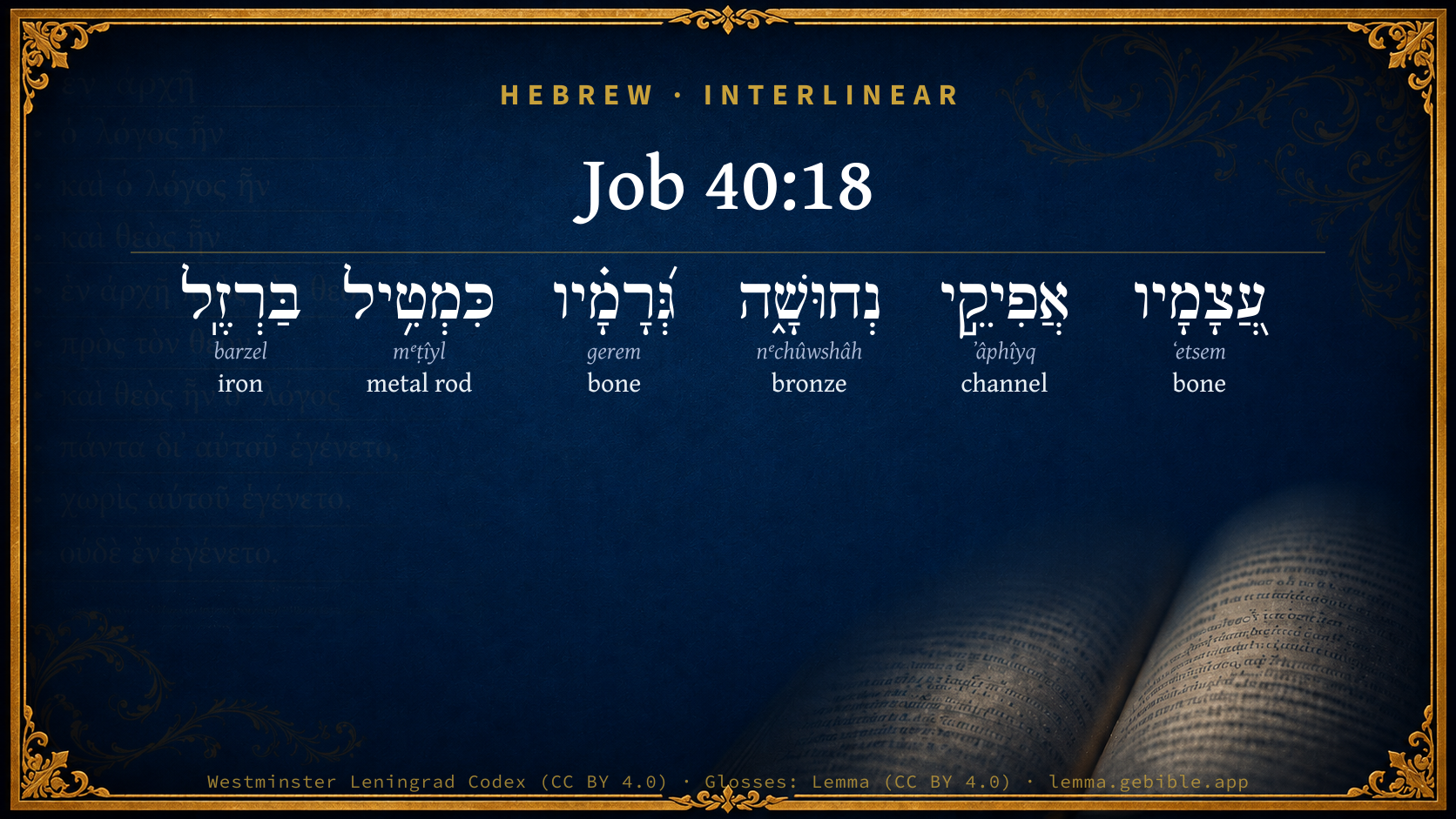
Job 40:18

Hebrew (Westminster Leningrad Codex) Job 40:18 appears in the Hebrew Old Testament. The text above is from the Westminster Leningrad Codex. Each word links to its Strong’s number, a concise gloss, and parsing drawn from the Open Scriptures Hebrew Bible morphology. Click any word for its full Brown-Driver-Briggs (BDB) entry.
Download image
Cite this verse

Job 40:18 (World English Bible). Public Domain. Lemma interlinear Bible study tool, https://lemma.gebible.app/v/job/40/18.

Show BibTeX & RIS
BibTeX
RIS
English Translation
His bones are like tubes of brass. His limbs are like bars of iron.
World English Bible · Public Domain
Highlights Full analysis ↓
Download a study sheet

One document with this verse’s original text, its word-by-word gloss line, the meaning frame, cross-references with their text, attributed commentary, and full source and license credits — printable, and it pastes into notes with its structure intact.

This verse Autodidact and up

Study sheet (.html) Plain text (.txt)

A passage Seminary Student

Up to 50 verses in one chapter. A passage sheet keeps up to 6 commentary sources and 12 cross-references per verse, in the order this page ranks them, and says so on the sheet whenever that leaves anything out. Ask for a single verse and you get the Autodidact verse sheet above.

Everything on this page stays free to read, with no account — the sheet is a download of what is already on screen, not access to it.

Want to remove ads? Support Godless Engineer
Compare translations 3

The same verse in 3 English versions, stacked beneath the original-language interlinear above. Click any original word for its lexicon entry.

Each is an independent rendering of the whole verse — the interlinear is not word-aligned to these translations.

Highlighted words mark where these versions differ — a whole-verse word diff, not a word-by-word alignment.

  • World English Bible Public Domain
    His bones are like tubes of brass. His limbs are like bars of iron.
  • King James Version Public Domain
    His bones are as strong pieces of brass; his bones are like bars of iron.
  • unfoldingWord Literal Text CC BY-SA 4.0
    Its bones tubes of bronze; its legs like bars of iron.

unfoldingWord Literal Text — © unfoldingWord, licensed CC BY-SA 4.0. Word-aligned USFM3 via Door43 (git.door43.org/unfoldingWord/en_ult).

Versions to compare (up to 4)

3 of 4 selected

Show all 18 translations

Every available English version of this verse, each an independent rendering of the whole verse.

  • World English Bible Public Domain
    His bones are like tubes of brass. His limbs are like bars of iron.
  • Berean Standard Bible Public Domain
    His bones are tubes of bronze; his limbs are rods of iron.
  • Majority Standard Bible Public Domain
    His bones are tubes of bronze; his limbs are rods of iron.
  • King James Version Public Domain
    His bones are as strong pieces of brass; his bones are like bars of iron.
  • American Standard Version (1901) Public Domain
    His bones are `as' tubes of brass; His limbs are like bars of iron.
  • Revised Version (1885) Public Domain
    His bones are as tubes of brass; his limbs are like bars of iron.
  • Geneva Bible (1599) Public Domain
    Behold, he spoyleth the riuer, and hasteth not: he trusteth that he can draw vp Iorden into his mouth.
  • Douay-Rheims (1899) Public Domain
    Behold, he will drink up a river, and not wonder: and he trusteth that the Jordan may run into his mouth.
  • Young's Literal Translation Public Domain
    His bones `are' tubes of brass, His bones `are' as a bar of iron.
  • Literal Standard Version CC BY-SA 4.0
    His bones [are] tubes of bronze, || His bones [are] as a bar of iron.
  • Unlocked Literal Bible CC BY-SA 4.0
    His bones are like tubes of bronze; his legs are like bars of iron.
  • unfoldingWord Literal Text CC BY-SA 4.0
    Its bones tubes of bronze; its legs like bars of iron.
  • Darby Bible Public Domain
    His bones are tubes of bronze, his members are like bars of iron.
  • World Messianic Bible Public Domain
    His bones are like tubes of bronze. His limbs are like bars of iron.
  • Webster's Bible Public Domain
    \\40:23\\Behold, he drinketh up a river, and hasteth not: he trusteth that he can draw up Jordan into his mouth.
  • Free Bible Version CC BY-SA 4.0
    Its bones are like bronze tubes; its limbs like iron rods.
  • Bible in Basic English Public Domain
    Truly, if the river is overflowing, it gives him no cause for fear; he has no sense of danger, even if Jordan is rushing against his mouth.
  • JPS Tanakh (1917) Public Domain
    His bones are as pipes of brass; his gristles are like bars of iron.

Literal Standard Version (2020), Covenant Press — licensed CC BY-SA 4.0. Text via the HelloAO Bible API (eBible.org). Unlocked Literal Bible (unfoldingWord) — licensed CC BY-SA 4.0. Text via the HelloAO Bible API (eBible.org). unfoldingWord Literal Text — © unfoldingWord, licensed CC BY-SA 4.0. Word-aligned USFM3 via Door43 (git.door43.org/unfoldingWord/en_ult). Free Bible Version, Dr. Jonathan Gallagher — licensed CC BY-SA 4.0. Text via the HelloAO Bible API (eBible.org).

Word by word

More ways to search: Search by grammar → Find every occurrence → Compare this word →

Practice this passage: Drill this verse → Learn its vocabulary →

About this verse

These counts appear in no published source. They are computed here, from the morphology-tagged text and Lemma’s own curated glosses. What Lemma adds →

6
words
6
distinct lemmas
Wisdom
section

Notable vocabulary

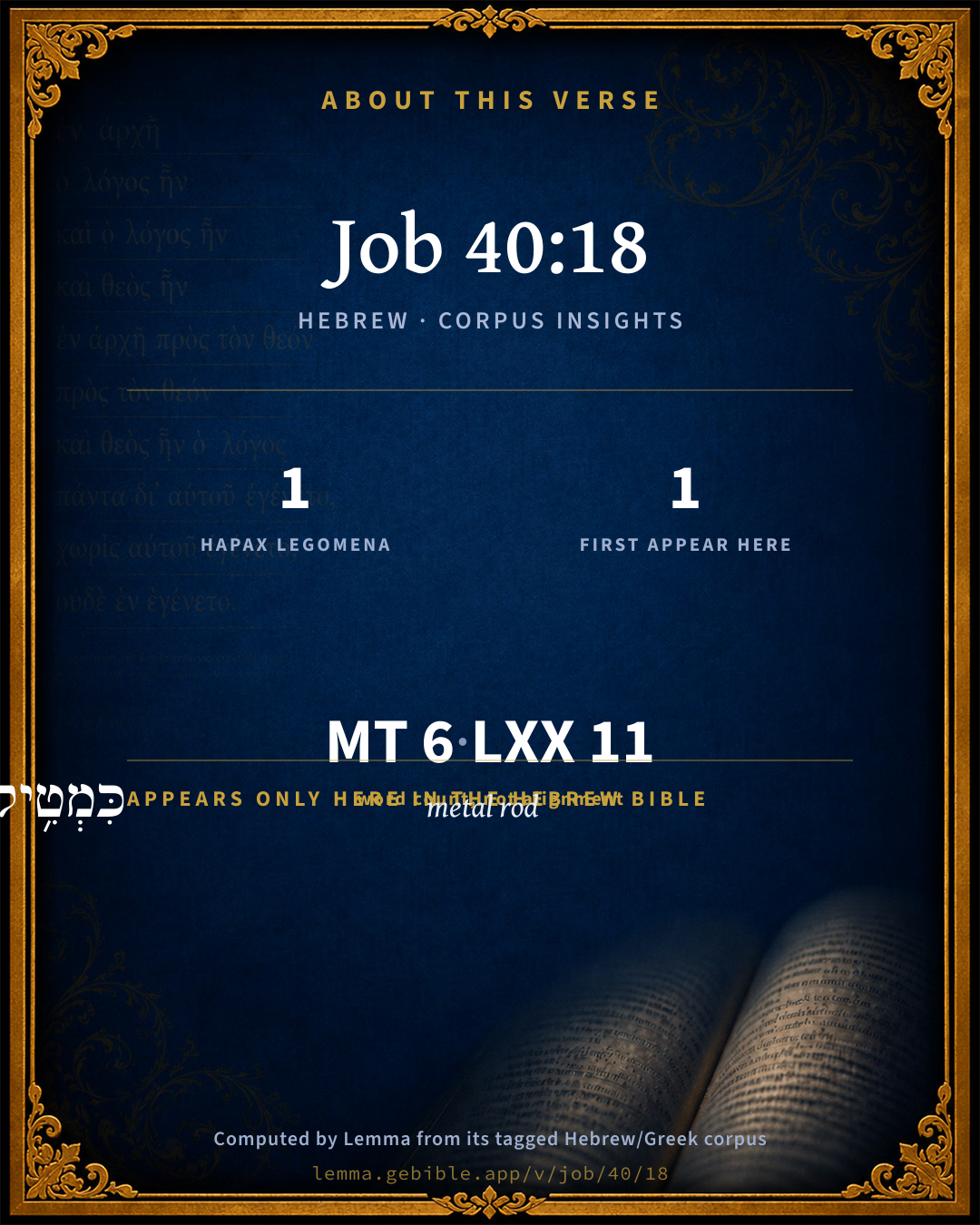
1 hapax legomenon — a word that appears only here in the entire Hebrew Bible:

  • כִּמְטִ֥יל metal rod H4300

First appearance in Scripture

This word makes its first canonical appearance in the Hebrew Bible here:

  • כִּמְטִ֥יל metal rod H4300

Shared distinctive vocabulary

גְּ֝רָמָ֗יו bone H1634 occurs in 5 verses of the Hebrew Bible. Also found in:

Grammatical profile

  • 6 nouns

Hebrew & Septuagint length

In English translation the verse runs 14 words from the Hebrew and 21 from the Septuagint (LXX English) — the Septuagint runs noticeably longer here. See the side-by-side →

A rough comparison of the two English renderings, which tokenize alike — not a word-level alignment.

Word counts can differ between the Hebrew and the Greek without any difference in meaning — e.g. the Hebrew direct-object marker אֵת has no separate Greek word, and Greek often adds the article ὁ.

In the original languages it is 6 Hebrew tokens and 11 Greek tokens — but the two are counted differently (Hebrew bundles its prefixes and suffixes into one token; the Greek is in lemma form), so that isn’t a like-for-like length.

Cross-references

2

Topical passages linked to Job 40:18 in the Treasury of Scripture Knowledge — connected by theme and wording, ordered by reader-vote popularity; previews shown in the World English Bible.

  • Job 7:12 Am I a sea, or a sea-monster, That you put a guard over me?
  • Isaiah 48:4 Because I knew that you are obstinate, and your neck is an iron sinew, and your brow brass;

Cross-references courtesy of OpenBible.info (CC BY 4.0).

Hebrew and Greek witnesses Masoretic Hebrew ↔ Greek Septuagint

The same verse in the two great witnesses to the Old Testament, shown verse-for-verse.

Here the Septuagint runs noticeably longer than the Hebrew — LXX2012 (modern English Septuagint) 21 words vs World English Bible 14. A rough length comparison of the two English translations, not a word-level alignment — read both below.

These are two independent witnesses, not word-aligned to each other, and the Septuagint is shown in lemma (dictionary) form.

Hebrew Job 40:18 Masoretic · Westminster Leningrad Codex

עֲ֭צָמָיו אֲפִיקֵ֣י נְחוּשָׁ֑ה גְּ֝רָמָ֗יו כִּמְטִ֥יל בַּרְזֶֽל

His bones are like tubes of brass. His limbs are like bars of iron.

World English Bible · Public Domain

Greek LXX Job 40:18 Septuagint · lemma form

ὁ πλευρά αὐτός πλευρά χάλκειος ὁ δέ ῥάχις αὐτός σίδηρος χυτός

If there should be a flood, he will not perceive it; he trust that Jordan will rush up into his mouth.

LXX2012 (modern English Septuagint) · Public Domain

On this verse, Joseph Benson's Commentary discusses the Septuagint’s reading. Read the note in Commentary ↓

Hebrew: Westminster Leningrad Codex (CC BY 4.0). Greek: Septuagint (public domain); English from LXX2012 (modern English Septuagint) (Public Domain). How the Septuagint differs from the Hebrew →

Commentary

Notes on Job 40:18 from classic Christian and Jewish commentators (each source and its license shown beneath its notes). The classic Christian expositions comment on the surrounding passage and are grouped to its opening verse, so a note may address several verses; the Jewish commentaries on the Tanakh (Rashi and others) are per-verse, so they appear only where the commentator wrote on this verse.

Lemma curates 59 commentaries, every one of them public domain or Creative Commons licensed, each selected and text-cleaned for this edition rather than reprinted as found. About our sources →

Trapp's Complete Commentary

John Trapp

Job 40:18 His bones [are as] strong pieces of brass; his bones [are] like bars of iron.

Ver. 18. His bones are as strony pieces of brass] Or, as conduit pipes of brass, whereby may be understood his hollow bones, as by bars of iron the solid ones, and by both (together with his trunk, composed of gristles, and his teeth and tusks, eight feet long, some of them) we may conjecture to be the size of his whole body; the size of all earthly creatures, saith Pliny; nine cubits high, saith Aelian, of some. Now can Job look upon such a monstrous creature, or hear his noise, or stand before him, without great horror? and will he not submit to the great God, and give him all his glory.

John Trapp, A Commentary or Exposition upon All the Books of the Old and New Testament (1647–1656) — public domain. Text from a community e-Sword module.

Joseph Benson's Commentary

Job 40:18-19. His bones — Under which title are comprehended his ribs, (as the LXX. here render it,) and his teeth; are as strong pieces of brass — Exceeding hard and strong. Such they are both in the elephant and river- horse. He is the chief of the ways of God — That is, of God’s works, namely, of that sort, or among living and brute creatures. This is eminently and unquestionably true of the elephant, in regard of his vast bulk and strength, joined with great activity; and especially of his admirable sagacity, and aptness to learn; and of his singular usefulness to man, his lord and master; and many other commendable qualities. And the hippopotamus also is, in some sort, the chief, or one of the chief, of God’s works, in regard of his bulk, which, say the authors of the Encyclopedia Britannica, “is so great that twelve oxen were found necessary to draw one ashore, which had been shot in a river beyond the Cape of Good Hope; and Hasselquist says, his hide is a load for a camel.” His strength and sagacity also are very remarkable, as well as the manner of his living, both in the water and on the land. But it must be granted, that the elephant exceeds the hippopotamus in many things. Can make his sword to approach unto him — Though he be so strong and terrible, yet God can easily subdue, or destroy him, either immediately, or by arming other creatures against him. But, העשׁו יגשׁ חרבו, hagnosho jaggesh charbo, may be properly rendered, He that made him hath applied, or given to him, his sword, or arms, that is, He hath formed him so as to make him appear dreadful and terrible. Heath renders it, He who made him hath furnished him with his scythe, taking the Hebrew word, rendered sword, or scythe, to denote the instrument by which this animal gathers his food. Houbigant’s translation of the clause is, His Creator sharpeneth his crooked tooth.

Joseph Benson's Commentary on the Old and New Testaments (1811–1818) — public domain. Text from a community e-Sword module.

Geneva Bible (1599)

Geneva Bible translators

He drinketh at leisure, and feareth nobody.

Geneva Bible (1599) marginal notes — public domain. Text via Bolls.life.

Jamieson, Fausset & Brown

Robert Jamieson, A. R. Fausset & David Brown

strong--rather, "tubes" of copper [UMBREIT].

Jamieson, Fausset & Brown — Commentary Critical and Explanatory on the Whole Bible (1871) — public domain (CC PDM 1.0). Text via the HelloAO Bible API.

Adam Clarke's Commentary

Verse 18. His bones are as strong pieces of brass-bars of iron.] The tusk I have mentioned above is uncommonly hard, solid, and weighty for its size.

Adam Clarke's Commentary on the Bible (1810–1826) — public domain. Text from a community e-Sword/MySword module.

Ellicott's Commentary for English Readers

(18) Strong pieces.—Or, perhaps, tubes. His limbs are like bars of iron.

A Bible Commentary for English Readers, edited by Charles John Ellicott (1878–1897) — public domain. Text from a community e-Sword module.

The Cambridge Bible for Schools and Colleges

gen. ed. J. J. S. Perowne

18. strong pieces of brass] Rather literally, are pipes of brass.

The Cambridge Bible for Schools and Colleges (gen. ed. J. J. S. Perowne; Cambridge University Press, 1878–1918) — public domain. Text from a community e-Sword module.

John Gill's Exposition

He is the chief of the ways of God,.... Or the beginning of them, that is, of the works of God in creation; which must be restrained to animals, otherwise there were works wrought before any of them were created. There were none made before the fifth day of the creation, and on that day was the river horse made; in which respect it has the preference to the elephant, not made till the sixth day. But if this phrase is expressive of the superior excellency of behemoth over other works of God, as it seems to be, it must be limited to the kind of which it is; otherwise man is the chief of all God's ways or works, made either on the fifth or sixth day: and so as the elephant may be observed to be the chief of the beasts of the earth, or of land animals, for its largeness and strength, its sagacity, docility, gentleness, and the like; so the river horse may be said to be the chief of its kind, of the aquatic animals, or of the amphibious ones, for the bulk of its body, which is not unlike that of the elephant, as says Diodorus Siculus (q); and it has been by some called the Egyptian elephant (r); and also from its great sagacity, of which instances are given by some writers (s). However, it is one of the chief works of God, or a famous, excellent, and remarkable one, which may be the sense of the expression; see Num 24:20. It might be remarked in favour of the elephant, that it seems to have its name from the first and chief; as the first letter in the Hebrew alphabet is called "aleph"; unless it should have its name from this root, on account of its docility;

he that made him can make his sword to approach unto him; not the sword of God, as if this creature could not be killed by any but by him that made it; for whether the elephant or river horse be understood, they are both to be taken and slain: but the sword of behemoth is that which he himself is furnished with; which some understand of the trunk of the elephant, with which he defends himself and annoys others; but that has no likeness of a sword. Bochart (t) renders the word by "harpe", which signifies a crooked instrument, sickle or scythe; and interprets it of the teeth of the river horse, which are sharp and long, and bent like a scythe. That which Thevenot (u) saw had four great teeth in the lower jaw, half a foot long, two whereof were crooked; and one on each side of the jaw; the other two were straight, and of the same length as the crooked, but standing out in the length: see the figure of it in Scheuchzer (w); by which it also appears to have six teeth. Another traveller says (x), of the teeth of the sea horse, that they are round like a bow, and about sixteen inches long, and in the biggest part more than six inches about: but another relation (y) agrees more nearly with Thevenot and Scheuchzer; that four of its teeth are longer than the rest, two in the upper jaw, one on each side, and two more in the under; these last are four or five inches long, the other two shorter; with which it mows down the corn and grass in great quantities: so that Diodorus Siculus (z) observes, that if this animal was very fruitful, and brought forth many young and frequently, the fields in Egypt would be utterly destroyed. This interpretation agrees with what follows.

(q) Ut supra. (Bibliothec. l. 2. p. 136. & l. 3. p. 173. 174. 175.) (r) Achilles Tatius, l. 4. (s) Ammian. Marcellin. Plin. Solin. ut supra. Vid. Plin. l. 28. c. 8. (t) Ut supra, (Apud Hierozoic. par. 2. l. 5. c. 14.) col. 760. (u) Travels, part 1. c. 72. (w) Physic. Sacr. tab. 532. (x) Dampier's Voyages, vol. 2. part 2. p. 105. (y) Capt. Rogers apud Dampier, ib. p. 106. (z) Ut supra. (Bibliothec. l. 2. p. 136. & l. 3. p. 173. 174. 175.)

John Gill's Exposition of the Whole Bible (1746–1763) — public domain (CC PDM 1.0). Text via the HelloAO Bible API.

Albert Barnes' Notes on the Bible

His bones are as strong pieces of brass - The circumstance here adverted to was remarkable, because the common residence of the animal was the water, and the bones of aquatic animals are generally hollow, and much less firm than those of land animals. It should be observed here, that the word rendered “brass” in the Scriptures most probably denotes “copper.” Brass is a compound metal, composed of copper and zinc; and there is no reason to suppose that the art of compounding it was known at as early a period of the world as the time of Job. The word here translated “strong pieces” (אפיק 'âphı̂yq) is rendered by Schultens “alvei - channels,” or “beds,” as of a rivulet or stream; and by Rosenmuller, Gesenius, Noyes, and Umbreit, “tubes” - supposed to allude to the fact that they seemed to be hollow tubes of brass. But the more common meaning of the word is “strong, mighty,” and there is no impropriety in retaining that sense here; and then the meaning would be, that his bones were so firm that they seemed to be made of solid metal.

Albert Barnes' Notes on the Bible (1834–1885) — public domain. Text from a community e-Sword/MySword module.

Haydock's Catholic Bible Commentary

Wonder. Hebrew, "make haste," taking time to render it muddy. (Ælian xiv. 44.) --- It can drink a great deal at once, and then abstain for a week. (Calmet) --- Run. Hebrew, "he may draw." Septuagint, "may knock at his mouth," (Haydock) in vain, (Calmet) as long as it can breathe by holding by holding its trunk out of the water. (Aristotle ix. 46.) --- Theo.[Theodotion?] in the Septuagint, "If there should be an inundation, it shall not perceive. It confideth that, or when, the Jordan shall knock at its mouth. He shall take it by its eye; saying snares, he shall bore [its] nose." (Haydock)

George Leo Haydock (1774–1849), Haydock's Catholic Family Bible and Commentary, 1859 edition — public domain. Excludes Psalms (Douay-Rheims chapter numbering differs from Protestant) and Deuterocanonical books (Catholic canon only).

Matthew Poole's English Annotations

His bones; under which title are comprehended his ribs (as the LXX here render it) and his teeth.

As strong pieces of brass, exceeding hard and strong, as they are in both these creature.

Matthew Poole's English Annotations on the Holy Bible (1683–1685) — public domain. Text from a community e-Sword/MySword module.

Whedon's Commentary on the Bible

Daniel D. Whedon

18. His bones… strong pieces of brass, etc. — Although he eat grass, his bones are as tubes of brass — are like hammered bars of iron. The second word rendered bones גרמים, may mean “ribs,” in contrast with the hollow bones before spoken of.

Daniel D. Whedon (gen. ed.), Commentary on the Old and New Testaments (1874–1909) — public domain. Text from a community e-Sword module.

The Pulpit Commentary

His bones are as strong pieces of brass; rather, as tubes of bronze. The great thigh-bones mhria of the Greeks are probably intended. These are hollow, being filled with marrow, and are so strong that they may be well compared to "tubes of bronze." (On the identity of nekhushah or nekhosheth with "bronze" rather than "brass," see the article on "Brass," in Dr. W. Smith"s "Dictionary of the Bible," vol. 1. p. 225.) His bones (rather, his ribs) are like bars of iron. Either the ribs, or the solid bones of the lower leg, forearm, etc., are intended.

The Pulpit Commentary (1880–1919), ed. H.D.M. Spence-Jones & Joseph S. Exell — public domain. Text from a community e-Sword module.

Rashi

Rabbi Shlomo Yitzchaki (Rashi)

as a load Heb. כִּמְטִיל, as a burden of iron.

Rashi on the Tanakh — English translations: “The Judaica Press complete Tanach with Rashi, translated by A. J. Rosenberg” (CC BY 4.0); “Pentateuch with Rashi's commentary by M. Rosenbaum and A.M. Silbermann, 1929-1934” (public domain); “The Metsudah Tanach series, Lakewood, N.J” (CC BY 4.0); and “The Book of Joshua, Metsudah Publications, 1997” (CC BY 4.0). Text via Sefaria.

Lesson kit

Teaching starters — assembled from the data on this page, not authored interpretation. Every prompt links to the verse data it draws on. Edit before teaching.

Job, in the Wisdom, opens this verse with 6 words (6 distinct Hebrew lemmas). Its most distinctive word is mᵉṭîyl (“metal rod”). The Greek Septuagint runs longer here. A historical commentator’s framing appears above. Read the whole chapter for the surrounding context.

Discussion questions

  1. The word mᵉṭîyl carries the sense “metal rod.” How does it shape the verse?
  2. This verse holds 1 word here found nowhere else in the Hebrew Bible. What might the rare word draw attention to?
  3. The word “metal rod” first appears here in Scripture. What is being introduced at this debut?
  4. Genesis 49:14 shares the word «bone» with this verse. How do the two illuminate each other?
  5. Compared with the Hebrew, the Septuagint runs longer here. What questions does that raise?
  6. The translations on this page render this verse differently — a whole-verse word diff, not a word-by-word alignment. What might account for the different wordings?
  7. Reading how Trapp's Complete Commentary and Joseph Benson's Commentary read this verse, where do the two commentators agree and where do they part?

Things to notice

Reading settings

Reading text

Shown beneath each verse's original-language words.

Old Testament
Old Testament edition

Read the OT as the Masoretic Hebrew (MT) or the Greek Septuagint (LXX).

English shown for the Greek Septuagint (in the Hebrew ↔ Greek comparison).

Comparing translations? Open the Compare panel on any verse page to stack up to four side by side.