Lamentations 4:7

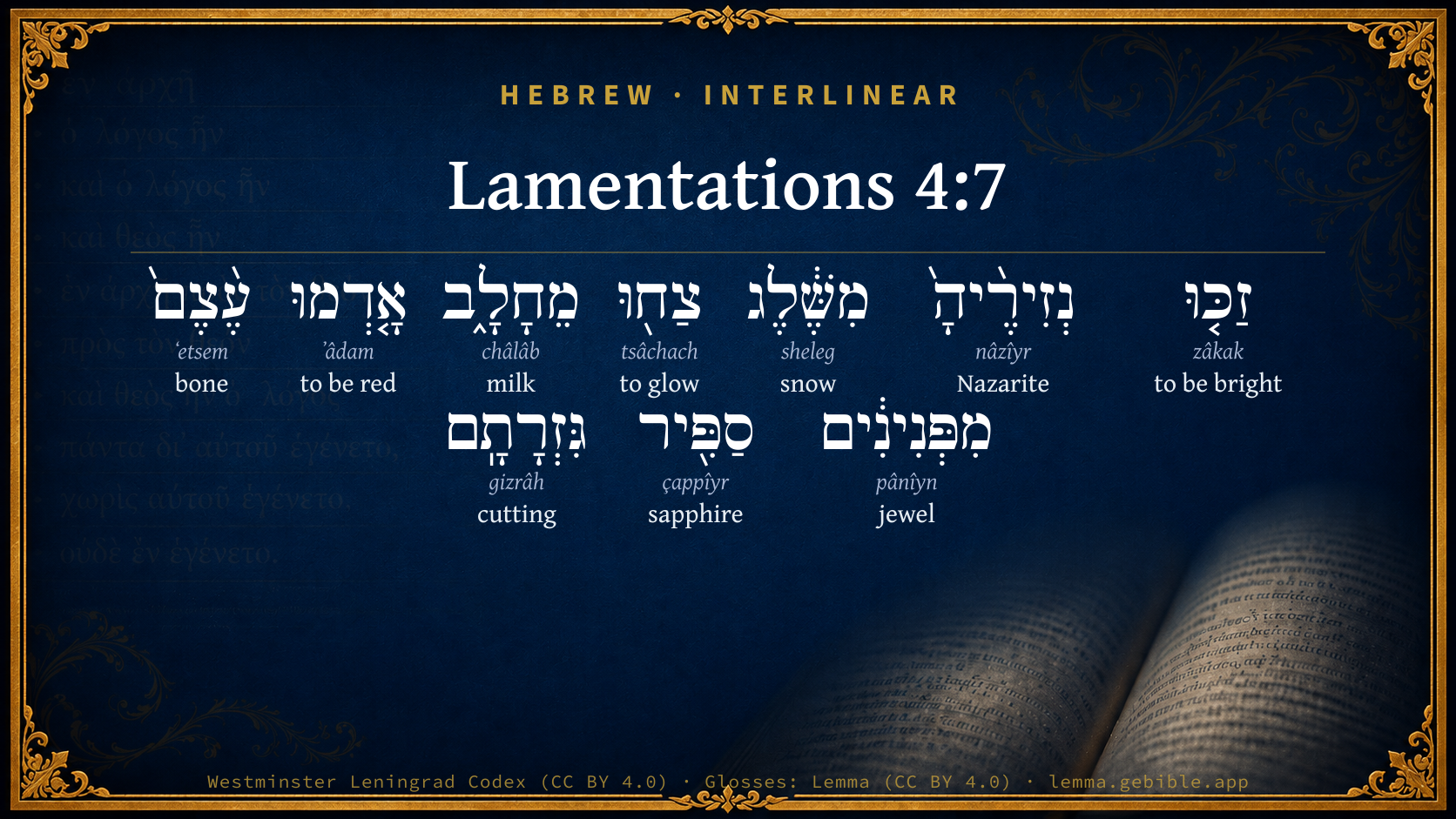
Hebrew (Westminster Leningrad Codex) Lamentations 4:7 appears in the Hebrew Old Testament. The text above is from the Westminster Leningrad Codex. Each word links to its Strong’s number, a concise gloss, and parsing drawn from the Open Scriptures Hebrew Bible morphology. Click any word for its full Brown-Driver-Briggs (BDB) entry.
Download image
Cite this verse

Lamentations 4:7 (World English Bible). Public Domain. Lemma interlinear Bible study tool, https://lemma.gebible.app/v/lamentations/4/7.

Show BibTeX & RIS
BibTeX
RIS
English Translation
Her nobles were purer than snow, they were whiter than milk; They were more ruddy in body than rubies, their polishing was as of sapphire.
World English Bible · Public Domain
Highlights
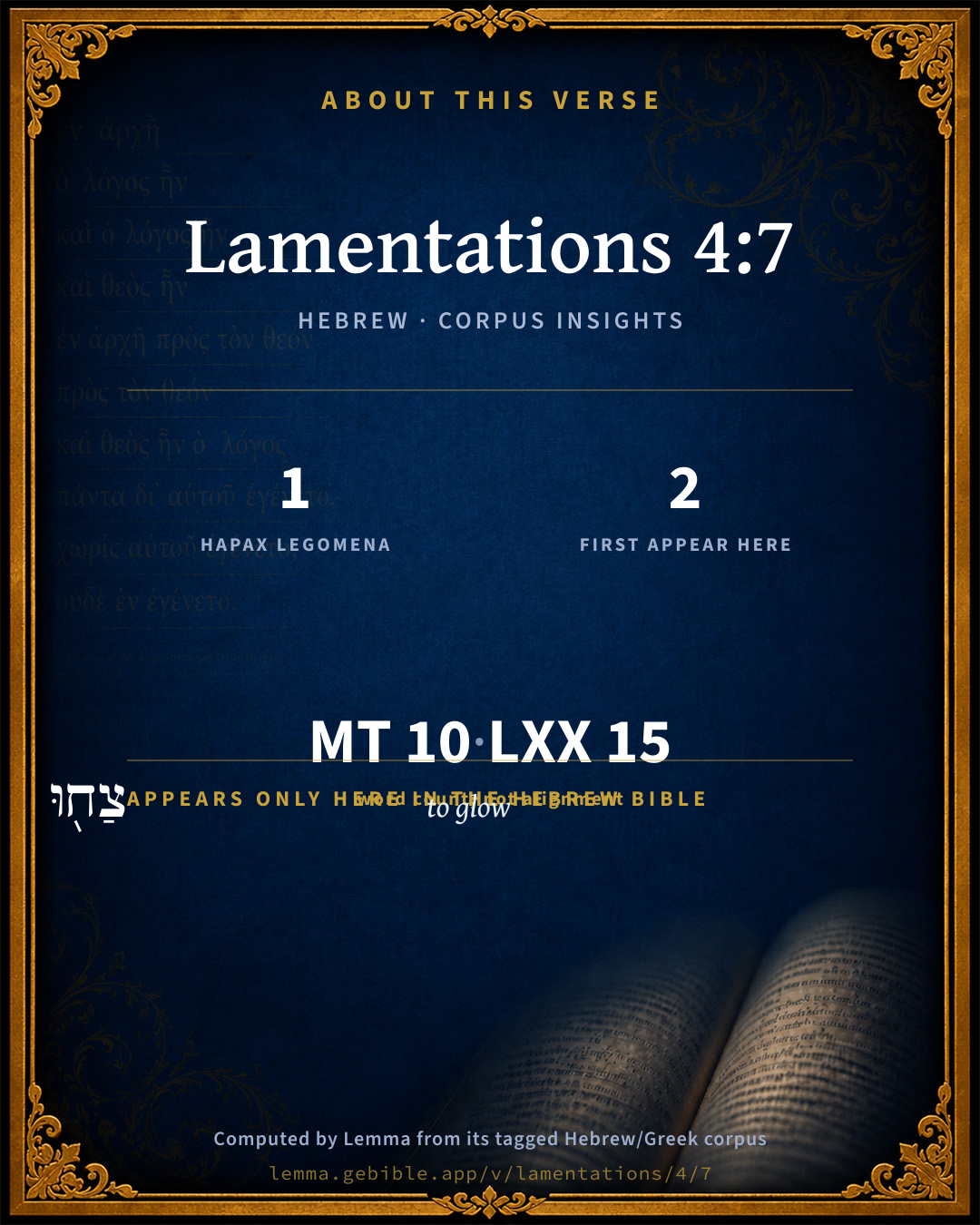
  • 1 hapax legomenon — only here in the Hebrew Bible
  • 2 first appearances in the Hebrew Bible
Full analysis ↓
Download a study sheet

One document with this verse’s original text, its word-by-word gloss line, the meaning frame, cross-references with their text, attributed commentary, and full source and license credits — printable, and it pastes into notes with its structure intact.

This verse Autodidact and up

Study sheet (.html) Plain text (.txt)

A passage Seminary Student

Up to 50 verses in one chapter. A passage sheet keeps up to 6 commentary sources and 12 cross-references per verse, in the order this page ranks them, and says so on the sheet whenever that leaves anything out. Ask for a single verse and you get the Autodidact verse sheet above.

Everything on this page stays free to read, with no account — the sheet is a download of what is already on screen, not access to it.

Want to remove ads? Support Godless Engineer
Compare translations 3

The same verse in 3 English versions, stacked beneath the original-language interlinear above. Click any original word for its lexicon entry.

Each is an independent rendering of the whole verse — the interlinear is not word-aligned to these translations.

Highlighted words mark where these versions differ — a whole-verse word diff, not a word-by-word alignment.

  • World English Bible Public Domain
    Her nobles were purer than snow, they were whiter than milk; They were more ruddy in body than rubies, their polishing was as of sapphire.
  • King James Version Public Domain
    Her Nazarites were purer than snow, they were whiter than milk, they were more ruddy in body than rubies, their polishing was of sapphire:
  • unfoldingWord Literal Text CC BY-SA 4.0
    Her Nazirites were purer than snow; they were whiter than milk. Their bones were more ruddy than corals; their form sapphire. HETH

unfoldingWord Literal Text — © unfoldingWord, licensed CC BY-SA 4.0. Word-aligned USFM3 via Door43 (git.door43.org/unfoldingWord/en_ult).

Versions to compare (up to 4)

3 of 4 selected

Show all 18 translations

Every available English version of this verse, each an independent rendering of the whole verse.

  • World English Bible Public Domain
    Her nobles were purer than snow, they were whiter than milk; They were more ruddy in body than rubies, their polishing was as of sapphire.
  • Berean Standard Bible Public Domain
    Her dignitaries were brighter than snow, whiter than milk; their bodies were more ruddy than rubies, their appearance like sapphires.
  • Majority Standard Bible Public Domain
    Her dignitaries were brighter than snow, whiter than milk; their bodies were more ruddy than rubies, their appearance like sapphires.
  • King James Version Public Domain
    Her Nazarites were purer than snow, they were whiter than milk, they were more ruddy in body than rubies, their polishing was of sapphire:
  • American Standard Version (1901) Public Domain
    Her nobles were purer than snow, they were whiter than milk; They were more ruddy in body than rubies, their polishing was as of sapphire.
  • Revised Version (1885) Public Domain
    Her nobles were purer than snow, they were whiter than milk, they were more ruddy in body than rubies, their polishing was as of sapphire:
  • Geneva Bible (1599) Public Domain
    Her Nazarites were purer then the snowe, and whiter then ye milke: they were more ruddie in bodie, then the redde precious stones; they were like polished saphir.
  • Douay-Rheims (1899) Public Domain
    Zain. Her Nazarites were whiter than snow, purer than milk, more ruddy than the old ivory, fairer than the sapphire.
  • Young's Literal Translation Public Domain
    Purer were her Nazarites than snow, Whiter than milk, ruddier of body than rubies, Of sapphire their form.
  • Literal Standard Version CC BY-SA 4.0
    Purer were her Nazarites than snow, || Whiter than milk, ruddier of body than rubies, || Of sapphire their form.
  • Unlocked Literal Bible CC BY-SA 4.0
    Her leaders were purer than snow, whiter than milk; their bodies were more ruddy than coral, their form was like sapphire.
  • unfoldingWord Literal Text CC BY-SA 4.0
    Her Nazirites were purer than snow; they were whiter than milk. Their bones were more ruddy than corals; their form sapphire. HETH
  • Darby Bible Public Domain
    Her Nazarites were purer than snow, whiter than milk; they were more ruddy in body than rubies, their figure was as sapphire.
  • World Messianic Bible Public Domain
    Her Nazirites were purer than snow. They were whiter than milk. They were more ruddy in body than rubies. Their polishing was like sapphire.
  • Webster's Bible Public Domain
    Her Nazarites were purer than snow, they were whiter than milk, they were more ruddy in body than rubies, their polishing was of sapphire:
  • Free Bible Version CC BY-SA 4.0
    Her leaders were purer than snow, whiter than milk; their bodies were a healthier red than coral, and they shone like lapis lazuli.
  • Bible in Basic English Public Domain
    Her holy ones were cleaner than snow, they were whiter than milk, their bodies were redder than corals, their form was as the sapphire:
  • JPS Tanakh (1917) Public Domain
    Her princes were purer than snow, they were whiter than milk, they were more ruddy in body than rubies, their polishing was as of sapphire;

Literal Standard Version (2020), Covenant Press — licensed CC BY-SA 4.0. Text via the HelloAO Bible API (eBible.org). Unlocked Literal Bible (unfoldingWord) — licensed CC BY-SA 4.0. Text via the HelloAO Bible API (eBible.org). unfoldingWord Literal Text — © unfoldingWord, licensed CC BY-SA 4.0. Word-aligned USFM3 via Door43 (git.door43.org/unfoldingWord/en_ult). Free Bible Version, Dr. Jonathan Gallagher — licensed CC BY-SA 4.0. Text via the HelloAO Bible API (eBible.org).

Word by word

More ways to search: Search by grammar → Find every occurrence → Compare this word →

Practice this passage: Drill this verse → Learn its vocabulary →

צַח֖וּ
tsâchach
H6705
“to glow”
Verb, Qal, Perfect, 3rd Person, Common, Plural
Part of Speech
Verb
Stem
Qal
Form
Perfect
Person
3rd Person
Gender
Common
Number
Plural
Full BDB Definition

Origin: a primitive root

TWOT: 1903

(Qal) to be dazzling, be aglow, glow
  1. זַכּ֤וּ zâkak H2141 “to be bright” Verb, Qal, Perfect, 3rd Person, Common, Plural
  2. נְזִירֶ֨יהָ֙ nâzîyr H5139 “Nazarites · her” Noun, Common, Masculine, Plural, Construct + Suffix, Personal, 3rd Person, Feminine, Singular
  3. מִשֶּׁ֔לֶג sheleg H7950 “from · snow” Preposition + Noun, Common, Masculine, Singular, Absolute
  4. מֵחָלָ֑ב châlâb H2461 “from · milk” Preposition + Noun, Common, Masculine, Singular, Absolute
  5. אָ֤דְמוּ ʼâdam H119 “to be red” Verb, Qal, Perfect, 3rd Person, Common, Plural
  6. עֶ֨צֶם֙ ʻetsem H6106 “bone” Noun, Common, Feminine, Singular, Absolute
  7. מִפְּנִינִ֔ים pânîyn H6443 “from · jewels” Preposition + Noun, Common, Both, Plural, Absolute
  8. סַפִּ֖יר çappîyr H5601 “sapphire” Noun, Common, Masculine, Singular, Absolute
  9. גִּזְרָתָֽם gizrâh H1508 “cutting · their” Noun, Common, Feminine, Singular, Construct + Suffix, Personal, 3rd Person, Masculine, Plural

About this verse

These counts appear in no published source. They are computed here, from the morphology-tagged text and Lemma’s own curated glosses. What Lemma adds →

10
words
10
distinct lemmas
Prophets
section

Notable vocabulary

1 hapax legomenon — a word that appears only here in the entire Hebrew Bible:

  • צַח֖וּ to glow H6705

First appearance in Scripture

These words make their first canonical appearance in the Hebrew Bible here:

  • צַח֖וּ to glow H6705
  • גִּזְרָתָֽם cutting H1508

Shared distinctive vocabulary

זַכּ֤וּ to be bright H2141 occurs in 4 verses of the Hebrew Bible. Also found in:

Grammatical profile

  • 3 verbs
  • 7 nouns

Verb forms

  • זַכּ֤וּ Qal · Perfect
  • צַח֖וּ Qal · Perfect
  • אָ֤דְמוּ Qal · Perfect

Hebrew & Septuagint length

In English translation the verse runs 25 words from the Hebrew and 26 from the Septuagint (LXX English) — closely comparable.

A rough comparison of the two English renderings, which tokenize alike — not a word-level alignment.

Word counts can differ between the Hebrew and the Greek without any difference in meaning — e.g. the Hebrew direct-object marker אֵת has no separate Greek word, and Greek often adds the article ὁ.

In the original languages it is 10 Hebrew tokens and 15 Greek tokens — but the two are counted differently (Hebrew bundles its prefixes and suffixes into one token; the Greek is in lemma form), so that isn’t a like-for-like length.

Cross-references

11

Topical passages linked to Lamentations 4:7 in the Treasury of Scripture Knowledge — connected by theme and wording, ordered by reader-vote popularity; previews shown in the World English Bible.

  • Psalms 51:7 Purify me with hyssop, and I will be clean. Wash me, and I will be whiter than snow.
  • Psalms 144:12 Then our sons will be like well-nurtured plants, Our daughters like pillars carved to adorn a palace.
  • Song of Solomon 5:10 My beloved is white and ruddy. The best among ten thousand.
  • 1 Samuel 16:12 He sent, and brought him in. Now he was ruddy, and withal of a beautiful face, and goodly to look on. Yahweh said, Arise, anoint him; for this is he.
  • Numbers 6:2–21 "Speak to the children of Israel, and tell them: When either man or woman shall make a special vow, the vow of a Nazirite, to separate himself to Yahweh,
  • Judges 13:5 for, behold, you shall conceive, and bear a son; and no razor shall come on his head; for the child shall be a Nazirite to God from the womb: and he shall begin to save Israel out of the hand of the Philistines.
  • Judges 13:7 but he said to me, Behold, you shall conceive, and bear a son; and now drink no wine nor strong drink, and eat not any unclean thing; for the child shall be a Nazirite to God from the womb to the day of his death.
  • Judges 16:17 He told her all his heart, and said to her, "No razor has ever come on my head; for I have been a Nazirite to God from my mother's womb. If I am shaved, then my strength will go from me, and I will become weak, and be like any other man."
  • Daniel 1:15 At the end of ten days their faces appeared fairer, and they were fatter in flesh, than all the youths who ate of the king's dainties.
  • Amos 2:11–12 I raised up some of your sons for prophets, And some of your young men for Nazirites. Isn't this true, You children of Israel?" says Yahweh.
  • Luke 1:15 For he will be great in the sight of the Lord, and he will drink no wine nor strong drink. He will be filled with the Holy Spirit, even from his mother's womb.

Cross-references courtesy of OpenBible.info (CC BY 4.0).

Hebrew and Greek witnesses Masoretic Hebrew ↔ Greek Septuagint

The same verse in the two great witnesses to the Old Testament, shown verse-for-verse.

These are two independent witnesses, not word-aligned to each other, and the Septuagint is shown in lemma (dictionary) form.

Hebrew Lamentations 4:7 Masoretic · Westminster Leningrad Codex

זַכּ֤וּ נְזִירֶ֨יהָ֙ מִשֶּׁ֔לֶג צַח֖וּ מֵחָלָ֑ב אָ֤דְמוּ עֶ֨צֶם֙ מִפְּנִינִ֔ים סַפִּ֖יר גִּזְרָתָֽם

Her nobles were purer than snow, they were whiter than milk; They were more ruddy in body than rubies, their polishing was as of sapphire.

World English Bible · Public Domain

Greek LXX Lamentations 4:7 Septuagint · lemma form

καθαρίζω ναζιραῖος αὐτός ὑπέρ χιών λάμπω ὑπέρ γάλα πυρρόω ὑπέρ λίθος σάπφειρος ὁ ἀπόσπασμα αὐτός

ZAIN. Her Nazarites were made purer than snow, they were whiter than milk, they were purified as with fire, their polishing was superior to sapphire stone.

LXX2012 (modern English Septuagint) · Public Domain

Hebrew: Westminster Leningrad Codex (CC BY 4.0). Greek: Septuagint (public domain); English from LXX2012 (modern English Septuagint) (Public Domain). How the Septuagint differs from the Hebrew →

Commentary

Notes on Lamentations 4:7 from classic Christian and Jewish commentators (each source and its license shown beneath its notes). The classic Christian expositions comment on the surrounding passage and are grouped to its opening verse, so a note may address several verses; the Jewish commentaries on the Tanakh (Rashi and others) are per-verse, so they appear only where the commentator wrote on this verse.

Lemma curates 59 commentaries, every one of them public domain or Creative Commons licensed, each selected and text-cleaned for this edition rather than reprinted as found. About our sources →

Trapp's Complete Commentary

John Trapp

Lam 4:7 Her Nazarites were purer than snow, they were whiter than milk, they were more ruddy in body than rubies, their polishing [was] of sapphire:

Ver. 7. Her Nazarites.] Who served God in a singular way of abstinence above other men. These had their rules given them, {Num 6:1-21} which while they observed,

They were purer than snow, whiter than milk.] Temperance is the mother of beauty, as luxury is of deformity. This is nothing to the Popish votaries, those epicures and abbey lubbers:

“ Quorum luxuriae totus non sufficit orbis. ”

Some by Nazarites here understand their nobles, and such as wore coronets on their heads. Nezar is a crown; {2Sa 1:10 2Ki 11:12} thus Joseph was a Nazarite; {Gen 49:26} so Daniel and his three associates, in whom that was verified,

“ Gratior est pulchro veniens in corpore virtus. ”

John Trapp, A Commentary or Exposition upon All the Books of the Old and New Testament (1647–1656) — public domain. Text from a community e-Sword module.

Joseph Benson's Commentary

Lam 4:7-9. Her Nazarites were purer than snow — It seems the word, נזיריה, ought not to be translated here Nazarites, or those who were separated by a vow to God; but princes, or chief men: so Waterland understands the word, as also Blaney, who renders it, her nobles. We find the same term applied to Joseph, as one separated, or distinguished in eminence and dignity above his brethren, Gen 49:26. By being purer than snow, and whiter than milk, seems to be intended the whiteness of their skin, or the fairness of their complexion; and by their being more ruddy in body than rubies, or brighter than pearls, as אדמו מפנינים, may be rendered, their high state of health may be meant. Their visage is blacker than a coal — The famine, and other hardships which they have endured, have altered their complexion, and made them look dry and withered. They that be slain with the sword are better, &c. — That is, their case is preferable to that of those slain with hunger; for these pine away, &c. — That is, they waste away and perish by slow degrees, and, before they quite expire, suffer great misery. Stricken through for want of the fruits of the field — Pierced with far more exquisite pain through want of sustenance, than if they had been run through with the sword.

Joseph Benson's Commentary on the Old and New Testaments (1811–1818) — public domain. Text from a community e-Sword module.

Tyndale Open Study Notes

Tyndale Open Resources

4:7 like fine jewels: (literally like lapis lazuli): Lapis lazuli is a beautiful blue stone that is soft enough to carve. It is often used in decorations and mosaics.

Tyndale Open Study Notes — © Tyndale Open Resources, licensed CC BY-SA 4.0. Text via the HelloAO Bible API.

Jamieson, Fausset & Brown

Robert Jamieson, A. R. Fausset & David Brown

Nazarites--literally, "separated ones" (Num 6:2). They were held once in the highest estimation, but now they are degraded. God's blessing formerly caused their body not to be the less fair and ruddy for their abstinence from strong drink. Compare the similar case of Daniel, &c. (Dan 1:8-15). Also David (Sa1 16:12; Sa1 17:42). Type of Messiah (Sol 5:10).

rubies--GESENIUS translates, "corals," from a Hebrew root, "to divide into branches," from the branching form of corals.

polishing--They were like exquisitely cut and polished sapphires. The "sapphires" may represent the blue veins of a healthy person.

Jamieson, Fausset & Brown — Commentary Critical and Explanatory on the Whole Bible (1871) — public domain (CC PDM 1.0). Text via the HelloAO Bible API.

Adam Clarke's Commentary

Verse 7. Her Nazarites were purer than snow] נזיר nazir does not always signify a person separated under a religious vow; it sometimes denotes what is chief or eminent. It is applied to Joseph, Ge 49:26. Blayney therefore translates here, HER NOBLES.

"Her nobles were purer than snow, they were whiter than milk;

They were ruddier on the bone than rubies; their veining was

the sapphires."

On which he remarks: - "In the first line the whiteness of their skin is described, and in the second, their flesh;" and as גזר gazar signifies to divide and intersect, as the blue veins do on the surface of the body, these are without doubt intended.

Milk will most certainly well apply to the whiteness of the skin; the beautiful ruby to the ruddiness of the flesh; and the sapphire, in its clear transcendent purple, to the veins in a fine complexion. The reverse of this state, as described in the following verse, needs no explanation. The face was a dismal dark brown, the flesh gone, the skin shrivelled, and apparently wrapped round the bones.

Adam Clarke's Commentary on the Bible (1810–1826) — public domain. Text from a community e-Sword/MySword module.

John Calvin's Commentaries

Here the Prophet speaks of Nazarites, by whom we know the worship of God was honored; for they, who were not content with the common observance of the Law, consecrated themselves to God, that by their example they might stimulate others. It was then a singular zeal in a few to consecrate themselves, so as to become Nazarites, or separated. What this custom was may be known from the sixth chapter of Numbers. For God, who has always repudiated all fictitious forms of worship, prescribed to the Nazarites what he approved in every particular. Hence Moses carefully men-honed all those things which were to be observed by the Nazarites.

As to the present passage, it is enough to say, that the Nazarites were peculiarly devoted to God’s service during the time of their separation, for it was only a temporary service.

Then the Prophet brings them forward, that it might hence be evident how sad was the change, which he never could have made the Jews to believe. He says that the Nazarites were purer than snow, and whiter that milk, and also ruddier than precious stones, so that they might be corn-pared to sapphire; for, by saying sapphire was their cutting, he means that they were like sapphires well polished. Now we know that the Nazarites abstained from wine and strong drink: hence abstinence might have lessened somewhat of their ruddiness. For he who is accustomed to drink wine, if he abstains for a time, is apt to grow pale; lie will then lose almost all his color, at least he will not be so ruddy; nor will there appear in his face and in his members so much rigor as when he took his ordinary support. Jeremiah, in short, teaches us flint the blessing of God was conspicuous in the Nazarites, for he wonderfully supported them while they were for a time abstinence.

John Calvin's Commentaries (1540-1563) — public domain. Text from the Calvin Translation Society English edition (1840s-50s) via the Christian Classics Ethereal Library (ccel.org). Calvin's coverage is partial (roughly two-thirds of the Bible); uncommented books and verses are honest gaps, never fabricated. The 19th-century editor's footnotes and remarks are omitted so the notes are faithfully Calvin's own voice.

Ellicott's Commentary for English Readers

(7) Her Nazarites . . .—The word has been rendered “princes” by some commentators, on the ground that it means literally those who are “separated” from their brethren (Gen_49:26; Deu_33:16), whether by rank or by the vows of consecration. There is no reason, however, for abandoning the rendering of the Authorised version. The reference to the Nazarites in Amo_2:11-12 shows that they were prominent as a body during the history of the monarchy, and the drift of Jeremiah’s mind, as seen in his admiration of the Rechabites (Jeremiah 35), shows that he was likely to think of them with reverence. The temperance, purity, cleanliness of such a body seem to have made them conspicuous among their fellows for an almost angelic beauty. (Comp. the interesting parallel of Dan_1:15.) They had the red and white complexion which was in the East the ideal of comeliness (1Sa_17:42; Song Son_5:10). Their “polishing” (better, their form) was faultless, like that of a well cut sapphire. For “rubies” read coral.

A Bible Commentary for English Readers, edited by Charles John Ellicott (1878–1897) — public domain. Text from a community e-Sword module.

The Cambridge Bible for Schools and Colleges

gen. ed. J. J. S. Perowne

7. nobles] probably right, as in Gen_49:26; Deu_33:16 (in which places mg. renders “princes”) as against the more frequent sense Nazirites (as mg. here).

rubies] mg. corals.

their polishing (lit. casting) was as of sapphire] Not only their bright, glowing appearance, but also their well-shaped figures suggested a carefully cut precious stone. Löhr, relying on the similarity of two Heb. consonants (g and n), by a slight change takes the word to be from the root which appears in Jer_7:29 (“cut off thine hair”) and renders The locks of their hair glittered as a sapphire.

7, 8. Cp. Lam_4:1-2. The emaciation produced by famine and hardship is vividly pourtrayed. Cp. Job_19:20; Job_30:30.

The Cambridge Bible for Schools and Colleges (gen. ed. J. J. S. Perowne; Cambridge University Press, 1878–1918) — public domain. Text from a community e-Sword module.

John Gill's Exposition

Her Nazarites were purer than snow,.... Such who separated themselves by a vow to the Lord, and abstained from drinking wine and strong drink, and by a moderate diet, and often washing themselves, as well as taking great care of their hair, appeared very neat and comely, like snow, without any spot or blemish. Some think such as were separated from others in dignity, very honourable persons, the sons of nobles, are meant, since the word has the signification of a "crown", and interpret it, her princes; Jarchi makes mention of this sense, and rejects it; but it is received by many: and the meaning is, that her young noblemen, who were well fed, and neatly dressed, looked as pure and as beautiful as the driven snow:

they were whiter than milk; this intends the same thing, expressed by another metaphor:

they were more ruddy in body than rubies; or rather "than precious stones"; and particularly "than pearls", which Bochart (q) proves at large are designed by the word used, which are white, and not red; and the word should be rendered, "clearer" or "whiter than pearls", as it is by Lyra and others (r); and the word in the Arabic language signifies white and clear (s), as pearls are; and so the phrase is expressive of the beauty and comeliness of these persons: and Ludolphus (t) says, that in the Ethiopic language it signifies "beautiful"; and he translates the whole, "they were more beautiful than pearls"; denoting the clearness of their skins, and the goodness of their complexion:

their polishing was of sapphire; or "their cutting, sapphire" (u); they were as beautiful as if they had been cut out of sapphire, and polished; which is a very precious stone, and looks very beautiful; so smooth were their skins. The Targum is,

"their face or countenance is as sapphire.''

Braunius (w) thinks the word used signifies the veins full of blood, which variously intersect the flesh like sapphirine rivers; and that the sense of the words is,

"their bodies were white like snow and milk, yea, shining like pearls (or red in the cheeks, lips, &c. like coral (x)); veins full of blood running between like sapphire, of a most agreeable sky colour; which is, a true description of a most fair and beautiful body.''

See Sol 5:14. All this is to be understood of them before the famine, but, when that came upon them, then they were as follow:

(q) Hierozoic. par. 2. l. 5. c. 6. p. 688. (r) "lucidiores corpore margaritis", Bochart; "candidi fuerunt in corpore prae margaritis", Noldius. (s) "camelis tributum, candidus perquam albus", Giggeius; "candidi coloris", Dorcas, Giggeius apud Golium, col. 49, 51. (t) Comment. in Ethiop. Hist. l. 1. No. 107. (u) "sapphirus excisio eorum", Pagninus, Montanus, Vatablus, Calvin; "quasi sectio eorum esset ex sapphiro", Munster. (w) De Vestitu Sacerdot. Hebr. l. 2. c. 12. sect. 7. p. 676. (x) So Bootius, Animadv. l. 4. c. 3. sect. 8. p. 144. Lutherus & Osiander in ib.

John Gill's Exposition of the Whole Bible (1746–1763) — public domain (CC PDM 1.0). Text via the HelloAO Bible API.

Albert Barnes' Notes on the Bible

The Nazarites from their temperance were remarkable for health and personal beauty, besides being held in religious veneration.

Rubies - Or, corals.

Their polishing was of sapphire - Or, their shape was “a sapphire.” The allusion is no longer to color, but to form. Their shape was exact and faultless as the cutting of a precious stone.

Albert Barnes' Notes on the Bible (1834–1885) — public domain. Text from a community e-Sword/MySword module.

Haydock's Catholic Bible Commentary

Old ivory. Whiteness shews its age. (Pliny, [Natural History?] iii. 8.) --- As it grows old it turns yellow, and loses much of its value. But the ancients had the art of dyeing it scarlet. (Virgil, Æneid xii.; Homer, Iliad iv.; Ovid ii. Am. v.) (Calmet) --- Hebrew poninim may signify (Haydock) "pearls," the shells of which are stained with a delicate red; though the epithet ruddy may mean "shining," in which sense purpureus is used. (Horace, iv. Od. 1.) --- The complexion of the Nazarites was fair, with a mixture of red, Canticle of Canticles v. 10. They were probably clothed in white, and were highly respected, 1 Machabees ii. 49., Amos ii. 11., and Numbers vi. 18. (Calmet)

George Leo Haydock (1774–1849), Haydock's Catholic Family Bible and Commentary, 1859 edition — public domain. Excludes Psalms (Douay-Rheims chapter numbering differs from Protestant) and Deuterocanonical books (Catholic canon only).

Matthew Poole's English Annotations

By

Nazarites in this place the most and best interpreters do not understand persons who were of the religious order of Nazarites, the laws of which order are to be read Num 6, and of whom we read Amo 2:11,12, for here is a beauty described (under several metaphors) which could never agree to them; but persons that were nobly and ingenuously bred; the word Nezer signifying a crown, or ensign of honour, 2Sa 1:10; 2Ki 11:12. The name Nazarite was given to persons splendid for their breeding and education, or honour and dignity; it is given to Joseph, Gen 49:26, we translate it separate from his brethren, Deu 33:16; so Nah 3:17. Her Nazarites in this place signifieth her separated ones, who either in respect of birth, education, estate, places of magistracy, or the like, were distinguished from the rest of the people. He expresseth their former splendid estate by the metaphors of snow, milk, rubies, and sapphires.

Matthew Poole's English Annotations on the Holy Bible (1683–1685) — public domain. Text from a community e-Sword/MySword module.

Whedon's Commentary on the Bible

Daniel D. Whedon

7. Nazarites — Men specially devoted to the service of religion. Such an order of men is recognized and regulated in the Mosaic law, but not called into existence by it. They are mentioned here as specially representative of the nation’s life.

Rubies — Rather. corals. Delitzsch (Psychology, page 75) refers to this place and Son_5:10, in proof that red on white — the normal colour of the human complexion — is the prime colour of beauty. — Dean Smith. But who knows this to be the normal colour of the human complexion? And how does such a passage prove it the prime colour of beauty?

Their polishing — More literally, their form of sapphire. “The point of comparison is not the colour, but the luminosity, of this precious stone.” — Keil.

It would seem that the Nazarites were mentioned as illustrating the sad and painful contrast which the times had wrought. When Israel was at peace and prosperous these, who perhaps were specially set apart to works of religion or charity, were perfect specimens of physical well-being: but in the following verses we have grouped together fearfully expressive features of their starvation and disease. It is proper, however, to say that Keil, Gesenius, and Nagelsbach take a different view of this word Nazarites, and translate princes or crowned ones.

Daniel D. Whedon (gen. ed.), Commentary on the Old and New Testaments (1874–1909) — public domain. Text from a community e-Sword module.

The Pulpit Commentary

Her Nazarites; rather, her eminent ones (just as Joseph is called n"zir ekhav, eminent among his brethren"). The rendering of the Authorized Version is lexically possible, but is intrinsically improbable. The Nazarites constituted too small a portion of the Jewish people to receive so prominent a place in the elegy. Rubies; rather, corals. Their polishing was of sapphire; literally, their shape was (like) a sapphire. But the point in which the sapphire is compared to the bodies of the princes is evidently not the outline of its form, but its gleaming brilliant appearance; so that the Authorized Version is substantially correct.

The Pulpit Commentary (1880–1919), ed. H.D.M. Spence-Jones & Joseph S. Exell — public domain. Text from a community e-Sword module.

John Wesley's Explanatory Notes

Nazarites - Her Nazarites in this place signify her separated ones, who either in respect of birth, education, estate, or place of magistracy, were distinguished from the rest of the people.

John Wesley, Explanatory Notes Upon the Whole Bible (1754–1765) — public domain. Text via the GEBible commentary corpus.

unfoldingWord translationNotes

Door43 World Missions Community

Her leaders were purer than snow, whiter than milk

Possible meanings are 1) Jerusalem's leaders were beautiful to look at because they were physically healthy or 2) the leaders were morally pure as new snow and milk are pure white. (See: Metaphor)

Her leaders

"Jerusalem's leaders"

their bodies were more ruddy than coral

"their bodies were redder than coral." This implies that they were healthy. AT: "their bodies were healthy and red" (See: Assumed Knowledge and Implicit Information)

coral

a rock-hard red substance that comes from the ocean and was used for making decorations

sapphire

a costly blue stone used in jewelry

Their appearance now is darker than soot

This may be because 1) the sun has darkened the leaders' skin or 2) the soot from the fires that burned Jerusalem has covered their faces.

they are not recognized

This can be stated in active form. AT: "no one can recognize them" (See: Active or Passive)

Their skin has shriveled on their bones

This implies that there was not much muscle or fat under the skin. (See: Assumed Knowledge and Implicit Information)

it has become as dry as wood

Their dry skin is compared to dry wood. (See: Simile)

translationWords

pure

snow

unfoldingWord translationNotes — © Distant Shores Media and the Door43 World Missions Community, licensed CC BY-SA 4.0. Source: git.door43.org/Door43/en_tn.

Rashi

Rabbi Shlomo Yitzchaki (Rashi)

Her Nazirites were purer Heb. נְזִירֶיהָ, her princes, like נֶזֶר and כֶּתֶר, a crown, but I say that [it means] real Nazirites, who had long hair and were remarkably handsome, and the antecedent is “the daughter of my people.”

their appearance was ruddier than coral Those whose appearance was ruddier than coral and whose forms were like sapphire—their complexions became darker than charcoal.

Rashi on the Tanakh — English translations: “The Judaica Press complete Tanach with Rashi, translated by A. J. Rosenberg” (CC BY 4.0); “Pentateuch with Rashi's commentary by M. Rosenbaum and A.M. Silbermann, 1929-1934” (public domain); “The Metsudah Tanach series, Lakewood, N.J” (CC BY 4.0); and “The Book of Joshua, Metsudah Publications, 1997” (CC BY 4.0). Text via Sefaria.

Lesson kit

Teaching starters — assembled from the data on this page, not authored interpretation. Every prompt links to the verse data it draws on. Edit before teaching.

Lamentations, in the Prophets, opens this verse with 10 words (10 distinct Hebrew lemmas). Its most distinctive word is tsâchach (“to glow”). A historical commentator’s framing appears above. Read the whole chapter for the surrounding context.

Discussion questions

  1. How does “to glow” (tsâchach) shape what this verse is saying?
  2. This verse holds 1 word here found nowhere else in the Hebrew Bible. What might the rare word draw attention to?
  3. 2 words here appear for the first time in Scripture. What is being introduced at this debut?
  4. Job 9:30 shares the word «to be bright» with this verse. How do the two illuminate each other?
  5. These translations render this verse differently. What is at stake in choosing one wording over another?
  6. The verb «זַכּ֤וּ» is Qal Perfect. How does its form color the action?
  7. Reading how Trapp's Complete Commentary and Joseph Benson's Commentary read this verse, where do the two commentators agree and where do they part?

Things to notice

Reading settings

Reading text

Shown beneath each verse's original-language words.

Old Testament
Old Testament edition

Read the OT as the Masoretic Hebrew (MT) or the Greek Septuagint (LXX).

English shown for the Greek Septuagint (in the Hebrew ↔ Greek comparison).

Comparing translations? Open the Compare panel on any verse page to stack up to four side by side.