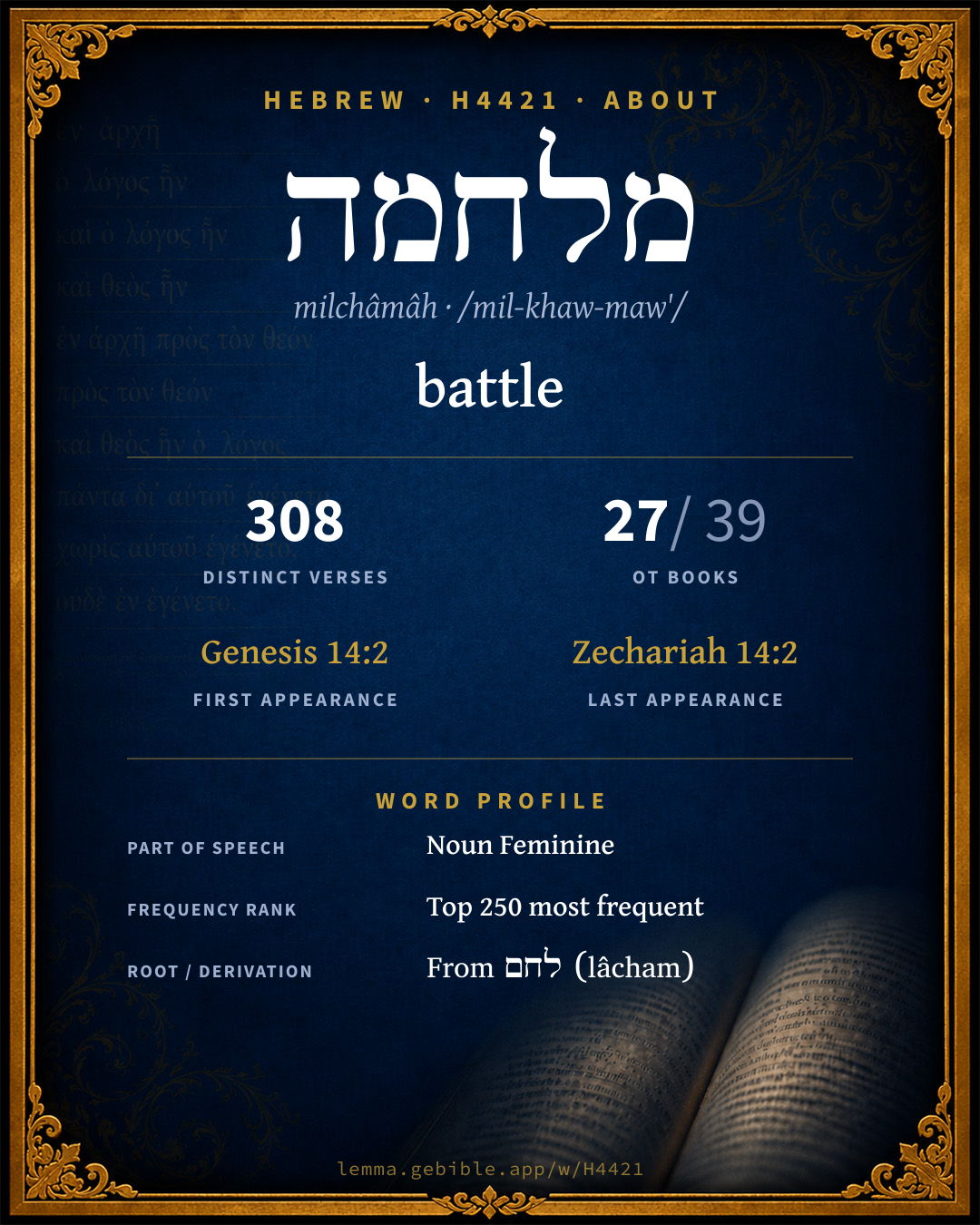
מִלְחָמָה
battle
Full lexicon entry — Brown-Driver-Briggs (BDB)
From Brown-Driver-Briggs (BDB)
Where this word appears
Grammar key — what these labels mean
Part of speech
- Noun
- A naming word — a person, place, thing, or idea.
Noun type
- Common
- A common noun — a general class of person, place, or thing (“king,” “city,” “water”), not a specific name.
State
- Absolute
- The independent form of a noun, not bound to a following word.
- Construct
- A noun bound to a following noun in a possessive / “of” relationship (the construct chain).
Gender
- Feminine
- Grammatically feminine.
Number
- Singular
- One.
- Plural
- More than one (in Hebrew, generally three or more).
Every verse where H4421 appears in the Book of Joshua — 18 distinct verses. Click any verse to open its interlinear word-by-word view. Verse text shown in the World English Bible for context — . Each verse’s Hebrew form is shown with its reference; the English is not keyword-highlighted, since the data carries no word-level English alignment. Use “Compare translations” on any verse to read it across multiple English versions. This concordance covers the Hebrew Bible; Septuagint (Greek Old Testament) occurrences are not indexed here.
Joshua
- Joshua 4:13 לַ/מִּלְחָמָ֔ה prep det + n c fs about forty thousand ready armed for war passed over before Yahweh to battle, to the plains of Jericho.
- Joshua 5:4 הַ/מִּלְחָמָ֗ה ptcl def.art + n c fs This is the cause why Joshua did circumcise: all the people who came forth out of Egypt, who were males, even all the men of war, died in the wilderness by the way, after they came forth out of Egypt.
- Joshua 5:6 הַ/מִּלְחָמָה֙ ptcl def.art + n c fs For the children of Israel walked forty years in the wilderness, until all the nation, even the men of war who came forth out of Egypt, were consumed, because they didn't listen to the voice of Yahweh: to whom Yahweh swore that he wouldn't let them see the land which Yahweh swore to their fathers that he would give us, a land flowing with milk and honey.
- Joshua 6:3 הַ/מִּלְחָמָ֔ה ptcl def.art + n c fs You shall compass the city, all the men of war, going about the city once. Thus shall you do six days.
- Joshua 8:1 הַ/מִּלְחָמָ֔ה ptcl def.art + n c fs Yahweh said to Joshua, Don't be afraid, neither be dismayed: take all the people of war with you, and arise, go up to Ai; behold, I have given into your hand the king of Ai, and his people, and his city, and his land;
- Joshua 8:3 הַ/מִּלְחָמָ֖ה ptcl def.art + n c fs So Joshua arose, and all the people of war, to go up to Ai: and Joshua chose out thirty thousand men, the mighty men of valor, and sent them forth by night.
- Joshua 8:11 הַ/מִּלְחָמָ֜ה ptcl def.art + n c fs All the people, [even] the [men of] war who were with him, went up, and drew near, and came before the city, and encamped on the north side of Ai: now there was a valley between him and Ai.
- Joshua 8:14 לַֽ/מִּלְחָמָ֞ה prep det + n c fs It happened, when the king of Ai saw it, that they hurried and rose up early, and the men of the city went out against Israel to battle, he and all his people, at the time appointed, before the Arabah; but he didn't know that there was an ambush against him behind the city.
- Joshua 10:7 הַ/מִּלְחָמָה֙ ptcl def.art + n c fs So Joshua went up from Gilgal, he, and all the people of war with him, and all the mighty men of valor.
- Joshua 10:24 הַ/מִּלְחָמָה֙ ptcl def.art + n c fs It happened, when they brought forth those kings to Joshua, that Joshua called for all the men of Israel, and said to the chiefs of the men of war who went with him, Come near, put your feet on the necks of these kings. They came near, and put their feet on the necks of them.
- Joshua 11:7 הַ/מִּלְחָמָ֨ה ptcl def.art + n c fs So Joshua came, and all the people of war with him, against them by the waters of Merom suddenly, and fell on them.
- Joshua 11:18 מִלְחָמָֽה n c fs Joshua made war a long time with all those kings.
- Joshua 11:19 בַ/מִּלְחָמָֽה prep det + n c fs There was not a city that made peace with the children of Israel, save the Hivites the inhabitants of Gibeon: they took all in battle.
- Joshua 11:20 הַ/מִּלְחָמָ֤ה ptcl def.art + n c fs For it was of Yahweh to harden their hearts, to come against Israel in battle, that he might utterly destroy them, that they might have no favor, but that he might destroy them, as Yahweh commanded Moses.
- Joshua 11:23 מִ/מִּלְחָמָֽה prep + n c fs So Joshua took the whole land, according to all that Yahweh spoke to Moses; and Joshua gave it for an inheritance to Israel according to their divisions by their tribes. The land had rest from war.
- Joshua 14:11 לַ/מִּלְחָמָ֖ה prep det + n c fs As yet I am as strong this day as I as in the day that Moses sent me: as my strength was then, even so is my strength now, for war, and to go out and to come in.
- Joshua 14:15 מִ/מִּלְחָמָֽה prep + n c fs Now the name of Hebron before was Kiriath Arba; [which Arba was] the greatest man among the Anakim. The land had rest from war.
- Joshua 17:1 מִלְחָמָ֔ה n c fs [This] was the lot for the tribe of Manasseh; for he was the firstborn of Joseph. As for Machir the firstborn of Manasseh, the father of Gilead, because he was a man of war, therefore he had Gilead and Bashan.
About this entry
At a glance — auto-summarized from this page’s data, not written by a person. Every figure links to its source below. This summary describes the numbers; it doesn’t interpret them.
The Hebrew noun מלחמה centers on the idea of “battle.” Debuting at Genesis 14:2, it then recurs through the corpus. It appears 308 verses across 27 books of the Hebrew Bible, among its common vocabulary. It shares a root with לחם, לחום and לחם. For the data behind this summary, explore the sense tree and the renderings breakdown below.
Gloss history
Strong's 1890 vs modern scholarship
About this word
Strong's H4421 catalogs a Hebrew word from the Hebrew Old Testament.
These counts are not copied from any lexicon or concordance. They are computed here, from the morphology-tagged Hebrew Old Testament. What Lemma adds →
- 308
- distinct verses
- The word appears in 308 distinct verses.
- 27 / 39
- OT books
- The word appears in 27 of 39 Old Testament books.
- #156
- by frequency
- Top 250 most frequent Hebrew words (rank 156 of 8,640 Hebrew words by occurrence).
View all 308 occurrences in the concordance →
Most concentrated in
- 1 Chronicles 31 verses 10%
- 1 Samuel 29 verses 9%
- 2 Samuel 29 verses 9%
By section of the Old Testament
By traditional corpus
Conventional, traditional groupings — biblical authorship is debated, so this is a traditional corpus grouping, not an authorship claim. Each share is this word’s portion of its verses in that division of the Hebrew canon. Each figure is a share of the word’s 308 distinct verses.
- Prophets (Nevi'im) 187 verses · 61%
- Writings (Ketuvim) 84 verses · 27%
- Torah (Pentateuch) 37 verses · 12%
How translations render this word
Counts come from each version’s own published word-to-Strong’s tagging or interlinear alignment — an approximate guide to how each version renders this word, not a word-level alignment the data otherwise carries. Because each total is that version’s own tagged count, the per-version totals vary from one another and need not match the appearance or distinct-verse counts above. These counts may also differ from a printed concordance because Lemma counts each distinctly tagged rendering and does not collapse phrase taggings into a single head-word total. This is a fixed set of word-tagged versions (KJV, ASV, BSB, ULT) and does not change with the reading translation you choose elsewhere. Each version’s license is shown beside its name below (and on Sources).
- King James Version: Battle 125×, War 125×, Was war 8×
- American Standard Version: Battle 109×, War 106×, Was war 6×
- Berean Standard Bible: Battle 134×, War 90×, Fight 11×
- unfoldingWord Literal Text: Battle 171×, War 106×, Battles 7×
King James Version Public Domain
Renders H4421 across 315 tagged occurrences — most commonly:
Plus 37 renderings that appear only once — usually multi-word phrases or single function words the recovered tagging swept in, not distinct renderings. Not rendered by a distinct English word in 4 further occurrences.
American Standard Version Public Domain
Renders H4421 across 312 tagged occurrences — most commonly:
Plus other, less common renderings. Plus 60 renderings that appear only once — usually multi-word phrases or single function words the recovered tagging swept in, not distinct renderings.
Berean Standard Bible Public Domain
Renders H4421 across 298 tagged occurrences — most commonly:
Plus other, less common renderings. Plus 29 renderings that appear only once — usually multi-word phrases or single function words the recovered tagging swept in, not distinct renderings. Not rendered by a distinct English word in 21 further occurrences.
unfoldingWord Literal Text CC BY-SA 4.0
Renders H4421 across 310 tagged occurrences — most commonly:
Plus 14 renderings that appear only once — usually multi-word phrases or single function words the recovered tagging swept in, not distinct renderings.
Senses in BDB
The 1 sense BDB distinguishes for this word, in lexicon order (not ranked by frequency or importance). The full entry — with sub-senses — is in the Lexicon Entry tab.
- battle, war
Word origin
n.f. battle, war;—abs. מ׳ Gn 14:2, 8 Ex 1:10 +; cstr. מִלְחֶ֫מֶת 1 S 13:22 (מ׳ מִכְמָשׁ 𝔊 Th We Bu HPS Ew§ 188 c Köii 182 > abs. Thes al.); sf. מִלְחַמְתִּי 2 Ch 35:21; מִלְחַמְתְּךָ 2 S 11:25; מִלְחַמְתֶּ֑ךָ Is 41:12, etc.; pl. מִלְחָמוֹת Is 42:13 + 7 times Ch ψψ; cstr. מִלְחֲמוֹת Ju 3:1 +, etc.;—battle, Gn 14:8 1 S 17:1, 2, 8; 31:3 1 K 20:14, 18, 29, 39 + often; war, Gn 14:2 Ex 1:10 Dt 20:12 Jos 11:23; 14:15 2 S 3:1 (וַתְּהִי הַמִּלְחָמָה אֲרֻכָּה) +; מִלְחֲמוֹת כְּנָ֑עַן Ju 3:1; סֵפֶר מִלְחֲמֹת י׳ Nu 21:14 (JE); acc. cogn. c. נלחם †1 S 8:20 2 Ch 32:8 and (מִלְחֲמוֹת י׳) 1 S 18:17; 25:28†; = art of war, למד מ׳ Is 2:4 learn war = Mi 4:3; למּד מ׳ Ju 3:2 teach war, fighting; מְלַמֵּד יָדַי לַמּ׳ 2 S 22:35 = ψ 18:35, cf. ψ 144:1; לְמוּדֵי מ׳ 1 Ch 5:18, מְלֻמְּדֵי מ׳ Ct 3:8 instructed in war; once = battlefield וַיָּבֹאוּ עַד הַמּ׳ 1 S 14:20 (so KitKauAT). The most freq. phrases are: †אִישׁ מ׳ Is 3:2 1 S 16:18; 17:33 2 S 17:8 Ez 39:20 Jos 17:1 (P), also (coll.) Ju 20:17, of י׳ Ex 15:3 (poem); אַנְשֵׁי הַמּ׳ Jos 6:3; 10:24 (both JE), Dt 2:14, 16 Jos 5:4, 6 (all D), Je 38:4; 39:4; 41:3, 16; 49:26; 51:32; 52:7, 25, also 1 K 9:22 2 K 25:4 Nu 31:28, 49 (P), Jo 4:9; late אַנְשֵׁי מ׳ Jo 2:7 1 Ch 12:39 (v 38 van d. H) 2 Ch 8:9; 17:13; אִישׁ מִלְחָמוֹת Is 42:13 1 Ch 28:3; אַנְשֵׁי מִלְחַמְתָּהּ Je 50:30 her men of war, cf. Is 41:12 Ez 27:10, 27; אִישׁ מִלְחֲמוֹת תֹּעִי 2 S 8:10 a man of battles of Toi, i.e. his frequent opponent (v. Dr), = 1 Ch 18:10; seldom גִּבּוֹר מ׳ ψ 24:8 (of י׳), גִּבּוֹרֵי מ׳ 2 Ch 13:3; שָׂרֵי מִלְחָמוֹת 2 Ch 32:6; עַם הַמּ׳ Jos 8:1, 3; 10:7; 11:7, cf. 8:11 (all JE), cf. also 1 S 13:16 add. 𝔊 We Dr, cf. Klo; אַנְשֵׁי חַיִל לַמּ׳ Je 48:14; צְבָא מ׳ battle-host Is 13:4, so צ׳ הַמּ׳ Nu 31:14 (P); also גְּדוּדֵי צְבָא מ׳ 1 Ch 7:4, יֹצְאֵי צ׳ לַמּ׳ v 11, אַנְשֵׁי צָבָא לַמּ׳ 1 Ch 12:9 (v 8 van d. H)†; weapons of war, כְּלֵי (ה)מ׳ Ju 18:11, 17 Je 21:4; 51:20 1 Ch 12:34 (v 33 van d. H), also fig. 2 S 1:27 (‖ גִּבּוֹרִים); כְּלֵי צְבָא מ׳ 1 Ch 12:38 (v 37 van d. H.); קֶשֶׁת מ׳ Zc 9:10; 10:4; כְּלֵי מִלְחַמְתּוֹ his weapons of war 1 S 8:12 Dt 1:41, cf. Ju 18:16 Ez 32:37; דִּבְרֵי הַמּ׳ = the news of the battle 2 S 11:18, 19 + v 22 add. 𝔊 The We Klo Dr Bu. Freq. combin. with vbs. are: עָרַךְ מ׳ draw up battle-line Ju 20:22 +, sq. אֵת with = against Gn 14:8 Ju 20:20, sq. עִם 2 Ch 13:3; אסר המּ׳ i.e. begin the battle 1 K 20:14, cf. 2 Ch 13:3; וַתִּקְרַב הַמּ׳ 1 K 20:29 and the battle was joined; עָשָׂה מ׳ make war Pr 20:8; 24:6 1 Ch 22:8, sq. אֵת with Gn 14:2 Jos 11:18 (D), sq. עִם Dt 20:12, 20 1 Ch 5:10, 19; †יָצָא לַמּ׳ עִם Ju 20:14, 20, 28, c. עַל 1 K 8:44 2 Ch 6:34; הָלַךְ לַמּ׳ עִם 2 K 8:28; נגשׁ לַמּ׳ עִם Ju 20:23, c. בְּ 1 S 7:10 2 S 10:13, abs. Je 46:3†; וַתְּהִי הַמּ׳ עִם 2 S 21:18, 19, c. בֵּין 2 S 3:1, cf. v 6 +; †קִדַּשׁ מ׳ consecrate war, i.e. open a campaign (with sacred rites, Che) Mi 3:5 Je 6:4 (both c. על), Jo 4:9; cf. †וְהַמּ׳ הִדְבִּיקָתְהוּ Ju 20:42 and the battle clung to them; וַתַּעֲלֶה הַמּ׳ 22:35 and the battle rose (high) = 2 Ch 18:34; וַתִּטּשׁ הַמּ׳ 1 S 4:2, read וַתֵּט הַמּ׳ (𝔊 We Klo Bu, cf. Dr) and the battle inclined (in favour of one side); נָפוֹצֶת הַמּ׳ 2 S 18:8 Qr the battle was spread (extended), so read 1 S 14:24 add. 𝔊 The We Klo Dr; תָּקוּם עָלַי מ׳ ψ 27:3 if war rise against me†; הַמּ׳ כָּבֵ֑דָה Ju 20:34 the battle was severe, cf. וַתִּכְבַּד הַמּ׳ אֶל־שָׁאוּל 1 S 31:3 = 1 Ch 10:3 (על for אל); so וַתְּהִי הַמּ׳ חֲזָקָה 1 S 14:52, חָזַק מִמֶּנּוּ הַמּ׳ 2 K 3:26; וַתְּהִי הַמּ׳ קָשָׁה 2 S 2:17: cf. כֹּבֶד מ׳ Is 21:15, עֱזוּז מ׳ 42:25.
— Brown-Driver-Briggs (Oxford 1906, public domain), digitized via Sefaria, supplemented by the OpenScriptures HebrewLexicon (CC BY 4.0). See Sources.
Derived from לחם (lâcham) (H3898) — to fight.
Jastrow Dictionary
A second Hebrew/Aramaic lexicon for comparison, covering Aramaic and post-biblical (Talmudic, Targumic, Midrashic) usage that the biblical-Hebrew BDB does not. Matched by lemma rather than by Strong’s number, so a lemma may carry more than one Jastrow headword (shown separately below), and the entries cover usage well beyond the Bible.
מִלְחָמָה
- war, contest. Sot. VIII, 1, a. fr. משוח מ׳ chaplain of the army (Deut. XX, 2), v. מָשַׁח I. Ib. 7 מִלְחֶמֶת הרשות (Bab. ed. 44ᵇ, pl.) secular (political) warfare; מ׳ מצוה a war for religious causes; מ׳ חובה וכ׳ a war of duty. Ib. 44ᵇ מ׳ יהושע וכ׳ the war of conquest under Joshua, all agree, is a war of duty &c.—Meg. 15ᵇ מִלְחַמְתָּהּ של תורה disputes about the Law; a. fr.—Pl. מִלְחָמוֹת. Sot. l. c. מִלְחֲמוֹת בית דוד לרווחה the wars of the house of David for extending the dominion. M. Kat. 25ᵇ (in a eulogy) גזע … ועמו ספר מ׳ an offspring of worthies came up from Babylonia and with him came the book of wars (allegorically for knowledge of the Law; oth. interpret. R. Hamnuna who came with Rabbah). Snh. 97ᵃ בשביעית מ׳ in the seventh Messianic year there will be wars; a. fr. e.g. Deuteronomy 20:2
A Dictionary of the Targumim, the Talmud Babli and Yerushalmi, and the Midrashic Literature (Marcus Jastrow; London, Luzac, 1903) — Public Domain. Digitized via Sefaria. Digitized via Sefaria. Full attribution on Sources.
Forms in the corpus
The 84 distinct written forms H4421 takes in the Hebrew Bible, most frequent first — each parse links to that state’s occurrences in the concordance. Hebrew forms include their vowel points and cantillation, so a single lemma takes many written forms.
The 60 most common forms are shown; 24 rarer forms follow in the full concordance.
Same root — word family
Other BDB entries built from the same root as H4421, grouped by Strong’s listed origin. These share a root / origin per the lexicon — not necessarily a shared meaning. Each links to that word’s own entry.
Derives from
Shares the same root
Compare all same-root words → Showing 4 of 5 — not the complete family. They share a root, not necessarily a meaning.
Septuagint verse parallels
This word appears in 294 verses that also exist in the Greek Old Testament (Septuagint), out of the 308 Hebrew verses it occurs in. You can read those verses in Greek by switching the Old Testament edition to the Septuagint.
Read these verses in the Septuagint
- Genesis 14:2
- Exodus 1:10
- Numbers 10:9
- Deuteronomy 1:41
- Joshua 4:13
- Judges 3:1
- 1 Samuel 4:1
- 2 Samuel 1:4
- 1 Kings 2:5
- 2 Kings 3:7
- 1 Chronicles 5:10
- 2 Chronicles 6:34
This is a verse-level parallel only — the same verses exist in both the Hebrew and Greek Old Testaments. No word-level Hebrew↔Greek correspondence is claimed: the data carries no such alignment, so no Greek word is shown as this Hebrew word’s translation. Coverage is not total — the Septuagint omits the deuterocanon and renumbers the Psalms, so some Hebrew verses have no direct Greek parallel.