
Daniel 11:20

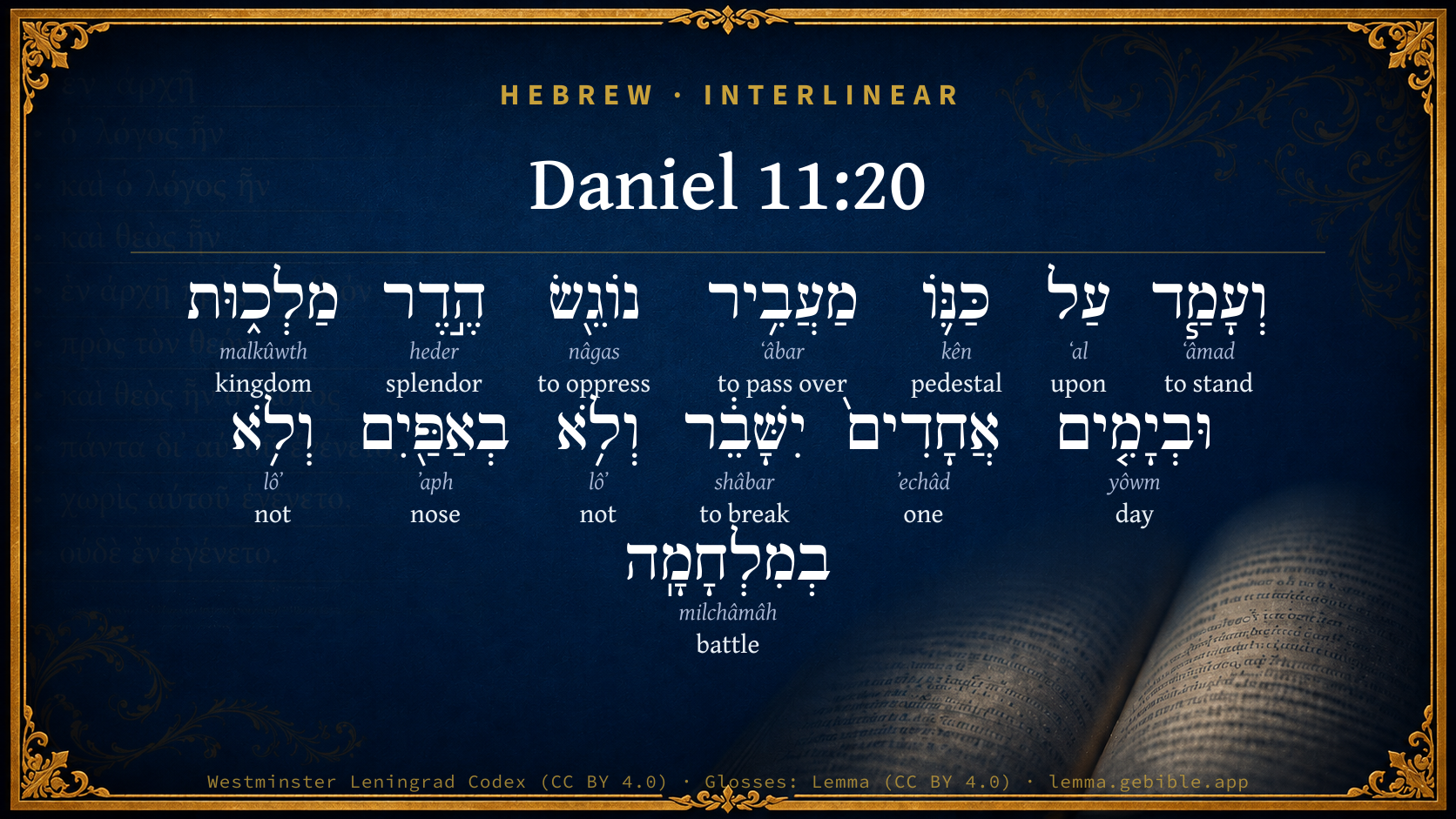
Hebrew (Westminster Leningrad Codex) Daniel 11:20 appears in the Hebrew Old Testament. The text above is from the Westminster Leningrad Codex. Each word links to its Strong’s number, a concise gloss, and parsing drawn from the Open Scriptures Hebrew Bible morphology. Click any word for its full Brown-Driver-Briggs (BDB) entry.
Download image
Cite this verse

Daniel 11:20 (World English Bible). Public Domain. Lemma interlinear Bible study tool, https://lemma.gebible.app/v/daniel/11/20.

Show BibTeX & RIS
BibTeX
RIS
English Translation
Then shall stand up in his place one who shall cause a tax collector to pass through the kingdom to maintain its glory; but within few days he shall be destroyed, neither in anger, nor in battle.
World English Bible · Public Domain
Highlights
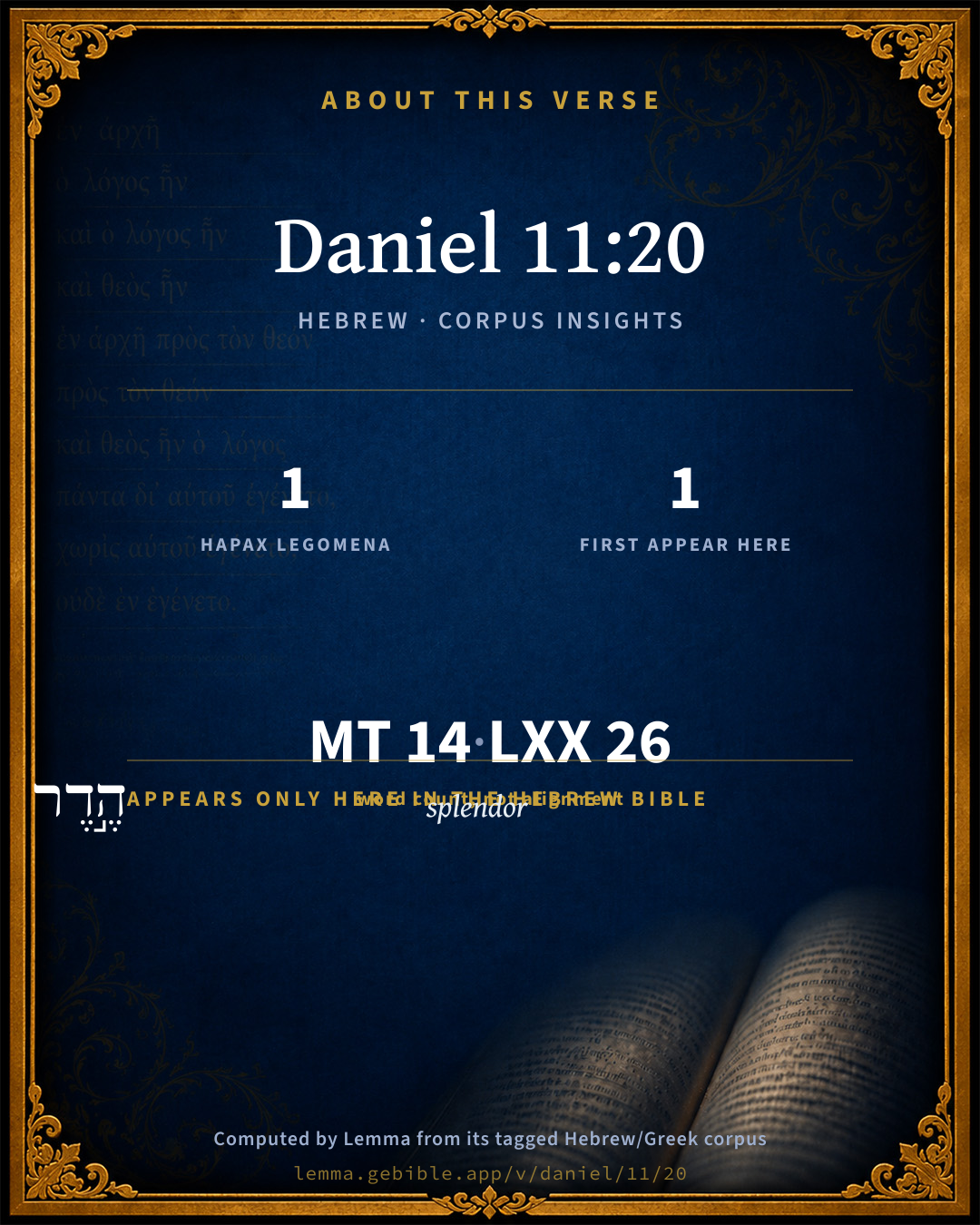
  • 1 hapax legomenon — only here in the Hebrew Bible
  • 1 first appearance in the Hebrew Bible
Full analysis ↓
Download a study sheet

One document with this verse’s original text, its word-by-word gloss line, the meaning frame, cross-references with their text, attributed commentary, and full source and license credits — printable, and it pastes into notes with its structure intact.

This verse Autodidact and up

Study sheet (.html) Plain text (.txt)

A passage Seminary Student

Up to 50 verses in one chapter. A passage sheet keeps up to 6 commentary sources and 12 cross-references per verse, in the order this page ranks them, and says so on the sheet whenever that leaves anything out. Ask for a single verse and you get the Autodidact verse sheet above.

Everything on this page stays free to read, with no account — the sheet is a download of what is already on screen, not access to it.

Want to remove ads? Support Godless Engineer
Compare translations 3

The same verse in 3 English versions, stacked beneath the original-language interlinear above. Click any original word for its lexicon entry.

Each is an independent rendering of the whole verse — the interlinear is not word-aligned to these translations.

Highlighted words mark where these versions differ — a whole-verse word diff, not a word-by-word alignment.

  • World English Bible Public Domain
    Then shall stand up in his place one who shall cause a tax collector to pass through the kingdom to maintain its glory; but within few days he shall be destroyed, neither in anger, nor in battle.
  • King James Version Public Domain
    Then shall stand up in his estate a raiser of taxes in the glory of the kingdom: but within few days he shall be destroyed, neither in anger, nor in battle.
  • unfoldingWord Literal Text CC BY-SA 4.0
    Then will arise in his place one who will send a tax collector for the splendor of the kingdom. But in a few days he will be broken, though not in anger nor in battle.

unfoldingWord Literal Text — © unfoldingWord, licensed CC BY-SA 4.0. Word-aligned USFM3 via Door43 (git.door43.org/unfoldingWord/en_ult).

Versions to compare (up to 4)

3 of 4 selected

Show all 18 translations

Every available English version of this verse, each an independent rendering of the whole verse.

  • World English Bible Public Domain
    Then shall stand up in his place one who shall cause a tax collector to pass through the kingdom to maintain its glory; but within few days he shall be destroyed, neither in anger, nor in battle.
  • Berean Standard Bible Public Domain
    In his place one will arise who will send out a tax collector for the glory of the kingdom; but within a few days he will be destroyed, though not in anger or in battle.
  • Majority Standard Bible Public Domain
    In his place one will arise who will send out a tax collector for the glory of the kingdom; but within a few days he will be destroyed, though not in anger or in battle.
  • King James Version Public Domain
    Then shall stand up in his estate a raiser of taxes in the glory of the kingdom: but within few days he shall be destroyed, neither in anger, nor in battle.
  • American Standard Version (1901) Public Domain
    Then shall stand up in his place one that shall cause an exactor to pass through the glory of the kingdom; but within few days he shall be destroyed, neither in anger, nor in battle.
  • Revised Version (1885) Public Domain
    Then shall stand up in his place one that shall cause an exactor to pass through the glory of the kingdom: but within few days he shall be destroyed, neither in anger, nor in battle.
  • Geneva Bible (1599) Public Domain
    Then shall stand vp in his place in the glorie of the kingdome, one that shall raise taxes: but after fewe dayes he shall be destroyed, neither in wrath, nor in battell.
  • Douay-Rheims (1899) Public Domain
    And there shall stand up in his place, one most vile, and unworthy of kingly honour: and in a few days he shall be destroyed, not in rage nor in battle.
  • Young's Literal Translation Public Domain
    `And stood up on his station hath `one' causing an exactor to pass over the honour of the kingdom, and in a few days he is destroyed, and not in anger, nor in battle.
  • Literal Standard Version CC BY-SA 4.0
    And stood up on his station has [one] causing an exactor to pass over the honor of the kingdom, and in a few days he is destroyed, and not in anger, nor in battle.
  • Unlocked Literal Bible CC BY-SA 4.0
    Then someone will rise up in his place who will make a tax collector pass through for the sake of the splendor of the kingdom. But in the next days he will be broken, but not in anger or in battle.
  • unfoldingWord Literal Text CC BY-SA 4.0
    Then will arise in his place one who will send a tax collector for the splendor of the kingdom. But in a few days he will be broken, though not in anger nor in battle.
  • Darby Bible Public Domain
    And in his place shall one stand up who shall cause the exactor to pass through the glory of the kingdom; but in a few days he shall be broken, neither in anger nor in battle.
  • World Messianic Bible Public Domain
    “Then one who will cause a tax collector to pass through the kingdom to maintain its glory will stand up in his place; but within few days he shall be destroyed, not in anger, and not in battle.
  • Webster's Bible Public Domain
    Then shall stand up in his estate a raiser of taxes in the glory of the kingdom: but within few days he shall be destroyed, neither in anger, nor in battle.
  • Free Bible Version CC BY-SA 4.0
    His successor will send out a tax collector to maintain royal wealth. However, in a short time he will die, but not violently or in battle.
  • Bible in Basic English Public Domain
    Then his place will be taken by one who will send out a man with the glory of a king to get wealth together; but after a short time destruction will overtake him, but not in wrath or in the fight.
  • JPS Tanakh (1917) Public Domain
    Then shall stand up in his place one that shall cause an exactor to pass through the glory of the kingdom; but within few days he shall be destroyed, neither in anger, nor in battle.

Literal Standard Version (2020), Covenant Press — licensed CC BY-SA 4.0. Text via the HelloAO Bible API (eBible.org). Unlocked Literal Bible (unfoldingWord) — licensed CC BY-SA 4.0. Text via the HelloAO Bible API (eBible.org). unfoldingWord Literal Text — © unfoldingWord, licensed CC BY-SA 4.0. Word-aligned USFM3 via Door43 (git.door43.org/unfoldingWord/en_ult). Free Bible Version, Dr. Jonathan Gallagher — licensed CC BY-SA 4.0. Text via the HelloAO Bible API (eBible.org).

Word by word

More ways to search: Search by grammar → Find every occurrence → Compare this word →

Practice this passage: Drill this verse → Learn its vocabulary →

הֶ֣דֶר
heder
H1925
“splendor of”
Noun, Common, Masculine, Singular, Construct
Part of Speech
Noun
Type
Common
Gender
Masculine
Number
Singular
State
Construct
Full BDB Definition

Origin: from H1921

TWOT: 477a

ornament, splendour, adornment, glory
  1. וְעָמַ֧ד ʻâmad H5975 “and · to stand” Conjunction + Verb, Qal, Sequential Perfect, 3rd Person, Masculine, Singular
  2. עַל ʻal H5921 “upon” Preposition
  3. כַּנּ֛וֹ kên H3653 “pedestal · his” Noun, Common, Masculine, Singular, Construct + Suffix, Personal, 3rd Person, Masculine, Singular
  4. מַעֲבִ֥יר ʻâbar H5674 “passing over” Verb, Hiphil, Participle Active, Masculine, Singular, Absolute
  5. נוֹגֵ֖שׂ nâgas H5065 “oppressing” Verb, Qal, Participle Active, Masculine, Singular, Absolute
  6. מַלְכ֑וּת malkûwth H4438 “kingdom” Noun, Common, Feminine, Singular, Absolute
  7. וּבְיָמִ֤ים yôwm H3117 “and · in/at · days” Conjunction + Preposition + Noun, Common, Masculine, Plural, Absolute
  8. אֲחָדִים֙ ʼechâd H259 “one” Adjective, Cardinal number, Masculine, Plural, Absolute
  9. יִשָּׁבֵ֔ר shâbar H7665 “to break” Verb, Niphal, Imperfect, 3rd Person, Masculine, Singular
  10. וְלֹ֥א lôʼ H3808 “and · not” Conjunction + Particle, Negative
  11. בְאַפַּ֖יִם ʼaph H639 “in/at · nostrils” Preposition + Noun, Common, Masculine, Dual, Absolute
  12. וְלֹ֥א lôʼ H3808 “and · not” Conjunction + Particle, Negative
  13. בְמִלְחָמָֽה milchâmâh H4421 “in/at · battle” Preposition + Noun, Common, Feminine, Singular, Absolute

About this verse

These counts appear in no published source. They are computed here, from the morphology-tagged text and Lemma’s own curated glosses. What Lemma adds →

14
words
13
distinct lemmas
Prophets
section

Notable vocabulary

1 hapax legomenon — a word that appears only here in the entire Hebrew Bible:

  • הֶ֣דֶר splendor H1925

First appearance in Scripture

This word makes its first canonical appearance in the Hebrew Bible here:

  • הֶ֣דֶר splendor H1925

Shared distinctive vocabulary

כַּנּ֛וֹ pedestal H3653 occurs in 17 verses of the Hebrew Bible. Also found in:

Grammatical profile

  • 4 verbs
  • 6 nouns
  • 1 adjective
  • 1 preposition
  • 2 particles

Verb forms

  • וְעָמַ֧ד Qal · Sequential Perfect
  • מַעֲבִ֥יר Hiphil · Participle Active
  • נוֹגֵ֖שׂ Qal · Participle Active
  • יִשָּׁבֵ֔ר Niphal · Imperfect

Repetition

A word recurs within this verse — often emphatic in Hebrew:

  • וְלֹ֥א not H3808 ×2

Hebrew & Septuagint length

In English translation the verse runs 37 words from the Hebrew and 40 from the Septuagint (LXX English) — closely comparable.

A rough comparison of the two English renderings, which tokenize alike — not a word-level alignment.

Word counts can differ between the Hebrew and the Greek without any difference in meaning — e.g. the Hebrew direct-object marker אֵת has no separate Greek word, and Greek often adds the article ὁ.

In the original languages it is 14 Hebrew tokens and 26 Greek tokens — but the two are counted differently (Hebrew bundles its prefixes and suffixes into one token; the Greek is in lemma form), so that isn’t a like-for-like length.

Cross-references

6

Topical passages linked to Daniel 11:20 in the Treasury of Scripture Knowledge — connected by theme and wording, ordered by reader-vote popularity; previews shown in the World English Bible.

  • Isaiah 60:17 For brass I will bring gold, and for iron I will bring silver, and for wood brass, and for stones iron. I will also make your officers peace, and righteousness your ruler.
  • Deuteronomy 15:2–3 This is the manner of the release: every creditor shall release that which he has lent to his neighbor; he shall not exact it of his neighbor and his brother; because Yahweh's release has been proclaimed.
  • 2 Kings 23:35 Jehoiakim gave the silver and the gold to Pharaoh; but he taxed the land to give the money according to the commandment of Pharaoh: he exacted the silver and the gold of the people of the land, of everyone according to his taxation, to give it to Pharaoh Necoh.
  • Proverbs 30:33 For as the churning of milk brings forth butter, And the wringing of the nose brings forth blood; So the forcing of wrath brings forth strife."
  • Daniel 11:7 But out of a shoot from her roots shall one stand up in his place, who shall come to the army, and shall enter into the fortress of the king of the north, and shall deal against them, and shall prevail.
  • Daniel 11:21 In his place shall stand up a contemptible person, to whom they had not given the honor of the kingdom: but he shall come in time of security, and shall obtain the kingdom by flatteries.

Cross-references courtesy of OpenBible.info (CC BY 4.0).

Hebrew and Greek witnesses Masoretic Hebrew ↔ Greek Septuagint

The same verse in the two great witnesses to the Old Testament, shown verse-for-verse.

These are two independent witnesses, not word-aligned to each other, and the Septuagint is shown in lemma (dictionary) form.

Hebrew Daniel 11:20 Masoretic · Westminster Leningrad Codex

וְעָמַ֧ד עַל כַּנּ֛וֹ מַעֲבִ֥יר נוֹגֵ֖שׂ הֶ֣דֶר מַלְכ֑וּת וּבְיָמִ֤ים אֲחָדִים֙ יִשָּׁבֵ֔ר וְלֹ֥א בְאַפַּ֖יִם וְלֹ֥א בְמִלְחָמָֽה

Then shall stand up in his place one who shall cause a tax collector to pass through the kingdom to maintain its glory; but within few days he shall be destroyed, neither in anger, nor in battle.

World English Bible · Public Domain

Greek LXX Daniel 11:20 Septuagint · lemma form

καί ἀναἵστημι ἐκ ὁ ῥίζα αὐτός φυτόν βασιλεία εἰς ἀνάστασις ἀνήρ τύπτω δόξα βασιλεύς καί ἐν ἡμέρα ἔσχατος συντρίβω καί οὐ ἐν ὀργή οὐδέ ἐν πόλεμος

And there shall arise out of his root one that shall cause a plant of the kingdom to pass over his place, earning kingly glory: and yet in those days shall he be broken, yet not openly, nor in war.

LXX2012 (modern English Septuagint) · Public Domain

On this verse, The Pulpit Commentary discusses the Septuagint’s reading. Read the note in Commentary ↓

Hebrew: Westminster Leningrad Codex (CC BY 4.0). Greek: Septuagint (public domain); English from LXX2012 (modern English Septuagint) (Public Domain). How the Septuagint differs from the Hebrew →

Commentary

Notes on Daniel 11:20 from classic Christian and Jewish commentators (each source and its license shown beneath its notes). The classic Christian expositions comment on the surrounding passage and are grouped to its opening verse, so a note may address several verses; the Jewish commentaries on the Tanakh (Rashi and others) are per-verse, so they appear only where the commentator wrote on this verse.

Lemma curates 59 commentaries, every one of them public domain or Creative Commons licensed, each selected and text-cleaned for this edition rather than reprinted as found. About our sources →

Ellicott's Commentary for English Readers

(20) A raiser of taxes.—The marginal version is to be preferred, as it gives the meaning of the word “exactor,” or “oppressor,” which it has in Exo_3:7, and in every passage where it occurs, except perhaps Isa_9:4. The new king of the north causes the “oppressor” to pass through “the majesty of the kingdom” (a phrase occurring elsewhere only in Psa_145:12; but comp. 1Ch_29:25), meaning the “richest parts of his kingdom,” and not necessarily Palestine. The effect of this policy was that the king fell a victim to a conspiracy in a few days. According to St. Jerome, the person alluded to was Seleucus Philopator.

With this verse the first part of the prophecy concludes. It is to be observed that thus far (1) notes of time are very scanty; we only meet with indefinite expressions, such as “in the end of years” (Dan_11:6), “certain years” (Dan_11:13), “within few days” (Dan_11:20), and vague terms expressing sequence of time. (2) There is nothing in the text which implies any change of sovereigns, except in Dan_11:7; Dan_11:19. It follows from a careful study of these verses that according to their natural and literal sense they speak of only two southern kings and only one northern king. The southern king of whom we read most is apparently the offspring of the daughter of the first southern king, mentioned in Dan_11:5, and it is he who engages in conflict with the first northern king, and with his sons (Dan_11:10). The whole prophecy is eschatological, and refers to two opposing earthly powers which will affect the destiny of God’s people in the last times. It relates a series of wars and political intrigues between these two powers, all of which prove futile, and it concludes with the account of the death of the first northern king. Dan_11:20 is a transition verse, in which another character is introduced, who will mark the approach of the end; while Dan_11:21 introduces the most prominent object of the prophecy—a person who remains before the reader till the end of the chapter, while the southern king gradually disappears (Dan_11:25; Dan_11:27; Dan_11:40), and what is apparently his country is mentioned without its sovereign in Dan_11:43.

A Bible Commentary for English Readers, edited by Charles John Ellicott (1878–1897) — public domain. Text from a community e-Sword module.

Trapp's Complete Commentary

John Trapp

Dan 11:20 Then shall stand up in his estate a raiser of taxes [in] the glory of the kingdom: but within few days he shall be destroyed, neither in anger, nor in battle.

Ver. 20. Then shall stand up in his estate a raiser of taxes.] Heb., One that causeth an exactor to pass over, who shall gather no less sums of curses than of coin. This was Seleucus Philopator, son to Antiochus the Great, and his father’s darling - whence also he had his surname - but not the people’s darling, as Scipio was at Rome, whom they called Corculum, or sweet heart; for this Seleucus, king of Syria, being the Romans’ tribute gatherer - to whom he was to pay, according to his father’s agreement, a thousand talents by the year - he was hated of the people, and poisoned by Heliodorus, a great man about him, in favour of Antiochus Epiphanes, his brother and successor in the kingdom.

John Trapp, A Commentary or Exposition upon All the Books of the Old and New Testament (1647–1656) — public domain. Text from a community e-Sword module.

Joseph Benson's Commentary

Dan 11:20. Then shall stand up in his estate — Hebrew, על כנו, on his base; Vulgate, in his place; or, shall succeed him; a raiser of taxes in the glory of his kingdom — Or, as in the margin, one that causeth an exacter to pass over, &c., that is, one who will send the tribute-gatherers through his kingdom. This was a very just description of Seleucus Philopater, the son and successor of Antiochus, who oppressed his people with most grievous taxes, that he might raise the tribute of one thousand talents, which he was obliged to pay annually to the Romans, as well as that he might support his own government. According to Jerome, he performed nothing worthy of the empire of Syria, and of his father, but reigned both idly and weakly, as Appian also testifies. He had an inclination, indeed, to shake off the Roman yoke, and therefore raised an army, with an intent to march over mount Taurus to the assistance of Pharnaces king of Pontus; but his dread of the Romans confined him at home within the bounds prescribed to him, and almost as soon as he had raised, he disbanded, his army. So that he was little more than a raiser of taxes all his days. He even sent his treasurer, Heliodorus, to seize the money deposited in the temple of Jerusalem. This was literally causing an exacter to pass over the glory of the kingdom, when he sent his treasurer to plunder that temple which even kings had honoured and magnified with their best gifts. But within a few days — Or rather, years, according to the prophetic style, he was to be destroyed — And accordingly his reign was of short duration in comparison of his father’s, for he reigned only twelve years, and his father thirty-seven. Or perhaps the passage may mean, that within a few days, or years, after his attempting to plunder the temple at Jerusalem, he should be destroyed: and not long after that, as all chronologers agree, he was destroyed, neither in anger, nor in battle — Neither through rebellion at home, nor in war abroad; but by the treachery of his own treasurer Heliodorus; the same wicked hand that was the instrument of his sacrilege being also the instrument of his death. “For Seleucus having sent his only son Demetrius to be a hostage at Rome instead of his brother Antiochus, and Antiochus being not yet returned to the Syrian court, Heliodorus thought this a fit opportunity to despatch his master, and, in the absence of the next heir to the crown, to usurp it to himself. But he was disappointed in his ambitious projects, and only made way for another’s usurped greatness instead of his own.” — Bishop Newton.

Joseph Benson's Commentary on the Old and New Testaments (1811–1818) — public domain. Text from a community e-Sword module.

Keil & Delitzsch

C. F. Keil & F. Delitzsch

Another stands up in his place, who causeth נוגשׂ to pass over, through his eagerness for riches. נוגשׂ most understand as a collector of tribute, referring for this to Kg2 23:35, and מלכוּת הדר מלכוּת as the Holy Land, and then think on Heliodorus, whom Seleucus Nicator sent to Jerusalem to seize the temple treasure. But this interpretation of the words is too limited. נגשׂ denotes, no doubt (Kg2 23:35), to collect gold and silver; but it does not thence follow that נוגשׂ, when silver and gold are not spoken of, means to collect tribute. The word in general designates the taskmaster who urges on the people to severe labour, afflicts and oppresses them as cattle. מלכוּת הדר is not synonymous with הצּבי ארץ, Dan 11:16, but stands much nearer to מלכוּת הוד, Dan 11:21, and designates the glory of the kingdom. The glory of the kingdom was brought down by נוגשׂ, and העביר refers to the whole kingdom of the king spoken of, not merely to the Holy Land, which formed but a part of his kingdom. By these oppressions of his kingdom he prepared himself in a short time for destruction. אחדים ימים (days few), as in Gen 27:44; Gen 29:20, the designation of a very short time. The reference of these words, "in days few," to the time after the pillage of the temple of Jerusalem by Heliodorus is not only an arbitrary proceeding, but is also contrary to the import of the words, since ב in בּימים does not mean post. מאפּים ולא, in contradistinction and contrast to במלחמה ולא, can only denote private enmity or private revenge. "Neither by anger (i.e., private revenge) nor by war" points to an immediate divine judgment.

If we now, before proceeding further in our exposition, attentively consider the contents of the revelation of vv. 5-20, so as to have a clear view of its relation to the historical fulfilment, we shall find the following to be the course of the thoughts exhibited: - After the fall of the Javanic world-kingdom (Dan 11:4) the king of the south shall attain to great power, and one of his princes shall found (Dan 11:5) a yet greater dominion in the north. After the course of years they shall enter into an agreement, for the king of the south shall give his daughter in marriage to the king of the north so as to establish a right relationship between them; but this agreement shall bring about the destruction of the daughter, as well as of her father and all who co-operated for the effecting of this marriage (Dan 11:6). Hereupon a descendant of that king of the south shall undertake a war against the king of the north, victoriously invade the country of the adversary, gather together great spoil and carry it away to Egypt, and for years hold the supremacy. The king of the north shall, it is true, penetrate into his kingdom, but he shall again return home without effecting anything (Dan 11:7-9). His sons also shall pass over the kingdom of the south with a multitude of hosts, but the multitude shall be given into the hand of the king, who shall not come to power by casting down myriads. The king of the north shall return with a host yet more numerous; against the king of the south many, also faithless members of the Jewish nation, shall rise up, and the king of the north shall take the fortified cities, without the king of the south having the power to offer him resistance (Dan 11:10-15). The conqueror shall now rule in the conquered lands after his own pleasure, and set his foot on the Holy Land with the intention of destroying it. Thereupon he shall come with the whole might of his kingdom against the king of the south, and by the marriage of his daughter seek to establish a right relationship with him, but he shall only thereby bring about the destruction of his daughter. Finally, he shall make an assault against the islands and the maritime countries of the west; but he shall be smitten by his chiefs, and be compelled to return to the fortresses of his own land, and shall fall (Dan 11:16-19). But his successor, who shall send taskmasters through the most glorious regions of the kingdom, shall be destroyed in a short time (Dan 11:20).

Thus the revelation depicts how, in the war of the kings of the south and of the north, first the king of the south subdued the north, but when at the summit of his conquest he sank under the power of his adversary through the insurrections and the revolt of an apostate party of the Jews; whereupon, by an assault upon the west in his endeavour, after a firmer establishment and a wider extension of his power, he brings about his own overthrow, and his successor, in consequence of the oppression of his kingdom, comes to his end in a few days.

Now, since the king who comes into his place (Dan 11:21.) after he has become strong raises himself up against the holy covenant, takes away the daily worship in the temple of the Lord, etc., is, according to the historical evidence found in the books of the Maccabees, the Seleucidan Antiochus Epiphanes, so the prophetic announcement, vv. 5-20, stretches itself over the period from the division of the monarchy of Alexander among his generals to the commencement of the reign of Antiochus Epiphanes in the year 175 b.c., during which there reigned seven Syrian and six Egyptian kings, viz. -

Syrian Kings (from b.c.) Egyptian Kings (from b.c.) Seleucus Nicator 310-280 Ptolemy Lagus 323-284 Antiochus Sidetes 280-260 Ptolemy Philadelphus 284 Antiochus Theus 260-245 Ptolemy Euergetes 246-221 Seleucus Callinicus 245-225 Ptolemy Philopator 221-204 Seleucis Ceraunus 225-223 Ptolemy Epiphanes 204-180 Antiochus the Great 223-186 Ptolemy Philometor 180

But in the prophetic revelation there is mention made of only four kings of the north (one in Dan 11:5-9; his sons, Dan 11:10-12; a third, Dan 11:13-19; and the fourth, Dan 11:20) and three kings of the south (the first, Dan 11:5 and Dan 11:6; the "branch," Dan 11:7-9; and the king, Dan 11:10-15), distinctly different, whereby of the former, the relation of the sons (Dan 11:10) to the king indefinitely mentioned in Dan 11:11, is admitted, and of the latter the kings of the south, it remains doubtful whether he who is spoken of in Dan 11:9-15 is different from or is identical with "the branch of her roots" (Dan 11:7). This circumstance shows that the prophecy does not treat of individual historical personages, but only places in view the king of the south and the king of the north as representatives of the power of these two kingdoms. Of these kings special deeds and undertakings are indeed mentioned, which point to definite persons; e.g., of the king of the north, that he was one of the princes of the king of the south, and founded a greater dominion than his (Dan 11:5); the marriage of the daughter of the king of the south to the king of the north (Dan 11:6); afterwards the marriage also of the daughter of the king of the north (Dan 11:17), and other special circumstances in the wars between the two, which are to be regarded not merely as individualizing portraitures, but denote concrete facts which have verified themselves in history. But yet all these specialities do not establish the view that the prophecy consists of a series of predictions of historical facta, because even these features of the prophecy which find their actual fulfilments in history do not coincide with the historical reality.

Thus all interpreters regard the king of the south, Dan 11:5, as Ptolemy Lagus, and that one of his princes (מן־שׂריו) who founded a greater dominion as Seleucus Nicator, or the "Conqueror," who, in the division of the countries which the conquerors made after the overthrow and death of Antiochus, obtained, according to Appian, Syr. c. 55, Syria from the Euphrates to the Mediterranean Sea and Phrygia; then by using every opportunity of enlarging his kingdom, he obtained also Mesopotamia, Armenia, and a part of Cappadocia, and besides subjugated the Persians, Parthians, Bactrains, Arabians, and other nations as far as the Indus, which Alexander had conquered; so that, after Alexander, no one had more nations of Asia under his sway than Seleucus, for from the borders of Phyrgia to the Indus all owned his sway. While this extension of his kingdom quite harmonizes with the prophecy of the greatness of his sovereignty, yet the designation "one of his princes" does not accord with the position of Ptolemy Lagus. Both of these were certainly at the beginning generals of Alexander. Seleucus, afterwards vicegerent of the Babylonians, found himself, however, from fear of Antigonus, who sought to put him to death, under the necessity of fleeing to Egypt to Ptolemy, by whom he was hospitably received, and with whom and other vicegerents he entered into a league against Antigonus, and when war arose, led an Egyptian fleet against Antigonus (Diod. Sic. xix. 55-62). He was accordingly not one of Ptolemy's generals.

Moreover, the marriage of the king's daughter, Dan 11:6, is thus explained by Jerome, and all interpreters who follow him: - Ptolemy Philadelphus made peace with Antiochus Theus, after many years' war, on the condition that Antiochus should put away his own wife Laodice, who was at the same time his half-sister, and disinherit her son, and should marry Berenice, the daughter of Ptolemy, and should appoint her first-born son as his successor on the throne of the kingdom (Appian, Syr. c. 65, and Jerome). This factum can be regarded as a fulfilling of the prophecy, Dan 11:6; but the consequences which resulted from this political marriage do not correspond with the consequences prophesied of. According to the testimony of history, Ptolemy died two years after this marriage, whereupon Antiochus set aside Berenice, and took to himself again his former wife Laodice, along with her children. But she effected the death of her husband by poison, as she feared his fickleness, and then her son Seleucus Callinicus ascended the throne. Berenice fled with her son to the asylum of Daphne, but she was there murdered along with him. The prophecy, according to this, differs from the historical facts, not merely in regard to the consequences of the events, but also in regard to the matter itself; for it speaks not only of the daughter, but also of her father being given up to death, while the natural death of her father is in no respect connected with that marriage, and not till after his death did the consequences fatal to his daughter and her child develop themselves.

Further, as to the contents of Dan 11:7-9, history furnishes the following confirmations: - In order to save his sister, who was put aside by Antiochus Theus, her brother, Ptolemy Euergetes, invaded the Syrian kingdom, in which Seleucus Callinicus had succeeded his father on the throne, in alliance with the armies of the Asiatic cities, and put to death his mother Laodice, since he had come too late to save his sister, in revenge for her murder, overthrew all the Syrian fortresses from Cilicia to the Tigris and Babylonia, and would have conquered the whole of the Syrian kingdom, if an insurrection which had broken out in Egypt had not caused him to return thither, carrying with him many images of the gods, and immense treasure, which he had taken from the vanquished cities. Then, while engaged in Egypt, Callinicus recovered the cities of Asia Minor, but failed to conquer the maritime countries, because his fleet was wrecked in a storm; and when he thereupon undertook a land expedition against Egypt, he was totally defeated, so that he returned to Antioch with only a few followers: cf. Justin, Hist. xxvii. 1, 2; Polyb. v. 58; and Appian, Syr. c. 65. On the other hand, the announcement of the war of his sons with many hosts overflowing the land, Dan 11:10, is not confirmed by history. After the death of Callinicus in captivity, his son Seleucus Ceraunus succeeded to the government, a very incompetent man, who after tow years was poisoned by his generals in the war with Attalus, without having undertaken anything against Egypt. His brother Antiochus, surnamed the Great, succeeded him, who, in order to recover Coele-Syria and Phoenicia, renewed the war against the king of Egypt (not till about two years after he ascended the throne, however, did Ptolemy Philopator begin to reign), in which he penetrated twice to Dura, two (German) miles north from Caesarea (Polyb. x. 49), then concluded a four months' truce, and led his host back to the Orontes (Polyb. v. 66; Justin, xxx. 1). After the renewal of hostilities he drove the Egyptian army back to Sidon, conquered Gilead and Samaria, and took up his winter-quarters in Ptolemais (Polyb. v. 63-71). In the beginning of the following year, however, he was defeated by the Egyptians at Raphia, not far from Gaza, and was compelled, with great loss in dead and prisoners, to return as quickly as possible to Antioch, and to leave Coele-Syria, Phoenicia, and Palestine to the Egyptians (Polyb. v. 79, 80, 82-86). Dan 11:11 and Dan 11:12 refer to this war. Thirteen our fourteen years after this, Antiochus, in league with Philip III of Macedon, renewed the war against the Egyptians, when, after Philopator's death, Ptolemy Epiphanes, being five years old, had ascended the throne, retook the three above-named countries (Coele-Syria, Phoenicia, and Palestine), vanquished the Egyptian host led by Scopas near Paneas, and compelled the fortress of Sidon, into which the Egyptians had fled, to surrender after a lengthened siege, and then concluded a peace with Ptolemy on the condition that he took to wife the daughter of Antiochus, Cleopatra, who should bring with her, as her dowry, Coele-Syria, Phoenicia, and Palestine (Polyb. xv. 20, xxviii. 17; App. Syr. c. i.; Liv. xxxiii. 19; and Joseph. Antt. xii. 4. 1). Since the time of Jerome, the prophecy Dan 11:13-17 has been referred to this last war. But also here the historical events fall far behind the contents of the prophecy. The prophecy points to the complete subjugation of the king of the south, while this war was carried on only for the possession of the Asiatic provinces of the Egyptian kingdom. Also the rising up of many (רבּים, Dan 11:14) against the king of the south is not historically verified; and even the relation spoken of by Josephus (Antt. xii. 3. 3) in which the Jews stood to Antiochus the Great was not of such a kind as to be capable of being regarded as a fulfilling of the "exalting themselves" of the פריצים בּני, Dan 11:14. Still less does the statement of Dan 11:16, that the king of the north would stand in the glorious land, agree with כּלה interpreted of conduct of Antiochus the Great toward the Jews; for according to Josephus, Antt. l.c., he treated the Jews round about Jerusalem favourably, because of their own accord they had submitted to him and had supported his army, and granted to them not only indulgence in regard to the observance of their religious ordinances, but also afforded them protection.

Moreover, Dan 11:18, containing the prophecy of the undertaking of the king of the north against the islands, has not its historical fulfilment in the expedition of Antiochus the Great against the coasts and islands of Asia Minor and the Hellespont; but Dan 11:19, that which is said regarding his return to the fortresses of his own land and his overthrow, does not so correspond with the historical issues of the reign of this king that one would be able to recognise therein a prediction of it. Finally, of his successor, Seleucus Philopator, to whom Dan 11:20 must refer, if the foregoing verses treat of Antiochus the Great, nothing further is communicated, than that he quum paternis cladibus fractas admodum Syriae opes accepisset, post otiosum nullisque admodum rebus gestis nobilitatum annorum duodecim regnum, was put to death through the treachery of Heliodorus, unius ex purpuratis (Liv. xli. 19, cf. App. Syr. c. 45), and the mission of Heliodorus to Jerusalem to seize the treasures of the temple, which is fabulously described in 2 Macc. 3:4ff. The ישּׁבר (shall be destroyed) of this king אחדים בּימים (within few days) does not harmonize with the fact of his twelve years' reign.

From this comparison this much follows, that the prophecy does not furnish a prediction of the historical wars of the Seleucidae and the Ptolemies, but an ideal description of the war of the kings of the north and the south in its general outlines, whereby, it is true, diverse special elements of the prophetical announcement have historically been fulfilled, but the historical reality does not correspond with the contents of the prophecy in anything like an exhaustive manner. This ideal character of the prophecy comes yet more prominently forward to view in the following prophetic description.

Keil & Delitzsch — Biblical Commentary on the Old Testament (1861–1891) — public domain (CC PDM 1.0). Text via the HelloAO Bible API. (Old Testament only.)

The Expositor's Bible

THIRD SECTION

(Dan_11:20-27)

Events under Seleucus Philopator down to the first attempts of Antiochus Epiphanes against Egypt (B.C. 170).

Dan_11:20 -Seleucus Philopator (B.C. 187-176) had a character the reverse of his fathers. He was no restless seeker for glory, but desired wealth and quietness. Among the Jews, however, he had a very evil reputation, for he sent an "exactor"-a mere tax-collector, Heliodorus-"to pass through the glory of the kingdom." He only reigned twelve years, and theft was "broken"- i.e ., murdered by Heliodorus, neither in anger nor in battle, but by poison administered by this "tax-collector." The versions all vary, but I feel little doubt that Dr. Joel is right when he sees in the curious phrase "nogesh heder malkooth," "one that shall cause a raiser of taxes to pass over the kingdom"-of which neither Theodotion nor the Vulgate can make anything-a cryptographic allusion to the name "Heliodorus"; and possibly the predicted fate may (by a change of subject) also refer to the fact that Heliodorus was checked, not by force, but by the vision in the Temple. {#/RAPC 2Ma 5:18,3:24-29} We find from #/RAPC 2Ma 4:1 that Simeon, the governor of the Temple, charged Onias with a trick to terrify Heliodorus, This is a very probable view of what occurred.

Dan_11:21 -Seleucus Philopator died B.C. 175 without an heir. This made room for a contemptible person, a reprobate, who had no real claim to royal dignity, being only a younger son of Antiochus the Great. He came by surprise, "in time of security." and obtained the kingdom by flatteries.

Dan_11:22.-Yet "the overflowing wings of Egypt" (or "the arms of a flood") "were swept away before him and broken; yea, and even a covenanted or allied prince." Some explain this of his nephew Ptolemy Philometor, others of Onias III, "the prince of the covenant"- i.e ., the princely high priest, whom Antiochus displaced in favour of his brother, the apostate Joshua, who Graecised his name into Jason, as his brother Onias did in calling himself Menelaus.

Dan_11:23 -This mean king should prosper by deceit which he practised on all connected with him; and though at first he had but few adherents, he should creep into power.

Dan_11:24 -"In time of security shall he come, even upon the fattest places of the province." By this may be meant his invasions of Galilee and Lower Egypt. Acting unlike any of his royal predecessors, he shall lavishly scatter his gains and his booty among needy followers, and shall plot to seize Pelusium, Naucratis, Alexandria, and other strongholds of Egypt for a time.

Dan_11:25 -After this (B.C. 171) he shall, with a "great army," seriously undertake his first invasion of Egypt, and shall be met by his nephew Ptolemy Philometor with another immense army. In spite of this, the young Egyptian King shall fail through the treachery of his own courtiers. He shall be outwitted and treacherously undermined by his uncle Antiochus. Yes! even while his army is fighting, and many are being slain, the very men who "eat of his dainties," even his favourite and trusted courtiers, Eulaeus and Lenaeus, will be devising his ruin, and his army shall be swept away.

Dan_11:26-27 (B.C. 174).-The Syrians and the Egyptian King, nephew and uncle, shall in nominal amity sit at one banquet, eating from one table; but all the while they will be distrustfully plotting against each other and "speaking lies" to each other. Antiochus will pretend to ally himself with the young Philometor against his brother Ptolemy Euergetes II-generally known by his derisive nickname as Ptolemy Physkon-whom after eleven months the Alexandrians had proclaimed king. But all these plots and counter-plots should be of none effect, for the end was not yet.

William Robertson Nicoll, ed., The Expositor's Bible (London: Hodder & Stoughton, 1887–1910) — public domain. 65 of 66 books (1 Corinthians is not separately keyed, as that volume carries no machine-parseable verse references); section-level commentary keyed to the opening verse. Introductory and overview sections not keyed to a specific passage are excluded.

Tyndale Open Study Notes

Tyndale Open Resources

11:20 Antiochus III’s successor was his son Seleucus IV Philopater (187–175 BC), who was known for his infamous act of sending Heliodorus, a tax collector, to exact large sums of money to maintain the royal splendor (but also to pay the ruinous tribute imposed on the Seleucids by Rome). Heliodorus attempted to plunder the Temple in Jerusalem but was divinely thwarted (see 2 Maccabees 3:1-40). Seleucus was murdered by Heliodorus after a very brief reign of seven years.

Tyndale Open Study Notes — © Tyndale Open Resources, licensed CC BY-SA 4.0. Text via the HelloAO Bible API.

Geneva Bible (1599)

Geneva Bible translators

Not by foreign enemies, or battle, but by treason.

That is, Seleucus shall succeed his father Antiochus.

Geneva Bible (1599) marginal notes — public domain. Text via Bolls.life.

Jamieson, Fausset & Brown

Robert Jamieson, A. R. Fausset & David Brown

in his estate--in Antiochus' stead: his successor, Seleucus Philopater, his son.

in the glory of the kingdom--that is, inheriting it by hereditary right. MAURER translates, "one who shall cause the tax gatherer (Heliodorus) to pass through the glory of the kingdom," that is, Judea, "the glorious land" (Dan 11:16, Dan 11:41; Dan 8:9). Simon, a Benjamite, in spite against Onias III, the high priest, gave information of the treasures in the Jewish temple; and Seleucus having reunited to Syria Cœlo-Syria and Palestine, the dowry formerly given by Antiochus the Great to Cleopatra, Ptolemy's wife, sent Heliodorus to Jerusalem to plunder the temple. This is narrated in 2 Maccabees 3:4, &c. Contrast Zac 9:8, "No oppressor shall pass through . . . any more."

within few days . . . destroyed--after a reign of twelve years, which were "few" compared with the thirty-seven years of Antiochus' reign. Heliodorus, the instrument of Seleucus' sacrilege, was made by God the instrument of his punishment. Seeking the crown, in the absence at Rome of Seleucus' only son and heir, Demetrius, he poisoned Seleucus. But Antiochus Epiphanes, Seleucus' brother, by the help of Eumenes, king of Pergamos, succeeded to the throne, 175 B.C.

neither in anger, nor in battle--not in a popular outbreak, nor in open battle.

Jamieson, Fausset & Brown — Commentary Critical and Explanatory on the Whole Bible (1871) — public domain (CC PDM 1.0). Text via the HelloAO Bible API.

Adam Clarke's Commentary

Verse 20. Then shall stand up in his estate a raiser of taxes] Seleucus Philopater succeeded his father Antiochus. He sent his treasurer Heliodorus to seize the money deposited in the temple of Jerusalem, which is here called the glory of the kingdom, see 2Macc 9:23. He was so cramped to pay the annual tax to the Romans, that he was obliged to burden his subjects with continual taxes.

He shall be destroyed, neither in anger - fighting against an enemy, nor in battle - at the head of his troops; but basely and treacherously, by the hand of Heliodorus his treasurer, who hoped to reign in his stead.

Adam Clarke's Commentary on the Bible (1810–1826) — public domain. Text from a community e-Sword/MySword module.

John Calvin's Commentaries

Seleucus, it is well known, did not long survive his father, for he was put to death either by poison, or by his domestics. Suspicion fell upon his brother Antiochus, who was sent back to his country after his father’s death was known. Demetrius alone was retained, who afterwards escaped by flight, for he left the city under the pretense of hunting, and followed the bank of the Tiber as far as Ostia, where he embarked on a small vessel, preferring to run all risks to remaining in perpetual banishment. Concerning Seleucus, the angel says, he shall stand in his place, meaning, he shall succeed by hereditary right to the office of Antiochus the Great. Thus he shall cause the exactor to pass over Some translate, He shall take away the exactor; for the verb עבר gneber, in Hiphil, signifies to take away. The Hebrews use the verb of this clause in the sense of excluding. Some interpreters think this language implies the praise of Seleucus for lessening the tributes imposed by his father, but historians shew this view to be false, and condemn his avarice and rapacity. In some points he was superior to his brother Antiochus; although both lustful and cruel to those around him. Through indulgence in great expenses, he could not be moderate and lenient towards his subjects; for luxury and prodigality always draw with them cruelty in the exaction of tribute. For he who is thus profuse, must necessarily extract the very blood from his people. As Seleucus was thus devoted to self-indulgence, this sense is more appropriate — he made the exactor to pass through, meaning, he laid new and fresh taxes on all his subjects. Nothing but this is said of him, since he was immediately put to death, as the second clause of the verse informs us. If we prefer taking the words — the glory of the kingdom — by way of opposition, Seleucus will be praised as an honor and an ornament. But I think we must supply the letter ל, l, and understand the passage thus, — He who shall cause the exactor to pass through shall stand in his place, and shall be destroyed in a few days By the word “destroyed,” he signifies a bloody death. But not in anger, says he. I wonder why some translate it “in mutual conflict,” because the Hebrews imply “anger” by this word; meaning, he should not perish in open warfare, or in the course of a battle, but by the hands of his domestics. Historians differ as to the kind of death which he died, some saying he was poisoned, and others, slain by the sword. But this difference is of no consequence. Antiochus Epiphanes next succeeds him.

John Calvin's Commentaries (1540-1563) — public domain. Text from the Calvin Translation Society English edition (1840s-50s) via the Christian Classics Ethereal Library (ccel.org). Calvin's coverage is partial (roughly two-thirds of the Bible); uncommented books and verses are honest gaps, never fabricated. The 19th-century editor's footnotes and remarks are omitted so the notes are faithfully Calvin's own voice.

The Cambridge Bible for Schools and Colleges

gen. ed. J. J. S. Perowne

20. Seleucus IV. (Philopator), b.c. 187–175.

Antiochus the Great left two sons, Seleucus and Antiochus (Epiphanes), both of whom successively followed him on the throne.

And in his place (Dan_11:7) shall stand up one that shall cause an exactor to pass through the glory of the kingdom] Seleucus IV. The words are generally considered to allude to an event from the reign of this monarch which affected the Jews. In 2 Maccabees 3 we read, namely, how one Simon, guardian of the Temple, having quarrelled with the high-priest Onias, gave information to Apollonius, governor of Cœle-Syria and Phœnicia, of the treasures contained in the Temple, with the suggestion that they might prove useful to the king: Seleucus thereupon commissioned his chief minister (τὸν ἐπὶ τῶν πραγμάτων), see Niese, op. cit. p. 29, to proceed to Jerusalem and appropriate them. Heliodorus accordingly visited Jerusalem for the purpose; but was prevented from carrying it out (according to the author of 2 Macc.) by a supernatural apparition, which appeared to him just as he was on the point of entering the treasury[369]. We are however imperfectly informed as to the events of Seleucus IV.’s reign; and it is possible that the allusion may be of a general kind: Seleucus (below, note) had to pay for nine years an annual sum of 1000 talents to the Romans, which he would naturally exact of his subject provinces; and perhaps the reference may be to the ‘exactor’ who visited Palestine regularly for the purpose[370].

[369] Cf. Ewald v. 292; Stanley, Jewish Church, iii. 287.

[370] Antiochus Epiphanes shortly afterwards sends into Judah an officer called ἅρχων φορολογίας (1Ma_1:29).

an exactor] cf. the cognate verb in 2Ki_23:35.

the glory of the kingdom] a prophet (Isa_13:19) had called Babylon ‘the beauty of kingdoms’; and so here the land of Judah is called ‘the glory of the kingdom’ (viz. of the Seleucidae), their noblest and choicest province. The Heb. in this part of the verse is however unusual; and Bevan, transposing two words, would read, ‘shall stand up an exactor (Seleucus IV. himself), who shall cause the glory of the kingdom (i.e. of his own kingdom) to pass away,’—with allusion to the inglorious reign of Seleucus IV.

but within few days (Gen_27:44; Gen_29:20, Heb.) he shall be broken, but not in anger, or in battle] not by a passionate deed of violence, and not in open fight, but (it is implied) in some less honourable way: in point of fact, Seleucus, after an uneventful reign of 12 years, met his death, perhaps by poison, through a plot headed by his chief minister, Heliodorus (Appian, Syr. c. 45 ἐξ ἐπιβουλῆς Ἡλιοδώρου). The ‘few days’ may be reckoned either from the mission of Heliodorus, or perhaps from the inception of the plot: in either case the general meaning will be that he would come to a speedy and untimely end.

broken] i.e. ruined; of a person, as Pro_6:15; Pro_29:1; ch. Dan_8:25. Cf. Dan_11:26, below.

in anger] if this is the meaning, the Heb. is very unusual; Behrmann suggests, on the strength of Aramaic analogies (cf. P.S[371] col. 278, bottom), that the expression may perhaps mean openly.

[371] .S. R. Payne Smith, Thesaurus Syriacus.

The Cambridge Bible for Schools and Colleges (gen. ed. J. J. S. Perowne; Cambridge University Press, 1878–1918) — public domain. Text from a community e-Sword module.

John Gill's Exposition

Then shall stand up in his estate a raiser of taxes in the glory of the kingdom,.... This was not Antiochus Epiphanes, as Theodoret, he is designed in the next verse; nor Ptolemy Epiphanes; as Porphyry, for he did not succeed Antiochus the great; nor Tryphon, tutor to Antiochus, as some Jewish writers; but Seleucus Philopator, the eldest son of Antiochus the great; who succeeded him, and was settled in his kingdom in his father's room, and stood upon his basis; and might well be called a raiser of taxes, being not only a covetous man, and a lover of money above all things; and therefore laid heavy taxes on his subjects, to gratify his avarice; but was indeed obliged to it, to raise the thousand talents yearly to pay the Romans, which his father had laid himself under obligation to do; and this took up the whole life of this his successor; for as there were twelve thousand talents to pay, a thousand each year, and Seleucus reigned in all but twelve years at most, he did nothing but raise taxes yearly to pay this tribute. It may be rendered, "then shall stand upon his basis": or, "in his room", as the Vulgate Latin version, in the room of Antiochus the great, "one that causes the exactors to pass through the glory of the kingdom" (o); that causes tax gatherers to go through the kingdom, and collect the tax of the people, who are the glory of the kingdom, especially the rich, the nobility, and gentry; or money, which is the glory of a nation: or, "shall cause the exactors to pass over to the glory of the kingdom"; that is, cause a tax gatherer to go over from Syria to the glorious land, or the glorious part of his dominion, the land of Judea; and so may have respect particularly to Heliodorus his treasurer, whom he sent to Jerusalem to demand the treasure of money he heard was laid up in the temple there; in the Apocrypha:

"Now when Apollonius came to the king, and had shewed him of the money whereof he was told, the king chose out Heliodorus his treasurer, and sent him with a commandment to bring him the foresaid money.'' (2 Maccabees 3:7)

but within few days he shall be destroyed, neither in anger, nor in battle; or, within a few years, as Grotius and Prideaux render it; "days" being often put for years. Seleucus reigned but twelve years at most, which were but few in comparison of the long reign of his father, which was a reign of thirty seven years; and he died not through the rage of the populace, or through the sedition and rebellion of his subjects, nor in war, with a foreign enemy; but through the treachery of Heliodorus his treasurer, by whom he was poisoned, as is supposed; either for the sake of Antiochus Epiphanes, who was at that very time returning from Rome, where he had been an hostage ever since the defeat of his father, the money being now paid, which was stipulated; or rather on his own account, having a design to seize the kingdom for himself.

(o) "stabit autem super basillius, qui transire faciet exactorem per decus regni", Michaelis.

John Gill's Exposition of the Whole Bible (1746–1763) — public domain (CC PDM 1.0). Text via the HelloAO Bible API.

Albert Barnes' Notes on the Bible

Then shall stand up in his estate - Margin, “or, place.” The word used - כן kên - means, properly, “a stand, station, place” (see the notes at Dan 11:7), and the idea here is simply that he would be succeeded in the kingdom by such an one. His successor would have the character and destiny which the prophecy proceeds to specify.

A raiser of taxes - One who shall be mainly characterized for this; that is, whose government would be distinguished eminently by his efforts to wring money out of the people. The Hebrew word נגשׂ nâgas' means, properly, to urge, to drive, to impel, and it is then applied to one who urges or presses a debtor, or who exacts tribute of a people. The word is used with reference to “money” exactions in Deu 15:2-3 : “Every creditor that lendeth aught unto his neighbor, he shall not exact it of his neighbor or of his brother. Of a foreigner thou mayest exact it again.” So in 2Ki 23:35, Jehoiakim taxed the land “to give the money according to the commandment of Pharaoh: he exacted the silver and the gold of the people of the land.” In Zec 9:8 - “And no oppressor shall pass through them anymore” - the same word is used. Here it denotes one who would be mainly characterized by his extorting tribute of his people, or using means to obtain money.

In the glory of the kingdom - The word “in” here is supplied by our translators. Lengerke renders it, “who shall suffer the tax-gatherer (eintreiber) to go through the glory of the kingdom.” This is evidently the meaning. He would lay the richest and most productive parts of his kingdom under contribution. This might be either to pay a debt contracted by a former monarch; or to carry on war; or to obtain the means of luxurious indulgence; or for purposes of magnificence and display.

But within few days - A comparatively brief period. Compare Gen 27:44; Gen 29:20. It is impossible from this to determine the precise period which he would live, but the language would leave the impression that his would be a short reign.

He shall be destroyed - Hebrew, “shall be broken. That is, his power shall be broken.” he shall cease to reign. It would not be certainly inferred from this that he would be put to death, or would die at that time, but that his reign then would come to an end, though it might be in some peaceful way.

Neither in anger - Hebrew, “angers.” Not in any tumult or excitement, or by any rage of his subjects. This would certainly imply that his death would be a peaceful death.

Nor in battle - As many kings fell. The description would indicate a reign of peace, and one whose end would be peace, but who would have but a brief reign. The reference here is, undoubtedly, to Seleucus Philopator, the oldest son of Antiochus the Great, and his immediate successor. The fulfillment of the prediction is seen in the following facts in regard to him:

(a) As an exactor of tribute. He was bound to pay the tribute which his father had agreed to pay to the Romans. This tribute amounted to a thousand talents annually, and consequently made it necessary for him to apply his energies to the raising of that sum. The Jewish talent of silver was equal to (in the 1850’s) about 1,505 of American money (about 339 British pounds), and, consequently, this thousand talents, of the Jewish talent of silver here referred to, was equal to (in 1850’s) about a million and a half dollars. The Greek talent of silver was worth (in 1850’s) 1,055 of American money (about 238 British pounds), and, if this was the talent, the sum would be about one million dollars. To raise this, in addition to the ordinary expenses of the government, would require an effort, and, as this was continued from year to year, and as Seleucus was known for little else, it was not unnatural that the should be characterized as the “raiser of taxes.”

(b) Especially would this be true in the estimation of the Jews, for no small part of these taxes, or this revenue, was derived from Palestine. Seleucus, taking advantage of the disturbances in Egypt, had reunited to the Syrian crown the provinces of Coelo-Syria and Palestine, which his father Antiochus the Great had given in dowry to his daughter Cleopatra, who was married to Ptolemy Epiphanes. - Jahn, “Heb. Commonwealth,” p. 255. In the year 176 b.c., Simon, a Benjamite, who became governor of the temple at Jerusalem, the farmer of the revenues of the Egyptian kings, attempted to make some innovations, which were steadily resisted by the high priest Onias III Simon, in anger, went to Apollonius, governor of Coelo-Syria under Seleucus, and informed him of the great treasures contained in the temple. “The king,” says Jahn (“Heb. Commonwealth,” p. 255), “through a friend to the Jews, and though he had regularly made disbursements, according to the directions of his father, toward sustaining the expenses of the sacrifices at Jerusalem, determined to apply to his own use the treasures of the temple, for the annual payment of one thousand talents to the Romans had reduced his finances to a very low ebb. With the design, therefore, of replenishing his exhausted treasury, he sent Heliodorus to Jerusalem to plunder the temple.” Compare Appian, “Syriac.” xlv. 60-65. See also Prideaux, “Con.” iii. 208; 2 Macc. 3. Besides this, the necessity of raising so much revenue would give him the character of a “raiser of taxes.”

(c) This was done in what might properly be termed “the glory of his kingdom,” or in what would, in the language of an Hebrew, be so called - Coelo-Syria and Palestine. To the eye of a Hebrew this was the glory of all lands, and the Jewish writers were accustomed to designate it by some such appellation. Compare the notes at Dan 11:16.

(d) His reign continued but a short time - answering to what is here said, that it would be for a “few days.” In fact, he reigned but eleven or twelve years, and that, compared with the long reign of Antiochus his father - thirty-seven years - was a brief period.

(e) The manner of his death. He did not fall in battle, nor was he cut off in a popular tumult. He was, in fact, poisoned. In the eleventh year of his reign, he sent his only son Demetrius as hostage to Rome, and released his brother Antiochus, who had resided twelve years in that city. As the heir to the crown was now out of the way, Heliodorus sought to raise himself to the royal dignity, and for this purpose he destroyed the king by poison. He attached a large party to his interests, and finally gained over those who were in favor of submitting to the king of Egypt. Antiochus Epiphanes received notice of these transactions while he was at Athens on his return from Rome. He applied himself to Eumenes, king of Pergamos, whom, with his brother Attalus, he easily induced to espouse his cause, and they, with the help of a part of the Syrians, deprived Heliodorus of his usurped authority. Thus, in the year 175 b.c., Antiochus Epiphanes quietly ascended the throne, while the lawful heir, Demetrius, was absent at Rome. Appian, “Syriac.” lxv. 60-65; Jahn, “Heb. Commonwealth,” ch. ix. Section 91. The remainder of this chapter is occupied with a detail of the crimes, the cruelties, and the oppressions of Antiochus Epiphanes, or Antiochus IV.

Albert Barnes' Notes on the Bible (1834–1885) — public domain. Text from a community e-Sword/MySword module.

Haydock's Catholic Bible Commentary

One more vile. Seleucus Philopator, who sent Heliodorus to plunder the temple; and was shortly after slain by the same Heliodorus. (Challoner) --- He reigned about twelve years; and had sent his own son, Demetrius, to be a hostage at Rome instead of Epiphanes, whom he designed to place at the head of an army to invade Egypt. Hebrew: "one who shall cause the exactor to pass over the glory of the kingdom," the temple. (2 Machabees iii.) (Calmet)

George Leo Haydock (1774–1849), Haydock's Catholic Family Bible and Commentary, 1859 edition — public domain. Excludes Psalms (Douay-Rheims chapter numbering differs from Protestant) and Deuterocanonical books (Catholic canon only).

Matthew Poole's English Annotations

This was Seleucus Philopater, a very covetous griper, who peeled his subjects; who being told by his friends this would alienate his friends from him, answered, Money was his best friend; and therefore spared not to rob the temple, for which cause he sent Heliodorus to rifle that treasury, 2Ma 3:7, therefore said to raise taxes in the glory of his kingdom.

But within few days he shall be destroyed; for he lived not out the thirst part of his father’s reign.

Neither in anger, nor in battle; not by open force, but by poison or secret wiles, and treachery of Heliodorus, as some write of him: the seed of evil-doers are never renowned, in life or death.

Matthew Poole's English Annotations on the Holy Bible (1683–1685) — public domain. Text from a community e-Sword/MySword module.

Whedon's Commentary on the Bible

Daniel D. Whedon

20. Estate — Rather, place (as in Dan_11:7; Dan_11:21; Dan_11:38). A raiser of taxes, etc. — Or, one that shall cause an exactor to pass over (through) the glory of the kingdom. The various versions greatly differ. The Vulgate renders, “in his stead shall stand a vile person and unworthy of royal dignity.” The reference is either to Heliodorus, the chancellor of Seleucus Philopator, who was sent by this king at the suggestion of Apollonius, governor of Coele-Syria and Phoenicia, to rob the temple of Jerusalem — being interrupted super-naturally in his purpose and scourged by divine agents, according to 2 Macc. iii — or to Seleucus IV, Philopator himself, who as the son and successor of Antiochus III fell heir to terrible financial embarrassments, which compelled him to exact heavy taxes, and may perhaps have induced him to countenance such robberies as that of Heliodorus. Palestine would most naturally be called by a Hebrew writer the glory of the [Syrian] kingdom; though Dr. Terry understands this to refer not to Palestine specifically, but generally to all of the most beautiful and productive portions of the kingdom.

Within few days — Seleucus IV only reigned in all a few days compared with his father (twelve years), and certainly only reigned a “few days” after the bootless mission of Heliodorus, mentioned above; for, according to the ancient account of his death, this courtier poisoned him, 176-175 B.C. Probably the method of his death explains why it can be said that he was “broken” neither in anger [that is, in a quarrel or insurrection, as was his father], nor in battle.

Daniel D. Whedon (gen. ed.), Commentary on the Old and New Testaments (1874–1909) — public domain. Text from a community e-Sword module.

The Pulpit Commentary

Then shall stand up in his estate a raiser of taxes in the glory of the kingdom; but within few days he shall be destroyed, neither in anger, nor in battle. The rendering of the LXX differs very much from this, "Then shall a plant arise out of his root to the restoration (ajnastasiv) of the kingdom, a man striking the glory of a king." It is impossible to find any connection between the opening clause of this and the corresponding clause in the Massoretic. Some of tile other clauses contain echoes of the Massoretic, or vice versa. The first clause of ver. 21 in the LXX really belongs to this verse, "In the last days he shall be broken, not in wrath nor in war," reading thus, ("aharoneem ) instead of ("ahadeem). Theodotion agrees in the first clause with the Septuagint, but is equally unintelligible, "There shall arise out of his root one removing a plant of the kingdom; on his preparation he shall act (prasswn), the glory of the kingdom: yet in those days he shall be broken, and not openly (ejnproswpoiv) nor in war shall he stand." The Peshitta renders, "In his stead shall one stand up who shall cause a ruler to pass through even the glory of your kings; and in a few days he shall be destroyed, not in tumult, nor in battle." The Vulgate renders, "In his stead shall stand a vile person (vilis-simus), and unworthy of royal dignity; and in a few days he shall be broken, not in fury, nor in battle." Difficult as is the interpretation of the words, just as difficult is it to find out the reference. Seleucus Philopator, who succeeded Antiochus, might be called a "raiser of taxes," as he had to meet as best he could the heavy demands of the Roman treasury. The rendering of the Revised suits also, "causing the exactor to pass through the glory of the kingdom." The reference might be to Heliodorus, were there any probability that he ever made an expedition to rob the temple. Certainly the story in 2 Maccabees makes it doubtful. It is not likely that Palestine would be exempt from taxation. To a Jew resident in Palestine the land the possession of which had been the occasion or" so many wars it might well seem the glory of the Syrian kingdom. But within few days he shall be destroyed. It is difficult to understand how the writer could reckon the reign of Seleucus Philopator as only a few days. His reign of twelve years was certainly much shorter than that of his father Antiochus, but longer than that of Epiphanes his brother, or of Seleucus III his uncle. The Greek versions do not give this clause. If we do not resort to the somewhat desperate remedy of altering the reading, we are compelled to measure the days from the taxing of Judaea. A good deal might be said for the reading of the LXX He shall be destroyed, neither in anger, nor in battle. If we may assume as correct the unsupported account of Appian, that Seleucus IV was assassinated by Heliodorus, we can see that he was destroyed "not in batlle." It conveys an idea of the facts of the case different from that given in Appian, when we say he was "not destroyed in anger." Moreover, the fact that Josephus refers to the death of Seleucus Philopator in terms that imply that be knew nothing of his violent death, makes his alleged assassination by Helio-dorus at least doubtful.

The Pulpit Commentary (1880–1919), ed. H.D.M. Spence-Jones & Joseph S. Exell — public domain. Text from a community e-Sword module.

John Wesley's Explanatory Notes

A raiser of taxes - Seleucus Philopator, who peeled his subjects, and spared not to rob the temple. Within few days - For he lived not out the third part of his father's reign. Not in battle - Not by open force, but by poison.

John Wesley, Explanatory Notes Upon the Whole Bible (1754–1765) — public domain. Text via the GEBible commentary corpus.

Scofield Reference Notes

C. I. Scofield

a raiser of taxes

A reference to the tribute exacted of the son of Antiochus the Great by the Romans.

The Scofield Reference Bible (1917 edition), notes by C. I. Scofield — public domain. Text from a community e-Sword module.

unfoldingWord translationNotes

Door43 World Missions Community

General Information:

The angel continues speaking to Daniel.

someone will rise up in his place

Rising up in a king's place represents becoming king in place of the previous king. AT: "another man will become king of the North instead of that king" (See: Metaphor)

will make a tax collector pass through

The tax collector will go through the land forcing people to pay taxes. AT: "will send someone to make the people pay taxes" (See: Assumed Knowledge and Implicit Information)

he will be broken

Here "he" refers to the new king. Being broken represents dying. AT: "the new king will die" (See: Metaphor)

but not in anger

Possible meanings are 1) no one was angry at the king, or 2) that the occasion and cause of the king's death were kept secret. (See: Metaphor)

a despised person to whom the people will not have given the honor of royal power

The people will refuse to acknowledge him as king because he is not a descendant of kings. AT: "a person whom the people will despise and will not honor as king" (See: Active or Passive)

An army will be swept away like a flood from before him

Being swept away represents being destroyed. This can be stated in active form. AT: "His army will completely destroy a great army as a flood destroys everything in its path" (See: Active or Passive and Simile)

Both that army and the leader of the covenant will be destroyed

This can be stated in active form. AT: "He will destroy that army and the leader of the covenant" (See: Active or Passive)

the leader of the covenant

"the leader of the priests." This phrase refers to the person who filled the most important religious position that God required in his covenant, that of the high priest.

translationWords

tax

splendor

kingdom

honor

flood

covenant

unfoldingWord translationNotes — © Distant Shores Media and the Door43 World Missions Community, licensed CC BY-SA 4.0. Source: git.door43.org/Door43/en_tn.

Rashi

Rabbi Shlomo Yitzchaki (Rashi)

And one who removes the oppressor will stand on his base and Mattathias the son of Johanan, who removed the oppressor from Israel, and who is the glory of the kingdom of Israel, will strengthen himself on his base on Mt. Modin, for he will be a prince and a mighty man, he and all his descendants after him, viz. the Hasmoneans.

in a few days it will be broken In a few days, their kingdom will be broken.

but not with anger of another nation.

and not with war but from themselves and with themselves, that Hyrcanus and Aristobulus will be jealous over the throne.

Rashi on the Tanakh — English translations: “The Judaica Press complete Tanach with Rashi, translated by A. J. Rosenberg” (CC BY 4.0); “Pentateuch with Rashi's commentary by M. Rosenbaum and A.M. Silbermann, 1929-1934” (public domain); “The Metsudah Tanach series, Lakewood, N.J” (CC BY 4.0); and “The Book of Joshua, Metsudah Publications, 1997” (CC BY 4.0). Text via Sefaria.

Lesson kit

Teaching starters — assembled from the data on this page, not authored interpretation. Every prompt links to the verse data it draws on. Edit before teaching.

Daniel, in the Prophets, opens this verse with 14 words (13 distinct Hebrew lemmas). Its most distinctive word is heder (“splendor”). A historical commentator’s framing appears above. Read the whole chapter for the surrounding context.

Discussion questions

  1. The word heder carries the sense “splendor.” How does it shape the verse?
  2. 1 word here appears nowhere else in the Hebrew Bible. Why might the author reach for such rare wording?
  3. This is the first place “splendor” appears in Scripture (first appears here). What does its debut here establish?
  4. How does Genesis 40:13, which shares the word «pedestal», read alongside this verse?
  5. What does the repetition of “not” (2× in this one verse) do in this verse?
  6. These translations render this verse differently. What is at stake in choosing one wording over another?
  7. «וְעָמַ֧ד» is a Qal Sequential Perfect verb. How does that grammatical form shape the action described?
  8. Compare how Ellicott's Commentary for English Readers and Trapp's Complete Commentary read this verse. Where do they agree or differ?

Things to notice

  • 1 word in this verse appears nowhere else in the Hebrew Bible.
  • 1 word makes its first canonical appearance in Scripture here.
  • This verse counts 14 Hebrew ↔ 26 Greek words.
  • These translations choose different wording for 25 words in this verse.
  • “not” occurs 2× in this single verse.

Reading settings

Reading text

Shown beneath each verse's original-language words.

Old Testament
Old Testament edition

Read the OT as the Masoretic Hebrew (MT) or the Greek Septuagint (LXX).

English shown for the Greek Septuagint (in the Hebrew ↔ Greek comparison).

Comparing translations? Open the Compare panel on any verse page to stack up to four side by side.