
Isaiah 30:32

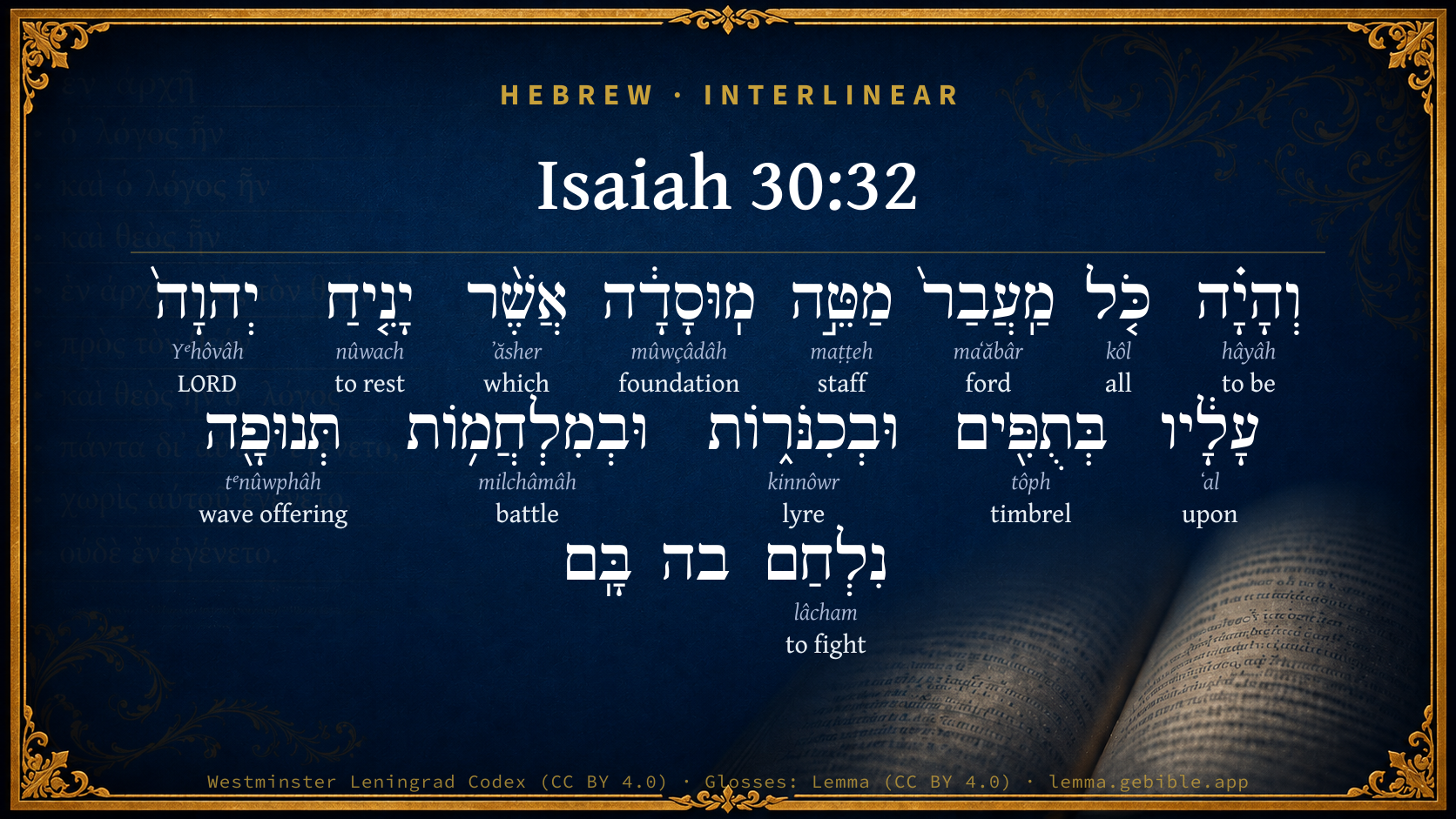
Hebrew (Westminster Leningrad Codex) Isaiah 30:32 appears in the Hebrew Old Testament. The text above is from the Westminster Leningrad Codex. Each word links to its Strong’s number, a concise gloss, and parsing drawn from the Open Scriptures Hebrew Bible morphology. Click any word for its full Brown-Driver-Briggs (BDB) entry.
Download image
Cite this verse

Isaiah 30:32 (World English Bible). Public Domain. Lemma interlinear Bible study tool, https://lemma.gebible.app/v/isaiah/30/32.

Show BibTeX & RIS
BibTeX
RIS
English Translation
Every stroke of the appointed staff, which Yahweh shall lay on him, shall be with [the sound of] tambourines and harps; and in battles with the brandishing [of his arm] will he fight with them.
World English Bible · Public Domain
Highlights
  • 1 first appearance in the Hebrew Bible
Full analysis ↓
Download a study sheet

One document with this verse’s original text, its word-by-word gloss line, the meaning frame, cross-references with their text, attributed commentary, and full source and license credits — printable, and it pastes into notes with its structure intact.

This verse Autodidact and up

Study sheet (.html) Plain text (.txt)

A passage Seminary Student

Up to 50 verses in one chapter. A passage sheet keeps up to 6 commentary sources and 12 cross-references per verse, in the order this page ranks them, and says so on the sheet whenever that leaves anything out. Ask for a single verse and you get the Autodidact verse sheet above.

Everything on this page stays free to read, with no account — the sheet is a download of what is already on screen, not access to it.

Want to remove ads? Support Godless Engineer
Compare translations 3

The same verse in 3 English versions, stacked beneath the original-language interlinear above. Click any original word for its lexicon entry.

Each is an independent rendering of the whole verse — the interlinear is not word-aligned to these translations.

Highlighted words mark where these versions differ — a whole-verse word diff, not a word-by-word alignment.

  • World English Bible Public Domain
    Every stroke of the appointed staff, which Yahweh shall lay on him, shall be with [the sound of] tambourines and harps; and in battles with the brandishing [of his arm] will he fight with them.
  • King James Version Public Domain
    And in every place where the grounded staff shall pass, which the LORD shall lay upon him, it shall be with tabrets and harps: and in battles of shaking will he fight with it.
  • unfoldingWord Literal Text CC BY-SA 4.0
    And every stroke of the appointed staff that Yahweh lays on him will be with tambourines and with harps, and in battles of brandishing he will fight with them.

unfoldingWord Literal Text — © unfoldingWord, licensed CC BY-SA 4.0. Word-aligned USFM3 via Door43 (git.door43.org/unfoldingWord/en_ult).

Versions to compare (up to 4)

3 of 4 selected

Show all 18 translations

Every available English version of this verse, each an independent rendering of the whole verse.

  • World English Bible Public Domain
    Every stroke of the appointed staff, which Yahweh shall lay on him, shall be with [the sound of] tambourines and harps; and in battles with the brandishing [of his arm] will he fight with them.
  • Berean Standard Bible Public Domain
    And with every stroke of the rod of punishment that the LORD brings down on them, the tambourines and lyres will sound as He battles with weapons brandished.
  • Majority Standard Bible Public Domain
    And with every stroke of the rod of punishment that the LORD brings down on them, the tambourines and lyres will sound as He battles with weapons brandished.
  • King James Version Public Domain
    And in every place where the grounded staff shall pass, which the LORD shall lay upon him, it shall be with tabrets and harps: and in battles of shaking will he fight with it.
  • American Standard Version (1901) Public Domain
    And every stroke of the appointed staff, which Jehovah shall lay upon him, shall be with `the sound of' tabrets and harps; and in battles with the brandishing `of his arm' will he fight with them.
  • Revised Version (1885) Public Domain
    And every stroke of the appointed staff, which the LORD shall lay upon him, shall be with tabrets and harps: and in battles of shaking will he fight with them.
  • Geneva Bible (1599) Public Domain
    And in euery place that ye staffe shall passe, it shall cleaue fast, which the Lord shall lay vpon him with tabrets and harpes: and with battels, and lifting vp of hands shall he fight against it.
  • Douay-Rheims (1899) Public Domain
    And the passage of the rod shall be strongly grounded, which the Lord shall make to rest upon him with timbrels and harps, and in great battles he shall over throw them.
  • Young's Literal Translation Public Domain
    And every passage of the settled staff, That Jehovah causeth to rest on him, Hath been with tabrets, and with harps, And in battles of shaking he hath fought with it.
  • Literal Standard Version CC BY-SA 4.0
    And every passage of the settled staff, || That YHWH causes to rest on him, || Has been with tambourines and with harps, || And in battles of shaking He has fought with it.
  • Unlocked Literal Bible CC BY-SA 4.0
    Every stroke of the appointed rod that Yahweh will lay on them will be accompanied with the music of tambourines and harps as he battles and fights with them.
  • unfoldingWord Literal Text CC BY-SA 4.0
    And every stroke of the appointed staff that Yahweh lays on him will be with tambourines and with harps, and in battles of brandishing he will fight with them.
  • Darby Bible Public Domain
    And wherever shall pass the appointed staff, which Jehovah shall lay upon him, it shall be with tambours and harps; and with tumultuous battles will he fight with it.
  • World Messianic Bible Public Domain
    Every stroke of the rod of punishment, which the LORD will lay on him, will be with the sound of tambourines and harps. He will fight with them in battles, brandishing weapons.
  • Webster's Bible Public Domain
    And in every place where the grounded staff shall pass, which the LORD shall lay upon him, it shall be with tabrets and harps: and in battles of shaking will he fight with it.
  • Free Bible Version CC BY-SA 4.0
    Every time the Lord hits them with his rod of punishment it will be accompanied by the music of tambourines and harps as he fights them, swinging into them in battle.
  • Bible in Basic English Public Domain
    And every blow of the rod of his punishment, which the Lord will send on him, will be with the sound of music: and with the waving of his sword the Lord will make war against him.
  • JPS Tanakh (1917) Public Domain
    And in every place where the appointed staff shall pass, which the LORD shall lay upon him, it shall be with tabrets and harps; and in battles of wielding will He fight with them.

Literal Standard Version (2020), Covenant Press — licensed CC BY-SA 4.0. Text via the HelloAO Bible API (eBible.org). Unlocked Literal Bible (unfoldingWord) — licensed CC BY-SA 4.0. Text via the HelloAO Bible API (eBible.org). unfoldingWord Literal Text — © unfoldingWord, licensed CC BY-SA 4.0. Word-aligned USFM3 via Door43 (git.door43.org/unfoldingWord/en_ult). Free Bible Version, Dr. Jonathan Gallagher — licensed CC BY-SA 4.0. Text via the HelloAO Bible API (eBible.org).

Word by word

More ways to search: Search by grammar → Find every occurrence → Compare this word →

Practice this passage: Drill this verse → Learn its vocabulary →

מֽוּסָדָ֔ה
mûwçâdâh
H4145
“foundation”
Noun, Common, Feminine, Singular, Absolute
Part of Speech
Noun
Type
Common
Gender
Feminine
Number
Singular
State
Absolute
Full BDB Definition

Origin: from H4143

TWOT: 875e

foundation, appointment
  1. וְהָיָ֗ה hâyâh H1961 “and · to be” Conjunction + Verb, Qal, Sequential Perfect, 3rd Person, Masculine, Singular
  2. כֹּ֤ל kôl H3605 “all of” Noun, Common, Masculine, Singular, Construct
  3. מַֽעֲבַר֙ maʻăbâr H4569 “ford of” Noun, Common, Masculine, Singular, Construct
  4. מַטֵּ֣ה maṭṭeh H4294 “staff of” Noun, Common, Masculine, Singular, Construct
  5. אֲשֶׁ֨ר ʼăsher H834 “which” Particle, Relative
  6. יָנִ֤יחַ nûwach H5117 “to rest” Verb, Hiphil, Imperfect, 3rd Person, Masculine, Singular
  7. יְהוָה֙ Yᵉhôvâh H3068 “LORD” Noun, Proper
  8. עָלָ֔יו ʻal H5921 “upon · him” Preposition + Suffix, Personal, 3rd Person, Masculine, Singular
  9. בְּתֻפִּ֖ים tôph H8596 “in/at · timbrels” Preposition + Noun, Common, Masculine, Plural, Absolute
  10. וּבְכִנֹּר֑וֹת kinnôwr H3658 “and · in/at · lyres” Conjunction + Preposition + Noun, Common, Masculine, Plural, Absolute
  11. וּבְמִלְחֲמ֥וֹת milchâmâh H4421 “and · in/at · battles of” Conjunction + Preposition + Noun, Common, Feminine, Plural, Construct
  12. תְּנוּפָ֖ה tᵉnûwphâh H8573 “wave offering” Noun, Common, Feminine, Singular, Absolute
  13. נִלְחַם lâcham H3898 “to fight” Verb, Niphal, Perfect, 3rd Person, Masculine, Singular

About this verse

These counts appear in no published source. They are computed here, from the morphology-tagged text and Lemma’s own curated glosses. What Lemma adds →

16
words
14
distinct lemmas
Prophets
section

Notable vocabulary

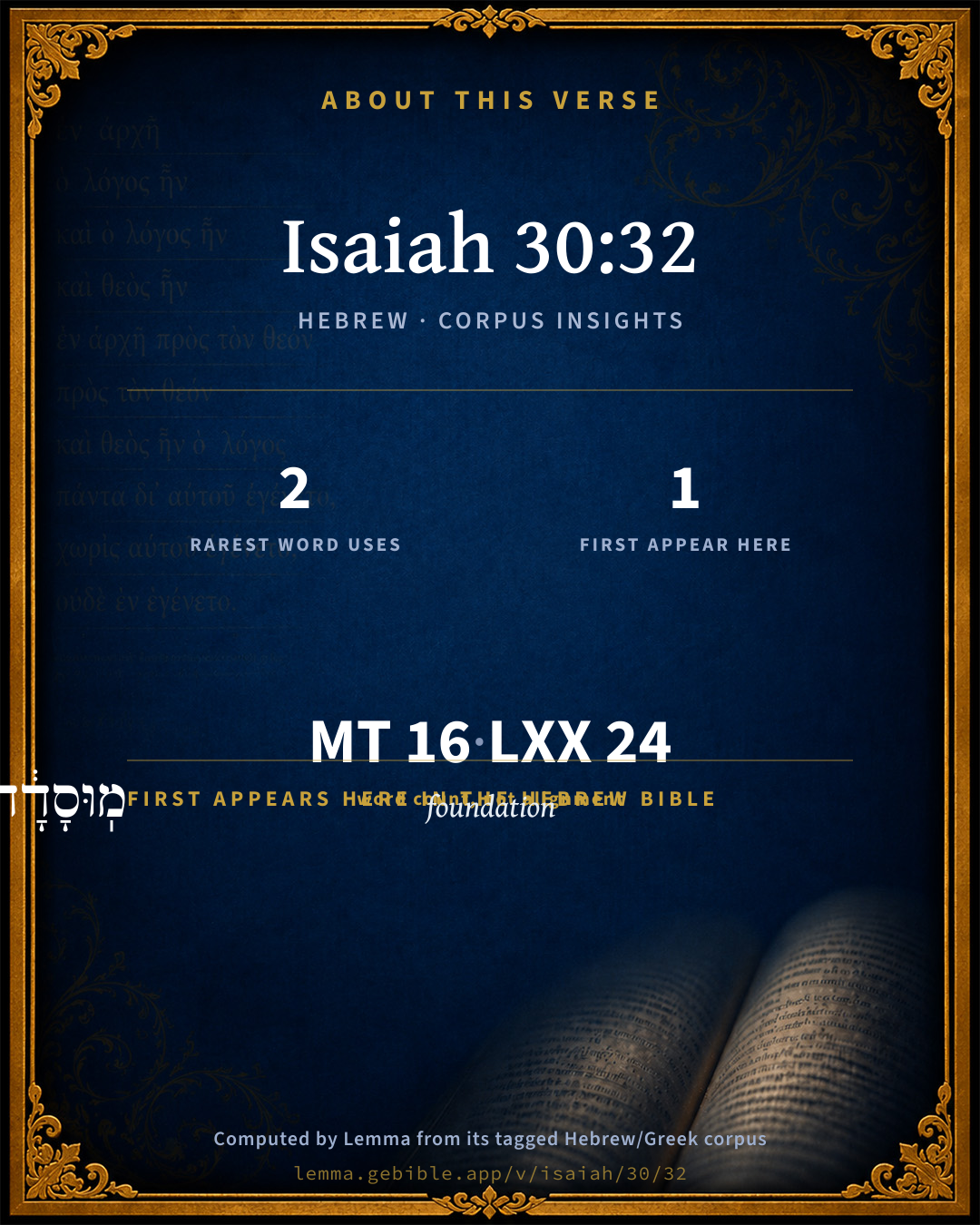
The rarest word here is מֽוּסָדָ֔ה foundation H4145 — appearing just 2 times in the whole Hebrew Bible.

First appearance in Scripture

This word makes its first canonical appearance in the Hebrew Bible here:

  • מֽוּסָדָ֔ה foundation H4145

Shared distinctive vocabulary

מֽוּסָדָ֔ה foundation H4145 occurs in 2 verses of the Hebrew Bible. Also found in:

Grammatical profile

  • 3 verbs
  • 9 nouns
  • 3 prepositions
  • 1 particle

Verb forms

  • וְהָיָ֗ה Qal · Sequential Perfect
  • יָנִ֤יחַ Hiphil · Imperfect
  • נִלְחַם Niphal · Perfect

Hebrew & Septuagint length

In English translation the verse runs 35 words from the Hebrew and 34 from the Septuagint (LXX English) — closely comparable.

A rough comparison of the two English renderings, which tokenize alike — not a word-level alignment.

Word counts can differ between the Hebrew and the Greek without any difference in meaning — e.g. the Hebrew direct-object marker אֵת has no separate Greek word, and Greek often adds the article ὁ.

In the original languages it is 16 Hebrew tokens and 24 Greek tokens — but the two are counted differently (Hebrew bundles its prefixes and suffixes into one token; the Greek is in lemma form), so that isn’t a like-for-like length.

Cross-references

12

Topical passages linked to Isaiah 30:32 in the Treasury of Scripture Knowledge — connected by theme and wording, ordered by reader-vote popularity; previews shown in the World English Bible.

  • Isaiah 11:15 Yahweh will utterly destroy the tongue of the Egyptian sea; and with his scorching wind will he wave his hand over the River, and will strike it into seven streams, and cause men to march over in sandals.
  • Psalms 81:1–2 Sing aloud to God, our strength! Make a joyful shout to the God of Jacob!
  • Isaiah 2:19 Men shall go into the caves of the rocks, And into the holes of the earth, From before the terror of Yahweh, And from the glory of his majesty, When he arises to shake the earth mightily.
  • Isaiah 19:16 In that day shall the Egyptians be like women; and they shall tremble and fear because of the shaking of the hand of Yahweh of Hosts, which he shakes over them.
  • Ezekiel 32:10 Yes, I will make many peoples amazed at you, and their kings shall be horribly afraid for you, when I shall brandish my sword before them; and they shall tremble at every moment, every man for his own life, in the day of your fall.
  • Genesis 31:27 Why did you flee secretly, and deceive me, and didn't tell me, that I might have sent you away with mirth and with songs, with tambourine and with harp;
  • 1 Samuel 10:5 After that you shall come to the hill of God, where is the garrison of the Philistines: and it shall happen, when you are come there to the city, that you shall meet a band of prophets coming down from the high place with a psaltery, and a tambourine, and a pipe, and a harp, before them; and they will be prophesying:
  • Job 16:12 I was at ease, and he broke me apart. Yes, he has taken me by the neck, and dashed me to pieces. He has also set me up for his target.
  • Job 21:11–12 They send forth their little ones like a flock. Their children dance.
  • Isaiah 24:8 The mirth of tambourines ceases, the noise of those who rejoice ends, the joy of the harp ceases.
  • Isaiah 30:29 You shall have a song as in the night when a holy feast is kept; and gladness of heart, as when one goes with a pipe to come to the mountain of Yahweh, to the Rock of Israel.
  • Hebrews 12:26 whose voice shook the earth, then, but now he has promised, saying, "Yet once more I will shake not only the earth, but also the heavens."

Cross-references courtesy of OpenBible.info (CC BY 4.0).

Hebrew and Greek witnesses Masoretic Hebrew ↔ Greek Septuagint

The same verse in the two great witnesses to the Old Testament, shown verse-for-verse.

These are two independent witnesses, not word-aligned to each other, and the Septuagint is shown in lemma (dictionary) form.

Hebrew Isaiah 30:32 Masoretic · Westminster Leningrad Codex

וְהָיָ֗ה כֹּ֤ל מַֽעֲבַר֙ מַטֵּ֣ה מֽוּסָדָ֔ה אֲשֶׁ֨ר יָנִ֤יחַ יְהוָה֙ עָלָ֔יו בְּתֻפִּ֖ים וּבְכִנֹּר֑וֹת וּבְמִלְחֲמ֥וֹת תְּנוּפָ֖ה נִלְחַם בה בָּֽם

Every stroke of the appointed staff, which Yahweh shall lay on him, shall be with [the sound of] tambourines and harps; and in battles with the brandishing [of his arm] will he fight with them.

World English Bible · Public Domain

Greek LXX Isaiah 30:32 Septuagint · lemma form

καί εἰμί αὐτός κυκλόθεν ὅθεν εἰμί αὐτός ὁ ἐλπίς ὁ βοήθεια ἐπί ὅς αὐτός πείθω αὐτός μετά αὐλός καί κιθάρα πολεμέω αὐτός ἐκ μεταβολή

And it shall happen to him from every side, that they from whom their hope of assistance was, in which he trusted, themselves shall war against him in turn with drums and with harp.

LXX2012 (modern English Septuagint) · Public Domain

Hebrew: Westminster Leningrad Codex (CC BY 4.0). Greek: Septuagint (public domain); English from LXX2012 (modern English Septuagint) (Public Domain). How the Septuagint differs from the Hebrew →

Targum (Aramaic paraphrase)

1

The Targum is the ancient Jewish Aramaic paraphrase of the Hebrew Scriptures — an interpretive translation, not the Hebrew text itself. Onkelos (literal) and Pseudo-Jonathan (expansive) render the Torah, and Jonathan the Prophets. Coverage is partial: where no permissively-licensed English translation exists for a verse, only the Aramaic is shown. This is verse-level text, not a word-by-word alignment to the Hebrew.

  1. Targum Jonathan Prophets (Joshua–Malachi)
    וִיהֵי כָּל מַעֲבַר רַבְרְבֵיהוֹן וְתַקִיפֵיהוֹן דִי יַנִיחַ יְיָ פּוּרְעֲנוּת גְבוּרְתֵּהּ בֵּינֵיהוֹן בְּתוּפִּין וּבְכִינוֹרִין יְשַׁבְּחוּן בֵּית יִשְׂרָאֵל וְעַל קְרָבָא תַקִיפָא דְיִתְעֲבֵּיד לְהוֹן בְּעַמְמַיָא:

    And it shall come to pass, that the Lord shall cause to rest the vengeance of His might in every pass of their princes and mighty ones, even amongst them. The house of Israel shall praise with tabrets and harps, because of the mighty war which shall be waged for them against the people.

    Targum Jonathan — Aramaic: “Mikraot Gedolot” (public domain). English: “Sefaria Community Translation” (CC0 1.0 (public-domain dedication)); “London "Chaldee Paraphrase," 1871” (public domain). Text via Sefaria.

Commentary

Notes on Isaiah 30:32 from classic Christian and Jewish commentators (each source and its license shown beneath its notes). The classic Christian expositions comment on the surrounding passage and are grouped to its opening verse, so a note may address several verses; the Jewish commentaries on the Tanakh (Rashi and others) are per-verse, so they appear only where the commentator wrote on this verse.

Lemma curates 59 commentaries, every one of them public domain or Creative Commons licensed, each selected and text-cleaned for this edition rather than reprinted as found. About our sources →

Trapp's Complete Commentary

John Trapp

Isa 30:32 And [in] every place where the grounded staff shall pass, which the LORD shall lay upon him, [it] shall be with tabrets and harps: and in battles of shaking will he fight with it.

Ver. 32. And in every place where the grounded staff shall pass.] Virga fundata, seu inflxa; God’s rod or staff, wherewith he beateth the Assyrians, shall pierce their flesh, and stick in it, make deep welts, yea, stick in their very bowels, as Ehud’s dagger did in Eglon’s guts. And this shall be done with little ado too.

It shall be with tabrets and harps.] Quasi per ludum, non tormentis bellicis.

And in battles of shaking will he fight with it.] Levi quadam velitatione bellica, by skirmishings only.

John Trapp, A Commentary or Exposition upon All the Books of the Old and New Testament (1647–1656) — public domain. Text from a community e-Sword module.

Joseph Benson's Commentary

Isa 30:32. Where the grounded staff shall pass — Instead of משׂה מוסדה, the grounded, or founded staff, of which, he says, no one yet has been able to make any tolerable sense. Bishop Lowth, on the authority of two MSS, (one of them ancient,) reads משׂה מופרה, the staff of correction, which Le Clerc also supposes to be the true reading. The bishop, therefore, translates the clause thus: And it shall be, that wherever shall pass the rod of correction, which Jehovah shall lay heavily upon him, it shall be accompanied with tabrets and harps; that is, as the bishop explains it, “with every demonstration of joy and thanksgiving for the destruction of the enemy in so wonderful a manner: with hymns of praise, accompanied with musical instruments.” And in battles of shaking, &c. — Or, as it may be better rendered, in fierce or tremendous battles shall he, namely, the Lord, fight against them, that is, against the Assyrians.

Joseph Benson's Commentary on the Old and New Testaments (1811–1818) — public domain. Text from a community e-Sword module.

Tyndale Open Study Notes

Tyndale Open Resources

30:32 tambourines and harps: Instruments formerly silenced in judgment (24:8) would again be used by God’s people; this time, the people would celebrate the Lord’s goodness rather than becoming spiritually complacent (see 5:12).

Tyndale Open Study Notes — © Tyndale Open Resources, licensed CC BY-SA 4.0. Text via the HelloAO Bible API.

Geneva Bible (1599)

Geneva Bible translators

It shall destroy.

Against Babel: meaning the Assyrians and Babylonians.

With joy and assurance of the victory.

Geneva Bible (1599) marginal notes — public domain. Text via Bolls.life.

Jamieson, Fausset & Brown

Robert Jamieson, A. R. Fausset & David Brown

grounded--rather, "decreed," "appointed" [MAURER].

staff--the avenging rod.

him--the Assyrian; type of all God's enemies in every age. Margin and MAURER construe, "Every passing through (infliction, Isa 28:15) of the appointed rod, which, &c., shall be with tabrets," that is, accompanied with joy on the part of the rescued peoples.

battles of shaking--that is, shock of battles (Isa 19:16; compare "sift . . . sieve," Isa 30:28).

with it--namely, Assyria.

Jamieson, Fausset & Brown — Commentary Critical and Explanatory on the Whole Bible (1871) — public domain (CC PDM 1.0). Text via the HelloAO Bible API.

Adam Clarke's Commentary

Verse 32. The grounded staff - "The rod of his correction"] For מוסדה musadah, the grounded staff, of which no one yet has been able to make any tolerable sense, Le Clerc conjectured מוסרה musarah, of correction; (see Pr 22:15;) and so it is in two MSS., (one of them ancient,) and seems to be so in the Bodleian MS. The Syriac has דשוע בדה deshuebedah, virgo domans, vet subjectionis, - "the taming rod, or rod of subjection."

With tabrets and harps] With every demonstration of joy and thanksgiving for the destruction of the enemy in so wonderful a manner: with hymns of praise, accompanied with musical instruments. See Isa 30:29.

With it - "Against them."] For בה bah, against her, fifty-two MSS. and five editions read בם bam, against them.

Adam Clarke's Commentary on the Bible (1810–1826) — public domain. Text from a community e-Sword/MySword module.

Ellicott's Commentary for English Readers

(32) And in every place where the grounded staff . . .—It is not clear what meaning the English was intended to convey. Better, Wherever shall pass the destined rod (literally, the rod of foundation) which the Lord causes to fall upon him.

It shall be with tabrets and harps . . .—i.e., at every stroke of God’s judgments upon Asshur Israel should raise its song of triumph with the timbrels and harps (or, perhaps, lutes), which were used by the people in their exultation after victory. So after Jephthah’s and David’s victories we have like processions (Jdg_11:34; 1Sa_18:6). Israel was to sing, as it were, its Te Deum over the fall of Assyria. So the long walls that connected Athens and the Piraeus were pulled down by the Spartans to the sound of music.

In battles of shaking will he fight with it.—Literally, battles of swinging, as marking the action of the warrior, who swings his sword rapidly to and fro, smiting his enemies at every stroke. The Hebrew pronoun for “it” is feminine, and has been referred by some critics to Jerusalem.

A Bible Commentary for English Readers, edited by Charles John Ellicott (1878–1897) — public domain. Text from a community e-Sword module.

The Cambridge Bible for Schools and Colleges

gen. ed. J. J. S. Perowne

32. The verse may be translated as in R.V. And every stroke of the appointed staff which the Lord shall lay upon him shall be with tabrets and harps; and in battles of shaking will he fight with them. The expression “grounded staff” is, however, barely intelligible; the emendation “staff of correction” (Pro_22:15) only replaces one singular expression by another, and is besides too easy to be worth much. The phrase “battles of shaking” is also difficult. “Battles of the swinging (of Jehovah’s rod)” is the construction usually put upon it, but the sense is rhetorically weak. The word for “shaking” is the technical term for the “wave offering” in the Law (e.g. Lev_7:30); hence Ewald renders “battles of wave-offering,” i.e. battles in which Assyria is devoted to destruction.

The Cambridge Bible for Schools and Colleges (gen. ed. J. J. S. Perowne; Cambridge University Press, 1878–1918) — public domain. Text from a community e-Sword module.

John Gill's Exposition

And in every place where the grounded staff shall pass,.... The storm before mentioned, the wrath and righteous judgment of God, founded upon his unalterable purposes and decrees; and, wherever it came, would fall with great weight, sink deep, stick fast, and remain fixed and sure, like a rod or staff fastened in the earth:

which the Lord shall lay upon him; or, "cause to rest upon him" (o); the Lord would lay his rod upon him, the Assyrian, and let it remain there, so that it should be a destroying rod or staff, as before; it should continue until it had done full execution, and utterly destroyed him. The Targum is,

"and there shall be every passage of their princes, and of their mighty ones, on whom the Lord shall cause to rest the vengeance of his power;''

and so the "grounded staff" may be understood of the Assyrian himself, that wherever he should be, this storm of vengeance should follow him, and rest upon him:

it shall be with tabrets and harps; the allusion is to the use of these in war; but, instead of these, no other music would be used at this time than what thunder, and rain, and hailstones made; unless this refers to the joy of God's people, upon the destruction of their enemies; so the Targum,

"with tabrets, and harps shall the house of Israel praise, because of the mighty war which shall be made for them among the people:''

see Rev 15:2,

and in battles of shaking will he fight with it; the Assyrian camp; or as the Keri, or marginal reading, "with them": with the Assyrians, with the men of the camp; the soldiers, as Kimchi explains it; that is, the Lord will fight with them in battles, by shaking his hand over them in a way of judgment, and thereby shaking them to pieces, and utterly destroying them; see Rev 19:11.

(o) "requiescere faciet", Pagninus, Montanus; "quiescere faciet", Cocceius.

John Gill's Exposition of the Whole Bible (1746–1763) — public domain (CC PDM 1.0). Text via the HelloAO Bible API.

Albert Barnes' Notes on the Bible

And in every place - Margin, ‘Every passing of the rod founded.’ Lowth renders it, ‘Whenever shall pass the rod of correction.’ The whole design of the passage is evidently to foretell the sudden destruction of the army of the Assyrians, and to show that this would be accomplished by the agency of God. The idea seems to be, that in all those places where the rod of the Assyrian would pass, that is, where he would cause devastation and desolation, there would be the sound of rejoicing with instruments of music when he should be overthrown.

The grounded staff - The word ‘staff’ here, or “rod,” seems to refer to that by which the Assyrian smote the nations Isa 30:31; or rather perhaps the Assyrian king himself as a rod of correction in the hand of Yahweh (see Isa 10:5). The word rendered ‘grounded’ (מוסדה mûsâdâh) has given great perplexity to commentators. Lowth supposes it should be מוסרח (“correction”), according to a conjecture of Le Clerc. Two manuscripts also read it in the same way. But the authority from the MSS. is not sufficient to justify a change in the present Hebrew text. This word, which is not very intelligibly rendered ‘grounded,’ is derived from יסד yâsad, to “found, to lay the foundation of a building” Ezr 3:12; Isa 54:11; then to establish, to appoint, to ordain Psa 104:8; Hab 1:12. The idea here is, therefore, that the rod referred to had been “appointed, constituted, ordained” by God; that is, that the Assyrian had been designated by him to accomplish important purposes as a rod, or as a means of punishing the nations.

Shall pass - In his march of desolation and conquest.

Which the Lord shall lay upon him - Or rather, as it should be translated, ‘upon which Yahweh should lay,’ that is, the rod, meaning that in all those places where Yahweh should lay this appointed scourge there would be yet rejoicing.

It shall be with tabrets and harps - Those places where he had passed, and which he had scourged, would be filled with joy and rejoicing at his complete overthrow, and at their entire deliverance from the scourge. For a description of the tabret and harp, see the notes at Isa 5:12.

And in battles of shaking - In the Hebrew there is an allusion here to what is said in Isa 30:28, that he would ‘sift,’ that is, agitate or toss the nations as in a winnowing shovel.

Will he fight with it - Margin, ‘Against them.’ Yahweh would fight against the ‘rod,’ to wit, the Assyrian, and destroy him (see Isa 37:36).

Albert Barnes' Notes on the Bible (1834–1885) — public domain. Text from a community e-Sword/MySword module.

Haydock's Catholic Bible Commentary

Harps. The sound of thunder will fill the people of Ezechias with joy, while the enemy shall perish irrecoverably. (Calmet)

George Leo Haydock (1774–1849), Haydock's Catholic Family Bible and Commentary, 1859 edition — public domain. Excludes Psalms (Douay-Rheims chapter numbering differs from Protestant) and Deuterocanonical books (Catholic canon only).

Matthew Poole's English Annotations

The grounded staff, Heb. the founded rod; the judgment of God, which is frequently called a rod in Scripture, and may be here called a founded rod, or the rod of foundation, either because it was firmly established, and certainly to come, by God’s immutable purpose and appointment; or because the rod should not slightly touch him, and pass over him, but strike deep, and be fixed, and as it were grounded or founded in his flesh, and made to rest upon him, as it follows in the next clause.

Shall lay, Heb. shall cause to rest; which is contrary to the manner of God’s dealing with his people, upon whom he will not suffer the rod of the wicked to rest, Psa 125:3.

Upon him; upon the Assyrian, mentioned in the foregoing verse.

It shall be with tabrets and harps: the sense is either,

1. Their destruction shall be celebrated by God’s people with joy, and music, and songs of praise. Or,

2. The victory shall be got, not by warlike instruments and achievements, but as it were by tabrets and harps; wherein he may possibly allude to the victory which Jehoshaphat got against Moab and Ammon, not by fighting; but only by singing and praising God with the voice, and with musical instruments, 2Ch 20:19,21,27,28; God being pleased to fight for them by his own immediate power; which also was the case here, which made the people of God sing a triumph before the fight, Isa 37:22. In battles of shaking; or, with battles or fightings of shaking, to wit, of shaking of the hand, of which kind of shaking this Hebrew word is constantly used, such as are performed by the mere shaking of the hand; namely, by God’s shaking his hand against them, as he threatens to do against others, Isa 11:15; 19:16, in which last place this very word is used, and in the former the verb from whence it comes. For that this shaking is an act of God seems more than probable, and from the following words, will he, i.e. God, as all understand it, fight against it. And so the sense of the place may be this, God will fight against them, and destroy them by his own hands. Will he, to wit, the Lord, who declareth himself to be the enemy of the Assyrian, both in the foregoing and following verses, fight with it; with the army of the Assyrians: or, according to the other Hebrew reading, with them; with the, Assyrians.

Matthew Poole's English Annotations on the Holy Bible (1683–1685) — public domain. Text from a community e-Sword/MySword module.

Whedon's Commentary on the Bible

Daniel D. Whedon

32. The grounded staff — This rendering is generally rejected as unintelligible. It is generally agreed by scholars that it means “rod of doom,” that is, the rod appointed to punish. The text may read thus: And it shall be that every passage [stroke, Henderson] of the rod of doom which Jehovah shall lay [cause to rest] on him [the Assyrian] shall be with tabrets and harps [accompanied with music on the part of the delivered ones] and shakings of wars, [or shocks of war, conducted in judgment by Jehovah.] While God visits furious judgments upon all defiant peoples, his own people are to join in songs of thanksgiving and fidelity to their deliverer. God governs the world. In all cases divine care “turns the tables” in behalf of the good and against the enemies of the good.

Tabrets — Drums of one head, or tambourines, beaten to music sung at festival entertainments, and many other occasions.

Daniel D. Whedon (gen. ed.), Commentary on the Old and New Testaments (1874–1909) — public domain. Text from a community e-Sword module.

The Pulpit Commentary

In every place where the grounded staff shall pass, etc.; rather, and it shall come to pass that every stroke (literally, passage) of the destined rod which Jehovah causes to rest upon him shall be with an accompaniment of drums and citherns. Each blow dealt to Assyria shall rejoice her enemies, and cause them to break out into songs of praise, accompanied by the music of various instruments. (comp. ver. 29; and see Exo_15:1-21) In battles of shaking; or, battles of swinging "those in which Jehovah swings his rod, and deals (repeated) blows to his enemies" (Cheyne). Will he fight with it; rather, will he fight against her; i.e. against Assyria.

The Pulpit Commentary (1880–1919), ed. H.D.M. Spence-Jones & Joseph S. Exell — public domain. Text from a community e-Sword module.

John Wesley's Explanatory Notes

The rod - Hebrew. the founded rod, the judgment of God, called a founded rod, because it was firmly established, by God's immutable purpose. Him - Upon the Assyrian. With harps - Their destruction shall be celebrated by God's people, with joy and musick, and songs of praise. Of shaking - Or, shaking of the hand, of which kind of shaking this Hebrew word is constantly used. God will fight against them, and destroy them by his own hand. With it - With the army of the Assyrians.

John Wesley, Explanatory Notes Upon the Whole Bible (1754–1765) — public domain. Text via the GEBible commentary corpus.

J. A. Alexander on Isaiah

Joseph Addison Alexander

“And every passage of the rod of doom, which Jehovah will lay (or cause to rest) upon him, shall be with tabrets and harps, and with fights of shaking it is fought therein.” There is the same diversity of judgment here as in the foregoing verse, with respect to the question whether the rod mentioned in the first clause is the rod which the Assyrian wielded, or the rod which smote himself. On the former supposition, the sense would seem to be, that in every place through which the rod of the oppressor had before passed there should now be heard the sound of joyful music. The reference to Jehovah’s judgments on Assyria is recommended by the reasons above given for applying the last words of v. 31 to the same catastrophe. Assuming therefore that the clause before us was likewise intended to be so applied, the sense would seem to be that every passage of Jehovah’s rod (i.e., every stroke which passes from it to the object) will be hailed, by those whom the Assyrian had oppressed, with joy and exultation. The common version, grounded staff, is almost unintelligible.

Joseph Addison Alexander, The Prophecies of Isaiah (1846–1847; New York: Scribner, 1870–1878) — public domain. Text from a community e-Sword module.

Rashi

Rabbi Shlomo Yitzchaki (Rashi)

And it shall be, every place where the established staff shall pass All the crossings of the strength of the foundations of his armies; all the places they passed and destroyed, and on the day of their downfall the Lord shall grant peace upon them through the news of their downfall, and they shall be joyful with drums and harps. And this is the interpretation of the verse in inverted order: And it shall be with drums and harps, every passing of the established staff upon which the Lord shall grant peace, and with wars of vain waving, lifting and lowering, did the Holy One, blessed be He, fight against them. And, according to Midrash Aggadah, the waving of the harvest of the Omer stood up for Israel in that war, for it was the night of the sixteenth of Nissan.

Rashi on the Tanakh — English translations: “The Judaica Press complete Tanach with Rashi, translated by A. J. Rosenberg” (CC BY 4.0); “Pentateuch with Rashi's commentary by M. Rosenbaum and A.M. Silbermann, 1929-1934” (public domain); “The Metsudah Tanach series, Lakewood, N.J” (CC BY 4.0); and “The Book of Joshua, Metsudah Publications, 1997” (CC BY 4.0). Text via Sefaria.

Ibn Ezra

Rabbi Abraham ibn Ezra

מוסדה Grounded. Participle Hophal; מטה is sometimes used as a feminine noun; comp. Mic. 6:9.—The following is the meaning of the whole verse: And in every place where this rod shall pass, and upon which the Lord shall lay his staff, it will be done. בתפים ובכנרות with tabrets and harps; the Lord will not be weary, but there will be a continual smiting by the angel, who shall rejoice as if he were playing with tabrets and harps.

תנופה Playing. Lit., moving, sc. the hand to play with musical instruments.

Ibn Ezra on the Tanakh — English translations: “Sefaria Community Translation” (CC0 1.0 (public-domain dedication)); “Yalkut, Sifsei Chachomim Chumash, Metsudah Publications, 2009” (CC BY 4.0); and “Commentary of Ibn Ezra on Isaiah - trans. by M. Friedlander, 1873” (public domain). Text via Sefaria.

Lesson kit

Teaching starters — assembled from the data on this page, not authored interpretation. Every prompt links to the verse data it draws on. Edit before teaching.

Isaiah, in the Prophets, opens this verse with 16 words (14 distinct Hebrew lemmas). Its most distinctive word is mûwçâdâh (“foundation”). A historical commentator’s framing appears above. Read the whole chapter for the surrounding context.

Discussion questions

  1. The word mûwçâdâh carries the sense “foundation.” How does it shape the verse?
  2. This is the first place “foundation” appears in Scripture (first appears here). What does its debut here establish?
  3. How does Ezekiel 41:8, which shares the word «foundation», read alongside this verse?
  4. The translations on this page render this verse differently — a whole-verse word diff, not a word-by-word alignment. What might account for the different wordings?
  5. «וְהָיָ֗ה» is a Qal Sequential Perfect verb. How does that grammatical form shape the action described?
  6. Compare how Trapp's Complete Commentary and Joseph Benson's Commentary read this verse. Where do they agree or differ?

Things to notice

Reading settings

Reading text

Shown beneath each verse's original-language words.

Old Testament
Old Testament edition

Read the OT as the Masoretic Hebrew (MT) or the Greek Septuagint (LXX).

English shown for the Greek Septuagint (in the Hebrew ↔ Greek comparison).

Comparing translations? Open the Compare panel on any verse page to stack up to four side by side.