
Jeremiah 28:8

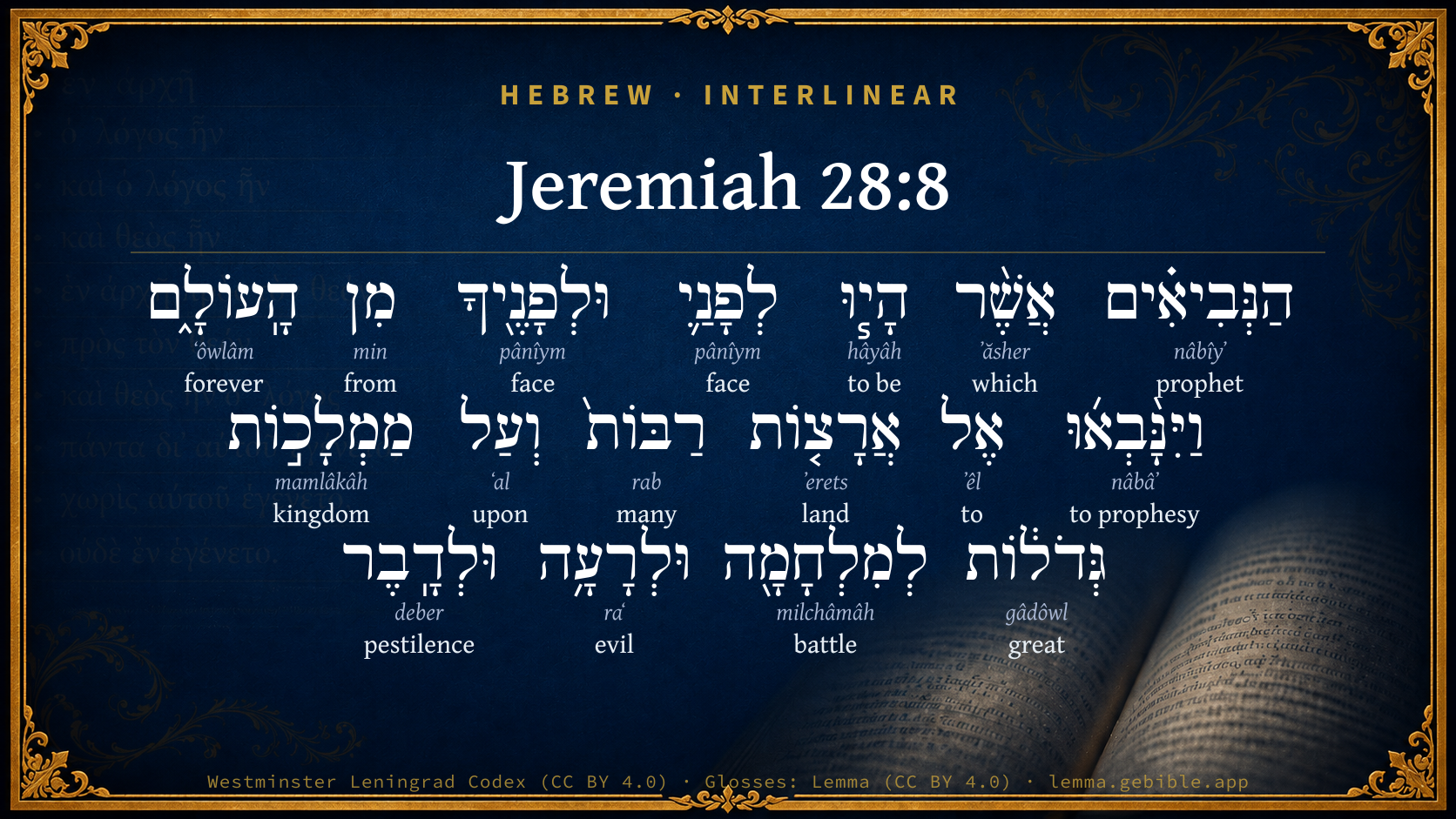
Hebrew (Westminster Leningrad Codex) Jeremiah 28:8 appears in the Hebrew Old Testament. The text above is from the Westminster Leningrad Codex. Each word links to its Strong’s number, a concise gloss, and parsing drawn from the Open Scriptures Hebrew Bible morphology. Click any word for its full Brown-Driver-Briggs (BDB) entry.
Download image
Cite this verse

Jeremiah 28:8 (World English Bible). Public Domain. Lemma interlinear Bible study tool, https://lemma.gebible.app/v/jeremiah/28/8.

Show BibTeX & RIS
BibTeX
RIS
English Translation
The prophets who have been before me and before you of old prophesied against many countries, and against great kingdoms, of war, and of evil, and of pestilence.
World English Bible · Public Domain
Download a study sheet

One document with this verse’s original text, its word-by-word gloss line, the meaning frame, cross-references with their text, attributed commentary, and full source and license credits — printable, and it pastes into notes with its structure intact.

This verse Autodidact and up

Study sheet (.html) Plain text (.txt)

A passage Seminary Student

Up to 50 verses in one chapter. A passage sheet keeps up to 6 commentary sources and 12 cross-references per verse, in the order this page ranks them, and says so on the sheet whenever that leaves anything out. Ask for a single verse and you get the Autodidact verse sheet above.

Everything on this page stays free to read, with no account — the sheet is a download of what is already on screen, not access to it.

Want to remove ads? Support Godless Engineer
Compare translations 3

The same verse in 3 English versions, stacked beneath the original-language interlinear above. Click any original word for its lexicon entry.

Each is an independent rendering of the whole verse — the interlinear is not word-aligned to these translations.

Highlighted words mark where these versions differ — a whole-verse word diff, not a word-by-word alignment.

  • World English Bible Public Domain
    The prophets who have been before me and before you of old prophesied against many countries, and against great kingdoms, of war, and of evil, and of pestilence.
  • King James Version Public Domain
    The prophets that have been before me and before thee of old prophesied both against many countries, and against great kingdoms, of war, and of evil, and of pestilence.
  • unfoldingWord Literal Text CC BY-SA 4.0
    The prophets who were to the face of me and to the face of you from ancient time, they prophesied to many lands and against great kingdoms, of war and of disaster and of plague.

unfoldingWord Literal Text — © unfoldingWord, licensed CC BY-SA 4.0. Word-aligned USFM3 via Door43 (git.door43.org/unfoldingWord/en_ult).

Versions to compare (up to 4)

3 of 4 selected

Show all 18 translations

Every available English version of this verse, each an independent rendering of the whole verse.

  • World English Bible Public Domain
    The prophets who have been before me and before you of old prophesied against many countries, and against great kingdoms, of war, and of evil, and of pestilence.
  • Berean Standard Bible Public Domain
    The prophets of old who preceded you and me prophesied war, disaster, and plague against many lands and great kingdoms.
  • Majority Standard Bible Public Domain
    The prophets of old who preceded you and me prophesied war, disaster, and plague against many lands and great kingdoms.
  • King James Version Public Domain
    The prophets that have been before me and before thee of old prophesied both against many countries, and against great kingdoms, of war, and of evil, and of pestilence.
  • American Standard Version (1901) Public Domain
    The prophets that have been before me and before thee of old prophesied against many countries, and against great kingdoms, of war, and of evil, and of pestilence.
  • Revised Version (1885) Public Domain
    The prophets that have been before me and before thee of old prophesied against many countries, and against great kingdoms, of war, and of evil, and of pestilence.
  • Geneva Bible (1599) Public Domain
    The Prophets that haue beene before mee and before thee in time past, prophecied against many countreyes, and against great kingdomes, of warre, and of plagues, and of pestilence.
  • Douay-Rheims (1899) Public Domain
    The prophets that have been before me, and before thee from the beginning, and have prophesied concerning many countries, and concerning great kingdoms, of war, and of affliction, and of famine.
  • Young's Literal Translation Public Domain
    The prophets who have been before me, and before thee, from of old, even they prophesy concerning many lands, and concerning great kingdoms, of battle, and of evil, and of pestilence.
  • Literal Standard Version CC BY-SA 4.0
    The prophets who have been before me, and before you, from of old, even they prophesy concerning many lands, and concerning great kingdoms, of battle, and of calamity, and of pestilence.
  • Unlocked Literal Bible CC BY-SA 4.0
    The prophets who existed before me and you from long ago also prophesied about many nations and against great kingdoms, about war, famine, and plague.
  • unfoldingWord Literal Text CC BY-SA 4.0
    The prophets who were to the face of me and to the face of you from ancient time, they prophesied to many lands and against great kingdoms, of war and of disaster and of plague.
  • Darby Bible Public Domain
    The prophets that have been before me and before thee of old, prophesied also concerning many countries and concerning great kingdoms, of war, and of evil, and of pestilence.
  • World Messianic Bible Public Domain
    The prophets who have been before me and before you of old prophesied against many countries, and against great kingdoms, of war, of evil, and of pestilence.
  • Webster's Bible Public Domain
    The prophets that have been before me and before thee of old prophesied both against many countries, and against great kingdoms, of war, and of evil, and of pestilence.
  • Free Bible Version CC BY-SA 4.0
    The prophets of long ago who came before you and me prophesied war, disaster, and disease against many countries and great kingdoms.
  • Bible in Basic English Public Domain
    The prophets, who were before me and before you, from early times gave word to a number of countries and great kingdoms about war and destruction and disease.
  • JPS Tanakh (1917) Public Domain
    The prophets that have been before me and before thee of old prophesied against many countries, and against great kingdoms, of war, and of evil, and of pestilence.

Literal Standard Version (2020), Covenant Press — licensed CC BY-SA 4.0. Text via the HelloAO Bible API (eBible.org). Unlocked Literal Bible (unfoldingWord) — licensed CC BY-SA 4.0. Text via the HelloAO Bible API (eBible.org). unfoldingWord Literal Text — © unfoldingWord, licensed CC BY-SA 4.0. Word-aligned USFM3 via Door43 (git.door43.org/unfoldingWord/en_ult). Free Bible Version, Dr. Jonathan Gallagher — licensed CC BY-SA 4.0. Text via the HelloAO Bible API (eBible.org).

Word by word

More ways to search: Search by grammar → Find every occurrence → Compare this word →

Practice this passage: Drill this verse → Learn its vocabulary →

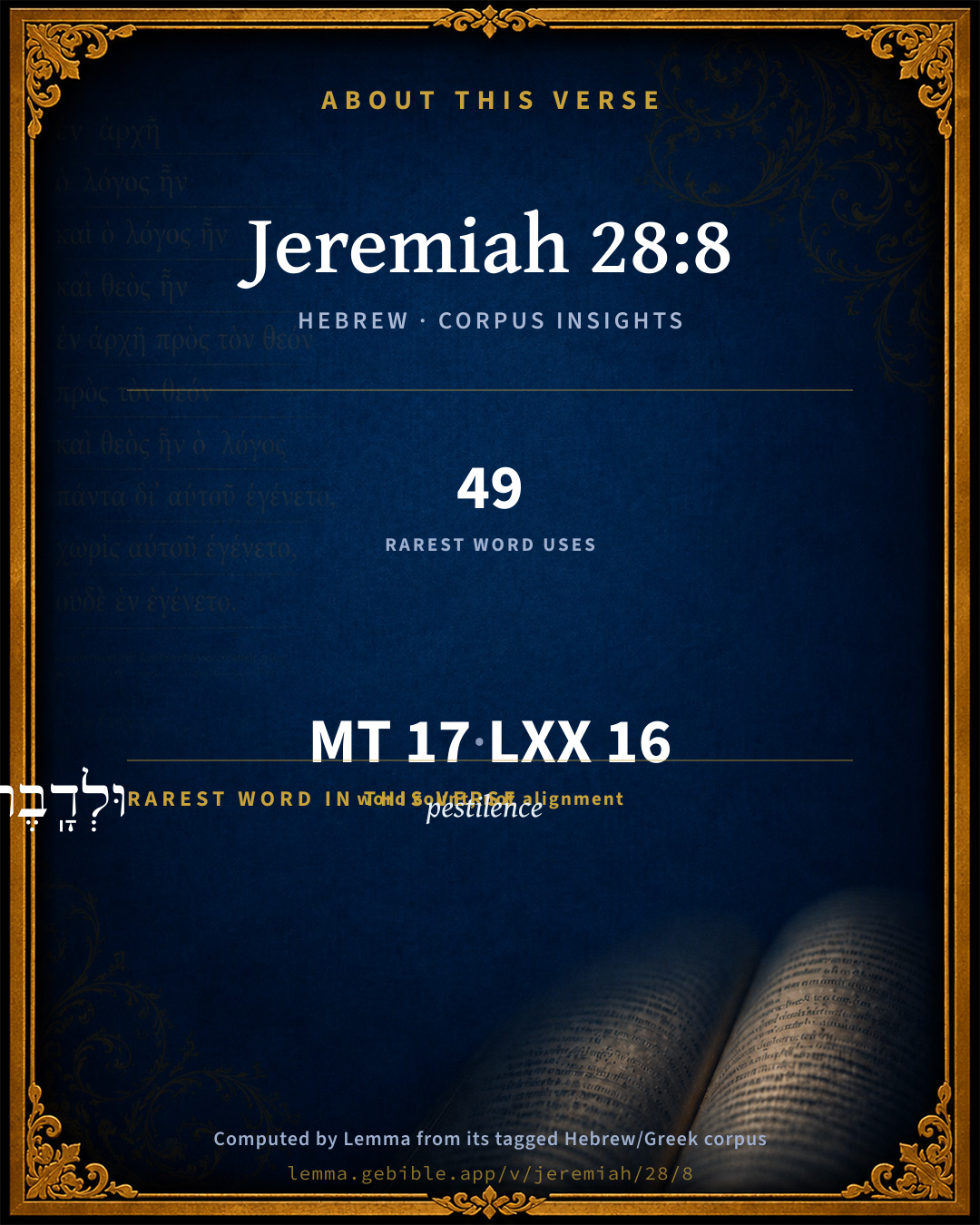
וּלְדָֽבֶר
deber
H1698
“and · to/for · pestilence”
Conjunction + Preposition + Noun, Common, Masculine, Singular, Absolute
Part of Speech
Conjunction + Preposition + Noun
Type
Common
Gender
Masculine
Number
Singular
State
Absolute
Full BDB Definition

Origin: from H1696 (in the sense of destroying)

TWOT: 399b

pestilence, plague - murrain, cattle disease, cattle-plague
  1. הַנְּבִיאִ֗ים nâbîyʼ H5030 “the · prophets” Particle, Definite Article + Noun, Common, Masculine, Plural, Absolute
  2. אֲשֶׁ֨ר ʼăsher H834 “which” Particle, Relative
  3. הָי֧וּ hâyâh H1961 “to be” Verb, Qal, Perfect, 3rd Person, Common, Plural
  4. לְפָנַ֛י pânîym H6440 “to/for · face(s) · my” Preposition + Noun, Common, Both, Plural, Construct + Suffix, Personal, 1st Person, Common, Singular
  5. וּלְפָנֶ֖יךָ pânîym H6440 “and · to/for · face(s) · your” Conjunction + Preposition + Noun, Common, Both, Plural, Construct + Suffix, Personal, 2nd Person, Masculine, Singular
  6. מִן min H4480 “from” Preposition
  7. הָֽעוֹלָ֑ם ʻôwlâm H5769 “the · forever” Particle, Definite Article + Noun, Common, Masculine, Singular, Absolute
  8. וַיִּנָּ֨בְא֜וּ nâbâʼ H5012 “and · to prophesy” Conjunction + Verb, Niphal, Sequential Imperfect, 3rd Person, Masculine, Plural
  9. אֶל ʼêl H413 “to” Preposition
  10. אֲרָצ֤וֹת ʼerets H776 “lands” Noun, Common, Both, Plural, Absolute
  11. רַבּוֹת֙ rab H7227 “many” Adjective, Adjective, Feminine, Plural, Absolute
  12. וְעַל ʻal H5921 “and · upon” Conjunction + Preposition
  13. מַמְלָכ֣וֹת mamlâkâh H4467 “kingdoms” Noun, Common, Feminine, Plural, Absolute
  14. גְּדֹל֔וֹת gâdôwl H1419 “great” Adjective, Adjective, Feminine, Plural, Absolute
  15. לְמִלְחָמָ֖ה milchâmâh H4421 “to/for · battle” Preposition + Noun, Common, Feminine, Singular, Absolute
  16. וּלְרָעָ֥ה raʻ H7451 “and · to/for · evil” Conjunction + Preposition + Adjective, Adjective, Feminine, Singular, Absolute

About this verse

These counts appear in no published source. They are computed here, from the morphology-tagged text and Lemma’s own curated glosses. What Lemma adds →

17
words
16
distinct lemmas
Prophets
section

Shared distinctive vocabulary

וּלְדָֽבֶר pestilence H1698 occurs in 48 verses of the Hebrew Bible. Also found in:

Grammatical profile

  • 2 verbs
  • 8 nouns
  • 3 adjectives
  • 3 prepositions
  • 1 particle

Verb forms

  • הָי֧וּ Qal · Perfect
  • וַיִּנָּ֨בְא֜וּ Niphal · Sequential Imperfect

Repetition

A word recurs within this verse — often emphatic in Hebrew:

  • לְפָנַ֛י face H6440 ×2

Hebrew & Septuagint length

In the original languages it is 17 Hebrew tokens and 16 Greek tokens — but the two are counted differently (Hebrew bundles its prefixes and suffixes into one token; the Greek is in lemma form), so that isn’t a like-for-like length.

Cross-references

21

Topical passages linked to Jeremiah 28:8 in the Treasury of Scripture Knowledge — connected by theme and wording, ordered by reader-vote popularity; previews shown in the World English Bible.

  • Deuteronomy 4:26–27 I call heaven and earth to witness against you this day, that you shall soon utterly perish from off the land whereunto you go over the Jordan to possess it; you shall not prolong your days on it, but shall utterly be destroyed.
  • 1 Kings 17:1 Elijah the Tishbite, who was of the foreigners of Gilead, said to Ahab, As Yahweh, the God of Israel, lives, before whom I stand, there shall not be dew nor rain these years, but according to my word.
  • 1 Kings 22:8 The king of Israel said to Jehoshaphat, there is yet one man by whom we may inquire of Yahweh, Micaiah the son of Imlah: but I hate him; for he does not prophesy good concerning me, but evil. Jehoshaphat said, "Don't let the king say so."
  • Leviticus 26:14–46 "'But if you will not listen to me, and will not do all these commandments;
  • Deuteronomy 28:15–68 But it shall come to pass, if you will not listen to the voice of Yahweh your God, to observe to do all his commandments and his statutes which I command you this day, that all these curses shall come on you, and overtake you.
  • Deuteronomy 29:18–28 lest there should be among you man, or woman, or family, or tribe, whose heart turns away this day from Yahweh our God, to go to serve the gods of those nations; lest there should be among you a root that bears gall and wormwood;
  • Deuteronomy 31:16–17 Yahweh said to Moses, Behold, you shall sleep with your fathers; and this people will rise up, and play the prostitute after the strange gods of the land, where they go to be among them, and will forsake me, and break my covenant which I have made with them.
  • Deuteronomy 32:15–44 But Jeshurun grew fat, and kicked: You have grown fat, you are grown thick, you are become sleek; Then he forsook God who made him, Lightly esteemed the Rock of his salvation.
  • 1 Samuel 2:27–32 There came a man of God to Eli, and said to him, Thus says Yahweh, Did I reveal myself to the house of your father, when they were in Egypt [in bondage] to Pharaoh's house?
  • 1 Samuel 3:11–14 Yahweh said to Samuel, Behold, I will do a thing in Israel, at which both the ears of everyone who hears it shall tingle.
  • 1 Kings 14:7–15 Go, tell Jeroboam, Thus says Yahweh, the God of Israel: Because I exalted you from among the people, and made you prince over my people Israel,
  • 1 Kings 21:18–24 Arise, go down to meet Ahab king of Israel, who dwells in Samaria: behold, he is in the vineyard of Naboth, where he is gone down to take possession of it.
  • Isaiah 5:1–8 Let me sing for my well beloved a song of my beloved about his vineyard. My beloved had a vineyard on a very fruitful hill.
  • Isaiah 6:9–12 He said, "Go, and tell this people, 'You hear indeed, But don't understand; And you see indeed, But don't perceive.'
  • Isaiah 13:18 [Their] bows shall dash the young men in pieces; and they shall have no pity on the fruit of the womb; their eye shall not spare children.
  • Isaiah 24:1–23 Behold, Yahweh makes the earth empty, and makes it waste, and turns it upside down, and scatters abroad the inhabitants of it.
  • Joel 1:2–20 Hear this, you elders, And listen, all you inhabitants of the land. Has this ever happened in your days, Or in the days of your fathers?
  • Joel 3:1–11 "For, behold, in those days, And in that time, When I restore the fortunes of Judah and Jerusalem,
  • Amos 1:2 He said: "Yahweh will roar from Zion, And utter his voice from Jerusalem; And the pastures of the shepherds will mourn, And the top of Carmel will wither."
  • Micah 3:8–12 But as for me, I am full of power by the Spirit of Yahweh, And of judgment, and of might, To declare to Jacob his disobedience, And to Israel his sin.
  • Nahum 1:1–3 An oracle about Nineveh. The book of the vision of Nahum the Elkoshite.

Cross-references courtesy of OpenBible.info (CC BY 4.0).

Hebrew and Greek witnesses Masoretic Hebrew ↔ Greek Septuagint

The same verse in the two great witnesses to the Old Testament, shown verse-for-verse.

These are two independent witnesses, not word-aligned to each other, and the Septuagint is shown in lemma (dictionary) form.

Hebrew Jeremiah 28:8 Masoretic · Westminster Leningrad Codex

הַנְּבִיאִ֗ים אֲשֶׁ֨ר הָי֧וּ לְפָנַ֛י וּלְפָנֶ֖יךָ מִן הָֽעוֹלָ֑ם וַיִּנָּ֨בְא֜וּ אֶל אֲרָצ֤וֹת רַבּוֹת֙ וְעַל מַמְלָכ֣וֹת גְּדֹל֔וֹת לְמִלְחָמָ֖ה וּלְרָעָ֥ה וּלְדָֽבֶר

The prophets who have been before me and before you of old prophesied against many countries, and against great kingdoms, of war, and of evil, and of pestilence.

World English Bible · Public Domain

Greek LXX Structure differs

In the Septuagint, Jeremiah is about an eighth shorter than the Hebrew and arranges its material differently — the Oracles Against the Nations (Hebrew chapters 46–51) appear in the middle of the Greek book, after 25:13. Because the chapter and verse boundaries do not line up, a verse-for-verse comparison with the Hebrew is not shown.

A verse-for-verse comparison isn’t shown here because the chapters and verses don’t line up. Switch to the LXX edition with the MT / LXX toggle above to read the Greek directly.

Hebrew: Westminster Leningrad Codex (CC BY 4.0). Greek: Septuagint (public domain); English from a public-domain English Septuagint. How the Septuagint differs from the Hebrew →

Targum (Aramaic paraphrase)

1

The Targum is the ancient Jewish Aramaic paraphrase of the Hebrew Scriptures — an interpretive translation, not the Hebrew text itself. Onkelos (literal) and Pseudo-Jonathan (expansive) render the Torah, and Jonathan the Prophets. Coverage is partial: where no permissively-licensed English translation exists for a verse, only the Aramaic is shown. This is verse-level text, not a word-by-word alignment to the Hebrew.

  1. Targum Jonathan Prophets (Joshua–Malachi)
    נְבִיַיָא דַהֲווֹ קֳדָמַי וּקְדָמָךְ מִן עַלְמָא וְאִתְנַבִּיאוּ עַל מְדִינָן סַגִיאִין וְעַל מַלְכְּוָן רַבְרְבָן לִקְרָבָא וּלְבִישָׁא וּלְמוֹתָא:

    (no public-domain English translation for this verse)

    Targum Jonathan — Aramaic: “Mikraot Gedolot” (public domain). English: “Sefaria Community Translation” (CC0 1.0 (public-domain dedication)); “London "Chaldee Paraphrase," 1871” (public domain). Text via Sefaria.

Commentary

Notes on Jeremiah 28:8 from classic Christian and Jewish commentators (each source and its license shown beneath its notes). The classic Christian expositions comment on the surrounding passage and are grouped to its opening verse, so a note may address several verses; the Jewish commentaries on the Tanakh (Rashi and others) are per-verse, so they appear only where the commentator wrote on this verse.

Lemma curates 59 commentaries, every one of them public domain or Creative Commons licensed, each selected and text-cleaned for this edition rather than reprinted as found. About our sources →

Trapp's Complete Commentary

John Trapp

Jer 28:8 The prophets that have been before me and before thee of old prophesied both against many countries, and against great kingdoms, of war, and of evil, and of pestilence.

Ver. 8. The prophets that have been before me, &c., ] q.d., Committamus, Anania, nos tempori, &c. Let us be judged by our peers, or rather by our ancients. It hath been ever usual with true prophets to declaim against the sins of the times, and to proclaim divine vengeance if men amend not. But thou doest nothing less than this: Ergo.

And of evil.] Or, Of famine, that greatest evil of all the three, where it is extreme. {a}

{a} Vide Piscat. in Schol.

John Trapp, A Commentary or Exposition upon All the Books of the Old and New Testament (1647–1656) — public domain. Text from a community e-Sword module.

Geneva Bible (1599)

Geneva Bible translators

Meaning, that the Prophets that did either denounce war or peace, were tried either true or false by the success of their prophecies, albeit God maketh to come to pass sometimes that which the false prophet speaketh to try the faith of his, Deut. 13:3.

Geneva Bible (1599) marginal notes — public domain. Text via Bolls.life.

Jamieson, Fausset & Brown

Robert Jamieson, A. R. Fausset & David Brown

prophets . . . before me--Hosea, Joel, Amos, and others.

evil--a few manuscripts, read "famine," which is more usually associated with the specification of war and pestilence (Jer 15:2; Jer 18:21; Jer 27:8, Jer 27:13). But evil here includes all the calamities flowing from war, not merely famine, but also desolation, &c. Evil, being the more difficult reading, is less likely to be the interpolated one than famine, which probably originated in copying the parallel passages.

Jamieson, Fausset & Brown — Commentary Critical and Explanatory on the Whole Bible (1871) — public domain (CC PDM 1.0). Text via the HelloAO Bible API.

Adam Clarke's Commentary

Verse 8. The prophets that have been before me] Namely, Joel, Amos, Hosea, Micah, Zephaniah, Nahum, Habakkuk, and others; all of whom denounced similar evils against a corrupt people.

Adam Clarke's Commentary on the Bible (1810–1826) — public domain. Text from a community e-Sword/MySword module.

John Calvin's Commentaries

But he makes here only a general statement, The Prophets who have been before, me and thee, and prophesied against many (or great) lands, and against great kingdoms, have prophesied of war, and of evil, and of pestilence The word רעה, roe, evil, is placed between two other kinds of evil; but it is to be taken here no doubt for famine, as it is evident from many other passages. Then he adds, changing the number, “When any prophet spoke of peace, the event proved whether or not he was a true prophet. Now, experience itself will shortly prove thee to be false, for after two years the people who are now in Babylon will be still there under oppression, and the condition of the residue will be nothing better, for those who now remain in the city and throughout all Judea shall be driven into exile as well as their brethren.”

John Calvin's Commentaries (1540-1563) — public domain. Text from the Calvin Translation Society English edition (1840s-50s) via the Christian Classics Ethereal Library (ccel.org). Calvin's coverage is partial (roughly two-thirds of the Bible); uncommented books and verses are honest gaps, never fabricated. The 19th-century editor's footnotes and remarks are omitted so the notes are faithfully Calvin's own voice.

Ellicott's Commentary for English Readers

(8) The prophets that have been before me and before thee . . .—The appeal to the past is of the nature of an inductive argument. The older prophets whose names were held in honour had not spoken smooth things. They had not prophesied of peace; war, pestilence, and famine had been the burden of their predictions. And there was, therefore, an antecedent probability in favour of one who spoke in the same tone now, rather than of those who held out flattering hopes of peace and victory. The onus probandi in such a conflict of claims lay with the latter, not the former. Prophecies like those of Elijah (1Ki_17:1; 1Ki_21:21-24), Micaiah (1Ki_22:17), Elisha (2Ki_8:1), Joel (Joe_1:1-20), Hosea (Hos_2:11-12), Amos (Amos 1-4), Micah (Mic_3:12), Isaiah (Isaiah 2-6), were probably in Jeremiah’s thoughts.

A Bible Commentary for English Readers, edited by Charles John Ellicott (1878–1897) — public domain. Text from a community e-Sword module.

John Gill's Exposition

The prophets that have been before me, and before thee of old,.... Such as Isaiah, Hoses, Joel, Amos, Micah, Nahum, Habakkuk, Zephaniah, and others: these

prophesied both against many countries and against great kingdoms; as Egypt, Babylon, Syria, Ethiopia, Moab, &c. as Isaiah particularly did:

of war, and of evil, and of pestilence; by evil some think is meant famine, because that usually goes along with the other mentioned, and there being but one letter in which the words for evil and famine differ; and now the prophets that prophesied of these were sent of God, were the true prophets of the Lord; and therefore this ought not to be objected to the prejudice of Jeremiah, that his prophecies were of this sort: yea, if they should not come to pass, yet a man is not to be counted a false prophet, because such things are threatened in case nations do not repent of their sins and reform, which they may do; and then the evils threatened are prevented, as in the case of the Ninevites.

John Gill's Exposition of the Whole Bible (1746–1763) — public domain (CC PDM 1.0). Text via the HelloAO Bible API.

Matthew Poole's English Annotations

That is, Thou and I are not the first prophets that have foretold to countries and nations the great judgments of God coming upon them,

war, evil, pestilence: by evil, some think is to be understood famine, but it is not much material.

Matthew Poole's English Annotations on the Holy Bible (1683–1685) — public domain. Text from a community e-Sword/MySword module.

Whedon's Commentary on the Bible

Daniel D. Whedon

8. The prophets that have been before me — Mentioned as the very best warrant for untoward predictions. With them it was not disloyalty, either to God or their country, to predict evil.

Daniel D. Whedon (gen. ed.), Commentary on the Old and New Testaments (1874–1909) — public domain. Text from a community e-Sword module.

The Pulpit Commentary

An appeal to ancient prophecy.

I THE PRINCIPLES OF THE APPEAL. Several important principles are here illustrated.

1. The value of a precedent. Novel circumstances demand novel actions. The spirit of progress should teach us to improve on the conduct of our forefathers. Yet the most radical progressionist must often see the use of a precedent. It is an appeal from the confusion and excitement of the moment to an example which can be studied more calmly. If the precedent is respected by both parties of a quarrel, there is in it a common meeting-place for a reconciliation. The Bible is useful to us in this way for its great examples.

2. The duty of referring to Scripture. Jeremiah did not simply refer to antiquity; he referred to ancient prophecy to the authority of a series of inspired teachers. This is the justification of our appeals to the Bible. It is not that the Bible is an old book, but that it is the fountain of special Divine illumination.

3. The unity of Scripture. The most original thinkers have usually started on the foundation prepared by their predecessors. But such men as Kepler and Newton have left their teachers far behind, and exposed the error of much of their teaching. It is different with the Bible. Here, too, there is the progressive development of thought, the growing light of revelation. But while the outer husk of the earlier ideas of the Bible is cast aside, those ideas themselves are not discarded, but enlarged and glorified by a fuller evolution. Definite laws are changed, but vital principles remain. Thus there is a marvelous unity in the Bible.

II THE RESULT OF THE APPEAL. This led to a confirmation of the darker view of the future. It was a sad result. It is only too true that the old prophets were preachers of repentance, threatening wrath and judgment. Their visions of the brighter future were few compared with their more stern predictions. The former, too, referred to distant times, the latter to circumstances of immediate interest. It is a terrible thought that an inspired view of human nature should lead so many great and good men to this gloomy conclusion. If these men rose from their graves and lifted up their voices in our own cities would they completely change their tone? Such a man as Thomas Carlyle seemed to realize something of the spirit of these old Hebrew prophets, and to him the condition of the modern world suggested the gloomiest forebodings. Happily, we do not look to the verdict of a prophet for our salvation. Christ has coma we listen to the teaching of apostles as well as to that of prophets. We have a New Testament. If the prophet exposes our sin and threatens our ruin, the gospel teacher points to the remedy in the redemption of the world by our Lord and Savior Jesus Christ.

The Pulpit Commentary (1880–1919), ed. H.D.M. Spence-Jones & Joseph S. Exell — public domain. Text from a community e-Sword module.

unfoldingWord translationNotes

Door43 World Missions Community

The prophets who existed before me and you from long ago

"The prophets who lived long ago before you and I"

then it will be known that he is indeed a prophet sent out by Yahweh

This can be translated in active form. AT: "then you will know that he is indeed a true prophet and that Yahweh has sent him out" (See: Active or Passive)

translationWords

nation

kingdom

famine

plague

peace

word

true

know

send

unfoldingWord translationNotes — © Distant Shores Media and the Door43 World Missions Community, licensed CC BY-SA 4.0. Source: git.door43.org/Door43/en_tn.

Lesson kit

Teaching starters — assembled from the data on this page, not authored interpretation. Every prompt links to the verse data it draws on. Edit before teaching.

Jeremiah, in the Prophets, opens this verse with 17 words (16 distinct Hebrew lemmas). Its most distinctive word is deber (“pestilence”). A historical commentator’s framing appears above. Read the whole chapter for the surrounding context.

Discussion questions

  1. How does “pestilence” (deber) shape what this verse is saying?
  2. How does Exodus 5:3, which shares the word «pestilence», read alongside this verse?
  3. What does the repetition of “face” (2× in this one verse) do in this verse?
  4. These translations render this verse differently; the difference is in the English rendering, not the original. What questions does that raise?
  5. «הָי֧וּ» is a Qal Perfect verb. How does that grammatical form shape the action described?
  6. Compare how Trapp's Complete Commentary and Geneva Bible (1599) read this verse. Where do they agree or differ?

Things to notice

Reading settings

Reading text

Shown beneath each verse's original-language words.

Old Testament
Old Testament edition

Read the OT as the Masoretic Hebrew (MT) or the Greek Septuagint (LXX).

English shown for the Greek Septuagint (in the Hebrew ↔ Greek comparison).

Comparing translations? Open the Compare panel on any verse page to stack up to four side by side.