
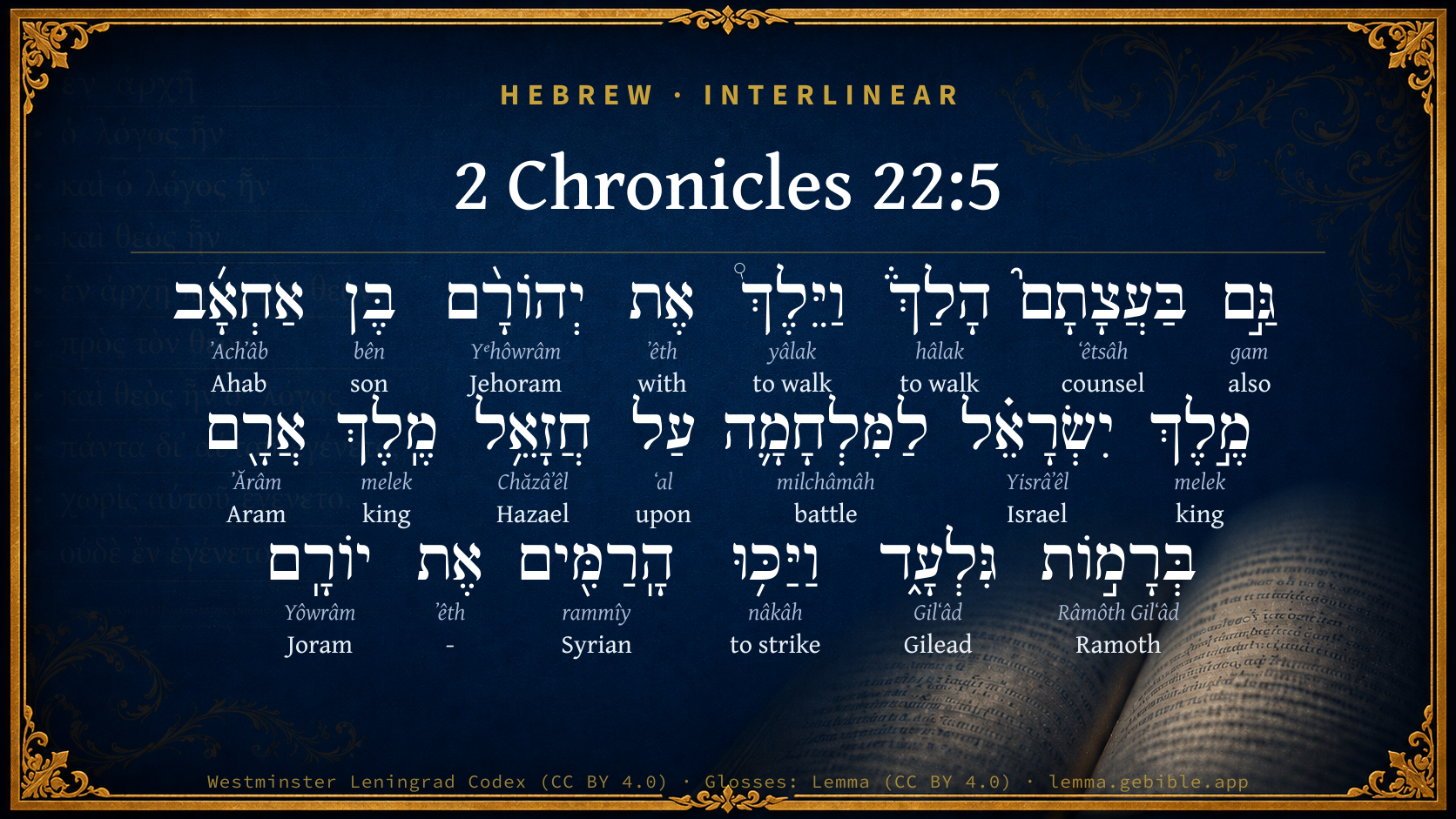
2 Chronicles 22:5

Hebrew (Westminster Leningrad Codex) 2 Chronicles 22:5 appears in the Hebrew Old Testament. The text above is from the Westminster Leningrad Codex. Each word links to its Strong’s number, a concise gloss, and parsing drawn from the Open Scriptures Hebrew Bible morphology. Click any word for its full Brown-Driver-Briggs (BDB) entry.
Download image
Cite this verse

2 Chronicles 22:5 (World English Bible). Public Domain. Lemma interlinear Bible study tool, https://lemma.gebible.app/v/2-chronicles/22/5.

Show BibTeX & RIS
BibTeX
RIS
English Translation
He walked also after their counsel, and went with Jehoram the son of Ahab king of Israel to war against Hazael king of Syria at Ramoth-gilead: and the Syrians wounded Joram.
World English Bible · Public Domain
Highlights
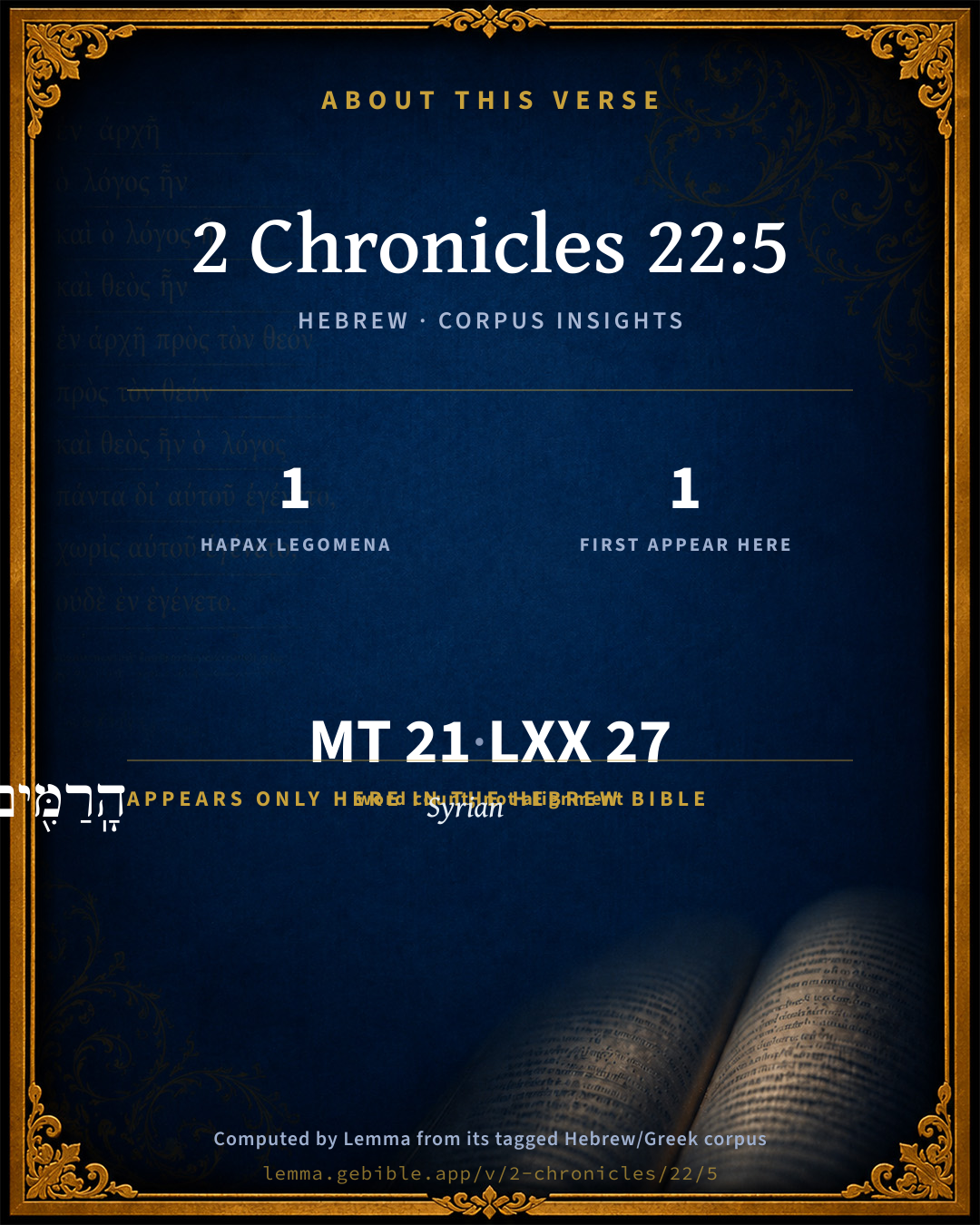
  • 1 hapax legomenon — only here in the Hebrew Bible
  • 1 first appearance in the Hebrew Bible
Full analysis ↓
Download a study sheet

One document with this verse’s original text, its word-by-word gloss line, the meaning frame, cross-references with their text, attributed commentary, and full source and license credits — printable, and it pastes into notes with its structure intact.

This verse Autodidact and up

Study sheet (.html) Plain text (.txt)

A passage Seminary Student

Up to 50 verses in one chapter. A passage sheet keeps up to 6 commentary sources and 12 cross-references per verse, in the order this page ranks them, and says so on the sheet whenever that leaves anything out. Ask for a single verse and you get the Autodidact verse sheet above.

Everything on this page stays free to read, with no account — the sheet is a download of what is already on screen, not access to it.

Want to remove ads? Support Godless Engineer
Compare translations 3

The same verse in 3 English versions, stacked beneath the original-language interlinear above. Click any original word for its lexicon entry.

Each is an independent rendering of the whole verse — the interlinear is not word-aligned to these translations.

Highlighted words mark where these versions differ — a whole-verse word diff, not a word-by-word alignment.

  • World English Bible Public Domain
    He walked also after their counsel, and went with Jehoram the son of Ahab king of Israel to war against Hazael king of Syria at Ramoth-gilead: and the Syrians wounded Joram.
  • King James Version Public Domain
    He walked also after their counsel, and went with Jehoram the son of Ahab king of Israel to war against Hazael king of Syria at Ramothgilead: and the Syrians smote Joram.
  • unfoldingWord Literal Text CC BY-SA 4.0
    Also, with their counsel he walked, and he went with Jehoram the son of Ahab, the king of Israel, for battle against Hazael, the king of Aram, at Ramoth Gilead. And the Arameans struck Joram.

unfoldingWord Literal Text — © unfoldingWord, licensed CC BY-SA 4.0. Word-aligned USFM3 via Door43 (git.door43.org/unfoldingWord/en_ult).

Versions to compare (up to 4)

3 of 4 selected

Show all 18 translations

Every available English version of this verse, each an independent rendering of the whole verse.

  • World English Bible Public Domain
    He walked also after their counsel, and went with Jehoram the son of Ahab king of Israel to war against Hazael king of Syria at Ramoth-gilead: and the Syrians wounded Joram.
  • Berean Standard Bible Public Domain
    Ahaziah also followed their counsel and went with Joram son of Ahab king of Israel to fight against Hazael king of Aram at Ramoth-gilead. But the Arameans wounded Joram;
  • Majority Standard Bible Public Domain
    Ahaziah also followed their counsel and went with Joram son of Ahab king of Israel to fight against Hazael king of Aram at Ramoth-gilead. But the Arameans wounded Joram.
  • King James Version Public Domain
    He walked also after their counsel, and went with Jehoram the son of Ahab king of Israel to war against Hazael king of Syria at Ramothgilead: and the Syrians smote Joram.
  • American Standard Version (1901) Public Domain
    He walked also after their counsel, and went with Jehoram the son of Ahab king of Israel to war against Hazael king of Syria at Ramoth-gilead: and the Syrians wounded Joram.
  • Revised Version (1885) Public Domain
    He walked also after their counsel, and went with Jehoram the son of Ahab king of Israel to war against Hazael king of Syria at Ramoth-gilead: and the Syrians wounded Joram.
  • Geneva Bible (1599) Public Domain
    And he walked after their counsel, and went with Iehoram the sonne of Ahab King of Israel to fight against Hazael king of Aram at Ramoth Gilead: and the Aramites smote Ioram.
  • Douay-Rheims (1899) Public Domain
    And he walked after their counsels. And he went with Joram the son of Achab king of Israel, to fight against Hazael king of Syria, at Ramoth Galaad: and the Syrians wounded Joram.
  • Young's Literal Translation Public Domain
    Also, in their counsel he hath walked, and goeth with Jehoram son of Ahab king of Israel to battle against Hazael king of Aram, in Ramoth-Gilead, and they of Ramah smite Joram;
  • Literal Standard Version CC BY-SA 4.0
    Also, he has walked in their counsel, and goes with Jehoram son of Ahab, king of Israel, to battle against Hazael king of Aram in Ramoth-Gilead, and they of Ramah strike Joram;
  • Unlocked Literal Bible CC BY-SA 4.0
    He also followed their advice; he went with Joram son of Ahab, king of Israel, to fight against Hazael, king of Aram, at Ramoth Gilead. The Arameans wounded Joram.
  • unfoldingWord Literal Text CC BY-SA 4.0
    Also, with their counsel he walked, and he went with Jehoram the son of Ahab, the king of Israel, for battle against Hazael, the king of Aram, at Ramoth Gilead. And the Arameans struck Joram.
  • Darby Bible Public Domain
    He walked also after their counsel, and went with Jehoram the son of Ahab, king of Israel, to the war against Hazael the king of Syria at Ramoth-Gilead; and the Syrians wounded Joram.
  • World Messianic Bible Public Domain
    He also followed their counsel, and went with Jehoram the son of Ahab king of Israel to war against Hazael king of Syria at Ramoth Gilead; and the Syrians wounded Joram.
  • Webster's Bible Public Domain
    He walked also after their counsel, and went with Jehoram the son of Ahab king of Israel to war against Hazael king of Syria at Ramoth-gilead: and the Syrians smote Joram.
  • Free Bible Version CC BY-SA 4.0
    He also followed their advice in joining with Joram, son of Ahab, king of Israel, in attacking Hazael, king of Aram, in Ramoth-gilead. The Arameans wounded Joram,
  • Bible in Basic English Public Domain
    Acting on their suggestion, he went with Jehoram, son of Ahab, king of Israel, to make war on Hazael, king of Aram, at Ramoth-gilead: and Joram was wounded by the bowmen.
  • JPS Tanakh (1917) Public Domain
    He walked also after their counsel, and went with Jehoram the son of Ahab king of Israel to war against Hazael king of Aram at Ramoth-gilead; and the Arameans wounded Joram.

Literal Standard Version (2020), Covenant Press — licensed CC BY-SA 4.0. Text via the HelloAO Bible API (eBible.org). Unlocked Literal Bible (unfoldingWord) — licensed CC BY-SA 4.0. Text via the HelloAO Bible API (eBible.org). unfoldingWord Literal Text — © unfoldingWord, licensed CC BY-SA 4.0. Word-aligned USFM3 via Door43 (git.door43.org/unfoldingWord/en_ult). Free Bible Version, Dr. Jonathan Gallagher — licensed CC BY-SA 4.0. Text via the HelloAO Bible API (eBible.org).

Word by word

More ways to search: Search by grammar → Find every occurrence → Compare this word →

Practice this passage: Drill this verse → Learn its vocabulary →

הָֽרַמִּ֖ים
rammîy
H7421
“the · Syrians”
Particle, Definite Article + Noun, Gentilic, Masculine, Plural, Absolute
Part of Speech
Particle + Noun
Type
Gentilic
Gender
Masculine
Number
Plural
State
Absolute
Full BDB Definition

Origin: for H761

TWOT: None

Syrian = see Syria " exalted" - an inhabitant of Syria
  1. גַּ֣ם gam H1571 “also” Particle, Accusative
  2. בַּעֲצָתָם֮ ʻêtsâh H6098 “in/at · counsel · their” Preposition + Noun, Common, Feminine, Singular, Construct + Suffix, Personal, 3rd Person, Masculine, Plural
  3. הָלַךְ֒ hâlak H1980 “to walk” Verb, Qal, Perfect, 3rd Person, Masculine, Singular
  4. וַיֵּלֶךְ֩ yâlak H3212 “and · to walk” Conjunction + Verb, Qal, Sequential Imperfect, 3rd Person, Masculine, Singular
  5. אֶת ʼêth H854 “with” Preposition
  6. יְהוֹרָ֨ם Yᵉhôwrâm H3088 “Jehoram” Noun, Proper
  7. בֶּן bên H1121 “son of” Noun, Common, Masculine, Singular, Construct
  8. אַחְאָ֜ב ʼAchʼâb H256 “Ahab” Noun, Proper
  9. מֶ֣לֶךְ melek H4428 “king of” Noun, Common, Masculine, Singular, Construct
  10. יִשְׂרָאֵ֗ל Yisrâʼêl H3478 “Israel” Noun, Proper
  11. לַמִּלְחָמָ֛ה milchâmâh H4421 “to/for the · battle” Preposition, Determined + Noun, Common, Feminine, Singular, Absolute
  12. עַל ʻal H5921 “upon” Preposition
  13. חֲזָאֵ֥ל Chăzâʼêl H2371 “Hazael” Noun, Proper
  14. מֶֽלֶךְ melek H4428 “king of” Noun, Common, Masculine, Singular, Construct
  15. אֲרָ֖ם ʼĂrâm H758 “Aram” Noun, Proper
  16. בְּרָמ֣וֹת Râmôth Gilʻâd H7433 “in/at · Ramoth” Preposition + Noun, Proper
  17. גִּלְעָ֑ד Gilʻâd H1568 “Gilead” Noun, Proper
  18. וַיַּכּ֥וּ nâkâh H5221 “and · to strike” Conjunction + Verb, Hiphil, Sequential Imperfect, 3rd Person, Masculine, Plural
  19. אֶת ʼêth H853 “-” Particle, Direct Object
  20. יוֹרָֽם Yôwrâm H3141 “Joram” Noun, Proper

About this verse

These counts appear in no published source. They are computed here, from the morphology-tagged text and Lemma’s own curated glosses. What Lemma adds →

21
words
20
distinct lemmas
Historical
section

Notable vocabulary

1 hapax legomenon — a word that appears only here in the entire Hebrew Bible:

  • הָֽרַמִּ֖ים Syrian H7421

First appearance in Scripture

This word makes its first canonical appearance in the Hebrew Bible here:

  • הָֽרַמִּ֖ים Syrian H7421

Shared distinctive vocabulary

יוֹרָֽם Joram H3141 occurs in 16 verses of the Hebrew Bible. Also found in:

Grammatical profile

  • 3 verbs
  • 14 nouns
  • 2 prepositions
  • 2 particles

Verb forms

  • הָלַךְ֒ Qal · Perfect
  • וַיֵּלֶךְ֩ Qal · Sequential Imperfect
  • וַיַּכּ֥וּ Hiphil · Sequential Imperfect

Repetition

A word recurs within this verse — often emphatic in Hebrew:

  • מֶ֣לֶךְ king H4428 ×2

Hebrew & Septuagint length

In English translation the verse runs 31 words from the Hebrew and 32 from the Septuagint (LXX English) — closely comparable.

A rough comparison of the two English renderings, which tokenize alike — not a word-level alignment.

Word counts can differ between the Hebrew and the Greek without any difference in meaning — e.g. the Hebrew direct-object marker אֵת has no separate Greek word, and Greek often adds the article ὁ.

In the original languages it is 21 Hebrew tokens and 27 Greek tokens — but the two are counted differently (Hebrew bundles its prefixes and suffixes into one token; the Greek is in lemma form), so that isn’t a like-for-like length.

Cross-references

9

Topical passages linked to 2 Chronicles 22:5 in the Treasury of Scripture Knowledge — connected by theme and wording, ordered by reader-vote popularity; previews shown in the World English Bible.

  • 1 Kings 22:3 The king of Israel said to his servants, "You know that Ramoth-gilead is ours, and we are still, and don't take it out of the hand of the king of Syria?"
  • 2 Kings 8:9 So Hazael went to meet him, and took a present with him, even of every good thing of Damascus, forty camels' burden, and came and stood before him, and said, Your son Benhadad king of Syria has sent me to you, saying, Shall I recover of this sickness?
  • 2 Kings 8:28–29 He went with Joram the son of Ahab to war against Hazael king of Syria at Ramoth-gilead: and the Syrians wounded Joram.
  • 2 Chronicles 18:3 Ahab king of Israel said to Jehoshaphat king of Judah, Will you go with me to Ramoth-gilead? He answered him, I am as you are, and my people as your people; and [we will be] with you in the war.
  • 2 Chronicles 18:31 It happened, when the captains of the chariots saw Jehoshaphat, that they said, It is the king of Israel. Therefore they turned about to fight against him: but Jehoshaphat cried out, and Yahweh helped him; and God moved them [to depart] from him.
  • 2 Chronicles 19:2 Jehu the son of Hanani the seer went out to meet him, and said to king Jehoshaphat, Should you help the wicked, and love those who hate Yahweh? for this thing wrath is on you from before Yahweh.
  • Psalms 1:1 Blessed is the man who doesn't walk in the counsel of the wicked, Nor stand in the way of sinners, Nor sit in the seat of scoffers;
  • Daniel 5:22 You his son, Belshazzar, have not humbled your heart, though you knew all this,
  • Micah 6:16 For the statutes of Omri are kept, And all the works of the house of Ahab. You walk in their counsels, That I may make you a ruin, And her inhabitants a hissing; And you will bear the reproach of my people."

Cross-references courtesy of OpenBible.info (CC BY 4.0).

Hebrew and Greek witnesses Masoretic Hebrew ↔ Greek Septuagint

The same verse in the two great witnesses to the Old Testament, shown verse-for-verse.

These are two independent witnesses, not word-aligned to each other, and the Septuagint is shown in lemma (dictionary) form.

Hebrew 2 Chronicles 22:5 Masoretic · Westminster Leningrad Codex

גַּ֣ם בַּעֲצָתָם֮ הָלַךְ֒ וַיֵּלֶךְ֩ אֶת יְהוֹרָ֨ם בֶּן אַחְאָ֜ב מֶ֣לֶךְ יִשְׂרָאֵ֗ל לַמִּלְחָמָ֛ה עַל חֲזָאֵ֥ל מֶֽלֶךְ אֲרָ֖ם בְּרָמ֣וֹת גִּלְעָ֑ד וַיַּכּ֥וּ הָֽרַמִּ֖ים אֶת יוֹרָֽם

He walked also after their counsel, and went with Jehoram the son of Ahab king of Israel to war against Hazael king of Syria at Ramoth-gilead: and the Syrians wounded Joram.

World English Bible · Public Domain

Greek LXX 2 Chronicles 22:5 Septuagint · lemma form

καί ἐν ὁ βουλή αὐτός πορεύομαι καί πορεύομαι μετά ιωραμ υἱός αχααβ εἰς πόλεμος ἐπί αζαηλ βασιλεύς συρία εἰς ραμα γαλαάδ καί πατάσσω ὁ τοξότης ὁ ιωραμ

And he walked in their counsels, and he went with Joram son of Achaab king of Israel to war against Azael king of Syria to Ramoth Galaad: and the archers struck Joram.

LXX2012 (modern English Septuagint) · Public Domain

On this verse, Ellicott's Commentary for English Readers discusses the Septuagint’s reading. Read the note in Commentary ↓

Hebrew: Westminster Leningrad Codex (CC BY 4.0). Greek: Septuagint (public domain); English from LXX2012 (modern English Septuagint) (Public Domain). How the Septuagint differs from the Hebrew →

Commentary

Notes on 2 Chronicles 22:5 from classic Christian and Jewish commentators (each source and its license shown beneath its notes). The classic Christian expositions comment on the surrounding passage and are grouped to its opening verse, so a note may address several verses; the Jewish commentaries on the Tanakh (Rashi and others) are per-verse, so they appear only where the commentator wrote on this verse.

Lemma curates 59 commentaries, every one of them public domain or Creative Commons licensed, each selected and text-cleaned for this edition rather than reprinted as found. About our sources →

Trapp's Complete Commentary

John Trapp

2Ch 22:5 He walked also after their counsel, and went with Jehoram the son of Ahab king of Israel to war against Hazael king of Syria at Ramothgilead: and the Syrians smote Joram.

Ver. 5. And went with Jehoram.] See 2Ki 8:28. He went to fetch his death.

John Trapp, A Commentary or Exposition upon All the Books of the Old and New Testament (1647–1656) — public domain. Text from a community e-Sword module.

Joseph Benson's Commentary

2Ch 22:5. He went with Jehoram to war against Hazael — Following the evil example of Jehoshaphat herein; though he would not follow him in what was good. But of this and the following verses, see notes on 2Ki 8:28-29; 2Ki 9:21; 2Ki 9:27.

Joseph Benson's Commentary on the Old and New Testaments (1811–1818) — public domain. Text from a community e-Sword module.

Tyndale Open Study Notes

Tyndale Open Resources

22:5-6 Ramoth-gilead, a Levitical city in the territory of Gad (Josh 21:38), was located on a major trade route and was strategic for Aram and Israel. • Jezreel, at the foot of Mount Gilboa in the plain of Jezreel, became the summer home of the Israelite kings.

Tyndale Open Study Notes — © Tyndale Open Resources, licensed CC BY-SA 4.0. Text via the HelloAO Bible API.

Jamieson, Fausset & Brown

Robert Jamieson, A. R. Fausset & David Brown

went . . . to war against Hazael, king of Syria--It may be mentioned as a very minute and therefore important confirmation of this part of the sacred history that the names of Jehu and Hazael, his contemporary, have both been found on Assyrian sculptures; and there is also a notice of Ithbaal, king of Sidon, who was the father of Jezebel.

Jamieson, Fausset & Brown — Commentary Critical and Explanatory on the Whole Bible (1871) — public domain (CC PDM 1.0). Text via the HelloAO Bible API.

Adam Clarke's Commentary

Verse 5. Went with Jehoram] See on 2Kg 8:28.

Adam Clarke's Commentary on the Bible (1810–1826) — public domain. Text from a community e-Sword/MySword module.

Ellicott's Commentary for English Readers

(5) He walked also after (in) their counsel.—An allusion to Psa_1:1. He became a close partner in the politics of his ally, and joined in his expedition against the Syrians. The words are not in Kings.

And went with Jehoram.—2Ki_8:28, “Joram.”

King of Israel.—Added by chronicler.

Against.—Kings, “with.”

Hazael king of Syria.—See Note on 2Ki_8:8, seq.; 13:3.

The Syrians.—Heb., hârammîm, instead of ‘Arammîm’ (Kings). So Vulg. and Targum. The Syriac, as usual, confuses Aram with Edom. The LXX. renders “the archers,” as if the word were the participle of râmâh, “to shoot.” Perhaps the chronicler intended ha-rômîm, “the archers.” (Comp. 1Sa_31:3; Jer_4:29.)

A Bible Commentary for English Readers, edited by Charles John Ellicott (1878–1897) — public domain. Text from a community e-Sword module.

The Cambridge Bible for Schools and Colleges

gen. ed. J. J. S. Perowne

5, 6 (= 2Ki_8:28-29). The Alliance with Jehoram of Israel

5. smote Joram] R.V. wounded Joram (as 2 Kin.).

The Cambridge Bible for Schools and Colleges (gen. ed. J. J. S. Perowne; Cambridge University Press, 1878–1918) — public domain. Text from a community e-Sword module.

John Gill's Exposition

He walked also after their counsel,.... Did as they advised him, as in matters of religion, so in political things, of which there is an instance in this and the next verse; of which see Gill on Kg2 8:28, Kg2 8:29.

.

2 Chronicles 22:7

ch2 22:7

ch2 22:7

ch2 22:7And the destruction of Ahaziah was of God by coming to Joram,.... Of his appointing; it was according to his purpose and decree, and was brought about by his overruling Providence, ordering the occasion and manner of it very justly for his sins:

for when he was come, he went out with Jehoram against Jehu the son of Nimshi; see Kg2 9:21,

whom the Lord had anointed to cut off the house of Ahab; raised up to be king of Israel for that purpose, Kg2 9:6, the Targum is,"whom Elijah anointed by the command of the Word of the Lord;''but it was not Elijah, but a prophet by the order of Elisha, that anointed him, Kg2 9:1, and this being done by direction of the Lord, is ascribed to him.

John Gill's Exposition of the Whole Bible (1746–1763) — public domain (CC PDM 1.0). Text via the HelloAO Bible API.

Matthew Poole's English Annotations

Went with Jehoram to war against Hazael; following the evil example of Jehoshaphat therein, 2Ch 18, though he would not follow him in what was good. But of this and the following verses, see 2Ki 8:28,29; 9:21,27.

Matthew Poole's English Annotations on the Holy Bible (1683–1685) — public domain. Text from a community e-Sword/MySword module.

The Pulpit Commentary

He went with Jehoram the son of Ahab. So the evil example of even the good lives after them. See Jehoshaphat (2Ch_18:8) followed by his son Jehoram first, (2Ki_3:9) and now by his grandson Ahaziah. The words of this verse and the next are almost identical with the parallel. (2Ki_8:28, 2Ki_8:29)

Ramoth-Gilead. It will be remembered that Ahab failed when he solicited and obtained the help of Jehoshaphat (1Ki_22:3-36; 2Ch_18:3-34) in his enterprise against Ramoth-Gilead. The present attempt, however, seems to have had a different issue. (2Ki_9:14, 2Ki_9:15) The Syrians; Hebrew, The initial radical here should be a, from neglect of observing which the Septuagint has translated "archers" (relate).

Vers. 5-12.

Our friends and their fate, etc

These verses offer us a cluster of truths which we may gather.

I THAT OUR FATE IS COMMONLY BOUND UP WITH THAT OF OUR FRIENDS. Ahaziah "went with Jehoram the son of Ahab" (ver. 5); and, allying himself with him in war, he visited him as a friend when he was at his home at Jezreel. But this friendship with God"s enemies led him to his destruction; his coming to Jehoram was "of God" (ver. 7); it was the way taken by Divine Providence to bring upon him the penalty of his guilt. For he perished with his friend on the same day and at the same hand (vers. 8, 9). When we are determining upon our alliances and our friendships, it is well not only to consider the station, the income, the reputation in society, of those who invite us to their confidence, but also to inquire concerning their probable whither-ward. In what direction are they moving? Toward what goal are their faces turned? What will their end be? Are they on an upward or on a downward course? For nothing is more likely than that we shall share their fate, that we shall become what they are becoming.

II THAT THE INFLUENCE OF A GOOD MAN GOES FAR BEYOND HIS OWN GENERATION. "They buried him, Because (they said) he is the son of Jehoshaphat," etc. (ver. 9). He was Jehoshaphat"s grandson; but though they had to go back two generations, the memory and the moral impression of the good king had not faded at any rate, had not been effaced. "The memory of the just" abides; it is fragrant after many years have gone; and the influence of the holy lasts when the memory has disappeared. Knowledge in the memory, peace in the mind, soundness in the soul, beauty and usefulness in the life, these are the fruits of the good man"s life, though they are not traced to his hand and not referred to his working; they are influences which spread and widen as the years go on.

III THAT IF WE PLACE OURSELVES UNDER THE DOMINION OF EVIL, WE DO NOT KNOW TO WHAT DEPTH WE MAY DESCEND. We have here a woman, who was brought up in a civilized court, and who had the opportunity of acquainting herself with the Law of the Lord, causing all her own grandsons to be murdered, in order that she might have the helm of the state in her own hands! To what a bottomless depth of moral degradation can a woman sink, when she gives herself up to the power of evil! And we do not, any of us, know the lengths of wrong-doing, the depths of iniquity, to which we may go, if we once yield to that strong temptation impurity, avarice, indulgence in strong drink, the intoxication of applause, or whatever it may be which is assailing and even threatening us. Shun the first step in an evil course, for the slope becomes steeper as we go further, and it leads down to a deep and dark gulf of shame and ruin.

IV THAT WOMANLY KINDNESS HAS A LARGE CONTRIBUTION TO BRING TO THE CAUSE AND KINGDOM OF GOD. It was a very great service, fruitful of large results, which Jehoshabeath now rendered (ver. 11). It was a very valuable service that womanly kindness and fidelity rendered to our Lord when he lived and when he died for us. The Apostle Paul had to thank womanly kindness for succour in the course of his career. Pity, with the hand of help it stretches forth, is a handmaid of piety, a valued servant in the king"s household.

V THAT IN THE HOUSE OF THE LORD WE MAY FIND A HIDING-PLACE FOR OURSELVES. (Ver. 12.) His aunt hid the infant Joash in the house of God (ver. 12). Many times, in many lands, has the house of God been a sanctuary, a place where men have taken refuge and have hidden themselves from the wrath of the pursuer. But there is a better way in which God"s house may be to us a sanctuary. We may go there to hide ourselves in him whose house it is. We may go there with our troubled or our sin-burdened heart, and we may hide in him who is the God of all grace and consolation, in him who is abundant in mercy and truth. (Psa_27:4, Psa_27:5) When we cherish a living faith in God our Saviour and our Friend, we "hide ourselves under the shadow of his wings". C. (Psa_17:8)

The Pulpit Commentary (1880–1919), ed. H.D.M. Spence-Jones & Joseph S. Exell — public domain. Text from a community e-Sword module.

Rashi

Rabbi Shlomo Yitzchaki (Rashi)

and the Arameans smote Joram - Heb. הָרַמִּים, like הָאֲרַמִּים. In many places the “aleph” is missing, as for instance (II Sam. 19:14): “And to Amasa you shall say (תֹמְרוּ).” And sometimes the “aleph” is added to a word, for instance (Ps. 89:1): “Ethan the Ezrahite (הָאֶזְרָחִי),” like הַזַּרְחִי, [descendant of Zerah], and the “aleph” of (Job 13:17): “and to my speech (וְאַחְוָתִי) in your ears.”

Rashi on the Tanakh — English translations: “The Judaica Press complete Tanach with Rashi, translated by A. J. Rosenberg” (CC BY 4.0); “Pentateuch with Rashi's commentary by M. Rosenbaum and A.M. Silbermann, 1929-1934” (public domain); “The Metsudah Tanach series, Lakewood, N.J” (CC BY 4.0); and “The Book of Joshua, Metsudah Publications, 1997” (CC BY 4.0). Text via Sefaria.

Lesson kit

Teaching starters — assembled from the data on this page, not authored interpretation. Every prompt links to the verse data it draws on. Edit before teaching.

2 Chronicles, in the Historical, opens this verse with 21 words (20 distinct Hebrew lemmas). Its most distinctive word is rammîy (“Syrian”). A historical commentator’s framing appears above. Read the whole chapter for the surrounding context.

Discussion questions

  1. What does “Syrian” (rammîy) contribute to the verse as a whole?
  2. 1 word here appears nowhere else in the Hebrew Bible. Why might the author reach for such rare wording?
  3. This is the first place “Syrian” appears in Scripture (first appears here). What does its debut here establish?
  4. How does 2 Samuel 8:10, which shares the word «Joram», read alongside this verse?
  5. What does the repetition of “king” (2× in this one verse) do in this verse?
  6. These translations render this verse differently; the difference is in the English rendering, not the original. What questions does that raise?
  7. «הָלַךְ֒» is a Qal Perfect verb. How does that grammatical form shape the action described?
  8. Compare how Trapp's Complete Commentary and Joseph Benson's Commentary read this verse. Where do they agree or differ?

Things to notice

  • 1 word in this verse appears nowhere else in the Hebrew Bible.
  • 1 word makes its first canonical appearance in Scripture here.
  • This verse counts 21 Hebrew ↔ 27 Greek words.
  • These translations choose different wording for 14 words in this verse.
  • “king” occurs 2× in this single verse.

Reading settings

Reading text

Shown beneath each verse's original-language words.

Old Testament
Old Testament edition

Read the OT as the Masoretic Hebrew (MT) or the Greek Septuagint (LXX).

English shown for the Greek Septuagint (in the Hebrew ↔ Greek comparison).

Comparing translations? Open the Compare panel on any verse page to stack up to four side by side.