Joshua 11:19

Hebrew (Westminster Leningrad Codex) Joshua 11:19 appears in the Hebrew Old Testament. The text above is from the Westminster Leningrad Codex. Each word links to its Strong’s number, a concise gloss, and parsing drawn from the Open Scriptures Hebrew Bible morphology. Click any word for its full Brown-Driver-Briggs (BDB) entry.
Download image
Cite this verse

Joshua 11:19 (World English Bible). Public Domain. Lemma interlinear Bible study tool, https://lemma.gebible.app/v/joshua/11/19.

Show BibTeX & RIS
BibTeX
RIS
English Translation
There was not a city that made peace with the children of Israel, save the Hivites the inhabitants of Gibeon: they took all in battle.
World English Bible · Public Domain
Download a study sheet

One document with this verse’s original text, its word-by-word gloss line, the meaning frame, cross-references with their text, attributed commentary, and full source and license credits — printable, and it pastes into notes with its structure intact.

This verse Autodidact and up

Study sheet (.html) Plain text (.txt)

A passage Seminary Student

Up to 50 verses in one chapter. A passage sheet keeps up to 6 commentary sources and 12 cross-references per verse, in the order this page ranks them, and says so on the sheet whenever that leaves anything out. Ask for a single verse and you get the Autodidact verse sheet above.

Everything on this page stays free to read, with no account — the sheet is a download of what is already on screen, not access to it.

Want to remove ads? Support Godless Engineer
Compare translations 3

The same verse in 3 English versions, stacked beneath the original-language interlinear above. Click any original word for its lexicon entry.

Each is an independent rendering of the whole verse — the interlinear is not word-aligned to these translations.

Highlighted words mark where these versions differ — a whole-verse word diff, not a word-by-word alignment.

  • World English Bible Public Domain
    There was not a city that made peace with the children of Israel, save the Hivites the inhabitants of Gibeon: they took all in battle.
  • King James Version Public Domain
    There was not a city that made peace with the children of Israel, save the Hivites the inhabitants of Gibeon: all other they took in battle.
  • unfoldingWord Literal Text CC BY-SA 4.0
    There was not a city that made peace with the sons of Israel except the Hivites, the dwellers of Gibeon. The all, they captured in battle.

unfoldingWord Literal Text — © unfoldingWord, licensed CC BY-SA 4.0. Word-aligned USFM3 via Door43 (git.door43.org/unfoldingWord/en_ult).

Versions to compare (up to 4)

3 of 4 selected

Show all 18 translations

Every available English version of this verse, each an independent rendering of the whole verse.

  • World English Bible Public Domain
    There was not a city that made peace with the children of Israel, save the Hivites the inhabitants of Gibeon: they took all in battle.
  • Berean Standard Bible Public Domain
    No city made peace with the Israelites except the Hivites living in Gibeon; all others were taken in battle.
  • Majority Standard Bible Public Domain
    No city made peace with the Israelites except the Hivites living in Gibeon; all others were taken in battle.
  • King James Version Public Domain
    There was not a city that made peace with the children of Israel, save the Hivites the inhabitants of Gibeon: all other they took in battle.
  • American Standard Version (1901) Public Domain
    There was not a city that made peace with the children of Israel, save the Hivites the inhabitants of Gibeon: they took all in battle.
  • Revised Version (1885) Public Domain
    There was not a city that made peace with the children of Israel, save the Hivites the inhabitants of Gibeon: they took all in battle.
  • Geneva Bible (1599) Public Domain
    Neither was there any citie that made peace with the children of Israel, saue those Hiuites that inhabited Gibeon: all other they tooke by battell.
  • Douay-Rheims (1899) Public Domain
    There was hot a city that delivered itself to the children of Israel, except the Hevite, who dwelt in Gabaon: for he took all by fight.
  • Young's Literal Translation Public Domain
    there hath not been a city which made peace with the sons of Israel save the Hivite, inhabitants of Gibeon; the whole they have taken in battle;
  • Literal Standard Version CC BY-SA 4.0
    there has not been a city which made peace with the sons of Israel except the Hivite, inhabitants of Gibeon; they have taken the whole in battle;
  • Unlocked Literal Bible CC BY-SA 4.0
    Not one city made peace with the army of Israel except the Hivites who lived in Gibeon. Israel captured all the rest of the cities in battle.
  • unfoldingWord Literal Text CC BY-SA 4.0
    There was not a city that made peace with the sons of Israel except the Hivites, the dwellers of Gibeon. The all, they captured in battle.
  • Darby Bible Public Domain
    There was not a city that made peace with the children of Israel, save the Hivites who dwelt at Gibeon; they took all in battle.
  • World Messianic Bible Public Domain
    There was not a city that made peace with the children of Israel, except the Hivites, the inhabitants of Gibeon. They took all in battle.
  • Webster's Bible Public Domain
    There was not a city that made peace with the children of Israel, save the Hivites the inhabitants of Gibeon: all other they took in battle.
  • Free Bible Version CC BY-SA 4.0
    Not a single town made peace with the Israelites except the Hivites, the inhabitants of Gibeon. All the rest were conquered in battle.
  • Bible in Basic English Public Domain
    Not one town made peace with the children of Israel, but only the Hivites of Gibeon: they took them all in war.
  • JPS Tanakh (1917) Public Domain
    There was not a city that made peace with the children of Israel, save the Hivites the inhabitants of Gibeon; they took all in battle.

Literal Standard Version (2020), Covenant Press — licensed CC BY-SA 4.0. Text via the HelloAO Bible API (eBible.org). Unlocked Literal Bible (unfoldingWord) — licensed CC BY-SA 4.0. Text via the HelloAO Bible API (eBible.org). unfoldingWord Literal Text — © unfoldingWord, licensed CC BY-SA 4.0. Word-aligned USFM3 via Door43 (git.door43.org/unfoldingWord/en_ult). Free Bible Version, Dr. Jonathan Gallagher — licensed CC BY-SA 4.0. Text via the HelloAO Bible API (eBible.org).

Word by word

More ways to search: Search by grammar → Find every occurrence → Compare this word →

Practice this passage: Drill this verse → Learn its vocabulary →

הַחִוִּ֖י
Chivvîy
H2340
“the · Hivite”
Particle, Definite Article + Noun, Gentilic, Masculine, Singular, Absolute
Part of Speech
Particle + Noun
Type
Gentilic
Gender
Masculine
Number
Singular
State
Absolute
Full BDB Definition

Origin: perhaps from H2333

TWOT: None

Hivite = "villagers" - 6th generation of descendants of Canaan, the son of Ham, who were living in northern Canaan near Mount Hermon at the time of the conquest
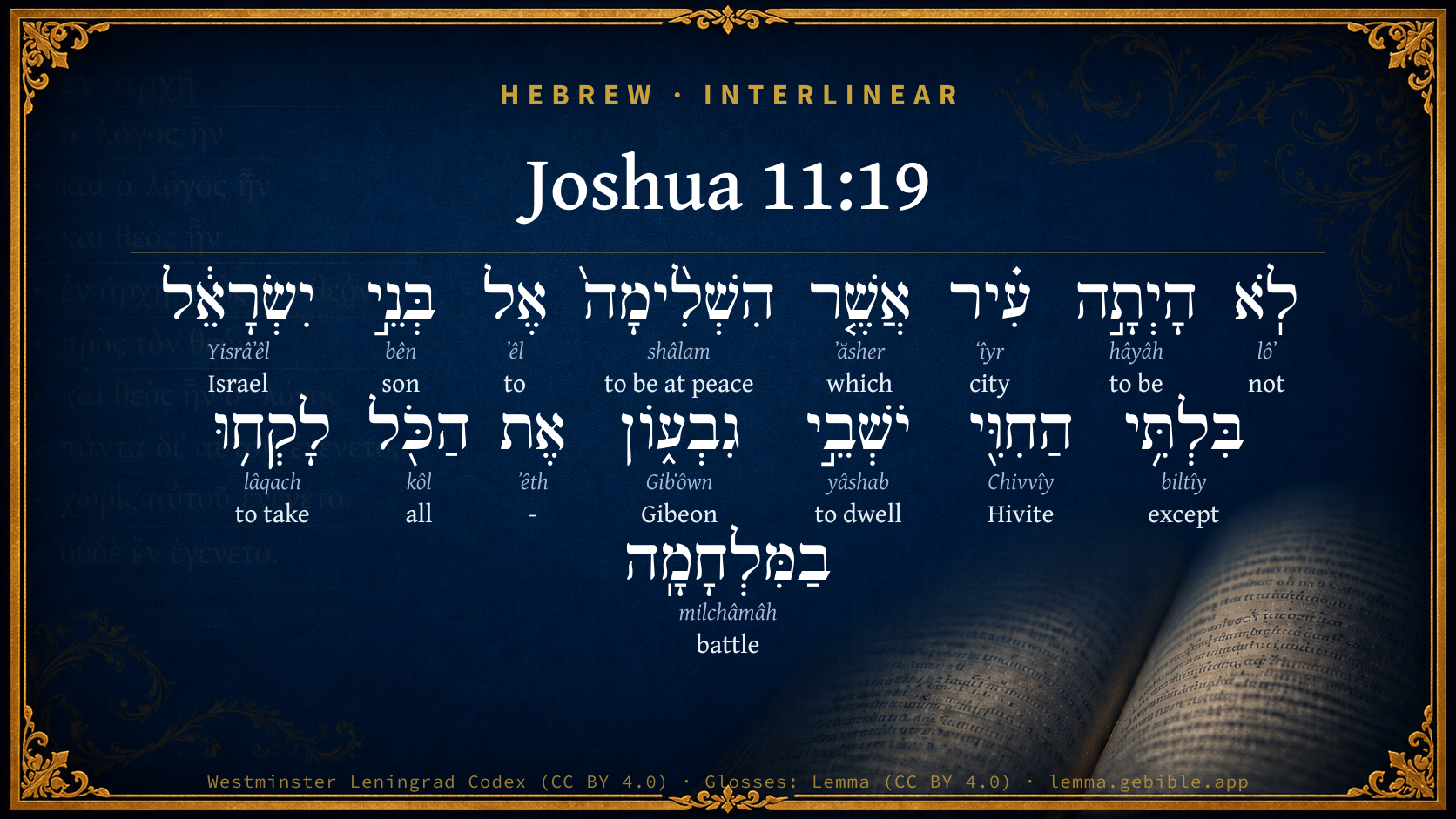
  1. לֹֽא lôʼ H3808 “not” Particle, Negative
  2. הָיְתָ֣ה hâyâh H1961 “to be” Verb, Qal, Perfect, 3rd Person, Feminine, Singular
  3. עִ֗יר ʻîyr H5892 “city” Noun, Common, Feminine, Singular, Absolute
  4. אֲשֶׁ֤ר ʼăsher H834 “which” Particle, Relative
  5. הִשְׁלִ֨ימָה֙ shâlam H7999 “to be at peace” Verb, Hiphil, Perfect, 3rd Person, Feminine, Singular
  6. אֶל ʼêl H413 “to” Preposition
  7. בְּנֵ֣י bên H1121 “sons of” Noun, Common, Masculine, Plural, Construct
  8. יִשְׂרָאֵ֔ל Yisrâʼêl H3478 “Israel” Noun, Proper
  9. בִּלְתִּ֥י biltîy H1115 “except” Conjunction
  10. יֹשְׁבֵ֣י yâshab H3427 “dwelling” Verb, Qal, Participle Active, Masculine, Plural, Construct
  11. גִבְע֑וֹן Gibʻôwn H1391 “Gibeon” Noun, Proper
  12. אֶת ʼêth H853 “-” Particle, Direct Object
  13. הַכֹּ֖ל kôl H3605 “the · all” Particle, Definite Article + Noun, Common, Masculine, Singular, Absolute
  14. לָקְח֥וּ lâqach H3947 “to take” Verb, Qal, Perfect, 3rd Person, Common, Plural
  15. בַמִּלְחָמָֽה milchâmâh H4421 “in/at the · battle” Preposition, Determined + Noun, Common, Feminine, Singular, Absolute

About this verse

These counts appear in no published source. They are computed here, from the morphology-tagged text and Lemma’s own curated glosses. What Lemma adds →

16
words
16
distinct lemmas
Historical
section

Notable vocabulary

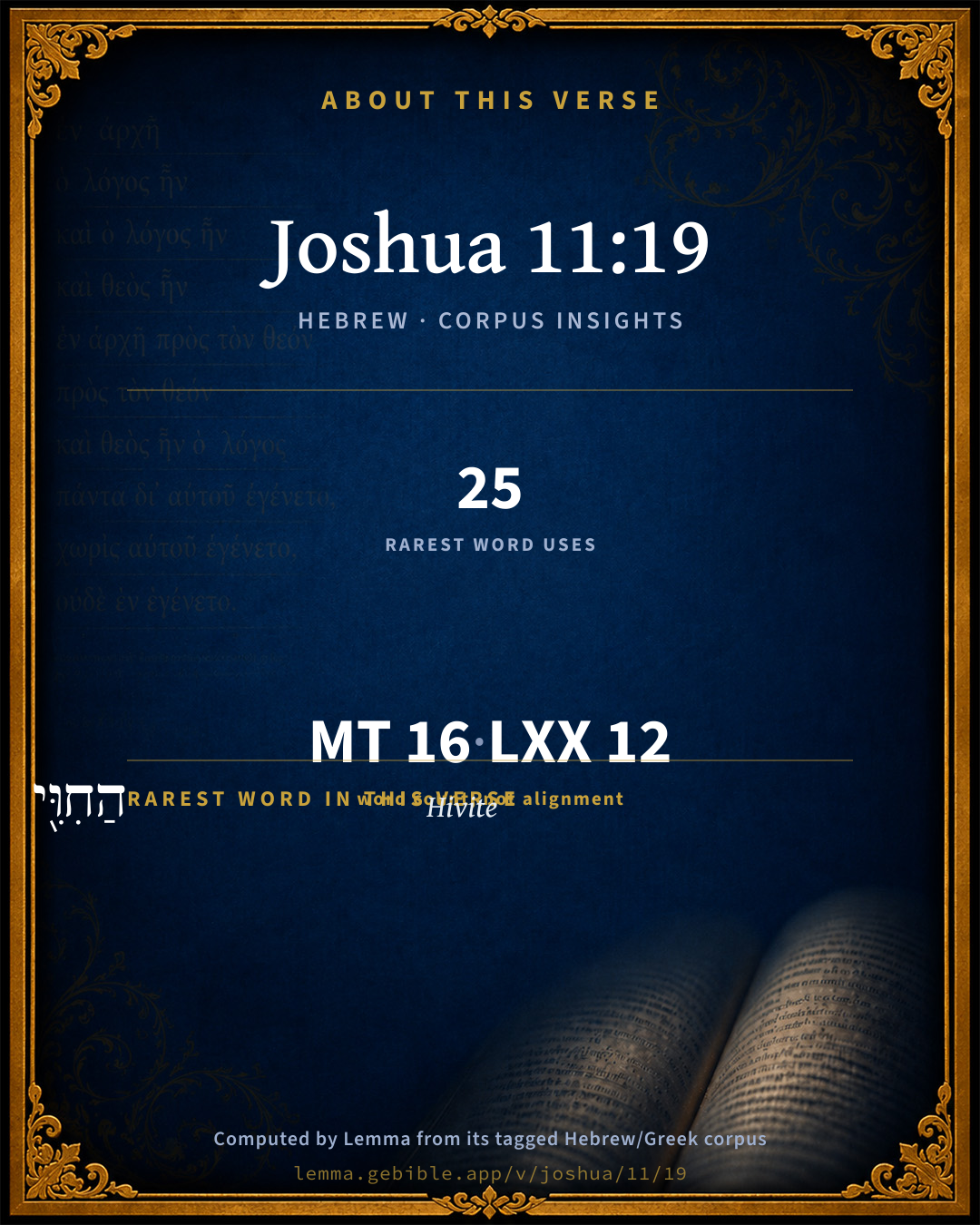
The rarest word here is הַחִוִּ֖י Hivite H2340 — appearing just 25 times in the whole Hebrew Bible.

Shared distinctive vocabulary

הַחִוִּ֖י Hivite H2340 occurs in 25 verses of the Hebrew Bible. Also found in:

Grammatical profile

  • 4 verbs
  • 7 nouns
  • 1 preposition
  • 1 conjunction
  • 3 particles

Verb forms

  • הָיְתָ֣ה Qal · Perfect
  • הִשְׁלִ֨ימָה֙ Hiphil · Perfect
  • יֹשְׁבֵ֣י Qal · Participle Active
  • לָקְח֥וּ Qal · Perfect

Hebrew & Septuagint length

In English translation the verse runs 25 words from the Hebrew and 14 from the Septuagint (LXX English) — the Septuagint runs noticeably shorter here. See the side-by-side →

A rough comparison of the two English renderings, which tokenize alike — not a word-level alignment.

Word counts can differ between the Hebrew and the Greek without any difference in meaning — e.g. the Hebrew direct-object marker אֵת has no separate Greek word, and Greek often adds the article ὁ.

In the original languages it is 16 Hebrew tokens and 12 Greek tokens — but the two are counted differently (Hebrew bundles its prefixes and suffixes into one token; the Greek is in lemma form), so that isn’t a like-for-like length.

Cross-references

1

Topical passages linked to Joshua 11:19 in the Treasury of Scripture Knowledge — connected by theme and wording, ordered by reader-vote popularity; previews shown in the World English Bible.

  • Joshua 9:3–27 But when the inhabitants of Gibeon heard what Joshua had done to Jericho and to Ai,

Cross-references courtesy of OpenBible.info (CC BY 4.0).

Hebrew and Greek witnesses Masoretic Hebrew ↔ Greek Septuagint

The same verse in the two great witnesses to the Old Testament, shown verse-for-verse.

Here the Septuagint runs noticeably shorter than the Hebrew — LXX2012 (modern English Septuagint) 14 words vs World English Bible 25. A rough length comparison of the two English translations, not a word-level alignment — read both below.

These are two independent witnesses, not word-aligned to each other, and the Septuagint is shown in lemma (dictionary) form.

Hebrew Joshua 11:19 Masoretic · Westminster Leningrad Codex

לֹֽא הָיְתָ֣ה עִ֗יר אֲשֶׁ֤ר הִשְׁלִ֨ימָה֙ אֶל בְּנֵ֣י יִשְׂרָאֵ֔ל בִּלְתִּ֥י הַחִוִּ֖י יֹשְׁבֵ֣י גִבְע֑וֹן אֶת הַכֹּ֖ל לָקְח֥וּ בַמִּלְחָמָֽה

There was not a city that made peace with the children of Israel, save the Hivites the inhabitants of Gibeon: they took all in battle.

World English Bible · Public Domain

Greek LXX Joshua 11:19 Septuagint · lemma form

καί οὐ εἰμί πόλις ὅς οὐ λαμβάνω ἰσραήλ πᾶς λαμβάνω ἐν πόλεμος

And there was no city which Israel took not; they took all in war.

LXX2012 (modern English Septuagint) · Public Domain

Hebrew: Westminster Leningrad Codex (CC BY 4.0). Greek: Septuagint (public domain); English from LXX2012 (modern English Septuagint) (Public Domain). How the Septuagint differs from the Hebrew →

Targum (Aramaic paraphrase)

1

The Targum is the ancient Jewish Aramaic paraphrase of the Hebrew Scriptures — an interpretive translation, not the Hebrew text itself. Onkelos (literal) and Pseudo-Jonathan (expansive) render the Torah, and Jonathan the Prophets. Coverage is partial: where no permissively-licensed English translation exists for a verse, only the Aramaic is shown. This is verse-level text, not a word-by-word alignment to the Hebrew.

  1. Targum Jonathan Prophets (Joshua–Malachi)
    לָא הֲוַת קַרְתָּא דְאַשְׁלֵימַת עִם בְּנֵי יִשְׂרָאֵל אֱלָהֵן חִוָאָה יַתְבֵי גִבְעוֹן יַת כּוֹלָא נְסִיבוּ בִּקְרָבָא:

    (no public-domain English translation for this verse)

    Targum Jonathan — Aramaic: “Mikraot Gedolot” (public domain). English: “Sefaria Community Translation” (CC0 1.0 (public-domain dedication)); “London "Chaldee Paraphrase," 1871” (public domain). Text via Sefaria.

Commentary

Notes on Joshua 11:19 from classic Christian and Jewish commentators (each source and its license shown beneath its notes). The classic Christian expositions comment on the surrounding passage and are grouped to its opening verse, so a note may address several verses; the Jewish commentaries on the Tanakh (Rashi and others) are per-verse, so they appear only where the commentator wrote on this verse.

Lemma curates 59 commentaries, every one of them public domain or Creative Commons licensed, each selected and text-cleaned for this edition rather than reprinted as found. About our sources →

Trapp's Complete Commentary

John Trapp

Jos 11:19 There was not a city that made peace with the children of Israel, save the Hivites the inhabitants of Gibeon: all [other] they took in battle.

Ver. 19. There was not a city that made peace.] Hence the war held out so long: they generally stood out to the last man. There is nothing more pertinacious than a strong lust: nothing more obstinate or inexpugnable than those Canaanites.

John Trapp, A Commentary or Exposition upon All the Books of the Old and New Testament (1647–1656) — public domain. Text from a community e-Sword module.

Joseph Benson's Commentary

Jos 11:19-20. All other they took in battle — That is, all that were taken by Joshua were taken by the sword, and therefore it is no wonder that the war was long, when the enemy was so obstinate. It was of the Lord to harden their hearts — In the same sense in which he hardened the heart of Pharaoh. He did not soften their hearts through the influence of his almighty grace, but gave them up to their own animosity, pride, confidence, and stubbornness; and so ordered things, in the course of his wise and righteous providence, that they were imboldened to fight with the Israelites, notwithstanding they had heard of the wonders that were repeatedly wrought for them. And this he did in order that their abominable and incorrigible wickedness might be punished, and that the Israelites might not be mixed with them, but be entire among themselves in the possession of the land. That he might destroy them utterly, and they might have no favour — Which they might have obtained if they had not been so inconsiderate, and self-confident, and rash as to imagine they could withstand those before whom the river Jordan fled back, and the walls of Jericho fell down flat; and so would not hearken to the terms that Joshua offered to them.

Joseph Benson's Commentary on the Old and New Testaments (1811–1818) — public domain. Text from a community e-Sword module.

Tyndale Open Study Notes

Tyndale Open Resources

11:19-20 The judgment on Canaan was God’s, not Israel’s. God had extended mercy to the Canaanites for several generations. However, God determined that “the sins of the Amorites” now “warrant their destruction” (Gen 15:16), and he hardened their hearts. God used Israel as the instrument and agent of his judgment, just as in later centuries God used other nations to execute judgment upon Israel and Judah for their sins.

Tyndale Open Study Notes — © Tyndale Open Resources, licensed CC BY-SA 4.0. Text via the HelloAO Bible API.

John Calvin's Commentaries

19. There was not a city that made peace, etc This sentence appears, at first sight, contradictory to what is everywhere said in the books of Moses, that the Israelites were not to enter into any league with those nations, or make any terms of peace with them, but, on the contrary, to destroy them utterly, and wipe out their race and name. (Exodus 23:32; Deuteronomy 7:2) Seeing the nations were thus excluded from the means of making any paction, and would in vain have made any proposals for peace, it seems absurd to ascribe the destruction, which they had not even the means of deprecating, to their obstinacy.

For, let us suppose that they had sent ambassadors before them with olive branches in their hands, and had been intent on pacific measures, Joshua would at once have answered that he could not lawfully enter into any negotiation, as the Lord had forbidden it. Wherefore, had they made a hundred attempts to avoid war, they must, nevertheless, have perished. Why, then, are they blamed for not having sought peace, as if they had not been driven by necessity to right, after they saw they had to do with an implacable people? But if it was not free to them to act otherwise, it is unjust to lay any blame upon them when they acted under compulsion in opposing the fury of their enemy.

To this objection, I answer, that the Israelites, though they were forbidden to show them any mercy, were met in a hostile manner, in order that the war might be just. And it was wonderfully arranged by the secret providence of God, that, being doomed to destruction, they should voluntarily offer themselves to it, and by provoking the Israelites be the cause of their own ruin. The Lord, therefore, besides ordering that pardon should be denied them, also incited them to blind fury, that no room might be left for mercy. And it behooved the people not to be too wise or prying in this matter. For while the Lord, on the one hand, interdicted them from entering into any covenant, and, on the other, was unwilling that they should take hostile measures without being provoked, a too anxious discussion of the procedure might have greatly unsettled their minds. Hence the only way of freeing themselves from perplexity was to lay their care on the bosom of God. And he in his incomprehensible wisdom provided that when the time for action arrived, his people should not be impeded in their course by any obstacle. Thus the kings beyond the Jordan, as they had been the first to take up arms, justly suffered the punishment of their temerity. For the Israelites did not assail them with hostile arms until they had been provoked. In the same way, also, the citizens of Jericho, by having shut their gates, were the first to declare war. The case is the same with the others, who, by their obstinacy, furnished the Israelites with a ground for prosecuting the war.

It now appears how perfectly consistent the two things are. The Lord commanded Moses to destroy the nations whom he had doomed to destruction; and he accordingly opened a way for his own decree when he hardened the reprobate. In the first place, then, stands the will of God, which must be regarded as the principal cause. For seeing their iniquity had reached its height, he determined to destroy them. This was the origin of the command given to Moses, a command, however, which would have failed of its effect had not the chosen people been armed to execute the divine judgment, by the perverseness and obstinacy of those who were to be destroyed. God hardens them for this very end, that they may shut themselves out from mercy. Hence that hardness is called his work, because it secures the accomplishment of his design. Should any attempt be made to darken so clear a matter by those who imagine that God only looks down from heaven to see what men will be pleased to do, and who cannot bear to think that the hearts of men are curbed by his secret agency, what else do they display than their own presumption? They only allow God a permissive power, and in this way make his counsel dependent on the pleasure of men. But what says the Spirit? That the hardening is from God, who thus precipitates those whom he means to destroy.

John Calvin's Commentaries (1540-1563) — public domain. Text from the Calvin Translation Society English edition (1840s-50s) via the Christian Classics Ethereal Library (ccel.org). Calvin's coverage is partial (roughly two-thirds of the Bible); uncommented books and verses are honest gaps, never fabricated. The 19th-century editor's footnotes and remarks are omitted so the notes are faithfully Calvin's own voice.

The Cambridge Bible for Schools and Colleges

gen. ed. J. J. S. Perowne

19. save the Hivites] Gibeon had surrendered peacefully (Jos_9:3; Jos_9:7; Jos_9:15; Jos_10:1; Jos_10:6). All the rest were taken in battle.

The Cambridge Bible for Schools and Colleges (gen. ed. J. J. S. Perowne; Cambridge University Press, 1878–1918) — public domain. Text from a community e-Sword module.

John Gill's Exposition

There was not a city that made peace with the children of Israel,.... Though, according to the Jews, Joshua, upon his first landing in Canaan, sent letters and messages to all the inhabitants of the land, offering them peace on certain terms; particularly that he sent three messages, or proposed three things to them; that those who had a mind to flee might flee; that those who were desirous of making peace might make it; and they that were for war, let them fight; all were for the last, and so perished (e):

save the Hivites and the inhabitants of Gibeon; these, some have thought, did not hear of the offers of peace, others think they did, and at first rejected them, but repenting were obliged to take the crafty methods they did to obtain it, of which see Jos 9:1,

all other they took in battle; refusing to submit to them and make peace with them.

(e) Hieros. Sheviith, fol. 37. 3.

John Gill's Exposition of the Whole Bible (1746–1763) — public domain (CC PDM 1.0). Text via the HelloAO Bible API.

Matthew Poole's English Annotations

To wit, all that were taken by Joshua, were taken by the sword, and therefore it is no wonder that the war was long, when the enemy was so obstinate.

Matthew Poole's English Annotations on the Holy Bible (1683–1685) — public domain. Text from a community e-Sword/MySword module.

John Wesley's Explanatory Notes

All other - Namely, all that were taken by Joshua, were taken by the sword, and therefore it is no wonder that the war was long, when the enemy was so obstinate.

John Wesley, Explanatory Notes Upon the Whole Bible (1754–1765) — public domain. Text via the GEBible commentary corpus.

Lesson kit

Teaching starters — assembled from the data on this page, not authored interpretation. Every prompt links to the verse data it draws on. Edit before teaching.

Joshua, in the Historical, opens this verse with 16 words (16 distinct Hebrew lemmas). Its most distinctive word is Chivvîy (“Hivite”). The Greek Septuagint runs shorter here. A historical commentator’s framing appears above. Read the whole chapter for the surrounding context.

Discussion questions

  1. How does “Hivite” (Chivvîy) shape what this verse is saying?
  2. Genesis 10:17 shares the word «Hivite» with this verse. How do the two illuminate each other?
  3. Compared with the Hebrew, the Septuagint runs shorter here. What questions does that raise?
  4. The translations on this page render this verse differently — a whole-verse word diff, not a word-by-word alignment. What might account for the different wordings?
  5. The verb «הָיְתָ֣ה» is Qal Perfect. How does its form color the action?
  6. Reading how Trapp's Complete Commentary and Joseph Benson's Commentary read this verse, where do the two commentators agree and where do they part?

Things to notice

Reading settings

Reading text

Shown beneath each verse's original-language words.

Old Testament
Old Testament edition

Read the OT as the Masoretic Hebrew (MT) or the Greek Septuagint (LXX).

English shown for the Greek Septuagint (in the Hebrew ↔ Greek comparison).

Comparing translations? Open the Compare panel on any verse page to stack up to four side by side.