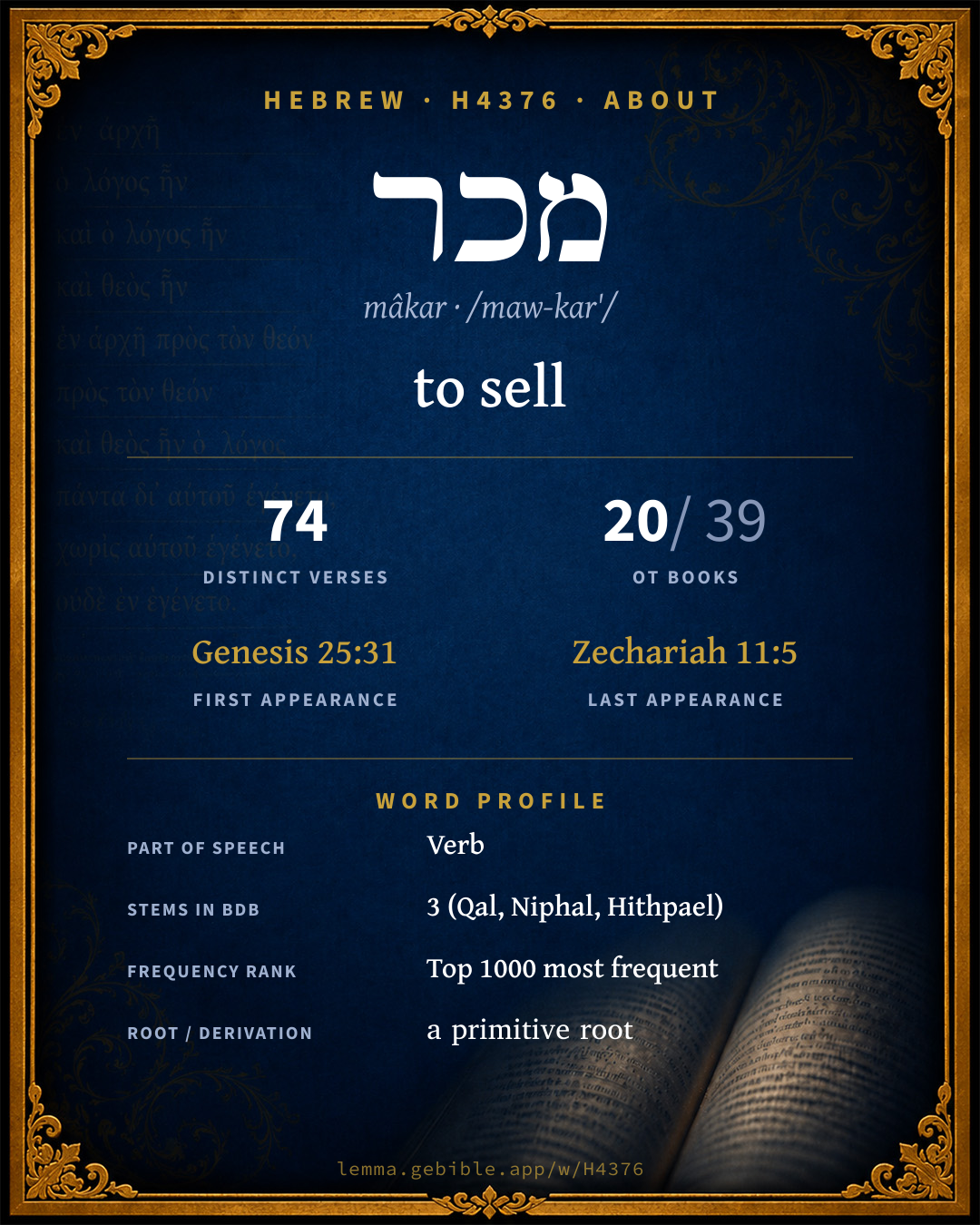
מָכַר
to sell
‘to sell’ is one of 2 main senses fuller range ↓
Full lexicon entry — Brown-Driver-Briggs (BDB)
From Brown-Driver-Briggs (BDB)
Where this word appears
See every Qal verb in the Hebrew Bible →
Grammar key — what these labels mean
Part of speech
- Verb
- An action or state-of-being word.
Stem
- Niphal
- Usually the simple passive or reflexive of the Qal (“he was written”).
- Qal
- The basic, simple active stem — the plain form of the verb (“he wrote”).
- Hithpael
- The reflexive or reciprocal stem (the subject acts on itself).
Form
- Sequential Perfect
- A perfect with prefixed waw continuing a preceding imperfect or command (waw-consecutive perfect).
- Sequential Imperfect
- An imperfect with prefixed waw — the standard past-narrative form (waw-consecutive imperfect).
- Imperfect
- An incomplete, ongoing, or future action (“he will / would write”).
- Perfect
- A completed action or state — Hebrew marks aspect (completeness) more than strict tense (“he wrote”).
- Infinitive Construct
- A bound verbal noun, frequently with prepositions (“to write / in writing”).
- Participle Active
- A verbal adjective expressing ongoing or characteristic action (“writing / one who writes”).
- Infinitive Absolute
- An unbound verbal noun, often intensifying or standing in for a finite verb.
- Cohortative
- A first-person volitional form expressing wish or resolve (“let me / let us write”).
- Participle Passive
- A verbal adjective expressing action received (“written”).
- Jussive
- A third- or second-person volitional form expressing wish or command (“let him write”).
- Imperative
- A direct command (“write!”).
State
- Absolute
- The independent form of a noun, not bound to a following word.
- Construct
- A noun bound to a following noun in a possessive / “of” relationship (the construct chain).
Person
- 3rd Person
- The one spoken about (“he / she / it / they”).
- 2nd Person
- The one addressed (“you”).
- 1st Person
- The speaker (“I / we”).
Gender
- Masculine
- Grammatically masculine.
- Common
- Either gender — not distinguished for this form.
- Feminine
- Grammatically feminine.
Number
- Singular
- One.
- Plural
- More than one (in Hebrew, generally three or more).
Grammatical forms 39 distinct
- Verb, Qal, Sequential Imperfect, 3rd Person, Masculine, Singular 6 times (8%)
- Verb, Qal, Perfect, 3rd Person, Masculine, Singular 5 times (6%)
- Verb, Niphal, Sequential Perfect, 3rd Person, Masculine, Singular 4 times (5%)
- Verb, Niphal, Imperfect, 3rd Person, Masculine, Singular 4 times (5%)
- Verb, Qal, Imperfect, 3rd Person, Masculine, Singular 4 times (5%)
- Verb, Qal, Perfect, 2nd Person, Masculine, Plural 4 times (5%)
- Verb, Qal, Perfect, 3rd Person, Common, Plural 4 times (5%)
- Verb, Qal, Infinitive Construct 4 times (5%)
+31 more forms (45 occurrences)
Parsed forms decoded from the imported morphology (morphhb / Westminster Leningrad Codex — WLC text public domain, morphhb tagging CC BY 4.0), counted across 80 parsed occurrences — not distinct verses.
Every verse where H4376 appears — 74 distinct verses across 20 books. Click any verse to open its interlinear word-by-word view. Verse text shown in the World English Bible for context — . Each verse’s Hebrew form is shown with its reference; the English is not keyword-highlighted, since the data carries no word-level English alignment. Use “Compare translations” on any verse to read it across multiple English versions. This concordance covers the Hebrew Bible; Septuagint (Greek Old Testament) occurrences are not indexed here.
Genesis 10 verses
- Genesis 25:31 מִכְרָ֥/ה Qal impv 2ms + sfx h Jacob said, "First, sell me your birthright."
- Genesis 25:33 וַ/יִּמְכֹּ֥ר conj + Qal wimpf 3ms Jacob said, "Swear to me first." He swore to him. He sold his birthright to Jacob.
- Genesis 31:15 מְכָרָ֑/נוּ Qal pf 3ms + sfx pers 1cp Aren't we accounted by him as foreigners? For he has sold us, and has also quite devoured our money.
- Genesis 37:27 וְ/נִמְכְּרֶ֣/נּוּ conj + Qal coh 1cp + sfx pers 3ms Come, and let's sell him to the Ishmaelites, and not let our hand be on him; for he is our brother, our flesh." His brothers listened to him.
- Genesis 37:28 וַ/יִּמְכְּר֧וּ conj + Qal wimpf 3mp Midianites who were merchants passed by, and they drew and lifted up Joseph out of the pit, and sold Joseph to the Ishmaelites for twenty pieces of silver. They brought Joseph into Egypt.
- Genesis 37:36 מָכְר֥וּ Qal pf 3cp The Midianites sold him into Egypt to Potiphar, an officer of Pharaoh's, the captain of the guard.
- Genesis 45:4 מְכַרְתֶּ֥ם Qal pf 2mp Joseph said to his brothers, "Come near to me, please." They came near. "He said, I am Joseph, your brother, whom you sold into Egypt.
- Genesis 45:5 מְכַרְתֶּ֥ם Qal pf 2mp Now don't be grieved, nor angry with yourselves, that you sold me here, for God sent me before you to preserve life.
- Genesis 47:20 מָכְר֤וּ Qal pf 3cp So Joseph bought all the land of Egypt for Pharaoh, for the Egyptians sold every man his field, because the famine was severe on them, and the land became Pharaoh's.
- Genesis 47:22 מָכְר֖וּ Qal pf 3cp Only he didn't buy the land of the priests, for the priests had a portion from Pharaoh, and ate their portion which Pharaoh gave them. That is why they didn't sell their land.
Exodus 6 verses
- Exodus 21:7 יִמְכֹּ֥ר Qal impf 3ms "If a man sells his daughter to be a maid-servant, she shall not go out as the men-servants do.
- Exodus 21:8 לְ/מָכְרָ֖/הּ prep + Qal inf.cs + sfx pers 3fs If she doesn't please her master, who has married her to himself, then he shall let her be redeemed. He shall have no right to sell her to a foreign people, seeing he has dealt deceitfully with her.
- Exodus 21:16 וּ/מְכָר֛/וֹ conj + Qal wpf 3ms + sfx pers 3ms "Anyone who kidnaps someone and sells him, or if he is found in his hand, he shall surely be put to death.
- Exodus 21:35 וּ/מָ֨כְר֜וּ conj + Qal wpf 3cp "If one man's bull injures another's, so that it dies, then they shall sell the live bull, and divide its price; and they shall also divide the dead animal.
- Exodus 22:1 מְכָר֑/וֹ Qal pf 3ms + sfx pers 3ms "If a man steals an ox or a sheep, and kills it, or sells it; he shall pay five oxen for an ox, and four sheep for a sheep.
- Exodus 22:3 וְ/נִמְכַּ֖ר conj + Niphal wpf 3ms If the sun has risen on him, there shall be guilt of bloodshed for him; he shall make restitution. If he has nothing, then he shall be sold for his theft.
Leviticus 16 verses
- Leviticus 25:14 תִמְכְּר֤וּ Qal impf 2mp "'If you sell anything to your neighbor, or buy from your neighbor, you shall not wrong one another.
- Leviticus 25:15 יִמְכָּר Qal impf 3ms According to the number of years after the Jubilee you shall buy from your neighbor. According to the number of years of the crops he shall sell to you.
- Leviticus 25:16 מֹכֵ֖ר Qal ptcp.act ms According to the length of the years you shall increase the price of it, and according to the shortness of the years you shall diminish the price of it; for he is selling the number of the crops to you.
- Leviticus 25:23 תִמָּכֵר֙ Niphal impf 3fs "'The land shall not be sold in perpetuity, for the land is mine; for you are strangers and live as foreigners with me.
- Leviticus 25:25 וּ/מָכַ֖ר conj + Qal wpf 3ms "'If your brother becomes poor, and sells some of his possessions, then his kinsman who is next to him shall come, and redeem that which his brother has sold.
- Leviticus 25:27 מָֽכַר Qal pf 3ms then let him reckon the years since the sale of it, and restore the surplus to the man to whom he sold it; and he shall return to his property.
- Leviticus 25:29 יִמְכֹּ֤ר Qal impf 3ms "'If a man sells a dwelling house in a walled city, then he may redeem it within a whole year after it has been sold. For a full year he shall have the right of redemption.
- Leviticus 25:34 יִמָּכֵ֑ר Niphal impf 3ms But the field of the suburbs of their cities may not be sold; for it is their perpetual possession.
- Leviticus 25:39 וְ/נִמְכַּר conj + Niphal wpf 3ms "'If your brother has grown poor among you, and sells himself to you; you shall not make him to serve as a slave.
- Leviticus 25:42 יִמָּכְר֖וּ Niphal impf 3mp For they are my servants, whom I brought forth out of the land of Egypt. They shall not be sold as slaves.
- Leviticus 25:47 וְ/נִמְכַּ֗ר conj + Niphal wpf 3ms "'If a stranger or sojourner with you becomes rich, and your brother beside him has grown poor, and sells himself to the stranger or foreigner living among you, or to a member of the stranger's family;
- Leviticus 25:48 נִמְכַּ֔ר Niphal pf 3ms after he is sold he may be redeemed. One of his brothers may redeem him;
- Leviticus 25:50 הִמָּ֣כְר/וֹ Niphal inf.cs + sfx pers 3ms He shall reckon with him who bought him from the year that he sold himself to him to the Year of Jubilee: and the price of his sale shall be according to the number of years; according to the time of a hired servant shall he be with him.
- Leviticus 27:20 מָכַ֥ר Qal pf 3ms If he will not redeem the field, or if he has sold the field to another man, it shall not be redeemed any more;
- Leviticus 27:27 וְ/נִמְכַּ֥ר conj + Niphal wpf 3ms If it is an unclean animal, then he shall buy it back according to your valuation, and shall add to it the fifth part of it: or if it isn't redeemed, then it shall be sold according to your valuation.
- Leviticus 27:28 יִמָּכֵ֖ר Niphal impf 3ms "'Notwithstanding, no devoted thing, that a man shall devote to Yahweh of all that he has, whether of man or animal, or of the field of his possession, shall be sold or redeemed: every devoted thing is most holy to Yahweh.
Deuteronomy 6 verses
- Deuteronomy 14:21 מָכֹר֙ Qal inf.abs You shall not eat of anything that dies of itself: you may give it to the foreigner living among you who is within your gates, that he may eat it; or you may sell it to a foreigner: for you are a holy people to Yahweh your God. You shall not boil a kid in its mother's milk.
- Deuteronomy 15:12 יִמָּכֵ֨ר Niphal impf 3ms If your brother, a Hebrew man, or a Hebrew woman, be sold to you, and serve you six years; then in the seventh year you shall let him go free from you.
- Deuteronomy 21:14 וּ/מָכֹ֥ר תִמְכְּרֶ֖/נָּה conj + Qal inf.abs Qal impf 2ms + sfx pers 3fs It shall be, if you have no delight in her, then you shall let her go where she will; but you shall not sell her at all for money, you shall not deal with her as a slave, because you have humbled her.
- Deuteronomy 24:7 וּ/מְכָר֑/וֹ conj + Qal wpf 3ms + sfx pers 3ms If a man be found stealing any of his brothers of the children of Israel, and he deal with him as a slave, or sell him; then that thief shall die: so shall you put away the evil from the midst of you.
- Deuteronomy 28:68 וְ/הִתְמַכַּרְתֶּ֨ם conj + Hithpael wpf 2mp Yahweh will bring you into Egypt again with ships, by the way of which I said to you, You shall see it no more again: and there you shall sell yourselves to your enemies for bondservants and for bondmaids, and no man shall buy you.
- Deuteronomy 32:30 מְכָרָ֔/ם Qal pf 3ms + sfx pers 3mp How should one chase a thousand, Two put ten thousand to flight, Except their Rock had sold them, Yahweh had delivered them up?
Judges 5 verses
- Judges 2:14 וַֽ/יִּמְכְּרֵ֞/ם conj + Qal wimpf 3ms + sfx pers 3mp The anger of Yahweh was kindled against Israel, and he delivered them into the hands of spoilers who despoiled them; and he sold them into the hands of their enemies round about, so that they could not any longer stand before their enemies.
- Judges 3:8 וַֽ/יִּמְכְּרֵ֗/ם conj + Qal wimpf 3ms + sfx pers 3mp Therefore the anger of Yahweh was kindled against Israel, and he sold them into the hand of Cushan Rishathaim king of Mesopotamia: and the children of Israel served Cushan Rishathaim eight years.
- Judges 4:2 וַ/יִּמְכְּרֵ֣/ם conj + Qal wimpf 3ms + sfx pers 3mp Yahweh sold them into the hand of Jabin king of Canaan, who reigned in Hazor; the captain of whose host was Sisera, who lived in Harosheth of the Gentiles.
- Judges 4:9 יִמְכֹּ֥ר Qal impf 3ms She said, I will surely go with you: notwithstanding, the journey that you take shall not be for your honor; for Yahweh will sell Sisera into the hand of a woman. Deborah arose, and went with Barak to Kedesh.
- Judges 10:7 וַֽ/יִּמְכְּרֵ/ם֙ conj + Qal wimpf 3ms + sfx pers 3mp The anger of Yahweh was kindled against Israel, and he sold them into the hand of the Philistines, and into the hand of the children of Ammon.
Ruth 1 verse
1 Samuel 1 verse
1 Kings 2 verses
- 1 Kings 21:20 הִתְמַכֶּרְ/ךָ֔ Hithpael inf.cs + sfx pers 2ms Ahab said to Elijah, Have you found me, my enemy? He answered, I have found you, because you have sold yourself to do that which is evil in the sight of Yahweh.
- 1 Kings 21:25 הִתְמַכֵּ֔ר Hithpael pf 3ms (But there was none like Ahab, who did sell himself to do that which was evil in the sight of Yahweh, whom Jezebel his wife stirred up.
2 Kings 2 verses
- 2 Kings 4:7 מִכְרִ֣י Qal impv 2fs Then she came and told the man of God. He said, Go, sell the oil, and pay your debt, and live you and your sons of the rest.
- 2 Kings 17:17 וַ/יִּֽתְמַכְּר֗וּ conj + Hithpael wimpf 3mp They caused their sons and their daughters to pass through the fire, and used divination and enchantments, and sold themselves to do that which was evil in the sight of Yahweh, to provoke him to anger.
Nehemiah 5 verses
- Nehemiah 5:8 הַ/נִּמְכָּרִ֤ים תִּמְכְּר֥וּ וְ/נִמְכְּרוּ ptcl def.art + Niphal ptcp.pass mp Qal impf 2mp conj + Niphal wpf 3cp I said to them, We after our ability have redeemed our brothers the Jews, that were sold to the nations; and would you even sell your brothers, and should they be sold to us? Then held they their peace, and found never a word.
- Nehemiah 10:31 לִ/מְכּ֔וֹר prep + Qal inf.cs and if the peoples of the land bring wares or any grain on the Sabbath day to sell, that we would not buy of them on the Sabbath, or on a holy day; and that we would forego the seventh year, and the exaction of every debt.
- Nehemiah 13:15 מִכְרָ֥/ם Qal inf.cs + sfx pers 3mp In those days saw I in Judah some men treading wine-presses on the Sabbath, and bringing in sheaves, and lading donkeys [therewith]; as also wine, grapes, and figs, and all manner of burdens, which they brought into Jerusalem on the Sabbath day: and I testified [against them] in the day in which they sold food.
- Nehemiah 13:16 וּ/מֹכְרִ֧ים conj + Qal ptcp.act mp There lived men of Tyre also therein, who brought in fish, and all manner of wares, and sold on the Sabbath to the children of Judah, and in Jerusalem.
- Nehemiah 13:20 וּ/מֹכְרֵ֧י conj + Qal ptcp.act mp cs So the merchants and sellers of all kind of wares lodged outside of Jerusalem once or twice.
Esther 1 verse
Psalms 2 verses
Proverbs 2 verses
Isaiah 3 verses
- Isaiah 24:2 כַּ/מּוֹכֵ֔ר prep det + Qal ptcp.act ms It shall be, as with the people, so with the priest; as with the servant, so with his master; as with the maid, so with her mistress; as with the buyer, so with the seller; as with the creditor, so with the debtor; as with the taker of interest, so with the giver of interest to him.
- Isaiah 50:1 מָכַ֥רְתִּי נִמְכַּרְתֶּ֔ם Qal pf 1cs Niphal pf 2mp Thus says Yahweh, Where is the bill of your mother's divorce, with which I have put her away? or which of my creditors is it to whom I have sold you? Behold, for your iniquities were you sold, and for your transgressions was your mother put away.
- Isaiah 52:3 נִמְכַּרְתֶּ֑ם Niphal pf 2mp For thus says Yahweh, You were sold for nothing; and you shall be redeemed without money.
Jeremiah 1 verse
Ezekiel 4 verses
- Ezekiel 7:12 וְ/הַ/מּוֹכֵ֖ר conj + ptcl def.art + Qal ptcp.act ms The time is come, the day draws near: don't let the buyer rejoice, nor the seller mourn; for wrath is on all the multitude of it.
- Ezekiel 7:13 הַ/מּוֹכֵ֗ר ptcl def.art + Qal ptcp.act ms For the seller shall not return to that which is sold, although they be yet alive: for the vision is touching the whole multitude of it, none shall return; neither shall any strengthen himself in the iniquity of his life.
- Ezekiel 30:12 וּ/מָכַרְתִּ֥י conj + Qal wpf 1cs I will make the rivers dry, and will sell the land into the hand of evil men; and I will make the land desolate, and all that is therein, by the hand of strangers: I, Yahweh, have spoken it.
- Ezekiel 48:14 יִמְכְּר֣וּ Qal impf 3mp They shall sell none of it, nor exchange it, nor shall the first fruits of the land be alienated; for it is holy to Yahweh.
Joel 4 verses
- Joel 3:3 מָכְר֥וּ Qal pf 3cp And have cast lots for my people, And have given a boy for a prostitute, And sold a girl for wine, that they may drink.
- Joel 3:6 מְכַרְתֶּ֖ם Qal pf 2mp And have sold the children of Judah and the children of Jerusalem to the sons of the Greeks, That you may remove them far from their border.
- Joel 3:7 מְכַרְתֶּ֥ם Qal pf 2mp Behold, I will stir them up out of the place where you have sold them, And will return your repayment on your own head;
- Joel 3:8 וּ/מָכַרְתִּ֞י וּ/מְכָר֥וּ/ם conj + Qal wpf 1cs conj + Qal wpf 3cp + sfx pers 3mp And I will sell your sons and your daughters into the hands of the children of Judah, And they will sell them to the men of Sheba, To a faraway nation, For Yahweh has spoken it."
Amos 1 verse
Nahum 1 verse
Zechariah 1 verse
About this entry
At a glance — auto-summarized from this page’s data, not written by a person. Every figure links to its source below. This summary describes the numbers; it doesn’t interpret them.
מכר (mâkar) is a Hebrew verb most often rendered “to sell.” Debuting at Genesis 25:31, it then recurs through the corpus. With 74 verses in 20 books, it is a moderately common word in the Hebrew Bible. As a verb its force shifts by stem, across 3 stems (Qal, Niphal, and more). From the same root come מכר, ממכר and מכיר. The sections below give every sense, occurrence, and version rendering.
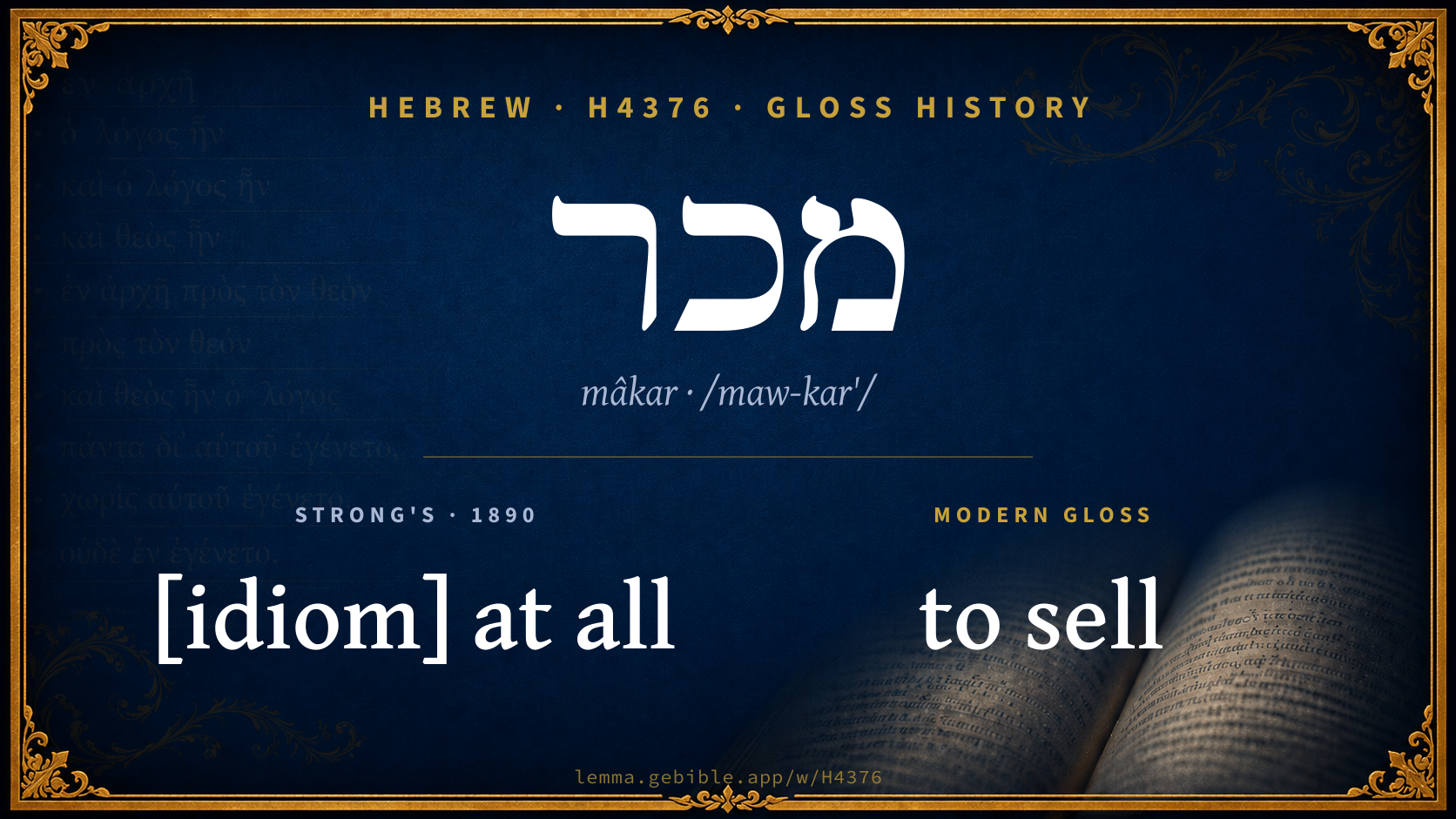
Gloss history
Strong's 1890 vs modern scholarship
About this word
Strong's H4376 catalogs a Hebrew word from the Hebrew Old Testament.
These counts are not copied from any lexicon or concordance. They are computed here, from the morphology-tagged Hebrew Old Testament. What Lemma adds →
- 74
- distinct verses
- The word appears in 74 distinct verses.
- 20 / 39
- OT books
- The word appears in 20 of 39 Old Testament books.
- #501
- by frequency
- Top 1000 most frequent Hebrew words (rank 501 of 8,640 Hebrew words by occurrence).
View all 74 occurrences in the concordance →
By section of the Old Testament
By traditional corpus
Conventional, traditional groupings — biblical authorship is debated, so this is a traditional corpus grouping, not an authorship claim. Each share is this word’s portion of its verses in that division of the Hebrew canon. Each figure is a share of the word’s 74 distinct verses.
- Torah (Pentateuch) 38 verses · 51%
- Prophets (Nevi'im) 25 verses · 34%
- Writings (Ketuvim) 11 verses · 15%
How translations render this word
Counts come from each version’s own published word-to-Strong’s tagging or interlinear alignment — an approximate guide to how each version renders this word, not a word-level alignment the data otherwise carries. Because each total is that version’s own tagged count, the per-version totals vary from one another and need not match the appearance or distinct-verse counts above. These counts may also differ from a printed concordance because Lemma counts each distinctly tagged rendering and does not collapse phrase taggings into a single head-word total. This is a fixed set of word-tagged versions (KJV, ASV, BSB, ULT) and does not change with the reading translation you choose elsewhere. Each version’s license is shown beside its name below (and on Sources).
- King James Version: Sell 9×, Sold 7×, He sold 6×
- American Standard Version: Sell 7×, Sold 7×, He sold 5×
- Berean Standard Bible: Sell 7×, Sold 6×, Sells 4×
- unfoldingWord Literal Text: Sell 6×, Be sold 4×, Shall 4×
King James Version Public Domain
Renders H4376 across 80 tagged occurrences — most commonly:
Plus 41 renderings that appear only once — usually multi-word phrases or single function words the recovered tagging swept in, not distinct renderings.
American Standard Version Public Domain
Renders H4376 across 80 tagged occurrences — most commonly:
Plus 42 renderings that appear only once — usually multi-word phrases or single function words the recovered tagging swept in, not distinct renderings.
Berean Standard Bible Public Domain
Renders H4376 across 79 tagged occurrences — most commonly:
Plus 39 renderings that appear only once — usually multi-word phrases or single function words the recovered tagging swept in, not distinct renderings. Not rendered by a distinct English word in 1 further occurrence.
unfoldingWord Literal Text CC BY-SA 4.0
Renders H4376 across 91 tagged occurrences — most commonly:
Plus other, less common renderings. Plus 40 renderings that appear only once — usually multi-word phrases or single function words the recovered tagging swept in, not distinct renderings.
Senses in the full BDB
Hebrew verbs can shift meaning by stem (binyan): Qal is the basic action, Niphal is often passive or reflexive, Piel often intensifies or makes it factitive, and Hiphil is typically causative. The senses below are grouped under the stem BDB assigns to each. This entry also uses Hithpael (reflexive or reciprocal).
What do BDB’s symbols mean?
BDB uses these scholarly abbreviations:
| Symbol | Meaning |
|---|---|
| 𝔊 | the Septuagint (the ancient Greek translation, LXX) |
| 𝔙 | the Vulgate (the Latin translation) |
| 𝔖 | the Syriac version (the Peshitta) |
| 𝔗 | the Targum (the Aramaic translation) |
| ψ | the Psalms |
| √ | root (the underlying root or stem) |
| ‖ | parallel passage (a synonymous or contrasted parallel) |
| † | the dagger: every passage where the word occurs is cited |
The 3 senses and sub-senses the full Brown-Driver-Briggs lexicon distinguishes for this word, in lexicon order (not ranked by frequency), with BDB’s own verbatim wording and sub-sense lettering. Shown in Hebrew script with BDB’s own scholarly abbreviations. The condensed entry is in the Lexicon Entry tab. See also the Forms in the corpus table below.
Qal
- Pf. מ׳ Lv 27:20 + 2 times; sf. מְכָרוֹ Ex 21:37 + 2 times; 1 s. מָכַרְתִּי Is 50:1 + 2 times, etc.; Impf. יִמְכֹּר Ex 21:7 +, etc.; Imv. מִכְרָ֫ה Gn 25:31; fs. מִכְרִי 2 K 4:7; Inf. abs. מָכֹר Dt 14:21; 21:14; cstr. מְכוֹר Ne 10:32; sf. מָכְרָהּ Ex 21:8; מִכְרָם Am 2:6 Ne 13:15 (cf. BaNB 104); Pt. מֹכֵר (מוֹכֵר) Lv 25:16 + 3 times; f. מֹכֶרֶת Na 3:4, etc.;—sell (c. בְּ pret. Am 2:6 Jo 4:3 ψ 44:13) sq. acc. e.g. land Gn 47:20, 22 (J), Lv 25:14 (acc. cogn.), v 25 (H; sq. מֵאֲחֻזָּתוֹ) cf. Ez 48:14 (sq. מִן partit.), Lv 25:15 (no obj. expr.), so v 27; 27:20 (H), Ru 4:3; house Lv 25:29 (H); beast Ex 21:35, 37 (E); flesh Dt 14:21 (no obj.); crop Lv 25:16 (H); food Ne 10:32; 13:15, 16, cf. v 20 (sq. מִמְכָר); oil 2 K 4:7; linen Pr 31:24; birthright Gn 25:31, 33 (J); most often human beings, e.g. as slaves Gn 37:27, 28, 36; 45:4, 5 (all JE), Ex 21:16 (E), Dt 21:14(×2); 24:7, cf. Am 2:6 Ne 5:8 Zc 11:5 Jo 4:3, 6, 7, 8(×2); especially daughters Ex 21:7, 8 (E); in marriage Gn 31:15 (E); Pt. = seller Is 24:2 Ez 7:12, 13; fig., obj. truth Pr 23:23; of Nineveh, selling nations גּוֹיִם Na 3:4; especially י׳ selling his people (to enemies), i.e. giving it entirely into their power: Dt 32:30 ψ 44:13 Is 50:1, also (מ׳ בְּיַד) Ju 2:14; 3:8; 4:2; 10:7; 1 S 12:9; cf. Ju 4:9 (Sisera to woman); also Ez 30:12 (del. Co after B al.) e.g. Leviticus 27:20
Niphal
- Pf. נִמְכַּר Lv 25:48 + 5 times, etc.; Impf. יִמָּכֵר Lv 25:34 + 3 times, etc.; Inf. הִמָּֽכְרוֹ Lv 25:20; Pt. pl. נִמְכָּרִים Ne 5:8;—be sold, of land Lv 25:23, 34; beast Lv 27:27; cf. v 28 (all P); of human beings as slaves Ex 22:2; for (בְּ) theft (E), Lv 25:42 (P), ψ 105:17 Est 7:4; sell oneself Lv 25:39, 47, 48, 50 (PH), Dt 15:12 Je 34:14 Ne 5:8(×2); fig. of Isr., sold by י׳, Is 50:1 for (בְּ) their sins, 52:3; cf. Est 7:4 = given over to death. e.g. Leviticus 25:48
Hithpael
- Pf. הִתְמַכֵּר 1 K 21:25; וְהִתְמַכַּרְתֶּם consec. Dt. 28:68; וַיִּתְמַכְּרוּ 2 K 17:17; Inf. הִתְמַכֶּרְךָ 1 K 21:20; sell oneself as slave Dt 28:68; fig. 1 K 21:20, 25 2 K 17:17, all sq. לַעֲשׂוֹת הָרַע. e.g. 1 Kings 21:25
Senses from the full Brown-Driver-Briggs lexicon (Brown, Driver, Briggs; Oxford 1906 — public domain), digitized via Sefaria, supplemented by the OpenScriptures HebrewLexicon (CC BY 4.0). Full attribution on Sources.
Word origin
vb. sell (NH id.; Ph. מכר; Zinj. מכרו price, DHMSendsch. 60; Aramaic ܡܟܰܪ, מְכַר marry (i.e. buy as a wife); cf. Assyrian makkûru, namkur(r)u, nakkuru, possession, property, DlHWB 408);—
— Brown-Driver-Briggs (Oxford 1906, public domain), digitized via Sefaria, supplemented by the OpenScriptures HebrewLexicon (CC BY 4.0). See Sources.
Origin: a primitive root
Jastrow Dictionary
A second Hebrew/Aramaic lexicon for comparison, covering Aramaic and post-biblical (Talmudic, Targumic, Midrashic) usage that the biblical-Hebrew BDB does not. Matched by lemma rather than by Strong’s number, so a lemma may carry more than one Jastrow headword (shown separately below), and the entries cover usage well beyond the Bible.
מָכַר
- to sell. Sifré Deut. 169 (ref. to Deut. XVIII, 8) מה מָכְרוּ וכ׳ what have the fathers sold to one another? (Answ. the weekly turns); Succ. 56ᵃ; Y. ib. V, end, 55ᵈ. B. Bath. 64ᵇ, a. fr. מוֹכֵר בעין יפה מוכר the seller is presumed to sell liberally, i.e. to sell all except that which is specified as excluded; מ׳ בעיין רעה מ׳ he sells only that which is specified as sold. Ib. IV, 1 …המוכר … לא מ׳ וכ׳ if one sells …, he has not implicitly sold &c. Sot. III, 8 אין האשה מוֹכֶרֶת וכ׳ a woman cannot sell her daughter; a. v. fr.—Part. pass. מָכוּר; f. מְכוּרָה; pl. מְכוּרִים מְכוּרִין; מְכוּרוֹת. Tosef. Ab. Zar. III (IV), 18 הרי זה מ׳ he is sold (the sale is valid). B. Bath. IV, 3. Tosef. B. Kam. VII, 8 חביות המ׳ וכ׳ wine casks which have been sold to the shopkeeper (awaiting delivery); a. v. fr. e.g. Deuteronomy 18:8
- to be sold. Sot. l. c. האיש נ׳ … נִמְכֶּרֶת a man can be sold for his theft, but a woman cannot &c. Mekh. Mishp. s. 2; a. fr.
*מְכַר
- , Ithpa. אִתְמַכַּר (denom. of מַכָּר) to be made acquainted. Targ. Prov. XIX, 14 Var. ed. Lag. (ed. מתמסרא, v. מְסַר).
מֶכֶר
- sale. Kidd. 6ᵇ במ׳ לא קנה if the transaction is a sale (of land), he has not acquired possession (by delivering the purchasing money as a loan). Ib. 47ᵃ ושוין במ׳ and they agree in the case of a sale. Keth. XI, 4 מִכְרָהּ בטל her sale is invalid; a. fr.—V. מִמְכָּר.
מַכָּר
- acquaintance, friend. Y. Gitt. III, 45ᵃ ויש מ׳ לעני has the poor man a friend?, i.e., is he who separates the poor man’s tithes permitted to reserve them for a certain person?—Pl. מַכָּרִים, constr. מַכָּרֵי. Ib. במ׳ כהונה וכ׳ the Mishnah speaks of friends of priests or Levites (to whom the owner is in the habit of giving the priestly shares); Bab. Gitt. 30ᵃ. Ib. במ׳ לא קתני (sub. כהונה) the Mishnah does not distinctly speak of friends. Ḥull. 133ᵃ; a. fr.
A Dictionary of the Targumim, the Talmud Babli and Yerushalmi, and the Midrashic Literature (Marcus Jastrow; London, Luzac, 1903) — Public Domain. Digitized via Sefaria. Digitized via Sefaria. Full attribution on Sources.
Forms in the corpus
The 75 distinct written forms H4376 takes in the Hebrew Bible, most frequent first — each parse links to that stem’s occurrences in the concordance. Hebrew forms include their vowel points and cantillation, so a single lemma takes many written forms.
The 60 most common forms are shown; 15 rarer forms follow in the full concordance.
Same root — word family
Other BDB entries built from the same root as H4376, grouped by Strong’s listed origin. These share a root / origin per the lexicon — not necessarily a shared meaning. Each links to that word’s own entry.
Derived from this word
Proper names from this root
People and places named from this root — a name, not an additional meaning of the word.
Compare all same-root words → Showing 4 of 5 — not the complete family. 2 of the same-root words are proper names (people or places). They share a root, not necessarily a meaning.
Septuagint verse parallels
This word appears in 65 verses that also exist in the Greek Old Testament (Septuagint), out of the 74 Hebrew verses it occurs in. You can read those verses in Greek by switching the Old Testament edition to the Septuagint.
Read these verses in the Septuagint
- Genesis 25:31
- Exodus 21:7
- Leviticus 25:14
- Deuteronomy 14:21
- Judges 2:14
- Ruth 4:3
- 1 Samuel 12:9
- 1 Kings 21:20
- 2 Kings 4:7
- Esther 7:4
- Psalms 44:12
- Proverbs 31:24
This is a verse-level parallel only — the same verses exist in both the Hebrew and Greek Old Testaments. No word-level Hebrew↔Greek correspondence is claimed: the data carries no such alignment, so no Greek word is shown as this Hebrew word’s translation. Coverage is not total — the Septuagint omits the deuterocanon and renumbers the Psalms, so some Hebrew verses have no direct Greek parallel.