
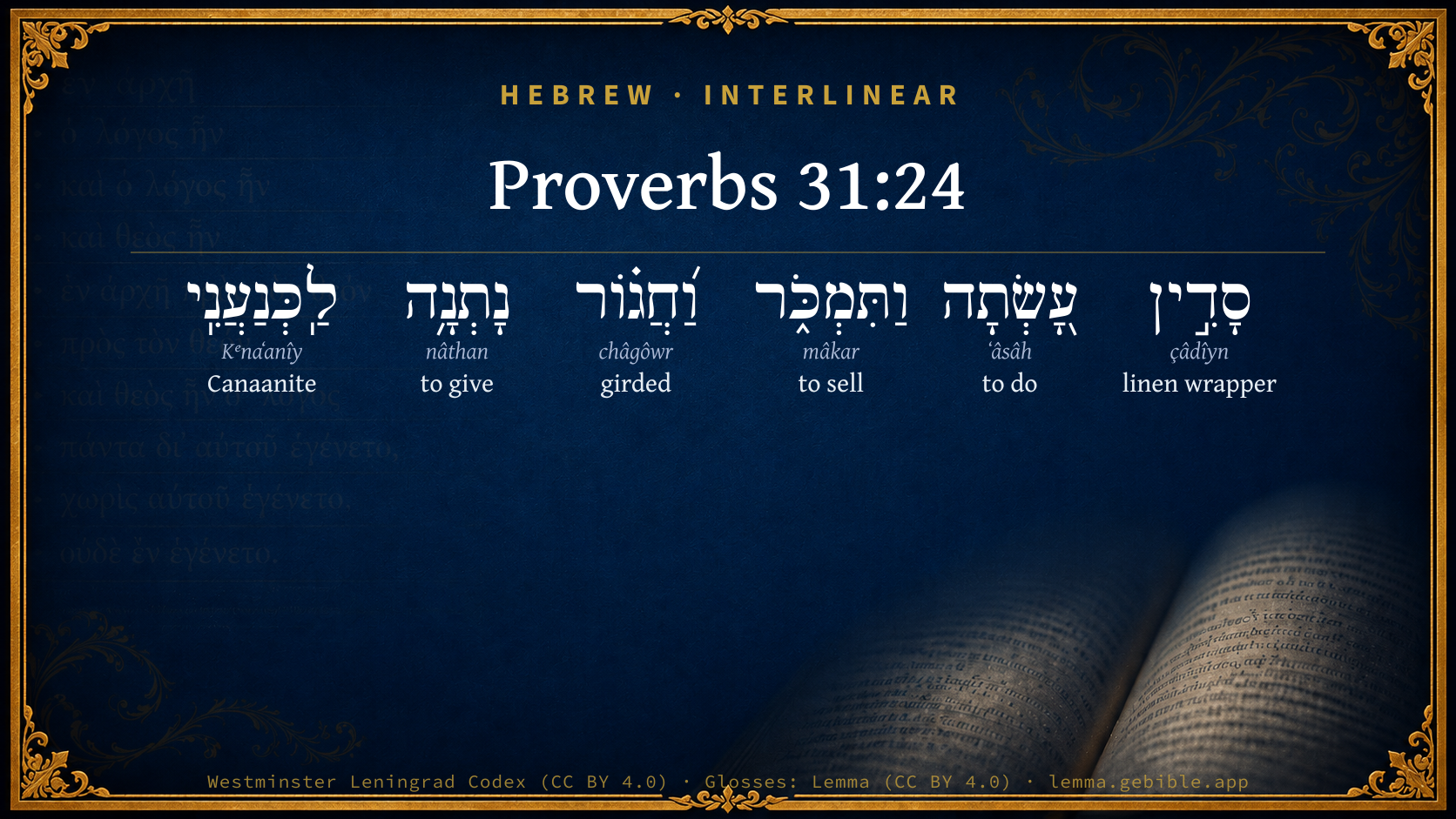
Proverbs 31:24

Hebrew (Westminster Leningrad Codex) Proverbs 31:24 appears in the Hebrew Old Testament. The text above is from the Westminster Leningrad Codex. Each word links to its Strong’s number, a concise gloss, and parsing drawn from the Open Scriptures Hebrew Bible morphology. Click any word for its full Brown-Driver-Briggs (BDB) entry.
Download image
Cite this verse

Proverbs 31:24 (World English Bible). Public Domain. Lemma interlinear Bible study tool, https://lemma.gebible.app/v/proverbs/31/24.

Show BibTeX & RIS
BibTeX
RIS
English Translation
She makes linen garments and sells them, And delivers sashes to the merchant.
World English Bible · Public Domain
Highlights Full analysis ↓
Download a study sheet

One document with this verse’s original text, its word-by-word gloss line, the meaning frame, cross-references with their text, attributed commentary, and full source and license credits — printable, and it pastes into notes with its structure intact.

This verse Autodidact and up

Study sheet (.html) Plain text (.txt)

A passage Seminary Student

Up to 50 verses in one chapter. A passage sheet keeps up to 6 commentary sources and 12 cross-references per verse, in the order this page ranks them, and says so on the sheet whenever that leaves anything out. Ask for a single verse and you get the Autodidact verse sheet above.

Everything on this page stays free to read, with no account — the sheet is a download of what is already on screen, not access to it.

Want to remove ads? Support Godless Engineer
Compare translations 3

The same verse in 3 English versions, stacked beneath the original-language interlinear above. Click any original word for its lexicon entry.

Each is an independent rendering of the whole verse — the interlinear is not word-aligned to these translations.

Highlighted words mark where these versions differ — a whole-verse word diff, not a word-by-word alignment.

  • World English Bible Public Domain
    She makes linen garments and sells them, And delivers sashes to the merchant.
  • King James Version Public Domain
    She maketh fine linen, and selleth it; and delivereth girdles unto the merchant.
  • unfoldingWord Literal Text CC BY-SA 4.0
    She makes a linen garment and sells, and a belt she gives to the Canaanite.

unfoldingWord Literal Text — © unfoldingWord, licensed CC BY-SA 4.0. Word-aligned USFM3 via Door43 (git.door43.org/unfoldingWord/en_ult).

Versions to compare (up to 4)

3 of 4 selected

Show all 18 translations

Every available English version of this verse, each an independent rendering of the whole verse.

  • World English Bible Public Domain
    She makes linen garments and sells them, And delivers sashes to the merchant.
  • Berean Standard Bible Public Domain
    She makes linen garments and sells them; she delivers sashes to the merchants.
  • Majority Standard Bible Public Domain
    She makes linen garments and sells them; she delivers sashes to the merchants.
  • King James Version Public Domain
    She maketh fine linen, and selleth it; and delivereth girdles unto the merchant.
  • American Standard Version (1901) Public Domain
    She maketh linen garments and selleth them, And delivereth girdles unto the merchant.
  • Revised Version (1885) Public Domain
    She maketh linen garments and selleth them; and delivereth girdles unto the merchant.
  • Geneva Bible (1599) Public Domain
    She maketh sheetes, and selleth them, and giueth girdels vnto the marchant.
  • Douay-Rheims (1899) Public Domain
    She made fine linen, and sold it, end delivered a girdle to the Chanaanite.
  • Young's Literal Translation Public Domain
    Linen garments she hath made, and selleth, And a girdle she hath given to the merchant.
  • Literal Standard Version CC BY-SA 4.0
    She has made linen garments, and sells, || And she has given a girdle to the merchant.
  • Unlocked Literal Bible CC BY-SA 4.0
    She makes linen garments and sells them, and she supplies sashes to the merchants.
  • unfoldingWord Literal Text CC BY-SA 4.0
    She makes a linen garment and sells, and a belt she gives to the Canaanite.
  • Darby Bible Public Domain
    She maketh body linen and selleth it, and delivereth girdles unto the merchant.
  • World Messianic Bible Public Domain
    She makes linen garments and sells them, and delivers sashes to the merchant.
  • Webster's Bible Public Domain
    She maketh fine linen, and selleth it; and delivereth girdles to the merchant.
  • Free Bible Version CC BY-SA 4.0
    She makes linen clothes for sale, and supplies merchants with belts.
  • Bible in Basic English Public Domain
    She makes linen robes and gets a price for them, and traders take her cloth bands for a price.
  • JPS Tanakh (1917) Public Domain
    She maketh linen garments and selleth them; and delivereth girdles unto the merchant.

Literal Standard Version (2020), Covenant Press — licensed CC BY-SA 4.0. Text via the HelloAO Bible API (eBible.org). Unlocked Literal Bible (unfoldingWord) — licensed CC BY-SA 4.0. Text via the HelloAO Bible API (eBible.org). unfoldingWord Literal Text — © unfoldingWord, licensed CC BY-SA 4.0. Word-aligned USFM3 via Door43 (git.door43.org/unfoldingWord/en_ult). Free Bible Version, Dr. Jonathan Gallagher — licensed CC BY-SA 4.0. Text via the HelloAO Bible API (eBible.org).

Word by word

More ways to search: Search by grammar → Find every occurrence → Compare this word →

Practice this passage: Drill this verse → Learn its vocabulary →

About this verse

These counts appear in no published source. They are computed here, from the morphology-tagged text and Lemma’s own curated glosses. What Lemma adds →

6
words
6
distinct lemmas
Wisdom
section

Notable vocabulary

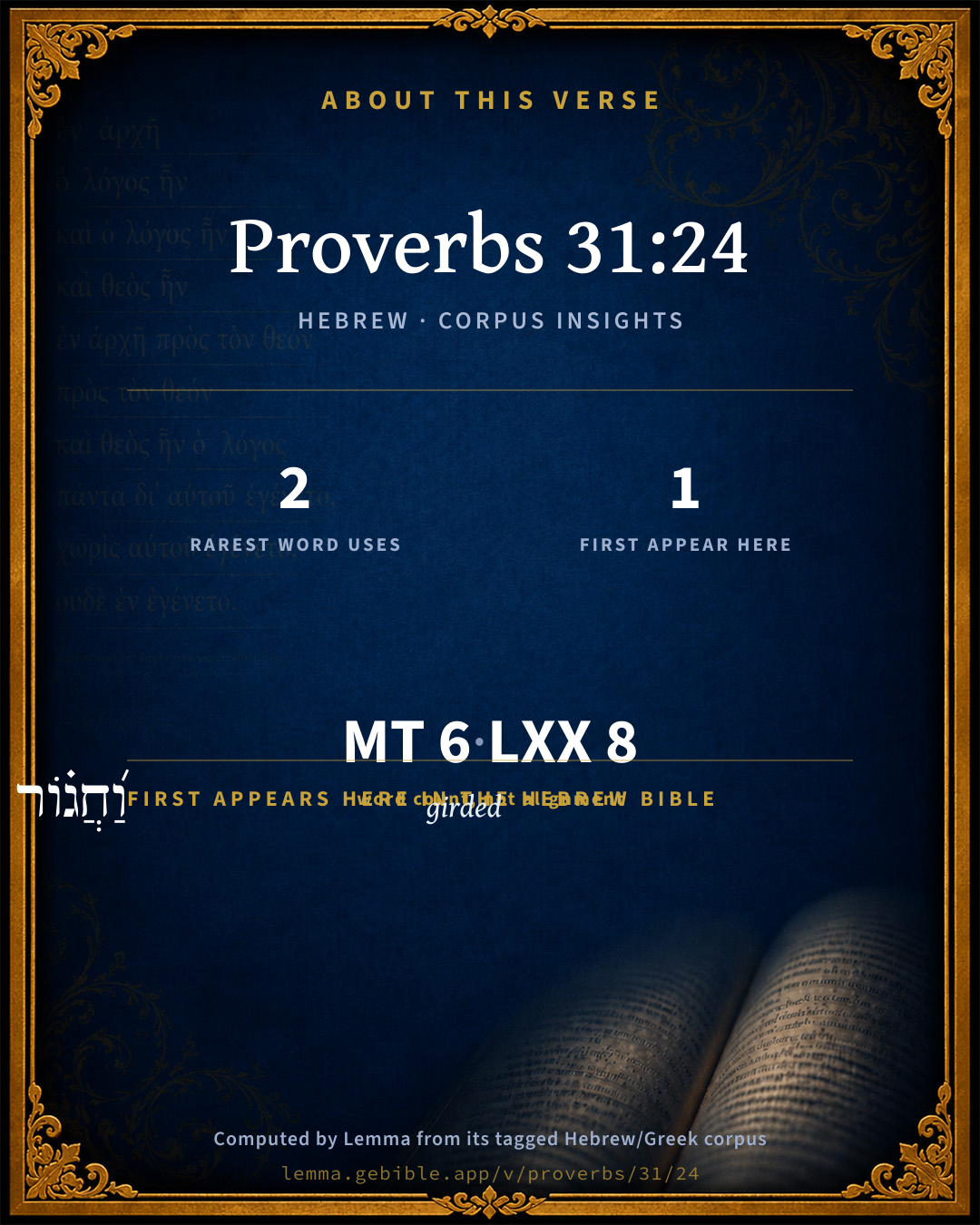
The rarest word here is וַ֝חֲג֗וֹר girded H2289 — appearing just 2 times in the whole Hebrew Bible.

First appearance in Scripture

This word makes its first canonical appearance in the Hebrew Bible here:

  • וַ֝חֲג֗וֹר girded H2289

Shared distinctive vocabulary

וַ֝חֲג֗וֹר girded H2289 occurs in 2 verses of the Hebrew Bible. Also found in:

Grammatical profile

  • 3 verbs
  • 3 nouns

Verb forms

  • עָ֭שְׂתָה Qal · Perfect
  • וַתִּמְכֹּ֑ר Qal · Sequential Imperfect
  • נָתְנָ֥ה Qal · Perfect

Hebrew & Septuagint length

In English translation the verse runs 13 words from the Hebrew and 22 from the Septuagint (LXX English) — the Septuagint runs noticeably longer here. See the side-by-side →

A rough comparison of the two English renderings, which tokenize alike — not a word-level alignment.

Word counts can differ between the Hebrew and the Greek without any difference in meaning — e.g. the Hebrew direct-object marker אֵת has no separate Greek word, and Greek often adds the article ὁ.

In the original languages it is 6 Hebrew tokens and 8 Greek tokens — but the two are counted differently (Hebrew bundles its prefixes and suffixes into one token; the Greek is in lemma form), so that isn’t a like-for-like length.

Cross-references

6

Topical passages linked to Proverbs 31:24 in the Treasury of Scripture Knowledge — connected by theme and wording, ordered by reader-vote popularity; previews shown in the World English Bible.

  • Ezekiel 27:16 Syria was your merchant by reason of the multitude of your handiworks: they traded for your wares with emeralds, purple, and embroidered work, and fine linen, and coral, and rubies.
  • Luke 16:19 "Now there was a certain rich man, and he was clothed in purple and fine linen, living in luxury every day.
  • Judges 14:12 Samson said to them, Let me now put forth a riddle to you: if you can declare it to me within the seven days of the feast, and find it out, then I will give you thirty linen garments and thirty changes of clothing;
  • 1 Kings 10:28 The horses which Solomon had were brought out of Egypt; and the king's merchants received them in droves, each drove at a price.
  • Proverbs 31:13 She seeks wool and flax, And works eagerly with her hands.
  • Proverbs 31:19 She lays her hands to the distaff, And her hands hold the spindle.

Cross-references courtesy of OpenBible.info (CC BY 4.0).

Hebrew and Greek witnesses Masoretic Hebrew ↔ Greek Septuagint

The same verse in the two great witnesses to the Old Testament, shown verse-for-verse.

Here the Septuagint runs noticeably longer than the Hebrew — LXX2012 (modern English Septuagint) 22 words vs World English Bible 13. A rough length comparison of the two English translations, not a word-level alignment — read both below.

These are two independent witnesses, not word-aligned to each other, and the Septuagint is shown in lemma (dictionary) form.

Hebrew Proverbs 31:24 Masoretic · Westminster Leningrad Codex

סָדִ֣ין עָ֭שְׂתָה וַתִּמְכֹּ֑ר וַ֝חֲג֗וֹר נָתְנָ֥ה לַֽכְּנַעֲנִֽי

She makes linen garments and sells them, And delivers sashes to the merchant.

World English Bible · Public Domain

Greek LXX Proverbs 31:24 Septuagint · lemma form

σινδών ποιέω καί ἀποδίδωμι περίζωμα δέ ὁ χαναναῖος

She makes fine linens, and sells girdles to the Chananites: she opens her mouth heedfully and with propriety, and controls her tongue.

LXX2012 (modern English Septuagint) · Public Domain

On this verse, The Cambridge Bible for Schools and Colleges discusses the Septuagint’s reading. Read the note in Commentary ↓

Hebrew: Westminster Leningrad Codex (CC BY 4.0). Greek: Septuagint (public domain); English from LXX2012 (modern English Septuagint) (Public Domain). How the Septuagint differs from the Hebrew →

Commentary

Notes on Proverbs 31:24 from classic Christian and Jewish commentators (each source and its license shown beneath its notes). The classic Christian expositions comment on the surrounding passage and are grouped to its opening verse, so a note may address several verses; the Jewish commentaries on the Tanakh (Rashi and others) are per-verse, so they appear only where the commentator wrote on this verse.

Lemma curates 59 commentaries, every one of them public domain or Creative Commons licensed, each selected and text-cleaned for this edition rather than reprinted as found. About our sources →

Trapp's Complete Commentary

John Trapp

Pro 31:24 She maketh fine linen, and selleth [it]; and delivereth girdles unto the merchant.

Ver. 24. She maketh fine linen and sells it.] Such sindons as our Saviour’s dead body was wrapt in, and for girdles. {read 2Sa 18:11 Isa 3:24 Jer 2:32} It was anciently no shame for a queen to make gain of her handiwork.

John Trapp, A Commentary or Exposition upon All the Books of the Old and New Testament (1647–1656) — public domain. Text from a community e-Sword module.

Geneva Bible (1599)

Geneva Bible translators

Or, linen cloth.

Geneva Bible (1599) marginal notes — public domain. Text via Bolls.life.

Jamieson, Fausset & Brown

Robert Jamieson, A. R. Fausset & David Brown

fine linen--or, "linen shirts," or the material for them.

girdles--were often costly and highly valued (Sa2 18:11).

delivereth--or, "giveth as a present" or "to sell."

Jamieson, Fausset & Brown — Commentary Critical and Explanatory on the Whole Bible (1871) — public domain (CC PDM 1.0). Text via the HelloAO Bible API.

Adam Clarke's Commentary

Verse 24. She maketh fine linen, and selleth it]

15. She is here remarkable for carrying on a traffic of splendid and ornamental dresses, or habits, as she is, Pr 31:13, for "a coarser manufacture," The סדון sidon is supposed to come from [Arabic] in Arabic; and to signify a kind of loose inner garment, shirt, chemise, or fine muslin covering. Some of these are so exceedingly fine, like the abrooam, that when spread on the grass, they are scarcely discernible. Some such garments as these are still worn by ladies in India and in China, and are so thin and transparent, that every part of the body may be seen through them. I have many representations of persons clothed in this way before me both of the Chinese, the Hindoo, and the Malabar ladies. Probably this eminent Jewish matron had such articles manufactured in her own house. She dealt also in girdles. These are still a very general and very expensive article of dress. I have seen them made of silk, and highly ornamented with gold and silver thread, worked into flowers and various curious devices. The loose Eastern robe is confined by these; and the word may also take in the shawl of the turban, which is often superb and costly. It is properly the girdle for the head. As these were generally woven, the consumption was great; and an able artist must have had a good trade.

The Arabic gives a remarkable translation of this verse: "She maketh towels, (or tablecloths,) and sells them to the inhabitants of Basra, (a city in Mesopotamia,) and fine linens, and sells them to the Canaanites." My old MS. Bible has, Sandel sche made and sold, and a litil girdil sche toke to Chanane. Perhaps לכנעני lakkenaani, for the merchant, may stand here for לכנענים lakkenaanim, the Canaanites.

Adam Clarke's Commentary on the Bible (1810–1826) — public domain. Text from a community e-Sword/MySword module.

The Cambridge Bible for Schools and Colleges

gen. ed. J. J. S. Perowne

24. fine linen] Rather, linen garments. The word, which is not the same as that rendered fine linen in Pro_31:22, denotes not the material but a made-up garment, σινδόνας LXX.; sindonem, Vulg. It is rendered sheets, A.V., but linen garments, R.V., in Jdg_14:12-13, where it is described in the note in this Series as “a wide flowing under-garment of linen, worn next the body.” See Isa_3:23.

girdles] These were often richly worked and very valuable. See 1Sa_18:4; 2Sa_18:11.

the merchant] Lit. the Canaanite (as in Job_41:6 [Heb. 40:30]; Isa_23:8), because the Canaanites were the great merchants of the time. See note in this Series on Zec_14:21.

This verse adds as it were the finishing stroke to the picture. While all home duties in every relation, to her husband, her children, her servants, and to the poor around her, are fully and faithfully discharged, she is yet able to increase her store by the sale of what the industry of herself and her maidens has produced. At the same time it throws an interesting light upon the state of society, in which the mistress of a large household and the wife of one who took his place “among the elders of the land’ did not think it unworthy of her to engage in honest trade.

The Cambridge Bible for Schools and Colleges (gen. ed. J. J. S. Perowne; Cambridge University Press, 1878–1918) — public domain. Text from a community e-Sword module.

John Gill's Exposition

She maketh fine linen, and selleth it,.... She not only seeks wool and flax, and spins it, but makes it up into fine linen, which she disposes of to advantage to herself and family. Kimchi says (y), the word signifies coverings for the night, as well as day he seems to design linen sheets: the Arabic version adds, and "sells it to the inhabitants of Bosra." This, in the mystic sense, may signify either the good works the church does, and which she proposes as a pattern and example to her members; or divine instruction, as others, the preaching of the Gospel, and the truths of it; which she sells, and others buy, though both without money and without price; for, as she freely receives, she freely gives: or the righteousness of Christ, which is called fine linen and white raiment; which, properly speaking, is made by Christ, and sold by him, or bought of him, as before, without money; see Rev 19:8; yet this the church makes her own, by laying hold upon it by faith, and which she holds forth freely to others in the Gospel; which is therefore called "the ministration of righteousness", Co2 3:9;

and delivereth girdles unto the merchant; to dispose of them for her; either to sell to others, to the Egyptian priests which wore them; or for their own use, to put their money in, girdles being used for that purpose; see Gill on Mat 10:9. Or, "a girdle to the Canaanite" (z); the Canaanites or Phoenicians being generally merchants, the word is put for one. By these may be meant ministers of the word; for, as the priests of Rome are called the merchants of the earth and false teachers are said to make merchandise men, Rev 18:3; so faithful ministers, who trade for the good of souls, and seek not theirs, but them, and not their own things, but Christ's, may be called merchants: and to these "the girdle of truth" is given; and these the church exhorts to gird their loins with it, as well as all her members, that they may be ready to every good work, and particularly prepared to preach the Gospel of peace, Eph 6:14.

(y) Sepher. Shorash. rad (z) "Chananaeo", V. L. Mercerus, Cocceius, Gejerus; "negotiatori Phoenicio", Schultens.

John Gill's Exposition of the Whole Bible (1746–1763) — public domain (CC PDM 1.0). Text via the HelloAO Bible API.

Albert Barnes' Notes on the Bible

Fine linen - Not the same word as in Pro 31:22 note; it describes a made-up garment Isa 3:23.

Merchant - literally, “Canaanite,” i. e., the Phoenician merchant.

Albert Barnes' Notes on the Bible (1834–1885) — public domain. Text from a community e-Sword/MySword module.

Haydock's Catholic Bible Commentary

The Chanaanite, the merchant; for Chanaanite, in Hebrew, signifies a merchant. (Challoner) --- The Phœnicians travelled into all countries. Traffic was not then deemed a discredit, even to kings. --- Girdles were worn both by men and women, and were very costly, insomuch that (Calmet) the kings of Persia assigned cities to furnish their wives with them. (Atheneus i. in Antylla.) --- They who practise and teach the law may be said to buy and sell. (Worthington)

George Leo Haydock (1774–1849), Haydock's Catholic Family Bible and Commentary, 1859 edition — public domain. Excludes Psalms (Douay-Rheims chapter numbering differs from Protestant) and Deuterocanonical books (Catholic canon only).

Matthew Poole's English Annotations

Curiously wrought of linen, and gold, or other precious materials, Jer 13:1; Dan 10:5, which in those parts were used both by men, 2Sa 20:8, and by women, Isa 3:24; Son 7:1.

Matthew Poole's English Annotations on the Holy Bible (1683–1685) — public domain. Text from a community e-Sword/MySword module.

Whedon's Commentary on the Bible

Daniel D. Whedon

24. Fine linen — סדין, (sadhin,) fine undergarments; those worn next the body — shirts. In the East these are frequently made of very fine and elegant texture — transparent gauze — and worn by persons of rank, especially ladies.

Girdles — Esteemed a necessity among the Orientals, where the flowing outer robe is worn. (See on Pro_31:17.) They are also made very ornamental, of costly materials and workmanship. Curiously wrought or embroidered girdles are an essential part of Eastern finery, both of men and women. The kings of Persia sometimes gave cities and provinces to their wives for the expense of their girdles. This was probably like our institution of “pin-money.” The girdle was used as a purse. Our Saviour (Mar_10:9) forbids the apostles to carry money with them in their purses or girdles. So Horace says, (Epis., lib. Pro_2:1,) “He who has lost his girdle (that is, his purse) is ready for any thing.”

The merchant — Literally, the Canaanite. The Canaanites, or Phoenicians, were the great merchants of antiquity, and hence the name was applied to merchants in general, like כשׂדים, (kasdim,) Chaldeans, for astrologers. Some, however, are of opinion that the name Canaan strictly means a merchant or trader, and that the Canaanites were so denominated from their prominent occupation. Compare Isa_23:8; Eze_17:6.

Daniel D. Whedon (gen. ed.), Commentary on the Old and New Testaments (1874–1909) — public domain. Text from a community e-Sword module.

The Pulpit Commentary

SAMECH. She maketh fine linen, and selleth it. The word for "fine linen" is sadin, not the same as in ver. 22. but equivalent to sindwn , and denoting linen garments; Delitzsch calls it "body linen". (comp. Jud_1:14:12, 13 Isa_3:23) Delivereth girdles unto the merchant; literally, unto the Canaanite; i.e. the Phoenician merchant, a generic name for all traders. (see Isa_23:8 Zec_14:21) Girdles were necessary articles of attire with the flowing robes of Eastern dress The common kind were made of leather, as is the use at the present day; but a more costly article was of linen curiously worked in gold and silver thread, and studded with jewels and gold. (see 2Sa_18:11 Dan_10:5) So Virgil (AEneid," 9:359) speaks of "aurea bullis cingula." We read of Queen Parysatis having certain villages assigned her for girdle money, eiv zwnhn dedomenai (Xen., "Anab.," 1:4, 9). Cicero alludes to the same custom in his Verrine oration: (Pro_3:33) "Solere aiunt barbaros reges Persarum ac Syrorum plures uxores habere, his autem uxoribus civitates attribuere hocmodo: haec civitas mulieri iu redimiculum proebeat, haec in collum, haec in crines" (comp. Plato, "Alcib. I," p. 123, B). Such rich and elaborately worked girdles the mistress could readily barter with Phoenician merchants, who would give in exchange purple (ver. 22) and other articles of use or luxury. On this passage St. Gregory thus moralizes: "What is signified by a garment of fine linen, but the subtle texture of holy preaching? In which men rest softly, because the mind of the faithful is refreshed therein by heavenly hope. Whence also the animals are shown to Peter in a linen sheet, because the souls of sinners mercifully gathered together are enclosed in the gentle quiet of faith. The Church therefore made and sold this fine garment, because she imparted in words that faith which she had woven by belief; and received from unbelievers a life of upright conversation. And she delivered a girdle to the Canaanite, because by the might of the righteousness she displayed, she constrained the lax doings of the Gentile world, in order that that might be maintained in their doings which is commanded. "Let your loins be girded about ("Moral.," 33:33).

The Pulpit Commentary (1880–1919), ed. H.D.M. Spence-Jones & Joseph S. Exell — public domain. Text from a community e-Sword module.

John Wesley's Explanatory Notes

Girdles - Curiously wrought of linen, and gold, or other precious materials.

John Wesley, Explanatory Notes Upon the Whole Bible (1754–1765) — public domain. Text via the GEBible commentary corpus.

Keil & Delitzsch

C. F. Keil & F. Delitzsch

The description, following the order of the letters, now directs attention to the profitable labour of the housewife:

24 ס She prepareth body-linen and selleth it,

And girdles doth she give to the Phoenicians.

It is a question whether סדין signifies σινδών, cloth from Sindhu, the land of India (vid., at Isa 3:23); the Arab. sadn (sadl), to cause to hang down, to descend (for the purpose of covering or veiling), offers an appropriate verbal root. In the Talmud, סדין is the sleeping linen, the curtain, the embroidered cloth, but particularly a light smock-frock, as summer costume, which was worn on the bare body (cf. Mar 14:51.). Kimchi explains the word by night-shirt; the Edictum Diocletiani, xviii. 16, names σινδόνες κοιταρίαι, as the Papyrus Louvre, ὀθόνια ἐγκοιμήτρια; and the connection in the Edict shows that linen attire (ἐκ λίνου) is meant, although - as with שׁשׁ, so also with סדין - with the ancients and the moderns, sometimes linen and sometimes cotton is spoken of without any distinction. Aethicus speaks of costly girdles, Cosmogr. 84, as fabricated at Jerusalem: baltea regalia ... ex Hierosolyma allata; Jerusalem and Scythopolis were in later times the chief places in Palestine for the art of weaving. In Galilee also, where excellent flax grew, the art of weaving was carried on; and the ὀθόναι, which, according to Clemens Alex. Paedag. ii. 10, p. 239, were exported ἐκ γῆς Ἑβραίων, are at least in their material certainly synon. with σινδόνες. Regarding נתן, syn. מכר, opp. לקח, syn. נשׂא = קנה, vid., at 16a. There is no reason to interpret כּנעני here, with the obliteration of the ethnographical meaning, in the general sense of סחר, trader, merchant; for purple, 22b, is a Phoenician manufacture, and thus, as an article of exchange, can be transferred to the possession of the industrious wife.

Keil & Delitzsch — Biblical Commentary on the Old Testament (1861–1891) — public domain (CC PDM 1.0). Text via the HelloAO Bible API. (Old Testament only.)

unfoldingWord translationNotes

Door43 World Missions Community

linen

cloth made from flax yarn

sashes

long pieces of cloth worn around the waist or over one shoulder

She is clothed with strength and honor

Having strength and honor is spoken of as if the woman were wearing them. This can be translated in active form. The abstract nouns "strength" and "honor" can be translated by an adjective and a verb, respectively. AT: "Everyone can see that she is strong, and so they honor her" (See: Metaphor and Abstract Nouns)

laughs at the time to come

This is probably an exaggeration to show that she is not afraid. AT: "is not afraid of what will happen in the future" (See: Hyperbole and Generalization)

translationWords

honor

unfoldingWord translationNotes — © Distant Shores Media and the Door43 World Missions Community, licensed CC BY-SA 4.0. Source: git.door43.org/Door43/en_tn.

Rashi

Rabbi Shlomo Yitzchaki (Rashi)

to the trafficker Heb. כנעני, a merchant.

Rashi on the Tanakh — English translations: “The Judaica Press complete Tanach with Rashi, translated by A. J. Rosenberg” (CC BY 4.0); “Pentateuch with Rashi's commentary by M. Rosenbaum and A.M. Silbermann, 1929-1934” (public domain); “The Metsudah Tanach series, Lakewood, N.J” (CC BY 4.0); and “The Book of Joshua, Metsudah Publications, 1997” (CC BY 4.0). Text via Sefaria.

Lesson kit

Teaching starters — assembled from the data on this page, not authored interpretation. Every prompt links to the verse data it draws on. Edit before teaching.

Proverbs, in the Wisdom, opens this verse with 6 words (6 distinct Hebrew lemmas). Its most distinctive word is châgôwr (“girded”). The Greek Septuagint runs longer here. A historical commentator’s framing appears above. Read the whole chapter for the surrounding context.

Discussion questions

  1. How does “girded” (châgôwr) shape what this verse is saying?
  2. This is the first place “girded” appears in Scripture (first appears here). What does its debut here establish?
  3. How does Ezekiel 23:15, which shares the word «girded», read alongside this verse?
  4. The Septuagint runs longer here than the Hebrew. What might account for the difference?
  5. These translations render this verse differently. What is at stake in choosing one wording over another?
  6. «עָ֭שְׂתָה» is a Qal Perfect verb. How does that grammatical form shape the action described?
  7. Compare how Trapp's Complete Commentary and Geneva Bible (1599) read this verse. Where do they agree or differ?

Things to notice

Reading settings

Reading text

Shown beneath each verse's original-language words.

Old Testament
Old Testament edition

Read the OT as the Masoretic Hebrew (MT) or the Greek Septuagint (LXX).

English shown for the Greek Septuagint (in the Hebrew ↔ Greek comparison).

Comparing translations? Open the Compare panel on any verse page to stack up to four side by side.