
Leviticus 25:47

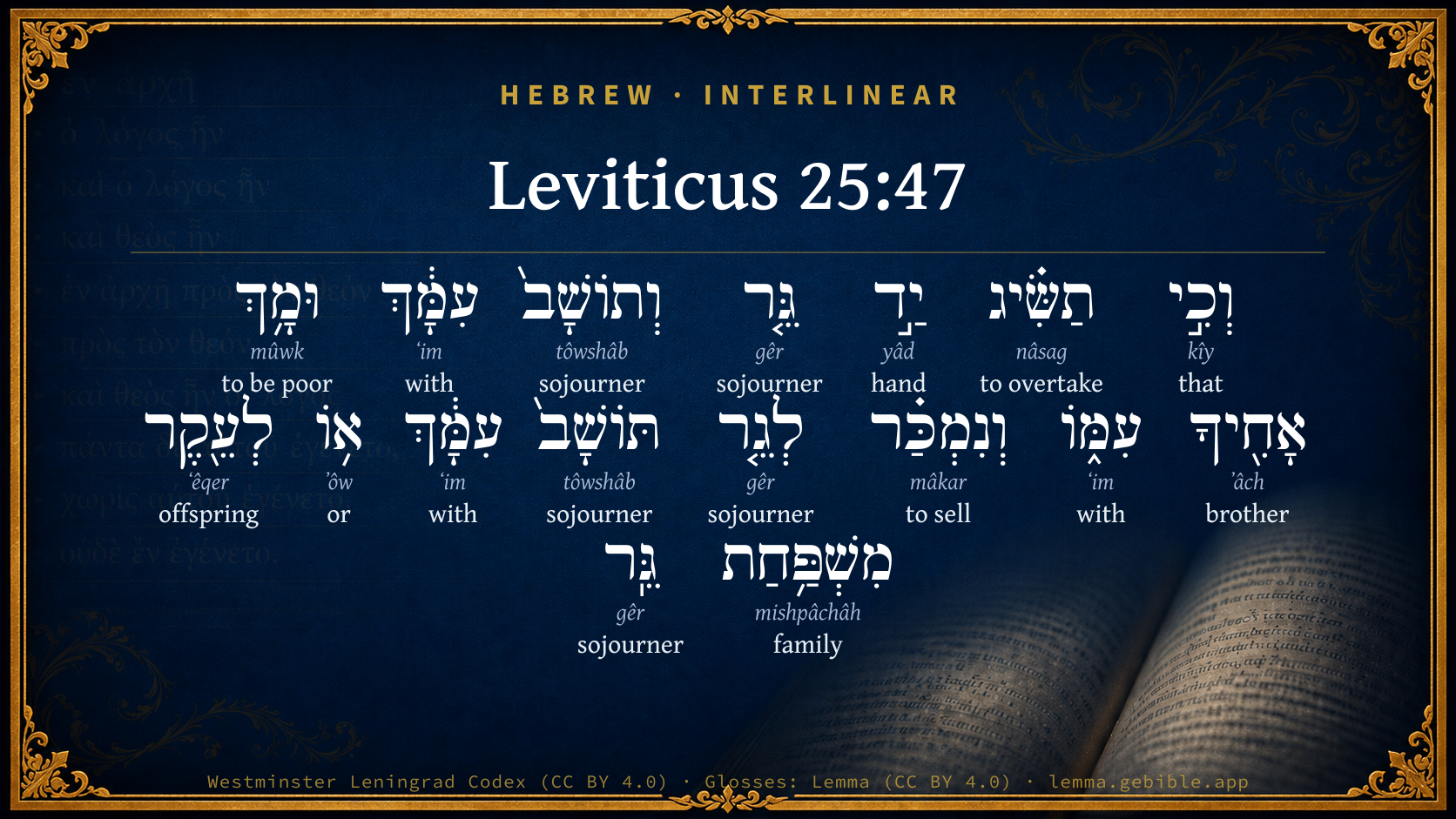
Hebrew (Westminster Leningrad Codex) Leviticus 25:47 appears in the Hebrew Old Testament. The text above is from the Westminster Leningrad Codex. Each word links to its Strong’s number, a concise gloss, and parsing drawn from the Open Scriptures Hebrew Bible morphology. Click any word for its full Brown-Driver-Briggs (BDB) entry.
Download image
Cite this verse

Leviticus 25:47 (World English Bible). Public Domain. Lemma interlinear Bible study tool, https://lemma.gebible.app/v/leviticus/25/47.

Show BibTeX & RIS
BibTeX
RIS
English Translation
"'If a stranger or sojourner with you becomes rich, and your brother beside him has grown poor, and sells himself to the stranger or foreigner living among you, or to a member of the stranger's family;
World English Bible · Public Domain
Highlights
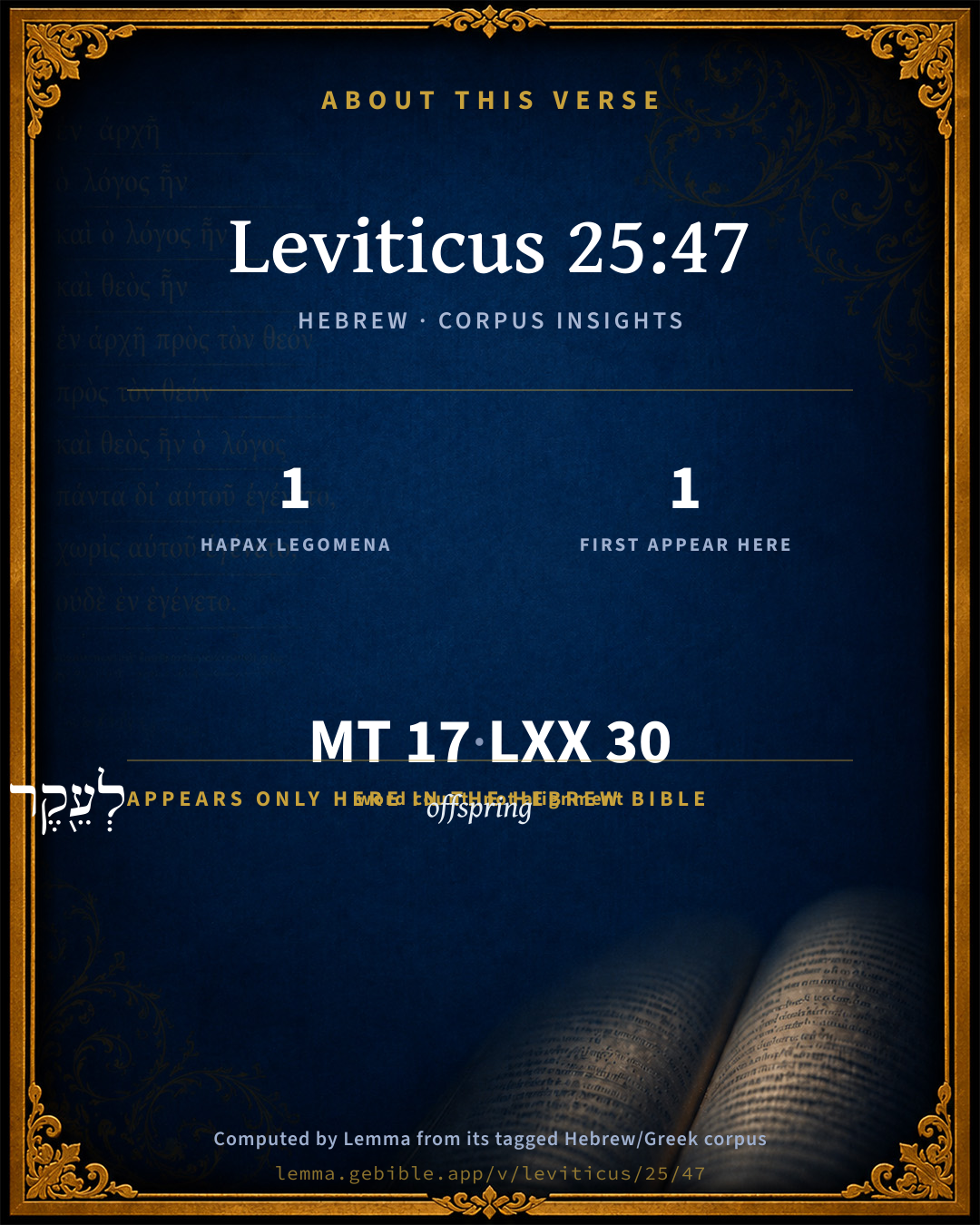
  • 1 hapax legomenon — only here in the Hebrew Bible
  • 1 first appearance in the Hebrew Bible
Full analysis ↓
Download a study sheet

One document with this verse’s original text, its word-by-word gloss line, the meaning frame, cross-references with their text, attributed commentary, and full source and license credits — printable, and it pastes into notes with its structure intact.

This verse Autodidact and up

Study sheet (.html) Plain text (.txt)

A passage Seminary Student

Up to 50 verses in one chapter. A passage sheet keeps up to 6 commentary sources and 12 cross-references per verse, in the order this page ranks them, and says so on the sheet whenever that leaves anything out. Ask for a single verse and you get the Autodidact verse sheet above.

Everything on this page stays free to read, with no account — the sheet is a download of what is already on screen, not access to it.

Want to remove ads? Support Godless Engineer
Compare translations 3

The same verse in 3 English versions, stacked beneath the original-language interlinear above. Click any original word for its lexicon entry.

Each is an independent rendering of the whole verse — the interlinear is not word-aligned to these translations.

Highlighted words mark where these versions differ — a whole-verse word diff, not a word-by-word alignment.

  • World English Bible Public Domain
    "'If a stranger or sojourner with you becomes rich, and your brother beside him has grown poor, and sells himself to the stranger or foreigner living among you, or to a member of the stranger's family;
  • King James Version Public Domain
    And if a sojourner or stranger wax rich by thee, and thy brother that dwelleth by him wax poor, and sell himself unto the stranger or sojourner by thee, or to the stock of the stranger's family:
  • unfoldingWord Literal Text CC BY-SA 4.0
    And if the hand of a sojourner or temporary resident with you reaches, and your brother with him becomes poor and sells himself to the sojourner (a temporary resident) with you, or to a member of the clan of a sojourner,

unfoldingWord Literal Text — © unfoldingWord, licensed CC BY-SA 4.0. Word-aligned USFM3 via Door43 (git.door43.org/unfoldingWord/en_ult).

Versions to compare (up to 4)

3 of 4 selected

Show all 18 translations

Every available English version of this verse, each an independent rendering of the whole verse.

  • World English Bible Public Domain
    "'If a stranger or sojourner with you becomes rich, and your brother beside him has grown poor, and sells himself to the stranger or foreigner living among you, or to a member of the stranger's family;
  • Berean Standard Bible Public Domain
    If a foreigner residing among you prospers, but your countryman dwelling near him becomes destitute and sells himself to the foreigner or to a member of his clan,
  • Majority Standard Bible Public Domain
    If a foreigner residing among you prospers, but your countryman dwelling near him becomes destitute and sells himself to the foreigner or to a member of his clan,
  • King James Version Public Domain
    And if a sojourner or stranger wax rich by thee, and thy brother that dwelleth by him wax poor, and sell himself unto the stranger or sojourner by thee, or to the stock of the stranger's family:
  • American Standard Version (1901) Public Domain
    And if a stranger or sojourner with thee be waxed rich, and thy brother be waxed poor beside him, and sell himself unto the stranger `or' sojourner with thee, or to the stock of the stranger's family;
  • Revised Version (1885) Public Domain
    And if a stranger or sojourner with thee be waxen rich, and thy brother be waxen poor beside him, and sell himself unto the stranger or sojourner with thee, or to the stock of the stranger’s family:
  • Geneva Bible (1599) Public Domain
    If a soiourner or a stranger dwelling by thee get riches, and thy brother by him be impouerished, and sell him selfe vnto the stranger or soiourner dwelling by thee, or to the stocke of the strangers familie,
  • Douay-Rheims (1899) Public Domain
    If the hand of a stranger or a sojourner grow strong among you, and thy brother being impoverished sell himself to him, or to any of his race:
  • Young's Literal Translation Public Domain
    `And when the hand of a sojourner or settler with thee attaineth `riches', and thy brother with him hath become poor, and he hath been sold to a sojourner, a settler with thee, or to the root of the family of a sojourner,
  • Literal Standard Version CC BY-SA 4.0
    And when the hand of a sojourner or settler with you attains [riches], and your brother with him has become poor, and he has been sold to a sojourner, a settler with you, or to the root of the family of a sojourner,
  • Unlocked Literal Bible CC BY-SA 4.0
    If a foreigner or someone living temporarily with you has become wealthy, and if one of your fellow Israelites has become poor and sells himself to that foreigner, or to someone in a foreigner's family,
  • unfoldingWord Literal Text CC BY-SA 4.0
    And if the hand of a sojourner or temporary resident with you reaches, and your brother with him becomes poor and sells himself to the sojourner (a temporary resident) with you, or to a member of the clan of a sojourner,
  • Darby Bible Public Domain
    And if a stranger or sojourner become wealthy beside thee, and thy brother beside him grow poor, and sell himself unto the stranger, who is settled by thee, or to a scion of the stranger's family,
  • World Messianic Bible Public Domain
    “‘If an alien or temporary resident with you becomes rich, and your brother beside him has grown poor, and sells himself to the stranger or foreigner living among you, or to a member of the stranger’s family,
  • Webster's Bible Public Domain
    And if a sojourner or a stranger shall become rich by thee, and thy brother that dwelleth by him shall become poor, and sell himself to the stranger or sojourner by thee, or to the stock of the stranger's family:
  • Free Bible Version CC BY-SA 4.0
    If a foreigner among you becomes successful, and one of your people living nearby becomes poor and sells themselves to the foreigner or to a member of the foreigner's family,
  • Bible in Basic English Public Domain
    And if one from another nation living among you gets wealth, and your countryman, at his side, becomes poor and gives himself for money to the man from another nation or to one of his family;
  • JPS Tanakh (1917) Public Domain
    And if a stranger who is a settler with thee be waxen rich, and thy brother be waxen poor beside him, and sell himself unto the stranger who is a settler with thee, or to the offshoot of a stranger's family,

Literal Standard Version (2020), Covenant Press — licensed CC BY-SA 4.0. Text via the HelloAO Bible API (eBible.org). Unlocked Literal Bible (unfoldingWord) — licensed CC BY-SA 4.0. Text via the HelloAO Bible API (eBible.org). unfoldingWord Literal Text — © unfoldingWord, licensed CC BY-SA 4.0. Word-aligned USFM3 via Door43 (git.door43.org/unfoldingWord/en_ult). Free Bible Version, Dr. Jonathan Gallagher — licensed CC BY-SA 4.0. Text via the HelloAO Bible API (eBible.org).

Word by word

More ways to search: Search by grammar → Find every occurrence → Compare this word →

Practice this passage: Drill this verse → Learn its vocabulary →

לְעֵ֖קֶר
ʻêqer
H6133
“to/for · offspring of”
Preposition + Noun, Common, Masculine, Singular, Construct
Part of Speech
Preposition + Noun
Type
Common
Gender
Masculine
Number
Singular
State
Construct
Full BDB Definition

Origin: from H6131 fig., a transplanted person, i.e. naturalised citizen

TWOT: 1681a

member, offspring, offshoot
  1. וְכִ֣י kîy H3588 “and · that” Conjunction + Conjunction
  2. תַשִּׂ֗יג nâsag H5381 “to overtake” Verb, Hiphil, Imperfect, 3rd Person, Feminine, Singular
  3. יַ֣ד yâd H3027 “hand of” Noun, Common, Both, Singular, Construct
  4. גֵּ֤ר gêr H1616 “sojourner” Noun, Common, Masculine, Singular, Absolute
  5. וְתוֹשָׁב֙ tôwshâb H8453 “and · sojourner” Conjunction + Noun, Common, Masculine, Singular, Absolute
  6. עִמָּ֔ךְ ʻim H5973 “with · you” Preposition + Suffix, Personal, 2nd Person, Feminine, Singular
  7. וּמָ֥ךְ mûwk H4134 “and · to be poor” Conjunction + Verb, Qal, Sequential Perfect, 3rd Person, Masculine, Singular
  8. אָחִ֖יךָ ʼâch H251 “brother · your” Noun, Common, Masculine, Singular, Construct + Suffix, Personal, 2nd Person, Masculine, Singular
  9. עִמּ֑וֹ ʻim H5973 “with · him” Preposition + Suffix, Personal, 3rd Person, Masculine, Singular
  10. וְנִמְכַּ֗ר mâkar H4376 “and · to sell” Conjunction + Verb, Niphal, Sequential Perfect, 3rd Person, Masculine, Singular
  11. לְגֵ֤ר gêr H1616 “to/for · sojourner” Preposition + Noun, Common, Masculine, Singular, Absolute
  12. תּוֹשָׁב֙ tôwshâb H8453 “sojourner” Noun, Common, Masculine, Singular, Absolute
  13. עִמָּ֔ךְ ʻim H5973 “with · you” Preposition + Suffix, Personal, 2nd Person, Feminine, Singular
  14. א֥וֹ ʼôw H176 “or” Conjunction
  15. מִשְׁפַּ֥חַת mishpâchâh H4940 “family of” Noun, Common, Feminine, Singular, Construct
  16. גֵּֽר gêr H1616 “sojourner” Noun, Common, Masculine, Singular, Absolute

About this verse

These counts appear in no published source. They are computed here, from the morphology-tagged text and Lemma’s own curated glosses. What Lemma adds →

17
words
12
distinct lemmas
Pentateuch
section

Notable vocabulary

1 hapax legomenon — a word that appears only here in the entire Hebrew Bible:

  • לְעֵ֖קֶר offspring H6133

First appearance in Scripture

This word makes its first canonical appearance in the Hebrew Bible here:

  • לְעֵ֖קֶר offspring H6133

Shared distinctive vocabulary

וּמָ֥ךְ to be poor H4134 occurs in 5 verses of the Hebrew Bible. Also found in:

Grammatical profile

  • 3 verbs
  • 9 nouns
  • 3 prepositions
  • 2 conjunctions

Verb forms

  • תַשִּׂ֗יג Hiphil · Imperfect
  • וּמָ֥ךְ Qal · Sequential Perfect
  • וְנִמְכַּ֗ר Niphal · Sequential Perfect

Repetition

Words recur within this verse — often emphatic in Hebrew:

  • גֵּ֤ר sojourner H1616 ×3
  • וְתוֹשָׁב֙ sojourner H8453 ×2
  • עִמָּ֔ךְ with H5973 ×3

Hebrew & Septuagint length

In English translation the verse runs 36 words from the Hebrew and 33 from the Septuagint (LXX English) — closely comparable.

A rough comparison of the two English renderings, which tokenize alike — not a word-level alignment.

Word counts can differ between the Hebrew and the Greek without any difference in meaning — e.g. the Hebrew direct-object marker אֵת has no separate Greek word, and Greek often adds the article ὁ.

In the original languages it is 17 Hebrew tokens and 30 Greek tokens — but the two are counted differently (Hebrew bundles its prefixes and suffixes into one token; the Greek is in lemma form), so that isn’t a like-for-like length.

Cross-references

3

Topical passages linked to Leviticus 25:47 in the Treasury of Scripture Knowledge — connected by theme and wording, ordered by reader-vote popularity; previews shown in the World English Bible.

  • Leviticus 25:26 If a man has no one to redeem it, and he becomes prosperous and finds sufficient means to redeem it;
  • 1 Samuel 2:7–8 Yahweh makes poor, and makes rich: He brings low, he also lifts up.
  • James 2:5 Listen, my beloved brothers. Didn't God choose those who are poor in this world to be rich in faith, and heirs of the Kingdom which he promised to those who love him?

Cross-references courtesy of OpenBible.info (CC BY 4.0).

Hebrew and Greek witnesses Masoretic Hebrew ↔ Greek Septuagint

The same verse in the two great witnesses to the Old Testament, shown verse-for-verse.

These are two independent witnesses, not word-aligned to each other, and the Septuagint is shown in lemma (dictionary) form.

Hebrew Leviticus 25:47 Masoretic · Westminster Leningrad Codex

וְכִ֣י תַשִּׂ֗יג יַ֣ד גֵּ֤ר וְתוֹשָׁב֙ עִמָּ֔ךְ וּמָ֥ךְ אָחִ֖יךָ עִמּ֑וֹ וְנִמְכַּ֗ר לְגֵ֤ר תּוֹשָׁב֙ עִמָּ֔ךְ א֥וֹ לְעֵ֖קֶר מִשְׁפַּ֥חַת גֵּֽר

"'If a stranger or sojourner with you becomes rich, and your brother beside him has grown poor, and sells himself to the stranger or foreigner living among you, or to a member of the stranger's family;

World English Bible · Public Domain

Greek LXX Leviticus 25:47 Septuagint · lemma form

ἐάν δέ εὑρίσκω ὁ χείρ ὁ προσήλυτος ἤ ὁ πάροικος ὁ παρά σύ καί ἀπορέω ὁ ἀδελφός σύ πιπράσκω ὁ προσήλυτος ἤ ὁ πάροικος ὁ παρά σύ ἐκ γενετή προσήλυτος

And if a stranger or sojourner with you wax rich, and your brother in distress be sold to the stranger or the sojourner that is with you, or to a proselyte by extraction;

LXX2012 (modern English Septuagint) · Public Domain

Hebrew: Westminster Leningrad Codex (CC BY 4.0). Greek: Septuagint (public domain); English from LXX2012 (modern English Septuagint) (Public Domain). How the Septuagint differs from the Hebrew →

Targum (Aramaic paraphrase)

2

The Targum is the ancient Jewish Aramaic paraphrase of the Hebrew Scriptures — an interpretive translation, not the Hebrew text itself. Onkelos (literal) and Pseudo-Jonathan (expansive) render the Torah, and Jonathan the Prophets. Coverage is partial: where no permissively-licensed English translation exists for a verse, only the Aramaic is shown. This is verse-level text, not a word-by-word alignment to the Hebrew.

  1. Targum Onkelos Torah (Genesis–Deuteronomy)
    וַאֲרֵי תַדְבֵּק יַד עָרֵל וְתוֹתָב עִמָךְ וְיִתְמַסְכַּן אָחוּךְ עִמֵהּ וְיִזְדַבַּן לְעָרֵל תּוֹתָב עִמָךְ אוֹ לְאַרְמַי זַרְעִית גִיוֹרָא

    (no public-domain English translation for this verse)

    Targum Onkelos — Aramaic: “Onkelos Genesis” (public domain); “Onkelos Exodus” (public domain); “Onkelos Leviticus” (public domain); “Onkelos Numbers” (public domain); “Onkelos Deuteronomy” (public domain). English: “Sefaria Community Translation” (CC0 1.0 (public-domain dedication)); “J.W. Etheridge. The Targums of Onkelos and Jonathan Ben Uzziel on the Pentateuch. London: Longmans, Green, 1862” (public domain). Text via Sefaria.

  2. Targum Pseudo-Jonathan Torah (Genesis–Deuteronomy)
    וַאֲרוּם תְּאַרַע יַד עָרֵל וְתּוֹתַב דְעִמָךְ וְיִתְמַסְכֵּן אָחוּךְ עִמֵיהּ וְיִזְדַבֵּן לְעָרֵל תּוֹתָב דְעִמָךְ אוֹ לִשְׁרִישׁ פּוּלְחָנָא נוּכְרָאָה לִמְשַׁמְשָׁא לָהּ וּלְפַלְחָהָא דְמִזַרְעִית גִיוֹרָא

    And if the hand of the uncircumcised sojourner with you wax strong, and thy brother with him become poor, and sell himself to the uncircumcised stranger who is with thee, or to the stock of a strange religion, to serve him or to worship with him who is of the generation of strangers;

    Targum Pseudo-Jonathan — Aramaic: “Targum Jonathan on Genesis” (public domain); “Targum Jonathan on Exodus” (public domain); “Targum Jonathan on Leviticus” (public domain); “Targum Jonathan on Numbers” (public domain); “Targum Jonathan on Deuteronomy” (public domain). English: “The Targum of Jonathan ben Uzziel, trans. J. W. Etheridge, London, 1862” (public domain). Text via Sefaria.

Commentary

Notes on Leviticus 25:47 from classic Christian and Jewish commentators (each source and its license shown beneath its notes). The classic Christian expositions comment on the surrounding passage and are grouped to its opening verse, so a note may address several verses; the Jewish commentaries on the Tanakh (Rashi and others) are per-verse, so they appear only where the commentator wrote on this verse.

Lemma curates 59 commentaries, every one of them public domain or Creative Commons licensed, each selected and text-cleaned for this edition rather than reprinted as found. About our sources →

Joseph Benson's Commentary

Lev 25:47. The stock of the strangers — Hebrew, root, that is, one of the root or stock. So the word root is elsewhere used for the branch or progeny growing from it. He seems to denote one of a foreign race and country, transplanted into the land of Israel, and there having taken root among the people of God; yet even such a one, though he hath some privilege by it, shall not have power to keep a Hebrew servant from the benefit of redemption.

Joseph Benson's Commentary on the Old and New Testaments (1811–1818) — public domain. Text from a community e-Sword module.

Whedon's Commentary on the Bible

Daniel D. Whedon

THE HEBREW SERVANT AND THE FOREIGN MASTER, Lev_25:47-55.

47. If a stranger wax rich — For his rights, see Lev_23:22, note. The ancient Hebrew master did not have a monopoly of money-making. His servant, “the stranger,” often amassed wealth. Foreigners and servants among them were in a much more privileged condition than they are at present in the same country under Mohammedan rule. A resident foreigner was allowed to purchase any pauper Hebrew who, in his distress, offered himself for sale. But no Christian or Jew in any land beneath the scepter of Islam is allowed to own a slave of any nationality, much less a Mohammedan. The latter only can enjoy the luxury of slave-holding, with the exception of some who are permitted to hold as slaves non-Mohammedan negroes.

Stock of the stranger’s family — His heirs. The person sold might become a fixture of the household.

Daniel D. Whedon (gen. ed.), Commentary on the Old and New Testaments (1874–1909) — public domain. Text from a community e-Sword module.

Tyndale Open Study Notes

Tyndale Open Resources

25:47-55 An Israelite who sold himself or a family member to a foreigner in Israel retained the right to buy himself or the family member back. If he could not find the resources to do that, he was not released during the seventh year (cp. Exod 21:2) but had to await the Year of Jubilee. During his service to the foreigner, the Israelite slave was to enjoy the status of a hired servant and not be treated like a slave (Lev 25:53). The people of Israel belonged to God; they were not to be sold as permanent slaves to anyone else.

Tyndale Open Study Notes — © Tyndale Open Resources, licensed CC BY-SA 4.0. Text via the HelloAO Bible API.

Geneva Bible (1599)

Geneva Bible translators

Hebrew, his hand take hold.

Geneva Bible (1599) marginal notes — public domain. Text via Bolls.life.

Ellicott's Commentary for English Readers

(47) And if a sojourner or stranger wax rich by thee.—Better, And if the hand of a stranger, and that a sojourner, attain riches by thee, that is, a stranger who has become a sojourner, or who has taken up his abode among the Israelites, and become prosperous by trading. Such a one had only to submit to the seven commandments given to Noah, and hence had not joined the Jewish religion. For this reason the Chaldee Version translates it, “And if the hand of an uncircumcised sojourner with thee wax strong.”

And thy brother that dwelleth by him wax poor.—Better, and thy brother by him wax poor, that is, the Israelite who traded with him is unfortunate in business, and is reduced to poverty.

And sell himself unto the stranger or sojourner by thee.—Better, and sells himself unto the stranger-sojourner by thee. The two terms as before describe the same person—the stranger who has become a sojourner. Hence the Chaldee Version translates it, “and sells himself to the uncircumcised stranger who is with thee.”

Or to the stock of the stranger’s family.—That is, the offshoot or descendant of a foreign family.

A Bible Commentary for English Readers, edited by Charles John Ellicott (1878–1897) — public domain. Text from a community e-Sword module.

The Cambridge Bible for Schools and Colleges

gen. ed. J. J. S. Perowne

47–55. The case of Israelites who are slaves of resident foreigners (H but with a large admixture of P)

Such a person might be redeemed, or, if he acquired the means, might redeem himself, the price of redemption to be calculated according to the number of years intervening before the Jubile, as in the case of the redemption of land (Lev_25:27). In any case the bondage was limited by the law of the Jubile.

The Cambridge Bible for Schools and Colleges (gen. ed. J. J. S. Perowne; Cambridge University Press, 1878–1918) — public domain. Text from a community e-Sword module.

John Gill's Exposition

And if a sojourner or stranger wax rich by thee,.... An uncircumcised one, as the Targums, a proselyte of the gate, who by living among and trading with the Israelites, might grow rich and wealthy in money, at least so as to be able to purchase an Hebrew servant, though not his lands, which he might not buy:

and thy brother that dwelleth by him wax poor; comes into low circumstances, and is reduced to great poverty, even extreme poverty; for only in such a case might he sell himself to an Israelite, and much less to a stranger, if this was not the case. Jarchi suggests, as in the phrase, "by thee", points at the cause or occasion of the sojourner or stranger becoming rich, his nearness unto, or cleaving to all Israelite; and so here the phrase, "by him", directs to the cause or occasion of the Israelite's becoming poor, his being near and cleaving to the sojourner or stranger: but they seem rather to be used, to show the reason of the poor Israelite falling into the hands of a rich sojourner; they being near neighbours to one another, and having a familiarity, the following bargain is struck between them:

and sell himself unto the stranger or sojourner thee; the uncircumcised sojourner, as the Targum of Jonathan:

or to the stock of a stranger's family; or "root" (a), one that sprung from a family, originally proselytes; which some understand of one, who though he be descended from such a family, was now rooted among the people of God, and incorporated into the commonwealth of Israel; and yet such an one could not detain an Hebrew servant longer than the year of jubilee: but the Jewish writers generally interpret it of an idolater (b).

(a) "radici", Vatablus, Piscator. (b) Targum Onk. Jon. Jarchi & Ben Melech, in loc. Kimchi in Sepher Shorash, rad.

John Gill's Exposition of the Whole Bible (1746–1763) — public domain (CC PDM 1.0). Text via the HelloAO Bible API.

Albert Barnes' Notes on the Bible

A sojourner or stranger - Rather, a foreigner who has settled among you. See Lev 16:29, note; Exo 20:10, note.

Lev 25:54

In these years - More properly, by one of these means. The extreme period of servitude in this case was six years, as when the master was a Hebrew Exo 21:2.

Looking at the law of the Jubilee from a simply practical point of view, its operation must have tended to remedy those evils which are always growing up in the ordinary conditions of human society. It prevented the permanent accumulation of land in the hands of a few, and periodically raised those whom fault or misfortune had sunk into poverty to a position of competency. It must also have tended to keep alive family feeling, and helped to preserve the family genealogies.

But in its more special character, as a law given by Yahweh to His special people, it was a standing lesson to those who would rightly regard it, on the terms upon which the enjoyment of the land of promise had been conferred upon them. All the land belonged to Yahweh as its supreme Lord, every Israelite as His vassal belonged to Him. The voice of the Jubilee horns, twice in every century, proclaimed the equitable and beneficent social order appointed for the people; they sounded that acceptable year of Yahweh which was to bring comfort to all that mourned, in which the slavery of sin was to be abolished, and the true liberty of God’s children was to be proclaimed Luk 2:25; Isa 61:2; Luk 4:19; Act 3:21; Rom 8:19-23; 1Pe 1:3-4.

Albert Barnes' Notes on the Bible (1834–1885) — public domain. Text from a community e-Sword/MySword module.

Haydock's Catholic Bible Commentary

Stranger, or Gentile, who engages at least to keep the precepts given to Noe. (Haydock)

George Leo Haydock (1774–1849), Haydock's Catholic Family Bible and Commentary, 1859 edition — public domain. Excludes Psalms (Douay-Rheims chapter numbering differs from Protestant) and Deuterocanonical books (Catholic canon only).

Matthew Poole's English Annotations

The stock, Heb. root, i.e. one of the root or stock. So the word root is elsewhere used for the branch or progeny growing from it, as Num 13:28; 2Ch 22:10. He seems to note one of a foreign race and country, transplanted into the land of Israel, and there having taken root amongst the people of God; yet even such a one, though he hath some privilege by it, yet he shall not have power to keep a Hebrew servant from the benefit of redemption.

Matthew Poole's English Annotations on the Holy Bible (1683–1685) — public domain. Text from a community e-Sword/MySword module.

The Pulpit Commentary

Vers. 47-55. Rules are laid down for the case of an Israelite who has sold himself for a slave to a non-Israelite. In this case he is not set free at the end of six years, as he would be if his master were a countryman, but in other respects his treatment is to be like that of the man with an Israelite master. He may be redeemed by the value of his work down to the jubilee being paid by himself or his kinsman; he is to be set free when the jubilee comes at any rate; he is to be treated kindly while continuing in his master"s service, and his countrymen are to see that no over-severity is used.

The Pulpit Commentary (1880–1919), ed. H.D.M. Spence-Jones & Joseph S. Exell — public domain. Text from a community e-Sword module.

John Wesley's Explanatory Notes

The flock - Hebrew. root, that is, one of the root or flock. So the word root is elsewhere used for the branch or progeny growing from it. He seems to note one of a foreign race and country, transplanted into the land of Israel, and there having taken root amongst the people of God, yet even such an one, though he hath some privilege by it, shall not have power to keep an Hebrew servant from the benefit of redemption.

John Wesley, Explanatory Notes Upon the Whole Bible (1754–1765) — public domain. Text via the GEBible commentary corpus.

unfoldingWord translationNotes

Door43 World Missions Community

after your fellow Israelite has been bought, he may be bought back. Someone in his family may redeem him

This can be stated in active form. AT: "after the foreigner buys your fellow Israelite, someone in the Israelite's family may buy him back" (See: Active or Passive)

translationWords

redeem

unfoldingWord translationNotes — © Distant Shores Media and the Door43 World Missions Community, licensed CC BY-SA 4.0. Source: git.door43.org/Door43/en_tn.

Rashi

Rabbi Shlomo Yitzchaki (Rashi)

יד גר ותושב [AND IF] A גר ותושב WAX RICH — This means a stranger, he being at the same time a sojourner with thee, as the Targum renders it: ערל תותב an uncircumcised sojourner (the phrase is hendiadys). The end of the verse proves this, for it states: “and he sells himself unto a strange sojourner” (גר תושב, without the copulative ו before the second word).

וכי תשיג יד גר ותושב עמך AND IF A STRANGE SOJOURNER WAX RICH BY THEE — The last word suggests: What was the cause that he has waxen rich? His close connection with thee (עמך) (Sifra, Behar, Chapter 8 1).

ומך אחיך עמו AND THY BROTHER WAX POOR BY HIM — Here again the last word suggests: What was the cause that he has waxen poor? His intimacy with him (Sifra, Behar, Chapter 8 1), — because of the fact that he learned evil from his (the stranger’s) evil doings.

משפחת גר — itself denotes a heathen; since, however, Scripture adds the word לעקר “to the stock of the heathen’s family” it thereby refers to one who sells himself to the idol itself — to be its servant; not to worship it as a deity, but e. g., to chop wood or to draw water which are to be used in connection with this idol worship (cf. Sifra, Behar, Chapter 8 1; Bava Kamma 113b; Arakhin 30b; Kiddushin 20a).

Rashi on the Tanakh — English translations: “The Judaica Press complete Tanach with Rashi, translated by A. J. Rosenberg” (CC BY 4.0); “Pentateuch with Rashi's commentary by M. Rosenbaum and A.M. Silbermann, 1929-1934” (public domain); “The Metsudah Tanach series, Lakewood, N.J” (CC BY 4.0); and “The Book of Joshua, Metsudah Publications, 1997” (CC BY 4.0). Text via Sefaria.

Ramban (Nachmanides)

Rabbi Moshe ben Nachman (Ramban / Nachmanides)

AND IF A STRANGER WHO IS A SETTLER WITH THEE BE WAXEN RICH, AND THY BROTHER BE WAXEN POOR BESIDE HIM, AND SELL HIMSELF UNTO THE STRANGER WHO IS A SETTLER WITH THEE, OR ‘L’EIKER’ (TO THE STOCK OF) THE FAMILY OF ‘GEIR’ (A STRANGER). “The family of ‘geir’ — this means an idolater. Since Scripture [also] stated l’eiker (‘to the stock of’ the idolater), it refers to one who sold himself to the idol itself — to be its servant; not to worship it as a deity, but to hew wood and draw water for its service.” This is Rashi’s language derived from the Torath Kohanim. 5:1. And if so, the verse is saying: l’eiker ‘u’mishpachath geir [“to the stock of ‘and’ to the family of the stranger,” — since according to Rashi the verse speaks of two different people — and omits the conjunctive “and” and merely says, l’eiker mishpachath geir — literally “to the stock of the family of a stranger”]. Scripture calls the idol eiker [“plucking” or “uprooting”] because a person is dutybound to uproot thoroughly an object of idol-worship and to extirpate it.But Onkelos translated l’eiker — l’armai (“to a gentile”), and this is the correct interpretation. Scripture is thus mentioning [the case of a Hebrew who] sold himself to a stranger who dwells with us, or who sold himself ‘l’eiker mishpachath geir’ (to the stock of the stranger’s family), who is himself a gentile, the word eiker thus being related to the expression ‘ikar sharshohi’ (the stump of its roots). Scripture states ‘mishpachath geir’ (the family of the stranger) [in order to indicate that] the stranger or the settler who became rich with us brought it about that the brother [i.e., the Israelite] become poor beside him [because he had emulated his ways] and thus be sold to the stock of the family of the stranger. Scripture commanded that he must be redeemed, this being a positive commandment upon all Israel that we are to redeem him, and then it commanded his kinsmen that they are the first [in this duty]. The purpose of the commandment is clear, that he should not become assimilated and learn from the ways [of his purchasers]. For in the case of [all] other sales, the redemption by kinsmen is a matter of choice [but here it is an obligation]. Therefore He said here, For unto Me the children of Israel are servants; they are My servants, meaning to say that “although the stranger who settled [with us] and the stock of his family do not have to observe the commandment of the Jubilee, they cannot buy My servants to be their [permanent] servants.”

Ramban (Nachmanides) on the Tanakh — English translation: “Commentary on the Torah by Ramban (Nachmanides). Translated and annotated by Charles B. Chavel. New York, Shilo Pub. House, 1971-1976” (CC BY 4.0). Text via Sefaria.

Lesson kit

Teaching starters — assembled from the data on this page, not authored interpretation. Every prompt links to the verse data it draws on. Edit before teaching.

Leviticus, in the Pentateuch, opens this verse with 17 words (12 distinct Hebrew lemmas). Its most distinctive word is ʻêqer (“offspring”). A historical commentator’s framing appears above. Read the whole chapter for the surrounding context.

Discussion questions

  1. The word ʻêqer carries the sense “offspring.” How does it shape the verse?
  2. This verse holds 1 word here found nowhere else in the Hebrew Bible. What might the rare word draw attention to?
  3. The word “offspring” first appears here in Scripture. What is being introduced at this debut?
  4. Leviticus 25:25 shares the word «to be poor» with this verse. How do the two illuminate each other?
  5. “sojourner” occurs 3× in this one verse. What is the effect of the repetition?
  6. The translations on this page render this verse differently — a whole-verse word diff, not a word-by-word alignment. What might account for the different wordings?
  7. The verb «תַשִּׂ֗יג» is Hiphil Imperfect. How does its form color the action?
  8. Reading how Joseph Benson's Commentary and Whedon's Commentary on the Bible read this verse, where do the two commentators agree and where do they part?

Things to notice

  • 1 word in this verse appears nowhere else in the Hebrew Bible.
  • 1 word makes its first canonical appearance in Scripture here.
  • This verse counts 17 Hebrew ↔ 30 Greek words.
  • These translations choose different wording for 23 words in this verse.
  • “sojourner” occurs 3× in this single verse.

Reading settings

Reading text

Shown beneath each verse's original-language words.

Old Testament
Old Testament edition

Read the OT as the Masoretic Hebrew (MT) or the Greek Septuagint (LXX).

English shown for the Greek Septuagint (in the Hebrew ↔ Greek comparison).

Comparing translations? Open the Compare panel on any verse page to stack up to four side by side.