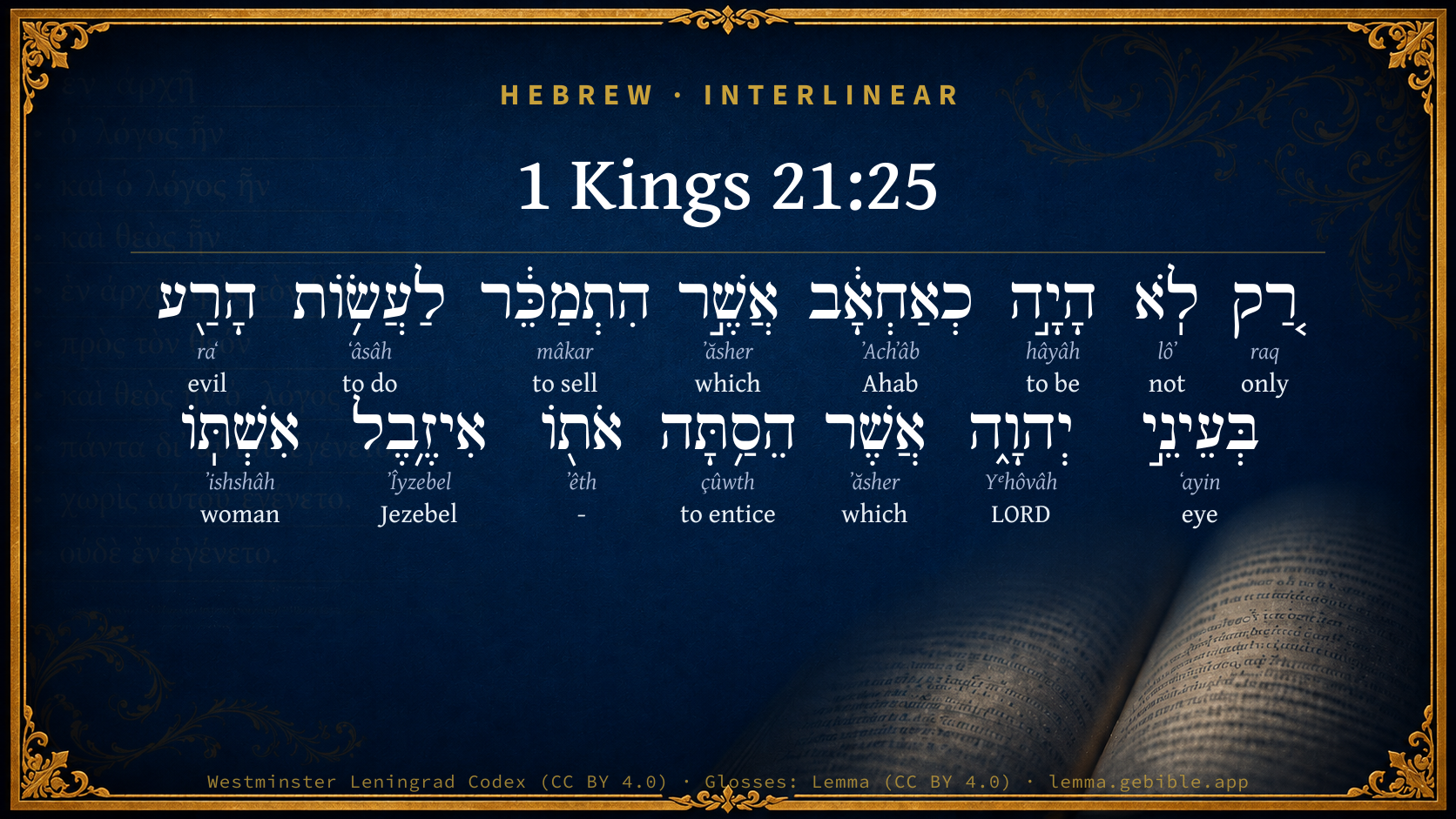
1 Kings 21:25

Hebrew (Westminster Leningrad Codex) 1 Kings 21:25 appears in the Hebrew Old Testament. The text above is from the Westminster Leningrad Codex. Each word links to its Strong’s number, a concise gloss, and parsing drawn from the Open Scriptures Hebrew Bible morphology. Click any word for its full Brown-Driver-Briggs (BDB) entry.
Download image
Cite this verse

1 Kings 21:25 (World English Bible). Public Domain. Lemma interlinear Bible study tool, https://lemma.gebible.app/v/1-kings/21/25.

Show BibTeX & RIS
BibTeX
RIS
English Translation
(But there was none like Ahab, who did sell himself to do that which was evil in the sight of Yahweh, whom Jezebel his wife stirred up.
World English Bible · Public Domain
Download a study sheet

One document with this verse’s original text, its word-by-word gloss line, the meaning frame, cross-references with their text, attributed commentary, and full source and license credits — printable, and it pastes into notes with its structure intact.

This verse Autodidact and up

Study sheet (.html) Plain text (.txt)

A passage Seminary Student

Up to 50 verses in one chapter. A passage sheet keeps up to 6 commentary sources and 12 cross-references per verse, in the order this page ranks them, and says so on the sheet whenever that leaves anything out. Ask for a single verse and you get the Autodidact verse sheet above.

Everything on this page stays free to read, with no account — the sheet is a download of what is already on screen, not access to it.

Want to remove ads? Support Godless Engineer
Compare translations 3

The same verse in 3 English versions, stacked beneath the original-language interlinear above. Click any original word for its lexicon entry.

Each is an independent rendering of the whole verse — the interlinear is not word-aligned to these translations.

Highlighted words mark where these versions differ — a whole-verse word diff, not a word-by-word alignment.

  • World English Bible Public Domain
    (But there was none like Ahab, who did sell himself to do that which was evil in the sight of Yahweh, whom Jezebel his wife stirred up.
  • King James Version Public Domain
    But there was none like unto Ahab, which did sell himself to work wickedness in the sight of the LORD, whom Jezebel his wife stirred up.
  • unfoldingWord Literal Text CC BY-SA 4.0
    Surely one was not like Ahab, who sold himself to do evil in the eyes of Yahweh, he whom Jezebel his wife incited.

unfoldingWord Literal Text — © unfoldingWord, licensed CC BY-SA 4.0. Word-aligned USFM3 via Door43 (git.door43.org/unfoldingWord/en_ult).

Versions to compare (up to 4)

3 of 4 selected

Show all 18 translations

Every available English version of this verse, each an independent rendering of the whole verse.

  • World English Bible Public Domain
    (But there was none like Ahab, who did sell himself to do that which was evil in the sight of Yahweh, whom Jezebel his wife stirred up.
  • Berean Standard Bible Public Domain
    (Surely there was never one like Ahab, who sold himself to do evil in the sight of the LORD, incited by his wife Jezebel.
  • Majority Standard Bible Public Domain
    (Surely there was never one like Ahab, who sold himself to do evil in the sight of the LORD, incited by his wife Jezebel.
  • King James Version Public Domain
    But there was none like unto Ahab, which did sell himself to work wickedness in the sight of the LORD, whom Jezebel his wife stirred up.
  • American Standard Version (1901) Public Domain
    (But there was none like unto Ahab, who did sell himself to do that which was evil in the sight of Jehovah, whom Jezebel his wife stirred up.
  • Revised Version (1885) Public Domain
    (But there was none like unto Ahab, which did sell himself to do that which was evil in the sight of the LORD, whom Jezebel his wife stirred up.
  • Geneva Bible (1599) Public Domain
    (But there was none like Ahab, who did fell him selfe, to worke wickednesse in the sight of the Lord: whom Iezebel his wife prouoked.
  • Douay-Rheims (1899) Public Domain
    Now there was not such another as Achab, who was sold to do evil in the sight of the Lord: for his wife Jezabel set him on,
  • Young's Literal Translation Public Domain
    surely there hath none been like Ahab, who sold himself to do the evil thing in the eyes of Jehovah, whom Jezebel his wife hath moved,
  • Literal Standard Version CC BY-SA 4.0
    surely there has been none like Ahab, who sold himself to do evil in the eyes of YHWH, whom his wife Jezebel has moved,
  • Unlocked Literal Bible CC BY-SA 4.0
    There was no one like Ahab, who sold himself to do what was evil in the sight of Yahweh, whom Jezebel his wife incited to sin.
  • unfoldingWord Literal Text CC BY-SA 4.0
    Surely one was not like Ahab, who sold himself to do evil in the eyes of Yahweh, he whom Jezebel his wife incited.
  • Darby Bible Public Domain
    (Surely there was none like to Ahab, who did sell himself to do evil in the sight of Jehovah, Jezebel his wife urging him on.
  • World Messianic Bible Public Domain
    But there was no one like Ahab, who sold himself to do that which was evil in the LORD’s sight, whom Jezebel his wife stirred up.
  • Webster's Bible Public Domain
    But there was none like Ahab, who sold himself to work wickedness in the sight of the LORD, whom Jezebel his wife instigated.
  • Free Bible Version CC BY-SA 4.0
    (No one else was so bad as Ahab, who sold himself to do what is evil in the Lord's sight, because his wife Jezebel encouraged him.
  • Bible in Basic English Public Domain
    (There was no one like Ahab, who gave himself up to do evil in the eyes of the Lord, moved to it by Jezebel his wife.
  • JPS Tanakh (1917) Public Domain
    But there was none like unto Ahab, who did give himself over to do that which was evil in the sight of the LORD, whom Jezebel his wife stirred up.

Literal Standard Version (2020), Covenant Press — licensed CC BY-SA 4.0. Text via the HelloAO Bible API (eBible.org). Unlocked Literal Bible (unfoldingWord) — licensed CC BY-SA 4.0. Text via the HelloAO Bible API (eBible.org). unfoldingWord Literal Text — © unfoldingWord, licensed CC BY-SA 4.0. Word-aligned USFM3 via Door43 (git.door43.org/unfoldingWord/en_ult). Free Bible Version, Dr. Jonathan Gallagher — licensed CC BY-SA 4.0. Text via the HelloAO Bible API (eBible.org).

Word by word

More ways to search: Search by grammar → Find every occurrence → Compare this word →

Practice this passage: Drill this verse → Learn its vocabulary →

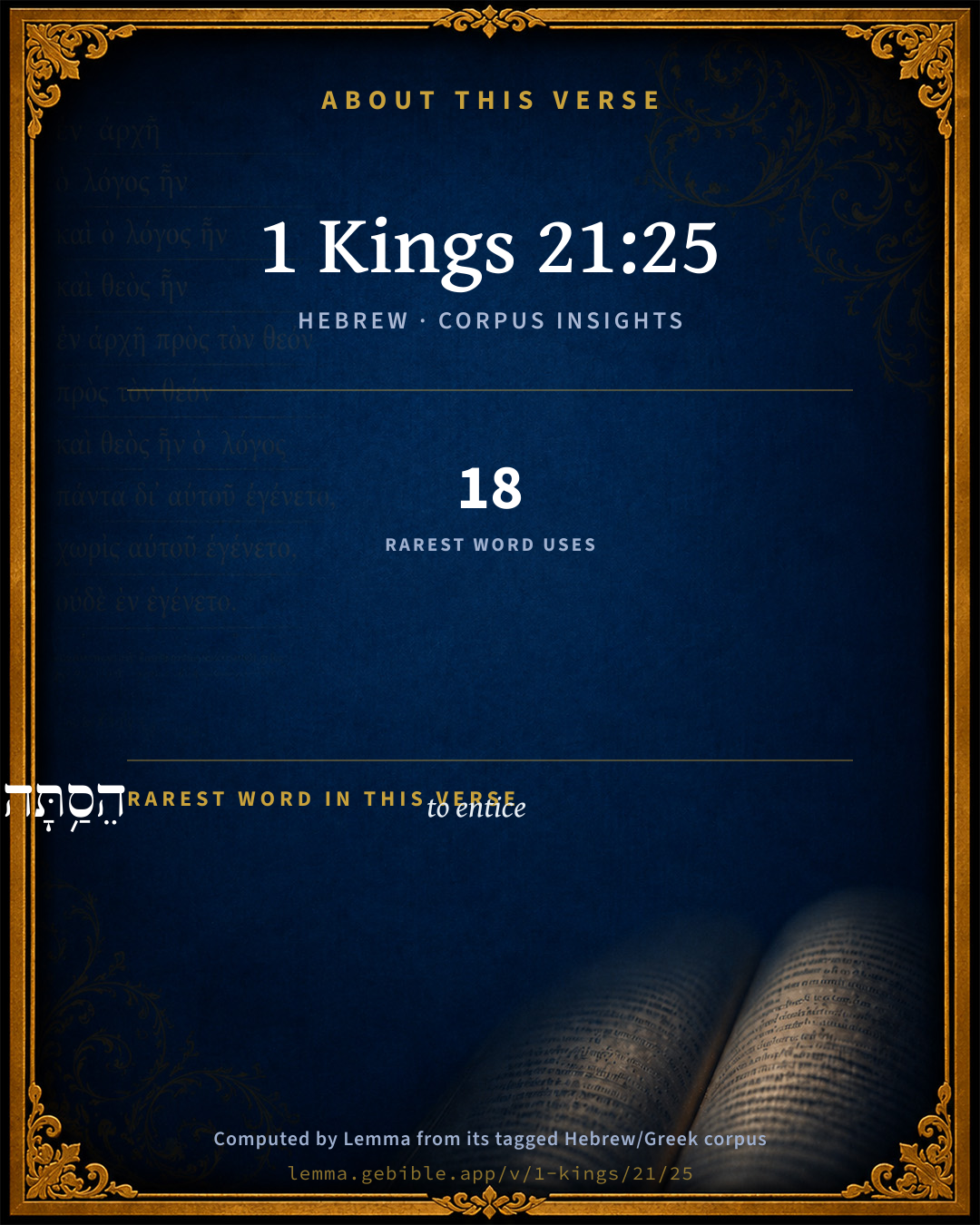
הֵסַ֥תָּה
çûwth
H5496
“to entice”
Verb, Hiphil, Perfect, 3rd Person, Feminine, Singular
Part of Speech
Verb
Stem
Hiphil
Form
Perfect
Person
3rd Person
Gender
Feminine
Number
Singular
Full BDB Definition

Origin: perhaps denominative from H7898

TWOT: 1481

to incite, allure, instigate, entice - (Hiphil) - to incite (to a request) - to allure, lure - to instigate (bad sense)
  1. רַ֚ק raq H7535 “only” Particle, Accusative
  2. לֹֽא lôʼ H3808 “not” Particle, Negative
  3. הָיָ֣ה hâyâh H1961 “to be” Verb, Qal, Perfect, 3rd Person, Masculine, Singular
  4. כְאַחְאָ֔ב ʼAchʼâb H256 “like/as · Ahab” Preposition + Noun, Proper
  5. אֲשֶׁ֣ר ʼăsher H834 “which” Particle, Relative
  6. הִתְמַכֵּ֔ר mâkar H4376 “to sell” Verb, Hithpael, Perfect, 3rd Person, Masculine, Singular
  7. לַעֲשׂ֥וֹת ʻâsâh H6213 “to do” Preposition + Verb, Qal, Infinitive Construct
  8. הָרַ֖ע raʻ H7451 “the · evil” Particle, Definite Article + Adjective, Adjective, Masculine, Singular, Absolute
  9. בְּעֵינֵ֣י ʻayin H5869 “in/at · eyes of” Preposition + Noun, Common, Both, Dual, Construct
  10. יְהוָ֑ה Yᵉhôvâh H3068 “LORD” Noun, Proper
  11. אֲשֶׁר ʼăsher H834 “which” Particle, Relative
  12. אֹת֖וֹ ʼêth H853 “- · him” Particle, Direct Object + Suffix, Personal, 3rd Person, Masculine, Singular
  13. אִיזֶ֥בֶל ʼÎyzebel H348 “Jezebel” Noun, Proper
  14. אִשְׁתּֽוֹ ʼishshâh H802 “woman · his” Noun, Common, Feminine, Singular, Construct + Suffix, Personal, 3rd Person, Masculine, Singular

About this verse

These counts appear in no published source. They are computed here, from the morphology-tagged text and Lemma’s own curated glosses. What Lemma adds →

15
words
14
distinct lemmas
Historical
section

Notable vocabulary

The rarest word here is הֵסַ֥תָּה to entice H5496 — appearing just 18 times in the whole Hebrew Bible.

Shared distinctive vocabulary

הֵסַ֥תָּה to entice H5496 occurs in 18 verses of the Hebrew Bible. Also found in:

Grammatical profile

  • 4 verbs
  • 5 nouns
  • 1 adjective
  • 5 particles

Verb forms

  • הָיָ֣ה Qal · Perfect
  • הִתְמַכֵּ֔ר Hithpael · Perfect
  • לַעֲשׂ֥וֹת Qal · Infinitive Construct
  • הֵסַ֥תָּה Hiphil · Perfect

Repetition

A word recurs within this verse — often emphatic in Hebrew:

  • אֲשֶׁ֣ר which H834 ×2

Hebrew & Septuagint length

In English translation the verse runs 27 words from the Hebrew and 50 from the Septuagint (LXX English) — the Septuagint runs noticeably longer here. See the side-by-side →

A rough comparison of the two English renderings, which tokenize alike — not a word-level alignment.

Word counts can differ between the Hebrew and the Greek without any difference in meaning — e.g. the Hebrew direct-object marker אֵת has no separate Greek word, and Greek often adds the article ὁ.

Cross-references

17

Topical passages linked to 1 Kings 21:25 in the Treasury of Scripture Knowledge — connected by theme and wording, ordered by reader-vote popularity; previews shown in the World English Bible.

  • 1 Kings 21:20 Ahab said to Elijah, Have you found me, my enemy? He answered, I have found you, because you have sold yourself to do that which is evil in the sight of Yahweh.
  • Proverbs 22:14 The mouth of an adulteress is a deep pit: He who is under Yahweh's wrath will fall into it.
  • 1 Kings 16:30–33 Ahab the son of Omri did that which was evil in the sight of Yahweh above all that were before him.
  • Ecclesiastes 7:26 I find more bitter than death the woman whose heart is snares and traps, whose hands are chains. Whoever pleases God shall escape from her; but the sinner will be ensnared by her.
  • 1 Kings 21:7 Jezebel his wife said to him, Do you now govern the kingdom of Israel? arise, and eat bread, and let your heart be merry: I will give you the vineyard of Naboth the Jezreelite.
  • Acts 14:2 But the disbelieving Jews stirred up and embittered the souls of the Gentiles against the brothers.
  • Romans 6:19 I speak in human terms because of the weakness of your flesh, for as you presented your members as servants to uncleanness and to wickedness upon wickedness, even so now present your members as servants to righteousness for sanctification.
  • 1 Kings 11:1–4 Now king Solomon loved many foreign women, together with the daughter of Pharaoh, women of the Moabites, Ammonites, Edomites, Sidonians, and Hittites;
  • 1 Kings 18:4 for it was so, when Jezebel cut off the prophets of Yahweh, that Obadiah took one hundred prophets, and hid them by fifty in a cave, and fed them with bread and water.)
  • 1 Kings 19:2 Then Jezebel send a messenger to Elijah, saying, So let the gods do to me, and more also, if I don't make your life as the life of one of them by tomorrow about this time.
  • 2 Kings 17:17 They caused their sons and their daughters to pass through the fire, and used divination and enchantments, and sold themselves to do that which was evil in the sight of Yahweh, to provoke him to anger.
  • 2 Kings 23:25 Like him was there no king before him, who turned to Yahweh with all his heart, and with all his soul, and with all his might, according to all the law of Moses; neither after him arose there any like him.
  • Isaiah 50:1 Thus says Yahweh, Where is the bill of your mother's divorce, with which I have put her away? or which of my creditors is it to whom I have sold you? Behold, for your iniquities were you sold, and for your transgressions was your mother put away.
  • Isaiah 52:3 For thus says Yahweh, You were sold for nothing; and you shall be redeemed without money.
  • Mark 6:17–27 For Herod himself had sent out and arrested John, and bound him in prison for the sake of Herodias, his brother Philip's wife, for he had married her.
  • Acts 6:12 They stirred up the people, the elders, and the scribes, and came against him and seized him, and brought him in to the council,
  • Romans 7:14 For we know that the law is spiritual, but I am fleshly, sold under sin.

Cross-references courtesy of OpenBible.info (CC BY 4.0).

Hebrew and Greek witnesses Masoretic Hebrew ↔ Greek Septuagint

The same verse in the two great witnesses to the Old Testament, shown verse-for-verse.

Here the Septuagint runs noticeably longer than the Hebrew — LXX2012 (modern English Septuagint) 50 words vs World English Bible 27. A rough length comparison of the two English translations, not a word-level alignment — read both below.

These are two independent witnesses, not word-aligned to each other, and the Septuagint is shown in lemma (dictionary) form.

Hebrew 1 Kings 21:25 Masoretic · Westminster Leningrad Codex

רַ֚ק לֹֽא הָיָ֣ה כְאַחְאָ֔ב אֲשֶׁ֣ר הִתְמַכֵּ֔ר לַעֲשׂ֥וֹת הָרַ֖ע בְּעֵינֵ֣י יְהוָ֑ה אֲשֶׁר הֵסַ֥תָּה אֹת֖וֹ אִיזֶ֥בֶל אִשְׁתּֽוֹ

(But there was none like Ahab, who did sell himself to do that which was evil in the sight of Yahweh, whom Jezebel his wife stirred up.

World English Bible · Public Domain

Greek LXX 1 Kings 21:25 Septuagint · lemma form

καί ἀλλάσσω σύ δύναμις κατά ὁ δύναμις ὁ πίπτω ἀπό σύ καί ἵππος κατά ὁ ἵππος καί ἅρμα κατά ὁ ἅρμα καί πολεμέω πρός αὐτός κατά εὐθύς καί κραταιόω ὑπέρ αὐτός καί ἀκούω ὁ φωνή αὐτός καί ποιέω οὕτως

And we will give you another army according to the army that was destroyed, and cavalry according to the cavalry, and chariots according to the chariots, and we will fight against them in the plain, and we shall prevail against them. And he listened to their voice, and did so.

LXX2012 (modern English Septuagint) · Public Domain

On this verse, Haydock's Catholic Bible Commentary discusses the Septuagint’s reading. Read the note in Commentary ↓

Hebrew: Westminster Leningrad Codex (CC BY 4.0). Greek: Septuagint (public domain); English from LXX2012 (modern English Septuagint) (Public Domain). How the Septuagint differs from the Hebrew →

Targum (Aramaic paraphrase)

1

The Targum is the ancient Jewish Aramaic paraphrase of the Hebrew Scriptures — an interpretive translation, not the Hebrew text itself. Onkelos (literal) and Pseudo-Jonathan (expansive) render the Torah, and Jonathan the Prophets. Coverage is partial: where no permissively-licensed English translation exists for a verse, only the Aramaic is shown. This is verse-level text, not a word-by-word alignment to the Hebrew.

  1. Targum Jonathan Prophets (Joshua–Malachi)
    לְחוֹד לָא הֲוָה כְאַחְאָב דַחֲשִׁיב לְמֶעְבַּד דְבִישׁ קֳדָם יְיָ דְאַטְעִיאַת יָתֵיהּ אִיזֶבֶל אִתְּתֵיהּ:

    (no public-domain English translation for this verse)

    Targum Jonathan — Aramaic: “Mikraot Gedolot” (public domain). English: “Sefaria Community Translation” (CC0 1.0 (public-domain dedication)); “London "Chaldee Paraphrase," 1871” (public domain). Text via Sefaria.

Commentary

Notes on 1 Kings 21:25 from classic Christian and Jewish commentators (each source and its license shown beneath its notes). The classic Christian expositions comment on the surrounding passage and are grouped to its opening verse, so a note may address several verses; the Jewish commentaries on the Tanakh (Rashi and others) are per-verse, so they appear only where the commentator wrote on this verse.

Lemma curates 59 commentaries, every one of them public domain or Creative Commons licensed, each selected and text-cleaned for this edition rather than reprinted as found. About our sources →

Trapp's Complete Commentary

John Trapp

1Ki 21:25 But there was none like unto Ahab, which did sell himself to work wickedness in the sight of the LORD, whom Jezebel his wife stirred up.

Ver. 25. But there was none like unto Ahab.] A very non-such, as is before noted, bipedum nequissimus, non scelestus sed ipsum scelus.

Which did sell himself, &c., whom Jezebel, &c.] She held him in such slavery, that, for a quiet life with her, and to enjoy her love, he was wholly at her service, not daring to deny anything that she would have done. This γυναικοκρατεια is a great mischief.

John Trapp, A Commentary or Exposition upon All the Books of the Old and New Testament (1647–1656) — public domain. Text from a community e-Sword module.

The Biblical Illustrator

Joseph S. Exell

1Ki_21:25

But there was none like unto Ahab, which did sell himself to work wickedness in the sight of the Lord.

Ahab

I. An illustration of the depths of human depravity.

1. Ahabs pre-eminence in sin (1Ki_16:30). There had been many instances of wickedness decked with the robes of royalty; but there was none like Ahab.

2. Ahabs bargain with hell. He stands before us as a self-sold slave of the devil. Ahab sold himself! What a bargain!

3. The daring character of Ahabs wickedness. In the sight of the Lord. Most strive to work wickedness under the covert of darkness--under the shades of night, or wearing the hypocrites mask. Not so Ahab.

II. An evidence of the unmanly servility of evil. Whom Jezebel his wife stirred up. This Syrian princess, whom Ahab had married, was a woman of the most consummate subtlety, duplicity, and cruelty.

III. A proof of the magnitude of the divine mercy. Great was the long-suffering of God in permitting Ahab to reign so long (2Pe_3:9). Great, too, was His mercy in regarding the humiliation of this guilty man (1Ki_21:29), i.e. the destruction of his posterity (Psa_86:15). God gives no repulse (says Bengel), when He gives good things: He neither upbraids us with our past folly and unworthiness, nor with future abuse of His goodness.

IV. The evanescent nature of merely selfish penitence. Ahab appeared by his fasting and humiliation to return to God; but his goodness proved like the morning cloud. He soon cast off the yoke of the Divine authority, and returned to his wallowing in the mire. In this he is the type of multitudes, who in their affliction say, Come, and let us return unto the Lord; but bring forth no fruits meet for repentance. (Patrick Morrison.)

The Biblical Illustrator, edited by Joseph S. Exell (c. 1880s–1900s) — public domain. Text from a community e-Sword module.

Joseph Benson's Commentary

1Ki 21:25-26. There was none like unto Ahab — Among all the kings of Israel who had been before him. Whom Jezebel his wife stirred up — This is added to show that temptations to sin are no excuse to the sinner. He did very abominably in following idols, &c. — There was no abomination which the people of Canaan committed, (here called the Amorites, according to their ancient name, Gen 15:16,) which Ahab did not imitate.

Joseph Benson's Commentary on the Old and New Testaments (1811–1818) — public domain. Text from a community e-Sword module.

Keil & Delitzsch

C. F. Keil & F. Delitzsch

Kg1 21:25, Kg1 21:26 contain a reflection on the part of the historian concerning Ahab's ungodly conduct, whereby he brought such an ignominious end upon himself and his house. וגו היה לא רק, "only there has not been (one) like Ahab," i.e., there was no one else like Ahab, "who sold himself," etc. הסתּה for הסיתה, from סוּת, to entice, to seduce or lead astray (cf. Ewald, 114, a., and Ges. 72, Anm. 6). ויּתעב, and he acted abominably. Amorites: for Canaanites, as in Gen 15:16, etc.

Keil & Delitzsch — Biblical Commentary on the Old Testament (1861–1891) — public domain (CC PDM 1.0). Text via the HelloAO Bible API. (Old Testament only.)

Tyndale Open Study Notes

Tyndale Open Resources

21:25-26 The author interrupts his account to reemphasize (see 16:30-34) Ahab’s evil character, to denounce the king’s commitment to idolatry, and to condemn his weakness in allowing himself to be under the influence of his wife Jezebel. Wicked Jezebel would stop at nothing to achieve her own ends (18:4; 19:1-2; 21:5-10, 15). Though arrogant and defiant to the end (2 Kgs 9:30-31), she eventually met her predicted doom (1 Kgs 21:23; 2 Kgs 9:32-37).

Tyndale Open Study Notes — © Tyndale Open Resources, licensed CC BY-SA 4.0. Text via the HelloAO Bible API.

Geneva Bible (1599)

Geneva Bible translators

By the wicked counsel of his wife he became a vile idolater, and cruel murderer, as one that gave himself wholly to serve sin.

Geneva Bible (1599) marginal notes — public domain. Text via Bolls.life.

Adam Clarke's Commentary

Verse 25. Did sell himself to work wickedness] He hired himself to the devil for this very purpose, that he might work wickedness. This was to be his employment, and at this he laboured.

In the sight of the Lord, whom Jezebel his wife stirred up.] A good wife is from the Lord; a bad wife is from the devil: Jezebel was of this kind; and she has had many successors.

Adam Clarke's Commentary on the Bible (1810–1826) — public domain. Text from a community e-Sword/MySword module.

Ellicott's Commentary for English Readers

(25) The dogs shall eat Jezebel.—In all his address to Ahab, Elijah has, as yet, disdained to name the instigator, on whom the coward king, no doubt, threw his guilt. Ahab stands revealed as the true culprit before God, without a shred of subterfuge to veil his ultimate responsibility. Now, briefly and sternly, the prophet notices the bolder criminal, pronouncing against her a doom of shame and horror, seldom falling upon a woman, but rightly visiting one who had forsworn the pity and modesty of her sex. In the “ditch” (see margin) outside the walls, where the refuse of the city gathers the half-wild dogs—the scavengers of Eastern cities—her dead body is to be thrown as offal, and to be torn and devoured.

This verse and the next are evidently the reflection of the compiler, catching its inspiration from the words of Elijah in 1Ki_21:20. There is in them a tone not only of condemnation, but of contempt, for a king most unkingly—thus selling himself to a half-unwilling course of crime, against the warnings of conscience, not disbelieved but neglected, for the sake of a paltry desire—thus moreover, grovelling under the open dominion of a woman, which, to an Eastern mind, familiar enough with female intrigues, but not with female imperiousness, would seem especially monstrous.

A Bible Commentary for English Readers, edited by Charles John Ellicott (1878–1897) — public domain. Text from a community e-Sword module.

The Cambridge Bible for Schools and Colleges

gen. ed. J. J. S. Perowne

25. to work wickedness] R.V. to do that which was evil. See above, 1Ki_21:20.

Ahab exceeded the wickedness of all the other kings in that he introduced Baal-worship, and allowed his wife to proceed to all lengths in her attempts to destroy any recognition of Jehovah, even such as remained in the corrupted worship of the northern kingdom.

The Cambridge Bible for Schools and Colleges (gen. ed. J. J. S. Perowne; Cambridge University Press, 1878–1918) — public domain. Text from a community e-Sword module.

Albert Barnes' Notes on the Bible

whom Jezebel stirred up - The history of Ahab’s reign throughout exhibits him as completely governed by his imperious wife. Instances of her influence are seen in 1Ki 21:7, 1Ki 21:15, marginal reference, 1Ki 18:4; 1Ki 19:2.

Albert Barnes' Notes on the Bible (1834–1885) — public domain. Text from a community e-Sword/MySword module.

Haydock's Catholic Bible Commentary

Now. Septuagint, "Moreover, Achab was foolishly sold, a man who was sold, &c., since Jezabel....changed him:" Greek: metetheken. His natural disposition was not perhaps so bad. But his unfortunate connexion with a most wicked wife involved him in ruin. Even when he began to relent, and was on the point of reforming his life, (ver. 27.) her influence spoiled all. (Haydock) --- He was sold to her, and she exercised a most severe tyranny over him, using his seal at pleasure, and treating him with indignity, ver. 7, 8. (Tirinus)

George Leo Haydock (1774–1849), Haydock's Catholic Family Bible and Commentary, 1859 edition — public domain. Excludes Psalms (Douay-Rheims chapter numbering differs from Protestant) and Deuterocanonical books (Catholic canon only).

Matthew Poole's English Annotations

There was none like unto Ahab; none among all the kings of Israel which had been before him.

Whom Jezebel his wife stirred up: this is added to show that temptations to sin are no excuse to the sinner.

Matthew Poole's English Annotations on the Holy Bible (1683–1685) — public domain. Text from a community e-Sword/MySword module.

Whedon's Commentary on the Bible

Daniel D. Whedon

25, 26. These two verses are parenthetically added by the writer of this history to intensify the thought of Ahab’s extreme wickedness, and to show the reason of the bitter judgments that were pronounced against him.

Daniel D. Whedon (gen. ed.), Commentary on the Old and New Testaments (1874–1909) — public domain. Text from a community e-Sword module.

The Pulpit Commentary

But Heb. Only there was none like unto Ahab, which did sell himself to work wickedness in the sight of the Lord as in ver. 20, whom Jezebel his wife stirred up or as Marg., incited, instigated and urged to sin. (Cf. Deu_13:7 Hebrews; Job_36:18)

Vers. 25-29.

Ahab"s Repentance.

After the terrible sentence pronounced by Elijah upon Ahab for his enormities follows this account of his repentance. The record teachesI THAT THERE IS REPENTANCE FOR THE VILEST. I Ahab answered this description.

(1) He "wrought wickedness." So have we all. But his was evil of no common order. "He did very abominably in following idols, according to all things as did the Amorites, whom the Lord cast out before the children of Israel." (See Gen_15:16; 2Ki_21:11)

(2) He wrought this wickedness "in the sight of the Lord," as the Amorites did not, for they had not the religious privileges of an Israelite. Ahab in particular had signal proofs of the presence of God. The shutting and opening of the heavens, to wit, together with the miracle on Carmel. Where much is given much is required.

(3) He had "sold himself" to work this wickedness. (See Rom_7:14) He was slave to Jezebel slave to Satan. He drudged hard in his serfdom.

(4) None of his predecessors had gone so far wrong. "There was none like unto Ahab". (see 1Ki_16:33) Jeroboam had "made Israel to sin," and Omri, at the instigation of Ahab, made "statutes" to confirm that sin. (Mic_6:16) Ahab went further, and established the worship of Baal, with its attendant abominations of Ashere. (See 1Ki_16:29-33)

(5) He was in the worst company. He had married a "cursed woman," and submitted to be led by her into the extremes of wickedness. "Whom Jezebel his wife stirred up." Under her instigation he consented to a wholesale massacre of the sons of the prophets; and now she makes him her accomplice in the murder of Naboth, with its attendant atrocities.

2. Yet Ahab took God"s message to heart.

(1) He believed the terrible sentence, as he had good reason to do, for it came by the hand of Elijah. In all his former experience he had found that the word of the Lord in Elijah"s mouth was truth.

(2) Now, with his death vividly before him, and the fearful doom of his house all the fruit of his crimes these crimes live up again, and pass in formidable order before his eyes. (See Ps 1 Ps 20) Conspicuous amongst the spectres that would move before him would be those of the newly murdered Naboth with his children.

(3) This ghastly phantasmagoria would be to him a premonition of the solemnities of the final judgment in which the thousands injured, whether in body or soul, by his bad conduct and influence, would cry to God"s justice for vengeance upon the royal culprit.

3. He humbled himself accordingly.

(1) Before Jehovah. He "rent his clothes" in token of deep grief. (See Gen_37:34; Job_1:20; Ezr_9:8) He put sackcloth upon his flesh, and fasted, and lay in sackcloth, and went softly. Here were all the signs of deep contrition before God. They were symbols of the prayer of the heart for mercy.

(2) Before men. To put on sackcloth he laid aside those robes of state in which he had prided himself. Instead of moving with his former kingly tramp he now "went softly." (Compare Isa_38:15) He moved withthe timid step of a culprit.

(3) Who will say his repentance was not genuine? God did not say so. He afterwards, indeed, professed to "hate" a faithful servant of God. (1Ki_22:8) But what does this prove? Simply that he afterwards relapsed into sin. And it admonishes us not to presume upon any dogma of infallible final perseverance, but, by the help of God, to "work out our own salvation with fear and trembling.

II THAT THERE IS MERCY FOR THE PENITENT.

1. God observed the repentance of Ahab.

(1) He observed it before man haft. He saw its first motions in the depths of his heart. He saw the prodigal "while yet a great way off". (Luk_15:20)

(2) Doubtless He graciously encouraged these motions so that they ripened into confession. And does not the goodness of God still lead men to repentance, even the vilest?

2. He called the attention of Elijah to it.

(1) To the prophet he said, "Seest thou how Ahab humbleth himself before me." This was an encouragement to the man of God. His labour was not in vain. Ahab required some moral courage to humble himself before Jehovah in the presence of Jezebel.

(2) God in His goodness directs His servants to those who are penitent that they may minister words of encouragement to them. Ananias was sent to. (Act_9:11)

3. He extended His mercy to the supplicant.

(1) "Because he humbleth himself before me, I will not bring the evil in his days: but in his son"s days will I bring the evil upon his house." The mercy is not a reversal of the mischief, neither was the repentance. The mischief is done, and cannot be reversed. Early piety is therefore earnestly to be desired that the mischief of an evil life may be avoided.

(2) It was a substantial benefit nevertheless.

(a) To Ahab personally. It was something to be spared the pain of witnessing the judgments of God upon his wicked house; but, what is still more considerable, this mercy contained a promise respecting the world to come; for, and especially in prophecy, things visible are signs or portents of things spiritual.

(b) It was also a benefit to his nation. For after this, probably, came the war with Ben-hadad, in which God interposed in a very remarkable manner on behalf of His people. In the Septuagint, which translation was made from much older copies of the Hebrew Bible than any now extant, this chapter and that here before it change places; and the order in the Septuagint is also followed by Josephus.

(3) This fact is very important, for it shows also where the backsliding of Ahab commenced. It was evidently in the false mercy which he showed to Ben-hadad. After this relapse God forsook him and handed him over to evil spirits and lying prophets, who wrought his ruin. "He that endureth to the end shall be saved. J.A.M.

The Pulpit Commentary (1880–1919), ed. H.D.M. Spence-Jones & Joseph S. Exell — public domain. Text from a community e-Sword module.

unfoldingWord translationNotes

Door43 World Missions Community

who sold himself to do what was evil

A person being committed to doing what is evil is spoken of as if that person had sold himself to evil. See how you translated this idea in 1 Kings 21:20. AT: "who dedicated himself to doing what was evil" (See: Metaphor)

what was evil in the sight of Yahweh

The phrase, "in the sight of" refers to someone's opinion. See how you translated this in 1 Kings 11:6. AT: "what Yahweh considers to be evil" (See: Metaphor)

removed before the people of Israel

Here "Israel" refers to all twelve tribes of Israel and not just to the northern kingdom. AT: "removed from the presence of the people of Israel" or "drove out of the land before the people of Israel" (See: Assumed Knowledge and Implicit Information)

translationWords

evil

Yahweh

works

false god

Amorite

Israel

unfoldingWord translationNotes — © Distant Shores Media and the Door43 World Missions Community, licensed CC BY-SA 4.0. Source: git.door43.org/Door43/en_tn.

Rashi

Rabbi Shlomo Yitzchaki (Rashi)

But there was none likes of Achov. Scripture testifies about him that there was none among the kings like him, for Yerovom and all those after him worshiped the calves out of fear, that if the people would go up to Yerusholayim, the kingdom would revert to the House of Dovid, but this one added the Baal and the Asheirah to anger [God].

Sold himself. He was sold to idolatry. I saw in [Talmud] Yerushalmi that Chieil from the house of Eili was his advisor, and every day he would estimate his value and give it to the pagan deities.

Rashi on the Tanakh — English translations: “The Judaica Press complete Tanach with Rashi, translated by A. J. Rosenberg” (CC BY 4.0); “Pentateuch with Rashi's commentary by M. Rosenbaum and A.M. Silbermann, 1929-1934” (public domain); “The Metsudah Tanach series, Lakewood, N.J” (CC BY 4.0); and “The Book of Joshua, Metsudah Publications, 1997” (CC BY 4.0). Text via Sefaria.

Lesson kit

Teaching starters — assembled from the data on this page, not authored interpretation. Every prompt links to the verse data it draws on. Edit before teaching.

1 Kings, in the Historical, opens this verse with 15 words (14 distinct Hebrew lemmas). Its most distinctive word is çûwth (“to entice”). The Greek Septuagint runs longer here. A historical commentator’s framing appears above. Read the whole chapter for the surrounding context.

Discussion questions

  1. What does “to entice” (çûwth) contribute to the verse as a whole?
  2. How does Deuteronomy 13:6, which shares the word «to entice», read alongside this verse?
  3. What does the repetition of “which” (2× in this one verse) do in this verse?
  4. The Septuagint runs longer here than the Hebrew. What might account for the difference?
  5. The translations on this page render this verse differently — a whole-verse word diff, not a word-by-word alignment. What might account for the different wordings?
  6. «הָיָ֣ה» is a Qal Perfect verb. How does that grammatical form shape the action described?
  7. Compare how Trapp's Complete Commentary and The Biblical Illustrator read this verse. Where do they agree or differ?

Things to notice

Reading settings

Reading text

Shown beneath each verse's original-language words.

Old Testament
Old Testament edition

Read the OT as the Masoretic Hebrew (MT) or the Greek Septuagint (LXX).

English shown for the Greek Septuagint (in the Hebrew ↔ Greek comparison).

Comparing translations? Open the Compare panel on any verse page to stack up to four side by side.