
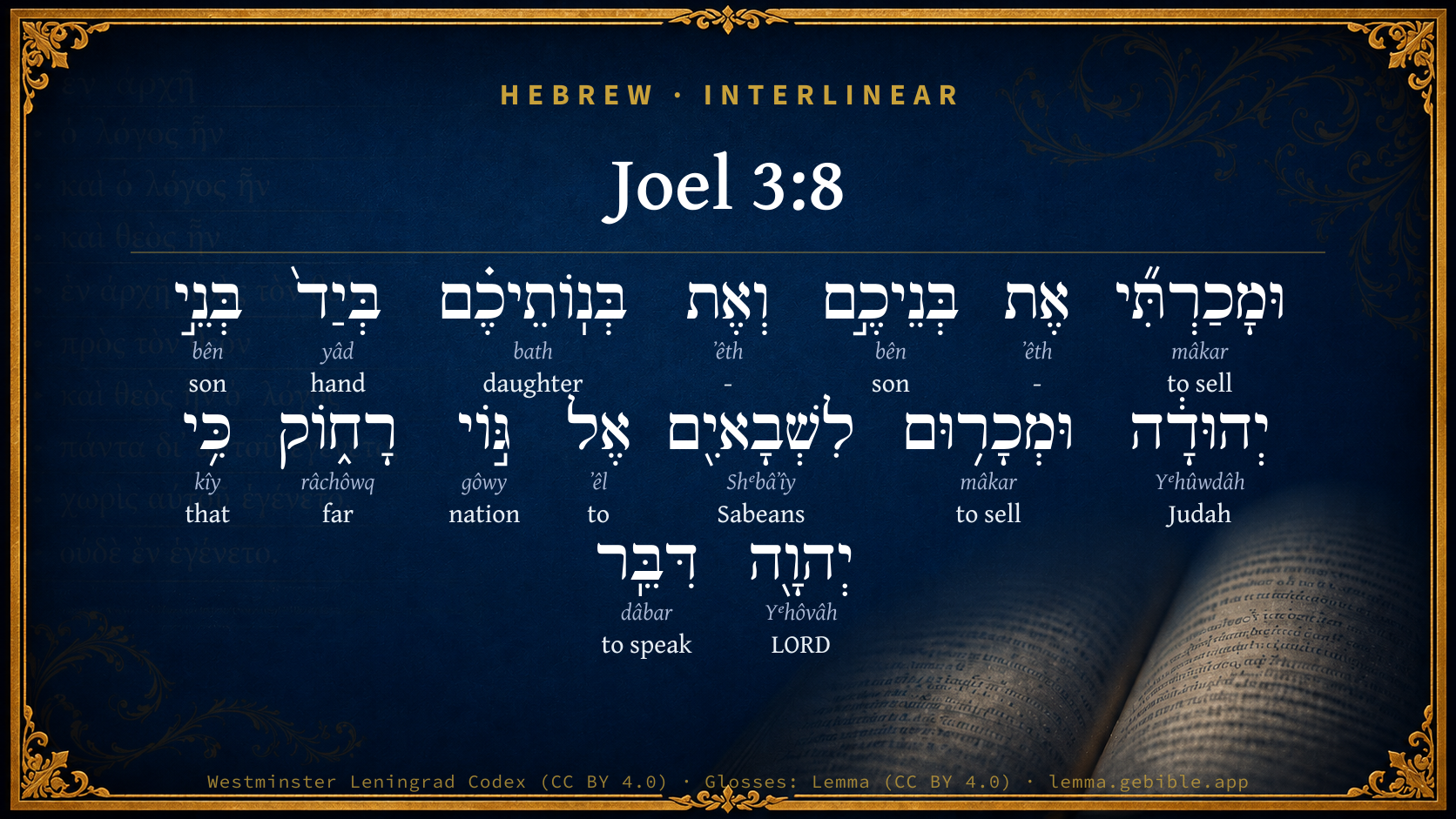
Joel 3:8

Hebrew (Westminster Leningrad Codex) Joel 3:8 appears in the Hebrew Old Testament. The text above is from the Westminster Leningrad Codex. Each word links to its Strong’s number, a concise gloss, and parsing drawn from the Open Scriptures Hebrew Bible morphology. Click any word for its full Brown-Driver-Briggs (BDB) entry.
Download image
Cite this verse

Joel 3:8 (World English Bible). Public Domain. Lemma interlinear Bible study tool, https://lemma.gebible.app/v/joel/3/8.

Show BibTeX & RIS
BibTeX
RIS
English Translation
And I will sell your sons and your daughters into the hands of the children of Judah, And they will sell them to the men of Sheba, To a faraway nation, For Yahweh has spoken it."
World English Bible · Public Domain
Highlights
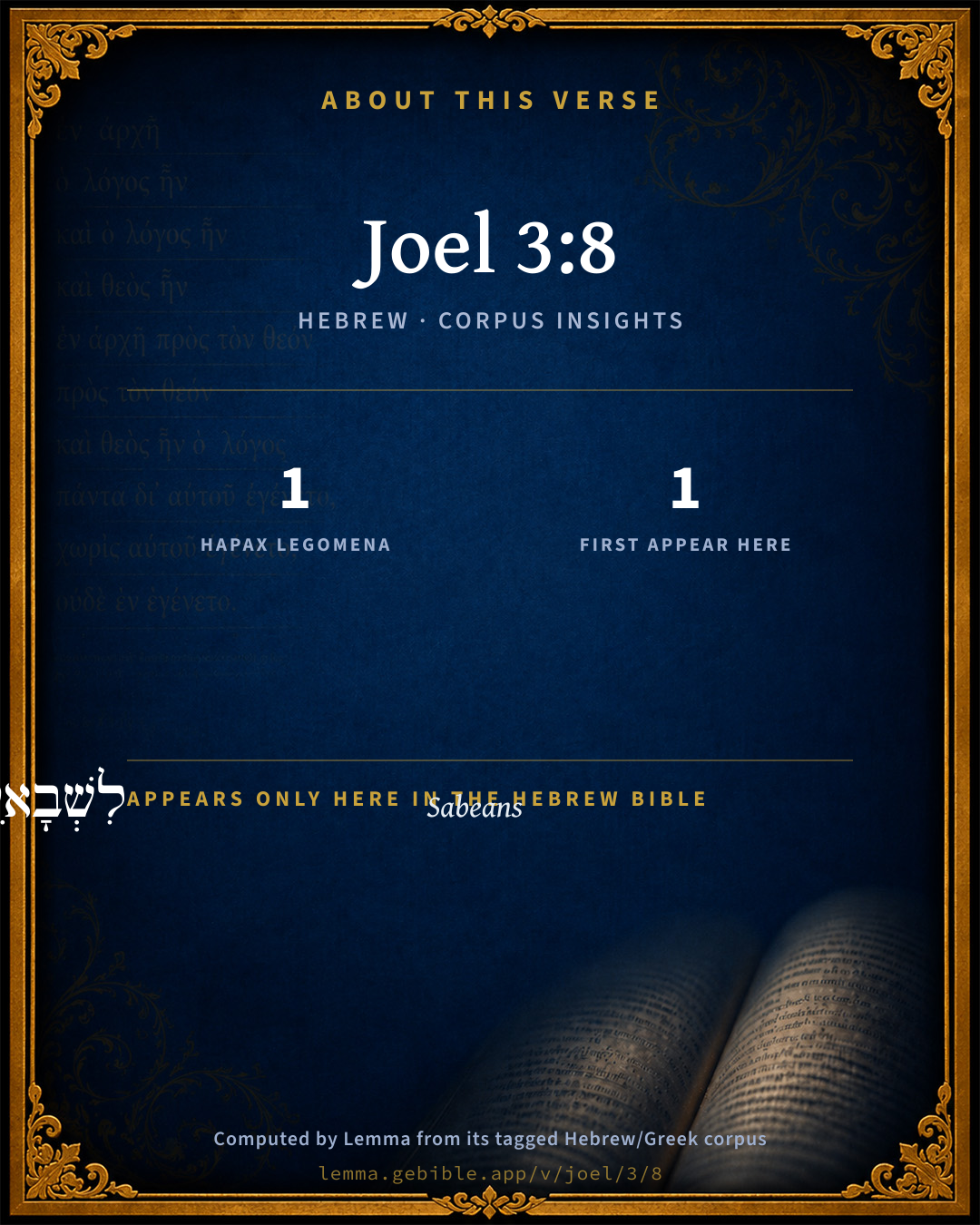
  • 1 hapax legomenon — only here in the Hebrew Bible
  • 1 first appearance in the Hebrew Bible
Full analysis ↓
Download a study sheet

One document with this verse’s original text, its word-by-word gloss line, the meaning frame, cross-references with their text, attributed commentary, and full source and license credits — printable, and it pastes into notes with its structure intact.

This verse Autodidact and up

Study sheet (.html) Plain text (.txt)

A passage Seminary Student

Up to 50 verses in one chapter. A passage sheet keeps up to 6 commentary sources and 12 cross-references per verse, in the order this page ranks them, and says so on the sheet whenever that leaves anything out. Ask for a single verse and you get the Autodidact verse sheet above.

Everything on this page stays free to read, with no account — the sheet is a download of what is already on screen, not access to it.

Want to remove ads? Support Godless Engineer
Compare translations 3

The same verse in 3 English versions, stacked beneath the original-language interlinear above. Click any original word for its lexicon entry.

Each is an independent rendering of the whole verse — the interlinear is not word-aligned to these translations.

Highlighted words mark where these versions differ — a whole-verse word diff, not a word-by-word alignment.

  • World English Bible Public Domain
    And I will sell your sons and your daughters into the hands of the children of Judah, And they will sell them to the men of Sheba, To a faraway nation, For Yahweh has spoken it."
  • King James Version Public Domain
    And I will sell your sons and your daughters into the hand of the children of Judah, and they shall sell them to the Sabeans, to a people far off: for the LORD hath spoken it.
  • unfoldingWord Literal Text CC BY-SA 4.0
    For I will sell your sons and your daughters into the hand of the sons of Judah, and they will sell them to the Sabeans, to a faraway nation.” For Yahweh has spoken.

unfoldingWord Literal Text — © unfoldingWord, licensed CC BY-SA 4.0. Word-aligned USFM3 via Door43 (git.door43.org/unfoldingWord/en_ult).

Versions to compare (up to 4)

3 of 4 selected

Show all 18 translations

Every available English version of this verse, each an independent rendering of the whole verse.

  • World English Bible Public Domain
    And I will sell your sons and your daughters into the hands of the children of Judah, And they will sell them to the men of Sheba, To a faraway nation, For Yahweh has spoken it."
  • Berean Standard Bible Public Domain
    I will sell your sons and daughters into the hands of the people of Judah, and they will sell them to the Sabeans—to a distant nation.” Indeed, the LORD has spoken.
  • Majority Standard Bible Public Domain
    I will sell your sons and daughters into the hands of the people of Judah, and they will sell them to the Sabeans—to a distant nation.” Indeed, the LORD has spoken.
  • King James Version Public Domain
    And I will sell your sons and your daughters into the hand of the children of Judah, and they shall sell them to the Sabeans, to a people far off: for the LORD hath spoken it.
  • American Standard Version (1901) Public Domain
    and I will sell your sons and your daughters into the hand of the children of Judah, and they shall sell them to the men of Sheba, to a nation far off: for Jehovah hath spoken it.
  • Revised Version (1885) Public Domain
    and I will sell your sons and your daughters into the hand of the children of Judah, and they shall sell them to the men of Sheba, to a nation far off: for the LORD hath spoken it.
  • Geneva Bible (1599) Public Domain
    And I will send your sonnes and your daughters into the hande of the children of Iudah, and they shall sell them to the Sabeans, to a people farre off: for the Lord hath spoken it.
  • Douay-Rheims (1899) Public Domain
    And I will sell your sons, and your daughters by the hands of the children of Juda, and they shall sell them to the Sabeans, a nation far off, for the Lord hath spoken it.
  • Young's Literal Translation Public Domain
    And have sold your sons and your daughters Into the hand of the sons of Judah, And they have sold them to Shabeans, Unto a nation far off, for Jehovah hath spoken.
  • Literal Standard Version CC BY-SA 4.0
    And have sold your sons and your daughters || Into the hand of the sons of Judah, || And they have sold them to Sabeans, || To a nation far off, for YHWH has spoken.”
  • Unlocked Literal Bible CC BY-SA 4.0
    I will sell your sons and your daughters, by the hand of the people of Judah. They will sell them to the Sabeans, to a nation far off, for Yahweh has spoken.”
  • unfoldingWord Literal Text CC BY-SA 4.0
    For I will sell your sons and your daughters into the hand of the sons of Judah, and they will sell them to the Sabeans, to a faraway nation.” For Yahweh has spoken.
  • Darby Bible Public Domain
    And I will sell your sons and your daughters into the hand of the children of Judah, and they shall sell them to the Sabeans, to a nation far off: for Jehovah hath spoken.
  • World Messianic Bible Public Domain
    and I will sell your sons and your daughters into the hands of the children of Judah, and they will sell them to the men of Sheba, to a faraway nation, for the LORD has spoken it.”
  • Webster's Bible Public Domain
    \\3:3\\And they have cast lots for my people; and have given a boy for a harlot, and sold a girl for wine, that they might drink.
  • Free Bible Version CC BY-SA 4.0
    I will sell your sons and daughters to the people of Judah, and they will sell them to the Sabeans, a distant nation. I the Lord have spoken.
  • Bible in Basic English Public Domain
    And they have put the fate of my people to the decision of chance: giving a boy for the price of a loose woman and a girl for a drink of wine.
  • JPS Tanakh (1917) Public Domain
    (4-8) and I will sell your sons and your daughters into the hand of the children of Judah, and they shall sell them to the men of Sheba, to a nation far off; for the LORD hath spoken.

Literal Standard Version (2020), Covenant Press — licensed CC BY-SA 4.0. Text via the HelloAO Bible API (eBible.org). Unlocked Literal Bible (unfoldingWord) — licensed CC BY-SA 4.0. Text via the HelloAO Bible API (eBible.org). unfoldingWord Literal Text — © unfoldingWord, licensed CC BY-SA 4.0. Word-aligned USFM3 via Door43 (git.door43.org/unfoldingWord/en_ult). Free Bible Version, Dr. Jonathan Gallagher — licensed CC BY-SA 4.0. Text via the HelloAO Bible API (eBible.org).

Word by word

More ways to search: Search by grammar → Find every occurrence → Compare this word →

Practice this passage: Drill this verse → Learn its vocabulary →

לִשְׁבָאיִ֖ם
Shᵉbâʼîy
H7615
“to/for · Sabeans”
Preposition + Noun, Gentilic, Masculine, Plural, Absolute
Part of Speech
Preposition + Noun
Type
Gentilic
Gender
Masculine
Number
Plural
State
Absolute
Full BDB Definition

Origin: patronymic from H7614

TWOT: None

Sabeans = "drunkard" or " he who is coming" - the people of the nation of Sheba
  1. וּמָכַרְתִּ֞י mâkar H4376 “and · to sell” Conjunction + Verb, Qal, Sequential Perfect, 1st Person, Common, Singular
  2. אֶת ʼêth H853 “-” Particle, Direct Object
  3. בְּנֵיכֶ֣ם bên H1121 “sons · your” Noun, Common, Masculine, Plural, Construct + Suffix, Personal, 2nd Person, Masculine, Plural
  4. וְאֶת ʼêth H853 “and · -” Conjunction + Particle, Direct Object
  5. בְּנֽוֹתֵיכֶ֗ם bath H1323 “daughters · your” Noun, Common, Feminine, Plural, Construct + Suffix, Personal, 2nd Person, Masculine, Plural
  6. בְּיַד֙ yâd H3027 “in/at · hand of” Preposition + Noun, Common, Both, Singular, Construct
  7. בְּנֵ֣י bên H1121 “sons of” Noun, Common, Masculine, Plural, Construct
  8. יְהוּדָ֔ה Yᵉhûwdâh H3063 “Judah” Noun, Proper
  9. וּמְכָר֥וּם mâkar H4376 “and · to sell · them” Conjunction + Verb, Qal, Sequential Perfect, 3rd Person, Common, Plural + Suffix, Personal, 3rd Person, Masculine, Plural
  10. אֶל ʼêl H413 “to” Preposition
  11. גּ֣וֹי gôwy H1471 “nation” Noun, Common, Masculine, Singular, Absolute
  12. רָח֑וֹק râchôwq H7350 “far” Adjective, Adjective, Masculine, Singular, Absolute
  13. כִּ֥י kîy H3588 “that” Conjunction
  14. יְהוָ֖ה Yᵉhôvâh H3068 “LORD” Noun, Proper
  15. דִּבֵּֽר dâbar H1696 “to speak” Verb, Piel, Perfect, 3rd Person, Masculine, Singular

About this verse

These counts appear in no published source. They are computed here, from the morphology-tagged text and Lemma’s own curated glosses. What Lemma adds →

16
words
13
distinct lemmas
Prophets
section

Notable vocabulary

1 hapax legomenon — a word that appears only here in the entire Hebrew Bible:

  • לִשְׁבָאיִ֖ם Sabeans H7615

First appearance in Scripture

This word makes its first canonical appearance in the Hebrew Bible here:

  • לִשְׁבָאיִ֖ם Sabeans H7615

Grammatical profile

  • 3 verbs
  • 8 nouns
  • 1 adjective
  • 1 preposition
  • 1 conjunction
  • 2 particles

Verb forms

  • וּמָכַרְתִּ֞י Qal · Sequential Perfect
  • וּמְכָר֥וּם Qal · Sequential Perfect
  • דִּבֵּֽר Piel · Perfect

Repetition

Words recur within this verse — often emphatic in Hebrew:

  • וּמָכַרְתִּ֞י to sell H4376 ×2
  • בְּנֵיכֶ֣ם son H1121 ×2

Hebrew & Septuagint length

In English translation the verse runs 36 words from the Hebrew and 35 from the Septuagint (LXX English) — closely comparable.

A rough comparison of the two English renderings, which tokenize alike — not a word-level alignment.

Word counts can differ between the Hebrew and the Greek without any difference in meaning — e.g. the Hebrew direct-object marker אֵת has no separate Greek word, and Greek often adds the article ὁ.

Cross-references

9

Topical passages linked to Joel 3:8 in the Treasury of Scripture Knowledge — connected by theme and wording, ordered by reader-vote popularity; previews shown in the World English Bible.

  • Isaiah 60:14 The sons of those who afflicted you shall come bending to you; and all those who despised you shall bow themselves down at the soles of your feet; and they shall call you The city of Yahweh, The Zion of the Holy One of Israel.
  • Job 1:15 and the Sabeans attacked, and took them away. Yes, they have killed the servants with the edge of the sword, and I alone have escaped to tell you."
  • Judges 2:14 The anger of Yahweh was kindled against Israel, and he delivered them into the hands of spoilers who despoiled them; and he sold them into the hands of their enemies round about, so that they could not any longer stand before their enemies.
  • Isaiah 14:1–2 For Yahweh will have compassion on Jacob, and will yet choose Israel, and set them in their own land: and the foreigner shall join himself with them, and they shall cleave to the house of Jacob.
  • Deuteronomy 32:30 How should one chase a thousand, Two put ten thousand to flight, Except their Rock had sold them, Yahweh had delivered them up?
  • Judges 4:2 Yahweh sold them into the hand of Jabin king of Canaan, who reigned in Hazor; the captain of whose host was Sisera, who lived in Harosheth of the Gentiles.
  • Judges 4:9 She said, I will surely go with you: notwithstanding, the journey that you take shall not be for your honor; for Yahweh will sell Sisera into the hand of a woman. Deborah arose, and went with Barak to Kedesh.
  • Jeremiah 6:20 To what purpose comes there to me frankincense from Sheba, and the sweet cane from a far country? your burnt offerings are not acceptable, nor your sacrifices pleasing to me.
  • Ezekiel 23:42 The voice of a multitude being at ease was with her: and with men of the common sort were brought drunkards from the wilderness; and they put bracelets on the hands of them [twain], and beautiful crowns on their heads.

Cross-references courtesy of OpenBible.info (CC BY 4.0).

Hebrew and Greek witnesses Masoretic Hebrew ↔ Greek Septuagint

The same verse in the two great witnesses to the Old Testament, shown verse-for-verse.

These are two independent witnesses, not word-aligned to each other, and the Septuagint is shown in lemma (dictionary) form.

Hebrew Joel 3:8 Masoretic · Westminster Leningrad Codex

וּמָכַרְתִּ֞י אֶת בְּנֵיכֶ֣ם וְאֶת בְּנֽוֹתֵיכֶ֗ם בְּיַד֙ בְּנֵ֣י יְהוּדָ֔ה וּמְכָר֥וּם לִשְׁבָאיִ֖ם אֶל גּ֣וֹי רָח֑וֹק כִּ֥י יְהוָ֖ה דִּבֵּֽר

And I will sell your sons and your daughters into the hands of the children of Judah, And they will sell them to the men of Sheba, To a faraway nation, For Yahweh has spoken it."

World English Bible · Public Domain

Greek LXX Joel 3:8 Septuagint · lemma form
And I will sell your sons and your daughters into the hands of the children of Juda, and they shall sell them into captivity to a far distant nation: for the Lord has spoken it.

LXX2012 (modern English Septuagint) · Public Domain

On this verse, The Pulpit Commentary discusses the Septuagint’s reading. Read the note in Commentary ↓

Hebrew: Westminster Leningrad Codex (CC BY 4.0). Greek: Septuagint (public domain); English from LXX2012 (modern English Septuagint) (Public Domain). How the Septuagint differs from the Hebrew →

Commentary

Notes on Joel 3:8 from classic Christian and Jewish commentators (each source and its license shown beneath its notes). The classic Christian expositions comment on the surrounding passage and are grouped to its opening verse, so a note may address several verses; the Jewish commentaries on the Tanakh (Rashi and others) are per-verse, so they appear only where the commentator wrote on this verse.

Lemma curates 59 commentaries, every one of them public domain or Creative Commons licensed, each selected and text-cleaned for this edition rather than reprinted as found. About our sources →

Trapp's Complete Commentary

John Trapp

Joe 3:8 And I will sell your sons and your daughters into the hand of the children of Judah, and they shall sell them to the Sabeans, to a people far off: for the LORD hath spoken [it].

Ver. 8. And I will sell your sons and your daughters] And so the scene shall be soon altered, and a strange vicissitude easily observed. But when was this done? or was it ever done? Ego putarim factum, etsi scriptura non dicat quando, saith Tarnovius: I suppose it was done, though the Scripture say not when. Others fly to allegories, and understand the text of the conversion of the Gentiles. I like their way best, that say, That which God did for the Church’s sake, the Church itself is said to do it. For their cruelties to the Jews, God delivered these nations up into the hands of Nebuchadnezzar first (who had a hard tug of it, and had therefore Egypt given him for his wages), and afterwards by Alexander the Great, who took Tyre, and razed it. And this was that great service spoken of Eze 29:18, wherein every head was made bald, and every shoulder bare, in filling up that strait of the sea, which separated it from the continent, before it could be taken. But taken it was, together with Sidon and Philistia; and their children sold as far as Sabaea, which was then counted the utmost part of the known earth, Mat 12:42 Luk 11:31, being part of Arabia the Happy, or (as some will) the Desert. All this was done for the Jews’ sake, though the world little considereth it. It was enough for them that they knew it to be so, according to this prophecy; and that God did hereby show his high esteem of them, by avenging them of their enemies, and by thus giving men for them, and people for their life, Isa 43:4.

For the Lord hath spoken it] And will therefore surely do it; neither could their Apollo deliver them out of God’s hands; though, to prevent his forsaking of them, when besieged by Alexander, the Tyrians chained and nailed that idol of theirs to a post, that they might be sure of it. But all would not do.

John Trapp, A Commentary or Exposition upon All the Books of the Old and New Testament (1647–1656) — public domain. Text from a community e-Sword module.

Geneva Bible (1599)

Geneva Bible translators

For afterward God sold them by Nebuchadnezzar and Alexander the great, for the love he bare to his people, and thereby they were comforted, as though the price had been theirs.

Geneva Bible (1599) marginal notes — public domain. Text via Bolls.life.

Jamieson, Fausset & Brown

Robert Jamieson, A. R. Fausset & David Brown

sell them to . . . Sabeans--The Persian Artaxerxes Mnemon and Darius Ochus, and chiefly the Greek Alexander, reduced the Phœnician and Philistine powers. Thirty thousand Tyrians after the capture of Tyre by the last conqueror, and multitudes of Philistines on the taking of Gaza, were sold as slaves. The Jews are here said to do that which the God of Judah does in vindication of their wrong, namely, sell the Phœnicians who sold them, to a people "far off," as was Greece, whither the Jews had been sold. The Sabeans at the most remote extremity of Arabia Felix are referred to (compare Jer 6:20; Mat 12:42).

Jamieson, Fausset & Brown — Commentary Critical and Explanatory on the Whole Bible (1871) — public domain (CC PDM 1.0). Text via the HelloAO Bible API.

Adam Clarke's Commentary

Verse 8. I will sell your sons] When Alexander took Tyre, he reduced into slavery all the lower people, and the women. Arrian, lib. ii., says that thirty thousand of them were sold. Artaxerxes Ochus destroyed Sidon, and subdued the other cities of Phoenicia. In all these wars, says Calmet, the Jews, who obeyed the Persians, did not neglect to purchase Phoenician slaves, whom they sold again to the Sabeans, or Arabs.

Adam Clarke's Commentary on the Bible (1810–1826) — public domain. Text from a community e-Sword/MySword module.

John Calvin's Commentaries

The Prophet describes here a wonderful change: the Syrians and Sidonians did sell the Jews; but who is to be the seller now? God himself will take this office, — I, he says, will sell your children, as though he said, “The Jews shall subdue you and reduce you to bondage,” — by whose authority? “It shall be, as if they bought you at my hands.” He means that this servitude would be legitimate; and thus he makes the Jews to be different from the Syrians and Sidonians, who had been violent robbers, and unjustly seized on what was not their own: and hence the manner of the sale is thus described, — “I myself shall be the author of this change, and the thing shall be done by my authority, as if I had interposed my own name;” and the Jews themselves shall sell, he says, your sons and your daughters to the Sabeans, a distant nation; that is, the people of the East: for the Prophet, I doubt not, by mentioning a part for the whole, meant here to designate Eastern nations, such as the Persians and Medes; but he says, that the Tyrians and Sidonians shall be driven to the meet distant countries; for the Sabeans were very far distant from the Phoenician Sea, and were known as being very nigh the Indians.

But it may be asked here, When has God executed this judgment? for the Jews never possessed such power as to be able to subdue neighboring nations, and to sell them at pleasure to unknown merchants. It would indeed be foolish and puerile to insist here on a literal fulfillment: at the same time, I do not say, that the Prophet speaks allegorically; for I am disposed to keep from allegories, as there is in them nothing sound nor solid: but I must yet say that there is a figurative language used here, when it is said, that the Syrians and Sidonians shall be sold and driven here and there into distant countries, and that this shall be done for the sake of God’s chosen people and his Church, as though the Jews were to be the sellers. When God says, “I will sell,” it is not meant that he is to descend from heaven for the purpose of selling, but that he will execute judgment on them; and then the second clause, — that they shall be sold by the Jews, derives its meaning from the first; and this cannot be a common sake, as if the Jews were to receive a price and make a merchandise of them. But God declares that the Jews would be the sellers, because in this manner he signifies his vengeance for the wrong done to them; that is, by selling them to the Sabeans, a distant nation. We further know, that the changes which then followed were such that God turned upside down nearly the whole world; for he drove the Syrian and the Sidonians to the most distant countries. No one could have thought that this was done for the sake of the Jews, who were hated and abominated by all. But yet God declares, that he would do this from regard to his Church even sell the Syrians and the Sidonians, though it was commonly unknown to men; for it was the hidden judgment of God. But the faithful who had been already taught that God would do this, were reminded by the event how precious to God is his heritage, since he avenges those wrongs, the memory of which had long before been buried. This then is the import of the whole. The Prophet now subjoins —

John Calvin's Commentaries (1540-1563) — public domain. Text from the Calvin Translation Society English edition (1840s-50s) via the Christian Classics Ethereal Library (ccel.org). Calvin's coverage is partial (roughly two-thirds of the Bible); uncommented books and verses are honest gaps, never fabricated. The 19th-century editor's footnotes and remarks are omitted so the notes are faithfully Calvin's own voice.

Ellicott's Commentary for English Readers

(8) I will sell your sons. . . .—The Philistines came under the power of Uzziah and Hezekiah, who may have sold them to the Sabeans on the Persian Gulf, by whom they would have been passed on to India. The Philistines were also sold in great numbers by the Grecian conquerors in the time of the Maccabees.

A Bible Commentary for English Readers, edited by Charles John Ellicott (1878–1897) — public domain. Text from a community e-Sword module.

The Cambridge Bible for Schools and Colleges

gen. ed. J. J. S. Perowne

8. You sold the children of Judah into slavery to a nation far off in the North West; I will sell your children into the hand of the Judahites, that they may sell them into slavery to a nation far off in the South East.

the men of Sheba] an important commercial nation of Arabia, described as a ‘son’ of Cush, Gen_10:7, of Yoḳṭan, Gen_10:28, and of Yoḳshan son of Ḳeṭurah, Gen_25:3; celebrated for their wealth in gold, spices, and precious stones, 1Ki_10:2; 1Ki_10:10 (the Queen of Sheba), Jer_6:20; Eze_27:22; Isa_60:6; Psa_72:15 (cf. Joe_3:10), and for the trade which their caravans (Job_6:19) carried on, Eze_27:22 f., Eze_38:13. The ancient geographers speak of Sabaeans in the S.W. of Arabia; and recently discovered inscriptions and other monuments shew that they were no mere trading-tribe, but a people inhabiting walled cities, possessing temples and other buildings, and enjoying a settled civilization. Sheba is mentioned also in the Assyrian inscriptions (K.A.T[49][50] pp. 92, 145 f.). The difference in the genealogies of Sheba is to be explained, probably, partly by the fact that (as in other cases) different theories were current respecting its ethnological affinities, partly by the fact that in Gen_10:7; Gen_25:3, if not also in Eze_38:13, a Northern colony, in the neighbourhood of Dedan (S.E. of Edom), is referred to.

[49] .A.T. … Eb. Schrader, Die Keilinschriften und das A. T., ed. 2, 1883 (translated under the title The Cuneiform Inscriptions and the O. T. 1885, 1888). The references are to the pagination of the German, which is given on the margin of the English translation.

[50] … Eb. Schrader, Die Keilinschriften und das A. T., ed. 2, 1883 (translated under the title The Cuneiform Inscriptions and the O. T. 1885, 1888). The references are to the pagination of the German, which is given on the margin of the English translation.

far off] comp. the corresponding verb (to make to be far off) in Joe_3:6 : note also in Jer_6:20 ‘a far country’ in parallelism with ‘Sheba.’

for Jehovah hath spoken it] a solemn asseverative formula, found also Isa_1:2; Isa_22:25; Isa_25:8; Oba_1:18 : so with the mouth of Jehovah, Isa_1:20; Isa_40:5; Isa_58:14; Mic_4:4.

The Cambridge Bible for Schools and Colleges (gen. ed. J. J. S. Perowne; Cambridge University Press, 1878–1918) — public domain. Text from a community e-Sword module.

John Gill's Exposition

And I will sell your sons and your daughters into the hand of the children of Judah,.... That is, deliver them into their hands, to dispose of them; this is thought to have been literally fulfilled in the Tyrians, when thirty thousand (g) of them were sold for slaves, upon the taking of their city by Alexander, who put some of them into the hands of the Jews, they being in friendship with him: it mystically designs the power that the Jewish church, converted, and in union with Gentile Christians, will have over the antichristian states:

and they shall sell them to the Sabeans, to a people far off; the inhabitants of Sheba, a country by the Jews reckoned the uttermost parts of the earth; see Mat 12:42. These are not the same with the Sabeans, the inhabitants of Arabia Deserts, that took away Job's oxen and asses; but rather those who were the inhabitants of Arabia Felix, which lay at a greater distance. So Strabo (h) says, the Sabeans inhabited Arabia Felix; and Diodorus Siculus (i) reckons the Sabeans as very populous, and one of the Arabian nations, who inhabited that Arabia which is called Felix, the metropolis of which is Saba; and he, as well as Strabo, observes, that this country produces many odoriferous plants, as cassia, cinnamon, frankincense, and calamus, or the sweet cane; hence incense is said to come "from Sheba, and the sweet cane from a far country", Jer 6:20; and since the Jews traded with these people for those spices, it is easy to conceive how they sold their captives to them: now these lived at a great distance, in the extreme parts of Arabia, both towards the Indian sea and the Arabian gulf. And Diodorus Siculus (k) observes, that , because of the distance of their situation, they never came into the power or under the dominion of any, or were never subdued. These seem to be the descendants of Cush, the son, of Ham; and if they were the descendants of Joktan, the son of Shem, as some think, these are placed by Vitringa (l) in Carmania; and where Pliny (m) makes mention of a city called Sabe, and of the river Sabis; and it is worthy of notice that the ancient Greek fathers (n), with one consent, interpret the Sabeans of the Saracens: and whether they may not design the Turks, in whose possession this country now is, and into whose hands the antichristian powers may be delivered by means of the Christians, both Jews and Gentiles, may be considered;

for the Lord hath spoken it; and therefore it shall be accomplished. The Targum is,

"for by the word of the Lord it is so decreed;''

whose counsels and decrees can never be frustrated. This, in an ancient book of the Jews called Mechilta, is referred to the prophecy of Noah concerning Canaan, whose sons inhabited Tyre, "a servant of servants shall he be to his brethren", Gen 9:25, as Jarchi observes.

(g) Arriam. de Exped. Alexand. l. 2. c. 24. (h) Geograph. l. 16. p. 536. (i) Bibliothec. l. 3. p. 179, 180. (k) Ibid. p. 181. (l) Comment. in Jessiam, c. 43. 3. (m) Nat. Hist. l. 6. c. 23. (n) In Catena Graec. Patr. apud Spanhem. Hist. Jobi, c. 3. p. 47.

John Gill's Exposition of the Whole Bible (1746–1763) — public domain (CC PDM 1.0). Text via the HelloAO Bible API.

Albert Barnes' Notes on the Bible

I will sell your sons - God Himself would reverse the injustice of people. The sons of Zion should be restored, the sons of the Phoenicians and of the Philistines sold into distant captivity. Tyre was taken by Nebuchadnezzar, and then by Alexander, who sold “more than 13,000” of the inhabitants into slavery ; Sidon was taken and destroyed by Artaxerxes Ochus, and it is said, above 40,000 of its inhabitants perished in the flames . The like befell the Philistines (see the notes at Zep 2:4-7). The Sabaeans are probably instanced, as being the remotest nation in the opposite direction, a nation, probably, the partner of Tyre’s traffic in people, as well as in their other merchandise, and who (as is the way of unregenerate nature) would as soon trade in Tyrians, as with Tyrians. The Sabaeans were like the Phoenicians, a wealthy merchant people, and, of old, united with them in the trade of the world, the Sabaeans sending forth their fleets across the Indian Ocean, as the Tyrians along the Mediterranean. Three fathers of distinct races bore the name Sheba; one, a descendant of Ham, the other two, descended from Shem. The Hamite Sheba was the son of Raamah, the son of Cush Gen 10:7, and doubtless dwelt of old in the country on the Persian gulf called by the name Raamah . Traces of the name Sheba occur there, and some even after our era . The Shemite Sabaeans, were, some descendants of Sheba, the tenth son of Joktan Gen 10:28; the others from Sheba, the son of Abraham and Keturah Gen 25:3. The Sabaeans, descended from Joktan, dwelt in the southwest extremity of Arabia, extending from the Red Sea to the Sea of Babel-mandeb. The country is still called “ard-es-Seba” , “land of Saba;” and Saba is often mentioned by Arabic writers .

To the Greeks and Latins they were known by the name of one division of the race (Himyar) Homeritae. Their descendants still speak an Arabic, acknowledged by the learned Arabs to be a distinct language from that which, through Muhammed, prevailed and was diffused ; a “species” of Arabic which they attribute “to the times of (the prophet) Hud (perhaps Eber) and those before him.”

It belonged to them as descendants of Joktan. Sabaeans are mentioned, distinct from both of these, as “dwelling in Arabia Felix, next beyond Syria, which they frequently invaded, before it belonged to the Romans.” These Sabaeans probably are those spoken of as marauders by Job ; and may have been descendants of Keturah. Those best known to the Greeks and Romans were, naturally, those in the south western corner of Arabia. The account of their riches and luxuries is detailed, and, although from different authorities consistent; else, almost fabulous.

One metropolis is said to have had 65 temples , private individuals had more than kingly magnificence . Arabic historians expanded into fable the extent and prerogatives of their Paradise lands, before the breaking of the artificial dike, made for the irrigation of their country . They traded with India, availing themselves doubtless of the Monsoon, and perhaps brought thence their gold, if not also the best and most costly frankincense . The Sheba of the prophet appears to have been the wealthy Sheba near the Red Sea. Indeed, in absence of evidence to the contrary, it is natural to understand the name of those best known.

Solomon unites it with Seba Psa 72:10, (the Aethiopian Sabae.) The known frankincense-districts are on the southwest corner of Arabia . The tree has diminished, perhaps has degenerated through the neglect consequent on Muslim oppression, diminished consumption, change of the line of commerce; but it still survives in those districts ; a relic of what is passed away. Ezekiel indeed unites “the merchants of Sheba and Raamah” Eze 27:22, as trading with Tyre. “The merchants of Sheba and Raamah, they were thy merchants; with the chief of all spices and with all precious stones and gold they occupied in thy fairs.” It may be that he joins them together as kindred tribes yet it is as probable that he unites the two great channels of merchandise, east and west, Raamah on the Persian Gulf, and Sheba near the Red Sea. Having just mentioned the produce of Northern Arabia as poured into Tyre, he would, in this case, enumerate north, east, and west of Arabia as combined to enrich her.

Agatharcides unites the Sabaeans of southwest Arabia with the Gerrhaeans, who were certainly on the Persian Gulf . “No people,” he says , “is apparently richer than the Sabaeans and Gerrhaeans, who dispense forth everything worth speaking of from Asia and Europe. These made the Syria of Ptolemy full of gold. These supplied the industry of the Phoenicians with profitable imports, not to mention countless other proofs of wealth.” Their caravans went to Elymais, Carmania; Charrae was their emporium; they returned to Gabala and Phoenicia . Wealth is the parent of luxury and effeminacy. At the time of our Lord’s Coming, the softness and effeminacy of the Sabaeans became proverbial. The “soft Sabaeans” is their characteristic in the Roman poets . Commerce, navigation, goldmines, being then carried on by means of slaves, and wealth and luxury at that time always demanding domestic slaves, the Sabaeans had need of slaves for both. They too had distant colonies , where the Tyrians could be transported, as far from Phoenicia, as the shores of the Aegean are from Palestine. The great law of divine justice, “as I have done, so God hath requited me” Jdg 1:7, was again fulfilled. It is a sacred proverb of God’s overruling Providence, written in the history of the world and in people’s consciences.

Albert Barnes' Notes on the Bible (1834–1885) — public domain. Text from a community e-Sword/MySword module.

Haydock's Catholic Bible Commentary

Sabeans; probably at the bottom of Arabia. (Calmet) --- Thirty thousand Tyreans were sold by Alexander. (Arrian ii.) --- The Jews would not fail to purchase. (Calmet)

George Leo Haydock (1774–1849), Haydock's Catholic Family Bible and Commentary, 1859 edition — public domain. Excludes Psalms (Douay-Rheims chapter numbering differs from Protestant) and Deuterocanonical books (Catholic canon only).

Matthew Poole's English Annotations

I will sell your sons and your daughters; give them up into the hands of the Jews, who thereby shall have opportunities of disposing of them as they see good; so you did with my people, so I will recompense you.

Into the hand of the children of Judah; to the Jews, the posterity and kindred of those you sold.

They shall sell them; either as factors for Nebuchadnezzar or Alexander the Great and his successors, or else as merchants trading on their own account, they shall make this one part of their trade, to sell Grecians, Tyrians, &c. Now though we should not have any particular history that relates the transactions of those people in this kind, yet we may rest assured it was done, since God said it should be done; nor can we expect, or is it necessary it should be, that the Jews should by a conquest of these people bring them captives, and sell them: the Zidonians, Tyrians, and Philistines did not so against the Jews, but they bought particular persons out of the hands of Syrians and Assyrians, who took the Jews captives; so when Tyre, and Zidon, and the Philistines shall be captivated by the Babylonish power, or by the Grecian, these shall sell their captives either into the hands or by the hands of the Jews.

Sabeans were a people in the parts of Arabia most remote from Tyre and Zidon; they were accounted the ends of the earth, Mat 12:42, and spread themselves along by the sea-coast on both sides of the Arabian bay or Red Sea, and passed over that sea, and planted in Africa, and were part of that country which now doth, or lately did belong to the emperor of Abyssinia, who (as the king of Spain in both Indies) glorieth in being king of both Sabeas, and successor to the queen of Sheba; to one or both of these Sabeans did the Jewish men-sellers dispose of those slaves.

To a people far off: this may be an elliptic speech, thus to be filled up, and the Sabeans shall sell them (i.e. whom they bought of the Jews) unto another nation far off from the Sabeans; or else it is an additional description of this people and their country,

For the Lord hath spoken it; then it was done, whether we know when, or by whom, or how many were sold, or not.

Matthew Poole's English Annotations on the Holy Bible (1683–1685) — public domain. Text from a community e-Sword/MySword module.

The Pulpit Commentary

And I will sell your sons and your daughters into the hand of the children of Judah, and they shall sell them to the Sabeans, to a people far off. The Hebrew expression does not mean "to sell by the hand of," as it is erroneously rendered by some; but "to sell into the hand," that is, to deliver over into the power of the children of Judah. The Sabeans were the inhabitants of Sheba, in Arabia Felix, a people actively engaged in trade, and related to the Pales-tinians in the south, as the Grecians in the north. They were a people as far off (or more so) in an easterly direction as the Greeks of Ionia in a westerly; and so Kimchi, "They were far off from their land more than the Javanites." "As the Tyrians sold Jewish prisoners to the maritime people of the far West, so the Jews should sell Tyrians to traders of the far East." The LXX, mistaking for the plural of ybiv, translate the clause, "They shall sell them into captivity to a far-distant nation." If we are not to understand these predictions, with Hengstenberg, as an application of the general truth that God shall gather again the dispersed of Judah and the captives of Israel, we may find their fulfilment in such events as the following: the defeat of the Philistines by Uzziah, "when he went forth and warred against the Philistines, and brake down the wall of Gath, and the wall of Jabneh, and the wall of Ashdod, and built cities about Ashdod, and among the Philistines;" their defeat also by Hezekiah, when "he smote the Philistines even unto Gaza, and the borders thereof, from the tower of the watchman to the fenced city;" and the temporary subjection of portions of Palestinian and Phoenician territory to the Jews in Maccabean times, together with the siege and destruction of their cities, as narrated by the Jewish historian Josephus and in the First Book of Maccabees. We learn also from Diodorus that thirteen thousand captive Tyrians were sold into slavery after the victory of Alexander the Great.

The Pulpit Commentary (1880–1919), ed. H.D.M. Spence-Jones & Joseph S. Exell — public domain. Text from a community e-Sword module.

John Wesley's Explanatory Notes

And I will sell - Give them up into the hands of the Jews.

John Wesley, Explanatory Notes Upon the Whole Bible (1754–1765) — public domain. Text via the GEBible commentary corpus.

Lesson kit

Teaching starters — assembled from the data on this page, not authored interpretation. Every prompt links to the verse data it draws on. Edit before teaching.

Joel, in the Prophets, opens this verse with 16 words (13 distinct Hebrew lemmas). Its most distinctive word is Shᵉbâʼîy (“Sabeans”). A historical commentator’s framing appears above. Read the whole chapter for the surrounding context.

Discussion questions

  1. What does “Sabeans” (Shᵉbâʼîy) contribute to the verse as a whole?
  2. 1 word here appears nowhere else in the Hebrew Bible. Why might the author reach for such rare wording?
  3. This is the first place “Sabeans” appears in Scripture (first appears here). What does its debut here establish?
  4. How does Isaiah 60:14, which shares this passage’s theme, read alongside this verse?
  5. What does the repetition of “to sell” (2× in this one verse) do in this verse?
  6. The translations on this page render this verse differently — a whole-verse word diff, not a word-by-word alignment. What might account for the different wordings?
  7. «וּמָכַרְתִּ֞י» is a Qal Sequential Perfect verb. How does that grammatical form shape the action described?
  8. Compare how Trapp's Complete Commentary and Geneva Bible (1599) read this verse. Where do they agree or differ?

Things to notice

  • 1 word in this verse appears nowhere else in the Hebrew Bible.
  • 1 word makes its first canonical appearance in Scripture here.
  • These translations choose different wording for 15 words in this verse.
  • “to sell” occurs 2× in this single verse.
  • 13 distinct Hebrew lemmas span 16 words in this verse.

Reading settings

Reading text

Shown beneath each verse's original-language words.

Old Testament
Old Testament edition

Read the OT as the Masoretic Hebrew (MT) or the Greek Septuagint (LXX).

English shown for the Greek Septuagint (in the Hebrew ↔ Greek comparison).

Comparing translations? Open the Compare panel on any verse page to stack up to four side by side.