
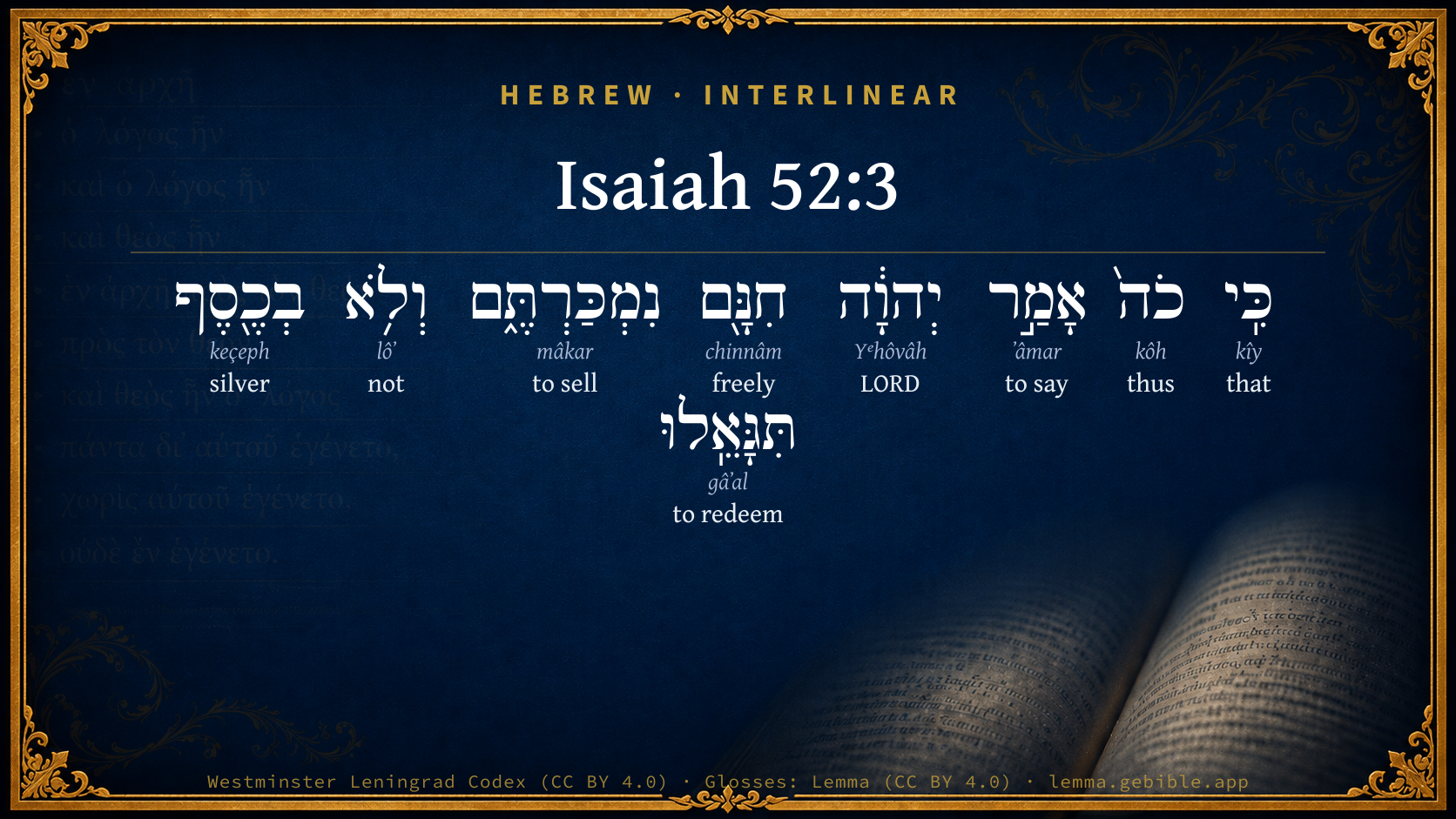
Isaiah 52:3

Hebrew (Westminster Leningrad Codex) Isaiah 52:3 appears in the Hebrew Old Testament. The text above is from the Westminster Leningrad Codex. Each word links to its Strong’s number, a concise gloss, and parsing drawn from the Open Scriptures Hebrew Bible morphology. Click any word for its full Brown-Driver-Briggs (BDB) entry.
Download image
Cite this verse

Isaiah 52:3 (World English Bible). Public Domain. Lemma interlinear Bible study tool, https://lemma.gebible.app/v/isaiah/52/3.

Show BibTeX & RIS
BibTeX
RIS
English Translation
For thus says Yahweh, You were sold for nothing; and you shall be redeemed without money.
World English Bible · Public Domain
Download a study sheet

One document with this verse’s original text, its word-by-word gloss line, the meaning frame, cross-references with their text, attributed commentary, and full source and license credits — printable, and it pastes into notes with its structure intact.

This verse Autodidact and up

Study sheet (.html) Plain text (.txt)

A passage Seminary Student

Up to 50 verses in one chapter. A passage sheet keeps up to 6 commentary sources and 12 cross-references per verse, in the order this page ranks them, and says so on the sheet whenever that leaves anything out. Ask for a single verse and you get the Autodidact verse sheet above.

Everything on this page stays free to read, with no account — the sheet is a download of what is already on screen, not access to it.

Want to remove ads? Support Godless Engineer
Compare translations 3

The same verse in 3 English versions, stacked beneath the original-language interlinear above. Click any original word for its lexicon entry.

Each is an independent rendering of the whole verse — the interlinear is not word-aligned to these translations.

Highlighted words mark where these versions differ — a whole-verse word diff, not a word-by-word alignment.

  • World English Bible Public Domain
    For thus says Yahweh, You were sold for nothing; and you shall be redeemed without money.
  • King James Version Public Domain
    For thus saith the LORD, Ye have sold yourselves for nought; and ye shall be redeemed without money.
  • unfoldingWord Literal Text CC BY-SA 4.0
    For thus says Yahweh, “You were sold for nothing, and not with silver will you be redeemed.”

unfoldingWord Literal Text — © unfoldingWord, licensed CC BY-SA 4.0. Word-aligned USFM3 via Door43 (git.door43.org/unfoldingWord/en_ult).

Versions to compare (up to 4)

3 of 4 selected

Show all 18 translations

Every available English version of this verse, each an independent rendering of the whole verse.

  • World English Bible Public Domain
    For thus says Yahweh, You were sold for nothing; and you shall be redeemed without money.
  • Berean Standard Bible Public Domain
    For this is what the LORD says: “You were sold for nothing, and without money you will be redeemed.”
  • Majority Standard Bible Public Domain
    For this is what the LORD says: “You were sold for nothing, and without money you will be redeemed.”
  • King James Version Public Domain
    For thus saith the LORD, Ye have sold yourselves for nought; and ye shall be redeemed without money.
  • American Standard Version (1901) Public Domain
    For thus saith Jehovah, Ye were sold for nought; and ye shall be redeemed without money.
  • Revised Version (1885) Public Domain
    For thus saith the LORD, Ye were sold for nought; and ye shall be redeemed without money.
  • Geneva Bible (1599) Public Domain
    For thus sayeth the Lord, Yee were solde for naught: therefore shall ye be redeemed without money.
  • Douay-Rheims (1899) Public Domain
    For thus saith the Lord: You were sold gratis, and you shall be redeemed without money.
  • Young's Literal Translation Public Domain
    For thus said Jehovah: `For nought ye have been sold, And not by money are ye redeemed.'
  • Literal Standard Version CC BY-SA 4.0
    For thus said YHWH: “You have been sold for nothing, || And you are redeemed without money.”
  • Unlocked Literal Bible CC BY-SA 4.0
    For this is what Yahweh says, “You were sold for nothing, and you will be redeemed without money.”
  • unfoldingWord Literal Text CC BY-SA 4.0
    For thus says Yahweh, “You were sold for nothing, and not with silver will you be redeemed.”
  • Darby Bible Public Domain
    For thus saith Jehovah: Ye have sold yourselves for nought, and ye shall be redeemed without money.
  • World Messianic Bible Public Domain
    For the LORD says, “You were sold for nothing; and you will be redeemed without money.”
  • Webster's Bible Public Domain
    For thus saith the LORD, Ye have sold yourselves for naught; and ye shall be redeemed without money.
  • Free Bible Version CC BY-SA 4.0
    This is what the Lord says: You were sold for nothing, and you will be bought back without money.
  • Bible in Basic English Public Domain
    For the Lord says, You were given for nothing, and you will be made free without price.
  • JPS Tanakh (1917) Public Domain
    For thus saith the LORD: Ye were sold for nought; and ye shall be redeemed without money.

Literal Standard Version (2020), Covenant Press — licensed CC BY-SA 4.0. Text via the HelloAO Bible API (eBible.org). Unlocked Literal Bible (unfoldingWord) — licensed CC BY-SA 4.0. Text via the HelloAO Bible API (eBible.org). unfoldingWord Literal Text — © unfoldingWord, licensed CC BY-SA 4.0. Word-aligned USFM3 via Door43 (git.door43.org/unfoldingWord/en_ult). Free Bible Version, Dr. Jonathan Gallagher — licensed CC BY-SA 4.0. Text via the HelloAO Bible API (eBible.org).

Word by word

More ways to search: Search by grammar → Find every occurrence → Compare this word →

Practice this passage: Drill this verse → Learn its vocabulary →

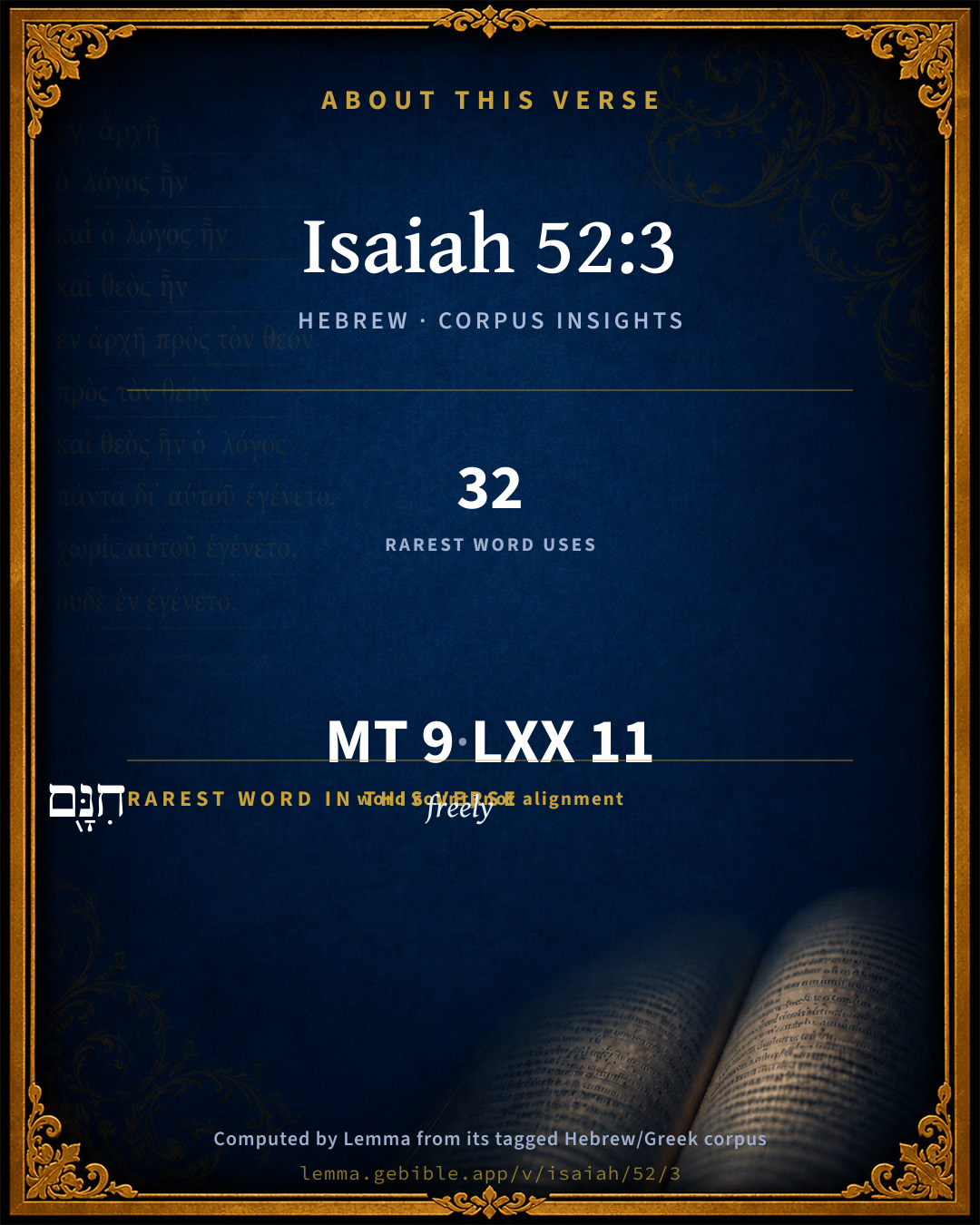
About this verse

These counts appear in no published source. They are computed here, from the morphology-tagged text and Lemma’s own curated glosses. What Lemma adds →

9
words
9
distinct lemmas
Prophets
section

Shared distinctive vocabulary

חִנָּ֖ם freely H2600 occurs in 31 verses of the Hebrew Bible. Also found in:

Grammatical profile

  • 3 verbs
  • 2 nouns
  • 1 conjunction
  • 2 adverbs
  • 1 particle

Verb forms

  • אָמַ֣ר Qal · Perfect
  • נִמְכַּרְתֶּ֑ם Niphal · Perfect
  • תִּגָּאֵֽלוּ Niphal · Imperfect

Hebrew & Septuagint length

In English translation the verse runs 16 words from the Hebrew and 19 from the Septuagint (LXX English) — closely comparable.

A rough comparison of the two English renderings, which tokenize alike — not a word-level alignment.

Word counts can differ between the Hebrew and the Greek without any difference in meaning — e.g. the Hebrew direct-object marker אֵת has no separate Greek word, and Greek often adds the article ὁ.

In the original languages it is 9 Hebrew tokens and 11 Greek tokens — but the two are counted differently (Hebrew bundles its prefixes and suffixes into one token; the Greek is in lemma form), so that isn’t a like-for-like length.

Cross-references

6

Topical passages linked to Isaiah 52:3 in the Treasury of Scripture Knowledge — connected by theme and wording, ordered by reader-vote popularity; previews shown in the World English Bible.

  • Isaiah 45:13 I have raised him up in righteousness, and I will make straight all his ways: he shall build my city, and he shall let my exiles go free, not for price nor reward, says Yahweh of Hosts.
  • 1 Peter 1:18 knowing that you were redeemed, not with corruptible things, with silver or gold, from the useless way of life handed down from your fathers,
  • Psalms 44:12 You sell your people for nothing, And have gained nothing from their sale.
  • Isaiah 50:1 Thus says Yahweh, Where is the bill of your mother's divorce, with which I have put her away? or which of my creditors is it to whom I have sold you? Behold, for your iniquities were you sold, and for your transgressions was your mother put away.
  • Jeremiah 15:13 Your substance and your treasures will I give for a spoil without price, and that for all your sins, even in all your borders.
  • Romans 7:14–25 For we know that the law is spiritual, but I am fleshly, sold under sin.

Cross-references courtesy of OpenBible.info (CC BY 4.0).

Hebrew and Greek witnesses Masoretic Hebrew ↔ Greek Septuagint

The same verse in the two great witnesses to the Old Testament, shown verse-for-verse.

These are two independent witnesses, not word-aligned to each other, and the Septuagint is shown in lemma (dictionary) form.

Hebrew Isaiah 52:3 Masoretic · Westminster Leningrad Codex

כִּֽי כֹה֙ אָמַ֣ר יְהוָ֔ה חִנָּ֖ם נִמְכַּרְתֶּ֑ם וְלֹ֥א בְכֶ֖סֶף תִּגָּאֵֽלוּ

For thus says Yahweh, You were sold for nothing; and you shall be redeemed without money.

World English Bible · Public Domain

Greek LXX Isaiah 52:3 Septuagint · lemma form

ὅτι ὅδε λέγω κύριος δωρεά πιπράσκω καί οὐ μετά ἀργύριον λυτρόω

For thus says the Lord, You⌃ have been sold for nothing; and you⌃ shall not be ransomed with silver.

LXX2012 (modern English Septuagint) · Public Domain

Hebrew: Westminster Leningrad Codex (CC BY 4.0). Greek: Septuagint (public domain); English from LXX2012 (modern English Septuagint) (Public Domain). How the Septuagint differs from the Hebrew →

Targum (Aramaic paraphrase)

1

The Targum is the ancient Jewish Aramaic paraphrase of the Hebrew Scriptures — an interpretive translation, not the Hebrew text itself. Onkelos (literal) and Pseudo-Jonathan (expansive) render the Torah, and Jonathan the Prophets. Coverage is partial: where no permissively-licensed English translation exists for a verse, only the Aramaic is shown. This is verse-level text, not a word-by-word alignment to the Hebrew.

  1. Targum Jonathan Prophets (Joshua–Malachi)
    אֲרֵי כִדְנָן אֲמַר יְיָ מַגָן אִזְדַבִּנְתּוּן וְלָא בִכְסַף תִּתְפַּרְקוּן:

    For thus saith the Lord, Ye were sold for nought; and ye shall be redeemed without money.

    Targum Jonathan — Aramaic: “Mikraot Gedolot” (public domain). English: “Sefaria Community Translation” (CC0 1.0 (public-domain dedication)); “London "Chaldee Paraphrase," 1871” (public domain). Text via Sefaria.

Commentary

Notes on Isaiah 52:3 from classic Christian and Jewish commentators (each source and its license shown beneath its notes). The classic Christian expositions comment on the surrounding passage and are grouped to its opening verse, so a note may address several verses; the Jewish commentaries on the Tanakh (Rashi and others) are per-verse, so they appear only where the commentator wrote on this verse.

Lemma curates 59 commentaries, every one of them public domain or Creative Commons licensed, each selected and text-cleaned for this edition rather than reprinted as found. About our sources →

Trapp's Complete Commentary

John Trapp

Isa 52:3 For thus saith the LORD, Ye have sold yourselves for nought; and ye shall be redeemed without money.

Ver. 3. For thus saith the Lord.] Thus he pleadeth the cause of his people. {Isa 51:22}

Ye have sold yourselves for nought.] Heb., Ye were sold for nought. I had not so much as thanks for you from the enemy; {a} no more hath he from the devil: and yet a letter was framed in Hildebrand’s days as sent from the devil, wherein he kindly thanked the Popish clergy for the many souls they daily sent him to hell by their negligence and wickedness. {b}

And ye shall be redeemed without money.] Heb., Without silver. So were we. {1Pe 1:18}

{a} Babylonii non egerunt mihi gratias. - Piscat.

{b} Mat. Paris. Hist., A.D. 1072.

John Trapp, A Commentary or Exposition upon All the Books of the Old and New Testament (1647–1656) — public domain. Text from a community e-Sword module.

The Biblical Illustrator

Joseph S. Exell

Isa_52:3

For thus saith the Lord, Ye have mold yourselves for nought

Sold for nought; redeemed without price

Ye have sold yourselves for nought.

You got nothing by it, nor did

I. God considers that when they by sin had sold themselves, He Himself, who had the prior, nay, the sole title to them, did not increase His wealth by the price (Psa_44:12). They did not so much as pay their debts to Him with it. The Babylonians gave Him no thanks for them, but rather reproached and blasphemed His name upon that account; and therefore they, having so long had you for nothing, shall at last restore you for nothing; you shall be redeemed without price, as was promised (chap. 45:13). (M. Henry.)

Selling oneself for nought

It appears to have been no unusual thing amongst the ancient Jews for a man who was sunk in debt and difficulties, and reduced to the extreme of poverty, to sell himself, or to be sold by his creditors, as a bondsman for a certain term of years. There seems to be an allusion to this circumstance in the text before us. In its strict and primary sense it relates peculiarly to the nation of the Jews, who by a long course of wicked and rebellious conduct had sold themselves, as it were, into the hands of their enemies; that is to say, their wickedness had been the immediate cause of their being delivered up by God into the hands of the Babylonians, who had reduced them into abject slavery. And they are said to have sold themselves for nought, inasmuch as there was nothing in the fruits and consequences of their sin to compensate for the miserable state into which it had reduced them. (A. Roberts, M. A.)

Redeemed without money

Did the Lord perform His word? Yes; for, after they had remained in their bondage during the time God had appointed it to last, He stirred up the spirit of Cyrus, a heathen king, to set them free. And on what terms? Captive exiles commonly pay dear for their deliverance. But what sum did Cyrus ask when he gave the Jews their liberty? Nothing whatsoever. He literally sent them home without the smallest recompense; without requiring or expecting anything at their hands. They were redeemed without money. (A. Roberts, M. A.)

Accusation and promise

A redemption, far more precious than the temporal redemption of Israel from their Babylonish bondage, is to be considered as here hinted at.

I. THE AWFUL ACCUSATION. It is twofold.

1. That we have sold ourselves. The figure here employed is used in other passages,of Scripture, to express the conduct of the sinner in abandoning himself to Satan s service. Thus of Ahab it is said, he did sell himself to work wickedness in the sight of the Lord; and of the people whom he governed, they sold themselves to do evil in the sight of the Lord to provoke Him to anger. St. Paul adopts a similar expression, in reference to himself, The law is spiritual, but I am carnal, sold under sin. In all these places the idea under which the conduct of sinners is described is that of a man selling himself for a slave. And under this guilt we are every one of us included.

2. That we have sold ourselves for nought.

(1) Look at the inducements of our sins--at the motives which led us to commit them. O how lightly and how cheaply have we yielded ourselves up to Satans service! He has not needed, as in our Lords case, to promise all the kingdoms of the world and the glory of them; he has not needed to tempt us with large offers or golden baits.

(2) Look again to the consequences of our sins. There have been many times, no doubt, when we have committed sin in expectation of some great advantage to be gained by it. But what has been the price? Bitter disappointment, pain, grief, anguish, and in the end, everlasting death. Such have been the only fruits which men have ever gathered from their sins.

II. THE MOST GRACIOUS PROMISE OR PROPOSAL. Ye shall be redeemed, etc. As freely as you have given yourselves up to ruin, so freely am I ready to deliver you from that ruin. Considered in this light, in what a striking manner does my text present to us the riches of Gods grace towards a ruined world! But to comprehend this matter more distinctly, look at the Cross of Jesus! (A. Roberts, M. A.)

Self-selling

The whole world is an emporium; buying and selling are going on everywhere. The text refers to the sale of self.

I. It is the most COMMON SALE in the emporium of the world. What do I mean by self? Not the body, not the mere bundle of intellectual faculties, but the conscience, the moral ego, the inner man, that which works the faculties and which will live when the body is dust. Now, men are selling this manhood for a variety of things.

1. For pleasure. The voluptuary and the debauchee have sold it, and it is gone far into the mud of sensuality.

2. For wealth. The worldling has sold it, and it is gone into the miserly grub.

3. For fame. The aspirant for worldly honours and distinctions has sold it, and it is lost in the rolling current of fashion.

II. It is the most FOOLISH SALE in the emporium of the world. Sold yourselves for nought. The man who has sold it far pleasure, what has he got? Nought. What is sensual pleasure but the pleasure of animals at best? and this wears out as animal life decays. Desire faileth. The man who has sold it for wealth, what has he got? That which will soon take wings and fly away. What shall it profit a man? etc. The man who has sold it for fame, what has he got? That which, if aromatic to-day, may be a stench to-morrow, and never at any time self-satisfying. Charles Lamb had fame, and what did he say? I walk up and down, thinking I am happy, but knowing I am not.

III. It is the most UNRIGHTEOUS SALE in the emporium of the world. No man has a right to sell his soul. All souls are Mine, saith God. Reason says you have no right to sell your soul; you are not self-produced nor self-sustained. Conscience says you have no right to sell your soul; as you barter it away, it groans damnation at you. God made the soul to investigate His works, adore His character and serve His will. (Homilist.)

Man unregenerate and regenerate

I. WHAT IS THE CONDITION OF MANKIND WHEN UNREGENERATE? In a state of sin, the text hath represented us as selling ourselves for nought; where each word is emphatical, and carries a peculiar sting in it.

1. We take upon us to drive a bargain where we have no propriety in what we expose to sale. What the prophet here charges us with exposing to sale is ourselves; and this, in other words, implies our souls, with all the interest which they have elsewhere depending upon our behaviour. Now in these our propriety is strictly and truly derivative and borrowed; it was God who made us, and not we ourselves; and every faculty and every power wherewith He hath entrusted us are employed injuriously whenever they run counter to His will and pleasure.

2. Let us consider what we are doing when we are selling ourselves. Our souls which were made to be immortal are the things we are bartering in this foolish bargain. And when once we have parted with them, what would we not give in exchange for them, to have them again, and save them?

3. The folly is yet farther aggravated by the consideration whhereupon we are induced to this wretched bargain. For the text hath charged us with selling ourselves for nought.

II. WHAT WHEN REGENERATE? What Christ hath done for us in the affair of our redemption, by cancelling the handwriting which lay against us, was on His part free grace and bounty. Our redemption being conditional, proceed we to consider the terms whereunto it is limited.

1. Repentance from dead works.

2. Faith.

3. A sincere obedience will naturally follow. (N. Marshall, D.D.)

The sinners ruin and recovery

I. THE SOLEMN STATEMENT.

II. A JOYFUL PROMISE. And ye shall be redeemed without money.

1. This redemption could not be effected by human means.

2. Nor is this redemption provided by the law which the sinner has transgressed.

3. It must be effected in a way that will secure the honour of the Divine law, as well as the salvation of the sinner. There is redemption by price, and redemption by power, and each is suited to our state.

4. The redemption of man was effected by Christ at a great price. Ye shall be redeemed without money. As the misery to which the sinner was exposed was infinite, so his deliverance required infinite means.

5. The effect of these sufferings is our redemption from captivity, and deliverance from the curse of the law. By faith, therefore, in the sacrifice of the Saviour deliverance is to be obtained. (Helps for the Pulpit.)

Ye shall be redeemed without money

The cheapness of moral redemption

Redemptions, social, commercial, and political, are generally very costly things. Millions of lives have been sacrificed, and untold treasures of gold expended in order to redeem from temporal bondage. But true moral redemption--the redemption of the soul from error to truth, from selfishness to benevolence, from the devil to God--is cheap. Without money.

I. THE MEANS OF MORAL REDEMPTION COST NOTHING.

1. You have Christ for nothing, He has given Himself.

2. You have the Bible for nothing.

3. You have the Spirit for nothing. No man can excuse himself for his moral bondage on the ground that he is too poor to obtain the means of redemption.

II. THE LABOUR INVOLVES NO SACRIFICE. Every moral bondsman must labour if he would be free, there is no moral emancipation irrespective of individual effort. Each captive must strike some hearty strokes ere his chains can be broken. But in this work there is no effort involving secular sacrifice. It need not prevent a man pursuing his ordinary avocations. He can be working out his freedom as well, if not better, when cultivating his farm, plying his handicraft, pursuing his merchandise, as alone in his chamber on his knees.

III. THE STRUGGLES CONDUCE TO TEMPORAL PROSPERITY (Mt 1Ti_4:8). (Homilist.)

The Biblical Illustrator, edited by Joseph S. Exell (c. 1880s–1900s) — public domain. Text from a community e-Sword module.

The Preacher's Complete Homiletical Commentary

Joseph S. Exell (gen. ed.)

SELLING AND REDEEMING THE SOUL

Isa_52:3. For thus saith the Lord, Ye have sold yourselves for nought, &c.

The Jews had gone headlong into sin, and as a punishment they had been carried captive to Babylon. They found that iniquity did not pay. Cyrus seized Babylon, and felt such pity for the captives, that without any compensation he let them go home. All of this is typical of a higher truth.

I. “Ye have sold yourselves for nought.” There are persons who do not seem to belong either to themselves or to God; the title-deeds have been passed over to “the world, the flesh, and the devil;” but the purchaser has never paid up. They have made over their entire nature, but the holders of the deeds, when called on for the money, declare themselves bankrupt. The world does not keep its promises; it does not pay ninety per cent., nor twenty, nor one; it gives no solace when friends die; no peace when conscience rings its alarm. “Ye have sold yourselves for nought;” your conscience went; your hope went; your Bible went; your heaven went, all for nothing.

II. “Ye shall be redeemed without money.” You were cheated out of your soul; the world has no right to take the title-deed from you. It can be proved. You need not say you are afraid of lawsuits, they are so expensive; for “ye shall be redeemed without money.”

Money is good for a great deal, but it cannot do anything in this matter of the soul. Blood is here the only lawful tender. Neither is our blood rich enough; it needs a sinless stream. We have in this day some who do not want a religion of blood; but the Bible says, “In the blood is the life;” and an apostle (1Pe_1:18-19). You put your lancet into the arm of our holy religion and withdraw the blood, and you leave it a mere corpse! No blood, no atonement, as prefigured in the Levitical sacrifices; “without shedding of blood there is no remission.” Some one says, “the thought of blood sickens me.” God intended it to sicken you with your sin; your sin caused Christ’s blood-shedding.

The highest price ever paid for anything was paid for your soul. The estranged property is bought back. Take it; “ye have sold yourselves for nought, and ye shall be redeemed without money.” Here is the price of your liberation—not money, but blood.—T. De Witt Talmage, D.D.: Christian Age, vol. ix. pp. 67–69.

Briefly review the circumstances under which these words were spoken. Israel had sold themselves as slaves, and for nothing. They were to be restored without money (Isa_45:13). All this equally applicable to us today. Israel’s captivity was temporal, ours is spiritual, and our redemption by Christ is “without money.” These words suggest—

I. SELLING THE SOUL. “Ye have sold yourselves for nought.”

1. What you have sold. Not your wares, your possessions, &c., but “yourselves.” “Not the body, not the mere bundle of intellectual faculties, but the conscience, the moral ego, the inner man,” that which works the faculties and which will live when the body is dust. It is your soul you have sold—the most precious thing God has given you—the gem of creation—the grand mark of man—the great possession. Put all the splendours of the visible creation into the scale, one soul outweighs them all (P. D. 3204). How many never think of the value of their soul, but sell it for the merest trifle.

2. To whom you have sold yourselves. To Satan. The worst being in God’s universe—the enemy of God and man—the enslaver and destroyer of souls (2Ti_2:26; Eph_2:1-2; Rom_6:17-19). To do his deadly work, and to be led captive at his will.

3. For what you have sold yourselves.

(1.) For worldly pleasure. But that is “nought”—unsatisfying, vanishing, leaves an aching void the world can never fill (Isa_55:2; H. E. I. 4609–4612).

(2.) For worldly wealth. But that is “nought”—will soon take wings and fly away. Wealth is not happiness—cannot procure the elixir of immortality—often degrades. Wealth is useless when, like Esau, we are “at the point to die” (Luk_12:15; Mar_8:36; H. E. I. 4358–4365, 4382–4386, 4389–4411).

(3.) For worldly fame. But that is “nought.” At best it is unsatisfying. Charles Lamb had fame, and what did he say? “I walk up and down thinking I am happy, but knowing I am not.” The great Dr. Johnson had fame, and what did he say? “I am afraid that some day I shall get crazy.” Such testimonies multiply daily. Verily, “all is vanity,” &c. (Ecc_2:11).

4. Who sold you? “Yourselves.”

(1.) It is a voluntary bargain. You cannot blame Adam, for, had you been in his place, you would have acted like him, &c. You love sin and sinful pleasures.

(2.) It is an unjust bargain. Reason and conscience say you have no right to sell your soul, for it belongs to God. “All souls are mine” (Heb_12:9; 1Co_6:19).

(3.) You must confess that you have made a bad bargain, and that the outcome of it is deception, disappointment, embarrassment, &c. (Hos_8:7).

II. REDEEMING THE SOUL.

1. The redemption of the soul could not be effected by any human means. The state of fallen man was so desperate that there was no hope for him in himself—no redeeming principle in his apostate nature; no possible way by which he could pay the price of his ransom. Nothing that the whole universe could offer, would be accepted as the price of it (Mic_6:6-7; Luk_7:42). Obedience to the moral law could not secure it, for it has been broken, and whatever man did in the way of righteousness, he would render no more than is absolutely due to God; besides, he is unable to obey it perfectly (Act_13:39; Rom_5:6; Rom_8:8; Rom_3:20; Rom_3:28; Gal_2:16, &c.)

2. The redemption of the soul was effected by the Son of God. In man’s desperate circumstances Divine mercy interposed, for nothing less than the sacrifice of “the Son of God” could remedy the infinite evil which sin had entailed upon humanity. Christ, the Ransomer, was Divine—met and satisfied the infinite demands of inviolable justice—assumed our nature in a state of lowliness and humiliation, but free from every stain of sin, that He might obey the law which man had broken, and suffer and die “the just for the unjust, that He might,” legally, “bring us to God” (Isa_53:5; Isa_53:10; Rom_8:3; 2Co_5:21; Gal_3:13; 1Pe_3:18; 1Pe_1:18-19). Our redemption by Christ secures the honour of the Divine character and law, &c. That would be no redemption which should cost the sacrifice of a single principle in the government of God, or make any compromise with the offenders. The justification of the penitent believer is perfectly consistent with the essential righteousness of God (Rom_3:24-26).

3. Personal redemption is realised by penitent faith in the Saviour’s atoning sacrifice (Mar_1:15; Joh_3:14-18; Joh_6:40; Joh_6:47; Joh_11:25-26; Act_20:20-21). Thus, repentance and faith are the conditions of personal redemption; while it is faith—a faith that presupposes repentance—which is emphatically the means of connecting the sinner with Christ, so that he is admitted to the Divine favour, and receives the Holy Spirit to inspire filial confidence, and to renew his soul. What repentance implies. The nature of the faith which is emphatically the condition and means of personal redemption:—reliance, appropriation, trust, coming to Jesus, receiving of Christ, &c. (H. E. I. 1957–1968.) The warrant of faith—Christ’s promises (Mat_11:28; Joh_6:35; Joh_6:37); the declared will and purpose of the Father, which assures the sinner that he cannot come to Christ in self-renunciation and be rejected (Joh_6:38-40; Rom_8:32). Personal redemption is therefore perfectly gratuitous—“without money,” without personal merit; and consequently is a manifestation of the abounding graciousness of God. St. Paul lays great stress on this (Rom_3:24; Rom_4:16; Rom_3:28). How excellent is this method of personal redemption, for it is adapted to all mankind (Rom_3:29-30); it shuts out pride from man (Rom_5:2-7); and it establishes the law (Rom_5:21).

CONCLUSION: Gratefully avail yourselves of God’s method of redemption offered to you in the Gospel, and constantly proclaimed to you by the ambassadors of Christ. It is suited to you. Let the redemption of your soul be your chief business—your “first” work. You may realise it now. The value of the present opportunity is unspeakably great. It may be now or never (Psa_49:8).—Alfred Tucker.

I. THE LORD’S CHARGE AGAINST HIS PEOPLE. “Ye have sold yourselves for nought.”

It teaches us,

1. That we are a sort of trading creatures; indigent and restless, wanting something we have not, and looking about to find it, that we may be happy. Buying and selling to get gain, that we may be happy. “For thus saith the Lord, Ye have sold yourselves for nought,” &c. (Psa_4:6; Jas_4:13.)

2. That which we part with for this supposed happiness is inestimably precious. Ourselves (Isa_1:1; Mar_8:36-37).

4. That the state into which we sell ourselves is deplorable. Like slaves. Joseph sold into Egypt (Psa_105:17-18). The Jews sold themselves into Babylon. “Tied with the chain of our sins” (Psa_9:17; Isa_52:5; Rev_3:17).

4. That the enemy to whom we sell ourselves is the devil (2Ti_2:26; Luk_9:21). Seen in Adam and Eve (Gen_3:1, &c), Judas, Ananias. Jesus Christ was tempted to this (Mat_4:8-9).

5. That we are volunteers in the sale of ourselves. “For thus saith the Lord, Ye have sold yourselves for nought,” &c. Ahab sold himself to work wickedness (Hos_13:9). The prodigal. Eve (Gen_3:6).

6. That in thus selling ourselves we rob and offend God. Because we are His creatures (Psa_100:1, &c.) We waste His goods (Luk_16:1).

7. That what we get in thus selling ourselves is nothing. “For thus saith the Lord, Ye have sold yourselves for nought,” &c. (Isa_55:1, &c.; Ecc_2:11; Hos_8:7).

II. GOD’S GRACIOUS DECLARATION CONCERNING THEM.

“Ye shall be redeemed without money.” which teaches us,

1. That God recovers His people to their forfeited privileges and enjoyments. “Redeemed” (1Sa_30:18; 1Sa_30:20). Such as

(1.) acceptance with God. As to their persons and services (Eph_1:6; Gen_4:4; Eze_20:40-41).

(2.) Conformity to the glorious image of God (2Co_3:18; Eph_4:24; 1Jn_3:2).

(3.) Fellowship with God. Adam had this (Gen_2:15, &c.) Believers have this (Eph_2:18; 1Jn_1:1-2).

(4.) A system of providential blessings (Rom_8:28; 1Co_3:1, &c.)

2. That this recovery is by redemption. “For thus saith the Lord, Ye have sold yourselves for nought,” &c. By price (Act_20:28). By power (Deu_7:8; Psa_106:1; Psa_106:7; Hos_13:14).

3. That this redemption is without money or merit on our part. “For thus saith the Lord, Ye have sold yourselves for nought,” &c. (Isa_55:1-2; Eze_20:42; Eze_20:44; Luk_7:42).

CONCLUSION.—

1. To the young, with whom Satan is beginning to tamper and bargain.

2. To the Antinomian, casting the blame of his captivity upon God. Adam and Eve (Gen_3:1, &c.)

3. To the captive—feeling his yoke, weakness and unworthiness (Jer_31:18; Jer_31:20; Rom_7:1, &c.)

4. To the ransomed returning Christian (Psa_126:1, &c.; Isa_35:10).—New Pulpit Assistant, pp. 226–230.

The Preacher's Complete Homiletical Commentary (gen. ed. Joseph S. Exell; Funk & Wagnalls, c. 1892) — public domain (pre-1929). A full-Bible homiletical/sermon-outline anthology covering 65 of 66 books (2 John is absent from the source module). Text from a community e-Sword module.

Keil & Delitzsch

C. F. Keil & F. Delitzsch

The reason for the address is now given in a well-sustained promise. "For thus saith Jehovah, Ye have been sold for nothing, and ye shall not be redeemed with silver. For thus saith the Lord Jehovah, My people went down to Egypt in the beginning to dwell there as guests; and Asshur has oppressed it for nothing. And now, what have I to do here? saith Jehovah: for my people are taken away for nothing; their oppressors shriek, saith Jehovah, and my name is continually blasphemed all the day. Therefore my people shall learn my name; therefore, in that day, that I am He who saith, There am I." Ye have been sold (this is the meaning of Isa 52:3); but this selling is merely a giving over to a foreign power, without the slightest advantage accusing to Him who had no other object in view than to cause them to atone for their sins (Isa 50:1), and without any other people taking their place, and serving Him in their stead as an equivalent for the loss He sustained. And there would be no need of silver to purchase the favour of Him who had given them up, since a manifestation of divine power would be all that would be required (Isa 45:13). For whether Jehovah show Himself to Israel as the Righteous One or as the Gracious One, as a Judge or as a Redeemer, He always acts as the Absolute One, exalted above all earthly affairs, having no need to receive anything, but able to give everything. He receives no recompense, and gives none. Whether punishing or redeeming, He always guards His people's honour, proving Himself in the one case to be all-sufficient, and in the other almighty, but acting in both cases freely from Himself.

In the train of thought in Isa 52:4-6 the reason is given for the general statement in Isa 52:3. Israel went down to Egypt, the country of the Nile valley, with the innocent intention of sojourning, i.e., living as a guest (gūr) there in a foreign land; and yet (as we may supply from the next clause, according to the law of a self-completing parallelism) there it fell into the bondage of the Pharaohs, who, whilst they did not fear Jehovah, but rather despised Him, were merely the blind instruments of His will. Asshur then oppressed it bephes, i.e., not "at last" (ultimo tempore, as Hvernick renders it), but (as אפס is the synonym of אין in Isa 40:17; Isa 41:2) "for nothing," i.e., without having acquired any right to it, but rather serving in its unrighteousness simply as the blind instrument of the righteousness of Jehovah, who through the instrumentality of Asshur put an end first of all to the kingdom of Israel, and then to the kingdom of Judah. The two references to the Egyptian and Assyrian oppressions are expressed in as brief terms as possible. But with the words "now therefore" the prophecy passes on in a much more copious strain to the present oppression in Babylon. Jehovah inquires, Quid mihi hic (What have I to do here)? Hitzig supposes pōh (here) to refer to heaven, in the sense of, "What pressing occupation have I here, that all this can take place without my interfering?" But such a question as this would be far more appropriate to the Zeus of the Greek comedy than to the Jehovah of prophecy. Knobel, who takes pōh as referring to the captivity, in accordance with the context, gives a ridiculous turn to the question, viz., "What do I get here in Babylonia, from the fact that my people are carried off for nothing? Only loss." He observes himself that there is a certain wit in the question. But it would be silly rather than witty, if, after Jehovah had just stated that He had given up His people for nothing, the prophet represented Him as preparing to redeem it by asking, "What have I gained by it?" The question can have no other meaning, according to Isa 22:16, than "What have I to do here?" Jehovah is thought of as present with His people (cf., Gen 46:4), and means to inquire whether He shall continue this penal condition of exile any longer (Targum, Rashi, Rosenmller, Ewald, Stier, etc.). The question implies an intention to redeem Israel, and the reason for this intention is introduced with kı̄. Israel is taken away (ablatus), viz., from its own native home, chinnâm, i.e., without the Chaldeans having any human claim upon them whatever. The words יהיליילוּ משׁליו (משׁלו) are not to be rendered, "its singers lament," as Reutschi and Rosenmller maintain, since the singers of Israel are called meshōrerı̄m; nor "its (Israel's) princes lament," as Vitringa and Hitzig supposed, since the people of the captivity, although they had still their national sârı̄m, had no other mōshelı̄m than the Chaldean oppressors (Isa 49:7; Isa 14:5). It is the intolerable tyranny of the oppressors of His people, that Jehovah assigns in this sentence as the reason for His interposition, which cannot any longer be deferred. It is true that we do meet with hēlı̄l (of which we have the future here without any syncope of the first syllable) in other passages in the sense of ululare, as a cry of pain; but just as הריע, רנן, רזח signify a yelling utterance of either joy or pain, so heeliil may also be applied to the harsh shrieking of the capricious tyrants, like Lucan's laetis ululare triumphis, and the Syriac ailel, which is used to denote a war-cry and other noises as well. In connection with this proud and haughty bluster, there is also the practice of making Jehovah's name the butt of their incessant blasphemy: מנּאץ is a part. hithpoel with an assimilated ת and a pausal ā for ē, although it might also be a passive hithpoal (for the ō in the middle syllable, compare מגאל, Mal 1:7; מבהל, Est 8:14). In Isa 52:6 there follows the closing sentence of the whole train of thought: therefore His people are to get to learn His name, i.e., the self-manifestation of its God, who is so despised by the heathen; therefore lâkhēn repeated with emphasis, like כּעל in Isa 59:18, and possibly min in Psa 45:9) in that day, the day of redemption, (supply "it shall get to learn") that "I am he who saith, Here am I," i.e., that He who has promised redemption is now present as the True and Omnipotent One to carry it into effect.

Keil & Delitzsch — Biblical Commentary on the Old Testament (1861–1891) — public domain (CC PDM 1.0). Text via the HelloAO Bible API. (Old Testament only.)

MacLaren's Expositions of Holy Scripture

Alexander MacLaren

Isaiah

A PARADOX OF SELLING AND BUYING

Isa 52:3.

THE first reference of these words is of course to the Captivity. They come in the midst of a grand prophecy of freedom, all full of leaping gladness and buoyant hope. The Seer speaks to the captives; they had ‘sold themselves for nought.’ What had they gained by their departure from God?-bondage. What had they won in exchange for their freedom?- only the hard service of Babylon. As Deuteronomy puts it: ‘Because thou servedst not the Lord thy God with joyfulness. . . by reason of the abundance of all things, therefore shalt thou serve thine enemies. . . in want of all things.’ A wise exchange! a good market they had brought their goods to! In striking ironical parallel the prophet goes on to say that so should they be redeemed. They had got nothing by bondage, they should give nothing for liberty. This text has its highest application in regard to our captivity and our redemption.

I. The reality of the captivity.

The true idea of bondage is that of coercion of will and conscience, the dominance and tyranny of what has no right to rule. So men are really in bondage when they think themselves most free. The only real slavery is that in which we are tied and bound by our own passions and lusts. ‘He that committeth sin is the slave of sin.’ He thinks himself master of himself and his actions, and boasts that he has broken away from the restraints of obedience, but really he has only exchanged masters. What a Master to reject-and what a master to prefer!

II. The voluntariness of the captivity.

‘Ye have sold yourselves,’ and become authors of your own bondage. No sin is forced upon any man, and no one is to blame for it but himself. The many excuses which people make to themselves are hollow. Now-a-days we hear a great deal of heredity, how a man is what his ancestors have made him, and of organisation, how a man is what his body makes him, and of environment, how a man is what his surroundings make him. There is much truth in all that, and men’s guilt is much diminished by circumstances, training, and temperament. The amount of responsibility is not for us to settle, in regard to others, or even in regard to ourselves. But all that does not touch the fact that we ourselves have sold ourselves. No false brethren have sold us as they did Joseph.

The strong tendency of human nature is always to throw the blame on some one else; God or the devil, the flesh or the world, it does not matter which. But it remains true that every man sinning is ‘drawn away of his own lust and enticed.’

After all, conscience witnesses to the truth, and by that mysterious sense of guilt and gnawing of remorse which is quite different from the sense of mistake, tears to tatters the sophistries. Nothing is more truly my own than my sin.

III. The profitlessness of the captivity.

‘For nought’; that is a picturesque way of putting the truth that all sinful life fails to satisfy a man. The meaning of one of the Hebrew words for sin is ‘missing the mark.’ It is a blunder as well as a crime. It is trying to draw water from broken cisterns. It is ‘as when a hungry man dreameth and behold he eateth, but he awaketh and his soul is empty.’ Sin buys men with fairy money, which looks like gold, but in the morning is found to be but a handful of yellow and faded leaves. ‘Why do ye spend your money for that which is not bread?’ It cannot but be so, for only God can satisfy a man, and only in doing His will are we sure of sowing seed which will yield us bread enough and to spare, and nothing but bread. In all other harvests, tares mingle and they yield poisoned flour. We never get what we aim at when we do wrong, for what we aim at is not the mere physical or other satisfaction which the temptation offers us, but rest of soul-and that we do not get. And we are sure to get something that we did not aim at or look for-a wounded conscience, a worsened nature, often hurts to health or reputation, and other consequent ills, that were carefully kept out of sight, while we were being seduced by the siren voice. The old story of the traitress, who bargained to let the enemies into the city, if they would give her ‘what they wore on their left arms,’ meaning bracelets, and was crushed to death under their shields heaped on her, is repeated in the experience of every man who listens to the ‘juggling fiends, who keep the word of promise to the ear, but break it to the hope.’ The truth of this is attested by a cloud of witnesses. Conscience and experience answer the question, ‘What fruit had ye then in those things whereof ye are now ashamed?’ Wasted lives answer; tyrannous evil habits answer; diseased bodies, blighted reputations, bitter memories answer.

IV. The unbought freedom.

‘Ye shall be redeemed without money.’ You gained nothing by your bondage; you need give nothing for your emancipation. The original reference is, of course, to the great act of divine power which set these literal captives free, not for price nor reward. As in the Exodus from Egypt, so in that from Babylon, no ransom was paid, but a nation of bondsmen was set at liberty without war or compensation. That was a strange thing in history. The paradox of buying back without buying is a symbol of the Christian redemption.

{1} A price has been paid.

‘Ye were redeemed not with corruptible things as silver and gold, but with the precious blood of Christ.’ The New Testament idea of redemption, no doubt, has its roots in the Old Testament provisions for the Goel or kinsman redeemer, who was to procure the freedom of a kinsman. But whatever figurative elements may enter into it, its core is the ethical truth that Christ’s death is the means by which the bonds of sin are broken. There is much in the many-sided applications and powers of that Death which we do not know, but this is clear, that by it the power of sin is destroyed and the guilt of sin taken away.

{2} That price has been paid for all.

We have therefore nothing to pay. A slave cannot redeem himself, for all that he has is his master’s already. So, no efforts of ours can set ourselves free from the ‘cords of our sins.’ Men try to bring something of their own. ‘I do my best and God will have mercy.’ We will bring our own penitence, efforts, good works, or rely on Church ordinances, or anything rather than sue in forma pauperis. How hard it is to get men to see that ‘It is finished,’ and to come and rest only on the mere mercy of God.

How do we ally ourselves with that completed work? By simple faith, of which an essential is the recognition that we have nothing and can do nothing.

Suppose an Israelite in Babylon who did not choose to avail himself of the offered freedom; he must die in bondage. So must we if we refuse to have eternal life as the gift of God. The prophet’s paradoxical invitation, ‘He that hath no money, come ye, buy. . . without money,’ is easily solved. The price is to give up ourselves and forsake all self-willed striving after self-purchased freedom which is but subtler bondage. ‘If the Son make you free, ye shall be free indeed.’ If not, then are ye slaves indeed, having ‘sold yourselves for nought,’ and declined to be ‘redeemed without money.’

Alexander MacLaren, Expositions of Holy Scripture (1904–1910) — public domain. Text from a community e-Sword module.

Tyndale Open Study Notes

Tyndale Open Resources

52:3 I sold you into exile . . . Now I can redeem you: The Lord was fully in control when he gave his people into the hands of their enemies. Likewise, he remained fully in control and could redeem them if he chose to do so.

Tyndale Open Study Notes — © Tyndale Open Resources, licensed CC BY-SA 4.0. Text via the HelloAO Bible API.

Geneva Bible (1599)

Geneva Bible translators

The Babylonians paid nothing to me for you: therefore I will take you again without ransom.

Geneva Bible (1599) marginal notes — public domain. Text via Bolls.life.

Jamieson, Fausset & Brown

Robert Jamieson, A. R. Fausset & David Brown

As you became your foes' servants, without their paying any price for you (Jer 15:13), so they shall release you without demanding any price or reward (Isa 45:13), (where Cyrus is represented as doing so: a type of their final restoration gratuitously in like manner). So the spiritual Israel, "sold under sin," gratuitously (Rom 7:14), shall be redeemed also gratuitously (Isa 55:1).

Jamieson, Fausset & Brown — Commentary Critical and Explanatory on the Whole Bible (1871) — public domain (CC PDM 1.0). Text via the HelloAO Bible API.

Ellicott's Commentary for English Readers

(3) Ye have sold yourselves . . .—Literally, ye were sold. The people had complained that Jehovah had “sold them” into the hands of their enemies (Psa_44:12). “Not so,” is the answer. “There was no real sale, only a temporary transfer, and therefore Jehovah can redeem you at His own pleasure. A comparison with Isa_43:3, shows how spiritual truths may present aspects that require the most opposite illustrations.

A Bible Commentary for English Readers, edited by Charles John Ellicott (1878–1897) — public domain. Text from a community e-Sword module.

The Cambridge Bible for Schools and Colleges

gen. ed. J. J. S. Perowne

3. Ye have sold yourselves] R.V. Ye were sold; See on ch. Isa_50:1; cf. Psa_44:12.

redeemed without money] Cf. ch. Isa_45:13. Jehovah gained nothing by delivering Israel into the hand of its enemies, and He asks nothing as the price of its redemption.

3–6. There is here a sudden change both in form and subject. The rhythmic structure of the preceding verses gives place to prose, and the figure of Jerusalem arising from the dust is altogether abandoned. Jehovah is represented as deliberating with Himself on the religious situation, so injurious to His honour, brought about by the unprecedented calamities of His people (Isa_52:4-5), and as resolving to end it by their deliverance (6). It is doubtful if the passage was the original sequel to Isa_52:1-2.

The Cambridge Bible for Schools and Colleges (gen. ed. J. J. S. Perowne; Cambridge University Press, 1878–1918) — public domain. Text from a community e-Sword module.

John Gill's Exposition

For thus saith the Lord, ye have sold yourselves for nought,.... As Ahab did to work wickedness; as men do freely, and get nothing by it; for there is nothing got in the service of sin, Satan, and antichrist, or by being slaves and vassals to them; not profit, but loss; not pleasure, but pain; not honour, but shame; not liberty, but bondage; not riches and wealth, but poverty and want, which Popery always brings into those countries and people where it obtains.

And ye shall be redeemed without money; in like manner as our spiritual and eternal redemption from sin, Satan, and the law, the world, death, and hell, is obtained; not without the price of the precious blood of the Lamb, but without such corruptible things as silver and gold, Pe1 1:18 and without any price paid to those by whom we are held captive, but to God, against whom we have sinned, whose law we have broken, and whose justice must be satisfied; and the blood of Christ is a sufficient price to answer all: hence redemption, though it cost Christ much, is entirely free to us; so will the redemption of the church, from the bondage and slavery of antichrist, be brought about by the power of God undeserved by them; not through their merits, and without any ransom price paid to those who held them captives.

John Gill's Exposition of the Whole Bible (1746–1763) — public domain (CC PDM 1.0). Text via the HelloAO Bible API.

Albert Barnes' Notes on the Bible

Ye have sold yourselves for nought - You became captives and prisoners without any price being paid for you. You cost nothing to those who made you prisoners. The idea is, that as they who had made them prisoners had done so without paying any price for them, it was equitable that they should be released in the same manner. When their captors had paid nothing for them, God would suffer nothing to be paid for them in turn; and they should be released, as they had been sold, without a price paid for them. Perhaps God intends here to reproach them for selling themselves in this manner without any compensation of any kind, and to show them the folly of it; but, at the same time, he intends to assure them that no price would be paid for their ransom.

Ye shall be redeemed - You shall be delivered from your long and painful captivity without any price being paid to the Babylonians. This was to be a remarkable proof of the power of God. Men do not usually give up captives and slaves, in whatever way they may have taken them, without demanding a price or ransom. But here God says that he designs to effect their deliverance without any such price being demanded or paid, and that as they had gone into captivity unpurchased, so they should return unpurchased. Accordingly he so overruled events as completely to effect this. The Babylonians, perhaps, in no way could have been induced to surrender them. God, therefore, designed to raise up Cyrus, a mild, just, and equitable prince; and to dispose him to suffer the exiles to depart, and to aid them in their return to their own land. In this way, they were rescued without money and without price, by the interposition of another.

Albert Barnes' Notes on the Bible (1834–1885) — public domain. Text from a community e-Sword/MySword module.

Haydock's Catholic Bible Commentary

Money. The Chaldeans acted impolitically in leaving the country without inhabitants, and Cyrus will derive no immediate advantage from your return. (Calmet) --- The Jews had not injured the Chaldeans, nor mankind the devil. But both had offended God, who out of mercy paid their ransom. (Worthington)

George Leo Haydock (1774–1849), Haydock's Catholic Family Bible and Commentary, 1859 edition — public domain. Excludes Psalms (Douay-Rheims chapter numbering differs from Protestant) and Deuterocanonical books (Catholic canon only).

Matthew Poole's English Annotations

Ye have sold yourselves, by your sins, into the hands of the Chaldeans,

for nought; without any price or valuable consideration paid by them, either to you or to me, your Lord and Owner.

Ye shall be redeemed without money; without paying any ransom.

Matthew Poole's English Annotations on the Holy Bible (1683–1685) — public domain. Text from a community e-Sword/MySword module.

Whedon's Commentary on the Bible

Daniel D. Whedon

3-6. Shall be redeemed without money — As the Babylonians paid no price for Israel, so they shall receive none for her return. God punishes injustice all round. His people, long time ago, went down to Egypt ostensibly to stay only till provision for their families should be obtainable in their own country. And because Egypt unjustly enslaved them, God overthrew the Egyptian king and his hosts. Equally, without cause, the Assyrian also became the oppressor of Israel.

Now… what have I here — That is, in the matter of remuneration to the Assyrio-Babylonian. On his part he carried Israel away unjustly, and cruelly treated her. Yet now these oppressors howl and rail at Jehovah for reclaiming his own with no offer of pay. Israel, indeed, was at fault, but not against the Babylonians. She sold herself to captivity, but this injury was toward God, for he had the exclusive right to ownership in her. The honour of Jehovah himself demanded her restoration without price, for she was sold for nothing; he had in return for her just nothing, except infamy upon his holy name. Because the desolation of Jerusalem for so long a time has been an injury to him, to his honour, he will now (Isa_52:6) reveal his name.

My people shall know my name — Whether he is thought of as El, or Elohim, or Jehovah, in each, or in all together, his name signifies the absolute, eternal, peaceful One, sole Creator and Ruler of all things.

In that day — The day when his Jerusalem-Zion and her people shall be completely restored, historically and spiritually, these wicked oppressors and all the oppressed shall know, and my people emphatically shall know, that I am he that doth speak. That is, that He who promised redemption is now present as the true and omnipotent One to carry it into effect.

Daniel D. Whedon (gen. ed.), Commentary on the Old and New Testaments (1874–1909) — public domain. Text from a community e-Sword module.

The Pulpit Commentary

Ye have sold yourselves for nought; rather, for nought were ye sold. God received nothing when he allowed his people to become the slaves of the Babylonians. He took no price for them, (see Isa_50:1) and therefore is free to claim them back without payment. (comp. Isa_45:13) He has but to say the word; and he is about to say it.

The Pulpit Commentary (1880–1919), ed. H.D.M. Spence-Jones & Joseph S. Exell — public domain. Text from a community e-Sword module.

John Wesley's Explanatory Notes

Sold yourselves - By your sins, without any valuable consideration paid by them either to you, or to your Lord and owner. Without money - Without paying any ransom.

John Wesley, Explanatory Notes Upon the Whole Bible (1754–1765) — public domain. Text via the GEBible commentary corpus.

J. A. Alexander on Isaiah

Joseph Addison Alexander

“For thus saith Jehovah, Ye were sold for nought, and not for money shall ye be redeemed.” These words are apparently designed to remove two difficulties in the way of Israel’s deliverance, a physical and a moral one. The essential meaning is, that it might be effected rightly and easily. As Jehovah had received no price for them, he was under no obligations to renounce His right to them; and as nothing had been gained by their rejection, so nothing would be lost by their recovery. The only obscurity arises from the singular nature of the figure under which the truth is here presented, by the transfer of expressions borrowed from the commercial intercourse of men to the free action of the divine sovereignty. The verse, as thus explained, agrees exactly with the terms of Psa 44:12. The reflexive meaning given in the English Version (ye have sold yourselves) is not sustained by usage nor required by the context.

Joseph Addison Alexander, The Prophecies of Isaiah (1846–1847; New York: Scribner, 1870–1878) — public domain. Text from a community e-Sword module.

Scofield Reference Notes

C. I. Scofield

redeemed

Heb. "goel," Redemp. (Kinsman type). (See Scofield "Isa 59:20").

The Scofield Reference Bible (1917 edition), notes by C. I. Scofield — public domain. Text from a community e-Sword module.

Rashi

Rabbi Shlomo Yitzchaki (Rashi)

You were sold for nought Because of worthless matters, i.e., the evil inclination, which affords you no reward.

and you shall not be redeemed for money but with repentance.

Rashi on the Tanakh — English translations: “The Judaica Press complete Tanach with Rashi, translated by A. J. Rosenberg” (CC BY 4.0); “Pentateuch with Rashi's commentary by M. Rosenbaum and A.M. Silbermann, 1929-1934” (public domain); “The Metsudah Tanach series, Lakewood, N.J” (CC BY 4.0); and “The Book of Joshua, Metsudah Publications, 1997” (CC BY 4.0). Text via Sefaria.

Ibn Ezra

Rabbi Abraham ibn Ezra

You have been sold, etc. I have sold you to the nations without receiving money for you, and so will I redeem you without giving money for you.

Ibn Ezra on the Tanakh — English translations: “Sefaria Community Translation” (CC0 1.0 (public-domain dedication)); “Yalkut, Sifsei Chachomim Chumash, Metsudah Publications, 2009” (CC BY 4.0); and “Commentary of Ibn Ezra on Isaiah - trans. by M. Friedlander, 1873” (public domain). Text via Sefaria.

Lesson kit

Teaching starters — assembled from the data on this page, not authored interpretation. Every prompt links to the verse data it draws on. Edit before teaching.

Isaiah, in the Prophets, opens this verse with 9 words (9 distinct Hebrew lemmas). Its most distinctive word is chinnâm (“freely”). A historical commentator’s framing appears above. Read the whole chapter for the surrounding context.

Discussion questions

  1. How does “freely” (chinnâm) shape what this verse is saying?
  2. How does Genesis 29:15, which shares the word «freely», read alongside this verse?
  3. These translations render this verse differently; the difference is in the English rendering, not the original. What questions does that raise?
  4. «אָמַ֣ר» is a Qal Perfect verb. How does that grammatical form shape the action described?
  5. Compare how Trapp's Complete Commentary and The Biblical Illustrator read this verse. Where do they agree or differ?

Things to notice

Reading settings

Reading text

Shown beneath each verse's original-language words.

Old Testament
Old Testament edition

Read the OT as the Masoretic Hebrew (MT) or the Greek Septuagint (LXX).

English shown for the Greek Septuagint (in the Hebrew ↔ Greek comparison).

Comparing translations? Open the Compare panel on any verse page to stack up to four side by side.