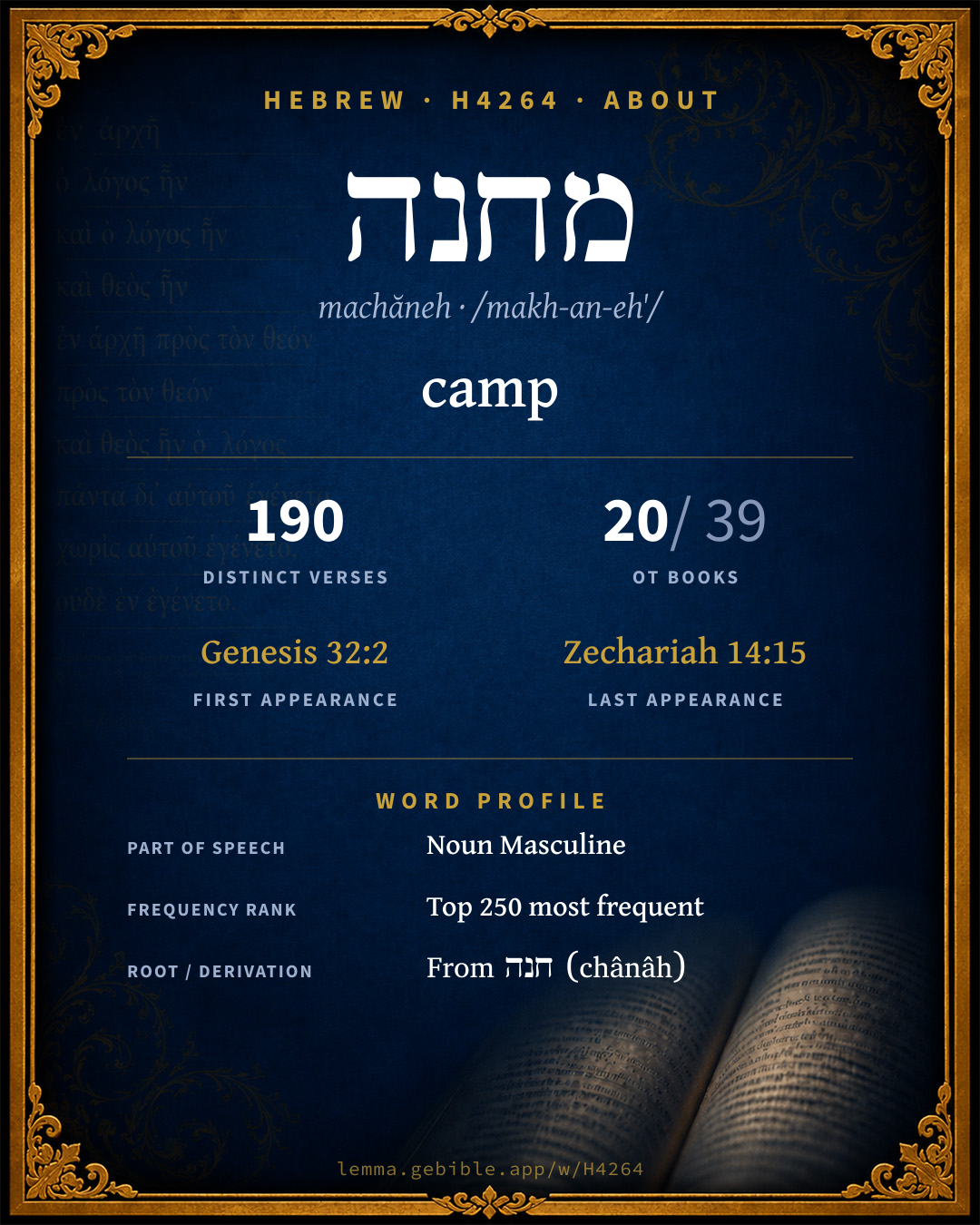
מַחֲנֶה
camp
‘camp’ is one of 4 main senses fuller range ↓
Full lexicon entry — Brown-Driver-Briggs (BDB)
From Brown-Driver-Briggs (BDB)
Where this word appears
See every Absolute-state word in the Hebrew Bible →
Grammar key — what these labels mean
Part of speech
- Noun
- A naming word — a person, place, thing, or idea.
Noun type
- Common
- A common noun — a general class of person, place, or thing (“king,” “city,” “water”), not a specific name.
- Proper
- A name of a specific person, place, or people (e.g. Abraham, Zion, Israel).
State
- Absolute
- The independent form of a noun, not bound to a following word.
- Construct
- A noun bound to a following noun in a possessive / “of” relationship (the construct chain).
Gender
- Both
- Attested as both masculine and feminine.
Number
- Singular
- One.
- Plural
- More than one (in Hebrew, generally three or more).
- Dual
- Exactly two — for natural pairs and some measures of time.
Every verse where H4264 appears in the Book of Judges — 21 distinct verses. Click any verse to open its interlinear word-by-word view. Verse text shown in the World English Bible for context — . Each verse’s Hebrew form is shown with its reference; the English is not keyword-highlighted, since the data carries no word-level English alignment. Use “Compare translations” on any verse to read it across multiple English versions. This concordance covers the Hebrew Bible; Septuagint (Greek Old Testament) occurrences are not indexed here.
Judges
- Judges 4:15 הַֽ/מַּחֲנֶ֛ה ptcl def.art + n c bs Yahweh confused Sisera, and all his chariots, and all his host, with the edge of the sword before Barak; and Sisera alighted from his chariot, and fled away on his feet.
- Judges 4:16 הַֽ/מַּחֲנֶ֔ה מַחֲנֵ֤ה ptcl def.art + n c bs n c bs cs But Barak pursued after the chariots, and after the host, to Harosheth of the Gentiles: and all the host of Sisera fell by the edge of the sword; there was not a man left.
- Judges 7:1 וּ/מַחֲנֵ֤ה conj + n c bs cs Then Jerubbaal, who is Gideon, and all the people who were with him, rose up early, and encamped beside the spring of Harod: and the camp of Midian was on the north side of them, by the hill of Moreh, in the valley.
- Judges 7:8 וּ/מַחֲנֵ֣ה conj + n c bs cs So the people took food in their hand, and their trumpets; and he sent all the men of Israel every man to his tent, but retained the three hundred men: and the camp of Midian was beneath him in the valley.
- Judges 7:9 בַּֽ/מַּחֲנֶ֑ה prep det + n c bs It happened the same night, that Yahweh said to him, Arise, get you down into the camp; for I have delivered it into your hand.
- Judges 7:10 הַֽ/מַּחֲנֶֽה ptcl def.art + n c bs But if you fear to go down, go you with Purah your servant down to the camp:
- Judges 7:11 בַּֽ/מַּחֲנֶ֑ה בַּֽ/מַּחֲנֶֽה prep det + n c bs prep det + n c bs and you shall hear what they say; and afterward shall your hands be strengthened to go down into the camp. Then went he down with Purah his servant to the outermost part of the armed men who were in the camp.
- Judges 7:13 בְּ/מַחֲנֵ֣ה prep + n c bs cs When Gideon had come, behold, there was a man telling a dream to his fellow; and he said, Behold, I dreamed a dream; and, behold, a cake of barley bread tumbled into the camp of Midian, and came to the tent, and struck it so that it fell, and turned it upside down, so that the tent lay flat.
- Judges 7:14 הַֽ/מַּחֲנֶֽה ptcl def.art + n c bs His fellow answered, This is nothing else save the sword of Gideon the son of Joash, a man of Israel: into his hand God has delivered Midian, and all the host.
- Judges 7:15 מַחֲנֵ֣ה מַחֲנֵ֥ה n c bs cs n c bs cs It was so, when Gideon heard the telling of the dream, and the interpretation of it, that he worshiped; and he returned into the camp of Israel, and said, Arise; for Yahweh has delivered into your hand the host of Midian.
- Judges 7:17 הַֽ/מַּחֲנֶ֔ה ptcl def.art + n c bs He said to them, Look on me, and do likewise: and, behold, when I come to the outermost part of the camp, it shall be that, as I do, so shall you do.
- Judges 7:18 הַֽ/מַּחֲנֶ֔ה ptcl def.art + n c bs When I blow the trumpet, I and all who are with me, then blow you the trumpets also on every side of all the camp, and say, For Yahweh and for Gideon.
- Judges 7:19 הַֽ/מַּחֲנֶ֗ה ptcl def.art + n c bs So Gideon, and the hundred men who were with him, came to the outermost part of the camp in the beginning of the middle watch, when they had but newly set the watch: and they blew the trumpets, and broke in pieces the pitchers that were in their hands.
- Judges 7:21 לַֽ/מַּחֲנֶ֑ה הַֽ/מַּחֲנֶ֛ה prep det + n c bs ptcl def.art + n c bs They stood every man in his place round about the camp; and all the host ran; and they shouted, and put [them] to flight.
- Judges 7:22 הַֽ/מַּחֲנֶ֑ה הַֽ/מַּחֲנֶ֜ה ptcl def.art + n c bs ptcl def.art + n c bs They blew the three hundred trumpets, and Yahweh set every man's sword against his fellow, and against all the host; and the host fled as far as Beth-shittah toward Zererah, as far as the border of Abel Meholah, by Tabbath.
- Judges 8:10 וּ/מַחֲנֵי/הֶ֤ם מַחֲנֵ֣ה conj + n c bp cs + sfx pers 3mp n c bs cs Now Zebah and Zalmunna were in Karkor, and their hosts with them, about fifteen thousand men, all who were left of all the host of the children of the east; for there fell one hundred twenty thousand men who drew sword.
- Judges 8:11 הַֽ/מַּחֲנֶ֔ה וְ/הַֽ/מַּחֲנֶ֖ה ptcl def.art + n c bs conj + ptcl def.art + n c bs Gideon went up by the way of those who lived in tents on the east of Nobah and Jogbehah, and struck the host; for the host was secure.
- Judges 8:12 הַֽ/מַּחֲנֶ֖ה ptcl def.art + n c bs Zebah and Zalmunna fled; and he pursued after them; and he took the two kings of Midian, Zebah and Zalmunna, and confused all the host.
- Judges 13:25 בְּ/מַחֲנֵה prep + n Proper The Spirit of Yahweh began to move him in Mahaneh-dan, between Zorah and Eshtaol.
- Judges 21:8 הַֽ/מַּחֲנֶ֛ה ptcl def.art + n c bs They said, What one is there of the tribes of Israel who didn't come up to Yahweh to Mizpah? Behold, there came none to the camp from Jabesh Gilead to the assembly.
- Judges 21:12 הַֽ/מַּחֲנֶה֙ ptcl def.art + n c bs They found among the inhabitants of Jabesh Gilead four hundred young virgins, who had not known man by lying with him; and they brought them to the camp to Shiloh, which is in the land of Canaan.
About this entry
At a glance — auto-summarized from this page’s data, not written by a person. Every figure links to its source below. This summary describes the numbers; it doesn’t interpret them.
“camp” is the headline sense of the Hebrew noun מחנה (machăneh). One archaism survives in the King James Version — “host” — where modern Bibles read “camp”; see the renderings breakdown. It appears 190 verses across 20 books of the Hebrew Bible, among its common vocabulary. First canonically at Genesis 32:2, it enters the text early. Its meaning spans more than one sense — see its full sense range. The sections below give every sense, occurrence, and version rendering.
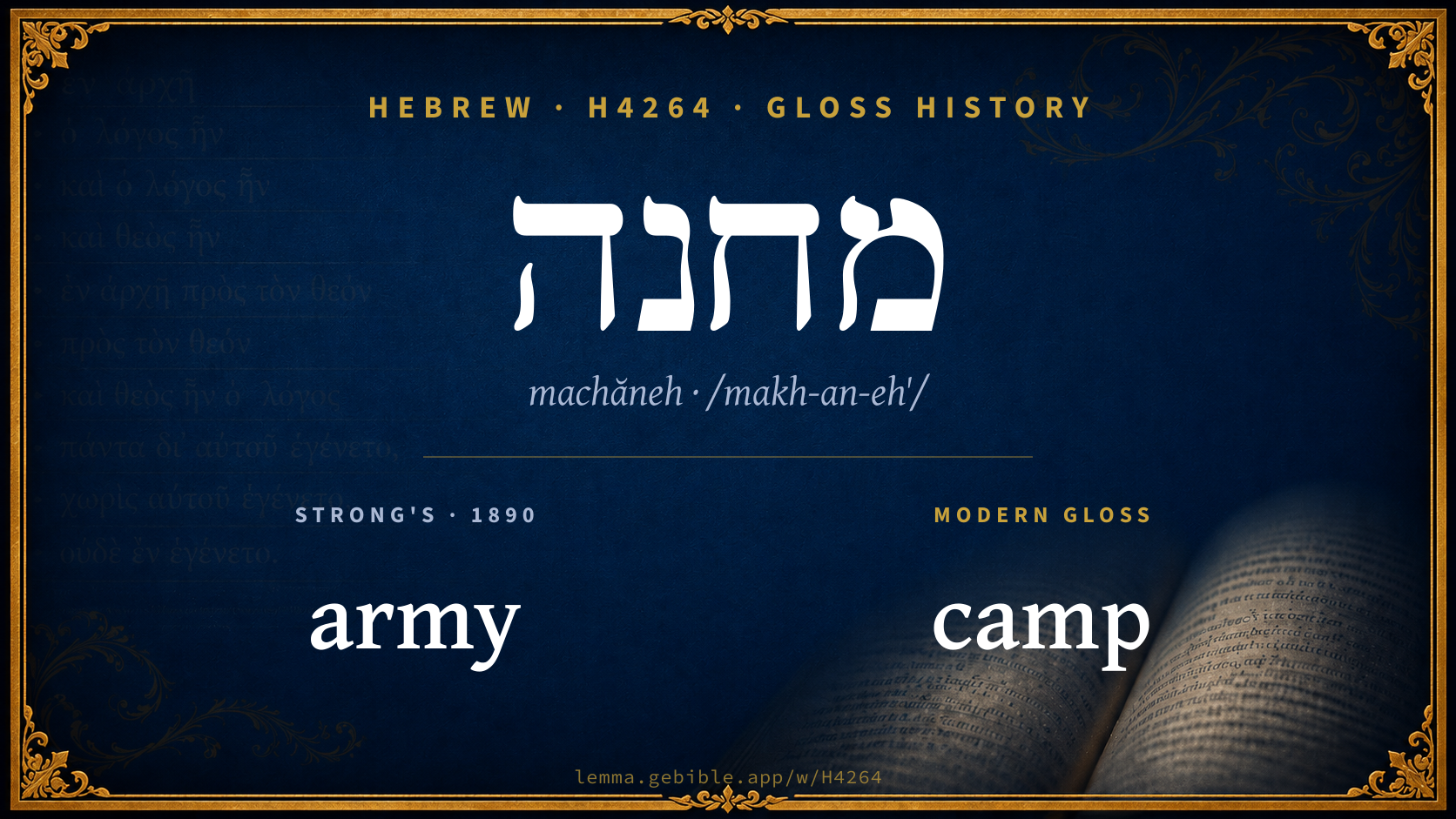
Gloss history
Strong's 1890 vs modern scholarship
About this word
Strong's H4264 catalogs a Hebrew word from the Hebrew Old Testament.
These counts are not copied from any lexicon or concordance. They are computed here, from the morphology-tagged Hebrew Old Testament. What Lemma adds →
- 190
- distinct verses
- The word appears in 190 distinct verses.
- 20 / 39
- OT books
- The word appears in 20 of 39 Old Testament books.
- #220
- by frequency
- Top 250 most frequent Hebrew words (rank 220 of 8,640 Hebrew words by occurrence).
View all 190 occurrences in the concordance →
By section of the Old Testament
By traditional corpus
Conventional, traditional groupings — biblical authorship is debated, so this is a traditional corpus grouping, not an authorship claim. Each share is this word’s portion of its verses in that division of the Hebrew canon. Each figure is a share of the word’s 190 distinct verses.
- Torah (Pentateuch) 90 verses · 47%
- Prophets (Nevi'im) 84 verses · 44%
- Writings (Ketuvim) 16 verses · 8%
How translations render this word
Counts come from each version’s own published word-to-Strong’s tagging or interlinear alignment — an approximate guide to how each version renders this word, not a word-level alignment the data otherwise carries. Because each total is that version’s own tagged count, the per-version totals vary from one another and need not match the appearance or distinct-verse counts above. These counts may also differ from a printed concordance because Lemma counts each distinctly tagged rendering and does not collapse phrase taggings into a single head-word total. This is a fixed set of word-tagged versions (KJV, ASV, BSB, ULT) and does not change with the reading translation you choose elsewhere. Each version’s license is shown beside its name below (and on Sources).
- King James Version: Camp 121×, Host 42×, Camps 6×
- American Standard Version: Camp 128×, Host 23×, Camps 6×
- Berean Standard Bible: Camp 139×, Army 20×, Camps 11×
- unfoldingWord Literal Text: Camp 139×, Camp of 41×, Camps 15×
King James Version Public Domain
Renders H4264 across 216 tagged occurrences — most commonly:
Plus 25 renderings that appear only once — usually multi-word phrases or single function words the recovered tagging swept in, not distinct renderings.
American Standard Version Public Domain
Renders H4264 across 215 tagged occurrences — most commonly:
Plus other, less common renderings. Plus 31 renderings that appear only once — usually multi-word phrases or single function words the recovered tagging swept in, not distinct renderings.
Berean Standard Bible Public Domain
Renders H4264 across 206 tagged occurrences — most commonly:
Plus 20 renderings that appear only once — usually multi-word phrases or single function words the recovered tagging swept in, not distinct renderings. Not rendered by a distinct English word in 9 further occurrences.
unfoldingWord Literal Text CC BY-SA 4.0
Renders H4264 across 218 tagged occurrences — most commonly:
Plus 18 renderings that appear only once — usually multi-word phrases or single function words the recovered tagging swept in, not distinct renderings.
7 senses and sub-senses in the full BDB
What do BDB’s symbols mean?
BDB uses these scholarly abbreviations:
| Symbol | Meaning |
|---|---|
| 𝔊 | the Septuagint (the ancient Greek translation, LXX) |
| 𝔙 | the Vulgate (the Latin translation) |
| 𝔖 | the Syriac version (the Peshitta) |
| 𝔗 | the Targum (the Aramaic translation) |
| ψ | the Psalms |
| √ | root (the underlying root or stem) |
| ‖ | parallel passage (a synonymous or contrasted parallel) |
| † | the dagger: every passage where the word occurs is cited |
The 7 senses and sub-senses the full Brown-Driver-Briggs lexicon distinguishes for this word, in lexicon order (not ranked by frequency), with BDB’s own verbatim wording and sub-sense lettering. Shown in Hebrew script with BDB’s own scholarly abbreviations. The condensed entry is in the Lexicon Entry tab. See also the Forms in the corpus table below.
- 1. camp, place of encampment:
- a. of caravan of travellers Gn 32:22 (J), especially of Isr. at Exod. and in wildern. Ex 16:13(×2) 19:16, 17 (all P; disting. from עַם); שַׁעַר מ׳ Ex 32:26 (JE); especially מִחוּץ המ׳ in connexion with uncleanness, etc., Ex 29:14; Lv 4:12 (P) + often, of position of tent of meeting Ex 33:7(×2) (JE), contr. Nu 2:17 (P), where of encampments of several tribes, cf. 1:52; 2:3; 10:2, 5, 6, 25 etc., (all P), already passing over to 3 (cf. הַחֹנִים 10:5, 6); e.g. Genesis 32:22
- b. specif. of camp of Levites, surrounding tabernacle, so that P can say אֹהֶל־מוֹעֵד מַחֲנֵה הַלְוִיִם Nu 2:17; and so (late) of temple הַשֹּׁעֲרִים לְמַחֲנוֹת בְּנֵי לֵוִי 1 Ch 9:18, as well as שַׁעֲרֵי מַחֲנוֹת י׳ 2 Ch 31:2; pl. (opp. מִבְצָרִים = fortresses) Nu 13:19. e.g. Numbers 2:17
- 2. camp of armed host Jos 6:11(×2), 14 (JE), 1 S 4:3, 5, 6(×2), 7; 17:53; 2 K 7:16 etc. e.g. Joshua 6:11
- 3.
- a. those who encamp Nu 10:5, 6; 1 Ch 11:5 ψ 27:3 (all c. vb. חנה), cf. (prob.) Is 37:36 = 2 K 19:35, etc. e.g. Numbers 10:5
- b. company, body of people; people and beasts Gn 32:8, 9(×2), 11; 33:8, funeral company of Jacob Gn 50:9; of Isr. on march Ex 14:19, 20 cf. Nu 10:5, 6. e.g. Genesis 32:8
- c. army, host Jos 8:13; 10:5; 11:4 Ju 4:15, 16(×2) 7:1, 8; 8:10(×2), 11(×2) 12 1 S 17:1, 46 2 K 3:9 even while in the thick of the fight; 1 K 22:34 = 2 Ch 18:33 etc. e.g. Joshua 8:13
Senses from the full Brown-Driver-Briggs lexicon (Brown, Driver, Briggs; Oxford 1906 — public domain), digitized via Sefaria, supplemented by the OpenScriptures HebrewLexicon (CC BY 4.0). Full attribution on Sources.
Word origin
n.m. Gn 33:8 + 16 times and f. ψ 27:3; 1 Ch 11:15 (on Gn 32:9a v. Di) encampment, camp—abs. מ׳ Gn 32:9(×2) + 126 times (incl. Ez 1:24, del. Co); cstr. מַחֲנֵה Gn 32:3 + 56 times; sf. מַחֲנֵהוּ Nu 1:52 + 5 times; מַחֲנֶיךָ Dt 23:15; 29:10, מַחֲנֶךָ Dt 23:15, מַחֲנֵיכֶם Am 4:10, מַחֲנֵיהֶם Nu 5:3 Ju 8:10 (cf. infr., and on form of noun c. sf. vid. Ges§ 93, 3, R 3); pl. abs. מַחֲנוֹת Gn 32:8 + 9 times; cstr. 1 Ch 9:18 + 2 times, מַחֲנִים Nu 13:19; sf. (appar. pl. n.) מַחֲנֵיהֶם Jos 10:4 + 5 times;—on du. v. מ׳ n.pr. infr.
— Brown-Driver-Briggs (Oxford 1906, public domain), digitized via Sefaria, supplemented by the OpenScriptures HebrewLexicon (CC BY 4.0). See Sources.
Derived from חנה (chânâh) (H2583) — to encamp.
Jastrow Dictionary
A second Hebrew/Aramaic lexicon for comparison, covering Aramaic and post-biblical (Talmudic, Targumic, Midrashic) usage that the biblical-Hebrew BDB does not. Matched by lemma rather than by Strong’s number, so a lemma may carry more than one Jastrow headword (shown separately below), and the entries cover usage well beyond the Bible.
מַחֲנֶה
- camp, esp. the encampment of the Israelites in the desert (v. Num. II); transferred to the limits of graded sacredness in Jerusalem (v. מְחִיצָה II). Sifré Num. 1 מַחְנֵה ישראל the camp of the Israelites (from the gate of Jerusalem to the Temple mount); מ׳ לויה the camp of the attendants (priests and Levites, from the Temple mount to the Temple court); מ׳ שכינה the camp of the Divine Majesty (from the entrance of the court and further). Ib. מ׳ ארון the camp of the Ark in the desert (= מ׳ לויה); Y. Sot. VIII, 22ᵇ bot.; a. fr.—Pl. מַחֲנוֹת. Sifré l. c. שלש מ׳ הן there are three camps of graded sacredness (= מְחִיצוֹת). e.g. Numbers 2:25
A Dictionary of the Targumim, the Talmud Babli and Yerushalmi, and the Midrashic Literature (Marcus Jastrow; London, Luzac, 1903) — Public Domain. Digitized via Sefaria. Digitized via Sefaria. Full attribution on Sources.
Forms in the corpus
The 78 distinct written forms H4264 takes in the Hebrew Bible, most frequent first — each parse links to that state’s occurrences in the concordance. Hebrew forms include their vowel points and cantillation, so a single lemma takes many written forms.
The 60 most common forms are shown; 18 rarer forms follow in the full concordance.
Same root — word family
Other BDB entries built from the same root as H4264, grouped by Strong’s listed origin. These share a root / origin per the lexicon — not necessarily a shared meaning. Each links to that word’s own entry.
Derives from
Shares the same root
- חנות chânûwth H2588 cell
- חנית chănîyth H2595 spear
- חנן chânan H2603 to be gracious
- תחנה tachănâh H8466 encampment
Proper names from this root
People and places named from this root — a name, not an additional meaning of the word.
Compare all same-root words → Showing 4 of 9 — not the complete family. 3 of the same-root words are proper names (people or places). They share a root, not necessarily a meaning.
Septuagint verse parallels
This word appears in 183 verses that also exist in the Greek Old Testament (Septuagint), out of the 190 Hebrew verses it occurs in. You can read those verses in Greek by switching the Old Testament edition to the Septuagint.
Read these verses in the Septuagint
- Genesis 32:2
- Exodus 14:19
- Leviticus 4:12
- Numbers 1:52
- Deuteronomy 2:14
- Joshua 1:11
- Judges 4:15
- 1 Samuel 4:3
- 2 Samuel 1:2
- 1 Kings 16:16
- 2 Kings 3:9
- 1 Chronicles 9:18
This is a verse-level parallel only — the same verses exist in both the Hebrew and Greek Old Testaments. No word-level Hebrew↔Greek correspondence is claimed: the data carries no such alignment, so no Greek word is shown as this Hebrew word’s translation. Coverage is not total — the Septuagint omits the deuterocanon and renumbers the Psalms, so some Hebrew verses have no direct Greek parallel.