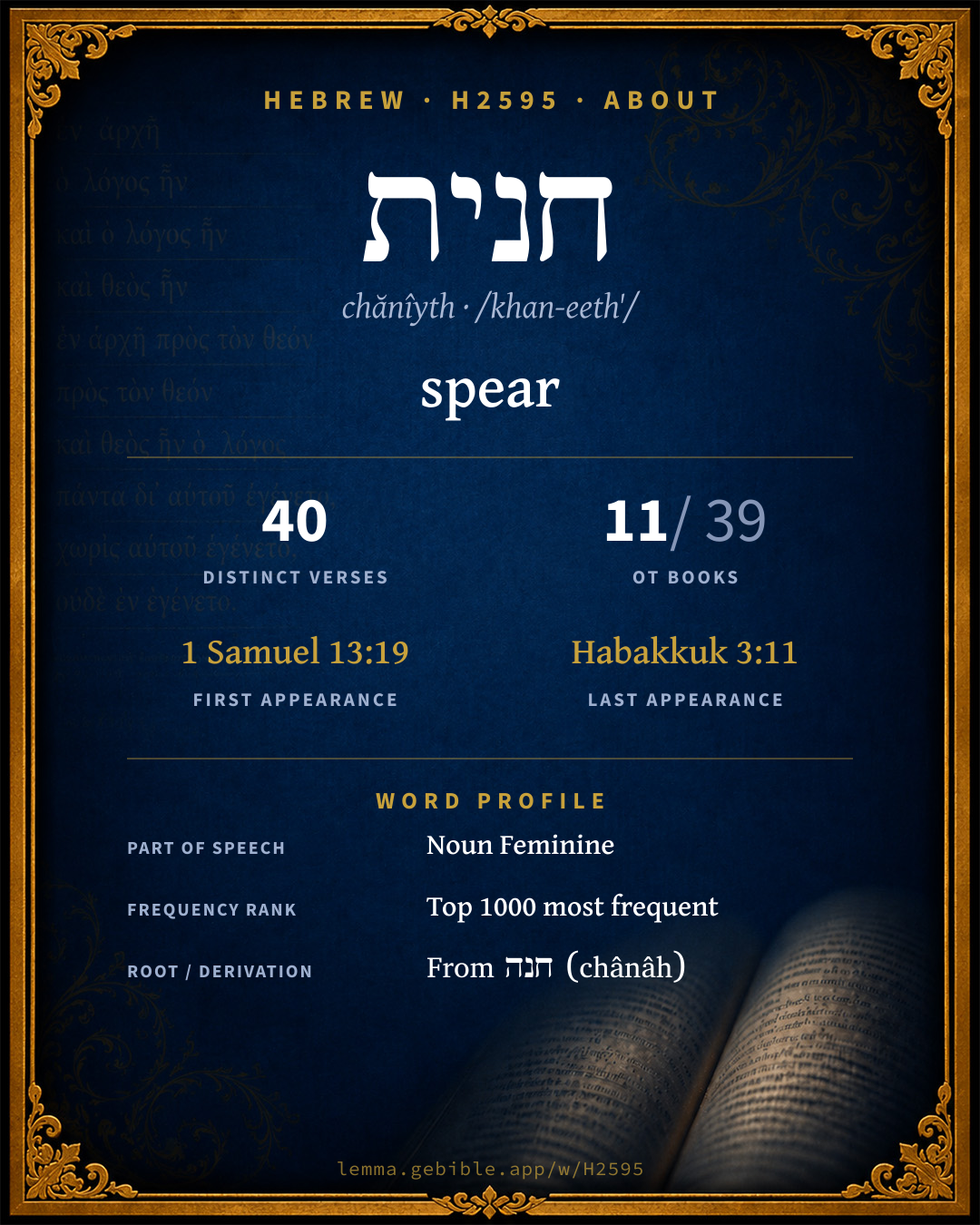
חֲנִית
spear
Full lexicon entry — Brown-Driver-Briggs (BDB)
From Brown-Driver-Briggs (BDB)
Where this word appears
See every Absolute-state word in the Hebrew Bible →
Grammar key — what these labels mean
Part of speech
- Noun
- A naming word — a person, place, thing, or idea.
Noun type
- Common
- A common noun — a general class of person, place, or thing (“king,” “city,” “water”), not a specific name.
State
- Absolute
- The independent form of a noun, not bound to a following word.
- Construct
- A noun bound to a following noun in a possessive / “of” relationship (the construct chain).
Gender
- Feminine
- Grammatically feminine.
Number
- Singular
- One.
- Plural
- More than one (in Hebrew, generally three or more).
Grammatical forms
- Noun, Common, Feminine, Singular, Absolute 30 times (63%)
- Noun, Common, Feminine, Singular, Construct 15 times (31%)
- Noun, Common, Feminine, Plural, Construct 2 times (4%)
- Noun, Common, Feminine, Plural, Absolute 1 time (2%)
Parsed forms decoded from the imported morphology (morphhb / Westminster Leningrad Codex — WLC text public domain, morphhb tagging CC BY 4.0), counted across 48 parsed occurrences — not distinct verses.
Every verse where H2595 appears — 40 distinct verses across 11 books. Click any verse to open its interlinear word-by-word view. Verse text shown in the World English Bible for context — . Each verse’s Hebrew form is shown with its reference; the English is not keyword-highlighted, since the data carries no word-level English alignment. Use “Compare translations” on any verse to read it across multiple English versions. This concordance covers the Hebrew Bible; Septuagint (Greek Old Testament) occurrences are not indexed here.
1 Samuel 18 verses
- 1 Samuel 13:19 חֲנִֽית n c fs Now there was no smith found throughout all the land of Israel; for the Philistines said, Lest the Hebrews make them swords or spears:
- 1 Samuel 13:22 וַ/חֲנִית֙ conj + n c fs So it came to pass in the day of battle, that there was neither sword nor spear found in the hand of any of the people who were with Saul and Jonathan: but with Saul and with Jonathan his son was there found.
- 1 Samuel 17:7 חֲנִית֗/וֹ חֲנִית֔/וֹ n c fs cs + sfx pers 3ms n c fs cs + sfx pers 3ms The staff of his spear was like a weaver's beam; and his spear's head [weighed] six hundred shekels of iron: and his shield-bearer went before him.
- 1 Samuel 17:45 וּ/בַ/חֲנִ֣ית conj + prep + n c fs Then said David to the Philistine, You come to me with a sword, and with a spear, and with a javelin: but I come to you in the name of Yahweh of hosts, the God of the armies of Israel, whom you have defied.
- 1 Samuel 17:47 וּ/בַ/חֲנִ֖ית conj + prep + n c fs and that all this assembly may know that Yahweh doesn't save with sword and spear: for the battle is Yahweh's, and he will give you into our hand.
- 1 Samuel 18:10 וְ/הַ/חֲנִ֖ית conj + ptcl def.art + n c fs It happened on the next day, that an evil spirit from God came mightily on Saul, and he prophesied in the midst of the house: and David played with his hand, as he did day by day. Saul had his spear in his hand;
- 1 Samuel 18:11 הַ/חֲנִ֔ית ptcl def.art + n c fs and Saul cast the spear; for he said, I will strike David even to the wall. David avoided out of his presence twice.
- 1 Samuel 19:9 וַ/חֲנִית֖/וֹ conj + n c fs cs + sfx pers 3ms An evil spirit from Yahweh was on Saul, as he sat in his house with his spear in his hand; and David was playing with his hand.
- 1 Samuel 19:10 בַּֽ/חֲנִית֙ הַ/חֲנִ֖ית prep det + n c fs ptcl def.art + n c fs Saul sought to strike David even to the wall with the spear; but he slipped away out of Saul's presence, and he struck the spear into the wall: and David fled, and escaped that night.
- 1 Samuel 20:33 הַ/חֲנִ֛ית ptcl def.art + n c fs Saul cast his spear at him to strike him. By this Jonathan knew that his father was determined to put David to death.
- 1 Samuel 21:8 חֲנִ֣ית n c fs David said to Ahimelech, Isn't there here under your hand spear or sword? for I have neither brought my sword nor my weapons with me, because the king's business required haste.
- 1 Samuel 22:6 וַ/חֲנִית֣/וֹ conj + n c fs cs + sfx pers 3ms Saul heard that David was discovered, and the men who were with him: now Saul was sitting in Gibeah, under the tamarisk tree in Ramah, with his spear in his hand, and all his servants were standing about him.
- 1 Samuel 26:7 וַ/חֲנִית֥/וֹ conj + n c fs cs + sfx pers 3ms So David and Abishai came to the people by night: and, behold, Saul lay sleeping within the place of the wagons, with his spear stuck in the ground at his head; and Abner and the people lay round about him.
- 1 Samuel 26:8 בַּ/חֲנִ֤ית prep det + n c fs Then said Abishai to David, God has delivered up your enemy into your hand this day: now therefore please let me strike him with the spear to the earth at one stroke, and I will not strike him the second time.
- 1 Samuel 26:11 הַ/חֲנִ֜ית ptcl def.art + n c fs Yahweh forbid that I should put forth my hand against Yahweh's anointed: but now please take the spear that is at his head, and the jar of water, and let us go.
- 1 Samuel 26:12 הַ/חֲנִ֜ית ptcl def.art + n c fs So David took the spear and the jar of water from Saul's head; and they got them away: and no man saw it, nor knew it, neither did any awake; for they were all asleep, because a deep sleep from Yahweh was fallen on them.
- 1 Samuel 26:16 חֲנִ֥ית n c fs cs This thing isn't good that you have done. As Yahweh lives, you are worthy to die, because you have not kept watch over your lord, Yahweh's anointed. Now see where the king's spear is, and the jar of water that was at his head.
- 1 Samuel 26:22 ה/חנית חֲנִ֣ית ptcl def.art + n c fs n c fs David answered, Behold the spear, O king! let then one of the young men come over and get it.
2 Samuel 6 verses
- 2 Samuel 1:6 חֲנִית֑/וֹ n c fs cs + sfx pers 3ms The young man who told him said, As I happened by chance on Mount Gilboa, behold, Saul was leaning on his spear; and, behold, the chariots and the horsemen followed hard after him.
- 2 Samuel 2:23 הַ/חֲנִ֜ית הַֽ/חֲנִית֙ ptcl def.art + n c fs ptcl def.art + n c fs However he refused to turn aside: therefore Abner with the hinder end of the spear struck him in the body, so that the spear came out behind him; and he fell down there, and died in the same place: and it happened, that as many as came to the place where Asahel fell down and died stood still.
- 2 Samuel 21:19 חֲנִית֔/וֹ n c fs cs + sfx pers 3ms There was again war with the Philistines at Gob; and Elhanan the son of Jaareoregim the Bethlehemite killed Goliath the Gittite's brother, the staff of whose spear was like a weaver's beam.
- 2 Samuel 23:7 חֲנִ֑ית n c fs But the man who touches them Must be armed with iron and the staff of a spear: They shall be utterly burned with fire in [their] place
- 2 Samuel 23:18 חֲנִית֔/וֹ n c fs cs + sfx pers 3ms Abishai, the brother of Joab, the son of Zeruiah, was chief of the three. He lifted up his spear against three hundred and killed them, and had a name among the three.
- 2 Samuel 23:21 חֲנִ֔ית הַ/חֲנִית֙ בַּ/חֲנִיתֽ/וֹ n c fs ptcl def.art + n c fs prep + n c fs cs + sfx pers 3ms He killed an Egyptian, a goodly man: and the Egyptian had a spear in his hand; but he went down to him with a staff, and plucked the spear out of the Egyptian's hand, and killed him with his own spear.
2 Kings 1 verse
1 Chronicles 5 verses
- 1 Chronicles 11:11 חֲנִית֛/וֹ n c fs cs + sfx pers 3ms This is the number of the mighty men whom David had: Jashobeam, the son of a Hachmonite, the chief of the thirty; he lifted up his spear against three hundred and killed them at one time.
- 1 Chronicles 11:20 חֲנִית֔/וֹ n c fs cs + sfx pers 3ms Abishai, the brother of Joab, he was chief of the three; for he lifted up his spear against three hundred and killed them, and had a name among the three.
- 1 Chronicles 11:23 חֲנִית֙ הַ/חֲנִית֙ בַּ/חֲנִיתֽ/וֹ n c fs ptcl def.art + n c fs prep + n c fs cs + sfx pers 3ms He killed an Egyptian, a man of great stature, five cubits high; and in the Egyptian's hand was a spear like a weaver's beam; and he went down to him with a staff, and plucked the spear out of the Egyptian's hand, and killed him with his own spear.
- 1 Chronicles 12:34 וַ/חֲנִ֔ית conj + n c fs Of Naphtali one thousand captains, and with them with shield and spear thirty-seven thousand.
- 1 Chronicles 20:5 חֲנִית֔/וֹ n c fs cs + sfx pers 3ms There was again war with the Philistines; and Elhanan the son of Jair killed Lahmi the brother of Goliath the Gittite, the staff of whose spear was like a weaver's beam.
2 Chronicles 1 verse
Job 2 verses
Psalms 3 verses
- Psalms 35:3 חֲנִ֣ית n c fs Brandish the spear and block those who pursue me. Tell my soul, "I am your salvation."
- Psalms 46:9 חֲנִ֑ית n c fs He makes wars cease to the end of the earth. He breaks the bow, and shatters the spear. He burns the chariots in the fire.
- Psalms 57:4 חֲנִ֣ית n c fs My soul is among lions. I lie among those who are set on fire, Even the sons of men, whose teeth are spears and arrows, And their tongue a sharp sword.
Isaiah 1 verse
Micah 1 verse
Nahum 1 verse
Habakkuk 1 verse
About this entry
At a glance — auto-summarized from this page’s data, not written by a person. Every figure links to its source below. This summary describes the numbers; it doesn’t interpret them.
The Hebrew noun חנית centers on the idea of “spear.” Its earliest occurrence is 1 Samuel 13:19. Spanning 40 verses in 11 books, it ranks among the moderately common words of the Hebrew Bible. 1 Samuel dominates its distribution — 18 of 40 verses. Related forms include חנה, חנות and חנן. Dig into 40-verse concordance and the renderings breakdown below.
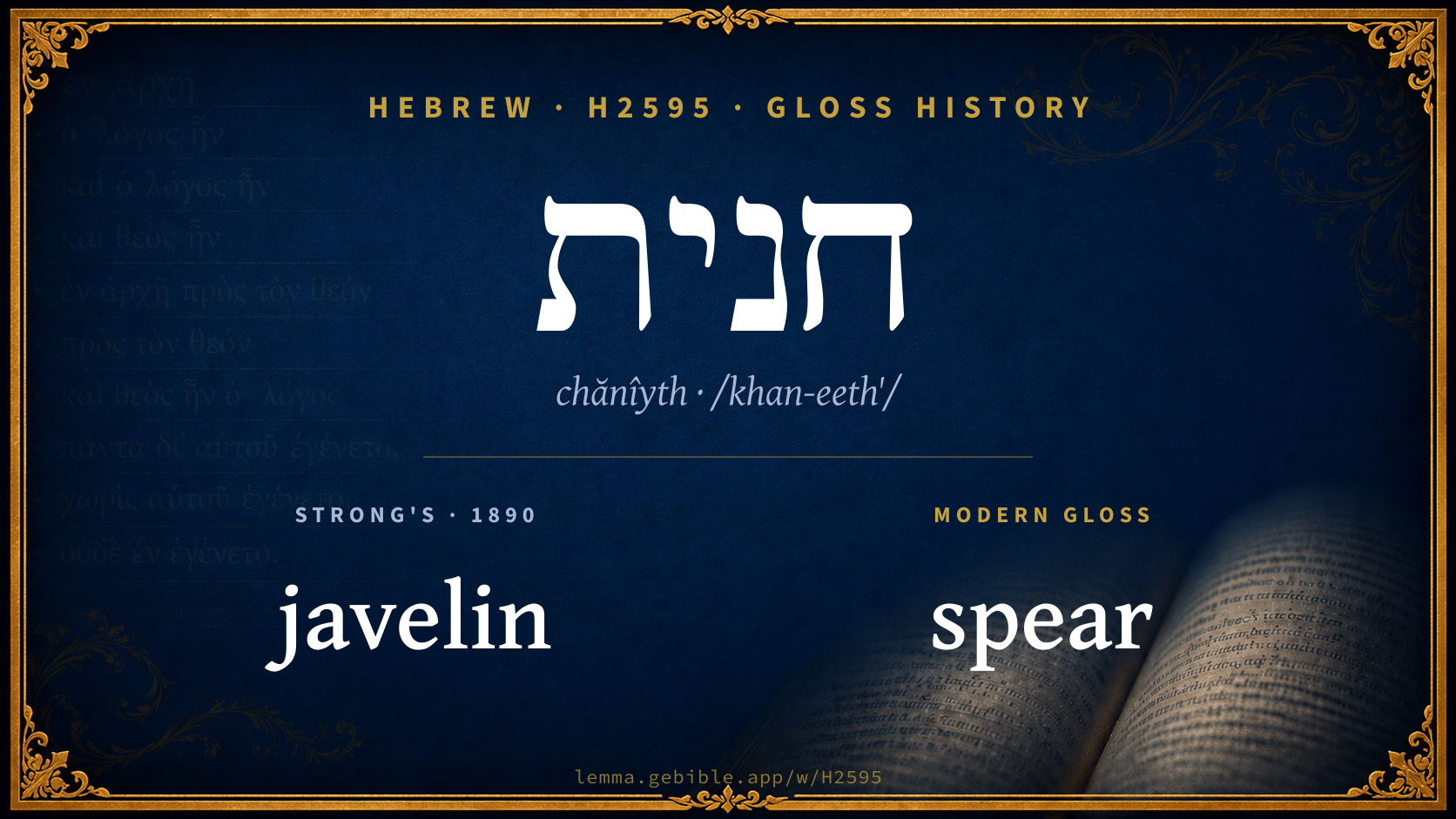
Gloss history
Strong's 1890 vs modern scholarship
About this word
Strong's H2595 catalogs a Hebrew word from the Hebrew Old Testament.
These counts are not copied from any lexicon or concordance. They are computed here, from the morphology-tagged Hebrew Old Testament. What Lemma adds →
- 40
- distinct verses
- The word appears in 40 distinct verses.
- 11 / 39
- OT books
- The word appears in 11 of 39 Old Testament books.
- #767
- by frequency
- Top 1000 most frequent Hebrew words (rank 767 of 8,640 Hebrew words by occurrence).
View all 40 occurrences in the concordance →
Most concentrated in
- 1 Samuel 18 verses 45%
- 2 Samuel 6 verses 15%
- 1 Chronicles 5 verses 13%
By section of the Old Testament
By traditional corpus
Conventional, traditional groupings — biblical authorship is debated, so this is a traditional corpus grouping, not an authorship claim. Each share is this word’s portion of its verses in that division of the Hebrew canon. Each figure is a share of the word’s 40 distinct verses.
- Prophets (Nevi'im) 29 verses · 73%
- Writings (Ketuvim) 11 verses · 28%
How translations render this word
Counts come from each version’s own published word-to-Strong’s tagging or interlinear alignment — an approximate guide to how each version renders this word, not a word-level alignment the data otherwise carries. Because each total is that version’s own tagged count, the per-version totals vary from one another and need not match the appearance or distinct-verse counts above. These counts may also differ from a printed concordance because Lemma counts each distinctly tagged rendering and does not collapse phrase taggings into a single head-word total. This is a fixed set of word-tagged versions (KJV, ASV, BSB, ULT) and does not change with the reading translation you choose elsewhere. Each version’s license is shown beside its name below (and on Sources).
BDB lists this Strong’s number as 2 distinct words (homographs). Each count above pools all of them and is not split by sense — see the Senses section below. A low-frequency rendering may belong to a different one of those words, not the primary meaning.
- King James Version†: Spear 26×, Javelin 5×, Spears 4×
- American Standard Version†: Spear 30×, Spears 4×, Own spear 2×
- Berean Standard Bible†: Spear 30×, Spears 5×, Had a spear 2×
- unfoldingWord Literal Text†: Spear 37×, Spears 4×, Was a spear 2×
King James Version Public Domain
Renders H2595 across 47† tagged occurrences — most commonly:
Plus 10 renderings that appear only once — usually multi-word phrases or single function words the recovered tagging swept in, not distinct renderings.
American Standard Version Public Domain
Renders H2595 across 47† tagged occurrences — most commonly:
Plus 11 renderings that appear only once — usually multi-word phrases or single function words the recovered tagging swept in, not distinct renderings.
Berean Standard Bible Public Domain
Renders H2595 across 45† tagged occurrences — most commonly:
Plus 4 renderings that appear only once — usually multi-word phrases or single function words the recovered tagging swept in, not distinct renderings. Not rendered by a distinct English word in 2 further occurrences.
unfoldingWord Literal Text CC BY-SA 4.0
Renders H2595 across 49† tagged occurrences — most commonly:
Plus 6 renderings that appear only once — usually multi-word phrases or single function words the recovered tagging swept in, not distinct renderings.
Senses in the full BDB
What do BDB’s symbols mean?
BDB uses these scholarly abbreviations:
| Symbol | Meaning |
|---|---|
| 𝔊 | the Septuagint (the ancient Greek translation, LXX) |
| 𝔙 | the Vulgate (the Latin translation) |
| 𝔖 | the Syriac version (the Peshitta) |
| 𝔗 | the Targum (the Aramaic translation) |
| ψ | the Psalms |
| √ | root (the underlying root or stem) |
| ‖ | parallel passage (a synonymous or contrasted parallel) |
| † | the dagger: every passage where the word occurs is cited |
The 5 senses and sub-senses the full Brown-Driver-Briggs lexicon distinguishes for this word, in lexicon order (not ranked by frequency), with BDB’s own verbatim wording and sub-sense lettering. Shown in Hebrew script with BDB’s own scholarly abbreviations. The condensed entry is in the Lexicon Entry tab. See also the Forms in the corpus table below.
- 1. spear, as hurled 1 S 18:10, 11; 19:9, 10(×2) 20:33; held by king 22:6; sign of king’s presence 26:7, 8, 11, 12, 16, 22 (v. RSK 171); also 2 S 1:6; 2:23; 21:19; 23:18, 21(×3) 1 Ch 11:11 = 2 S 23:8, where read הוּא עוֹרֵר אֶת־חֲנִיתוֹ (for הוּא עֲדִינוֹ הָעֶצְנִו֯) according to Ew Th Ke Klo Dr (not We), 1 Ch 11:20, 23(×3); pl. 2 Ch 23:9; often ‖ חֶרֶב 1 S 13:19, 22; 17:45, 47; 21:9; Is 2:4 = Mi 4:3,; Na 3:3; ‖ שְׁלָטִים 2 K 11:10; ‖ צִנָּה 1 Ch 12:35 (Baer); מַסָּע Jb 41:18; סְגֹר ψ 35:3; ‖ קֶשֶׁת ψ 46:10. e.g. 1 Samuel 18:10
- 2.
- a. shaft of spear is עֵץ ח׳ 2 S 23:7; 1 Ch 20:5 + 1 S 17:7 Qr (doubtless right; Kt חץ). e.g. 2 Samuel 23:7
- b. spear-head לַהֶבֶת ח׳ 1 S 17:7, cf. לַהַב ח׳ Jb 39:23; בְּרַק ח׳ Na 3:3; Hb 3:11. e.g. 1 Samuel 17:7
- c. butt of spear אַחֲרֵי ח׳ 2 S 2:23. e.g. 2 Samuel 2:23
- 3. metaph. of teeth of lions ψ 57:5 (‖ חצים; fig. of Psalmist’s enemies). e.g. Psalms 57:5
Senses from the full Brown-Driver-Briggs lexicon (Brown, Driver, Briggs; Oxford 1906 — public domain), digitized via Sefaria, supplemented by the OpenScriptures HebrewLexicon (CC BY 4.0). Full attribution on Sources.
Word origin
n.f. spear (as flexible? v. Thes);—abs. חֲנִית 2 S 13:19 + 26 times; cstr. id. 1 S 26:16 (so v 22 Qr, where Kt has art.); sf. חֲנִיתֶ֑ךָ Hb 3:11; חֲנִיתוֹ 1 S 17:7(×2) + 11 times + 2 S 23:8, v. infr.; pl. חֲנִיתִים 2 Ch 23:9; חֲנִיתוֹתֵיהֶם Is 2:4 = חֲנִיתֹתֵיהֶם Mi 4:3;—
— Brown-Driver-Briggs (Oxford 1906, public domain), digitized via Sefaria, supplemented by the OpenScriptures HebrewLexicon (CC BY 4.0). See Sources.
Derived from חנה (chânâh) (H2583) — to encamp.
Jastrow Dictionary
A second Hebrew/Aramaic lexicon for comparison, covering Aramaic and post-biblical (Talmudic, Targumic, Midrashic) usage that the biblical-Hebrew BDB does not. Matched by lemma rather than by Strong’s number, so a lemma may carry more than one Jastrow headword (shown separately below), and the entries cover usage well beyond the Bible.
חֲנִית
- חנה to bend, v. Ges. Thes. s. v.) spear. Yalk. Job. 927.—Pl. חֲנִיתוֹת. Ib. Gen. 133.
A Dictionary of the Targumim, the Talmud Babli and Yerushalmi, and the Midrashic Literature (Marcus Jastrow; London, Luzac, 1903) — Public Domain. Digitized via Sefaria. Digitized via Sefaria. Full attribution on Sources.
Forms in the corpus
The 33 distinct written forms H2595 takes in the Hebrew Bible, most frequent first — each parse links to that state’s occurrences in the concordance. Hebrew forms include their vowel points and cantillation, so a single lemma takes many written forms.
Same root — word family
Other BDB entries built from the same root as H2595, grouped by Strong’s listed origin. These share a root / origin per the lexicon — not necessarily a shared meaning. Each links to that word’s own entry.
Derives from
Shares the same root
- חנות chânûwth H2588 cell
- חנן chânan H2603 to be gracious
- מחנה machăneh H4264 camp
- תחנה tachănâh H8466 encampment
Proper names from this root
People and places named from this root — a name, not an additional meaning of the word.
Compare all same-root words → Showing 4 of 7 — not the complete family. 1 of the same-root words is a proper name (a person or place). They share a root, not necessarily a meaning.
Septuagint verse parallels
This word appears in 38 verses that also exist in the Greek Old Testament (Septuagint), out of the 40 Hebrew verses it occurs in. You can read those verses in Greek by switching the Old Testament edition to the Septuagint.
Read these verses in the Septuagint
- 1 Samuel 13:19
- 2 Samuel 1:6
- 2 Kings 11:10
- 1 Chronicles 11:11
- 2 Chronicles 23:9
- Job 39:23
- Psalms 35:3
- Isaiah 2:4
- Micah 4:3
- Nahum 3:3
- Habakkuk 3:11
This is a verse-level parallel only — the same verses exist in both the Hebrew and Greek Old Testaments. No word-level Hebrew↔Greek correspondence is claimed: the data carries no such alignment, so no Greek word is shown as this Hebrew word’s translation. Coverage is not total — the Septuagint omits the deuterocanon and renumbers the Psalms, so some Hebrew verses have no direct Greek parallel.