
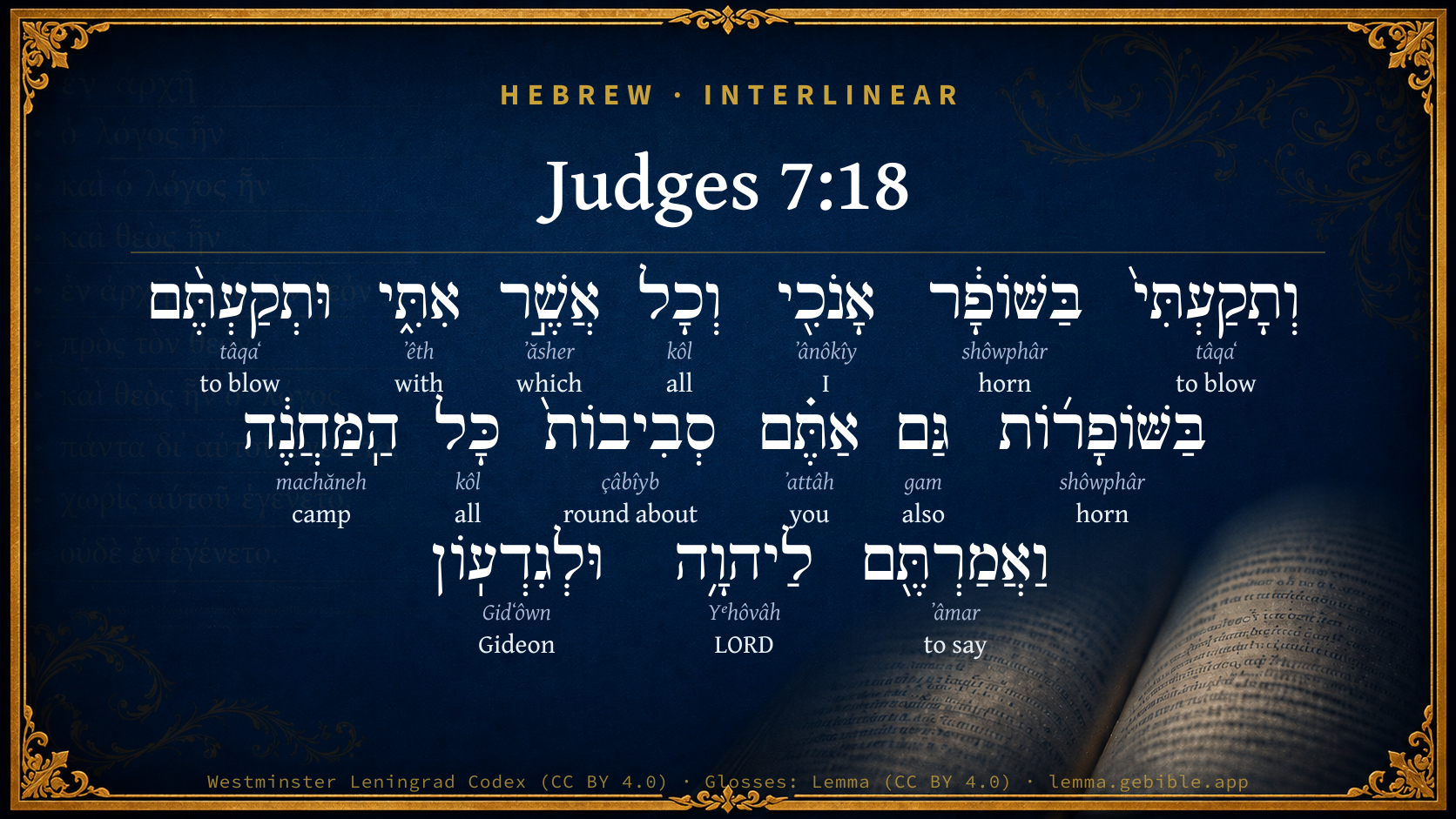
Judges 7:18

Hebrew (Westminster Leningrad Codex) Judges 7:18 appears in the Hebrew Old Testament. The text above is from the Westminster Leningrad Codex. Each word links to its Strong’s number, a concise gloss, and parsing drawn from the Open Scriptures Hebrew Bible morphology. Click any word for its full Brown-Driver-Briggs (BDB) entry.
Download image
Cite this verse

Judges 7:18 (World English Bible). Public Domain. Lemma interlinear Bible study tool, https://lemma.gebible.app/v/judges/7/18.

Show BibTeX & RIS
BibTeX
RIS
English Translation
When I blow the trumpet, I and all who are with me, then blow you the trumpets also on every side of all the camp, and say, For Yahweh and for Gideon.
World English Bible · Public Domain
Download a study sheet

One document with this verse’s original text, its word-by-word gloss line, the meaning frame, cross-references with their text, attributed commentary, and full source and license credits — printable, and it pastes into notes with its structure intact.

This verse Autodidact and up

Study sheet (.html) Plain text (.txt)

A passage Seminary Student

Up to 50 verses in one chapter. A passage sheet keeps up to 6 commentary sources and 12 cross-references per verse, in the order this page ranks them, and says so on the sheet whenever that leaves anything out. Ask for a single verse and you get the Autodidact verse sheet above.

Everything on this page stays free to read, with no account — the sheet is a download of what is already on screen, not access to it.

Want to remove ads? Support Godless Engineer
Compare translations 3

The same verse in 3 English versions, stacked beneath the original-language interlinear above. Click any original word for its lexicon entry.

Each is an independent rendering of the whole verse — the interlinear is not word-aligned to these translations.

Highlighted words mark where these versions differ — a whole-verse word diff, not a word-by-word alignment.

  • World English Bible Public Domain
    When I blow the trumpet, I and all who are with me, then blow you the trumpets also on every side of all the camp, and say, For Yahweh and for Gideon.
  • King James Version Public Domain
    When I blow with a trumpet, I and all that are with me, then blow ye the trumpets also on every side of all the camp, and say, The sword of the LORD, and of Gideon.
  • unfoldingWord Literal Text CC BY-SA 4.0
    And I will blow on the shofar, I and all who with me, and you shall blow on the shofars, also you, around all of the camp. And you shall say, ‘For Yahweh and for Gideon!’”

unfoldingWord Literal Text — © unfoldingWord, licensed CC BY-SA 4.0. Word-aligned USFM3 via Door43 (git.door43.org/unfoldingWord/en_ult).

Versions to compare (up to 4)

3 of 4 selected

Show all 18 translations

Every available English version of this verse, each an independent rendering of the whole verse.

  • World English Bible Public Domain
    When I blow the trumpet, I and all who are with me, then blow you the trumpets also on every side of all the camp, and say, For Yahweh and for Gideon.
  • Berean Standard Bible Public Domain
    When I and all who are with me blow our horns, then you are also to blow your horns from all around the camp and shout, ‘For the LORD and for Gideon!’”
  • Majority Standard Bible Public Domain
    When I and all who are with me blow our horns, then you are also to blow your horns from all around the camp and shout, ‘For the LORD and for Gideon!’”
  • King James Version Public Domain
    When I blow with a trumpet, I and all that are with me, then blow ye the trumpets also on every side of all the camp, and say, The sword of the LORD, and of Gideon.
  • American Standard Version (1901) Public Domain
    When I blow the trumpet, I and all that are with me, then blow ye the trumpets also on every side of all the camp, and say, For Jehovah and for Gideon.
  • Revised Version (1885) Public Domain
    When I blow the trumpet, I and all that are with me, then blow ye the trumpets also on every side of all the camp, and say, For the LORD and for Gideon.
  • Geneva Bible (1599) Public Domain
    When I blowe with a trumpet and all that are with me, blowe ye with trumpets also on euery side of the hoste, and say, For the Lord, and for Gideon.
  • Douay-Rheims (1899) Public Domain
    When the trumpet shall sound in my hand, do you also blow the trumpets on every side of the camp.
  • Young's Literal Translation Public Domain
    and I have blown with a trumpet -- I and all who `are' with me, and ye have blown with trumpets, even ye, round about all the camp, and have said, For Jehovah and for Gideon.'
  • Literal Standard Version CC BY-SA 4.0
    and I have blown with a horn—I and all who [are] with me, and you have blown with horns, even you, around all the camp, and have said, For YHWH and for Gideon!”
  • Unlocked Literal Bible CC BY-SA 4.0
    When I blow the trumpet, I and all who are with me, then blow your trumpets also on every side of the entire camp and shout, 'For Yahweh and for Gideon!'”
  • unfoldingWord Literal Text CC BY-SA 4.0
    And I will blow on the shofar, I and all who with me, and you shall blow on the shofars, also you, around all of the camp. And you shall say, ‘For Yahweh and for Gideon!’”
  • Darby Bible Public Domain
    When I blow the trumpet, I and all who are with me, then blow the trumpets also on every side of all the camp, and shout, 'For the LORD and for Gideon.'"
  • World Messianic Bible Public Domain
    When I blow the shofar, I and all who are with me, then blow the shofars also on every side of all the camp, and shout, ‘For the LORD and for Gideon!’”
  • Webster's Bible Public Domain
    When I blow with a trumpet, I and all that are with me, then blow ye the trumpets also on every side of all the camp, and say, The sword of the LORD, and of Gideon.
  • Free Bible Version CC BY-SA 4.0
    When I and those with me blow the trumpets, then you are to blow your trumpets from all around the camp, and shout, ‘For the Lord and for Gideon!’”
  • Bible in Basic English Public Domain
    At the sound of my horn, and the horns of those who are with me, let your horns be sounded all round the tents, and say, For the Lord and for Gideon.
  • JPS Tanakh (1917) Public Domain
    When I blow the horn, I and all that are with me, then blow ye the horns also on every side of all the camp, and say: For the LORD and for Gideon!'

Literal Standard Version (2020), Covenant Press — licensed CC BY-SA 4.0. Text via the HelloAO Bible API (eBible.org). Unlocked Literal Bible (unfoldingWord) — licensed CC BY-SA 4.0. Text via the HelloAO Bible API (eBible.org). unfoldingWord Literal Text — © unfoldingWord, licensed CC BY-SA 4.0. Word-aligned USFM3 via Door43 (git.door43.org/unfoldingWord/en_ult). Free Bible Version, Dr. Jonathan Gallagher — licensed CC BY-SA 4.0. Text via the HelloAO Bible API (eBible.org).

Word by word

More ways to search: Search by grammar → Find every occurrence → Compare this word →

Practice this passage: Drill this verse → Learn its vocabulary →

וּלְגִדְעֽוֹן
Gidʻôwn
H1439
“and · to/for · Gideon”
Conjunction + Preposition + Noun, Proper
Part of Speech
Conjunction + Preposition + Noun
Type
Proper
Full BDB Definition

Origin: from H1438

TWOT: 316a

Gideon = "hewer" - youngest son of Joash of the Abiezrites, fifth judge of Israel who led the Israelites against the Midianites
  1. וְתָקַעְתִּי֙ tâqaʻ H8628 “and · to blow” Conjunction + Verb, Qal, Sequential Perfect, 1st Person, Common, Singular
  2. בַּשּׁוֹפָ֔ר shôwphâr H7782 “in/at the · horn” Preposition, Determined + Noun, Common, Masculine, Singular, Absolute
  3. אָנֹכִ֖י ʼânôkîy H595 “I” Pronoun, Personal, 1st Person, Common, Singular
  4. וְכָל kôl H3605 “and · all of” Conjunction + Noun, Common, Masculine, Singular, Construct
  5. אֲשֶׁ֣ר ʼăsher H834 “which” Particle, Relative
  6. אִתִּ֑י ʼêth H854 “with · me” Preposition + Suffix, Personal, 1st Person, Common, Singular
  7. וּתְקַעְתֶּ֨ם tâqaʻ H8628 “and · to blow” Conjunction + Verb, Qal, Sequential Perfect, 2nd Person, Masculine, Plural
  8. בַּשּׁוֹפָר֜וֹת shôwphâr H7782 “in/at the · horns” Preposition, Determined + Noun, Common, Masculine, Plural, Absolute
  9. גַּם gam H1571 “also” Particle, Accusative
  10. אַתֶּ֗ם ʼattâh H859 “you” Pronoun, Personal, 2nd Person, Masculine, Plural
  11. סְבִיבוֹת֙ çâbîyb H5439 “surroundings of” Noun, Common, Both, Plural, Construct
  12. כָּל kôl H3605 “all of” Noun, Common, Masculine, Singular, Construct
  13. הַֽמַּחֲנֶ֔ה machăneh H4264 “the · camp” Particle, Definite Article + Noun, Common, Both, Singular, Absolute
  14. וַאֲמַרְתֶּ֖ם ʼâmar H559 “and · to say” Conjunction + Verb, Qal, Sequential Perfect, 2nd Person, Masculine, Plural
  15. לַיהוָ֥ה Yᵉhôvâh H3068 “to/for · LORD” Preposition + Noun, Proper

About this verse

These counts appear in no published source. They are computed here, from the morphology-tagged text and Lemma’s own curated glosses. What Lemma adds →

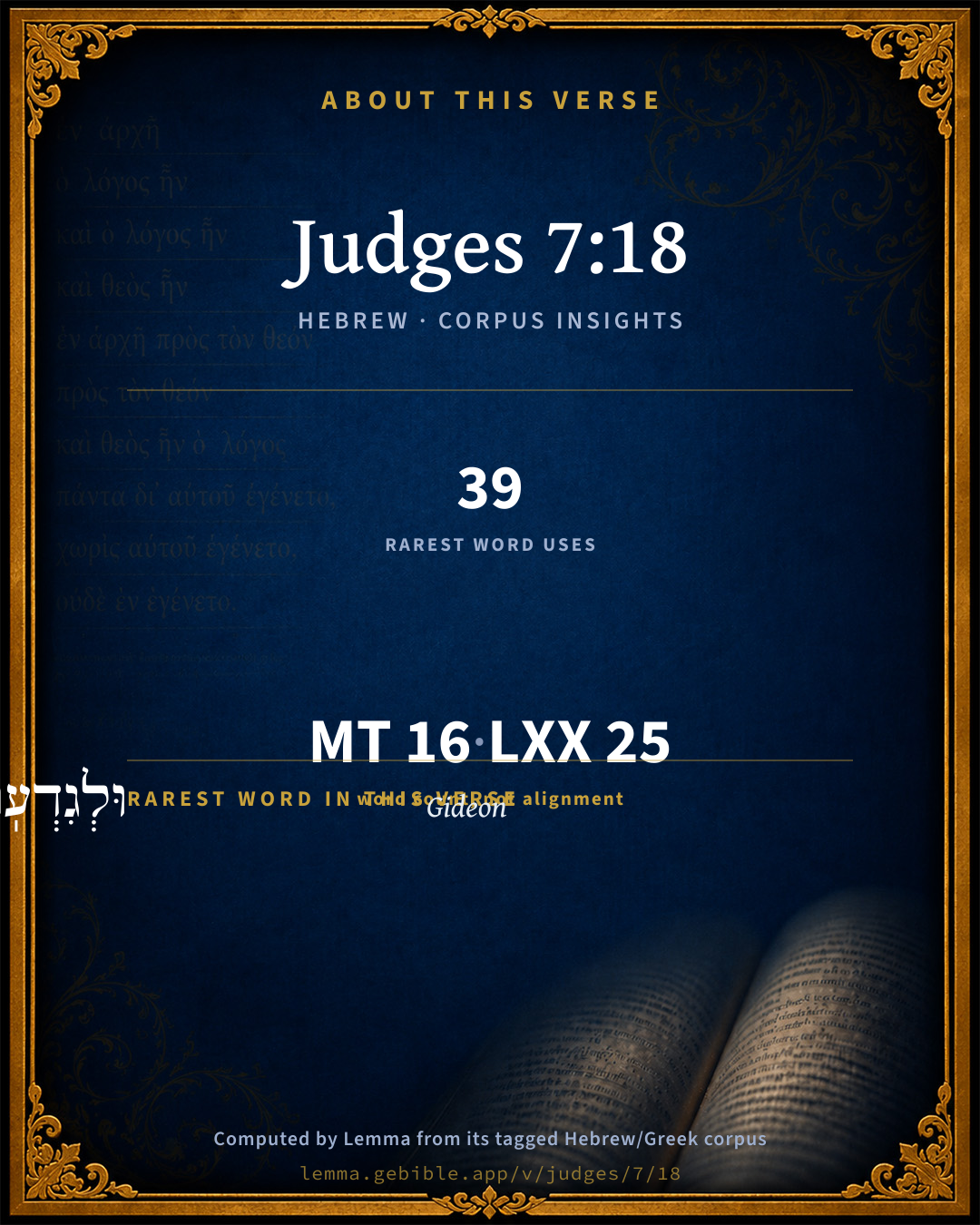
16
words
13
distinct lemmas
Historical
section

Shared distinctive vocabulary

וּלְגִדְעֽוֹן Gideon H1439 occurs in 37 verses of the Hebrew Bible. Also found in:

Grammatical profile

  • 3 verbs
  • 8 nouns
  • 2 pronouns
  • 1 preposition
  • 2 particles

Verb forms

  • וְתָקַעְתִּי֙ Qal · Sequential Perfect
  • וּתְקַעְתֶּ֨ם Qal · Sequential Perfect
  • וַאֲמַרְתֶּ֖ם Qal · Sequential Perfect

Repetition

Words recur within this verse — often emphatic in Hebrew:

  • וְתָקַעְתִּי֙ to blow H8628 ×2
  • בַּשּׁוֹפָ֔ר horn H7782 ×2
  • וְכָל all H3605 ×2

Hebrew & Septuagint length

In English translation the verse runs 32 words from the Hebrew and 31 from the Septuagint (LXX English) — closely comparable.

A rough comparison of the two English renderings, which tokenize alike — not a word-level alignment.

Word counts can differ between the Hebrew and the Greek without any difference in meaning — e.g. the Hebrew direct-object marker אֵת has no separate Greek word, and Greek often adds the article ὁ.

In the original languages it is 16 Hebrew tokens and 25 Greek tokens — but the two are counted differently (Hebrew bundles its prefixes and suffixes into one token; the Greek is in lemma form), so that isn’t a like-for-like length.

Cross-references

2

Topical passages linked to Judges 7:18 in the Treasury of Scripture Knowledge — connected by theme and wording, ordered by reader-vote popularity; previews shown in the World English Bible.

  • 2 Chronicles 20:15–17 and he said, Listen you, all Judah, and you inhabitants of Jerusalem, and you king Jehoshaphat: Thus says Yahweh to you, Don't be afraid you, neither be dismayed by reason of this great multitude; for the battle is not yours, but God's.
  • 1 Samuel 17:47 and that all this assembly may know that Yahweh doesn't save with sword and spear: for the battle is Yahweh's, and he will give you into our hand.

Cross-references courtesy of OpenBible.info (CC BY 4.0).

Hebrew and Greek witnesses Masoretic Hebrew ↔ Greek Septuagint

The same verse in the two great witnesses to the Old Testament, shown verse-for-verse.

These are two independent witnesses, not word-aligned to each other, and the Septuagint is shown in lemma (dictionary) form.

Hebrew Judges 7:18 Masoretic · Westminster Leningrad Codex

וְתָקַעְתִּי֙ בַּשּׁוֹפָ֔ר אָנֹכִ֖י וְכָל אֲשֶׁ֣ר אִתִּ֑י וּתְקַעְתֶּ֨ם בַּשּׁוֹפָר֜וֹת גַּם אַתֶּ֗ם סְבִיבוֹת֙ כָּל הַֽמַּחֲנֶ֔ה וַאֲמַרְתֶּ֖ם לַיהוָ֥ה וּלְגִדְעֽוֹן

When I blow the trumpet, I and all who are with me, then blow you the trumpets also on every side of all the camp, and say, For Yahweh and for Gideon.

World English Bible · Public Domain

Greek LXX Judges 7:18 Septuagint · lemma form

καί σαλπίζω ἐν ὁ κερατίνη ἐγώ καί πᾶς μετά ἐγώ σαλπίζω ἐν ὁ κερατίνη κύκλος ὅλος ὁ παρεμβολή καί εἶπον ὁ κύριος καί ὁ γεδεων

And I will sound with the horn, and all you⌃ with me shall sound with the horn round about the whole camp, and you⌃ shall say, For the Lord and Gedeon.

LXX2012 (modern English Septuagint) · Public Domain

On this verse, Ellicott's Commentary for English Readers discusses the Septuagint’s reading. Read the note in Commentary ↓

Hebrew: Westminster Leningrad Codex (CC BY 4.0). Greek: Septuagint (public domain); English from LXX2012 (modern English Septuagint) (Public Domain). How the Septuagint differs from the Hebrew →

Targum (Aramaic paraphrase)

1

The Targum is the ancient Jewish Aramaic paraphrase of the Hebrew Scriptures — an interpretive translation, not the Hebrew text itself. Onkelos (literal) and Pseudo-Jonathan (expansive) render the Torah, and Jonathan the Prophets. Coverage is partial: where no permissively-licensed English translation exists for a verse, only the Aramaic is shown. This is verse-level text, not a word-by-word alignment to the Hebrew.

  1. Targum Jonathan Prophets (Joshua–Malachi)
    וְאֶתְקַע בְּשׁוֹפָרָא אֲנָא וְכָל דְעִמִי וְתִתְקְעוּן בְּשׁוֹפָרַיָא אַף אַתּוּן סַחֲרָנוּת כָּל מַשְׁרִיתָא וְתֵימְרוּן חַרְבָּא דְמִקַטְלָא מִן קֳדָם יְיָ וְנִצְחָנָא עַל יְדֵי גִדְעוֹן:

    (no public-domain English translation for this verse)

    Targum Jonathan — Aramaic: “Mikraot Gedolot” (public domain). English: “Sefaria Community Translation” (CC0 1.0 (public-domain dedication)); “London "Chaldee Paraphrase," 1871” (public domain). Text via Sefaria.

Commentary

Notes on Judges 7:18 from classic Christian and Jewish commentators (each source and its license shown beneath its notes). The classic Christian expositions comment on the surrounding passage and are grouped to its opening verse, so a note may address several verses; the Jewish commentaries on the Tanakh (Rashi and others) are per-verse, so they appear only where the commentator wrote on this verse.

Lemma curates 59 commentaries, every one of them public domain or Creative Commons licensed, each selected and text-cleaned for this edition rather than reprinted as found. About our sources →

Trapp's Complete Commentary

John Trapp

Jdg 7:18 When I blow with a trumpet, I and all that [are] with me, then blow ye the trumpets also on every side of all the camp, and say, [The sword] of the LORD, and of Gideon.

Ver. 18. The sword of the Lord, and of Gideon.] Domino et Gideoni; this was the word. {a} Against Jehovah there was no fighting: and Gideon’s name was now grown terrible to them, as Scipio’s afterwards was to the Carthaginians, Hunniades’s to the Turks, &c.

{a} Tessera et symbolum fuit quo terrerent hostes, et ipsi se mutub cognoscerent. - Lav.

John Trapp, A Commentary or Exposition upon All the Books of the Old and New Testament (1647–1656) — public domain. Text from a community e-Sword module.

Geneva Bible (1599)

Geneva Bible translators

That is, the victory shall be the Lord’s and Gideon’s his servant.

Geneva Bible (1599) marginal notes — public domain. Text via Bolls.life.

Adam Clarke's Commentary

Verse 18. The sword of the Lord, and of Gideon.] The word חרב chereb, "sword," is not found in this verse, though it is necessarily implied, and is found in Jdg 7:20. But it is found in this place in the Chaldee, Syriac, and Arabic, and in eight of Kennicott's and De Rossi's MSS. The reading appears to be genuine.

Adam Clarke's Commentary on the Bible (1810–1826) — public domain. Text from a community e-Sword/MySword module.

Ellicott's Commentary for English Readers

(18) The sword of the Lord, and of Gideon.—Literally, for Jehovah and for Gideon (LXX., Τῷ κυρίῳ καὶ τῷ Γεδεων; Vulg., clangite et conclamate Domino et Gedeoni), but the particle le often has the meaning of, as in “a Psalm to David,” which is found at the beginning of many Psalms. Our version here understands the word “sword” (chereb) from Jdg_6:20, as is also done in some MSS. of the LXX. It is better to omit it. The watchword and war-cry, then, resembles that given by Cyrus to his soldiers—“Zeus, our ally and leader” (Cyrop. iii. 28). The mention of his own name was only for the purpose of terrifying the enemy (Jdg_7:14).

A Bible Commentary for English Readers, edited by Charles John Ellicott (1878–1897) — public domain. Text from a community e-Sword module.

John Gill's Exposition

When I blow with a trumpet, I and all that are with me,.... He being at the head of one of the three companies, Jdg 7:19 perhaps the middlemost, which might stand for the body of the army; and the other two be one to the right and the other to the left of him, and so could more easily discover his motions:

then blow ye the trumpets also on every side of all the camp; for it seems they were so disposed as to be around the camp, which when the trumpets were blown at once on every side, with such a blaze of light, and crashing of the pitchers, must be very terrifying, as if there was no way for them to escape, and especially when they should hear the following dreadful sounds:

and say, the sword of the Lord, and of Gideon; or "for the Lord, and for Gideon"; and which may be supplied, either the light is for the Lord, and for Gideon; or the victory is for the Lord, and for Gideon; we supply it from Jdg 7:20. The name Jehovah, these Heathens had often heard, as the God of Israel, would now be dreadful to them, and the name of Gideon also; whose name, as appears by the interpretation of the dream, was terrible among them; for which reason Gideon added it, and not out of arrogance and vanity; and puts it after the name of the Lord, as being only an instrument the Lord thought fit to make use of, otherwise all the glory belonged to him.

John Gill's Exposition of the Whole Bible (1746–1763) — public domain (CC PDM 1.0). Text via the HelloAO Bible API.

Haydock's Catholic Bible Commentary

Camp, and shout together to the Lord and to Gedeon: or rather "the sword of, &c., ver. 20. The war is the Lord’s, victory to or by the hand of Gedeon," Chaldean. He is the minister of God’s justice to punish Madian. (Menochius) --- It is not derogation to God (Calmet) that honour is given to his servants. (Worthington) --- Protestants supply the word which seems to be wanting. The sword of the Lord, &c. (Haydock)

George Leo Haydock (1774–1849), Haydock's Catholic Family Bible and Commentary, 1859 edition — public domain. Excludes Psalms (Douay-Rheims chapter numbering differs from Protestant) and Deuterocanonical books (Catholic canon only).

Matthew Poole's English Annotations

He mentions his own name, together with God’s, not out of vain ostentation or arrogance, as if he would equal himself with God; for he mentions God in the first and chief place, and himself only as his minister; but from prudent policy, because his name was grown formidable to them, and so was likely to further his design, and their flight, as it did.

Matthew Poole's English Annotations on the Holy Bible (1683–1685) — public domain. Text from a community e-Sword/MySword module.

The Pulpit Commentary

The sword of the Lord, etc. The word sword is not in the original here, though it is in ver. 20. It has either dropped out of the text accidentally, or what we have here is the shorter form of the war-cry. It is observable how careful Gideon is to put the name of Jehovah first. It was his cause against Baal, and the battle was to be fought in his strength, and the glory of the victory was to be his. The cry, "The sword of Gideon," would be peculiarly terrible to the many who had heard of the dream, of which the fulfilment was come so quickly.

The Pulpit Commentary (1880–1919), ed. H.D.M. Spence-Jones & Joseph S. Exell — public domain. Text from a community e-Sword module.

John Wesley's Explanatory Notes

Of Gideon - He mentions his own name, together with God's, not out of arrogance, as if he would equal himself with God; but from prudent policy, because his name was grown formidable to them, and so was likely to further his design. See ver. 14.

John Wesley, Explanatory Notes Upon the Whole Bible (1754–1765) — public domain. Text via the GEBible commentary corpus.

Rashi

Rabbi Shlomo Yitzchaki (Rashi)

I, and everyone with me. One of the divisions and one hundred men accompanied him.

For Adonoy, and for Gidon. The sword that executes is from Adonoy, so that victory is Gidon's.

Rashi on the Tanakh — English translations: “The Judaica Press complete Tanach with Rashi, translated by A. J. Rosenberg” (CC BY 4.0); “Pentateuch with Rashi's commentary by M. Rosenbaum and A.M. Silbermann, 1929-1934” (public domain); “The Metsudah Tanach series, Lakewood, N.J” (CC BY 4.0); and “The Book of Joshua, Metsudah Publications, 1997” (CC BY 4.0). Text via Sefaria.

Lesson kit

Teaching starters — assembled from the data on this page, not authored interpretation. Every prompt links to the verse data it draws on. Edit before teaching.

Judges, in the Historical, opens this verse with 16 words (13 distinct Hebrew lemmas). Its most distinctive word is Gidʻôwn (“Gideon”). A historical commentator’s framing appears above. Read the whole chapter for the surrounding context.

Discussion questions

  1. The word Gidʻôwn carries the sense “Gideon.” How does it shape the verse?
  2. Judges 6:11 shares the word «Gideon» with this verse. How do the two illuminate each other?
  3. “to blow” occurs 2× in this one verse. What is the effect of the repetition?
  4. These translations render this verse differently. What is at stake in choosing one wording over another?
  5. The verb «וְתָקַעְתִּי֙» is Qal Sequential Perfect. How does its form color the action?
  6. Reading how Trapp's Complete Commentary and Geneva Bible (1599) read this verse, where do the two commentators agree and where do they part?

Things to notice

Reading settings

Reading text

Shown beneath each verse's original-language words.

Old Testament
Old Testament edition

Read the OT as the Masoretic Hebrew (MT) or the Greek Septuagint (LXX).

English shown for the Greek Septuagint (in the Hebrew ↔ Greek comparison).

Comparing translations? Open the Compare panel on any verse page to stack up to four side by side.