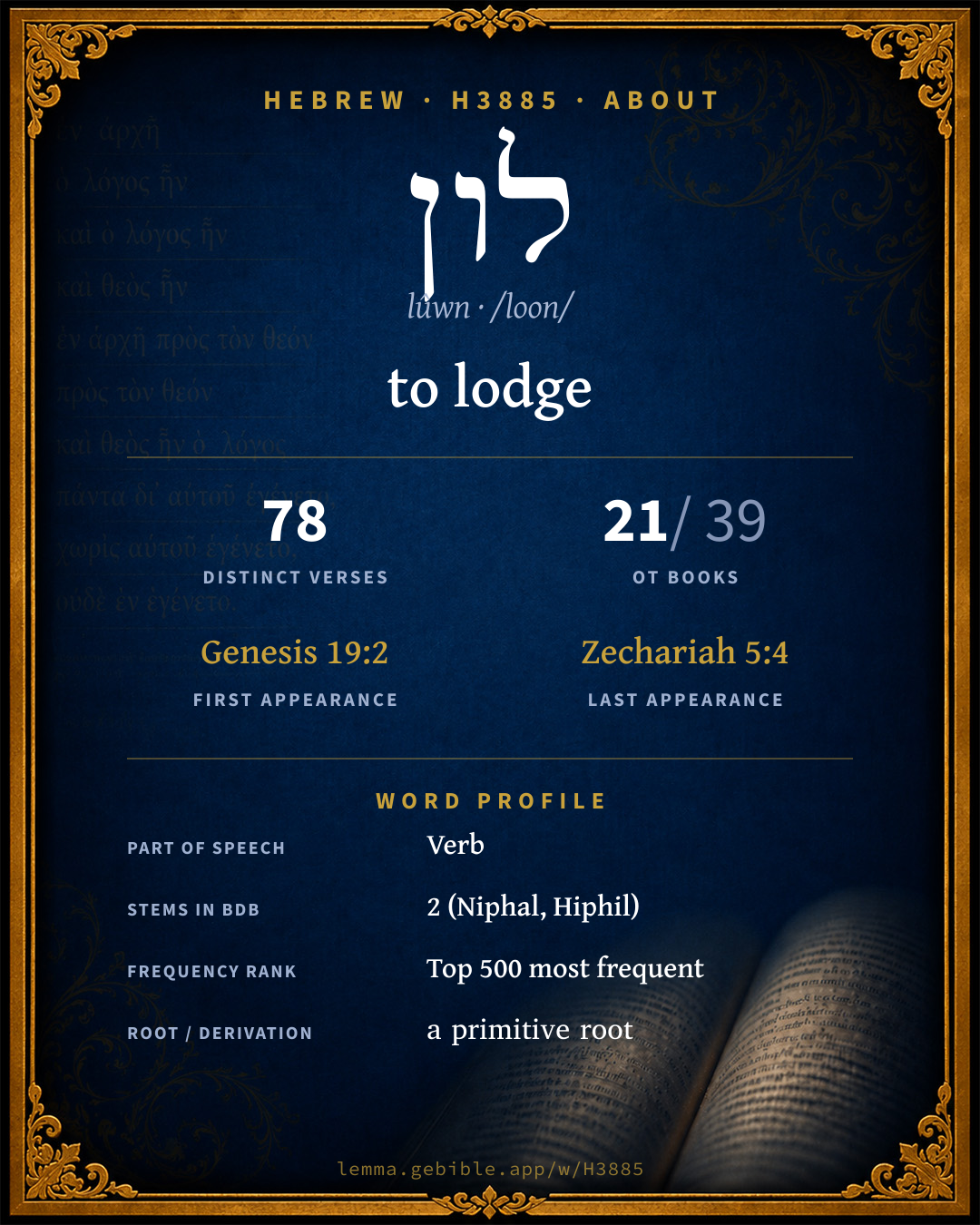
לוּן
to lodge
also: stop over, pass the night, abide fuller range ↓
Full lexicon entry — Brown-Driver-Briggs (BDB)
From Brown-Driver-Briggs (BDB)
Where this word appears
See every Qal verb in the Hebrew Bible →
Grammar key — what these labels mean
Part of speech
- Verb
- An action or state-of-being word.
Stem
- Qal
- The basic, simple active stem — the plain form of the verb (“he wrote”).
- Niphal
- Usually the simple passive or reflexive of the Qal (“he was written”).
- Hiphil
- The causative active stem (“he caused / brought about”).
- Hithpolel
- The reflexive counterpart of the Polel.
Form
- Imperfect
- An incomplete, ongoing, or future action (“he will / would write”).
- Sequential Imperfect
- An imperfect with prefixed waw — the standard past-narrative form (waw-consecutive imperfect).
- Infinitive Construct
- A bound verbal noun, frequently with prepositions (“to write / in writing”).
- Participle Active
- A verbal adjective expressing ongoing or characteristic action (“writing / one who writes”).
- Imperative
- A direct command (“write!”).
- Jussive
- A third- or second-person volitional form expressing wish or command (“let him write”).
- Perfect
- A completed action or state — Hebrew marks aspect (completeness) more than strict tense (“he wrote”).
- Sequential Perfect
- A perfect with prefixed waw continuing a preceding imperfect or command (waw-consecutive perfect).
- Cohortative
- A first-person volitional form expressing wish or resolve (“let me / let us write”).
State
- Absolute
- The independent form of a noun, not bound to a following word.
Person
- 3rd Person
- The one spoken about (“he / she / it / they”).
- 2nd Person
- The one addressed (“you”).
- 1st Person
- The speaker (“I / we”).
Gender
- Masculine
- Grammatically masculine.
- Feminine
- Grammatically feminine.
- Common
- Either gender — not distinguished for this form.
Number
- Singular
- One.
- Plural
- More than one (in Hebrew, generally three or more).
Grammatical forms 27 distinct
- Verb, Qal, Imperfect, 3rd Person, Masculine, Singular 14 times (16%)
- Verb, Qal, Sequential Imperfect, 3rd Person, Masculine, Plural 8 times (9%)
- Verb, Qal, Infinitive Construct 7 times (8%)
- Verb, Qal, Imperfect, 3rd Person, Feminine, Singular 7 times (8%)
- Verb, Niphal, Sequential Imperfect, 3rd Person, Masculine, Plural 6 times (7%)
- Verb, Qal, Sequential Imperfect, 3rd Person, Masculine, Singular 5 times (6%)
- Verb, Qal, Imperfect, 3rd Person, Masculine, Plural 5 times (6%)
- Verb, Hiphil, Imperfect, 2nd Person, Masculine, Plural 4 times (5%)
+19 more forms (31 occurrences)
Parsed forms decoded from the imported morphology (morphhb / Westminster Leningrad Codex — WLC text public domain, morphhb tagging CC BY 4.0), counted across 87 parsed occurrences — not distinct verses.
Every verse where H3885 appears — 78 distinct verses across 21 books. Click any verse to open its interlinear word-by-word view. Verse text shown in the World English Bible for context — . Each verse’s Hebrew form is shown with its reference; the English is not keyword-highlighted, since the data carries no word-level English alignment. Use “Compare translations” on any verse to read it across multiple English versions. This concordance covers the Hebrew Bible; Septuagint (Greek Old Testament) occurrences are not indexed here.
Genesis 8 verses
- Genesis 19:2 וְ/לִ֨ינוּ֙ נָלִֽין conj + Qal impv 2mp Qal impf 1cp and he said, "See now, my lords, please turn aside into your servant's house, stay all night, wash your feet, and you will rise up early, and go on your way." They said, "No, but we will stay in the street all night."
- Genesis 24:23 לָ/לִֽין prep + Qal inf.cs and said, "Whose daughter are you? Please tell me. Is there room in your father's house for us to lodge in?"
- Genesis 24:25 לָ/לֽוּן prep + Qal inf.cs She said moreover to him, "We have both straw and provender enough, and room to lodge in."
- Genesis 24:54 וַ/יָּלִ֑ינוּ conj + Qal wimpf 3mp They ate and drank, he and the men who were with him, and stayed all night. They rose up in the morning, and he said, "Send me away to my master."
- Genesis 28:11 וַ/יָּ֤לֶן conj + Qal wimpf 3ms He came to a certain place, and stayed there all night, because the sun had set. He took one of the stones of the place, and put it under his head, and lay down in that place to sleep.
- Genesis 31:54 וַ/יָּלִ֖ינוּ conj + Qal wimpf 3mp Jacob offered a sacrifice in the mountain, and called his relatives to eat bread. They ate bread, and stayed all night in the mountain.
- Genesis 32:13 וַ/יָּ֥לֶן conj + Qal wimpf 3ms He lodged there that night, and took from that which he had with him, a present for Esau, his brother:
- Genesis 32:21 לָ֥ן Qal ptcp.act ms So the present passed over before him: and he himself lodged that night in the camp.
Exodus 6 verses
- Exodus 15:24 וַ/יִּלֹּ֧נוּ conj + Niphal wimpf 3mp The people murmured against Moses, saying, "What shall we drink?"
- Exodus 16:2 ו/ילינו וַ/יִּלּ֜וֹנוּ conj + Hiphil wimpf 3mp conj + Niphal wimpf 3mp The whole congregation of the children of Israel murmured against Moses and against Aaron in the wilderness;
- Exodus 16:7 תלונו תַלִּ֖ינוּ Hiphil impf 2mp Hiphil impf 2mp and in the morning, then you shall see the glory of Yahweh; because he hears your murmurings against Yahweh. Who are we, that you murmur against us?"
- Exodus 17:3 וַ/יָּ֥לֶן conj + Hiphil wimpf 3ms The people were thirsty for water there; and the people murmured against Moses, and said, "Why have you brought us up out of Egypt, to kill us, our children, and our livestock with thirst?"
- Exodus 23:18 יָלִ֥ין Qal impf 3ms "You shall not offer the blood of my sacrifice with leavened bread, neither shall the fat of my feast remain all night until the morning.
- Exodus 34:25 יָלִ֣ין Qal impf 3ms "You shall not offer the blood of my sacrifice with leavened bread; neither shall the sacrifice of the feast of the Passover be left to the morning.
Leviticus 1 verse
Numbers 8 verses
- Numbers 14:2 וַ/יִּלֹּ֨נוּ֙ conj + Niphal wimpf 3mp All the children of Israel murmured against Moses and against Aaron: and the whole congregation said to them, Would that we had died in the land of Egypt! or would that we had died in this wilderness!
- Numbers 14:27 מַלִּינִ֖ים מַלִּינִ֛ים Hiphil ptcp.act mp Hiphil ptcp.act mp How long [shall I bear] with this evil congregation, that murmur against me? I have heard the murmurings of the children of Israel, which they murmur against me.
- Numbers 14:29 הֲלִֽינֹתֶ֖ם Hiphil pf 2mp your dead bodies shall fall in this wilderness; and all who were numbered of you, according to your whole number, from twenty years old and upward, who have murmured against me,
- Numbers 14:36 ו/ילונו וַ/יַּלִּ֤ינוּ conj + Niphal wimpf 3mp conj + Hiphil wimpf 3mp The men, whom Moses sent to spy out the land, who returned, and made all the congregation to murmur against him, by bringing up an evil report against the land,
- Numbers 16:11 תלונו תַלִּ֖ינוּ Hiphil impf 2mp Hiphil impf 2mp Therefore you and all your company are gathered together against Yahweh: and Aaron, what is he who you murmur against him?
- Numbers 16:41 וַ/יִּלֹּ֜נוּ conj + Niphal wimpf 3mp But on the next day all the congregation of the children of Israel murmured against Moses and against Aaron, saying, You have killed the people of Yahweh.
- Numbers 17:5 מַלִּינִ֖ם Hiphil ptcp.act mp It shall happen, that the rod of the man whom I shall choose shall bud: and I will make to cease from me the murmurings of the children of Israel, which they murmur against you.
- Numbers 22:8 לִ֤ינוּ Qal impv 2mp He said to them, Lodge here this night, and I will bring you word again, as Yahweh shall speak to me: and the princes of Moab abode with Balaam.
Deuteronomy 2 verses
- Deuteronomy 16:4 יָלִ֣ין Qal impf 3ms There shall be no yeast seen with you in all your borders seven days; neither shall any of the flesh, which you sacrifice the first day at even, remain all night until the morning.
- Deuteronomy 21:23 תָלִ֨ין Qal impf 3fs his body shall not remain all night on the tree, but you shall surely bury him the same day; for he who is hanged is accursed of God; that you don't defile your land which Yahweh your God gives you for an inheritance.
Joshua 5 verses
- Joshua 3:1 וַ/יָּלִ֥נוּ conj + Qal wimpf 3mp Joshua rose up early in the morning; and they removed from Shittim, and came to the Jordan, he and all the children of Israel; and they lodged there before they passed over.
- Joshua 4:3 תָּלִ֥ינוּ Qal impf 2mp and command you them, saying, Take hence out of the midst of the Jordan, out of the place where the priests' feet stood firm, twelve stones, and carry them over with you, and lay them down in the lodging-place, where you shall lodge this night.
- Joshua 6:11 וַ/יָּלִ֖ינוּ conj + Qal wimpf 3mp So he caused the ark of Yahweh to compass the city, going about it once: and they came into the camp, and lodged in the camp.
- Joshua 8:9 וַ/יָּ֧לֶן conj + Qal wimpf 3ms Joshua sent them forth; and they went to set up the ambush, and stayed between Bethel and Ai, on the west side of Ai: but Joshua lodged that night among the people.
- Joshua 9:18 וַ/יִּלֹּ֥נוּ conj + Niphal wimpf 3mp The children of Israel didn't strike them, because the princes of the congregation had sworn to them by Yahweh, the God of Israel. All the congregation murmured against the princes.
Judges 11 verses
- Judges 18:2 וַ/יָּלִ֖ינוּ conj + Qal wimpf 3mp The children of Dan sent of their family five men from their whole number, men of valor, from Zorah, and from Eshtaol, to spy out the land, and to search it; and they said to them, Go, search the land. They came to the hill-country of Ephraim, to the house of Micah, and lodged there.
- Judges 19:4 וַ/יָּלִ֖ינוּ conj + Qal wimpf 3mp His father-in-law, the young lady's father, retained him; and he abode with him three days: so they ate and drink, and lodged there.
- Judges 19:6 וְ/לִ֖ין conj + Qal impv 2ms So they sat down, and ate and drink, both of them together: and the young lady's father said to the man, Please be pleased to stay all night, and let your heart be merry.
- Judges 19:7 וַ/יָּ֥לֶן conj + Qal wimpf 3ms The man rose up to depart; but his father-in-law urged him, and he lodged there again.
- Judges 19:9 לִֽינוּ לִ֥ין Qal impv 2mp Qal impv 2ms When the man rose up to depart, he, and his concubine, and his servant, his father-in-law, the young lady's father, said to him, Behold, now the day draws toward evening, please stay all night: behold, the day grows to an end, lodge here, that your heart may be merry; and tomorrow get you early on your way, that you may go home.
- Judges 19:10 לָ/ל֔וּן prep + Qal inf.cs But the man wouldn't stay that night, but he rose up and departed, and came over against Jebus (the same is Jerusalem): and there were with him a couple of donkeys saddled; his concubine also was with him.
- Judges 19:11 וְ/נָלִ֥ין conj + Qal impf 1cp When they were by Jebus, the day was far spent; and the servant said to his master, Please come and let us turn aside into this city of the Jebusites, and lodge in it.
- Judges 19:13 וְ/לַ֥נּוּ conj + Qal wpf 1cp He said to his servant, Come and let us draw near to one of these places; and we will lodge in Gibeah, or in Ramah.
- Judges 19:15 לָ/ל֣וּן לָ/לֽוּן prep + Qal inf.cs prep + Qal inf.cs They turned aside there, to go in to lodge in Gibeah: and he went in, and sat him down in the street of the city; for there was no man who took them into his house to lodge.
- Judges 19:20 תָּלַֽן Qal juss 2ms The old man said, Peace be to you; howsoever let all your wants lie on me; only don't lodge in the street.
- Judges 20:4 לָ/לֽוּן prep + Qal inf.cs The Levite, the husband of the woman who was murdered, answered, I came into Gibeah that belongs to Benjamin, I and my concubine, to lodge.
Ruth 2 verses
- Ruth 1:16 תָּלִ֨ינִי֙ אָלִ֔ין Qal impf 2fs Qal impf 1cs Ruth said, "Don't entreat me to leave you, and to return from following after you, for where you go, I will go; and where you lodge, I will lodge; your people shall be my people, and your God my God;
- Ruth 3:13 לִ֣ינִי Qal impv 2fs Stay this night, and it shall be in the morning, that if he will perform to you the part of a kinsman, well; let him do the kinsman's part: but if he will not do the part of a kinsman to you, then will I do the part of a kinsman to you, as Yahweh lives: lie down until the morning.
2 Samuel 4 verses
- 2 Samuel 12:16 וְ/לָ֖ן conj + Qal pf 3ms David therefore begged God for the child; and David fasted, and went in, and lay all night on the earth.
- 2 Samuel 17:8 יָלִ֖ין Qal impf 3ms Hushai said moreover, You know your father and his men, that they are mighty men, and they are fierce in their minds, as a bear robbed of her cubs in the field; and your father is a man of war, and will not lodge with the people.
- 2 Samuel 17:16 תָּ֤לֶן Qal juss 2ms Now therefore send quickly, and tell David, saying, Don't lodge this night at the fords of the wilderness, but by all means pass over; lest the king be swallowed up, and all the people who are with him.
- 2 Samuel 19:7 יָלִ֨ין Qal impf 3ms Now therefore arise, go forth, and speak comfortably to your servants; for I swear by Yahweh, if you don't go forth, there will not stay a man with you this night: and that will be worse to you than all the evil that has happened to you from your youth until now.
1 Kings 1 verse
1 Chronicles 1 verse
Nehemiah 3 verses
- Nehemiah 4:22 יָלִ֖ינוּ Qal impf 3mp Likewise at the same time said I to the people, Let everyone with his servant lodge within Jerusalem, that in the night they may be a guard to us, and may labor in the day.
- Nehemiah 13:20 וַ/יָּלִ֨ינוּ conj + Qal wimpf 3mp So the merchants and sellers of all kind of wares lodged outside of Jerusalem once or twice.
- Nehemiah 13:21 לֵנִים֙ Qal ptcp.act mp Then I testified against them, and said to them, Why lodge you about the wall? if you do so again, I will lay hands on you. From that time forth came they no more on the Sabbath.
Job 8 verses
- Job 17:2 תָּלַ֥ן Qal impf 3fs Surely there are mockers with me, My eye dwells on their provocation.
- Job 19:4 תָּלִ֥ין Qal impf 3fs If it is true that I have erred, My error remains with myself.
- Job 24:7 יָ֭לִינוּ Qal impf 3mp They lie all night naked without clothing, And have no covering in the cold.
- Job 29:19 יָלִ֥ין Qal impf 3ms My root is spread out to the waters, The dew lies all night on my branch;
- Job 31:32 יָלִ֣ין Qal impf 3ms (The foreigner has not lodged in the street; But I have opened my doors to the traveler);
- Job 39:9 יָ֝לִ֗ין Qal impf 3ms "Will the wild ox be content to serve you? Or will he stay by your feeding trough?
- Job 39:28 וְ/יִתְלֹנָ֑ן conj + Hithpolel impf 3ms On the cliff he dwells, and makes his home, On the point of the cliff, and the stronghold.
- Job 41:22 יָלִ֣ין Qal impf 3ms In his neck there is strength. Terror dances before him.
Psalms 6 verses
- Psalms 25:13 תָּלִ֑ין Qal impf 3fs His soul shall dwell at ease. His seed shall inherit the land.
- Psalms 30:5 יָלִ֥ין Qal impf 3ms For his anger is but for a moment; His favor is for a lifetime. Weeping may stay for the night, But joy comes in the morning.
- Psalms 49:12 יָלִ֑ין Qal impf 3ms But man, despite his riches, doesn't endure. He is like the animals that perish.
- Psalms 55:7 אָלִ֖ין Qal impf 1cs Behold, then I would wander far off. I would lodge in the wilderness." Selah.
- Psalms 59:15 וַ/יָּלִֽינוּ conj + Qal wimpf 3mp They shall wander up and down for food, And wait all night if they aren't satisfied.
- Psalms 91:1 יִתְלוֹנָֽן Hithpolel impf 3ms He who dwells in the secret place of the Most High Will rest in the shadow of the Almighty.
Proverbs 2 verses
Song of Solomon 2 verses
Isaiah 3 verses
- Isaiah 1:21 יָלִ֥ין Qal impf 3ms How the faithful city has become a prostitute! She was full of justice; righteousness lodged in her, But now murderers.
- Isaiah 21:13 תָּלִ֔ינוּ Qal impf 2mp The burden on Arabia. In the forest in Arabia shall you lodge, you caravans of Dedanites.
- Isaiah 65:4 יָלִ֑ינוּ Qal impf 3mp who sit among the graves, and lodge in the secret places; who eat pig's flesh, and broth of abominable things is in their vessels;
Jeremiah 2 verses
- Jeremiah 4:14 תָּלִ֥ין Qal impf 3fs Jerusalem, wash your heart from wickedness, that you may be saved. How long shall your evil thoughts lodge within you?
- Jeremiah 14:8 לָ/לֽוּן prep + Qal inf.cs You hope of Israel, the Savior of it in the time of trouble, why should you be as a foreigner in the land, and as a wayfaring man who turns aside to stay for a night?
Joel 1 verse
Zephaniah 1 verse
Zechariah 1 verse
About this entry
At a glance — auto-summarized from this page’s data, not written by a person. Every figure links to its source below. This summary describes the numbers; it doesn’t interpret them.
“to lodge” is the headline sense of the Hebrew verb לון (lûwn). Where the King James Version says “lodge,” newer translations reach for “spend the night” (Berean Standard Bible); the renderings breakdown has the detail. It appears 78 verses across 21 books of the Hebrew Bible, among its moderately common vocabulary. First canonically at Genesis 19:2, it enters the text early. Read the stem: it spans 2 stems, including Niphal and Hiphil. See the sense tree, 78-verse concordance, and the renderings breakdown below.
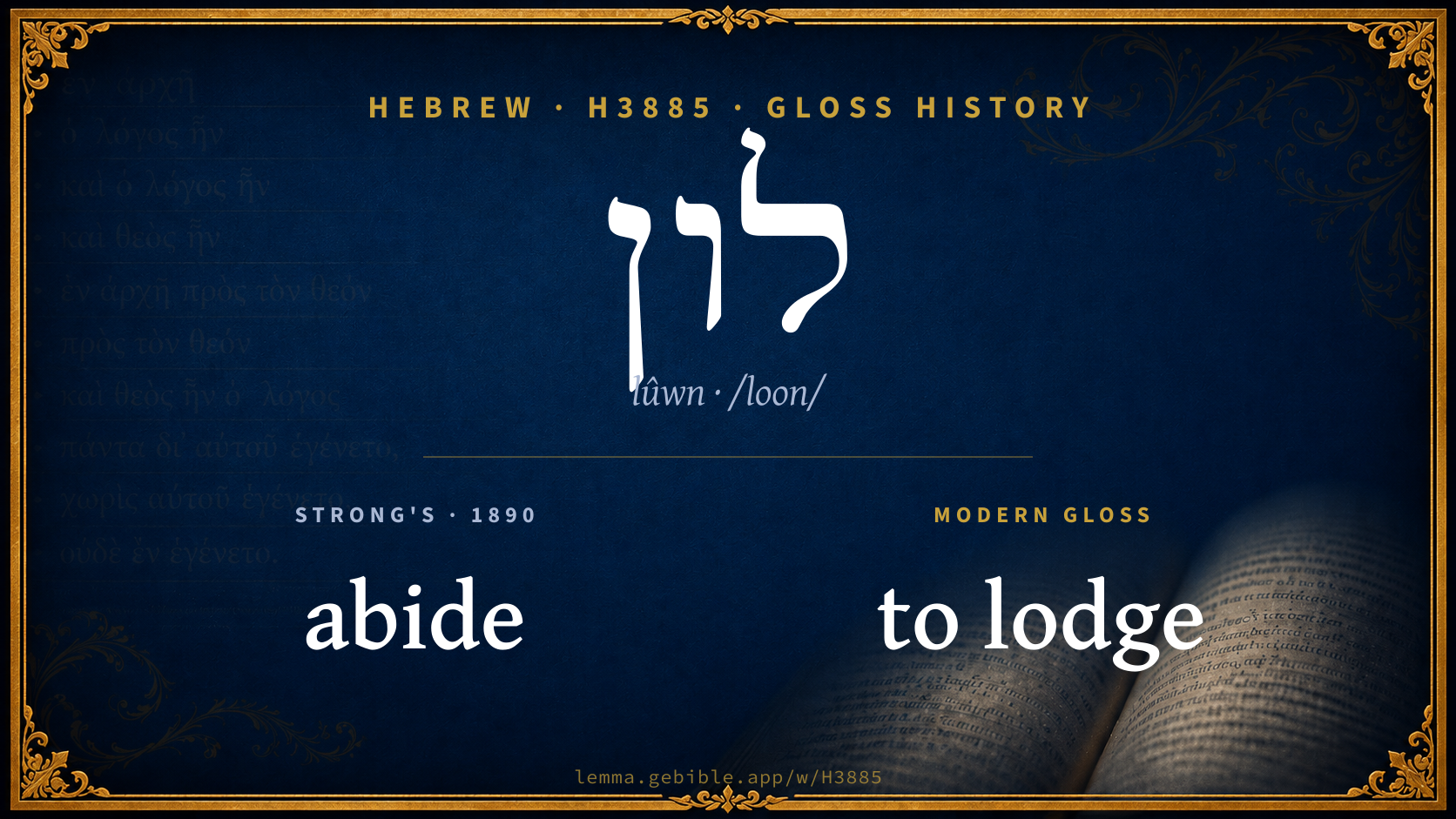
Gloss history
Strong's 1890 vs modern scholarship
About this word
Strong's H3885 catalogs a Hebrew word from the Hebrew Old Testament.
These counts are not copied from any lexicon or concordance. They are computed here, from the morphology-tagged Hebrew Old Testament. What Lemma adds →
- 78
- distinct verses
- The word appears in 78 distinct verses.
- 21 / 39
- OT books
- The word appears in 21 of 39 Old Testament books.
- #470
- by frequency
- Top 500 most frequent Hebrew words (rank 470 of 8,640 Hebrew words by occurrence).
View all 78 occurrences in the concordance →
By section of the Old Testament
By traditional corpus
Conventional, traditional groupings — biblical authorship is debated, so this is a traditional corpus grouping, not an authorship claim. Each share is this word’s portion of its verses in that division of the Hebrew canon. Each figure is a share of the word’s 78 distinct verses.
- Prophets (Nevi'im) 29 verses · 37%
- Torah (Pentateuch) 25 verses · 32%
- Writings (Ketuvim) 24 verses · 31%
How translations render this word
Counts come from each version’s own published word-to-Strong’s tagging or interlinear alignment — an approximate guide to how each version renders this word, not a word-level alignment the data otherwise carries. Because each total is that version’s own tagged count, the per-version totals vary from one another and need not match the appearance or distinct-verse counts above. These counts may also differ from a printed concordance because Lemma counts each distinctly tagged rendering and does not collapse phrase taggings into a single head-word total. This is a fixed set of word-tagged versions (KJV, ASV, BSB, ULT) and does not change with the reading translation you choose elsewhere. Each version’s license is shown beside its name below (and on Sources).
BDB lists this Strong’s number as 2 distinct words (homographs). Each count above pools all of them and is not split by sense — see the Senses section below. A low-frequency rendering may belong to a different one of those words, not the primary meaning.
- King James Version†: Lodge 10×, Lodged 7×, Murmured 6×
- American Standard Version†: Lodge 7×, Murmured 6×, Lodged 5×
- Berean Standard Bible†: Spend the night 13×, Grumbled 5×, Spent 3×
- unfoldingWord Literal Text†: Lodge 15×, And 8×, Murmured 7×
King James Version Public Domain
Renders H3885 across 85† tagged occurrences — most commonly:
Plus 43 renderings that appear only once — usually multi-word phrases or single function words the recovered tagging swept in, not distinct renderings. Not rendered by a distinct English word in 3 further occurrences.
American Standard Version Public Domain
Renders H3885 across 85† tagged occurrences — most commonly:
Plus 48 renderings that appear only once — usually multi-word phrases or single function words the recovered tagging swept in, not distinct renderings.
Berean Standard Bible Public Domain
Renders H3885 across 80† tagged occurrences — most commonly:
Plus 41 renderings that appear only once — usually multi-word phrases or single function words the recovered tagging swept in, not distinct renderings. Not rendered by a distinct English word in 3 further occurrences.
unfoldingWord Literal Text CC BY-SA 4.0
Renders H3885 across 105† tagged occurrences — most commonly:
Plus other, less common renderings. Plus 40 renderings that appear only once — usually multi-word phrases or single function words the recovered tagging swept in, not distinct renderings.
8 senses and sub-senses in the full BDB
Hebrew verbs can shift meaning by stem (binyan): Qal is the basic action, Niphal is often passive or reflexive, Piel often intensifies or makes it factitive, and Hiphil is typically causative. The senses below are grouped under the stem BDB assigns to each.
What do BDB’s symbols mean?
BDB uses these scholarly abbreviations:
| Symbol | Meaning |
|---|---|
| 𝔊 | the Septuagint (the ancient Greek translation, LXX) |
| 𝔙 | the Vulgate (the Latin translation) |
| 𝔖 | the Syriac version (the Peshitta) |
| 𝔗 | the Targum (the Aramaic translation) |
| ψ | the Psalms |
| √ | root (the underlying root or stem) |
| ‖ | parallel passage (a synonymous or contrasted parallel) |
| † | the dagger: every passage where the word occurs is cited |
The 8 senses and sub-senses the full Brown-Driver-Briggs lexicon distinguishes for this word, in lexicon order (not ranked by frequency), with BDB’s own verbatim wording and sub-sense lettering. Shown in Hebrew script with BDB’s own scholarly abbreviations. The condensed entry is in the Lexicon Entry tab. See also the Forms in the corpus table below.
לון I . vb. lodge, pass the night, fig. abide (NH לִינָה n. lodging, spending the night
- 1. lodge, pass the night:
- a. lit., human subj., often c. prep. or adv. of place, Gn 19:2; 28:11; Ju 19:13, 15; Ru 1:16; Jb 24:7 + often (on 2 S 17:8 v. Hiph.); c. ה loc., וְלָן וְשָׁכַב אַ֫רְצָה 2 S 12:16; c. ב loc. + ב temp. בַּלַּיְלָה הַהוּא Gn 32:14, 22; Jos 8:9; c. הַלַּיְלָה (accus. temp.), Nu 22:8; Jos 4:3; 2 S 17:16; 19:8; Ru 3:13; of the wicked ψ 59:16, according to Hup De Pe al.; לון 𝔊𝔙 Aq Che Bae al., cf. AV; sim. of temporary sojourn Je 14:8 (of י׳ in Isr.) e.g. Genesis 19:2
- b. of animals: wild ox (רְאֵם) Jb 39:9 (sq. עַל־אֲבוּסֶ֑ךָ), porcupine (קִפֹּד) Zp 2:14. e.g. Job 39:9
- c. inanim. subj. = remain all night: of fat of sacrifice Ex 23:18 (E; sq. עַד־בֹּקֶר), passover meal 34:25 (P; sq. לַבֹּקֶר), Dt 16:4 (sq. לַבֹּקֶר; all these without local designation), wages of hireling Lv 19:13 (H; אֶת = with + עַד־בֹּקֶר); of dead body Dt 21:23 (עַל loc.); dew Jb 29:19 (ב loc.); bunch of myrrh Ct 1:13 (בֵּין loc.) e.g. Exodus 23:18
- d. fig. בָּעֶרֶב יָלִין בֶּ֑כִי ψ 30:6 at evening weeping may come to lodge (opp. וְלַבֹּקֶר רִנָּה). e.g. Psalms 30:6
- 2. fig. abide, remain, subj. עַיִן (= look upon), c. ב Jb 17:2; of error, 19:4 (c. prep. אֵת pers.), strength 41:14 (of crocod.; c. ב); of righteousness, Is 1:21 (c. ב); נַפְשׁוֹ בְטוֹב תָּלִין ψ 25:13; of hearkening ear Pr 15:31, c. בְּקֶרֶב; of thoughts Je 4:14, c. id.; abs., of man, continue, endure, ψ 49:13, שָׂבֵעַ יָלִין Pr 19:23 he shall continue satisfied. Hiph. Impf. יָלִין cause to rest, lodge, sq. acc., 2 S 17:8 v. Köi. 509. Hithpoʿl. Impf. יִתְלֹנָ֑ן Jb 39:28 dwell, abide, of eagle; fig. בְּצֵל שַׁדַּי יִתְלוֹנָ֑ן ψ 91:1 of one trusting in י׳. e.g. Job 17:2
לון II murmur, only Ex 15, 16, 17, Nu 14, 16, 17, and Jos 9
Niphal
- Impf. 3 mpl. וַיִּלּוֹ֫נוּ Ex 15:24 + 3 times + Ex 16:2 Qr (Kt וילינו) + Nu 14:36 Kt (Qr וַיַּלִּי֫נוּ, Hiph.); 2 mpl. תִּלּוֹ֫נוּ Ex 16:7; Nu 16:11, both Kt (Qr תַּלִּי֫נוּ); on forms v. Ges§ 72 ee Köi. 509;—murmur against, sq. עַל Ex 15:24 (JE), 16:2, 7; Nu 14:2; 16:11; 17:6 Jos 9:18 (all P; all of people Isr.); abs. ψ 59:16 (v. ׃לון 1 a). e.g. Exodus 15:24
Hiphil
- Pf. 2 mpl. חֲלִינֹתֶם Nu 14:29; Impf. וַיָּ֫לָן Ex 17:3; וַיַּלִּי֫נוּ Ex 16:2 Kt, Nu 14:36 Qr; 2 mpl. תַּלִּי֫נוּ Ex 16:7 Qr, Nu 16:11 Qr (on all vid. supr.); Pt. pl. מַלִּינִים Ex 16:8 + 3 times;—murmur = Niph., sq. על Ex 17:3 (E), elsewhere P: 16:8 Nu 14:27(×2), 29; 17:20; cause to murmur, sq. acc. + עַל Nu 14:36 Qr; (cf. also supra Niph.) e.g. Numbers 14:29
Senses from the full Brown-Driver-Briggs lexicon (Brown, Driver, Briggs; Oxford 1906 — public domain), digitized via Sefaria, supplemented by the OpenScriptures HebrewLexicon (CC BY 4.0). Full attribution on Sources.
Word origin
I. . vb. lodge, pass the night, fig. abide (NH לִינָה n. lodging, spending the night; cf. NöZMG xxxvii (1883), 535 ff.; according to Thes kindred with לַיְלָה (q.v. infra), with change of ל and ן)—Qal Pf. לָן Gn 32:22; 2 S 12:16; 3 fs. וְלָ֫נֶה consec. (before monosyl.) Zc 5:4; 1 pl. וְלַנּוּ consec. Ju 19:13 (v. Ges§ 73. R. 1 Köi. 508); Impf. יָלִין Ex 23:18 + 13 times + 2 S 17:8, but cf. Hiph.; וַיָּ֫לֶן Gn 28:11 + 4 times; 3 fs. תָּלִין Lv 19:13 + 4 times; תָּלַ֫ן Jb 17:2 (v. Köi. 509); 2 ms. juss. אַל־תָּ֫לֶן 2 S 17:16; תָּלַ֑ן Ju 19:20 (v. Köl.c.), etc.; Imv. לִין Ju 19:6, 9, etc.; Inf. cstr. לָלוּן Gn 24:25 + 5 times; לָלִין 24:23; Pt. pl. לֵנִים Ne 13:21;—
II. vb. murmur, only Ex 15, 16, 17, Nu 14, 16, 17, and Jos 9:18 (Sam. always defect., hence NöZMG xxxvii, 1883, 535 n. thinks poss. לנן [cf. רנן?]; from limited occurrence, he supposes it disappeared early; but found chiefly in P);—
— Brown-Driver-Briggs (Oxford 1906, public domain), digitized via Sefaria, supplemented by the OpenScriptures HebrewLexicon (CC BY 4.0). See Sources.
Origin: a primitive root
Jastrow Dictionary
A second Hebrew/Aramaic lexicon for comparison, covering Aramaic and post-biblical (Talmudic, Targumic, Midrashic) usage that the biblical-Hebrew BDB does not. Matched by lemma rather than by Strong’s number, so a lemma may carry more than one Jastrow headword (shown separately below), and the entries cover usage well beyond the Bible.
לוּן
- (b. h.) to stay over night, to take (night-) lodging; to be kept over night. Num. R. s. 12, beg. (ref. to Ps. XCI, 1) שלָו שם לינות הרבה, v. לִינָה. Ib. הקב"ה … נתאוה לָלוּן בצלינו the Lord … is desirous to lodge under our shade (Tabernacle). Snh. VI, 4 ואם לן but if his body was allowed to hang over night. Pes. 42ᵃ מים שלָנוּ water which has been kept in vessels over night (misunderstood for ‘our water’, v. בִּית). Ber. 18ᵇ ולן בבית הקברות and stayed over night in the burial ground; a. fr.—[Gen. R. s. 60, distinction between לָלִין, Gen. XXIV, 23 and לָלוּן, ib. 25, v. לִינָה.] e.g. Psalms 91:1
- to keep over night. B. Kam. 99ᵃ עובר משום (לא) בל תָּלִין transgresses the law which says, (Lev. XIX, 13) ‘thou shalt not &c.’; B. Mets. IX, 12 יש בו משום לא תלין וכ׳ the prohibition to keep the wages of the hired man over night applies to it; ib. 111ᵇ; a. fr.—Esp. to leave a corpse unburied over night. Snh. VI, 5 כל המֵלִין את וכ׳ whosoever postpones the burial of his dead transgresses a prohibitory law (ref. to Deut. XXI, 23 in its general application); הֵלִינוֹ לכבודו וכ׳ but if one kept him over night for his honor’s sake (to prepare a more honorable burial) &c.; a. fr.—V. הֲלָנָה. e.g. Leviticus 19:13
- , Nithpol. נִתְלוֹנֵן to seek shelter; to take refuge. Num. R. l. c. (ref. to Ps. l. c.) [read:] שדי תִּתְלוֹנֵן בצל שעשה לך וכ׳ Almighty, be pleased to lodge in the shade which Bezaleel has made for thee. Yalk. Job 906 יש להם מנוס שׁיִתְלוֹנְנוּ מדינה וכ׳ have a place of refuge where to find shelter from the judgment of Gehenna; (Yalk. Jud. 41 שינצלו).
לוּן II
- to join.
- (cmp. קָהַל) to rise against, murmur, rebel. Ex. R. s. 25 כיון שׁהִלִּינוּ היה וכ׳ when they rebelled, it would have been necessary that the anger (of the Lord) &c.
- same. Tosef. B. Bath. VII, 9 המִתְלוֹנְנִים והמרגלים וכ׳ the rebellious (Num. XIV, sq.) and the spies … took no share &c.
לוֹן
- = לְהוֹן, unto them. Y. Ber. III, 6ᵇ top; a. fr.
A Dictionary of the Targumim, the Talmud Babli and Yerushalmi, and the Midrashic Literature (Marcus Jastrow; London, Luzac, 1903) — Public Domain. Digitized via Sefaria. Digitized via Sefaria. Full attribution on Sources.
Forms in the corpus
The 67 distinct written forms H3885 takes in the Hebrew Bible, most frequent first — each parse links to that stem’s occurrences in the concordance. Hebrew forms include their vowel points and cantillation, so a single lemma takes many written forms.
The 60 most common forms are shown; 7 rarer forms follow in the full concordance.
Same root — word family
Other BDB entries built from the same root as H3885, grouped by Strong’s listed origin. These share a root / origin per the lexicon — not necessarily a shared meaning. Each links to that word’s own entry.
Derived from this word
Proper names from this root
People and places named from this root — a name, not an additional meaning of the word.
Compare all same-root words → Showing 4 of 5 — not the complete family. 1 of the same-root words is a proper name (a person or place). They share a root, not necessarily a meaning.
Septuagint verse parallels
This word appears in 71 verses that also exist in the Greek Old Testament (Septuagint), out of the 78 Hebrew verses it occurs in. You can read those verses in Greek by switching the Old Testament edition to the Septuagint.
Read these verses in the Septuagint
- Genesis 19:2
- Exodus 15:24
- Leviticus 19:13
- Numbers 14:2
- Deuteronomy 16:4
- Joshua 3:1
- Judges 18:2
- Ruth 1:16
- 2 Samuel 12:16
- 1 Kings 19:9
- 1 Chronicles 9:27
- Job 17:2
This is a verse-level parallel only — the same verses exist in both the Hebrew and Greek Old Testaments. No word-level Hebrew↔Greek correspondence is claimed: the data carries no such alignment, so no Greek word is shown as this Hebrew word’s translation. Coverage is not total — the Septuagint omits the deuterocanon and renumbers the Psalms, so some Hebrew verses have no direct Greek parallel.