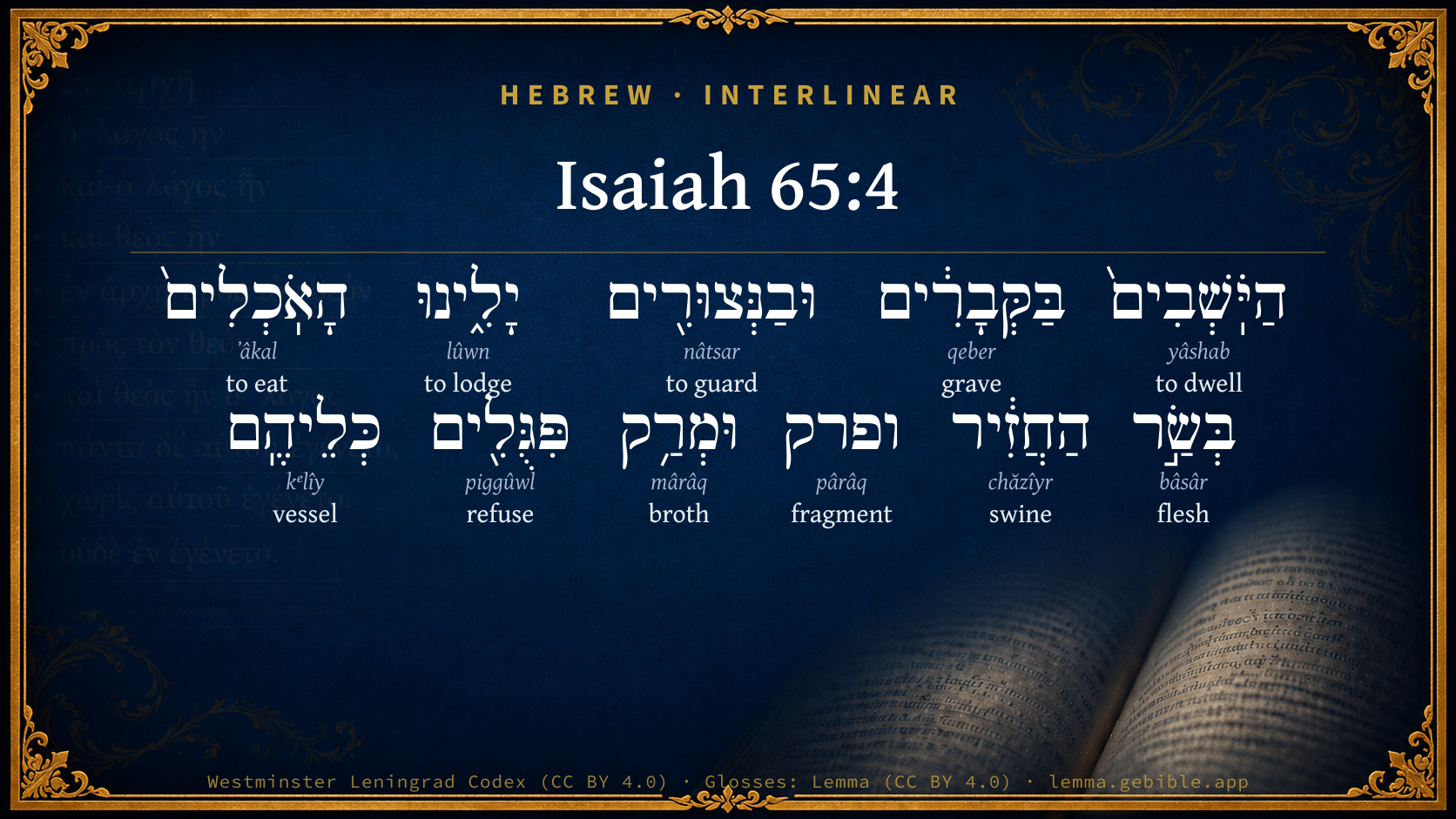
Isaiah 65:4

Hebrew (Westminster Leningrad Codex) Isaiah 65:4 appears in the Hebrew Old Testament. The text above is from the Westminster Leningrad Codex. Each word links to its Strong’s number, a concise gloss, and parsing drawn from the Open Scriptures Hebrew Bible morphology. Click any word for its full Brown-Driver-Briggs (BDB) entry.
Download image
Cite this verse

Isaiah 65:4 (World English Bible). Public Domain. Lemma interlinear Bible study tool, https://lemma.gebible.app/v/isaiah/65/4.

Show BibTeX & RIS
BibTeX
RIS
English Translation
who sit among the graves, and lodge in the secret places; who eat pig's flesh, and broth of abominable things is in their vessels;
World English Bible · Public Domain
Highlights Full analysis ↓
Download a study sheet

One document with this verse’s original text, its word-by-word gloss line, the meaning frame, cross-references with their text, attributed commentary, and full source and license credits — printable, and it pastes into notes with its structure intact.

This verse Autodidact and up

Study sheet (.html) Plain text (.txt)

A passage Seminary Student

Up to 50 verses in one chapter. A passage sheet keeps up to 6 commentary sources and 12 cross-references per verse, in the order this page ranks them, and says so on the sheet whenever that leaves anything out. Ask for a single verse and you get the Autodidact verse sheet above.

Everything on this page stays free to read, with no account — the sheet is a download of what is already on screen, not access to it.

Want to remove ads? Support Godless Engineer
Compare translations 3

The same verse in 3 English versions, stacked beneath the original-language interlinear above. Click any original word for its lexicon entry.

Each is an independent rendering of the whole verse — the interlinear is not word-aligned to these translations.

Highlighted words mark where these versions differ — a whole-verse word diff, not a word-by-word alignment.

  • World English Bible Public Domain
    who sit among the graves, and lodge in the secret places; who eat pig's flesh, and broth of abominable things is in their vessels;
  • King James Version Public Domain
    Which remain among the graves, and lodge in the monuments, which eat swine's flesh, and broth of abominable things is in their vessels;
  • unfoldingWord Literal Text CC BY-SA 4.0
    sitting among graves, and they lodged in secret places, eating the flesh of the pig, and the broth of unclean things in their vessels,

unfoldingWord Literal Text — © unfoldingWord, licensed CC BY-SA 4.0. Word-aligned USFM3 via Door43 (git.door43.org/unfoldingWord/en_ult).

Versions to compare (up to 4)

3 of 4 selected

Show all 18 translations

Every available English version of this verse, each an independent rendering of the whole verse.

  • World English Bible Public Domain
    who sit among the graves, and lodge in the secret places; who eat pig's flesh, and broth of abominable things is in their vessels;
  • Berean Standard Bible Public Domain
    sitting among the graves, spending nights in secret places, eating the meat of pigs and polluted broth from their bowls.
  • Majority Standard Bible Public Domain
    sitting among the graves, spending nights in secret places, eating the meat of pigs and polluted broth from their bowls.
  • King James Version Public Domain
    Which remain among the graves, and lodge in the monuments, which eat swine's flesh, and broth of abominable things is in their vessels;
  • American Standard Version (1901) Public Domain
    that sit among the graves, and lodge in the secret places; that eat swine's flesh, and broth of abominable things is in their vessels;
  • Revised Version (1885) Public Domain
    which sit among the graves, and lodge in the secret places; which eat swine’s flesh, and broth of abominable things is in their vessels;
  • Geneva Bible (1599) Public Domain
    Which remaine among the graues, and lodge in the desarts, which eate swines flesh, and the broth of things polluted are in their vessels.
  • Douay-Rheims (1899) Public Domain
    That dwell in sepulchres, and sleep in the temple of idols: that eat swine's flesh, and profane broth is in their vessels.
  • Young's Literal Translation Public Domain
    Who are dwelling among sepulchres, And lodge in reserved places, Who are eating flesh of the sow, And a piece of abominable things -- their vessels.
  • Literal Standard Version CC BY-SA 4.0
    Who are dwelling among tombs, || And lodge in reserved places, || Who are eating flesh of the sow, || And a piece of abominations—their vessels.
  • Unlocked Literal Bible CC BY-SA 4.0
    They sit among the graves and keep watch all night, and eat pork with the broth of foul meat in their dishes.
  • unfoldingWord Literal Text CC BY-SA 4.0
    sitting among graves, and they lodged in secret places, eating the flesh of the pig, and the broth of unclean things in their vessels,
  • Darby Bible Public Domain
    who sit down among the graves, and lodge in the secret places; who eat swine's flesh, and broth of abominable things [is in] their vessels;
  • World Messianic Bible Public Domain
    who sit among the graves, and spend nights in secret places; who eat pig’s meat, and broth of abominable things is in their vessels;
  • Webster's Bible Public Domain
    Which remain among the graves, and lodge in the monuments, which eat swine's flesh, and broth of abominable things is in their vessels;
  • Free Bible Version CC BY-SA 4.0
    They spend the night among the graves and in caves, eating pork and cooking other unclean meats.
  • Bible in Basic English Public Domain
    Who are seated in the resting-places of the dead, and by night are in the secret places; who take pig's flesh for food, and have the liquid of disgusting things in their vessels.
  • JPS Tanakh (1917) Public Domain
    That sit among the graves, and lodge in the vaults; that eat swine's flesh, and broth of abominable things is in their vessels;

Literal Standard Version (2020), Covenant Press — licensed CC BY-SA 4.0. Text via the HelloAO Bible API (eBible.org). Unlocked Literal Bible (unfoldingWord) — licensed CC BY-SA 4.0. Text via the HelloAO Bible API (eBible.org). unfoldingWord Literal Text — © unfoldingWord, licensed CC BY-SA 4.0. Word-aligned USFM3 via Door43 (git.door43.org/unfoldingWord/en_ult). Free Bible Version, Dr. Jonathan Gallagher — licensed CC BY-SA 4.0. Text via the HelloAO Bible API (eBible.org).

Word by word

More ways to search: Search by grammar → Find every occurrence → Compare this word →

Practice this passage: Drill this verse → Learn its vocabulary →

ופרק
pârâq
H6564
“and · fragment of”
Conjunction + Noun, Common, Masculine, Singular, Construct
Part of Speech
Conjunction + Noun
Type
Common
Gender
Masculine
Number
Singular
State
Construct
Full BDB Definition

Origin: from H6561

TWOT: 1828b

fragment, broken crumb, broth
  1. הַיֹּֽשְׁבִים֙ yâshab H3427 “the · dwelling” Particle, Definite Article + Verb, Qal, Participle Active, Masculine, Plural, Absolute
  2. בַּקְּבָרִ֔ים qeber H6913 “in/at the · graves” Preposition, Determined + Noun, Common, Masculine, Plural, Absolute
  3. וּבַנְּצוּרִ֖ים nâtsar H5341 “and · in/at the · guarded places” Conjunction + Preposition, Determined + Noun, Common, Masculine, Plural, Absolute
  4. יָלִ֑ינוּ lûwn H3885 “to lodge” Verb, Qal, Imperfect, 3rd Person, Masculine, Plural
  5. הָאֹֽכְלִים֙ ʼâkal H398 “the · eating” Particle, Definite Article + Verb, Qal, Participle Active, Masculine, Plural, Absolute
  6. בְּשַׂ֣ר bâsâr H1320 “flesh of” Noun, Common, Masculine, Singular, Construct
  7. הַחֲזִ֔יר chăzîyr H2386 “the · swine” Particle, Definite Article + Noun, Common, Masculine, Singular, Absolute
  8. וּמְרַ֥ק mârâq H4839 “and · broth of” Conjunction + Noun, Common, Masculine, Singular, Construct
  9. פִּגֻּלִ֖ים piggûwl H6292 “foul things” Noun, Common, Masculine, Plural, Absolute
  10. כְּלֵיהֶֽם kᵉlîy H3627 “vessels · their” Noun, Common, Masculine, Plural, Construct + Suffix, Personal, 3rd Person, Masculine, Plural

About this verse

These counts appear in no published source. They are computed here, from the morphology-tagged text and Lemma’s own curated glosses. What Lemma adds →

11
words
11
distinct lemmas
Prophets
section

Notable vocabulary

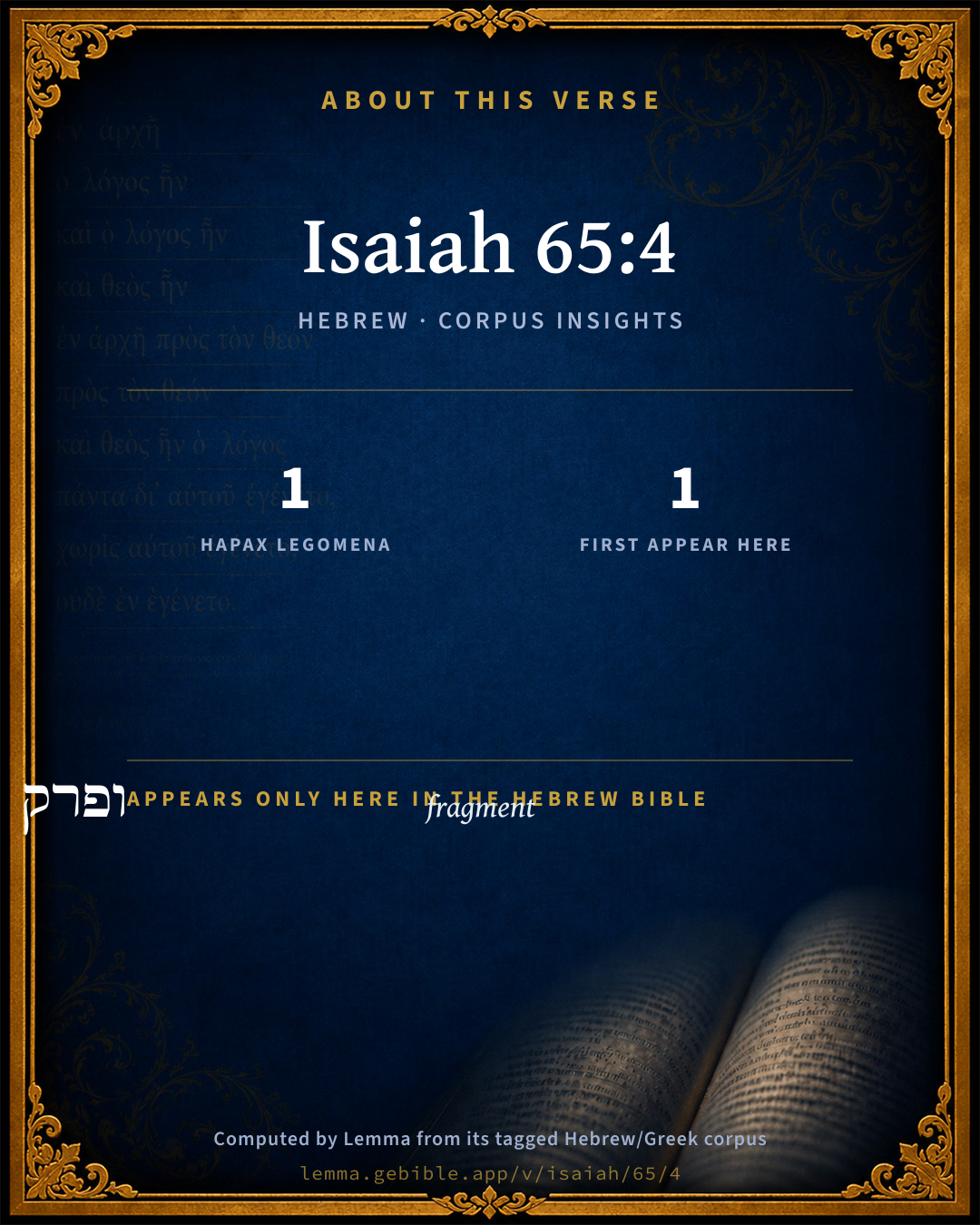
1 hapax legomenon — a word that appears only here in the entire Hebrew Bible:

  • ופרק fragment H6564

First appearance in Scripture

This word makes its first canonical appearance in the Hebrew Bible here:

  • ופרק fragment H6564

Shared distinctive vocabulary

וּמְרַ֥ק broth H4839 occurs in 3 verses of the Hebrew Bible. Also found in:

Grammatical profile

  • 3 verbs
  • 8 nouns

Verb forms

  • הַיֹּֽשְׁבִים֙ Qal · Participle Active
  • יָלִ֑ינוּ Qal · Imperfect
  • הָאֹֽכְלִים֙ Qal · Participle Active

Hebrew & Septuagint length

In English translation the verse runs 24 words from the Hebrew and 34 from the Septuagint (LXX English) — the Septuagint runs noticeably longer here. See the side-by-side →

A rough comparison of the two English renderings, which tokenize alike — not a word-level alignment.

Word counts can differ between the Hebrew and the Greek without any difference in meaning — e.g. the Hebrew direct-object marker אֵת has no separate Greek word, and Greek often adds the article ὁ.

Cross-references

15

Topical passages linked to Isaiah 65:4 in the Treasury of Scripture Knowledge — connected by theme and wording, ordered by reader-vote popularity; previews shown in the World English Bible.

  • Isaiah 66:17 Those who sanctify themselves and purify themselves [to go] to the gardens, behind one in the midst, eating pig's flesh, and the abomination, and the mouse, they shall come to an end together, says Yahweh.
  • Leviticus 11:7 The pig, because he has a split hoof, and is cloven-footed, but doesn't chew the cud, he is unclean to you.
  • Deuteronomy 14:8 The pig, because it has a split hoof but doesn't chew the cud, is unclean to you: of their flesh you shall not eat, and their carcasses you shall not touch.
  • Isaiah 66:3 He who kills an ox is as he who kills a man; he who sacrifices a lamb, as he who breaks a dog's neck; he who offers an offering, [as he who offers] pig's blood; he who burns frankincense, as he who blesses an idol. Yes, they have chosen their own ways, and their soul delights in their abominations:
  • Deuteronomy 14:3 You shall not eat any abominable thing.
  • Deuteronomy 18:11 or a charmer, or a consulter with a familiar spirit, or a wizard, or a necromancer.
  • Ezekiel 4:14 Then said I, Ah Lord Yahweh! behold, my soul has not been polluted; for from my youth up even until now have I not eaten of that which dies of itself, or is torn of animals; neither came there abominable flesh into my mouth.
  • Matthew 8:28 When he came to the other side, into the country of the Gergesenes, two people possessed by demons met him there, coming out of the tombs, exceedingly fierce, so that nobody could pass by that way.
  • Mark 5:2–5 When he had come out of the boat, immediately there met him out of the tombs a man with an unclean spirit,
  • Luke 8:27 When Jesus stepped ashore, a certain man out of the city who had demons for a long time met him. He wore no clothes, and didn't live in a house, but in the tombs.
  • Exodus 23:19 The first of the first fruits of your ground you shall bring into the house of Yahweh your God. "You shall not boil a kid in its mother's milk.
  • Exodus 34:26 You shall bring the first of the first fruits of your ground to the house of Yahweh your God. You shall not boil a young goat in its mother's milk."
  • Numbers 19:11 He who touches the dead body of any man shall be unclean seven days:
  • Numbers 19:16–20 Whoever in the open field touches one who is slain with a sword, or a dead body, or a bone of a man, or a grave, shall be unclean seven days.
  • Deuteronomy 14:21 You shall not eat of anything that dies of itself: you may give it to the foreigner living among you who is within your gates, that he may eat it; or you may sell it to a foreigner: for you are a holy people to Yahweh your God. You shall not boil a kid in its mother's milk.

Cross-references courtesy of OpenBible.info (CC BY 4.0).

Hebrew and Greek witnesses Masoretic Hebrew ↔ Greek Septuagint

The same verse in the two great witnesses to the Old Testament, shown verse-for-verse.

Here the Septuagint runs noticeably longer than the Hebrew — LXX2012 (modern English Septuagint) 34 words vs World English Bible 24. A rough length comparison of the two English translations, not a word-level alignment — read both below.

These are two independent witnesses, not word-aligned to each other, and the Septuagint is shown in lemma (dictionary) form.

Hebrew Isaiah 65:4 Masoretic · Westminster Leningrad Codex

הַיֹּֽשְׁבִים֙ בַּקְּבָרִ֔ים וּבַנְּצוּרִ֖ים יָלִ֑ינוּ הָאֹֽכְלִים֙ בְּשַׂ֣ר הַחֲזִ֔יר ופרק וּמְרַ֥ק פִּגֻּלִ֖ים כְּלֵיהֶֽם

who sit among the graves, and lodge in the secret places; who eat pig's flesh, and broth of abominable things is in their vessels;

World English Bible · Public Domain

Greek LXX Isaiah 65:4 Septuagint · lemma form

καί ἐν ὁ μνῆμα καί ἐν ὁ σπήλαιον κοιμάω διά ἐνύπνιον ὁ ἐσθίω κρέας ὕειος καί ζωμός θυσία μολύνω πᾶς ὁ σκεῦος αὐτός

They lie down to sleep in the tombs and in the caves for the sake of dreams, even they that eat swine's flesh, and the broth of their sacrifices: all their vessels are defiled:

LXX2012 (modern English Septuagint) · Public Domain

On this verse, Adam Clarke's Commentary discusses the Septuagint’s reading. Read the note in Commentary ↓

Hebrew: Westminster Leningrad Codex (CC BY 4.0). Greek: Septuagint (public domain); English from LXX2012 (modern English Septuagint) (Public Domain). How the Septuagint differs from the Hebrew →

Targum (Aramaic paraphrase)

1

The Targum is the ancient Jewish Aramaic paraphrase of the Hebrew Scriptures — an interpretive translation, not the Hebrew text itself. Onkelos (literal) and Pseudo-Jonathan (expansive) render the Torah, and Jonathan the Prophets. Coverage is partial: where no permissively-licensed English translation exists for a verse, only the Aramaic is shown. This is verse-level text, not a word-by-word alignment to the Hebrew.

  1. Targum Jonathan Prophets (Joshua–Malachi)
    דְיָתְבִין בְּבָתַּיָא דְבָנָן מֵעֲפַר קִבְרַיָא וְעִם פִּגְרֵי בְּנֵי אֱנָשָׁא דַיְרִין דְאָכְלִין בְּשַׂר חֲזִירָא וּרְטַב פִּגוּל בְּמַנֵיהוֹן:

    Who dwell in houses, which are built of the dust of graves, with the dead bodies of the sons of men they dwell, which eat swine's flesh, and broth of abominable things is in their vessels;

    Targum Jonathan — Aramaic: “Mikraot Gedolot” (public domain). English: “Sefaria Community Translation” (CC0 1.0 (public-domain dedication)); “London "Chaldee Paraphrase," 1871” (public domain). Text via Sefaria.

Commentary

Notes on Isaiah 65:4 from classic Christian and Jewish commentators (each source and its license shown beneath its notes). The classic Christian expositions comment on the surrounding passage and are grouped to its opening verse, so a note may address several verses; the Jewish commentaries on the Tanakh (Rashi and others) are per-verse, so they appear only where the commentator wrote on this verse.

Lemma curates 59 commentaries, every one of them public domain or Creative Commons licensed, each selected and text-cleaned for this edition rather than reprinted as found. About our sources →

Trapp's Complete Commentary

John Trapp

Isa 65:4 Which remain among the graves, and lodge in the monuments, which eat swine’s flesh, and broth of abominable [things is in] their vessels;

Ver. 4. Which remain among the graves.] Which use necromancy and consult with devils - as Saul did, and died for it - contrary to Deu 18:11. See Isa 8:19 Mar 5:5. {See Trapp on "Isa 8:19"} {See Trapp on "Mar 5:5"} This they had learned from the heathens, with whom it was common, as Tertullian teacheth.

And lodge in the monuments.] As believing that there they should dream dreams divinatory, or have revelations in the night. By such ill arts as these, Timotheus Herulus made himself bishop of Alexandria, A.D. 467; and Boniface VIII duped Celestine V of the Popedom, A.D. 1295. Some {a} render it, that lodge with the kept ones, i.e., with their idols, which they were fain to keep, for fear they should be stolen.

That eat swine’s flesh.] Which was flatly forbidden; {Lev 11:7} and which those martyrs in the Maccabees would rather die than do. But these belly gods, who, like swine, had their souls only to keep their bodies from putrifying, securely violated this plain law - gratifying their lusts, and making their gut their god.

And broth of abominable things is in their vessels.] They had animos in patinis, catinis, calicibus, &c. Therein they kept the broth of their swine’s flesh, {b} which they offered, and in offering eat of. But what saith one from this text? Men must not only abhor the devil’s beef, but his broth too; all occasions, appearances.

{a} Jun., Piscat.

{b} Porcus quasi spurcus. - Rupert.

John Trapp, A Commentary or Exposition upon All the Books of the Old and New Testament (1647–1656) — public domain. Text from a community e-Sword module.

Tyndale Open Study Notes

Tyndale Open Resources

65:4 worshiping the dead: God had banned the practice of necromancy (consulting dead spirits; see 8:19-22; 47:9; Deut 18:9-11). • the flesh of pigs . . . other forbidden foods: See Isa 66:3-4; Lev 11:7; Deut 14:3, 8.

Tyndale Open Study Notes — © Tyndale Open Resources, licensed CC BY-SA 4.0. Text via the HelloAO Bible API.

Geneva Bible (1599)

Geneva Bible translators

Which was contrary to God’s Commandment, Lev. 11:7; Deut. 14:8.

To consult with spirits, and to conjure devils, which was forbidden, Deut. 18:11.

Geneva Bible (1599) marginal notes — public domain. Text via Bolls.life.

Jamieson, Fausset & Brown

Robert Jamieson, A. R. Fausset & David Brown

remain among . . . graves--namely, for purposes of necromancy, as if to hold converse with the dead (Isa 8:19-20; compare Mar 5:3); or, for the sake of purifications, usually performed at night among sepulchres, to appease the manes [MAURER].

monuments--Hebrew, "pass the night in hidden recesses," either the idol's inmost shrines ("consecrated precincts") [HORSLEY], where they used to sleep, in order to have divine communications in dreams [JEROME]; or better, on account of the parallel "graves," sepulchral caves [MAURER].

eat swine's flesh--To eat it at all was contrary to God's law (Lev 11:7), but it much increased their guilt that they ate it in idolatrous sacrifices (compare Isa 66:17). VARRO (On Agriculture, 2.4) says that swine were first used in sacrifices; the Latins sacrificed a pig to Ceres; it was also offered on occasion of treaties and marriages.

broth--so called from the "pieces" (Margin) or fragments of bread over which the broth was poured [GESENIUS]; such broth, made of swine's flesh, offered in sacrifice, was thought to be especially acceptable to the idol and was used in magic rites. Or, "fragments (pieces) of abominable foods," &c. This fourth clause explains more fully the third, as the second does the first [MAURER].

is in--rather, literally, "is their vessels," that is, constitute their vessels' contents. The Jews, in our Lord's days, and ever since the return from Babylon, have been free from idolatry; still the imagery from idolatrous abominations, as being the sin most loathsome in God's eyes and that most prevalent in Isaiah's time, is employed to describe the foul sin of Israel in all ages, culminating in their killing Messiah, and still rejecting Him.

Jamieson, Fausset & Brown — Commentary Critical and Explanatory on the Whole Bible (1871) — public domain (CC PDM 1.0). Text via the HelloAO Bible API.

Adam Clarke's Commentary

Verse 4. Which remain among the graves] "For the purpose of evoking the dead. They lodged in desert places that demons might appear to them; for demons do appear in such places, to those who do believe in them." - Kimchi.

In the monuments - "In the caverns"] בנצורים bannetsurim, a word of doubtful signification. An ancient MS. has בצורים batstsurim, another בצרים batstsurim, "in the rocks;" and Le Clec thinks the Septuagint had it so in their copy. They render it by εν τοις στηλαιοις, "in the caves."

Which eat swine's flesh] This was expressly forbidden by the law, Le 11:7, but among the heathen was in principal request in their sacrifices and feasts. Antiochus Epiphanes compelled the Jews to eat swine's flesh, as a full proof of their renouncing their religion, 2Mac. 6:18; 7:1. "And the broth of abominable meats," for lustrations, magical arts, and other superstitious and abominable practices.

In their vessels] For כליהם keleyhem, a MS. had at first בכליהם bichleyhem. So the Vulgate and Chaldee, (and the preposition seems necessary to the sense,) "in their vessels."

Adam Clarke's Commentary on the Bible (1810–1826) — public domain. Text from a community e-Sword/MySword module.

Ellicott's Commentary for English Readers

(4) Which remain among the graves.—Probably the rock graves of Palestine, which, although they were ceremonially unclean, were not unfrequently used as dwellings (Mat_8:28; Mar_5:3). The charge may be one merely of neglecting the precepts of the Law, but possibly also may imply that the graves were frequented, as in Isa_8:19; Isa_29:4, for necromantic purposes.

Lodge in the monuments . . .—Here, again, the words probably point to practices more or less idolatrous, and common among the heathen of the time. Jerome (in loc.) notes the fact that men went to sleep in the crypts of the Temple of Æsculapius, in the hope of gaining visions of the future, and translates in delubris idolorum.

Which eat swine’s flesh.—The flesh of swine was apparently forbidden, not on sanitary grounds only or chiefly, but because that animal was sacrificed in the festivals of Thammuz (Eze_8:14), or Adonis. (Comp. Isa_66:17.) It may be noted, as against the view that the verse points to the practices of the Babylonian exiles, that no reference to swine has been found in any cuneiform inscriptions. In Egypt, as in Palestine, it was looked upon as unclean (Herod. ii. 47, 48). On the worship of Thammuz, see an article by the Rev. A. H. Sayce, in the Contemporary Review for September, 1883.

Broth of abominable things.—The words indicate, as before, a sacrificial feast of unclean meats, and therefore connected with a violation of the Mosaic law, possibly with some form of heathen mysteries or divination from the viscera of slaughtered animals. The word occurs here and in Isa_66:3, once in Deuteronomy (Isa_29:17), and frequently in Leviticus (Lev_11:11; Lev_11:13; Lev_18:26; Lev_18:30).

A Bible Commentary for English Readers, edited by Charles John Ellicott (1878–1897) — public domain. Text from a community e-Sword module.

The Cambridge Bible for Schools and Colleges

gen. ed. J. J. S. Perowne

4. The first two lines read:

Who sit in the graves,

and pass the night in secret (lit. guarded) places.

The practice of “sitting in graves” is undoubtedly rooted in the worship of ancestors (Schwally, Das Leben nach dem Tode, pp. 68, 71), and the object probably was to obtain oracles from the dead. The phrase “pass the night” seems to point to the custom known to the ancients as incubation: “ubi stratis pellibus hostiarum incubare soliti erant, ut somniis futura cognoscerent” (Jerome). This idea is expressed by the LXX. (which runs the two clauses into one): κοιμῶνται διὰ ἐνύπνια; i.e. for the purpose of obtaining dream-oracles. But whether the “secret places” are connected with the “graves” is uncertain.

which eat swine’s flesh] in sacrificial meals; in any case a violation of the Law (Deu_14:8; Lev_11:7). From the fact that wild pigs are mentioned in the cuneiform inscriptions (Jensen, Zeitschrift für Assyriologie, Vol. i. pp. 306 ff.) it has been inferred that the Jews were tempted into this during the Exile. But the swine was “forbidden food to all the Semites,” being sacred to more than one deity, and used in sacrifice only in some exceptional rites (W. R. Smith, Religion of the Semites2, pp. 218, 290 f., 351). It is probably such mystic sacrifices that are here referred to; and there was no place where lax Jews were more likely to be enticed into them than in their own land.

broth of abominable things] Such creatures as are enumerated in Isa_66:17. The “sacrifices are boiled and yield a magical hell-broth” (W. R. Smith, Marriage and Kinship, p. 310). “Broth” is the rendering of the Qìrê (mârâq, Jdg_6:19 f.); the Kìthîb has a word (pârâq) which might mean “piece” (sing.), although it does not occur elsewhere.

The Cambridge Bible for Schools and Colleges (gen. ed. J. J. S. Perowne; Cambridge University Press, 1878–1918) — public domain. Text from a community e-Sword module.

John Gill's Exposition

Which remain among the graves,.... In order to practise necromancy, to consult the dead, where they imagined demons and departed spirits haunted, and of whom they fancied they might get knowledge of future things:

and lodge in the monuments: whole nights for the same purposes. The Vulgate Latin version is, "that sleep in the temples of idols"; after the manner of the Heathens, who used to sleep there in order to obtain dreams, whereby they might be able to foretell things to come, as they did in the temple of Aesculapius; or, "in desolate places" (k), as Kimchi and Ben Melech interpret it; where they expected to meet with demons and noxious spirits, to give them knowledge of things to come. The Targum paraphrases both clauses thus,

"who dwell in houses built of the dust of graves, and lodge with the corpse of the children of men;''

so corpse, according to Jarchi, are expressed by this word, which signifies "kept", or "preserved" (l), as in Isa 49:6, because they are put in a strait place, from whence they cannot get out; though some think idols are meant, called so by way of derision, because kept for fear of being stolen, or because they cannot keep themselves, nor their votaries:

which eat swine's flesh; forbidden by the law, Lev 11:7,

and broth of abominable things is in their vessels; or "pots": broth made of swine's flesh, and of other sorts of flesh which were unclean by the law. Our version follows the marginal (m) reading; as do the Targum, Aben Ezra, Jarchi, and Kimchi; but the written text is, "a fragment" (n), or piece, or pieces, of abominable things; both may be retained in the sense of the passage; slices of flesh unclean, and so abominable by the law, were put into their pots and stewed, and made broth of, which they drank. Spencer (o) thinks the milk in which kids were boiled is meant, which the Zabians kept in vessels, and sprinkled on the trees in their gardens, to make them more fruitful; hence mention is made of idolatrous practices in gardens, in the preceding verse.

(k) "In desertis locis", Munster, Pagninus. (l) "apud custodita", Junius & Tremellius; "custoditos", Piscator. (m) "jusculum". (n) "fragmentum". (o) De Legibus Hebr. I. 2. c. 8. sect. 2. p. 275.

John Gill's Exposition of the Whole Bible (1746–1763) — public domain (CC PDM 1.0). Text via the HelloAO Bible API.

Albert Barnes' Notes on the Bible

Which remain among the graves - That is, evidently for purposes of necromancy and divination. They do it to appear to hold converse with the dead, and to receive communications from them. The idea in necromancy was, that departed spirits must be acquainted with future events, or at least with the secret things of the invisible world where they dwelt, and that certain persons, by various arts, could become intimate with them, or ‘familiar’ with them, and, by obtaining their secrets, be able to communicate important truths to the living. It seems to have been supposed that this acquaintance might be increased by lodging in the tombs and among the monuments, that they might thus be near to the dead, and have more intimate communion with them (compare the notes at Isa 8:19-20). It is to be recollected, that tombs among the ancients, and especially in Oriental countries, were commonly excavations from the sides of hills, or frequently were large caves. Such places would furnish spacious lodgings for those who chose to reside there, and were, in fact, often resorted to by those who had no houses, and by robbers (see Mat 8:28; Mar 5:3).

And lodge in the monuments - Evidently for some purpose of superstition and idolatry. There is, however, some considerable variety in the exposition of the word rendered here ‘monuments,’ as well as in regard to the whole passage. The word rendered ‘lodge’ (ילינוּ yâliynû), means properly to pass the night, and refers not to a permanent dwelling in any place, but to remaining over night; and the probability is, that they went to the places referred to, to sleep - in order that they might receive communications in their dreams from idols, by being near them, or in order that they might have communication with departed spirits. The word rendered ‘monuments’ (נצוּרים netsûrı̂ym) is derived from נצר nâtsar, to watch, to guard, to keep; then to keep from view, to hide - and means properly hidden recesses; and dark and obscure retreats. It may be applied either to the adyta or secret places of pagan temples where their oracles were consulted and many of their rites were performed; or it may be applied to sepulchral caverns, the dark and hidden places where the dead were buried. The Septuagint renders it, ‘They sleep in tombs and in caves (ἐν τοῖς σπηλαίοις en tois spēlaiois) for the purpose of dreaming’ (διὰ ἐνύπνια dia enupnia); in allusion to the custom of sleeping in the temples, or near the oracles of their gods, for the purpose of obtaining from them communications by dreams. This custom is not unfrequently alluded to by the ancient writers. An instance of this kind occurs in Virgil:

- huc dona sacerdos

Cum tulit, et caesarum ovium sub nocte silenti

Pellibus incubuit stratis, somnosque petivit:

Multa modis simulacra videt volitantia miris,

Et varias audit voces, fruiturque Deorum,

Colloquio, atque imis Acheronta affatur Avernis.

AEaeid, vii. 86-91.

‘Here in distress the Italian nations come,

Anxious to clear their doubts and earn their doom;

First on the fleeces of the slaughter’d sheep,

By night the sacred priest dissolves in sleep;

When in a train before his slumbering eye,

Their airy forms and wondrous visions fly:

He calls the powers who guard the infernal floods,

And talks inspired familiar with the gods.’

Pitt

In the temples of Serapis and AEsculapius, it was common for the sick and infirm who came there to be cured, to sleep there, with the belief that the proper remedy would be communicated by dreams. ‘The following places may also be referred to as illustrating this custom: Pausan. Phoc. 31; Cic. Divin. i. 43; Strabo vi. 3, 9; S. H. Meibom. De incubatione in fanta Deorum olim facta. Helmst. 1659, 4. Lowth and Noyes render it, ‘In caverns.’ The Chaldee renders it, ‘Who dwelt in houses which are built of the dust of sepulchres, and abide with the dead bodies of dead people.’ There can be no doubt that the prophet here alludes to some such custom of sleeping in the tombs, for the alleged purpose of conversing with the dead, or in temples for the purpose of communion with the idols by dreams, or with the expectation that they would receive responses by dreams (compare the notes at Isa 14:9)

Which eat swine’s flesh - This was expressly forbidden by the Jewish law Lev 11:7, and is held in abomination by the Jews now. Yet the flesh of the swine was freely eaten by the pagan; and when the Jews conformed to their customs in other respects, they doubtless forgot also the law commanding a distinction to be made in meats. Antiochus Epiphanes compelled the Jews to eat swine’s flesh as a token of their submission, and of their renouncing their religion. The case of Eleazer, who chose to die as a martyr, rather than give such a proof that he had renounced his religion, and who preferred death rather than to dissemble, is recorded in 2 Macc. 6:19-31. See also the affecting case of the mother and her seven sons, who all died in a similar manner, in 2 Macc. 7. Yet it seems that, in the time of Isaiah, they had no such devotedness to their national religion. They freely conformed to the nations around them, and thus gave public demonstration that they disregarded the commands of Yahweh. It is also to be observed, that swine were often sacrificed by the pagan, and were eaten in their feasts in honor of idols. The crime here referred to, therefore, was not merely that of partaking of the flesh, but it was that of joining with the pagan in idolatrous sacrifices. Thus Ovid says:

Prima Ceres avidae gavisa est sanguine porcae,

Ulta suas merita caede nocentis opes.

Fastor, i. 349

So Horace:

- immolet aequis

Hic porcum Laribus -

Serm. ii. 164

Thus, Varro (De Re Rustic. ii. 4), says ‘The swine is called in Greek ὗς hus (formerly θῦς thus), and was so called from the word which signifies to sacrifice (θύειν thuein), for the swine seem first to have been used in sacrifices. Of this custom we have vestiges in the fact, that the first sacrifices to Ceres are of the swine; and that in the beginning of peace, when a treaty is made, a hog is sacrificed; and that in the beginning of marriage contracts in Etruria, the new wife and the new husband first sacrifice a hog. The primitive Latins, and also the Greeks in Italy, seem to have done the same thing.’ Spencer (De Leg. Heb i. 7) supposes that this was done often in caves and dark recesses, and that the prophet refers to this custom here. If this view be correct, then the offence consisted not merely in eating swine’s flesh, but in eating it in connection with sacrifices, or joining with the pagan in their idolatrous worship.

And broth of abominable things - Margin, ‘Pieces.’ Lowth says that this was for ‘lustrations, magical arts, and other superstitious and abominable practices.’ The word rendered here ‘broth,’ and in the margin ‘pieces’ (פרק pârâq), is derived from the verb פרק pâraq, to break (whence the Latin frango; the Goth. brikan; the Germ. breoken; and the English break), and means that which is broken, or a fragment; and hence, broth or soup, from the fragments or crumbs of bread over which the broth is poured. The Septuagint renders this, ‘And all their vessels are polluted.’ It is not improbable that the broth or soup used here was in some way employed in arts of incantation or necromancy. Compare Shakespeare’s account of the witches in Macbeth:

1. Witch: Where hast thou been, sister?

2. Witch: Killing swine.

Act i. Sc. 3.

Hec: Your vessels and your spells provide,

Your charms, and everything beside.

Act iii. Sc. 5.

1. Witch: Round about the caldron go,

In the poison’d entrails throw,

Toad that under the cold stone,

Days and nights hath thirty-one,

Fillet of a finny snake,

In the caldron boil and bake,

Eye of newt, and toe of frog,

Wool of bat, and tongue of dog,

Adder’s fork, and blind worm’s sting,

Lizard’s leg, and howlet’s wing,

For a charm of powerful trouble,

Like a hell-broth boil and bubble.

Act iv. Sc. 1.

It seems probable that some such magical incantations were used in the time of Isaiah. Such things are known to have been practiced in regions of idolatry (see Marco Polo, De Region. Orient., iii. 24). ‘When the priests of the idol,’ says he, ‘wish to engage in sacred things, they call the consecrated girls, and with them, in the presence of the idols, they engage in the dance, and sing aloud. These girls bear with them vessels of food, which they place on the table before the idols, and they entreat the gods to eat of the food, and particularly they pour out broth made of flesh before them, that they may appease them.’ The whole scene here described by the prophet is one connected with idolatry and magical incantations; and the prophet means to rebuke them for having forsaken God and fallen into all the abominable and stupid arts of idolaters. It was not merely that they had eaten the flesh of swine, or that they had made broth of unclean meats - which would have been minor, though real offences - it was that they had fallen into all the abominable practices connected with idolatry and necromancy.

Albert Barnes' Notes on the Bible (1834–1885) — public domain. Text from a community e-Sword/MySword module.

Haydock's Catholic Bible Commentary

Idols: to have dreams, (Strabo xvi.) and commit impurities. --- Broth of swine’s flesh, which was prohibited, Leviticus xi. 7.

George Leo Haydock (1774–1849), Haydock's Catholic Family Bible and Commentary, 1859 edition — public domain. Excludes Psalms (Douay-Rheims chapter numbering differs from Protestant) and Deuterocanonical books (Catholic canon only).

Matthew Poole's English Annotations

They remained among the graves, either there expecting revelations by dreams, or there consulting with devils, who were thought to delight in such places; or to practise necromancy, all which were forbidden, Deu 18:11; Isa 8:19. And they

lodged in the monuments; the Hebrew word here used gives advantage to interpreters to vary in their senses. The word signifies only places kept or observed; some interpret it of idol temples; some of caves and dens, in which the heathens used to worship their idols; some of tombs or monuments for dead persons: besides the idolatry of the thing, there was in it a sinful imitation of the heathens, and a swerving from the rule which God had given them. They also ate

swine’s flesh, contrary to the Divine law, Lev 11:7; Deu 14:8; and they endured in their vessels

broth of abominable things; so the word is used, Jdg 6:19,23; others read it, parts or pieces of abominable things; that is, broth, or pieces of such flesh as was to the Jews unclean by the law, Le 11. Every creature of God is good, but God’s prohibition had made the flesh of divers creatures an abominable thing to the Jews, they might not touch their flesh, Lev 11:28; but they, taking the measures of their duty from their appetite, or from their reason, concluding from natural principles, made no conscience of the positive law of God. This was their iniquity, which is further aggravated in the next verse.

Matthew Poole's English Annotations on the Holy Bible (1683–1685) — public domain. Text from a community e-Sword/MySword module.

The Pulpit Commentary

Which remain among the graves. The rock tombs of Palestine seem to be meant. Persons remained among" these, in spite of the ceremonial defilement thereby incurred, either with the object of raising the dead, and obtaining prophecies from them, or of getting prophetic intimations made to them in dreams (see Jerome"s "Comment.," ad loc. ). And lodge in the monuments; or, in the crypts. N"tsurim may refer to the mysteries celebrated in natural caves and artificial crypts" (Delitzsch). An account of such mysteries is given by Chwolsohn in his" Die Ssabier und der Ssabismus," vol. it. pp. 332, et Seq. which eat swine"s flesh. Not in mere defiance of the Law, but in sacrificial meals (Isa_66:17) of which swine"s flesh formed a part. Swine were sacrificial animals in Egypt (Herod., 2:47, 48), in Phoenicia (Lucian, "De Dea Syra," and with the Greeks and Romans. They do not appear to have been employed for the purpose either by the Assyrians or the Babylonians. It was probably in Palestine that the Jews had eaten "swine"s flesh," at sacrifices to Baal or Astarte (Ashtoreth). In later times to do so was regarded as one of the worst abominations. (RAPC 1Ma 1:41-64 2Ma 6 2Ma 7) Broth of abominable things. Either broth made from swine"s flesh, or from the flesh of other unclean animals, as the hare and rabbit, (Lev_11:5, Lev_11:6) or perhaps simply broth made from the flesh of any animals that had been offered to idols. (Act_15:29)

The Pulpit Commentary (1880–1919), ed. H.D.M. Spence-Jones & Joseph S. Exell — public domain. Text from a community e-Sword module.

John Wesley's Explanatory Notes

Remain - They remained among the graves, there consulting with devils, who were thought to delight in such places; or to practice necromancy, all which were forbidden, Deut. xviii, 11 chap. viii, 19. Monuments - Some interpret it of idol temples, some of caves and dens, in which the Heathens used to worship their idols. Broth of abominable things - Of such flesh as was to the Jews unclean by the law.

John Wesley, Explanatory Notes Upon the Whole Bible (1754–1765) — public domain. Text via the GEBible commentary corpus.

J. A. Alexander on Isaiah

Joseph Addison Alexander

“Sitting in the graves, and in the holes they will lodge, eating the flesh of swine, and broth of filthy things (is in) their vessels.” All agree that this verse is intended to depict in revolting colors the idolatrous customs of the people. Nor is there much doubt as to the construction of the sentence, or the force of the particular expressions. But the obscurity which overhangs the usage referred to has originated various archaeological discussions which throw no light on the drift of the passage, nor even on the literal translation of the words, but are investigated merely for their own sake or their bearing upon other objects. Such are the questions, whether these idolaters sat in the graves or among them; whether for necromantic purposes, (i.e., to interrogate the dead, or to perform sacrificial rites to their memory, or to obtain demoniacal inspiration); whether the Hebrew word means monuments, or caves, or temples; whether these were lodged in for licentious purposes, or to obtain prophetic dreams; whether they are charged with simply eating pork for food, or after it had been sacrificed to idols; whether swine’s flesh was forbidden for medicinal reasons, or because the heathen sacrificed and ate it, or on other grounds; whether prq {piS} means broth or bits of meat, and if the former, whether it was so called on account of the bread broken in it, or for other reasons, etc. The only question of grammatical construction which has found a place among these topics of pedantic disquisition is of small importance with respect to the interpretation of the passage. It is the question whether ‘vessels’ is to be governed by a preposition understood or explained as an accusative of place, or as the predicate of the proposition, broth of abominable meats are their vessels. Even if we should successively adopt and then discard every one of the opinions some of which have now been mentioned, the essential meaning of the verse would still remain the same, as a highly wrought description of idolatrous.

Joseph Addison Alexander, The Prophecies of Isaiah (1846–1847; New York: Scribner, 1870–1878) — public domain. Text from a community e-Sword module.

Rashi

Rabbi Shlomo Yitzchaki (Rashi)

They sit among the graves so that a spirit of defilement of demons should rest upon them.

and with corpses Heb. וּבַנְּצוּרִים. They are the bodies of the dead, who are as placed in a siege (מָצוֹר), unable to get out.

and broth of abominations Heb. מְרַק, despicable broth. Comp. (Jud. 6:20) “And the broth (הַמָּרָק) pour out.”

Rashi on the Tanakh — English translations: “The Judaica Press complete Tanach with Rashi, translated by A. J. Rosenberg” (CC BY 4.0); “Pentateuch with Rashi's commentary by M. Rosenbaum and A.M. Silbermann, 1929-1934” (public domain); “The Metsudah Tanach series, Lakewood, N.J” (CC BY 4.0); and “The Book of Joshua, Metsudah Publications, 1997” (CC BY 4.0). Text via Sefaria.

Ibn Ezra

Rabbi Abraham ibn Ezra

That sit among the graves, to inquire of the dead, and to listen to the spirits.

ובנצורים And in ruins.. Comp. נצורה waste (1:8).

Which eat, etc. All this is done in order to provoke me.

וטרק And broth. Its meaning is well known; comp. Judg. 6:20. The Ketib is ופרק; the two words, however, are the same in meaning.

Ibn Ezra on the Tanakh — English translations: “Sefaria Community Translation” (CC0 1.0 (public-domain dedication)); “Yalkut, Sifsei Chachomim Chumash, Metsudah Publications, 2009” (CC BY 4.0); and “Commentary of Ibn Ezra on Isaiah - trans. by M. Friedlander, 1873” (public domain). Text via Sefaria.

Lesson kit

Teaching starters — assembled from the data on this page, not authored interpretation. Every prompt links to the verse data it draws on. Edit before teaching.

Isaiah, in the Prophets, opens this verse with 11 words (11 distinct Hebrew lemmas). Its most distinctive word is pârâq (“fragment”). The Greek Septuagint runs longer here. A historical commentator’s framing appears above. Read the whole chapter for the surrounding context.

Discussion questions

  1. What does “fragment” (pârâq) contribute to the verse as a whole?
  2. This verse holds 1 word here found nowhere else in the Hebrew Bible. What might the rare word draw attention to?
  3. The word “fragment” first appears here in Scripture. What is being introduced at this debut?
  4. Judges 6:19 shares the word «broth» with this verse. How do the two illuminate each other?
  5. Compared with the Hebrew, the Septuagint runs longer here. What questions does that raise?
  6. The translations on this page render this verse differently — a whole-verse word diff, not a word-by-word alignment. What might account for the different wordings?
  7. The verb «הַיֹּֽשְׁבִים֙» is Qal Participle Active. How does its form color the action?
  8. Reading how Trapp's Complete Commentary and Tyndale Open Study Notes read this verse, where do the two commentators agree and where do they part?

Things to notice

  • 1 word in this verse appears nowhere else in the Hebrew Bible.
  • 1 word makes its first canonical appearance in Scripture here.
  • These translations choose different wording for 17 words in this verse.
  • 11 distinct Hebrew lemmas span 11 words in this verse.

Reading settings

Reading text

Shown beneath each verse's original-language words.

Old Testament
Old Testament edition

Read the OT as the Masoretic Hebrew (MT) or the Greek Septuagint (LXX).

English shown for the Greek Septuagint (in the Hebrew ↔ Greek comparison).

Comparing translations? Open the Compare panel on any verse page to stack up to four side by side.