

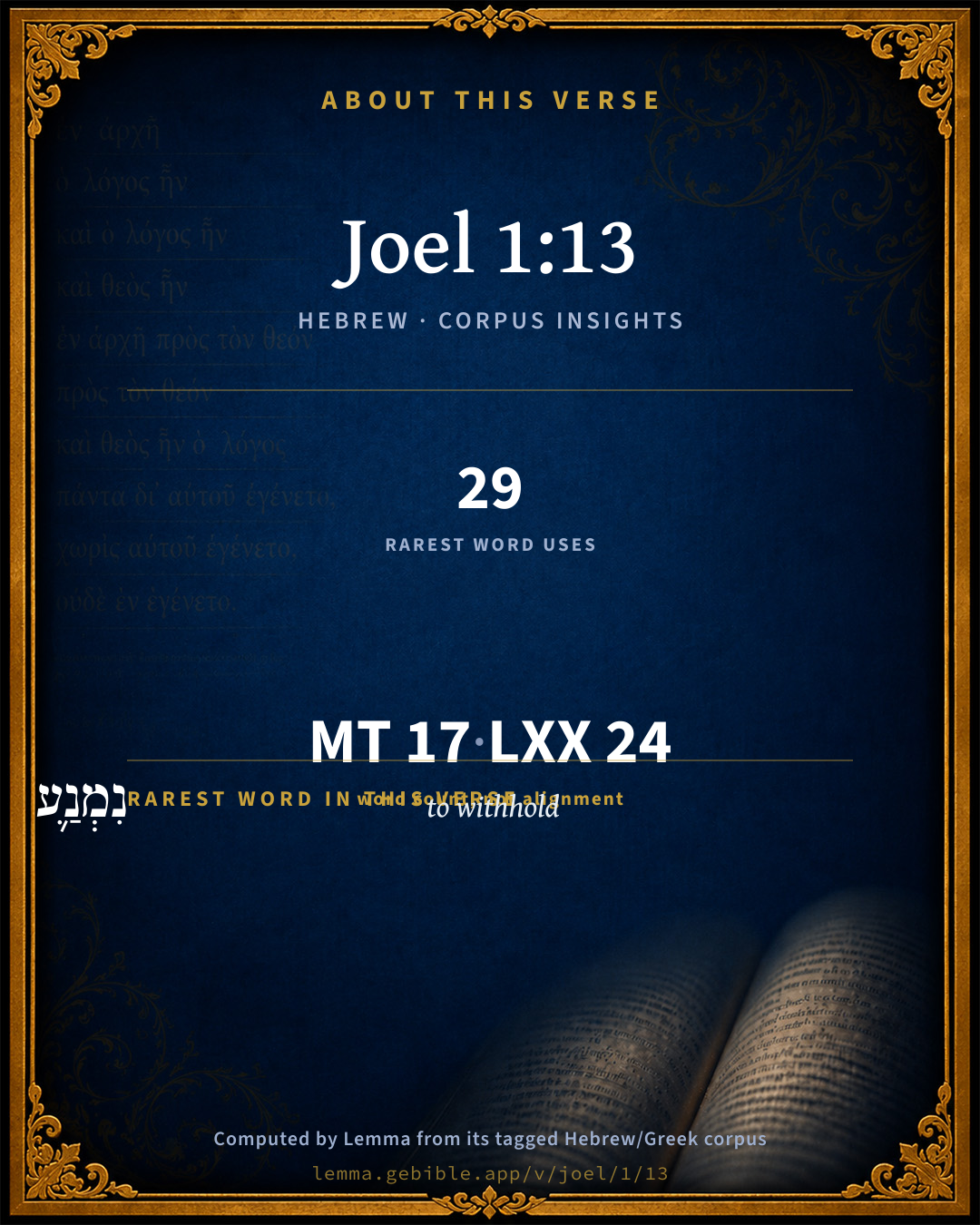
Joel 1:13

Hebrew (Westminster Leningrad Codex) Joel 1:13 appears in the Hebrew Old Testament. The text above is from the Westminster Leningrad Codex. Each word links to its Strong’s number, a concise gloss, and parsing drawn from the Open Scriptures Hebrew Bible morphology. Click any word for its full Brown-Driver-Briggs (BDB) entry.
Download image
Cite this verse

Joel 1:13 (World English Bible). Public Domain. Lemma interlinear Bible study tool, https://lemma.gebible.app/v/joel/1/13.

Show BibTeX & RIS
BibTeX
RIS
English Translation
Put on sackcloth and mourn, you priests! Wail, you ministers of the altar. Come, lie all night in sackcloth, you ministers of my God, For the meal offering and the drink offering are withheld from your God's house.
World English Bible · Public Domain
Download a study sheet

One document with this verse’s original text, its word-by-word gloss line, the meaning frame, cross-references with their text, attributed commentary, and full source and license credits — printable, and it pastes into notes with its structure intact.

This verse Autodidact and up

Study sheet (.html) Plain text (.txt)

A passage Seminary Student

Up to 50 verses in one chapter. A passage sheet keeps up to 6 commentary sources and 12 cross-references per verse, in the order this page ranks them, and says so on the sheet whenever that leaves anything out. Ask for a single verse and you get the Autodidact verse sheet above.

Everything on this page stays free to read, with no account — the sheet is a download of what is already on screen, not access to it.

Want to remove ads? Support Godless Engineer
Compare translations 3

The same verse in 3 English versions, stacked beneath the original-language interlinear above. Click any original word for its lexicon entry.

Each is an independent rendering of the whole verse — the interlinear is not word-aligned to these translations.

Highlighted words mark where these versions differ — a whole-verse word diff, not a word-by-word alignment.

  • World English Bible Public Domain
    Put on sackcloth and mourn, you priests! Wail, you ministers of the altar. Come, lie all night in sackcloth, you ministers of my God, For the meal offering and the drink offering are withheld from your God's house.
  • King James Version Public Domain
    Gird yourselves, and lament, ye priests: howl, ye ministers of the altar: come, lie all night in sackcloth, ye ministers of my God: for the meat offering and the drink offering is withholden from the house of your God.
  • unfoldingWord Literal Text CC BY-SA 4.0
    Dress and lament, you priests! Wail, you servants of the altar. Come, lodge in sackcloth, servants of my God, for the grain offering and the drink offering have been withheld from the house of your God.

unfoldingWord Literal Text — © unfoldingWord, licensed CC BY-SA 4.0. Word-aligned USFM3 via Door43 (git.door43.org/unfoldingWord/en_ult).

Versions to compare (up to 4)

3 of 4 selected

Show all 18 translations

Every available English version of this verse, each an independent rendering of the whole verse.

  • World English Bible Public Domain
    Put on sackcloth and mourn, you priests! Wail, you ministers of the altar. Come, lie all night in sackcloth, you ministers of my God, For the meal offering and the drink offering are withheld from your God's house.
  • Berean Standard Bible Public Domain
    Put on sackcloth and lament, O priests; wail, O ministers of the altar. Come, spend the night in sackcloth, O ministers of my God, because the grain and drink offerings are withheld from the house of your God.
  • Majority Standard Bible Public Domain
    Put on sackcloth and lament, O priests; wail, O ministers of the altar. Come, spend the night in sackcloth, O ministers of my God, because the grain and drink offerings are withheld from the house of your God.
  • King James Version Public Domain
    Gird yourselves, and lament, ye priests: howl, ye ministers of the altar: come, lie all night in sackcloth, ye ministers of my God: for the meat offering and the drink offering is withholden from the house of your God.
  • American Standard Version (1901) Public Domain
    Gird yourselves `with sackcloth', and lament, ye priests; wail, ye ministers of the altar; come, lie all night in sackcloth, ye ministers of my God: for the meal-offering and the drink-offering are withholden from the house of your God.
  • Revised Version (1885) Public Domain
    Gird yourselves with sackcloth, and lament, ye priests; howl, ye ministers of the altar; come, lie all night in sackcloth, ye ministers of my God: for the meal offering and the drink offering is withholden from the house of your God.
  • Geneva Bible (1599) Public Domain
    Girde your selues and lament, ye Priests: howle ye ministers of the altar: come, and lie all night in sackecloth, ye ministers of my God: for the meate offring, and the drinke offring is taken away from the house of your God.
  • Douay-Rheims (1899) Public Domain
    Gird yourselves, and lament, O ye priests, howl, ye ministers of the altars: go in, lie in sackcloth, ye ministers of my God: because sacrifice and libation is cut off from the house of your God.
  • Young's Literal Translation Public Domain
    Gird, and lament, ye priests, Howl, ye ministrants of the altar, Come in, lodge in sackcloth, ministrants of my God, For withheld from the house of your God hath been present and libation.
  • Literal Standard Version CC BY-SA 4.0
    Gird, and lament, you priests, || Howl, you servants of the altar, || Come in, lodge in sackcloth, servants of my God, || For present and drink-offering have been withheld from the house of your God.
  • Unlocked Literal Bible CC BY-SA 4.0
    Put on sackcloth and mourn, you priests! Wail, you servants of the altar. Come, lie all night in sackcloth, you servants of my God. For the grain offering and the drink offering have been withheld from the house of your God.
  • unfoldingWord Literal Text CC BY-SA 4.0
    Dress and lament, you priests! Wail, you servants of the altar. Come, lodge in sackcloth, servants of my God, for the grain offering and the drink offering have been withheld from the house of your God.
  • Darby Bible Public Domain
    Gird yourselves, and lament, ye priests; howl, ministers of the altar; come, lie all night in sackcloth, ye ministers of my God: for the oblation and the drink-offering are withholden from the house of your God.
  • World Messianic Bible Public Domain
    Put on sackcloth and mourn, you priests! Wail, you ministers of the altar. Come, lie all night in sackcloth, you ministers of my God, for the meal offering and the drink offering are withheld from your God’s house.
  • Webster's Bible Public Domain
    Gird yourselves, and lament, ye priests: howl, ye ministers of the altar: come, lie all night in sackcloth, ye ministers of my God: for the meat-offering and the drink-offering is withheld from the house of your God.
  • Free Bible Version CC BY-SA 4.0
    Dress in sackcloth, you priests, and mourn; weep, you who minister before the altar! Go and spend the night in sackcloth, you ministers of my God, for the grain and wine offerings have stopped in the Temple.
  • Bible in Basic English Public Domain
    Put haircloth round you and give yourselves to sorrow, you priests; give cries of grief, you servants of the altar: come in, and, clothed in haircloth, let the night go past, you servants of my God: for the meal offering and the drink offering have been kept back from the house of your God.
  • JPS Tanakh (1917) Public Domain
    Gird yourselves, and lament, ye priests, wail, ye ministers of the altar; come, lie all night in sackcloth, ye ministers of my God; for the meal-offering and the drink-offering is withholden from the house of your God.

Literal Standard Version (2020), Covenant Press — licensed CC BY-SA 4.0. Text via the HelloAO Bible API (eBible.org). Unlocked Literal Bible (unfoldingWord) — licensed CC BY-SA 4.0. Text via the HelloAO Bible API (eBible.org). unfoldingWord Literal Text — © unfoldingWord, licensed CC BY-SA 4.0. Word-aligned USFM3 via Door43 (git.door43.org/unfoldingWord/en_ult). Free Bible Version, Dr. Jonathan Gallagher — licensed CC BY-SA 4.0. Text via the HelloAO Bible API (eBible.org).

Word by word

More ways to search: Search by grammar → Find every occurrence → Compare this word →

Practice this passage: Drill this verse → Learn its vocabulary →

נִמְנַ֛ע
mânaʻ
H4513
“to withhold”
Verb, Niphal, Perfect, 3rd Person, Masculine, Singular
Part of Speech
Verb
Stem
Niphal
Form
Perfect
Person
3rd Person
Gender
Masculine
Number
Singular
Full BDB Definition

Origin: a primitive root

TWOT: 1216

to withhold, hold back, keep back, refrain, deny, keep restrain, hinder - (Qal) to withhold - (Niphal) to be withheld
  1. חִגְר֨וּ châgar H2296 “gird” Verb, Qal, Imperative, 2nd Person, Masculine, Plural
  2. וְסִפְד֜וּ çâphad H5594 “and · wail” Conjunction + Verb, Qal, Imperative, 2nd Person, Masculine, Plural
  3. הַכֹּהֲנִ֗ים kôhên H3548 “the · priests” Particle, Definite Article + Noun, Common, Masculine, Plural, Absolute
  4. הֵילִ֨ילוּ֙ yâlal H3213 “howl” Verb, Hiphil, Imperative, 2nd Person, Masculine, Plural
  5. מְשָׁרְתֵ֣י shârath H8334 “ministering” Verb, Piel, Participle Active, Masculine, Plural, Construct
  6. מִזְבֵּ֔חַ mizbêach H4196 “altar” Noun, Common, Masculine, Singular, Absolute
  7. בֹּ֚אוּ bôwʼ H935 “enter” Verb, Qal, Imperative, 2nd Person, Masculine, Plural
  8. לִ֣ינוּ lûwn H3885 “lodge” Verb, Qal, Imperative, 2nd Person, Masculine, Plural
  9. בַשַּׂקִּ֔ים saq H8242 “in/at the · sacks” Preposition, Determined + Noun, Common, Masculine, Plural, Absolute
  10. מְשָׁרְתֵ֖י shârath H8334 “ministering” Verb, Piel, Participle Active, Masculine, Plural, Construct
  11. אֱלֹהָ֑י ʼĕlôhîym H430 “God(s) · my” Noun, Common, Masculine, Plural, Construct + Suffix, Personal, 1st Person, Common, Singular
  12. כִּ֥י kîy H3588 “that” Conjunction
  13. מִבֵּ֥ית bayith H1004 “from · house of” Preposition + Noun, Common, Masculine, Singular, Construct
  14. אֱלֹהֵיכֶ֖ם ʼĕlôhîym H430 “God(s) · your” Noun, Common, Masculine, Plural, Construct + Suffix, Personal, 2nd Person, Masculine, Plural
  15. מִנְחָ֥ה minchâh H4503 “offering” Noun, Common, Feminine, Singular, Absolute
  16. וָנָֽסֶךְ neçek H5262 “and · drink offering” Conjunction + Noun, Common, Masculine, Singular, Absolute

About this verse

These counts appear in no published source. They are computed here, from the morphology-tagged text and Lemma’s own curated glosses. What Lemma adds →

17
words
15
distinct lemmas
Prophets
section

Shared distinctive vocabulary

נִמְנַ֛ע to withhold H4513 occurs in 29 verses of the Hebrew Bible. Also found in:

Grammatical profile

  • 8 verbs
  • 8 nouns
  • 1 conjunction

Verb forms

  • חִגְר֨וּ Qal · Imperative
  • וְסִפְד֜וּ Qal · Imperative
  • הֵילִ֨ילוּ֙ Hiphil · Imperative
  • מְשָׁרְתֵ֣י Piel · Participle Active
  • בֹּ֚אוּ Qal · Imperative
  • לִ֣ינוּ Qal · Imperative
  • מְשָׁרְתֵ֖י Piel · Participle Active
  • נִמְנַ֛ע Niphal · Perfect

Repetition

Words recur within this verse — often emphatic in Hebrew:

  • מְשָׁרְתֵ֣י to minister H8334 ×2
  • אֱלֹהָ֑י God H430 ×2

Hebrew & Septuagint length

In English translation the verse runs 38 words from the Hebrew and 38 from the Septuagint (LXX English) — the same length.

A rough comparison of the two English renderings, which tokenize alike — not a word-level alignment.

Word counts can differ between the Hebrew and the Greek without any difference in meaning — e.g. the Hebrew direct-object marker אֵת has no separate Greek word, and Greek often adds the article ὁ.

In the original languages it is 17 Hebrew tokens and 24 Greek tokens — but the two are counted differently (Hebrew bundles its prefixes and suffixes into one token; the Greek is in lemma form), so that isn’t a like-for-like length.

Cross-references

17

Topical passages linked to Joel 1:13 in the Treasury of Scripture Knowledge — connected by theme and wording, ordered by reader-vote popularity; previews shown in the World English Bible.

  • Jeremiah 4:8 For this gird you with sackcloth, lament and wail; for the fierce anger of Yahweh hasn't turned back from us.
  • Joel 1:8–9 Mourn like a virgin dressed in sackcloth for the husband of her youth!
  • 1 Kings 21:27 It happened, when Ahab heard those words, that he tore his clothes, and put sackcloth on his flesh, and fasted, and lay in sackcloth, and went softly.
  • Jeremiah 9:10 For the mountains will I take up a weeping and wailing, and for the pastures of the wilderness a lamentation, because they are burned up, so that none passes through; neither can men hear the voice of the cattle; both the birds of the sky and the animals are fled, they are gone.
  • Ezekiel 7:18 They shall also gird themselves with sackcloth, and horror shall cover them; and shame shall be on all faces, and baldness on all their heads.
  • Joel 2:17 Let the priests, the ministers of Yahweh, weep between the porch and the altar, And let them say, "Spare your people, Yahweh, And don't give your heritage to reproach, That the nations should rule over them. Why should they say among the peoples, 'Where is their God?'"
  • Jonah 3:5–8 The people of Nineveh believed God; and they proclaimed a fast, and put on sackcloth, from the greatest of them even to the least of them.
  • Leviticus 2:8–10 You shall bring the meal offering that is made of these things to Yahweh: and it shall be presented to the priest, and he shall bring it to the altar.
  • Numbers 29:6 besides the burnt offering of the new moon, and the meal-offering of it, and the continual burnt offering and the meal-offering of it, and their drink-offerings, according to their ordinance, for a sweet savor, an offering made by fire to Yahweh.
  • 2 Samuel 12:16 David therefore begged God for the child; and David fasted, and went in, and lay all night on the earth.
  • Isaiah 61:6 But you shall be named the priests of Yahweh; men shall call you the ministers of our God: you shall eat the wealth of the nations, and in their glory shall you boast yourselves.
  • 1 Corinthians 4:1 So let a man think of us as Christ's servants, and stewards of God's mysteries.
  • 1 Corinthians 9:13 Don't you know that those who serve around sacred things eat from the things of the temple, and those who wait on the altar have their portion with the altar?
  • 2 Corinthians 3:6 who also made us sufficient as servants of a new covenant; not of the letter, but of the Spirit. For the letter kills, but the Spirit gives life.
  • 2 Corinthians 6:4 but in everything commending ourselves, as servants of God, in great endurance, in afflictions, in hardships, in distresses,
  • 2 Corinthians 11:23 Are they servants of Christ? (I speak as one beside himself) I am more so; in labors more abundantly, in prisons more abundantly, in stripes above measure, in deaths often.
  • Hebrews 7:13–14 For he of whom these things are said belongs to another tribe, from which no one has officiated at the altar.

Cross-references courtesy of OpenBible.info (CC BY 4.0).

Hebrew and Greek witnesses Masoretic Hebrew ↔ Greek Septuagint

The same verse in the two great witnesses to the Old Testament, shown verse-for-verse.

These are two independent witnesses, not word-aligned to each other, and the Septuagint is shown in lemma (dictionary) form.

Hebrew Joel 1:13 Masoretic · Westminster Leningrad Codex

חִגְר֨וּ וְסִפְד֜וּ הַכֹּהֲנִ֗ים הֵילִ֨ילוּ֙ מְשָׁרְתֵ֣י מִזְבֵּ֔חַ בֹּ֚אוּ לִ֣ינוּ בַשַּׂקִּ֔ים מְשָׁרְתֵ֖י אֱלֹהָ֑י כִּ֥י נִמְנַ֛ע מִבֵּ֥ית אֱלֹהֵיכֶ֖ם מִנְחָ֥ה וָנָֽסֶךְ

Put on sackcloth and mourn, you priests! Wail, you ministers of the altar. Come, lie all night in sackcloth, you ministers of my God, For the meal offering and the drink offering are withheld from your God's house.

World English Bible · Public Domain

Greek LXX Joel 1:13 Septuagint · lemma form

περιζώννυμι καί κόπτω ὁ ἱερεύς θρηνέω ὁ λειτουργέω θυσιαστήριον εἰςἔρχομαι ὑπνόω ἐν σάκκος λειτουργέω θεός ὅτι ἀποἔχω ἐκ οἶκος θεός σύ θυσία καί σπονδή

Gird yourselves with sackcloth, and lament, you⌃ priests: mourn, you⌃ that serve at the altar: go in, sleep in sackcloths, you⌃ that minister to God: for the meat-offering and drink-offering are withheld from the house of your God.

LXX2012 (modern English Septuagint) · Public Domain

On this verse, Whedon's Commentary on the Bible discusses the Septuagint’s reading. Read the note in Commentary ↓

Hebrew: Westminster Leningrad Codex (CC BY 4.0). Greek: Septuagint (public domain); English from LXX2012 (modern English Septuagint) (Public Domain). How the Septuagint differs from the Hebrew →

Targum (Aramaic paraphrase)

1

The Targum is the ancient Jewish Aramaic paraphrase of the Hebrew Scriptures — an interpretive translation, not the Hebrew text itself. Onkelos (literal) and Pseudo-Jonathan (expansive) render the Torah, and Jonathan the Prophets. Coverage is partial: where no permissively-licensed English translation exists for a verse, only the Aramaic is shown. This is verse-level text, not a word-by-word alignment to the Hebrew.

  1. Targum Jonathan Prophets (Joshua–Malachi)
    אֱסַרוּ וּסְפִידוּ כַהֲנַיָא אַיְלִילוּ דִמְשַׁמְשִׁין עַל מַדְבְּחָא עוּלוּ בִיתוּ בְּסַקַיָא דִמְשַׁמְשִׁין קֳדָם אֱלָהַי אֲרֵי אִתְמְנַע מִבֵּית מַקְדְשָׁא דֶאֱלָהָכוֹן קוּרְבְּנִין וְנִסְכִין:

    (no public-domain English translation for this verse)

    Targum Jonathan — Aramaic: “Mikraot Gedolot” (public domain). English: “Sefaria Community Translation” (CC0 1.0 (public-domain dedication)); “London "Chaldee Paraphrase," 1871” (public domain). Text via Sefaria.

Commentary

Notes on Joel 1:13 from classic Christian and Jewish commentators (each source and its license shown beneath its notes). The classic Christian expositions comment on the surrounding passage and are grouped to its opening verse, so a note may address several verses; the Jewish commentaries on the Tanakh (Rashi and others) are per-verse, so they appear only where the commentator wrote on this verse.

Lemma curates 59 commentaries, every one of them public domain or Creative Commons licensed, each selected and text-cleaned for this edition rather than reprinted as found. About our sources →

Trapp's Complete Commentary

John Trapp

Joe 1:13 Gird yourselves, and lament, ye priests: howl, ye ministers of the altar: come, lie all night in sackcloth, ye ministers of my God: for the meat offering and the drink offering is withholden from the house of your God.

Ver. 13. Gird yourselves and lament, ye priests] Be you priest, and first in the practice of humiliation: be you an example of the believers in word, in conversation, &c., 1Ti 4:12, a pattern of piety, τυπος. Si vis ne flere, &c. If others shall lament, you must begin to them; and say, as Abimolech did to his soldiers, "What ye have seen me do, make haste and do likewise," Jdg 9:48; and as St Paul doth to his Philippians, "Those things which ye have both learned and received, and heard and seen in me, do; and the God of peace shall be with you," Php 4:9.

For the meat offering and the drink offering, &c.] Your maintenance is substracted, and (that which should more affect you) the sacred service of God is intermitted, and so the glory is departed, the daily sacrifice is neglected, which the Jews counted and called the abomination of desolation. Phineas’s wife was not without natural affection, 1Sa 4:21, but her spiritual affections prevailed. Therefore in the declaration of her sorrow, that of her father-in-law and husband is but once named; but twice it came in, The glory is departed, The glory is departed. All comforts are but Ichabods to a good heart without the ordinances: without the sincere milk of the word God’s new-born babes cannot be quitted. I could not live in paradise without the word (said Luther), as with the word I could easily live in hell itself.

John Trapp, A Commentary or Exposition upon All the Books of the Old and New Testament (1647–1656) — public domain. Text from a community e-Sword module.

The Biblical Illustrator

Joseph S. Exell

Joe_1:13-14

Gird yourselves, and lament, ye priests: howl, ye ministers of the altar.

Ministerial duty in the time of dire national calamity

The prophet now directs his message to the priests of Judah, and intimates that the calamity which had befallen their nation had a deep moral significance to which they should give earnest heed, and which should awaken them to immediate activity.

I. That in times of national calamity the ministerial office becomes of the highest importance. It is evident that Joel regarded the office of the priest as of the highest importance in these times of dread calamity. He had called the drunkards from their slumber, but they could do nothing to avert the immediate danger. He had made known to the husbandmen the extent of their loss, but they could not render much aid in the terrible crisis; but now he turns to the priests, and urges upon them the duty of initiating and guiding the nation to a reformed life. He knew that they would be more likely than any other class of men to help him in this arduous work. And why?

1. Because the ministerial office wields a great social influence, and is therefore competent to initiate moral reformation.

2. Because the ministerial office is supposed to seek the general good of men, and will therefore be credited with lofty motive in seeking moral reformation.

3. Because the ministerial office touches the springs of the inner life of a nation, and can therefore infuse healing remedy.

II. That in time of national calamity the ministerial office should be repentant in its inmost soul. Gird yourselves, and lament, ye priests: howl, ye ministers of the altar: come, lie all night in sackcloth, ye ministers of my God.

1. Then the ministerial office should be characterised by quick energy. The priests of Judah were to gird themselves. They were to hasten at once to the duty required by the circumstances of the nation and by the retribution of God. This was no time for indifference or sloth; their best energies were required.

2. Then the ministerial office should be characterised by deep sorrow. The priests of Judah were to lament and put on tokens of deep grief; they were to robe themselves in sackcloth. Their outward attire was to be indicative of their inward feeling of repentance before God.

3. Then the ministerial office should be characterised by untiring watchfulness. The priests of Judah were to lie all night in sackcloth and give themselves to prayer; their tears of repentance were not to be wiped away by the gentle hand of sleep.

4. Then the ministerial office should be characterised by true humility. We can readily imagine that the priests of Judah would experience a sense of humiliation as they gazed upon the neglected temple worship, and they would bow in abasement before the Lord of the temple.

III. That in times of national calamity the ministerial office must endeavour to awaken the people to the initial acts of reformation. Sanctify ye a fast, etc.

1. They proclaim a fast. The priests of Judah were to proclaim a fast, and they were also to sanctify it. A mere abstinence from food is of little service before God unless it be accompanied by those thoughts and devotions of the soul which alone can hallow it.

2. They call an assembly. The prophet commands that all the nation should be called and gathered into the temple, that public prayer might be added to private abstinence. It appears that fasting was always connected with a solemn convocation; the confession and humiliation of men must be unanimous and open. Humiliation for sin must not be confined to secrecy and solitude, but must be made in the great congregation, that the law which has been openly broken may be openly honoured, and that the ways of God may be justified before men.

3. They urge to supplication. The putting on of sackcloth by the priests, the abstaining from food by the people, the coming into the temple, would avail nothing unless it all were joined with earnest supplication; hence the assembled worshippers are urged to cry unto the Lord.

Lessons:--

1. That the ministerial office should exert its best energy to prevent moral apostasy in the nation.

2. That in times of such apostasy it must give an example of true repentance.

3. That in such times it should initiate the necessary worship in order to avert the Divine displeasure. (J. S. Exell, M. A.)

Sanctify ye a fast.--

On fast day

Fasting has, in all ages and among all nations, been an exercise much in use in times of mourning and affliction. There is no example of fasting before the time of Moses. And he enjoins only one fast, on the solemn day of expiation. After the time of Moses examples of fasting were very common among the Jews. It does not appear from the practice of our Saviour and His disciples that He instituted any particular fast, or enjoined any to be kept out of pure devotion. Fasting has, in itself, this peculiar good, that it provokes attention, by interrupting ordinary habits; the flow of business and pleasure is on a sudden stopt; the world is thrown into gloom, and a certain solemnity of thought obtruded upon those whose outward senses must be influenced before their inward hearts can be moved. The object, then, of this day is to confess our sins, and to repent of them. The object of the ministers of the Gospel is, to state what those sins are, what are their consequences, and how they may be avoided. Sins may be considered under a twofold division. Those which individuals always commit, which are the consequence of our fallen state, and inseparable from our fallen nature. Those which are the result of any particular depravity, existing in a greater degree at this time than at any other, or in this country than among any other people. As to the first class of sins, it is right to remind mankind of those imperfections, inherent in their nature, lest they should relax from the exertions of which they are really capable. Coming to that part of our conduct which is variable, to that small and contracted sphere in which it is allotted to us to do better or to do worse, begin with the subject of religion. Here may be noticed that prodigious increase of sectaries, of all ranks and descriptions, which are daily springing up in this kingdom. These men seem to think that the spirit of religion consists in a certain fervid irritability of mind. They are always straining at gnats, always suspecting happiness, degrading the majesty of the Gospel. The moment fanatical men hear anything plain and practical introduced into religion, then they say this is secular, this is worldly, this is moral, this is not of Christ. But the only way to know Christ is not to make our notions His notions, or to substitute any conjectures of our own as to what religion ought to be for an humble and faithful inquiry of what it is. There is a contrary excess in matters of religion not less fatal than fanaticism, and still more common. That languor and indifference upon serious subjects which characterises so great a part of mankind; not speculative disbelief, not profligate scoffing against religion, not incompliance with the ceremonies it enjoins; but no penetration of Christianity into the real character, little influence of the Gospel upon the daily conduct; a cold, careless, unfruitful belief. Lot it be our care to steer between these opposite extremes; to be serious without being enthusiastic; to be reasonable without being cold. Alike to curb the excesses of those who have zeal without discretion, and to stimulate the feelings of others who have conformity without zeal; remembering always that every thing intended to endure must be regulated by moderation, discretion, and knowledge. (J. Smith, M. A.)

An extraordinary fast

It must have been in the kingdom of Judah what the drought of Ahabs reign had been in the kingdom of Israel. It was a day of Divine judgment, a day of darkness and of gloominess, a day of clouds and thick darkness. The harsh blast of the consecrated rams horn called an assembly for an extraordinary fast. Not a soul was to be absent. All were there stretched in front of the altar. The altar itself presented the dreariest of all sights, a hearth without its sacred fire, a table spread without its sacred feast. The priestly caste, instead of gathering as usual upon its steps and platform, were driven, as it were, to the farther space; they turned their backs to the dead altar, and lay prostrate, gazing towards the Invisible Presence within the sanctuary. Instead of the hymns and music, which, since the time of David, had entered into their prayers, there was nothing heard but the passionate sobs, and the loud dissonant howls such as only an eastern hierarchy could utter. Instead of the mass of white mantles, which they usually presented, they were wrapped in black goats hair sackcloth, twisted round them; not with the brilliant sashes of the priestly attire, but with a rough girdle of the same texture, which they never unbound night or day. What they wore of their common dress was rent asunder or cast off. With bare breasts they waved their black drapery towards the temple, and shrieked aloud, Spare Thy people, O Lord! (Dean Stanley.)

The duty, object, and method of keeping a public fast

Unusual duties require unusual preparation.

I. The duty of keeping a public fast. It is enjoined on due occasions by God Himself. In Joels time what was the occasion? It was a famine. How strikingly it is described. The Word of God repeatedly declares that such a calamity is sent on nations as a punishment for national sins. When God sends a famine in punishment for our sins He Himself calls for humiliation and fasting. This duty has been recognised from time to time. As in the days of Joshua, the Judges, Samuel, Jehoshaphat, Ezra, etc. There is nothing in the New Testament to set the duty aside. We have no instance of a Christian nation fasting, but we have no instance of a nation having become Christian.

II. The object of a fast day. Not to provide opportunity for seeking our own pleasure. Not substituting food equally or more pleasant, even by way of change. Some call it fasting to deny themselves food in one form, to take it in another, with equal or greater zest. Fasting is not an end in itself, but a means conducive to an end. The object is, humiliation for sin in order to pardon and justification. Therefore ministers must aim to arouse the national conscience. There must be humiliation in order to reflection; the deepest contrition of heart for sin, in order to turning wholly to God, with faith in the revelation of Himself in the Gospel and in all His grace, mercy, long-suffering, loving-kindness, and readiness to forgive and save, through Jesus Christ. And we must determine on reformation. A fast is worthless without that desirable end.

III. The method of keeping a public fast. No formal rules can be laid down. The rights of conscience and private judgment must be respected.

1. Sanctify the day. Set it apart from all common uses. And seek grace to sanctify it aright.

2. Attend in a right spirit on public worship, joining in public humiliation and united confession.

3. There should be special and appropriate prayer, both at home, and at church.

4. Make special gifts to the poor.

5. Specially honour Christ as Mediator. He can feel for the hungry, the famishing, the dying. He can pity poor perishing sinners. Let Him come between, and intercede with His own effectual intercession, and the famine shall cease. (John Hambleton, M. A.)

Public fasting

The priests are commanded to appoint a solemn and public fast, that so all ranks of persons, both rulers and people, being called to the Temple, may solemnly pour out their prayers before God.

1. Private mourning and humiliation is not enough under public calamities, but there ought also to be general humiliation, by the solemn convening of all ranks, to mourn in a public way.

2. Fasts and humiliations, especially such as are public, should not be rashly gone about, but with due preparation and upstirring for so solemn a service.

3. For the right discharge of such a duty it is requisite that men be sensible of their former abuse of mercies.

4. Exercises of humiliation will not be acceptable to God unless they be seasoned and managed with faith and affection to God. (George Hutcheson.)

The great fast

We have observed abundance of tears shed for the destruction of the fruits of the earth by the locusts, now here we have those tears turned into the right channel, that of repentance and humiliation before God. The judgment was very heavy, and here they are directed to own the hand of God in it, His mighty hand, and to humble themselves under it.

I. A proclamation issued out for a general fast. The priests are ordered to appoint one; they must not only mourn themselves, but they must call upon others to mourn too. Under public judgments there ought to be public humiliations. With all the marks of sorrow and shame sin must be confessed and bewailed, the righteousness of God must be acknowledged and His favour implored. Observe what is to be done by a nation at such a time.

1. A day is to be appointed for this purpose, a day of restraint (marg.), a day in which people must be restrained from their other ordinary business, and from all bodily refreshments.

2. It must be a fast, a religious abstaining from meat and drink, further than is of absolute necessity. Hereby we own ourselves unworthy of our necessary food, and that we have forfeited it, and deserve to be wholly deprived of it; we punish ourselves and mortify the body, which has been the occasion of sin; we keep it in a frame fit to serve the soul in serving God, and, by the appetites craving food, the desires of the soul towards that which is better than life, and all the supports of it, are excited.

3. There must be a solemn assembly. All had contributed to the national guilt, all shared in the national calamity, and therefore they must all join in the professions of repentance.

4. They must come together in the temple, because that was the house of prayer, and there they might hope to meet with God.

5. They must sanctify this fast, must observe it, in a religious manner, with sincere devotion.

6. They must cry unto the Lord. To Him they must make their complaint and offer up their supplication.

II. Some considerations suggested to induce them to proclaim this fast, and to observe it strictly.

1. God was beginning a controversy with them. It is time to cry unto the Lord,. for the day of the Lord is at hand. Either they mean the continuance and consequences of this present judgment which they now saw but breaking in upon them, or some greater judgments which this was but a preface to. Therefore cry to God, for--

(1) The day of His judgment is very near.

(2). It will be very terrible.

2. They saw themselves already under the tokens of His dis: pleasure.

(1) Let them look into their own houses, and there was no plenty there, as there used to be.

(2) Let them look into Gods house, and see the effects of the judgment there.

3. The prophet returns to describe the grievousness of the calamity, in some particulars of it.

(1) The caterpillars have devoured the corn.

(2) The cattle, too, perish for want of grass.

III. The prophet stirs them up to cry to God, with the consideration of the examples given them for it.

1. His own example. O Lord! to Thee will I cry.

2. The example of the inferior creatures. When they groan by reason of their calamity, He is pleased to interpret it as if they cried to Him; much more will He put a favourable construction upon the groanings of His own children, though sometimes so feeble that they cannot be uttered. (Matthew Henry.)

The Biblical Illustrator, edited by Joseph S. Exell (c. 1880s–1900s) — public domain. Text from a community e-Sword module.

Joseph Benson's Commentary

Joe 1:13. Gird yourselves — Namely, with sackcloth; and lament, ye priests — Because the meat-offerings and drink-offerings were cut off: see Joe 1:9. Lie all night in sackcloth — Let those priests, whose turn it is to keep the night-watches in the temple, cover themselves with sackcloth, as is usual in times of the greatest calamity; and let them not put it off when they betake themselves to rest, but sleep in sackcloth instead of their ordinary garments.

Joseph Benson's Commentary on the Old and New Testaments (1811–1818) — public domain. Text from a community e-Sword module.

Whedon's Commentary on the Bible

Daniel D. Whedon

13, 14. The affliction is not removed by lamentation and mourning; on the contrary, in the prophet’s mind it is but beginning. To him it is a sign of the approaching day of Jehovah, a day of terror to Israel because of the people’s rebellion against God. There is but one means to drive away the present calamity and to avert the one still in the future, namely, repentance and supplication. The prophet, therefore, proceeds to call upon the priests and the people to institute a day of fasting and prayer; in 13, 14 the weeping priests (Joe_1:9) are exhorted to put off their festal garments and clothe themselves in the garment of mourning — sackcloth — and, as the spiritual leaders, to gather the people to a solemn assembly, for prayer and penitence (compare Isa_32:12).

Gird yourselves — With sackcloth (8). The wearing of sackcloth by the priests, dressed ordinarily in their peculiar festal garments, would add solemnity to the occasion.

Lament — Not the common Hebrew word (8), but the verb used elsewhere especially of mourning for the dead; therefore expressive of intense grief. LXX., “smite yourselves” (Isa_32:12) — that is, upon the breast. Among the ancients external expressions of grief were much more common than among more highly civilized peoples, though their grief was not necessarily more real or intense. Ordinarily grief was expressed by the tearing of the outer garment (Joe_2:13), the smiting of the breast, the wringing of the hands, deep sighs and loud wailing. Certainly to the prophet these external expressions were only to symbolize the heart-sorrow (Joe_2:13).

Ministers of the altar — Parallel to “Jehovah’s ministers” (Joe_1:9; compare Eze_45:4). Wearing the sackcloth the priests are to come to the temple and there lie all night — The verb means not necessarily “lie,” but also simply “remain.” That seems to be the thought here; the prophets are to wear the sackcloth and offer supplications, without interruption day or night, as long as the condition of the land calls for such service (Joe_2:17; compare 1Ki_21:27; 2Ki_19:1).

Ministers (or, servants) of my God — The God whom I serve, in whose name I speak, and “from whom I can promise you a hearing.” The reason for this appeal is the same as that for the lamentation in Joe_1:9 — the cessation of the daily sacrifice, which is regarded as the greatest calamity. To this personal appeal is added an earnest exhortation that the priests should arrange for a public day of penitence and prayer in order that the people might be impressed more strongly with the belief that the national calamity was a punishment from God, and that a return to him in sincerity of heart was the only means of turning it aside.

Sanctify — In the use of the verb qaddesh in this connection appears the primary meaning of the verb, to set apart, that is, from that which is profane; hence, appoint.

A fast — Fasting in a religious sense is the voluntary abstinence from food, expressive of sorrow and penitence. The origin of the custom is not quite clear from the Old Testament, though it was very widespread. It was practiced during the period of mourning (1Sa_31:13; 2Sa_1:12), especially on the occasion of great calamities (Jdg_20:26; 1Sa_7:6; 2Sa_12:16); for it was thought that in this manner the divine favor could be secured. Fasting was to symbolize a spiritual condition, the earnest yearning, of the heart which finds expression in right doing (Joe_2:13; Isaiah 58). In the later period this inner, spiritual significance was lost sight of, and it was thought that the painstaking observance of the form was sufficient to secure the desired ends. It is this overemphasis of the external which accounts for passages such as Mat_11:18-19; Mat_15:11; Mat_17:21.

Call a solemn assembly — Extend the call to a public religious gathering, an hour of prayer. It is interesting to compare with this passage Isa_1:13; Amo_5:21. Everyone is to participate in these solemn exercises. Elders [“old men”] — Since a distinction is made between old men and all the inhabitants of the land, it is probable, if not certain, that the old men are the elders in an official sense (Gen_50:7; Jos_9:11, etc.; not so in Joe_1:2; Joe_2:16). The elders, while holding official positions, were in religious matters subject to the priests. Kuenen, Merx, and others give a different meaning to the passage; they regard elders as a vocative, inhabitants as the object: the elders are to gather the inhabitants. But the first interpretation is to be preferred. The purpose of it all is to cry to Jehovah from the depths of the heart, that he may have mercy, remove the present calamity, and withhold the further blow.

Daniel D. Whedon (gen. ed.), Commentary on the Old and New Testaments (1874–1909) — public domain. Text from a community e-Sword module.

The Preacher's Complete Homiletical Commentary

Joseph S. Exell (gen. ed.)

CRITICAL NOTES.]

Joe_1:13.] A summons to repentance. Priests] first; they have been negligent, and must set the example of penitence. Sackcloth] Outward garments must indicate inward grief (Isa_32:11; Jer_4:8).

Joe_1:14. Sanctify] Set apart, hallow days of fasting. Solemn assem.] Lit. proclaim a restraint, i.e. let young and old cease manual labour to fast and pray (2Ch_20:3-13). Elders] in office and age. Cry] Not a mere formal fast, but intense and earnest prayer for mercy and help.

MINISTERS OF THE SANCTUARY AN EXAMPLE OF PENITENCE AND PIETY IN THE DAY OF CALAMITY.—Joe_1:13-14

The fourth call is to priests of the temple, who are first to humble themselves in private as a preparation for public confession. A fast must be appointed, and they must lead the princes and people in solemn prayer before Almighty God. When judgment begins at the house of God, penitence should begin also, for priests are often the first and greatest cause of sorrow.

I. They must mourn for sin. “Lament” and howl. In all true penitence there will be a due sense of guilt. Physical evil may cause sorrow, the destruction of vegetation and vineyards may create lamentation; but moral evil compels us to feel guilty; and justice cries for punishment.

1. Mourn in sackcloth. “Gird yourselves.” Outward garments are of no avail without inward contrition. We must rend our hearts, not our garments. Yet by outward acts we must incite others, testify our abject condition before God, and renounce all carnal customs and delights. “For this gird you with sackcloth, lament and howl; for the fierce anger of the Lord is not turned back from us.”

2. Mourn continually. “Come, lie all night in sackcloth.” Day and night was the temple service. So there must not be occasional grief, but lamentation without intermission. Guilt often disturbs the sleep of night, and men lie not at ease, but in sorrow. Instead of going to rest and employing the night in Psalmody, many have more reason to confess their sins and deprecate the wrath of God. “All the night make I my bed to swim: I water my couch with tears.”

3. Mourn with others. All classes, the princes, and elders, and all the people, were to mourn universally. Chiefs in authority, and elders in sanctity and grey hairs, were to form one band and lament with one heart and voice. The example of old men must stimulate the young to repentance; and the authority of priests must urge others to the fear and worship of God. All had contributed to national guilt, all were equally exposed, and all must join together in national humiliation. The more public and prevalent, the more pleasing and acceptable to God is national sorrow. “Then all the children of Israel, and all the people, went up, and came unto the house of God and wept, and sat there before the Lord” (Jdg_20:26; 2Ch_30:3; Jon_3:5; Jon_3:7-8).

II. They must sanctify a fast. “Sanctify ye a fast.”

1. Universal cessation from labour. The day must be fixed, set apart and solemnly observed. “Proclaim a restraint,” let manual labour cease, and hallow the fast with acts of devotion and fruits meet for repentance. No servile work must be done, the time must be consecrated, like the Sabbath, not to eating, and drinking, and seeking pleasure, but to supplication and obedience.

2. Universal worship. The elders and all the inhabitants were to assemble in the house of God. England did well to observe a day of thanksgiving for the restoration of the Prince of Wales. What a spectacle to continental nations! Fasting without devotion was only a form of sorrow. Festive joys must give place to religious worship. Fasting must be connected with the mortification of the flesh, the contrition of the spirit, and humiliation in the house of God. Here all were commanded to repair to confess their guilt and obey their laws. The house of God is the house of prayer; the place in which he has put his name, and the centre of Divine influence and Christian friendship. Here the world loses its charms, trials are forgotten, the mind is elevated, and sympathies “meet and mingle into bliss.” “I have hallowed this house, which thou hast built, to put my name there for ever; and mine eyes and mine heart shall be there perpetually” (1Ki_9:3). “What prayer and supplication soever be made by any man, or by all thy people Israel, in this house. Then hear thou in heaven thy dwelling-place” (1Ki_8:38; 2Ch_6:33).

3. Universal supplication. “And cry unto the Lord.” (a) Supplication must be united. All must not merely be present, but all must join together in prayer. Attendance must be devout, the time must be spent before God, not in gazing at men. United prayer has power with God and influence upon men. It is thus that heaven is taken by violence and national calamities averted. (b) Supplication must be earnest. “Cry unto the Lord.” It is not a listless, irreverent prayer, but a loud earnest cry. No formal customary supplication will suffice; the distress is great, the routine of life and worship must be disregarded, and the “cry” must be with impassioned earnestness and repetition. Cold prayers are a mockery and never climb to heaven. “So long as the light shines bright and the fires of devotion and desires flame out,” says Jeremy Taylor, “so long the mind of a man stands close to the altar and waits upon the sacrifice; but as the fires die and desires decay, so the mind steals away and walks abroad.” We are taken from the fields to the sanctuary in this picture. A train of priests, clothed in sackcloth and worn with vigils, stand between the porch and the altar, weeping and making supplication to God; a large assembly, led by the elders, gather round them, bend their heads in passionate grief, and unite in earnest cry for mercy and deliverance. Priest and peasant, kings and princes, old and young, bow in confession, petition, and humiliation before their Maker, and thus own their dependence and set an example to others. “Let the priests, the ministers of the Lord, weep between the porch and the altar, and let them say, Spare thy people, O Lord.”

ILLUSTRATIONS TO CHAPTER 1

Joe_1:13-14. Ministers. A country parson fighting against the devil in his parish has nobler ideas than Alexander had [Adam]. Example works more than precept; for words without practice are but counsels without effect. But when we do as we say, we illustrate and confirm the rule which we prescribe. “Men believe more by the eyes than by the ears,” says Seneca.

The Preacher's Complete Homiletical Commentary (gen. ed. Joseph S. Exell; Funk & Wagnalls, c. 1892) — public domain (pre-1929). A full-Bible homiletical/sermon-outline anthology covering 65 of 66 books (2 John is absent from the source module). Text from a community e-Sword module.

Keil & Delitzsch

C. F. Keil & F. Delitzsch

The affliction is not removed by mourning and lamentation, but only through repentance and supplication to the Lord, who can turn away all evil. The prophet therefore proceeds to call upon the priests to offer to the Lord penitential supplication day and night in the temple, and to call the elders and all the people to observe a day of fasting, penitence, and prayer; and then offers supplication himself to the Lord to have compassion upon them (Joe 1:19). From the motive assigned for this appeal, we may also see that a terrible drought had been associated with the devastation by the locusts, from which both man and beast had endured the most bitter suffering, and that Joel regarded this terrible calamity as a sign of the coming of the day of the Lord. Joe 1:13. "Gird yourselves, and lament, ye priests; howl, ye servants of the altar; come, pass the night in sackcloth, ye servants of my God: for the meat-offering and drink-offering are withdrawn from the house of your God. Joe 1:14. Sanctify a fast, call out an assembly, assemble the elders, all ye inhabitants of the land, at the house of Jehovah your God, and cry to Jehovah." From what follows we must supply bassaqqı̄m (with sackcloth) to chigrū (gird yourselves). Gird yourselves with mourning apparel, i.e., put it on (see Joe 1:8). In this they are to pass the night, to offer supplication day and night, or incessantly, standing between the altar and the porch (Joe 2:17). "Servants of my God," i.e., of the God whose prophet I am, and from whom I can promise you a hearing. The reason assigned for this appeal is the same as for the lamentation in Joe 1:9. But it is not the priests only who are to pray incessantly to the Lord; the elders and all the people are to do the same. קדּשׁ צום, to sanctify a fast, i.e., to appoint a holy fast, a divine service of prayer connected with fasting. To this end the priests are to call an ‛ătsârâh, i.e., a meeting of the congregation for religious worship. ‛Atsârâh, or ‛ătsereth, πανήγυρις, is synonymous with מקרא קודשׁ in Lev 23:36 (see the exposition of that passage). In what follows, כּל־ישׁבי ה is attached ἀσυνδέτως to זקנים; and the latter is not a vocative, but an accusative of the object. On the other hand, בּית יהוה is an accus. loci, and dependent upon אספוּ. זעק, to cry, used of loud and importunate prayer. It is only by this that destruction can still be averted.

Keil & Delitzsch — Biblical Commentary on the Old Testament (1861–1891) — public domain (CC PDM 1.0). Text via the HelloAO Bible API. (Old Testament only.)

Tyndale Open Study Notes

Tyndale Open Resources

1:13-14 The priests were to lead all the people in public rites of mourning at the Temple. Their outward actions must be matched by authentic inward change (see 2:13).

Tyndale Open Study Notes — © Tyndale Open Resources, licensed CC BY-SA 4.0. Text via the HelloAO Bible API.

Geneva Bible (1599)

Geneva Bible translators

He showeth that the only means to avoid God’s wrath, and to have all things restored, is unfeigned repentance.

Geneva Bible (1599) marginal notes — public domain. Text via Bolls.life.

Jamieson, Fausset & Brown

Robert Jamieson, A. R. Fausset & David Brown

Gird yourselves--namely, with sackcloth; as in Isa 32:11, the ellipsis is supplied (compare Jer 4:8).

lament, ye priests--as it is your duty to set the example to others; also as the guilt was greater, and a greater scandal was occasioned, by your sin to the cause of God.

come--the Septuagint, "enter" the house of God (compare Joe 1:14).

lie all night in sackcloth--so Ahab (Kg1 21:27).

ministers of my God-- (Co1 9:13). Joel claims authority for his doctrine; it is in God's name and by His mission I speak to you.

Jamieson, Fausset & Brown — Commentary Critical and Explanatory on the Whole Bible (1871) — public domain (CC PDM 1.0). Text via the HelloAO Bible API.

John Calvin's Commentaries

Now the Prophet begins to exhort the people to repentance. Having represented them as grievously afflicted by the hand of God, he now adds that a remedy was at hand, provided they solicited the favor of God; and at the same tine he denounces a more grievous punishment in future; for it would not have been enough that they had been reminded of their calamities and evils, except they also feared in time to come. Hence the Prophet, that he might the more move them, says, that the hand of God was still stretched out, and that there was something worse nigh at hand, except they of themselves anticipated it. This is the purport of the whole. I now come to the words.

Be girded, lament and howl, he says, ye priests, the ministers of the altar The verb חגרו chegeru may be explained in two ways. Some understand it thus “Gird yourselves with sackcloth;” for shortly after he says with sackcloth, or in sackcloth. But we may take it as simply meaning, gird yourselves, that is, Hasten; for this metaphorical expression often occurs. As to the drift of the passage, there is but little difference, whether we read, “Gird yourselves with sackcloth,” or, “Hasten.” And he addresses the priests, though a common and general exhortation to the whole people afterwards follows. But as God made them the leaders of his people, it behaved them to afford others an example. It is the common duty of all the godly to pray for and to further the salvation of their brethren; but it is a duty especially enjoined on the ministers of the word and on pastors. So also, when God calls those to repentance who preside over others, they ought to lead the way, and for two reasons; — first, because they have not been in vain chosen by the Lord for this end, that they might outshine others, and be as luminaries; — secondly, because they who bear any public office ought to feel a double guilty when the Lord visits public sins with judgment. Private men indeed sin; but in pastors there is the blame of negligence, and still more, when they deviate even the least from the right way, a greater offense is given. Rightly then does the Prophet begin with the priests, when he bids the whole people to repent. And he not only bids them to put on sackcloth, but commands them also, as we shall see, to proclaim a fast, and then to call an assembly: ye priests, he says, be girded, and put on sackcloth, wail, howl, and pass the night in sackcloth; and then he calls them the ministers of the altar and the ministers of God, but in a different sense; for the Prophet does not substitute the altar for God, as he would thus have formed an idol; but they are called the ministers of the altar, because they offered there sacrifices to God. They are indeed with strict propriety the ministers of God; but as the priests, when they sacrificed, stood in the presence of God, and as the altar was to them as it were the way of access to him, they are called the ministers of the altar. He calls them, at the same time, the ministers of God, and, as it has been stated, they are properly so called.

But he says here אלהי alei (my God.) The iod, my, is by some omitted, as if it were a servile letter, but redundant. I, however, doubt not but that the Prophet here mentions Him as his God; for he thus intended to claim more authority for his doctrine. His concern or his contest was with the whole people; and they, no doubt, in their usual ways proudly opposed against him the name of God as their shield. “What! are we not the very people of God?” Hence the Prophet, in order to prove this presumption false, sets forth God as being on his side. He therefore says, ‘The ministers of my God.’ Had any one objected and said, that he was in common the God of the whole people, the Prophet had a ready answer, — “I am specially sent by Him, and sustain his person, and plead the cause which he has committed to me: He is then my God and not yours.” We now then see the Prophet’s meaning in this expression. He now adds, for cut off is offering and libation from the house of our God. He confesses Him at the same time to be their God with reference to the priesthood; for nothing, we know, was presumptuously invented by the Jews, as the temple was built by Godly command, and sacrifices were offered according to the rule of the law. He then ascribes to the priesthood this honor, that God ruled in the temple; for God, as we have already said, approved of that worship as having proceeded from his word: and to this purpose is that saying of Christ, ‘We know what we worship.’ But yet the priests did not rightly worship God; for though their external rites were according to the command of God, yet as their hearts were polluted, it is certain that whatever they did was repudiated by God, until, being touched with the fear of his judgment, they fled to his mercy, as the Prophet now exhorts them to do.

John Calvin's Commentaries (1540-1563) — public domain. Text from the Calvin Translation Society English edition (1840s-50s) via the Christian Classics Ethereal Library (ccel.org). Calvin's coverage is partial (roughly two-thirds of the Bible); uncommented books and verses are honest gaps, never fabricated. The 19th-century editor's footnotes and remarks are omitted so the notes are faithfully Calvin's own voice.

Ellicott's Commentary for English Readers

(13) Gird yourselves, and lament.—The priests are exhorted to commence preparations for a national humiliation, beginning with themselves; for the visitation touches them in a vital part: they have no sacrifices to offer to the Lord.

A Bible Commentary for English Readers, edited by Charles John Ellicott (1878–1897) — public domain. Text from a community e-Sword module.

The Cambridge Bible for Schools and Colleges

gen. ed. J. J. S. Perowne

13–15. The cessation of the daily sacrifices again occupies the prophet’s thought; and he turns to the priests, bidding them not mourn only (Joe_1:9), but clothe themselves in sackcloth, and proclaim a day of public fast and humiliation. The occasion, namely, is not one for grief only: it is one which calls also for penitence and prayer; such a calamity is a judgement, not merely betokening God’s present anger with His people, but awakening the apprehension of sorer judgements in the future, which it behoves the nation, by timely penitence, if possible to avert.

Gird yourselves] viz. with sackcloth (Joe_1:8), as the R.V. supplies. So Isa_32:11.

lament] wail (see on Amo_5:16). A different word from the unusual one so rendered in Joe_1:8.

ministers of the altar] cf. ministers of the sanctuary, Eze_45:4.

lie all night in sackcloth] as Ahab did, when he humbled himself before Elijah (1Ki_21:27). The sackcloth would be a token not only of grief, but also of penitence (1 Ki. l.c.; Neh_9:1; Jon_3:5-6); and the mention of it leads on accordingly to the thought of Joe_1:14.

The Cambridge Bible for Schools and Colleges (gen. ed. J. J. S. Perowne; Cambridge University Press, 1878–1918) — public domain. Text from a community e-Sword module.

John Gill's Exposition

Gird yourselves, and lament, ye priests,.... Prepare and be ready to raise up lamentation and mourning; or gird yourselves with sackcloth, and mourn in that, as Aben Ezra and Kimchi supply the words; see Jer 4:8;

howl, ye ministers of the altar; who served there, by laying on and burning the sacrifices, or offering incense:

come, lie all night in sackcloth, ye ministers of my God; that is, come into the house of the Lord, as Kimchi; into the court of the priests, and there lie all night, in the sackcloth girded with; putting up prayers to God, with weeping and lamentations, that he would avert the judgments that were come or were coming upon theme:

for the meat offering and the drink offering are withholden from the house of your God; See Gill on Joe 1:9.

John Gill's Exposition of the Whole Bible (1746–1763) — public domain (CC PDM 1.0). Text via the HelloAO Bible API.

Albert Barnes' Notes on the Bible

Gird yourselves - that is, with haircloth, as is elsewhere expressed Isa 22:12; Jer 4:8; Jer 6:26. The outward affliction is an expression of the inward grief, and itself excites to further grief. This their garment of affliction and penitence, they were not to put off day and night. Their wonted duty was to “offer up sacrifice for their own sins and the sins of the people” Heb 7:27, and to entreat God for them. This their office the prophet calls them to discharge day and night; to “come” into the court of the temple, and there, where God showed Himself in majesty and mercy, “lie all night” prostrate before God, not at ease, but in sackcloth. He calls to them in the Name of his God, “Ye ministers of my God;” of Him, to whom, whosoever forsook Him, he himself was faithful. : “The prophets called the God of all, their own God, being united to Him by singular love and reverential obedience, so that they could say, “God is the strength of my heart and my portion forever” Psa 73:26. He calls Him, further, “their” God, (your God) in order to remind them of His special favor to them, and their duty to Him who allowed them to call Him “their” God.

Albert Barnes' Notes on the Bible (1834–1885) — public domain. Text from a community e-Sword/MySword module.

Haydock's Catholic Bible Commentary

Go in to the temple, or sleep on sackcloth, Judith iv. 9. (Calmet)

George Leo Haydock (1774–1849), Haydock's Catholic Family Bible and Commentary, 1859 edition — public domain. Excludes Psalms (Douay-Rheims chapter numbering differs from Protestant) and Deuterocanonical books (Catholic canon only).

Matthew Poole's English Annotations

Gird yourselves; bind your mourning sackcloth close to you with a girdle, that it may be more troublesome to the flesh; for though in Hebrew it is only gird, the phrase is well known in the Scripture, on these occasions, to include sackcloth, as what is girded on the mourner, and sackcloth is expressly mentioned Joe 1:8, and in many other places, Isa 15:3; Jer 4:8; Lam 2:10; Eze 7:18; 27:31.

Lament; weep bitterly, as they do who mourn for the dead, lament over your dead joys; let it be a hearty grief, as that of Abraham for Sarah, Gen 23:2, of Jacob’s children and friends sorrowing for his death, Ge 1 10, or of Israel lamenting their brave judge, 1Sa 28:3. Ye priests; that you may be example to others, and because they had, as observed yet. 9, a double cause to mourn, one more than the rest of the people.

Howl: see Joe 1:5.

Ye ministers of the altar: they were the Lord’s ministers, Joe 1:9; now ministers of the altar, they served the Lord in the things of the altar.

Lie all night; the case needs a continued fasting, weeping, and supplication in the most humble posture, and with all the tokens of an afflicted spirit. The priests should above others mourn; if they mourn in the day, the priests should mourn night and day.

My God, who, having sent me to speak to you in his name, doth call you to this, that he may pardon and bless you. when you repent.

The meat-offering, & c.: see Joe 1:9.

Matthew Poole's English Annotations on the Holy Bible (1683–1685) — public domain. Text from a community e-Sword/MySword module.

The Pulpit Commentary

Gird yourselves, and lament, ye priests: howl, ye ministers of the altar: come, lie all night in sackcloth, ye ministers of my God. The invitation, or rather exhortation, here is to something more than lamentation and mourning; for, however natural in the circumstances, affliction itself could not avert or remove the calamity. They are urged, therefore, to repentance as well as lamentation. They were to assume the outward signs of the inward grace: they were to gird themselves with sackcloth, the outward symbol of their inward sorrow; next they were to enter the temple or house of God; they were to spend the night there in the attitude and garb of mourners; night and day they were to bewail their sins with humble, penitent, and contrite hearts. The priests are the persons first addressed, and that not only because, in discharge of their priestly functions as ministers of Jehovah and ministering at the altar, they had been specially touched by the present distress; but also because of their official position they were to present an example to the people whose leaders they were and on whose behalf they ministered. (comp. 1Co_9:13, "Do ye not know that they which minister about holy things live of the things of the temple? and they which wait at the altar are partakers with the altar? Kimchi gives a correct exposition of this verse: Gird, that is to say, gird on sackcloth, and he explains afterwards, pass the night in sackcloth, because even by night ye shall not remove the sackcloth from off you; perhaps Jehovah will have mercy upon you. And he says, "ministers of the altar," and adds, "ministers of my God," because the ministry was as the altar to God; and he connects the ministry to God to the altar, as wherein they minister to Jehovah." For the meat offering and the drink offering is withholden from the house of your God. This is the reason assigned for the urgent call to repentance; and it is much the same with that in the beginning of the ninth verse.

The Pulpit Commentary (1880–1919), ed. H.D.M. Spence-Jones & Joseph S. Exell — public domain. Text from a community e-Sword module.

Kretzmann's Popular Commentary

Paul E. Kretzmann

Prescribing Fasting and Penitence

v. 13. Gird yourselves, namely, with garments of mourning, and lament, ye priests; howl, ye ministers of the altar, whose chief duties were concerned with the sacrifices brought on the two altars of the Temple. Come, lie all night in sackcloth, ye ministers of my God, extending their exercises of mourning even through the night season; for the meat-offering and the drink-offering is withholden from the house of your God, Cf v. 9, so that all the usual sacrifices had to be discontinued.

v. 14. Sanctify ye a fast, appointing a day or a number of days for a special religious service, during which the depth of the people’s grief should be indicated by their abstaining from food; call a solemn assembly, such as were held in connection with the great festivals; gather the elders and all the inhabitants of the land into the house of the Lord, your God, and cry unto the Lord, with impetuous and importunate praying.

v. 15. Alas for the day! so the prophet himself laments, for the day of the Lord, the time of His stern visitation, is at hand, and as a destruction from the Almighty shall it come, bringing its desolating scourge upon the land.

v. 16. Is not the meat cut off before our eyes? as their food supply was destroyed by the invading hordes of locusts, yea, joy and gladness from the house of our God? since the various sacrifices and meals of thanksgiving were no longer possible.

v. 17. The seed is rotten under their clods, withering in the soil on account of the terrible drought; the garners are laid desolate, the granaries being empty because there could be no harvest; the barns, which otherwise harbored such rich crops, are broken down, falling to pieces for want of money to repair them; for the corn is withered.

v. 18. How do the beasts groan! since the meadows also were dried up. The herds of cattle are perplexed, the word being chosen to denote the restless hunting of hungry cattle, because they have no pasture; yea, the flocks of sheep are made desolate, bearing their sufferings as a consequence of the transgressions of the people of the land. All this causes the prophet to lift up his voice to the Lord in a cry for help.

v. 19. O Lord, to Thee will I cry; for the fire, the parching heat, hath devoured the pastures of the wilderness, of the great Judean steppes, and the flame, the fierce heat of the drought, hath burned all the trees of the field.

v. 20. The beasts of the field, both domestic and wild animals, cry also unto Thee, their dumb misery being a powerful appeal for help; for the rivers of waters are dried up, and the fire hath devoured the pastures of the wilderness. Cf Job 38:41; Psa 104:21; Psa 145:15; Psa 147:9; Jer 14:5-6. All creation groans and travails in pain together until now on account of the burden of man’s guilt. Rom 8:19-22.

Paul E. Kretzmann, Popular Commentary of the Bible (1921–1924) — public domain. Text from a community e-Sword module.

unfoldingWord translationNotes

Door43 World Missions Community

General Information:

God speaks to the priests in Israel

the grain offering and the drink offering

regular offerings in the temple

the house of Yahweh your God

the temple in Jerusalem

translationWords

sackcloth

priest

altar

Yahweh

God

holy

fast

assembly

elder

unfoldingWord translationNotes — © Distant Shores Media and the Door43 World Missions Community, licensed CC BY-SA 4.0. Source: git.door43.org/Door43/en_tn.

Lesson kit

Teaching starters — assembled from the data on this page, not authored interpretation. Every prompt links to the verse data it draws on. Edit before teaching.

Joel, in the Prophets, opens this verse with 17 words (15 distinct Hebrew lemmas). Its most distinctive word is mânaʻ (“to withhold”). A historical commentator’s framing appears above. Read the whole chapter for the surrounding context.

Discussion questions

  1. What does “to withhold” (mânaʻ) contribute to the verse as a whole?
  2. How does Genesis 30:2, which shares the word «to withhold», read alongside this verse?
  3. What does the repetition of “to minister” (2× in this one verse) do in this verse?
  4. These translations render this verse differently; the difference is in the English rendering, not the original. What questions does that raise?
  5. «חִגְר֨וּ» is a Qal Imperative verb. How does that grammatical form shape the action described?
  6. Compare how Trapp's Complete Commentary and The Biblical Illustrator read this verse. Where do they agree or differ?

Things to notice

Reading settings

Reading text

Shown beneath each verse's original-language words.

Old Testament
Old Testament edition

Read the OT as the Masoretic Hebrew (MT) or the Greek Septuagint (LXX).

English shown for the Greek Septuagint (in the Hebrew ↔ Greek comparison).

Comparing translations? Open the Compare panel on any verse page to stack up to four side by side.