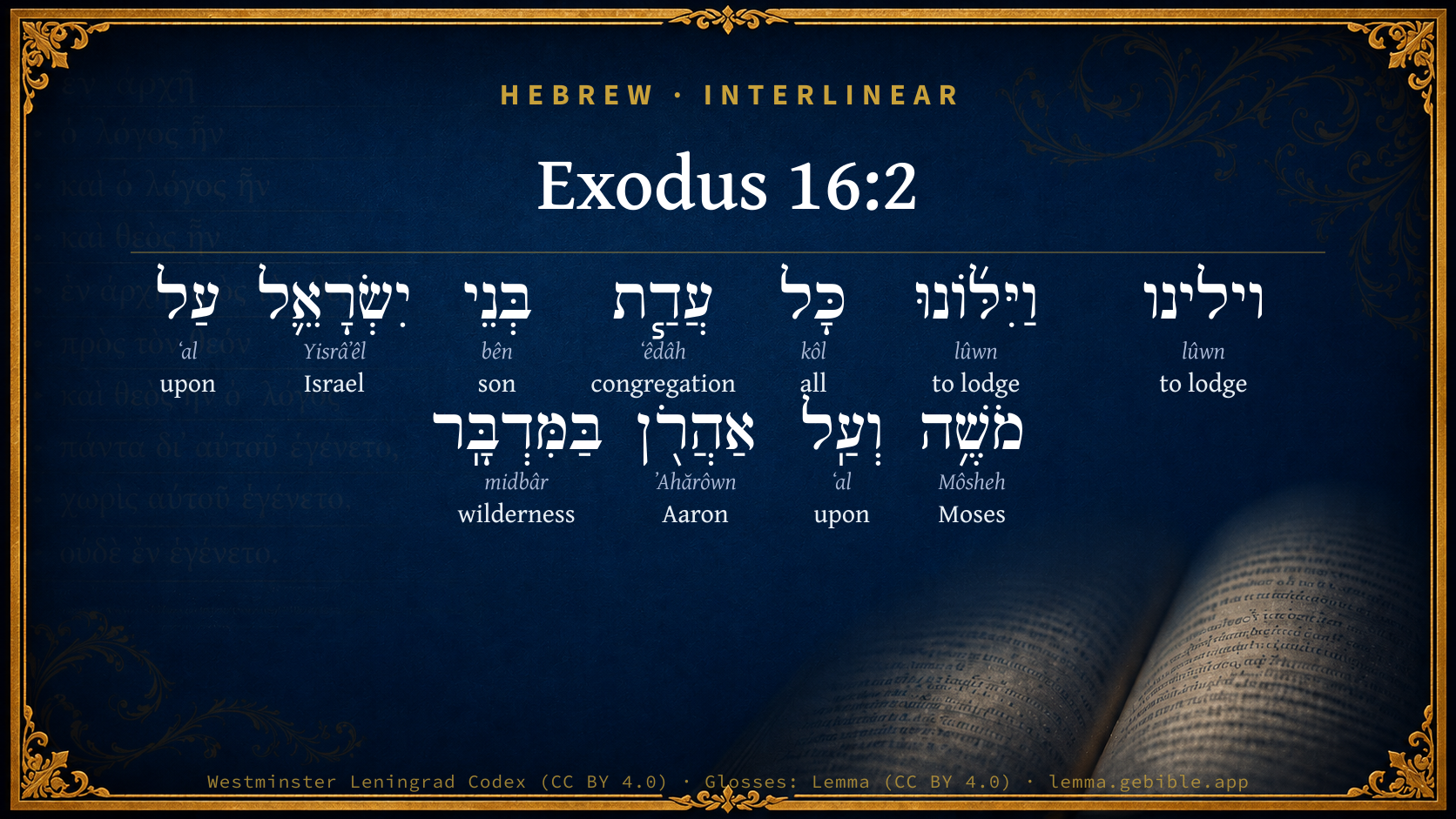
Exodus 16:2

Hebrew (Westminster Leningrad Codex) Exodus 16:2 appears in the Hebrew Old Testament. The text above is from the Westminster Leningrad Codex. Each word links to its Strong’s number, a concise gloss, and parsing drawn from the Open Scriptures Hebrew Bible morphology. Click any word for its full Brown-Driver-Briggs (BDB) entry.
Download image
Cite this verse

Exodus 16:2 (World English Bible). Public Domain. Lemma interlinear Bible study tool, https://lemma.gebible.app/v/exodus/16/2.

Show BibTeX & RIS
BibTeX
RIS
English Translation
The whole congregation of the children of Israel murmured against Moses and against Aaron in the wilderness;
World English Bible · Public Domain
Download a study sheet

One document with this verse’s original text, its word-by-word gloss line, the meaning frame, cross-references with their text, attributed commentary, and full source and license credits — printable, and it pastes into notes with its structure intact.

This verse Autodidact and up

Study sheet (.html) Plain text (.txt)

A passage Seminary Student

Up to 50 verses in one chapter. A passage sheet keeps up to 6 commentary sources and 12 cross-references per verse, in the order this page ranks them, and says so on the sheet whenever that leaves anything out. Ask for a single verse and you get the Autodidact verse sheet above.

Everything on this page stays free to read, with no account — the sheet is a download of what is already on screen, not access to it.

Want to remove ads? Support Godless Engineer
Compare translations 3

The same verse in 3 English versions, stacked beneath the original-language interlinear above. Click any original word for its lexicon entry.

Each is an independent rendering of the whole verse — the interlinear is not word-aligned to these translations.

Highlighted words mark where these versions differ — a whole-verse word diff, not a word-by-word alignment.

  • World English Bible Public Domain
    The whole congregation of the children of Israel murmured against Moses and against Aaron in the wilderness;
  • King James Version Public Domain
    And the whole congregation of the children of Israel murmured against Moses and Aaron in the wilderness:
  • unfoldingWord Literal Text CC BY-SA 4.0
    And all the congregation of the sons of Israel murmured against Moses and against Aaron in the wilderness.

unfoldingWord Literal Text — © unfoldingWord, licensed CC BY-SA 4.0. Word-aligned USFM3 via Door43 (git.door43.org/unfoldingWord/en_ult).

Versions to compare (up to 4)

3 of 4 selected

Show all 18 translations

Every available English version of this verse, each an independent rendering of the whole verse.

  • World English Bible Public Domain
    The whole congregation of the children of Israel murmured against Moses and against Aaron in the wilderness;
  • Berean Standard Bible Public Domain
    And there in the desert they all grumbled against Moses and Aaron.
  • Majority Standard Bible Public Domain
    And there in the desert the whole congregation of Israel grumbled against Moses and Aaron.
  • King James Version Public Domain
    And the whole congregation of the children of Israel murmured against Moses and Aaron in the wilderness:
  • American Standard Version (1901) Public Domain
    And the whole congregation of the children of Israel murmured against Moses and against Aaron in the wilderness:
  • Revised Version (1885) Public Domain
    And the whole congregation of the children of Israel murmured against Moses and against Aaron in the wilderness:
  • Geneva Bible (1599) Public Domain
    And the whole Congregation of the children of Israel murmured against Moses and against Aaron in the wildernesse.
  • Douay-Rheims (1899) Public Domain
    And all the congregation of the children of Israel murmured against Moses and Aaron in the wilderness.
  • Young's Literal Translation Public Domain
    And all the company of the sons of Israel murmur against Moses and against Aaron in the wilderness;
  • Literal Standard Version CC BY-SA 4.0
    And all the congregation of the sons of Israel murmur against Moses and against Aaron in the wilderness;
  • Unlocked Literal Bible CC BY-SA 4.0
    The whole community of Israelites complained against Moses and Aaron in the wilderness.
  • unfoldingWord Literal Text CC BY-SA 4.0
    And all the congregation of the sons of Israel murmured against Moses and against Aaron in the wilderness.
  • Darby Bible Public Domain
    And the whole assembly of the children of Israel murmured against Moses and against Aaron in the wilderness.
  • World Messianic Bible Public Domain
    The whole congregation of the children of Israel murmured against Moses and against Aaron in the wilderness;
  • Webster's Bible Public Domain
    And the whole congregation of the children of Israel murmured against Moses and Aaron in the wilderness.
  • Free Bible Version CC BY-SA 4.0
    There in the desert they complained to Moses and Aaron.
  • Bible in Basic English Public Domain
    And all the children of Israel were crying out against Moses and Aaron in the waste land:
  • JPS Tanakh (1917) Public Domain
    And the whole congregation of the children of Israel murmured against Moses and against Aaron in the wilderness;

Literal Standard Version (2020), Covenant Press — licensed CC BY-SA 4.0. Text via the HelloAO Bible API (eBible.org). Unlocked Literal Bible (unfoldingWord) — licensed CC BY-SA 4.0. Text via the HelloAO Bible API (eBible.org). unfoldingWord Literal Text — © unfoldingWord, licensed CC BY-SA 4.0. Word-aligned USFM3 via Door43 (git.door43.org/unfoldingWord/en_ult). Free Bible Version, Dr. Jonathan Gallagher — licensed CC BY-SA 4.0. Text via the HelloAO Bible API (eBible.org).

Word by word

More ways to search: Search by grammar → Find every occurrence → Compare this word →

Practice this passage: Drill this verse → Learn its vocabulary →

וילינו
lûwn
H3885
“and · to lodge”
Conjunction + Verb, Hiphil, Sequential Imperfect, 3rd Person, Masculine, Plural
Part of Speech
Conjunction + Verb
Stem
Hiphil
Form
Sequential Imperfect
Person
3rd Person
Gender
Masculine
Number
Plural
Full BDB Definition

Origin: a primitive root

TWOT: 1096 , 1097

to lodge, stop over, pass the night, abide - (Qal) - to lodge, pass the night - to abide, remain (figuratively) - (Hiphil) to cause to rest or lodge - (Hithpalpel) to dwell, abide - to grumble, complain, murmur - (Niphal) to grumble - (Hiphil) to complain, cause to grumble
  1. וַיִּלּ֜וֹנוּ lûwn H3885 “and · to lodge” Conjunction + Verb, Niphal, Sequential Imperfect, 3rd Person, Masculine, Plural
  2. כָּל kôl H3605 “all of” Noun, Common, Masculine, Singular, Construct
  3. עֲדַ֧ת ʻêdâh H5712 “congregation of” Noun, Common, Feminine, Singular, Construct
  4. בְּנֵי bên H1121 “sons of” Noun, Common, Masculine, Plural, Construct
  5. יִשְׂרָאֵ֛ל Yisrâʼêl H3478 “Israel” Noun, Proper
  6. עַל ʻal H5921 “upon” Preposition
  7. מֹשֶׁ֥ה Môsheh H4872 “Moses” Noun, Proper
  8. וְעַֽל ʻal H5921 “and · upon” Conjunction + Preposition
  9. אַהֲרֹ֖ן ʼAhărôwn H175 “Aaron” Noun, Proper
  10. בַּמִּדְבָּֽר midbâr H4057 “in/at the · wilderness” Preposition, Determined + Noun, Common, Masculine, Singular, Absolute

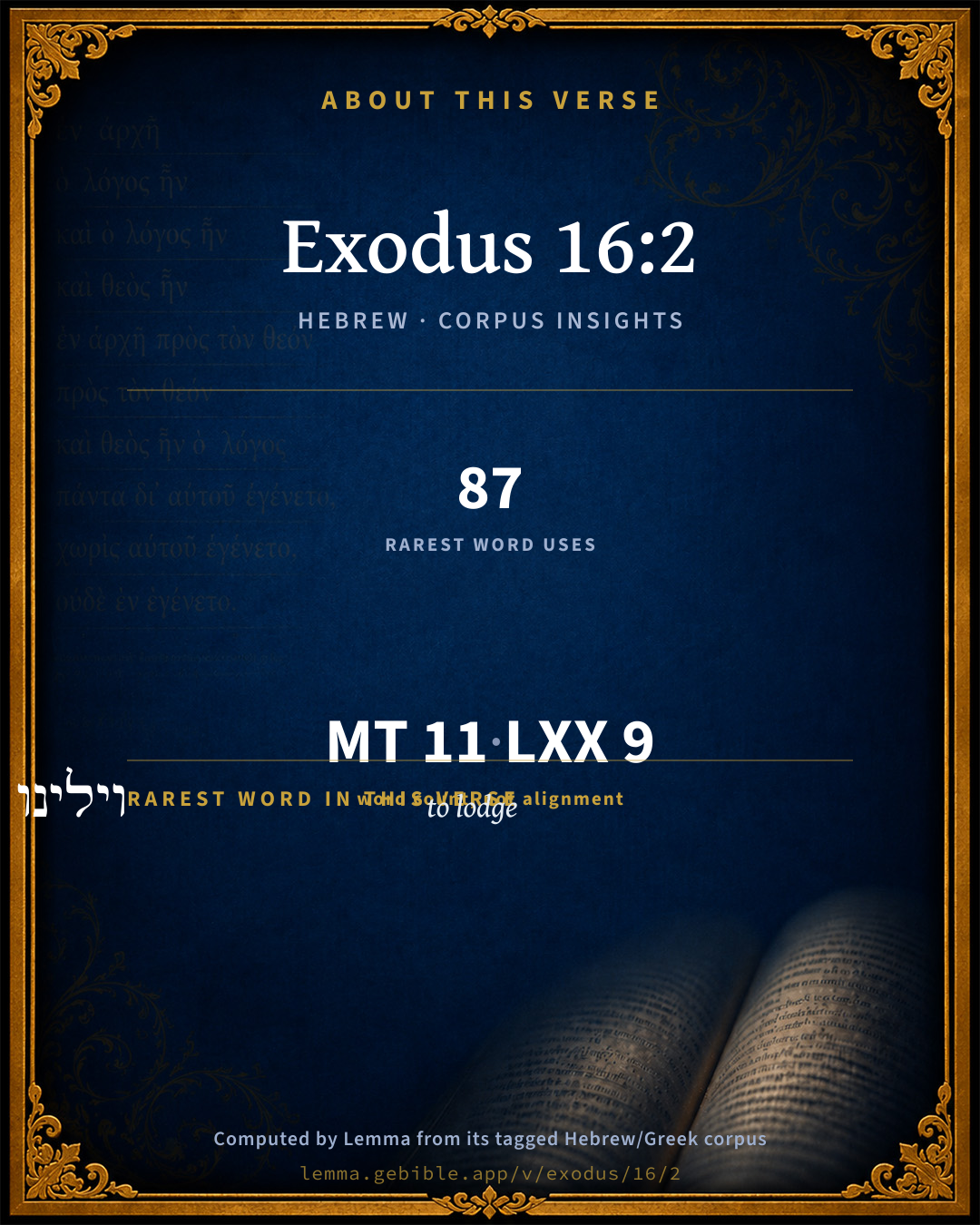
About this verse

These counts appear in no published source. They are computed here, from the morphology-tagged text and Lemma’s own curated glosses. What Lemma adds →

11
words
9
distinct lemmas
Pentateuch
section

Grammatical profile

  • 2 verbs
  • 7 nouns
  • 2 prepositions

Verb forms

  • וילינו Hiphil · Sequential Imperfect
  • וַיִּלּ֜וֹנוּ Niphal · Sequential Imperfect

Repetition

Words recur within this verse — often emphatic in Hebrew:

  • וילינו to lodge H3885 ×2
  • עַל upon H5921 ×2

Hebrew & Septuagint length

In English translation the verse runs 17 words from the Hebrew and 13 from the Septuagint (LXX English) — closely comparable.

A rough comparison of the two English renderings, which tokenize alike — not a word-level alignment.

Word counts can differ between the Hebrew and the Greek without any difference in meaning — e.g. the Hebrew direct-object marker אֵת has no separate Greek word, and Greek often adds the article ὁ.

In the original languages it is 11 Hebrew tokens and 9 Greek tokens — but the two are counted differently (Hebrew bundles its prefixes and suffixes into one token; the Greek is in lemma form), so that isn’t a like-for-like length.

Cross-references

7

Topical passages linked to Exodus 16:2 in the Treasury of Scripture Knowledge — connected by theme and wording, ordered by reader-vote popularity; previews shown in the World English Bible.

  • Exodus 15:24 The people murmured against Moses, saying, "What shall we drink?"
  • 1 Corinthians 10:10 Neither grumble, as some of them also grumbled, and perished by the destroyer.
  • Psalms 106:7 Our fathers didn't understand your wonders in Egypt. They didn't remember the multitude of your loving kindnesses, But were rebellious at the sea, even at the Red Sea.
  • Psalms 106:25 But murmured in their tents, And didn't listen to Yahweh's voice.
  • Exodus 14:11 They said to Moses, "Because there were no graves in Egypt, have you taken us away to die in the wilderness? Why have you treated us this way, to bring us forth out of Egypt?
  • Psalms 106:13 They soon forgot his works. They didn't wait for his counsel,
  • Genesis 19:4 But before they lay down, the men of the city, the men of Sodom, surrounded the house, both young and old, all the people from every quarter.

Cross-references courtesy of OpenBible.info (CC BY 4.0).

Hebrew and Greek witnesses Masoretic Hebrew ↔ Greek Septuagint

The same verse in the two great witnesses to the Old Testament, shown verse-for-verse.

These are two independent witnesses, not word-aligned to each other, and the Septuagint is shown in lemma (dictionary) form.

Hebrew Exodus 16:2 Masoretic · Westminster Leningrad Codex

וילינו וַיִּלּ֜וֹנוּ כָּל עֲדַ֧ת בְּנֵי יִשְׂרָאֵ֛ל עַל מֹשֶׁ֥ה וְעַֽל אַהֲרֹ֖ן בַּמִּדְבָּֽר

The whole congregation of the children of Israel murmured against Moses and against Aaron in the wilderness;

World English Bible · Public Domain

Greek LXX Exodus 16:2 Septuagint · lemma form

διαγογγύζω πᾶς συναγωγή υἱός ἰσραήλ ἐπί μωυσῆς καί ααρων

all the congregation of the children of Israel murmured against Moses and Aaron.

LXX2012 (modern English Septuagint) · Public Domain

Hebrew: Westminster Leningrad Codex (CC BY 4.0). Greek: Septuagint (public domain); English from LXX2012 (modern English Septuagint) (Public Domain). How the Septuagint differs from the Hebrew →

Targum (Aramaic paraphrase)

2

The Targum is the ancient Jewish Aramaic paraphrase of the Hebrew Scriptures — an interpretive translation, not the Hebrew text itself. Onkelos (literal) and Pseudo-Jonathan (expansive) render the Torah, and Jonathan the Prophets. Coverage is partial: where no permissively-licensed English translation exists for a verse, only the Aramaic is shown. This is verse-level text, not a word-by-word alignment to the Hebrew.

  1. Targum Onkelos Torah (Genesis–Deuteronomy)
    וְאִתְרָעָמוּ כָּל כְּנִשְׁתָּא דִבְנֵי יִשְׂרָאֵל עַל משֶׁה וְעַל אַהֲרֹן בְּמַדְבְּרָא:

    (no public-domain English translation for this verse)

    Targum Onkelos — Aramaic: “Onkelos Genesis” (public domain); “Onkelos Exodus” (public domain); “Onkelos Leviticus” (public domain); “Onkelos Numbers” (public domain); “Onkelos Deuteronomy” (public domain). English: “Sefaria Community Translation” (CC0 1.0 (public-domain dedication)); “J.W. Etheridge. The Targums of Onkelos and Jonathan Ben Uzziel on the Pentateuch. London: Longmans, Green, 1862” (public domain). Text via Sefaria.

  2. Targum Pseudo-Jonathan Torah (Genesis–Deuteronomy)
    וּבְהַהוּא יוֹמָא פָּסַק לְהוֹן לִישָׁא דְאַפִּיקוּ מִמִּצְרַיִם וְאִתְרַעֲמוּן כָּל בְּנֵי יִשְרָאֵל עַל משֶׁה וְעַל אַהֲרן בְּמַדְבְּרָא

    And on that day the bread which they had brought out of Mizraim was finished. And all the sons of Israel grumbled against Mosheh and against Aharon in the desert.

    Targum Pseudo-Jonathan — Aramaic: “Targum Jonathan on Genesis” (public domain); “Targum Jonathan on Exodus” (public domain); “Targum Jonathan on Leviticus” (public domain); “Targum Jonathan on Numbers” (public domain); “Targum Jonathan on Deuteronomy” (public domain). English: “The Targum of Jonathan ben Uzziel, trans. J. W. Etheridge, London, 1862” (public domain). Text via Sefaria.

Commentary

Notes on Exodus 16:2 from classic Christian and Jewish commentators (each source and its license shown beneath its notes). The classic Christian expositions comment on the surrounding passage and are grouped to its opening verse, so a note may address several verses; the Jewish commentaries on the Tanakh (Rashi and others) are per-verse, so they appear only where the commentator wrote on this verse.

Lemma curates 59 commentaries, every one of them public domain or Creative Commons licensed, each selected and text-cleaned for this edition rather than reprinted as found. About our sources →

Trapp's Complete Commentary

John Trapp

Exo 16:2 And the whole congregation of the children of Israel murmured against Moses and Aaron in the wilderness:

Ver. 2. And the whole congregation.] The most part of the people. Diaconos paucitas honorabiles fecit, saith Jerome: sic et veros Israelitas.

John Trapp, A Commentary or Exposition upon All the Books of the Old and New Testament (1647–1656) — public domain. Text from a community e-Sword module.

Joseph Benson's Commentary

Exo 16:2. The whole congregation murmured — For want of bread, having consumed all the dough or flour which they had brought out of Egypt. A month’s provision, it seems, the host of Israel took with them out of Egypt, when they came thence on the 15th day of the first month, which by the 15th of the second month was all spent. Against Moses and Aaron — God’s vicegerents among them. How weak and perverse is human nature! They had just seen the bitter waters instantaneously made sweet to assuage their thirst, and a little while before had been miraculously delivered at the Red sea, when there seemed to be no possible way for their escape; and yet so far were they from learning to trust in that divine, almighty Providence, that had so wonderfully and so evidently wrought for them, that on the very first difficulty and distress they break out into the most desponding murmurings!

Joseph Benson's Commentary on the Old and New Testaments (1811–1818) — public domain. Text from a community e-Sword module.

Tyndale Open Study Notes

Tyndale Open Resources

16:2 complained: The people were developing a pattern of faithlessness manifested in complaining.

Tyndale Open Study Notes — © Tyndale Open Resources, licensed CC BY-SA 4.0. Text via the HelloAO Bible API.

Jamieson, Fausset & Brown

Robert Jamieson, A. R. Fausset & David Brown

the whole congregation . . . murmured against Moses and Aaron--Modern travellers through the desert of Sinai are accustomed to take as much as is sufficient for the sustenance of men and beasts during forty days. The Israelites having been rather more than a month on their journey, their store of corn or other provisions was altogether or nearly exhausted; and there being no prospect of procuring any means of subsistence in the desert, except some wild olives and wild honey (Deu 32:13), loud complaints were made against the leaders.

Jamieson, Fausset & Brown — Commentary Critical and Explanatory on the Whole Bible (1871) — public domain (CC PDM 1.0). Text via the HelloAO Bible API.

Adam Clarke's Commentary

Verse 2. The whole congregation - murmured] This is an additional proof of the degraded state of the minds of this people; See Clarke on Ex 13:17. And this very circumstance affords a convincing argument that a people so stupidly carnal could not have been induced to leave Egypt had they not been persuaded so to do by the most evident and striking miracles. Human nature can never be reduced to a more abject state in this world than that in which the body is enthralled by political slavery, and the soul debased by the influence of sin. These poor Hebrews were both slaves and sinners, and were therefore capable of the meanest and most disgraceful acts.

Adam Clarke's Commentary on the Bible (1810–1826) — public domain. Text from a community e-Sword/MySword module.

Ellicott's Commentary for English Readers

(2) The whole congregration . . . murmured.—This is the third “murmuring.” The first was at Pi-hahiroth, on the appearance of the host of Pharaoh (Exo_14:11-12); the second was at Marah, when the water proved undrinkable (Exo_15:24); the third, in the wilderness of Sin, was brought about by no special occurrence—unless it were the exhaustion of the supplies of grain which had been brought out of Egypt—but seems to have resulted from a general dissatisfaction with the conditions of life in the wilderness, and with the prospects which lay before them.

A Bible Commentary for English Readers, edited by Charles John Ellicott (1878–1897) — public domain. Text from a community e-Sword module.

The Cambridge Bible for Schools and Colleges

gen. ed. J. J. S. Perowne

2. murmured] Exo_15:24, Exo_17:3.

2, 3. The people’s murmurings: they would rather have died suddenly by Jehovah’s hand in Egypt, in the enjoyment of plenty, than have been thus brought, by the fault of their leaders, to a lingering and painful death in the wilderness.

The Cambridge Bible for Schools and Colleges (gen. ed. J. J. S. Perowne; Cambridge University Press, 1878–1918) — public domain. Text from a community e-Sword module.

John Gill's Exposition

And the whole congregation of the children of Israel murmured,.... For want of bread; for the Targum of Jonathan says, that day the dough ceased they brought of Egypt, on which, and the unleavened cakes they had lived thirty days; and for a longer space of time it was not sufficient, as Josephus (g) and other Jewish writers (h) observe; and now it was all spent, and they were in the utmost distress for bread, and fall a murmuring as they were used to do, when in any distress, even the whole congregation of them, at least the far greater part; some few might be excepted, as Caleb and Joshua, and some others: and they

murmured against Moses and Aaron in the wilderness; in the wilderness of Sin, where they were, and where no corn was to be had to make bread of; and their murmuring was not only against Moses, as before when they wanted water, but against Aaron also, who were jointly concerned in bringing them out of Egypt. It is a common case, when things do not go so well as to be wished for in church or state, for people to murmur against their governors, ecclesiastic or civil, and lay all the blame to them.

(g) Antiqu. l. 2. c. 15. sect. 1. (h) Seder Olam Rabba, c. 5. p. 17.

John Gill's Exposition of the Whole Bible (1746–1763) — public domain (CC PDM 1.0). Text via the HelloAO Bible API.

Albert Barnes' Notes on the Bible

Murmured - The want of food was first felt after six weeks from the time of the departure from Egypt, see Exo 16:1 : we have no notice previously of any deficiency of bread.

Albert Barnes' Notes on the Bible (1834–1885) — public domain. Text from a community e-Sword/MySword module.

Matthew Poole's English Annotations

For want of meat, as appears from the following verse, their provisions brought out of Egypt being now spent.

Matthew Poole's English Annotations on the Holy Bible (1683–1685) — public domain. Text from a community e-Sword/MySword module.

Whedon's Commentary on the Bible

Daniel D. Whedon

2. The whole congregation… murmured — The stores that they had brought from Egypt were now exhausted, although they obtained much sustenance from their herds and flocks; but they saw nothing to eat in this barren waste, and looked forward with terror to the long journey that was yet before them. A month’s experience of the desert had broken the courage of the whole host, and there was a general disaffection and rebellion, though there were doubtless individual instances of patience and of faith. The present suffering blotted out of remembrance the wonderful experiences of the Red Sea and of Marah. So short was their memory of God’s goodness!

Daniel D. Whedon (gen. ed.), Commentary on the Old and New Testaments (1874–1909) — public domain. Text from a community e-Sword module.

The Pulpit Commentary

The whole congregation murmured, It has been observed above, that only the poorer sort could have been as yet in any peril of actual starvation; but it may well have been that the rest, once launched into the wilderness, and becoming practically acquainted with its unproductiveness, foresaw that ultimately starvation must come upon them too, when all the cattle were eaten up, or had died through insufficient nourishment Nothing is more clear than that, without the miracle of the manna, it would have been impossible for a population of two millions to have supported themselves for forty years, or even for two years, in such a region as the Sinaitic peninsula, even though it had been in ancient times three or four times as productive as at present. The cattle brought out of Egypt must have rapidly diminished; (Exo_17:3) and though the Israelites had brought with them also great wealth in the precious metals, yet it must have been some time before they could establish commercial relations with the neighbouring nations so as to obtain such supplies as they needed. Thus we can well understand that at the expiration of a month the people generally should have recognized that their situation was one of great danger, and should have vented their discontent upon their leaders.

The Pulpit Commentary (1880–1919), ed. H.D.M. Spence-Jones & Joseph S. Exell — public domain. Text from a community e-Sword module.

John Wesley's Explanatory Notes

Then the whole congregation murmured against Moses and Aaron - God's viceregents among them.

John Wesley, Explanatory Notes Upon the Whole Bible (1754–1765) — public domain. Text via the GEBible commentary corpus.

Keil & Delitzsch

C. F. Keil & F. Delitzsch

Here, in this arid sandy waste, the whole congregation murmured against Moses and Aaron on account of the want of food. What they brought with them from Egypt had been consumed in the 30 days that had elapsed since they came out (Exo 16:1). In their vexation the people expressed the wish that they had died in Egypt by the flesh-pot, in the midst of plenty, "by the hand of Jehovah," i.e., by the last plague which Jehovah sent upon Egypt, rather than here in the desert of slow starvation. The form ויּלּינוּ is a Hiphil according to the consonants, and should be pointed ילּינוּ, from הלּין for הלין (see Ges. 72, Anm. 9, and Ewald, 114c.). As the want really existed, Jehovah promised them help (Exo 16:4). He would rain bread from heaven, which the Israelites should gather every day for their daily need, to try the people, whether they would walk in His law or not. In what the trial was to consist, is briefly indicated in Exo 16:5 : "And it will come to pass on the sixth day (of the week), that they will prepare what they have brought, and it will be double what they gather daily." The meaning is, that what they gathered and brought into their tents on the sixth day of the week, and made ready for eating, would be twice as much as what they gathered on every other day; not that Jehovah would miraculously double what was brought home on the sixth day, as Knobel interprets the words in order to make out a discrepancy between Exo 16:5 and Exo 16:22. הכין, to prepare, is to be understood as applying partly to the measuring of what had been gathered (Exo 16:18), and partly to the pounding and grinding of the grains of manna into meal (Num 11:8). In what respect this was a test for the people, is pointed out in Exo 16:16. Here, in Exo 16:4 and Exo 16:5, the promise of God is only briefly noticed, and its leading points referred to; it is described in detail afterwards, in the communications which Moses and Aaron make to the people. In Exo 16:6, Exo 16:7, they first tell the people, "At even, then shall ye know that Jehovah hath brought you out of Egypt; and in the morning, then shall ye see the glory of the Lord." Bearing in mind the parallelism of the clauses, we obtain this meaning, that in the evening and in the morning the Israelites would perceive the glory of the Lord, who had brought them out of Egypt. "Seeing" is synonymous with "knowing." Seeing the glory of Jehovah did not consist in the sight of the glory of the Lord which appeared in the cloud, as mentioned in Exo 16:10, but in their perception or experience of that glory in the miraculous gift of flesh and bread (Exo 16:8, cf. Num 14:22). "By His hearing" (בּשׁמעו), i.e., because He has heard, "your murmuring against Jehovah ("Against Him" in Exo 16:8, as in Gen 19:24); for what are we, that ye murmur against us?" The murmuring of the people against Moses and Aaron as their leaders really affected Jehovah as the actual guide, and not Moses and Aaron, who had only executed His will. Jehovah would therefore manifest His glory to the people, to prove to them that He had heard their murmuring. The announcement of this manifestation of God is more fully explained to the people by Moses in Exo 16:8, and the explanation is linked on to the leading clause in Exo 16:7 by the words, "when He giveth," etc. Ye shall see the glory of Jehovah, when Jehovah shall give you, etc.

Keil & Delitzsch — Biblical Commentary on the Old Testament (1861–1891) — public domain (CC PDM 1.0). Text via the HelloAO Bible API. (Old Testament only.)

Rashi

Rabbi Shlomo Yitzchaki (Rashi)

וילנו AND THEY MURMURED, because the bread had come to an end.

Rashi on the Tanakh — English translations: “The Judaica Press complete Tanach with Rashi, translated by A. J. Rosenberg” (CC BY 4.0); “Pentateuch with Rashi's commentary by M. Rosenbaum and A.M. Silbermann, 1929-1934” (public domain); “The Metsudah Tanach series, Lakewood, N.J” (CC BY 4.0); and “The Book of Joshua, Metsudah Publications, 1997” (CC BY 4.0). Text via Sefaria.

Ramban (Nachmanides)

Rabbi Moshe ben Nachman (Ramban / Nachmanides)

AND THE WHOLE CONGREGATION OF THE CHILDREN OF ISRAEL MURMURED AGAINST MOSES. Scripture should have first narrated the nature of the complaint just as it did in Marah. and Rephidim,. and at all other complaints — and stated here first: “and there was no flesh to eat, nor bread for them to the full, and the people were famished for bread.” Now Rashi explained that the reason Scripture specifically mentions [that the date of their arrival in the wilderness of Sin] was on the fifteenth day of the second month is in order “to make this encampment unique. On that day, there came to an end the provision which the Israelites took along with them from Egypt, and they now needed the manna. It thus informs you that they ate sixty-one meals of the remains of the dough [which they had baked in Egypt on the day of the exodus].” [Thus far the language of Rashi.] This is a tradition received by our Rabbis, and the reason that Scripture did not [first] explain the nature of their complaint was that it had not elaborated on this miracle which was done for them secretively, [i.e., that the remains of the dough furnished sixty-one meals]. And it is as I have already written in Seder Vayigash concerning the reason [that Scripture is disposed to be silent on hidden miracles]. Rabbi Abraham ibn Ezra wrote that Scripture records the date on the fifteenth day of the second month in order to explain that a month’s time had already elapsed since their departure from Egypt. In the meantime, they consumed the bread they took out of Egypt as well as their cattle, since they were a great multitude of people. This was the reason for the murmuring.In my opinion, the reason for their complaint is to be found in the Scriptural expression, and they came… unto the wilderness of Sin. When they came to that wilderness far away from Egypt, they began saying: “What shall we eat? What will this great wilderness into which we have come supply us with?” It may be that at first they had thought that after a few days they would come to the cities round about them. Now that a month had gone by and they found no city of habitation, they said, “We will all die in the great wilderness into which we have come.” This then is the meaning of the verse, And the whole congregation of the children of Israel murmured against Moses and against Aaron in the wilderness, the murmuring being because of the wilderness. And so likewise the people said, for ye have brought us forth into this wilderness, to put to death this whole assembly by famine. Thus they mentioned “the wilderness’ and “the assembly,” therein stating that a large assembly such as this will undoubtedly die of hunger in this great wilderness. The Holy One, blessed be He, hearkened unto them, and He now began to prepare a table for them in the wilderness until they came to a land inhabited.

Ramban (Nachmanides) on the Tanakh — English translation: “Commentary on the Torah by Ramban (Nachmanides). Translated and annotated by Charles B. Chavel. New York, Shilo Pub. House, 1971-1976” (CC BY 4.0). Text via Sefaria.

Lesson kit

Teaching starters — assembled from the data on this page, not authored interpretation. Every prompt links to the verse data it draws on. Edit before teaching.

Exodus, in the Pentateuch, opens this verse with 11 words (9 distinct Hebrew lemmas). Its most distinctive word is lûwn (“to lodge”). A historical commentator’s framing appears above. Read the whole chapter for the surrounding context.

Discussion questions

  1. How does “to lodge” (lûwn) shape what this verse is saying?
  2. How does Exodus 15:24, which shares this passage’s theme, read alongside this verse?
  3. What does the repetition of “to lodge” (2× in this one verse) do in this verse?
  4. The translations on this page render this verse differently — a whole-verse word diff, not a word-by-word alignment. What might account for the different wordings?
  5. «וילינו» is a Hiphil Sequential Imperfect verb. How does that grammatical form shape the action described?
  6. Compare how Trapp's Complete Commentary and Joseph Benson's Commentary read this verse. Where do they agree or differ?

Things to notice

Reading settings

Reading text

Shown beneath each verse's original-language words.

Old Testament
Old Testament edition

Read the OT as the Masoretic Hebrew (MT) or the Greek Septuagint (LXX).

English shown for the Greek Septuagint (in the Hebrew ↔ Greek comparison).

Comparing translations? Open the Compare panel on any verse page to stack up to four side by side.