
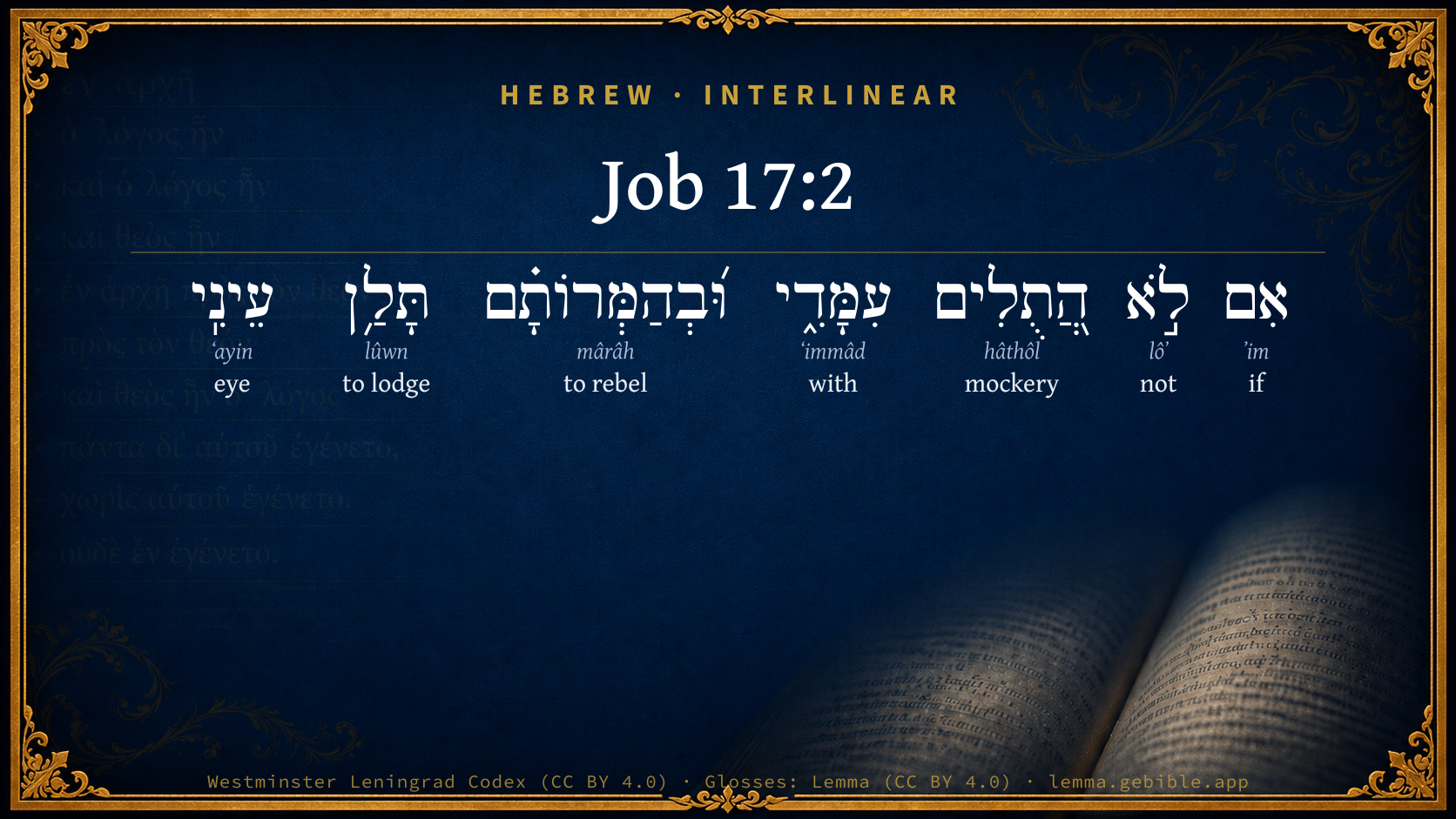
Job 17:2

Hebrew (Westminster Leningrad Codex) Job 17:2 appears in the Hebrew Old Testament. The text above is from the Westminster Leningrad Codex. Each word links to its Strong’s number, a concise gloss, and parsing drawn from the Open Scriptures Hebrew Bible morphology. Click any word for its full Brown-Driver-Briggs (BDB) entry.
Download image
Cite this verse

Job 17:2 (World English Bible). Public Domain. Lemma interlinear Bible study tool, https://lemma.gebible.app/v/job/17/2.

Show BibTeX & RIS
BibTeX
RIS
English Translation
Surely there are mockers with me, My eye dwells on their provocation.
World English Bible · Public Domain
Highlights
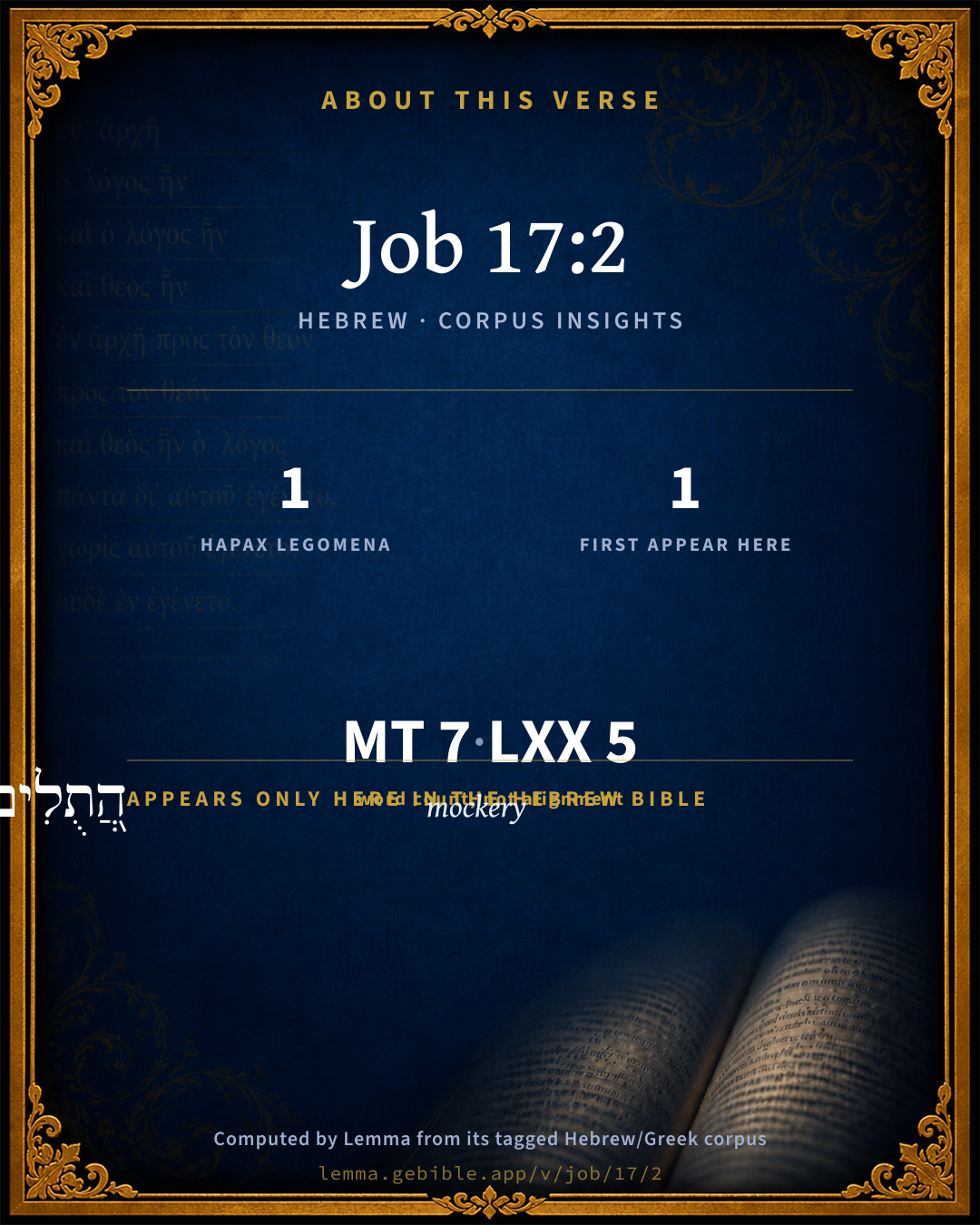
  • 1 hapax legomenon — only here in the Hebrew Bible
  • 1 first appearance in the Hebrew Bible
Full analysis ↓
Download a study sheet

One document with this verse’s original text, its word-by-word gloss line, the meaning frame, cross-references with their text, attributed commentary, and full source and license credits — printable, and it pastes into notes with its structure intact.

This verse Autodidact and up

Study sheet (.html) Plain text (.txt)

A passage Seminary Student

Up to 50 verses in one chapter. A passage sheet keeps up to 6 commentary sources and 12 cross-references per verse, in the order this page ranks them, and says so on the sheet whenever that leaves anything out. Ask for a single verse and you get the Autodidact verse sheet above.

Everything on this page stays free to read, with no account — the sheet is a download of what is already on screen, not access to it.

Want to remove ads? Support Godless Engineer
Compare translations 3

The same verse in 3 English versions, stacked beneath the original-language interlinear above. Click any original word for its lexicon entry.

Each is an independent rendering of the whole verse — the interlinear is not word-aligned to these translations.

Highlighted words mark where these versions differ — a whole-verse word diff, not a word-by-word alignment.

  • World English Bible Public Domain
    Surely there are mockers with me, My eye dwells on their provocation.
  • King James Version Public Domain
    Are there not mockers with me? and doth not mine eye continue in their provocation?
  • unfoldingWord Literal Text CC BY-SA 4.0
    If not mockers with me? And on their provocations my eye lingers.

unfoldingWord Literal Text — © unfoldingWord, licensed CC BY-SA 4.0. Word-aligned USFM3 via Door43 (git.door43.org/unfoldingWord/en_ult).

Versions to compare (up to 4)

3 of 4 selected

Show all 18 translations

Every available English version of this verse, each an independent rendering of the whole verse.

  • World English Bible Public Domain
    Surely there are mockers with me, My eye dwells on their provocation.
  • Berean Standard Bible Public Domain
    Surely mockers surround me, and my eyes must gaze at their rebellion.
  • Majority Standard Bible Public Domain
    Surely mockers surround me, and my eyes must gaze at their rebellion.
  • King James Version Public Domain
    Are there not mockers with me? and doth not mine eye continue in their provocation?
  • American Standard Version (1901) Public Domain
    Surely there are mockers with me, And mine eye dwelleth upon their provocation.
  • Revised Version (1885) Public Domain
    Surely there are mockers with me, and mine eye abideth in their provocation.
  • Geneva Bible (1599) Public Domain
    There are none but mockers with mee, and mine eye continueth in their bitternesse.
  • Douay-Rheims (1899) Public Domain
    I have not sinned, and my eye abideth in bitterness.
  • Young's Literal Translation Public Domain
    If not -- mockeries `are' with me. And in their provocations mine eye lodgeth.
  • Literal Standard Version CC BY-SA 4.0
    If not—mockeries [are] with me. And my eye lodges in their provocations.
  • Unlocked Literal Bible CC BY-SA 4.0
    Surely there are mockers with me; my eye must always see their provocation.
  • unfoldingWord Literal Text CC BY-SA 4.0
    If not mockers with me? And on their provocations my eye lingers.
  • Darby Bible Public Domain
    Are there not mockers around me? and doth [not] mine eye abide in their provocation?
  • World Messianic Bible Public Domain
    Surely there are mockers with me. My eye dwells on their provocation.
  • Webster's Bible Public Domain
    Are there not mockers with me? and doth not my eye continue in their provocation?
  • Free Bible Version CC BY-SA 4.0
    Mockers surround me. I see how bitterly they ridicule me.
  • Bible in Basic English Public Domain
    Truly, those who make sport of me are round about me, and my eyes become dark because of their bitter laughing.
  • JPS Tanakh (1917) Public Domain
    Surely there are mockers with me, and mine eye abideth in their provocation.

Literal Standard Version (2020), Covenant Press — licensed CC BY-SA 4.0. Text via the HelloAO Bible API (eBible.org). Unlocked Literal Bible (unfoldingWord) — licensed CC BY-SA 4.0. Text via the HelloAO Bible API (eBible.org). unfoldingWord Literal Text — © unfoldingWord, licensed CC BY-SA 4.0. Word-aligned USFM3 via Door43 (git.door43.org/unfoldingWord/en_ult). Free Bible Version, Dr. Jonathan Gallagher — licensed CC BY-SA 4.0. Text via the HelloAO Bible API (eBible.org).

Word by word

More ways to search: Search by grammar → Find every occurrence → Compare this word →

Practice this passage: Drill this verse → Learn its vocabulary →

About this verse

These counts appear in no published source. They are computed here, from the morphology-tagged text and Lemma’s own curated glosses. What Lemma adds →

7
words
7
distinct lemmas
Wisdom
section

Notable vocabulary

1 hapax legomenon — a word that appears only here in the entire Hebrew Bible:

  • הֲ֭תֻלִים mockery H2049

First appearance in Scripture

This word makes its first canonical appearance in the Hebrew Bible here:

  • הֲ֭תֻלִים mockery H2049

Shared distinctive vocabulary

עִמָּדִ֑י with H5978 occurs in 44 verses of the Hebrew Bible. Also found in:

Grammatical profile

  • 2 verbs
  • 2 nouns
  • 1 preposition
  • 1 conjunction
  • 1 particle

Verb forms

  • וּ֝בְהַמְּרוֹתָ֗ם Hiphil · Infinitive Construct
  • תָּלַ֥ן Qal · Imperfect

Hebrew & Septuagint length

In English translation the verse runs 12 words from the Hebrew and 14 from the Septuagint (LXX English) — closely comparable.

A rough comparison of the two English renderings, which tokenize alike — not a word-level alignment.

Word counts can differ between the Hebrew and the Greek without any difference in meaning — e.g. the Hebrew direct-object marker אֵת has no separate Greek word, and Greek often adds the article ὁ.

In the original languages it is 7 Hebrew tokens and 5 Greek tokens — but the two are counted differently (Hebrew bundles its prefixes and suffixes into one token; the Greek is in lemma form), so that isn’t a like-for-like length.

Cross-references

9

Topical passages linked to Job 17:2 in the Treasury of Scripture Knowledge — connected by theme and wording, ordered by reader-vote popularity; previews shown in the World English Bible.

  • 1 Samuel 1:6–7 Her rival provoked her sore, to make her fret, because Yahweh had shut up her womb.
  • Job 12:4 I am like one who is a joke to his neighbor, I, who called on God, and he answered. The just, the blameless man is a joke.
  • Job 16:20 My friends scoff at me. My eyes pour out tears to God,
  • Matthew 27:39–44 Those who passed by blasphemed him, wagging their heads,
  • Job 13:9 Is it good that he should search you out? Or as one deceives a man, will you deceive him?
  • Job 21:3 Allow me, and I also will speak; After I have spoken, mock on.
  • Psalms 25:13 His soul shall dwell at ease. His seed shall inherit the land.
  • Psalms 35:14–16 I behaved myself as though it had been my friend or my brother. I bowed down mourning, as one who mourns his mother.
  • Psalms 91:1 He who dwells in the secret place of the Most High Will rest in the shadow of the Almighty.

Cross-references courtesy of OpenBible.info (CC BY 4.0).

Hebrew and Greek witnesses Masoretic Hebrew ↔ Greek Septuagint

The same verse in the two great witnesses to the Old Testament, shown verse-for-verse.

These are two independent witnesses, not word-aligned to each other, and the Septuagint is shown in lemma (dictionary) form.

Hebrew Job 17:2 Masoretic · Westminster Leningrad Codex

אִם לֹ֣א הֲ֭תֻלִים עִמָּדִ֑י וּ֝בְהַמְּרוֹתָ֗ם תָּלַ֥ן עֵינִֽי

Surely there are mockers with me, My eye dwells on their provocation.

World English Bible · Public Domain

Greek LXX Job 17:2 Septuagint · lemma form

λίσσομαι κάμνω καί τίς ποιέω

Weary I entreat; and what have I done? and strangers have stolen my goods.

LXX2012 (modern English Septuagint) · Public Domain

On this verse, Adam Clarke's Commentary discusses the Septuagint’s reading. Read the note in Commentary ↓

Hebrew: Westminster Leningrad Codex (CC BY 4.0). Greek: Septuagint (public domain); English from LXX2012 (modern English Septuagint) (Public Domain). How the Septuagint differs from the Hebrew →

Commentary

Notes on Job 17:2 from classic Christian and Jewish commentators (each source and its license shown beneath its notes). The classic Christian expositions comment on the surrounding passage and are grouped to its opening verse, so a note may address several verses; the Jewish commentaries on the Tanakh (Rashi and others) are per-verse, so they appear only where the commentator wrote on this verse.

Lemma curates 59 commentaries, every one of them public domain or Creative Commons licensed, each selected and text-cleaned for this edition rather than reprinted as found. About our sources →

Trapp's Complete Commentary

John Trapp

Job 17:2 [Are there] not mockers with me? and doth not mine eye continue in their provocation?

Ver. 2. Are there no mockers with me?] Heb. If there be not mockers with me, q.d. despeream, let me be punished, or let me be blamed for wishing to argue it out with God; so some Jewish doctors sense it. Job had before complained about his friends’ jeering and girding at him, Job 16:20. To be mocked in misery is no small aggravation. See what is threatened, Pro 1:26. The proverb is, Oculus, fides, et fama non patiuntur iocos, There is no jesting with a man’s eye, faith, and fame. Junius rendereth the text thus, Forasmuch as there are no mockings with me, I mean honestly, and deal plainly, and yet mine eye continueth in their provocations, neither can I be set right in their opinions, so prejudiced they are against me.

And doth not mine eye continue in their provocation?] Heb. Lodge or tarry all night in their provocations, or bitternesses? Broughton readeth, In these men’s vexing lodgeth mine eye; that is, I lodge not so much in my bed as in the thoughts of my friends’ unkindness. And indeed, saith one, a man may sleep better upon bare boards than upon hard words. Some refer it to the eye of his mind lifted up to God in prayer; but yet no sweetness coming from him either internally or externally. The former is rather to be followed.

John Trapp, A Commentary or Exposition upon All the Books of the Old and New Testament (1647–1656) — public domain. Text from a community e-Sword module.

Joseph Benson's Commentary

Job 17:2. Are there not mockers with me? — Do not my friends, instead of comforting, mock and abuse me, as if I had made use of religion only as a cloak to cover my wickedness? Thus he returns to what he had said chap. Job 16:20), and intimates the necessity and justice of his following appeal, which otherwise might have been thought too bold. And doth not mine eye continue in their provocation? — That is, doth not their provocation continue in mine eye? Do not I still behold them provoking me to my face? Or he may speak of the eye of his mind, and then the meaning is, Their provoking scoffs and reproaches do not only molest me in the day-time, when they are with me, but lodge with me (for the word תלן, talan, here rendered continue, signifies to lodge) in the night, and are continually in my thoughts.

Joseph Benson's Commentary on the Old and New Testaments (1811–1818) — public domain. Text from a community e-Sword module.

Tyndale Open Study Notes

Tyndale Open Resources

17:2 surrounded by mockers: Laments typically describe mockery as the response of the wicked to the distress of the righteous (Pss 22:7; 69:10-12; 89:50-52). In wisdom literature, mockery is directed against the right behavior (Prov 1:22; 9:7).

Tyndale Open Study Notes — © Tyndale Open Resources, licensed CC BY-SA 4.0. Text via the HelloAO Bible API.

Geneva Bible (1599)

Geneva Bible translators

I see still that they seek but to vex me.

Instead of comfort, being now at death’s door, he had but them that mocked at him, and discouraged him.

Geneva Bible (1599) marginal notes — public domain. Text via Bolls.life.

Jamieson, Fausset & Brown

Robert Jamieson, A. R. Fausset & David Brown

UMBREIT, more emphatically, "had I only not to endure mockery, in the midst of their contentions I (mine eye) would remain quiet."

eye continue--Hebrew, "tarry all night"; a figure taken from sleep at night, to express undisturbed rest; opposed to (Job 16:20), when the eye of Job is represented as pouring out tears to God without rest.

Jamieson, Fausset & Brown — Commentary Critical and Explanatory on the Whole Bible (1871) — public domain (CC PDM 1.0). Text via the HelloAO Bible API.

Adam Clarke's Commentary

Verse 2. Are there not mockers with me?] This has been variously translated. The VULGATE: "I have not sinned, and yet my eye dwells upon afflictions." SEPTUAGINT: "I conjure you, labouring under afflictions, what evil have I done? Yet strangers have robbed me of my substance." Mr. GOOD: "But are not revilers before me? Alas, mine eye penetrateth their rebukes." CALMET thinks the Hebrew might be translated thus: "If I have not been united in friendship with the wicked, why are my eyes in bitterness?" COVERDALE translates both verses thus: My breth fayleth, my dayes are shortened, I am harde at deathes dore. I have disceaved no man, yet must myne eye continue in hevynesse. Mr. HEATH "Were it not so, I have sarcasms enow in store; and I could spend the whole night unmoved at their aggravations." The general meaning is sufficiently plain, and the reader has got translations enough.

Adam Clarke's Commentary on the Bible (1810–1826) — public domain. Text from a community e-Sword/MySword module.

Ellicott's Commentary for English Readers

(2) Mine eye continue in their provocation?—“It sees, and can see nothing else; has nothing else to look upon “: a bitter reproach against his friends.

A Bible Commentary for English Readers, edited by Charles John Ellicott (1878–1897) — public domain. Text from a community e-Sword module.

The Cambridge Bible for Schools and Colleges

gen. ed. J. J. S. Perowne

2. Are there not mockers with me] lit. mockery. The interrogative form is possible, but more likely the verse is a strong asseveration, uttered in a tone of indignant impatience. The connexion indicates that the reference is to the illusory hopes and promises of restoration in this life which the friends held out to Job. He complains that he is beset with such mockeries. This seems also the meaning of the “provocation” on which his eye has to dwell, though in this their offensive exhortations to repentance may also be included. This provocation of theirs his friends were always inflicting upon him, troublesome comforters as they were (Job_16:2). The true state of things Job knows very well (Job_17:1; Job_17:10-16); their delusive hopes are not things he can hope for; and he turns in impatience from them with a greater importunity unto God, and appeals to Him for that which may yet be attained, and which above all things he longs for (Job_17:3).

The Cambridge Bible for Schools and Colleges (gen. ed. J. J. S. Perowne; Cambridge University Press, 1878–1918) — public domain. Text from a community e-Sword module.

John Gill's Exposition

Are there not mockers with me?.... Meaning not irreligious persons, such as make a mock at sin, a jest of religion, a laugh at good men, sneer at the doctrines and ordinances of God, and scoff at things future, as the coming of Christ, the resurrection of the dead, and a future judgment; with whom it is very uncomfortable to be, as well as with any sort of profane men, and such there were no doubt in Job's time; but he seems to design his friends, by whom be thought himself mocked, and who were, as he imagined, scorners of him, Job 12:4; and therefore for this reason entreats his case might be heard, and his cause pleaded:

and doth not mine eye continue in their provocation? or "lodge all night" (q); his sense is, that they were continually provoking him with their words, their scoffs and jeers, their censures and calumnies, and the weak reasons and arguments they made use of to support their charges and suspicions; these dwelt upon his mind not only in the daytime but in the night, so that he could not get a wink of sleep for them; their words were so teasing and distressing, and they acted such a cruel part to him, and stuck so close to him, and hung upon his thoughts, that he could not get clear of them in the night season; but his mind ran upon them, which kept him waking, that he could not close his eyelids for thinking of them.

(q) "pernoctat", Junius & Tremellius, Piscator, Drusius, Schmidt, Michaelis, Schultens.

John Gill's Exposition of the Whole Bible (1746–1763) — public domain (CC PDM 1.0). Text via the HelloAO Bible API.

Albert Barnes' Notes on the Bible

And doth not mine eye continue in their provocation? - Margin “lodge.” This is the meaning of the Hebrew word used here - נלן tālan. It properly denotes to pass the night or to lodge in a place, as distinguished from a permanent residence. The idea here seems to be, that his eye “rested” on their provocations. It remained fixed on them. It was not a mere glance, a passing notice, but was such a view as resulted from a careful observation. It was not such a view as a traveler would obtain by passing hastily by, but it was such as one would obtain who had encamped for a time, and had an opportunity of looking around him with care, and seeing things as they were. Thus explained, there is much poetic beauty in the passage. The Vulgate, however, renders it, “I have not sinned, and mine eye remains in bitterness.” The Septuagint, “I supplicate in distress - κάμνων kamnōn - yet what have I done? Strangers came, and stole my substance: who is the man?” The simple meaning is, that Job had a calm view of their wickedness, and that he could not be deceived.

Albert Barnes' Notes on the Bible (1834–1885) — public domain. Text from a community e-Sword/MySword module.

Haydock's Catholic Bible Commentary

Not sinned. That is, I am not guilty of such sins as they charge me with. (Challoner) --- Hebrew, "the wicked were not with me" in friendship at any time. Protestants, "Are there not mockers with me?" (Haydock) --- Job was doubly afflicted, with corporal pain and calumny: yet hopeth in God. (Worthington)

George Leo Haydock (1774–1849), Haydock's Catholic Family Bible and Commentary, 1859 edition — public domain. Excludes Psalms (Douay-Rheims chapter numbering differs from Protestant) and Deuterocanonical books (Catholic canon only).

Matthew Poole's English Annotations

Do not my friends, instead of comforting, mock and abuse me, as if I had made use of religion only as a cloak to my wickedness? Heb. If there be not mockers with me, understand, let God do so or so to me. It is a form of an oath, which is defectively expressed, after the manner of the Hebrews. Assuredly I am in the midst of cruel mockers, which is a sore aggravation of my affliction. Thus he returns to what he had said Job 16:20, and intimates the necessity and justice of his following appeal, which otherwise might be thought too bold.

Mine eye; either,

1. The eyes of my body. Do they not continue to provoke me to my face? Or rather,

2. The eye of my mind. Their provoking scoffs and reproaches do not only molest me in the day-time, when they are with me, but lodge with me in the night, and are continually in my thoughts, and break my sleep, and disturb me in dreams. And therefore if I be a little disordered, I may be excused.

Matthew Poole's English Annotations on the Holy Bible (1683–1685) — public domain. Text from a community e-Sword/MySword module.

Whedon's Commentary on the Bible

Daniel D. Whedon

2. Mockers — Surely mockers are with me, and on their quarrelling mine eye dwells. Notwithstanding the grave is all that remains for Job, (Job_17:1,) his quasi friends mock him with promissory illusions of long life, and embitter his existence with janglings night and day so that his eye can rest on nothing else.

Continue — Hebrew, Pass the night.

Daniel D. Whedon (gen. ed.), Commentary on the Old and New Testaments (1874–1909) — public domain. Text from a community e-Sword module.

The Pulpit Commentary

Are there not mockers with me? literally, mockeries the abstract for the concrete. (For the sentiment, comp. Job_16:20 and Job_30:1-14) And doth not mine eye continue in their provocation? i.e. "Have I anything else to look upon? Are not the mockers always about me, always provoking me?"

The Pulpit Commentary (1880–1919), ed. H.D.M. Spence-Jones & Joseph S. Exell — public domain. Text from a community e-Sword module.

John Wesley's Explanatory Notes

Are not - Do not my friends, instead of comforting, mock me? Thus he returns to what he had said, chap. xvi, 20, and intimates the justice of his following appeal.

John Wesley, Explanatory Notes Upon the Whole Bible (1754–1765) — public domain. Text via the GEBible commentary corpus.

Rashi

Rabbi Shlomo Yitzchaki (Rashi)

even if there were no [Even if] this had not befallen me, that scornful people had gathered with me in my consolations to mock me.

in their provocation Heb. ובהמרותם, like (Ezek. 20:8, 13, 21), “And they provoked (וימרו) me”; (Deut. 9:7), “you have been provoking (ממרים).” [This is] an expression meaning: in their provocation.

my eye...abide My eye, my heart, and my thought abide in them.

Rashi on the Tanakh — English translations: “The Judaica Press complete Tanach with Rashi, translated by A. J. Rosenberg” (CC BY 4.0); “Pentateuch with Rashi's commentary by M. Rosenbaum and A.M. Silbermann, 1929-1934” (public domain); “The Metsudah Tanach series, Lakewood, N.J” (CC BY 4.0); and “The Book of Joshua, Metsudah Publications, 1997” (CC BY 4.0). Text via Sefaria.

Lesson kit

Teaching starters — assembled from the data on this page, not authored interpretation. Every prompt links to the verse data it draws on. Edit before teaching.

Job, in the Wisdom, opens this verse with 7 words (7 distinct Hebrew lemmas). Its most distinctive word is hâthôl (“mockery”). A historical commentator’s framing appears above. Read the whole chapter for the surrounding context.

Discussion questions

  1. How does “mockery” (hâthôl) shape what this verse is saying?
  2. 1 word here appears nowhere else in the Hebrew Bible. Why might the author reach for such rare wording?
  3. This is the first place “mockery” appears in Scripture (first appears here). What does its debut here establish?
  4. How does Genesis 3:12, which shares the word «with», read alongside this verse?
  5. The translations on this page render this verse differently — a whole-verse word diff, not a word-by-word alignment. What might account for the different wordings?
  6. «וּ֝בְהַמְּרוֹתָ֗ם» is a Hiphil Infinitive Construct verb. How does that grammatical form shape the action described?
  7. Compare how Trapp's Complete Commentary and Joseph Benson's Commentary read this verse. Where do they agree or differ?

Things to notice

Reading settings

Reading text

Shown beneath each verse's original-language words.

Old Testament
Old Testament edition

Read the OT as the Masoretic Hebrew (MT) or the Greek Septuagint (LXX).

English shown for the Greek Septuagint (in the Hebrew ↔ Greek comparison).

Comparing translations? Open the Compare panel on any verse page to stack up to four side by side.