
Job 29:19

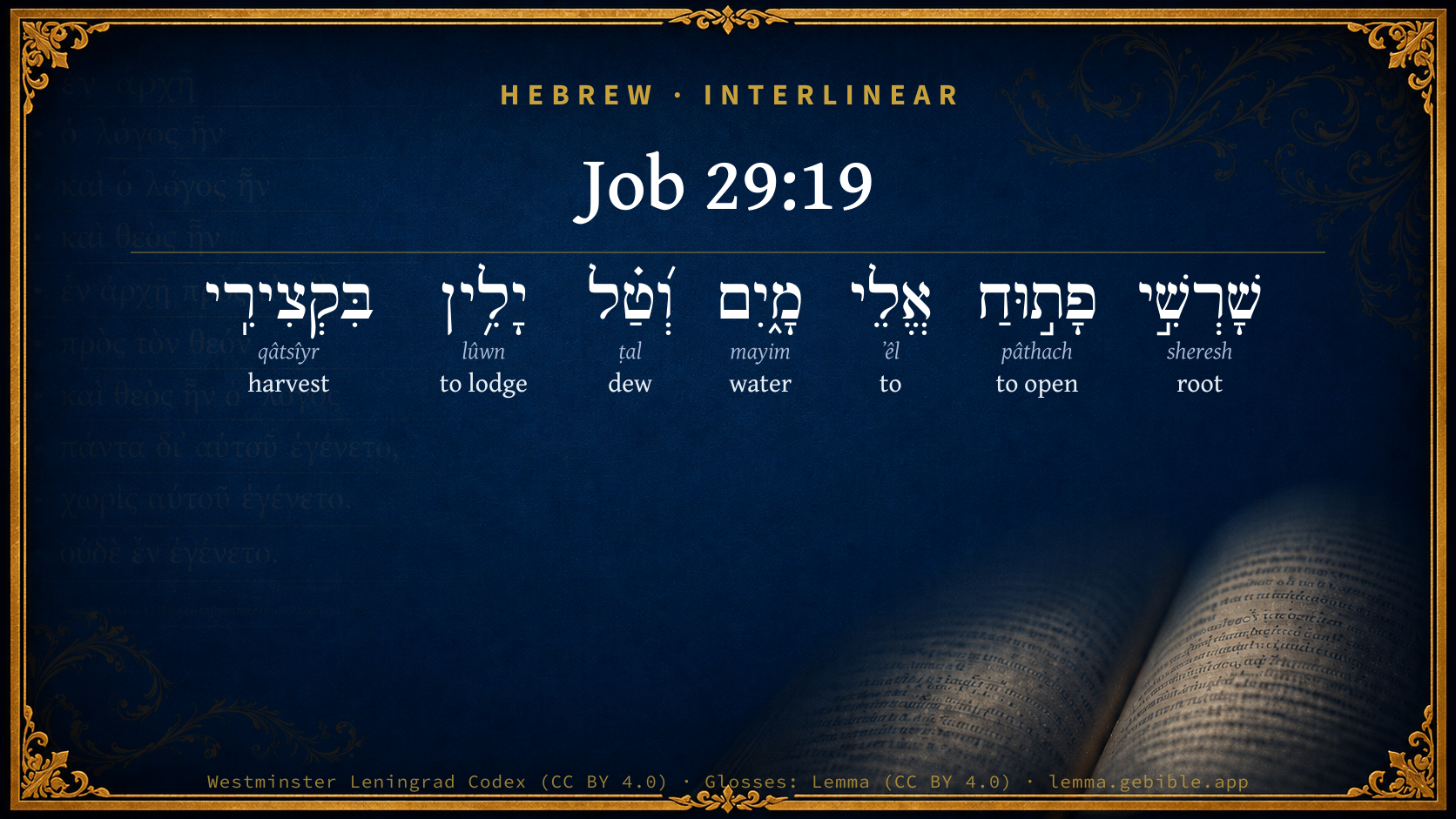
Hebrew (Westminster Leningrad Codex) Job 29:19 appears in the Hebrew Old Testament. The text above is from the Westminster Leningrad Codex. Each word links to its Strong’s number, a concise gloss, and parsing drawn from the Open Scriptures Hebrew Bible morphology. Click any word for its full Brown-Driver-Briggs (BDB) entry.
Download image
Cite this verse

Job 29:19 (World English Bible). Public Domain. Lemma interlinear Bible study tool, https://lemma.gebible.app/v/job/29/19.

Show BibTeX & RIS
BibTeX
RIS
English Translation
My root is spread out to the waters, The dew lies all night on my branch;
World English Bible · Public Domain
Download a study sheet

One document with this verse’s original text, its word-by-word gloss line, the meaning frame, cross-references with their text, attributed commentary, and full source and license credits — printable, and it pastes into notes with its structure intact.

This verse Autodidact and up

Study sheet (.html) Plain text (.txt)

A passage Seminary Student

Up to 50 verses in one chapter. A passage sheet keeps up to 6 commentary sources and 12 cross-references per verse, in the order this page ranks them, and says so on the sheet whenever that leaves anything out. Ask for a single verse and you get the Autodidact verse sheet above.

Everything on this page stays free to read, with no account — the sheet is a download of what is already on screen, not access to it.

Want to remove ads? Support Godless Engineer
Compare translations 3

The same verse in 3 English versions, stacked beneath the original-language interlinear above. Click any original word for its lexicon entry.

Each is an independent rendering of the whole verse — the interlinear is not word-aligned to these translations.

Highlighted words mark where these versions differ — a whole-verse word diff, not a word-by-word alignment.

  • World English Bible Public Domain
    My root is spread out to the waters, The dew lies all night on my branch;
  • King James Version Public Domain
    My root was spread out by the waters, and the dew lay all night upon my branch.
  • unfoldingWord Literal Text CC BY-SA 4.0
    My root is spread out to the waters, and the dew lodges on my branch.

unfoldingWord Literal Text — © unfoldingWord, licensed CC BY-SA 4.0. Word-aligned USFM3 via Door43 (git.door43.org/unfoldingWord/en_ult).

Versions to compare (up to 4)

3 of 4 selected

Show all 18 translations

Every available English version of this verse, each an independent rendering of the whole verse.

  • World English Bible Public Domain
    My root is spread out to the waters, The dew lies all night on my branch;
  • Berean Standard Bible Public Domain
    My roots will spread out to the waters, and the dew will rest nightly on my branches.
  • Majority Standard Bible Public Domain
    My roots will spread out to the waters, and the dew will rest nightly on my branches.
  • King James Version Public Domain
    My root was spread out by the waters, and the dew lay all night upon my branch.
  • American Standard Version (1901) Public Domain
    My root is spread out to the waters, And the dew lieth all night upon my branch;
  • Revised Version (1885) Public Domain
    My root is spread out to the waters, and the dew lieth all night upon my branch:
  • Geneva Bible (1599) Public Domain
    For my roote is spread out by the water, and the dewe shall lye vpon my branche.
  • Douay-Rheims (1899) Public Domain
    My root is opened beside the waters, and dew shall continue in my harvest.
  • Young's Literal Translation Public Domain
    My root is open unto the waters, And dew doth lodge on my branch.
  • Literal Standard Version CC BY-SA 4.0
    My root is open to the waters, || And dew lodges on my branch.
  • Unlocked Literal Bible CC BY-SA 4.0
    My roots are spread out to the waters, and dew lies all night on my branches.
  • unfoldingWord Literal Text CC BY-SA 4.0
    My root is spread out to the waters, and the dew lodges on my branch.
  • Darby Bible Public Domain
    My root shall be spread out to the waters, and the dew will lie all night on my branch;
  • World Messianic Bible Public Domain
    My root is spread out to the waters. The dew lies all night on my branch.
  • Webster's Bible Public Domain
    My root was spread out by the waters, and the dew lay all night upon my branch.
  • Free Bible Version CC BY-SA 4.0
    Like a tree my roots spread out to the water; the dew rests on my branches overnight.
  • Bible in Basic English Public Domain
    My root will be open to the waters, and the night mist will be on my branches,
  • JPS Tanakh (1917) Public Domain
    My root shall be spread out to the waters, and the dew shall lie all night upon my branch;

Literal Standard Version (2020), Covenant Press — licensed CC BY-SA 4.0. Text via the HelloAO Bible API (eBible.org). Unlocked Literal Bible (unfoldingWord) — licensed CC BY-SA 4.0. Text via the HelloAO Bible API (eBible.org). unfoldingWord Literal Text — © unfoldingWord, licensed CC BY-SA 4.0. Word-aligned USFM3 via Door43 (git.door43.org/unfoldingWord/en_ult). Free Bible Version, Dr. Jonathan Gallagher — licensed CC BY-SA 4.0. Text via the HelloAO Bible API (eBible.org).

Word by word

More ways to search: Search by grammar → Find every occurrence → Compare this word →

Practice this passage: Drill this verse → Learn its vocabulary →

About this verse

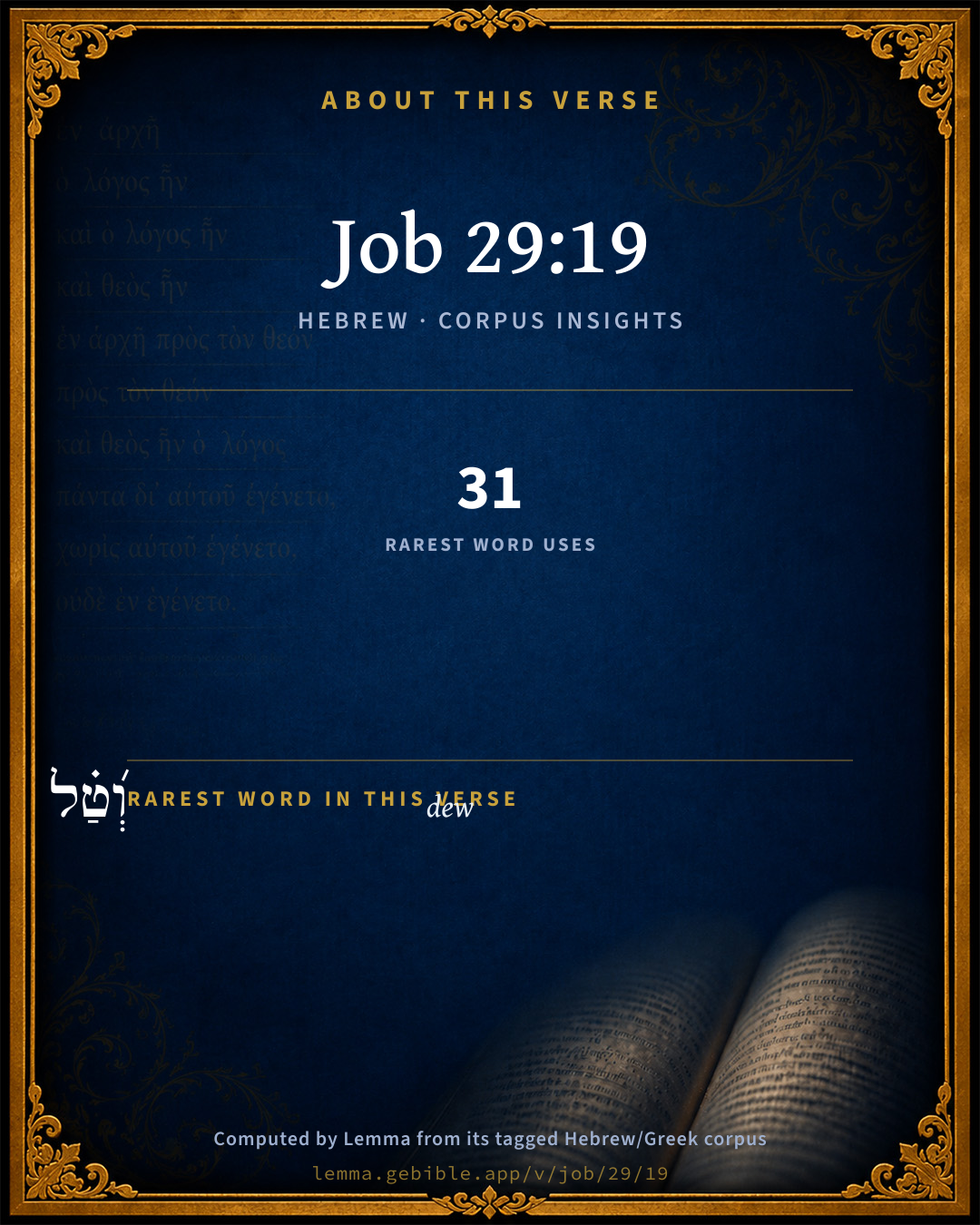
These counts appear in no published source. They are computed here, from the morphology-tagged text and Lemma’s own curated glosses. What Lemma adds →

7
words
7
distinct lemmas
Wisdom
section

Shared distinctive vocabulary

וְ֝טַ֗ל dew H2919 occurs in 30 verses of the Hebrew Bible. Also found in:

Grammatical profile

  • 2 verbs
  • 4 nouns
  • 1 preposition

Verb forms

  • פָת֣וּחַ Qal · Participle Passive
  • יָלִ֥ין Qal · Imperfect

Hebrew & Septuagint length

In English translation the verse runs 16 words from the Hebrew and 16 from the Septuagint (LXX English) — the same length.

A rough comparison of the two English renderings, which tokenize alike — not a word-level alignment.

Word counts can differ between the Hebrew and the Greek without any difference in meaning — e.g. the Hebrew direct-object marker אֵת has no separate Greek word, and Greek often adds the article ὁ.

Cross-references

4

Topical passages linked to Job 29:19 in the Treasury of Scripture Knowledge — connected by theme and wording, ordered by reader-vote popularity; previews shown in the World English Bible.

  • Psalms 1:3 He will be like a tree planted by the streams of water, That brings forth its fruit in its season, Whose leaf also does not wither. Whatever he does shall prosper.
  • Jeremiah 17:8 For he shall be as a tree planted by the waters, who spreads out its roots by the river, and shall not fear when heat comes, but its leaf shall be green; and shall not be careful in the year of drought, neither shall cease from yielding fruit.
  • Job 18:16 His roots shall be dried up beneath, Above shall his branch be cut off.
  • Hosea 14:5–7 I will be like the dew to Israel. He will blossom like the lily, And send down his roots like Lebanon.

Cross-references courtesy of OpenBible.info (CC BY 4.0).

Hebrew and Greek witnesses Masoretic Hebrew ↔ Greek Septuagint

The same verse in the two great witnesses to the Old Testament, shown verse-for-verse.

These are two independent witnesses, not word-aligned to each other, and the Septuagint is shown in lemma (dictionary) form.

Hebrew Job 29:19 Masoretic · Westminster Leningrad Codex

שָׁרְשִׁ֣י פָת֣וּחַ אֱלֵי מָ֑יִם וְ֝טַ֗ל יָלִ֥ין בִּקְצִירִֽי

My root is spread out to the waters, The dew lies all night on my branch;

World English Bible · Public Domain

Greek LXX Job 29:19 Septuagint · lemma form

ὁ ῥίζα ἐγώ δια ἀναοἴγω ἐπί ὕδωρ καί δρόσος αὐλίζω ἐν ὁ θερισμός ἐγώ

My root was spread out by the water, and the dew would lodge on my crop.

LXX2012 (modern English Septuagint) · Public Domain

On this verse, Albert Barnes' Notes on the Bible discusses the Septuagint’s reading. Read the note in Commentary ↓

Hebrew: Westminster Leningrad Codex (CC BY 4.0). Greek: Septuagint (public domain); English from LXX2012 (modern English Septuagint) (Public Domain). How the Septuagint differs from the Hebrew →

Commentary

Notes on Job 29:19 from classic Christian and Jewish commentators (each source and its license shown beneath its notes). The classic Christian expositions comment on the surrounding passage and are grouped to its opening verse, so a note may address several verses; the Jewish commentaries on the Tanakh (Rashi and others) are per-verse, so they appear only where the commentator wrote on this verse.

Lemma curates 59 commentaries, every one of them public domain or Creative Commons licensed, each selected and text-cleaned for this edition rather than reprinted as found. About our sources →

Trapp's Complete Commentary

John Trapp

Job 29:19 My root [was] spread out by the waters, and the dew lay all night upon my branch.

Ver. 19. My root was spread out by the waters] Heb. Opened to the waters; which therefore had free recourse to it, and much refreshed it. Hereby he describeth his flourishing condition when time was, through the perpetual inflowings of God’s free grace and favour.

And the dew lay all might upon my branch] Pernoctabat; because in the night the dew falleth. Beza thus paraphraseth this whole verse: For, downward, the root of my good and upright conscience was spread out by the ever flowing waters of God’s bountifulness, with which it was daily watered; and upward, the boughs growing out of this root, to wit, my children, my servants, nay flocks of sheep, and in a word, my substance, were washed with the celestial dew which from heaven fell down upon them; so that by this blessing of God they were marvellously increased.

John Trapp, A Commentary or Exposition upon All the Books of the Old and New Testament (1647–1656) — public domain. Text from a community e-Sword module.

Joseph Benson's Commentary

Job 29:19-20. My root was spread out by the waters — I was like a tree, whose root, spreading out itself by the waters, receives continual moisture and nourishment from the earth, so that it is in no danger of withering; and, being deeply fixed in the ground, is kept firm, so that it is in no danger of being overturned. And the dew lay all night upon my branches — I was watered by the divine favour and influence from above, as well as nourished from the earth beneath, and consequently prospered in soul as well as body, and was enriched with spiritual as well as temporal blessings. Let none think to support their prosperity or comfort with what they draw from the earth, without that blessing which is derived from heaven. My glory was fresh in me — My reputation did not wither and decay, but continued to grow every day. Through the divine favour he persevered and increased in all holiness and usefulness; and those about him had continually something new to say in his praise, so that, instead of losing any part of the love and respect paid him by his friends and neighbours, his honour and credit increased day by day; and his bow was renewed in his hand — That is, his power to protect himself, and to annoy those that assailed him, so that he thought he had as little reason as any man to fear the insults and injuries of the Sabeans and Chaldeans, or any other hostile power.

Joseph Benson's Commentary on the Old and New Testaments (1811–1818) — public domain. Text from a community e-Sword module.

Geneva Bible (1599)

Geneva Bible translators

My felicity doth increase.

Geneva Bible (1599) marginal notes — public domain. Text via Bolls.life.

Jamieson, Fausset & Brown

Robert Jamieson, A. R. Fausset & David Brown

Literally, "opened to the waters." Opposed to Job 18:16. Vigorous health.

Jamieson, Fausset & Brown — Commentary Critical and Explanatory on the Whole Bible (1871) — public domain (CC PDM 1.0). Text via the HelloAO Bible API.

Adam Clarke's Commentary

Verse 19. My root was spread out by the waters] A metaphor taken from a healthy tree growing beside a rivulet where there is plenty of water; which in consequence flourishes in all seasons; its leaf does not wither, nor its fruit fall off. See Ps 1:3; Jer 17:8.

Adam Clarke's Commentary on the Bible (1810–1826) — public domain. Text from a community e-Sword/MySword module.

Ellicott's Commentary for English Readers

(19) My root was spread.—It is perhaps better to read this and the next verse in the present: “My root is spread out . . . and the dew lieth. My glory is fresh in me, and my bow is renewed.” (Comp. Gen_49:24.)

A Bible Commentary for English Readers, edited by Charles John Ellicott (1878–1897) — public domain. Text from a community e-Sword module.

The Cambridge Bible for Schools and Colleges

gen. ed. J. J. S. Perowne

19. Comp. the image, ch. Job_14:8-9. The dew lying all night upon his branch would keep it fresh and green.

19, 20. These verses continue the description of Job’s outlook into the future in those happy days. They read better thus,

19. My root shall be spread out to the waters,

And the dew shall lie all night upon my branch;

20. My glory shall be fresh in me,

And my bow shall be renewed in my hand.

The Cambridge Bible for Schools and Colleges (gen. ed. J. J. S. Perowne; Cambridge University Press, 1878–1918) — public domain. Text from a community e-Sword module.

John Gill's Exposition

My root was spread out by the waters,.... According to our version and others, Job here, and in the following verses, gives the reasons of his hope and confidence of his long life, and quiet and comfortable death amidst all his prosperity and happiness; which were founded upon his flourishing circumstances, and the great respect that was shown him among men; and this is the sense, if we read the words in the past tense, as we and many others do; or in the present tense, "my root is spread", &c. as others; but there are some interpreters, both Jewish and Christian (b), that render them in the future tense, here and to the end of the chapter; and so they are a continuation of Job's hope and trust, in the times of his prosperity, that things would always continue as they were with him, and much more abundantly; and indeed all is true of Job, in every sense, and all may be taken into the account; and that these words, and the following, as they describe what had been, and at the then present time, when he concluded the above in his mind, was his case, so they may also declare what he believed would be always his case to the end of his days. Here he compares himself to a tree well rooted and happily situated by plenty of water, and which may be expressive both of his temporal and spiritual prosperity: his outward prosperity seemed to him to have been well settled and established, being like a tree that had taken root, and was like to continue, being watered with the favour and blessing of God, which maketh rich; and as to his spiritual estate, he was like a tree planted by a river of water, to which good men are often compared in Scripture, Psa 1:3; they are in general called trees of righteousness, and are sometimes likened to particular trees, as to olives, cedars, and palm trees; and some think, as Pineda, that it is to the latter Job here has respect; the last clause of Job 29:18 being in the Latin Vulgate version so rendered as to countenance this sense; and it may be observed that this tree having thick long leaves, and fruit full of juice, and its wood spongy, requires much water; and, as Pliny (c) says, delights in watery places; nor is it content with rain, but is better satisfied with waters flowing about it; hence it is often found necessary to dig about it, and lay its roots open, that the waters may more easily come at them, and flow about them (d) and so the words here in the original text are, "my root" was, is, or shall be "open to the waters" (e): good men, as they are rooted in the love of God, and in the person of Christ, so they have, as Job had, the root of the matter in them, the truth of grace, or a principle of grace; which is watered, and kept alive and flourishing, by the love and favour of God shed abroad in the heart; by fresh supplies of grace out of the fulness of Christ, who is the fountain of gardens, and well of living waters; and by the means of grace, the word and ordinances, the still waters to which saints are led, and by which they are made to lie down, and where they are watered, refreshed, and comforted:

and the dew lay all night upon my branch; so that the water being at his root below, and the dew on his branch above, he must be in a fruitful and flourishing condition: the dew is a great blessing to the earth, to trees, herbs, and plants, and the cause of great fertility; and this may respect Job's temporal happiness, in the health and prosperity of his children, who were to him what branches are to a tree; and in the affluence of worldly good things, with which through the blessing of God, as dew upon him, he abounded; and may also have regard to his spiritual affairs: believers in Christ are branches in him, as Job was one; and the dew of divine grace and favour lies upon them continually, even in the darkest seasons; which revives and refreshes their souls, and makes them fruitful in the exercise of grace, and performance of good works; see Pro 19:12; the dew falls in the night, and the sooner it fails the longer it lies, and is most useful: some render the words "upon my harvest", or "mowing" (f); the dew is of great use in harvest time; mowers and reapers choose the morning to work in, when the stalks are moistened by the dew; and which is of use to keep the ears of corn from shedding by swelling the fibres, and so retaining the grains in their proper places (g); see Isa 18:4.

(b) Jarchi, Ben Gerson, Bar Tzemach, Schmidt, Schultens. (c) Nat. Hist. l. 13. 4. (d) Palladius apud Scheuchzer, ut supra (Physic. Sacr. l. vol. 4.), p. 759. (e) "aperta ad aquas", Montanus, Bolducius, Mercerus, Cocceius, Schmidt, Michaelis, Schultens. (f) "in messe mea", Montanus, Tigurine version; "in segete mea", Cocceius; so the Targum. (g) Vid. Scheuchzer, ut supra. (Physic. Sacr. l. vol. 4. p. 759.)

John Gill's Exposition of the Whole Bible (1746–1763) — public domain (CC PDM 1.0). Text via the HelloAO Bible API.

Albert Barnes' Notes on the Bible

My root was spread out by the waters - Margin, as the Hebrew, “opened.” The meaning is, that it was spread abroad or extended far, so that the moisture of the earth had free access to it; or it was like a tree planted near a stream, whose root ran down to the water. This is an image designed to denote great prosperity. In the East, such an image would be more striking than with us. Here green, large, and beautiful trees are so common as to excite little or no attention. In such a country as Arabia, however, where general desolation exists, such a tree would be a most beautiful object, and a most striking image of prosperity; compare DeWette on Psa 1:3.

And the dew lay all night upon my branch - In the absence of rain - which seldom falls in deserts - the scanty vegetation is dependent on the dews that fall at night. Those dews are often very abundant. Volney (Travels i. 51) says, “We, who are inhabitants of humid regions, cannot well understand how a country can be productive without rain, but in Egypt, the dew which falls copiously in the night, supplies the place of rain.” See, also, Shaw’s Travels, p. 379. “To the same cause also (the violent heat of the day), succeeded afterward by the coldness of the night, we may attribute the plentiful dews, and those thick, offensive mists, one or other of which we had every night too sensible a proof of. The dews, particularly, (as we had the heavens only for our covering), would frequently wet us to the skin.” The sense here is, as a tree standing on the verge of a river, and watered each night by copious dews, appears beautiful and flourishing, so was my condition. The Septuagint, however, renders this, “And the dew abode at night on my harvest” - καί δρόσος ἀυλισθήσεται ἐν τῷ θερισμῷ μου kai drosos aulisthēsetai en tō therismō mou. So the Chaldee - וטלא בחצדי יבית. A thought, similar to the one in this passage, occurs in a Chinese Ode, translated by Sir William Jones, in his works, vol. ii. p. 351:

Vide illius aquae rivum

Virides arundines jucunde luxuriant!

Sic est decorus virtutibus princeps noster!

“Seest thou yon stream, around whose banks

The green reeds crowd in joyous ranks?

In nutrient virtue and in grace,

Such is the Prince that rules our race.”

Dr. Good

Albert Barnes' Notes on the Bible (1834–1885) — public domain. Text from a community e-Sword/MySword module.

Haydock's Catholic Bible Commentary

Harvest. Protestants, "branch." (Psalm i. 3., and Isaias xviii. 4.) (Haydock)

George Leo Haydock (1774–1849), Haydock's Catholic Family Bible and Commentary, 1859 edition — public domain. Excludes Psalms (Douay-Rheims chapter numbering differs from Protestant) and Deuterocanonical books (Catholic canon only).

Matthew Poole's English Annotations

I was continually watered by Divine favour and blessing, as a tree which is constantly supplied with moisture, both in its root and branches, and consequently must needs be fruitful and flourishing.

Matthew Poole's English Annotations on the Holy Bible (1683–1685) — public domain. Text from a community e-Sword/MySword module.

Whedon's Commentary on the Bible

Daniel D. Whedon

19. This and the following verse are a continuation of the pleasing thoughts and flattering hopes of Job, as expressed in Job_29:18. The verbs are all future. Thus my root shall be open to the waters, and the dew shall lie all night in my branch.

Daniel D. Whedon (gen. ed.), Commentary on the Old and New Testaments (1874–1909) — public domain. Text from a community e-Sword module.

The Pulpit Commentary

My root was spread out by the waters; (comp. Psa_1:3 Jer_17:8) rather, to the waters so that the waters reached it and nourished it. And the dew lay all night upon my branch. Job compares himself, in his former prosperous state, to a tree growing by a river-side, which receives a double nourishment from the actual water of the stream, which reaches its roots, and from the moisture evaporated from the stream, which hangs in the air, and descends in the shape of dew upon its leaves and branches. Both sources of refreshment represent the grace and favour of God.

The Pulpit Commentary (1880–1919), ed. H.D.M. Spence-Jones & Joseph S. Exell — public domain. Text from a community e-Sword module.

Rashi

Rabbi Shlomo Yitzchaki (Rashi)

My root will be open etc. All this I was saying to myself, that my root would not dry up, and my branches would not die, like (above 14:9), “and it will produce a branch (קציר).” They are יונקות, tender branches of a tree.

Rashi on the Tanakh — English translations: “The Judaica Press complete Tanach with Rashi, translated by A. J. Rosenberg” (CC BY 4.0); “Pentateuch with Rashi's commentary by M. Rosenbaum and A.M. Silbermann, 1929-1934” (public domain); “The Metsudah Tanach series, Lakewood, N.J” (CC BY 4.0); and “The Book of Joshua, Metsudah Publications, 1997” (CC BY 4.0). Text via Sefaria.

Lesson kit

Teaching starters — assembled from the data on this page, not authored interpretation. Every prompt links to the verse data it draws on. Edit before teaching.

Job, in the Wisdom, opens this verse with 7 words (7 distinct Hebrew lemmas). Its most distinctive word is ṭal (“dew”). A historical commentator’s framing appears above. Read the whole chapter for the surrounding context.

Discussion questions

  1. How does “dew” (ṭal) shape what this verse is saying?
  2. Genesis 27:28 shares the word «dew» with this verse. How do the two illuminate each other?
  3. These translations render this verse differently; the difference is in the English rendering, not the original. What questions does that raise?
  4. The verb «פָת֣וּחַ» is Qal Participle Passive. How does its form color the action?
  5. Reading how Trapp's Complete Commentary and Joseph Benson's Commentary read this verse, where do the two commentators agree and where do they part?

Things to notice

Reading settings

Reading text

Shown beneath each verse's original-language words.

Old Testament
Old Testament edition

Read the OT as the Masoretic Hebrew (MT) or the Greek Septuagint (LXX).

English shown for the Greek Septuagint (in the Hebrew ↔ Greek comparison).

Comparing translations? Open the Compare panel on any verse page to stack up to four side by side.